This Italian Dye House is Changing Luxury Denim
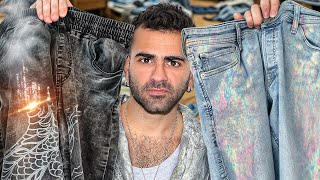
Carlo Cosseri runs Green Lab, an Italian dye house that treats denim like a recipe of layered processes. The factory uses custom machines including a foam system that cuts water use by ten times, ozone oxidizers, and an in-house laser for distressing. A quality specialist hand-retouches color inconsistencies with a custom pen.
Chapters
Glass Factory.
For me, denim is only techniques. It's a layering matter of techniques. It takes time. It took time to obtain this kind of perfection.
Here it looks like a laboratory of like a crazy chemist, which is him.
That was sick!
Denim is always building the recipe. It's not just making the process.
This interview is brought to you in part by Lil Denim Jeans. Nick, this is one half of the Denim Jeans crew, and we have the honor today to be here.
I'm Carlo Cosseri, and this is Green Lab.
How did Green Lab start?
My grandpa, he start like the real industrial business, building a big company. Where we had like shops all around Italy where we collect stuff from all the people and we used to wash inside. Around '80s, when this like denim, this boom of washed denim starts to come from US to Italy, we were ready, we were ready because we were already laundry with machines done. And then in Italy, they invented acid wash. So everything start, all the laundries, all the companies start with this finishing. So Acid is Italian. After that, you know, the business start to grow and we start to layer. You know, as I said before, denim is a matter of layering. More you layer, cooler it becomes at the end.
This is where we dye. This is the first step, it's the base. This machine we are dyeing now. You can feel it because it's really hot, 87 degrees. And in this case, it's a plain color. Color, colorants, salt, a fixing agent, that's it.
And what could be something more complicated?
Like, it can be like all dyeing with a really high contrast. After this process, it can go again in the washing department to make it like really stone and destroyed. In this area, we, we convert machines that were used for dyeing wool or knit pieces into denim, because now process of a pair of jeans, it's really long. So we have a lot of wet, dry, wet, dry and wet-dry, like even to 10 times. So we convert this machine to divide it into slices. It's not like this, that it's one, one tumbler. It's like this.
So when they purchased this machine, it was a full-size tumbler. When it's in a full-size tumbler, the pair of jeans moves around a lot more. The more a pair of jeans moves, the more it gets damaged. If you keep the amount of room it has to move around to be much smaller, the damage is far less. So by having smaller compartments, they guarantee the life of the jeans to be much, much longer. And the way they create these machines is by actually welding them and converting them into these compartments, as opposed to buying them this way, because they don't exist this way. This is their own invention.
This, this Kividu machine is only for stone washer. Of course you can use it for other kind of washes, but it's built to wash it water and pumice stone, or synthetic stones. Really old-school machine and really old-school way to work. If you want to, like, a proper authentic denim wash, it's with this. This and this, that in the past were used for standard stone wash, as we have seen before, we convert and we make this particular finishing with rugs.
So this tumbler is rolling right now, and there's a bunch of these different towels that are in there that are soaked with an oxidant that creates an acid wash-like effect, but it's just tumbling with the jeans. The oxidant is applied onto the towel, it's their own formula, and that's how they achieve a certain result with the jeans themselves.
So this is how it started.
Oh my God, no way! This dry garment, which is very far from done, goes through this tumbling process with the oxidized rags in order to create this much lighter garment. This is actually still wet. So when it goes through the dryer, it's going to become even whiter. This is just a median step in the process. That's kind of how it goes here. There's a lot of steps to everything they do.
This is a dryer that we built. We built inside because it's a dryer that works with the heat that comes from the heater that we have outside to warm up the water. So the waste of the heat of the big machine, we use it here.
Oh, wow. Okay. So you're recycling all the heat from your other machines and using it on this machine to hang dry all of these denims.
These are 3 machines that can work with ozone, ozone gas, to oxidate, to clean it, to bleach, to change the shade of the indigo. And this is also a machine that we invent. It's a foam generator that we use to make all chemicals in the machine. With this machine, 70 kilos, 70 liters.
10 times savings on water just because of this machine by using foam instead of using the water right away. I got you. So Green Lab is consistently emphasizing how many steps they can apply to make the most artisanal pairs of jeans in the world. Here we have another washing process, and it just shows you the dance that a pair of jeans or a garment in general will do in this facility when it goes through getting the wash it's trying to achieve. It'll dance between hang drying, tumbling drying, washing over there with certain enzymes, washing over here with other enzymes, stone washing, dyeing, and so on. So that's what's constantly going on in a facility like this in order to get some of the best finishes in the world.
And so what's it like working with your father?
In the beginning was quite tough, but it's, uh, I need to say thank you to him because of the space that he gave me. Now, you know, I'm here. I'm pushing. We are making good job thanks to him. Everything that you have seen about, you know, the technology that we are using comes from him because he is an engineer. Always had this kind of approach to this job to make it artisanal, of course, but always with a touch of technology.
With this machine, we can spray everything from bleaching agent to colors to resins to everything. In this case, the guy is spraying a solution of color, light color, and the silicone to make it darker because, you know, some customers want this really vibrant blue with a bit of dirty.
So over here it has a very whitish yellowish color, and the spray that he's applying is achieving this darker color over here. You trigger finger, you, eh?
So this is the laser room. This is where we laser everything from denim to dyeing. But like, uh, okay, so you're cutting create distressing with the lasering. Yeah.
And you'll do that for knitwear as well?
Yeah, knitwear, denim, everything. We can even like make artworks like this.
Wow, these are very worn out. Yeah, brand new pair of jeans.
Yeah, we take this, we scan it, and we reproduce.
So right now the laser up here is allowing him to align the pair of jeans exactly with where the pattern is going to go down based on what's inside the program. There's dimensions, and those dimensions line up exactly with that laser. And now he's going to begin lasering. That was sick! Seeing lasering like that up close, you're not really going to get the opportunity. That's really, really cool. Italy had no choice but to invent extremely innovative machines like this because their cost of production are much higher. Staff are paid more here than other countries, so they needed to innovate patents and come up with solutions like this in order to not allow their costs for denim manufacturing to be too high. So in this case, Carlos's father actually has a patent on these kinds of laser machines, and he was a crucial part in the invention of this specific laser machine over here. Very cool.
After all the process and the steps that we have seen is the quality control. She's checking that, you know, the color on the, on the panel, it's uniform, because sometimes the shrinkage is not like like super perfect, and we have like small lines that she retouch with a really particular like pen that it's filled with colorants and the fixing agent. So when it iron, it's fixed.
So these markers are actually composed of the same chemical compounds that the machines are using? Yeah, it's just very specifically able to do cotton and for denim.
Amazing.
Very For example, this, you know, white small line, when it's more evident, not in this case, the girl, she's gonna like retouch it in a way that it looks a bit more uniform.
So this is like extremely subtle. This is like really the difference between luxury production and standard.
Exactly.
What does denim mean to you?
I mean, it's such a natural thing, right? If you think about ourselves and our skin, it gets a bit older, it has these Scars and every mark on it tells your personality. You just have this whole world where you can go in depth every day and you can start layering these ideas.
Of course, it's my life. It's really deep in my soul. It's amazing because, you know, it can always be changed. I mean, it's impossible to get birthed.
And then it has a revolutionary aspect. Like the Berlin Wall broke by people wearing denim, you know, and like I always get a bit crazy because this is just too much of like powerful clothes because it's—
It has so much history.
Clothes.
And it's all just in clothing, just in living, breathing cotton.
These jeans have this rainbow effect to them, a rainbow-like sheen combined with this dirt effect.
It's a really unique kind of foil that it's transparent but with this oily effect. We dirty like with the sponge and then we apply the foil.
Underneath the foil. It's crazy. It's really nice.
In order to create a product like this before it's even been worn is incredibly complicated. It's really, really hard to achieve something like this, and I'm sure Nick can attest because all he does all day is manufacture jeans that are impossible to make.
But sometimes there is like real chemistry behind all this stuff.
What was the process for achieving this? Okay, because this is really a particular pair of denim if I've ever seen I've seen one. How did you achieve this?
So this is really— it's a technique that we develop inside. It's a layered of colors and foils with a laser in the middle of the process that can give this kind of layer— layered look.
But it still has that shine to it and that really nice hand feel.
Yeah, because basically is this kind of same finishing of this but much more complex 3D layer disc.
We had a tour of the production. Now we go in the R&D where all the magic happens.
That's really the best spot.
From the idea to the first sample to the SMS, we, we wash everything here. Basically are the same machine, but everything smaller. In Denim, we always try to wash as less as possible to keep it as clean as possible. This is for stone, as we have seen in production. This machine, it's only for acid wash.
Yeah, it's stone soaked with chemicals.
In this section here, yeah, we dye. This is only for sampling. We can dye from 200 grams to 1.5 kilos on those machines.
So it's like basically either a swatch or a pair of jeans.
Yeah. When the developers need something, like to copy whiskers, to a reference for a shade or for a, like, indigo wash, they can take a garment here.
It's things that you reference yourselves in-house?
Yeah, only for us. Denim is always building the recipe. It's not just making the process.
What keeps you motivated to keep coming in and doing this every single day?
It's a mix. I mean, a big part of this, of course, is is my customers, our customers. When customers are happy, I see that what I develop as just an idea, it has like a success in selling, I'm the happiest guy in the world, you know. So 50% it's coming from the customers, the other 50% it comes from the people where I work with. You know, when I see that people that I work with are happy, They come to work smiling. I'm really happy. I'm really, you know, when I go to sleep, I say, okay, I'm making something good, you know.










