What is the Factory Cost of a Supreme and Palace Hoodie?
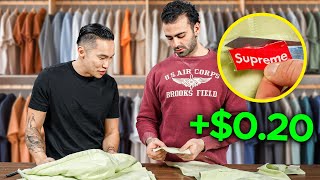
In this YouTube video, Will Larsy and his co‑host dissect a Supreme and a Palace hoodie to understand how they are built, where they are made, and how much they likely cost to produce. They begin by noting the extreme heaviness and dry feel of the fabrics, describing the unusual horizontal grain direction of the Supreme hoodie and the ribbing used to control shrinkage. They detail construction elements such as double‑lined hoods, 1x1 ribbing, bar‑tacks, aglets, and the placement of the S‑patch embroidery. The discussion moves to the Palace hoodie’s large puff‑print and extensive embroidery, explaining how panels are embroidered before assembly and how puff printing works. They measure the Supreme hoodie’s fabric weight at roughly 498 GSM, noting that such a heavy knit from Canada is costly. They identify the likely factories: Rupa Knitting Mill in Ontario, Canada for the Supreme hoodie, and a Vietnamese factory called “Unavailable” for the Palace hoodie, describing each factory’s typical order minimums and capabilities. The hosts then estimate a cost breakdown—fabric $10‑$12 per yard, embellishment $4‑$5, labor $7, totaling about $25‑$30 per hoodie—while acknowledging the impact of minimum order quantities and logistics on pricing. Throughout, they comment on wearability, design intent, and the value of physically deconstructing garments to learn apparel manufacturing.
Chapters
This is like extremely dense. It's very dry, to be honest. Extremely dry to the touch.
For my preferences, it's a little too thick. As a day-to-day hoodie, I don't know if I would say I'd want to wear this.
Yeah, it's maybe a little bit too heavy to just put on and off, and you would really feel like you're being choked. This coat is not really wearable in my opinion. We think we have a very good idea of which factories got behind these.
Your discretion advised for Hypebeast. We're going to cut these up. They didn't say make me the cheapest thing possible.
Fabric Super heavy, super dry.
Very structured.
This, like, I put the hood over my head, it doesn't feel like there's a weighted blanket on my head. It just feels like it's lightly covering it. There's no way. There's no way. There's just no way.
Wow. That's crazy.
Supreme versus Palace. Everyone has probably bought a Supreme hoodie if they were into streetwear at some point. And Palace has become the clear competitor as a skate brand. Absolutely. We're gonna do what you do best. Cut them up, assess what we think they cost. We think we have a very good idea of which factories got behind these.
And we're gonna take a look at like how well are they actually made and are they worth the price that you're paying.
Start off with the OG.
You know a little bit more about the history of this product than I do. So one thing I see very clearly is the fabric direction here is turned to the side. Yeah. And this is something that's prevalent across all the kind of Supremes, is like their kind of design intent for this.
Most hoodies, right? The fabric is made so that it's going this way.
Yep.
And with this, it's going horizontally. Very unusual choice. I haven't really seen much of that before. But yeah, all Supreme hoodies are actually made this way.
You have to include this kind of ribbing on the side to allow for that stretch. Otherwise, when this thing shrinks and during the drying process, it's gonna be so tight. But that being said, it's not gonna shrink that much in the vertical direction, so it won't ever become really short because of this.
Exactly. You can see that this part is the ribbing, although they're the same color and they look really similar. If you actually look close up, you'll notice that for the ribbing, it's a little bit of a wider yarn, and on top of that, it's going vertically, right? Whereas the rest of the hoodie is going horizontally. So the ribbing is all the way down the sides here, it's all around the elastic waistband, and it's on the cuffs as well. This is essentially the same thing as a Box Logo hoodie, but instead of putting a box logo in the middle, they They've decided to do this S patch, which should be a little bit to the right.
It kind of bothers me how much it is to the center.
Placement should be a little bit further to the right.
It's like half an inch to the right. Very clean embroidery, I would say. The way you get some of the front yarn in the back is changing the bobbin tension so that you're not going to get any of this thread showing through the front, but it'll, it'll come in the back. Perfect placement, actually. It's just a little bit out. Fabric is a fleece fabric. Super thick fleece.
This is like extremely dense. It's very dry, to be honest. Extremely dry to the touch.
For my preferences, it's a little too thick. Yeah, I get the kind of intention when it comes to a lot of skate stuff. It's almost to like protect you too if you fall. I got Supreme here. Supreme New York, 100% cotton, made in Canada. Double-lined hood. This hood's so heavy. You can have a hoodie with a double line and just line it with a separate fabric and would have been a little better, but this is—
this hood is not really wearable in my opinion. It's bit too thick.
I would say this feels like a hard yarn. Drawstrings, classic, classic.
Aglets, good finishing job. It only comes out on one side.
It's a pretty thick needle to be able to puncture the seam.
Very thick needle. On top of that, that R is actually embroidered over the flatlock stitching. I think these are retailing at around $160.
For fabric this heavy, for price point, I think, you know, there's still like bar tacks in the pockets to reinforce it. This This is a very, I would say, durable hoodie. You're not gonna have to worry about falling to the ground and getting bumps and scrapes. This is something that's gonna almost like a second skin or a piece of armor almost, I would say. As a day-to-day hoodie, I don't know if I would say I would want to wear this.
Yeah, it's maybe a little bit too heavy to just put on and off. I mean, you would really feel like you're being choked, personally. That's just my take.
Yeah, you got the two-panel hood. Alright, let's take a look at the Palace. Has a large puff print here. Really clean puff print.
Clean puff print.
It's not too, like, too over the top. I love the color. This is a—
Yeah, it's like a mutated green color.
Mm-hmm. And then a lot of embroidered flies all over this.
This means, like, even on the hood, right? Here, on the back of the hood. So all of these panels have to be embroidered separately before the hoodie was sewn together.
Yeah.
Which is a huge pain.
So this is actually compared to that one, that one was a fleece, this is a French terry. How much does this cost?
I think around the same price point, right around $160, something like that.
When I, yeah, when I definitely, when I see all these different flies, all these panels are running through an embroidery machine and it's going to be very specific the placement. So you're probably, we'll show a clip here of a commercial embroidery machine, you're You're gonna have to be loading all these up with one panel and then the next panel, and they're each running a separate program. This is a program, this program, this program, this program. This is something you have to go overseas for just because of the labor.
You need the setup for this. I mean, this is made in a bigger factory.
Yeah, made in Vietnam.
Made in Vietnam.
Yeah. Kangaroo pocket here. I think overall, like, very clean. We got the branded eyelets here.
Oh, branded, really? Okay, that's a nice touch. I mean, they could have closed off the ends.
Double-lined, two-panel hood. You have the Palace main label in there. It's not something you're going to be wearing without a shirt underneath or a long sleeve because this fabric's quite scratchy on the inside. It's very large terry. If you're making something that's really heavy in terms of GSM, there's multiple ways of getting there, and using very large yarn and large yarns for the loops especially is going to be an easier way of getting there. The stitching is pretty good. There's not a lot of untrimmed threads. I would say—
it's not bad, it's not bad.
The workmanship is not horrible.
It's not bad.
Yeah, I think one thing you guys have to keep in mind is when we're taking a look at this, we're going to be judging this based off the retail price. If this was $1,000, this would be unacceptable. This would be a very different conversation that we're having. Yeah, but for $160 US or Canadian, US, probably. Yeah, yeah, around that. Like, I think that's pretty— like, it's not bad at all. When you're doing panels like this, you're actually not going to be using the fabric itself, but you're going to be using a separate fabric that is like a jersey that looks exactly like it. Exactly, just to give you that. And you can see the heathering is not exactly the same, but close enough to achieve the aesthetic they're looking at. You know, before we cut this up, do you want to take a look at the fit? Yeah, yeah, let's do that.
Fabric, super heavy, super dry, very structured. Yeah, it's super rigid. All of the wrinkling ends up kind of being vertical wrinkling because the direction of the fabric is horizontal. Um, I'd say also the neck is very tight. I would have made a looser neck. I feel like I'm being choked a little bit.
There's probably a little— you probably need to size up for this.
Yeah, I would say, I would say I definitely need to size up. I'd be very curious to see what happens when you put this in the dryer. Hoodie is very comfortable, maybe a little bit too baggy for my style, but Putting the hood on, this hood is much better.
Much better.
Like way, way better. No, this is perfect.
Where's the Supreme one cut off back here?
Yeah, this like, I put the hood over my head, it doesn't feel like there's a weighted blanket on my head. It just feels like it's lightly covering it. It's easy, I'm agile, I can move my head around. This is a good hood. The rib is short compared to the torso, which is super long, very skater look. If I were to wear this hoodie, I'd wear it folded in like this, and then the pocket would naturally sit where it needs to.
When you're changing the grain direction of a fabric like this, Champion also does this, this is like the reverse weave. So when you're looking at fabric, there's different stretches if you're stretching it this way or this way. So when you're making it sideways like this, and the same thing with the reverse weave, you're actually gonna be limited how much it shrinks. So this, in terms of its length, when you buy it, and I assume a lot of people who are gonna be watching this are not following care instructions, they're throwing it in the dryer, not really gonna have to worry about a lot of vertical shrinkage. However, you're gonna have to worry about horizontal shrinkage, which is why they have this ribbing here.
Yeah, so they add the ribbing so it basically limits the amount of horizontal shrinkage going down.
Yeah.
It's interesting. It's a very interesting approach.
Yeah, it's a different way to make something a little, I guess, a little more durable. So we got the initial tag. We have the side tag here. There you go.
That comes out nice and easy.
I like that it's bar tacked, so it's going to give it a little bit more security. There is the kangaroo pocket. Let's take off the, the ribbing next.
360.
I'm going to become an expert at this soon. It's a great way, especially if you're starting a clothing brand, cutting apart and taking apart clothing is a great way to learn how clothing is made. Fabric comes in a roll, and depending on the cuttable width, you're actually now flipping that pattern piece So you might actually get less patterns into that same roll of fabric, so it might increase your fabric consumption.
Yeah, I want everybody to go to Gucci right now, buy a hoodie, and cut it up so you really get to know what it's like cutting up a hoodie.
Even better, go right to Hermès.
Yeah, just go to— just go to Loro Piana, honestly. Go drop $20,000.
You know, we were gonna— I was looking at doing a Loro Piana, but that was, uh, you know, $1,300 for a t-shirt was, uh, it's an investment. A little bit shocking.
Like, honestly, if you guys really want that video, like you genuinely want that video, we'll make it.
But we need 10,000 likes on this video. Next up, we are gonna have the side ribbing. So this is gonna be the same as the cuff and same as the bottom ribbing itself. And what a ribbing is, is it's knit in a way that gives you a lot more mechanical stretch. Especially in the horizontal nature, but you're still going to be limited in the vertical stretch, just like any other single jersey knit.
So yeah, this rib is 1x1 rib. Yeah, it's just dual layered, dual layered knitting pattern, a space, another knitting pattern. It's the same thing on the other side. Therefore, it's 1x1.
I'll show you this on a macro lens too. This is very heavy fabric, guys.
This is extremely heavy fabric.
So if you look at even just like making a garment, there is gonna be just the raw material cost. And when you're getting to a knit that's heavy, just the raw material cost is gonna push this up. It being made in Canada too is gonna push it up.
This is the hardest style, bro. Assassin's Creed drip, you know?
So we got the arm panels here. We got the rib, side ribbing. We got the kangaroo pocket. The fleece is basically a terry. And what they're doing is they're what's called napping. You're taking metal brushes across the back to break all those fibers to give you this kind of fleece feeling.
Very heavily brushed. It's extremely, extremely dense fabric. Super heavyweight.
When you're doing laundry, all the lint that you are getting in your laundry is just the loose cotton fibers itself. There is the fabric with the fleece removed right here.
Completely unnecessarily cut this. The embroidered patch for the S. Clean job. Nice.
It's a nice embroidery.
It's a very nice embroidery.
It's a prime. Let's open it up to show them.
Mark. All the thread in the middle instantly lifts up, and that's because it's a patch. So actually the thread goes from one side of the S all the way to the other side of the S. That's how they get these long marks that are really beautiful.
You actually have to program the direction of these yarns when you're embroidering. So a lot of fakes, let's say, they might not— they might have an embroidered logo, but if it's not the same programming, you're not going to be able to actually have the same aesthetic. Yeah, so when you're doing double layer, you— a lot of, let's say, women's white shirts would have double layer as well. They'll double layer the front because they don't want it to be sheer, but a lot of brands will cheap out and not double layer the back, so the back is still sheer.
Can we please just take a second to talk about how much damn hood Supreme is giving you? This is all the hood, bro. Oh, all of this is hood. This is, this is literally both panels of the hood put together, folded like this, and here's your hood. This is how much hood they give you. Is that insane?
So actually, what I actually noticed here too, this is what you, you stick on garments when there's manufacturing defects. So that you can actually remove them from production.
And that was fully left inside the hood?
That was left inside the hood.
Wow, that's crazy.
What we're doing here is we're going to assess what the GSM of this fabric is. And what GSM stands for is grams per square meter. And what this cutter does is it cuts 1/100th of a square meter of fabric. Depending on how heavy your fabric is with GSM, your material cost is going to go up again. And the reason why this scale has a box over it is because it's calibrated extremely sensitive. So you said 440, I said 441.
There's no way, there's no way, there's just no way.
We're just so bad.
There's no way. I know they're not making a 500 GSM hoodie. I'm sorry, they're not. Like there's something that happens.
All right, I got another, I got another scale. We're gonna double check.
Oh my God, 498 GSM. It's actually aggressive. Of course, made in Canada for 500 GSM is a fortune.
Yeah, you know, you're actually not gonna find a lot of places that'll even like stock this heavy of a fabric. That's the thing too, but they're netting it up.
Uh, we know the factory, we're going to talk about that briefly.
All right, so I'm gonna put this aside. You know, this is 500 GSM. Now we have all the different components. Let's take a look at the Palace hoodie, and then we'll come back and we'll talk about where it's kind of made and, uh, the pricing of the product.
Palace Skateboards, the UK skating team. Big hoodie, even bigger puff print embroidery all over. Quite impressive.
This is a nice woven.
You think so?
In terms of, in terms of its, uh, fidelity or like density it is.
Woo! Wow.
If you look at the density of that, it's quite nice. So this garment's made in Vietnam. So looking at wovens here, you can actually make wovens in Toronto. I know a lot of the suppliers, but you have to think of when was the last time a garment industry was really booming in Toronto or Montreal? Decades ago.
Long time.
So a lot of the machinery they're using decades ago. When you're going over to Asia and you're looking at products like this, everything's new. So they're able to get this kind of density in terms of their wovens, and that's just a byproduct of a burgeoning industry there.
Best woven labels I've ever seen have been made in China and Turkey. Yeah, just from experience, it's not really a surprise. They have the volume to actually be consistently churning out and upgrading their machines. So You're just gonna get better quality woven labels out there than you will if you try to make them in other places.
So typically when you are using a rib, it'll be a 1x1, which it'll look the same on the inside as outside. We saw the Supreme hoodie. This is actually what we call double knit, so there's two knit structures here on the front and the back. Yeah, you can start seeing it separate here. Basically a single jersey on this side and then it's a rib on this side.
Why they chose to do this, I don't understand. Maybe it washes differently, but it is an additional cost and it just seems very random for especially this kind of product. Yeah, it's, it's like a very specific attention to detail that no one would ever notice.
I mean, ribbing's done. Let's, uh, take off this pocket, kangaroo pocket in the front. So when you're actually— when we were talking earlier about embroidering, yeah. You basically have a bunch of these cut, you place it into the embroidery machine, and it's just doing these, and you're pumping out just this one panel and then the next panel.
And the reason we know that is because if you try to embroider this while it was actually attached to the hoodie— so you can never do this on a blank, for example— that little bug embroidery would go all the way through to the inside of the hoodie. In this case, we see that it's only going through to the inside of the kangaroo pocket, which means that this was individually embroidered first. First, yeah, and then sewed on. And in general, for production, if you're doing any sort of embroidery, it's always easier to embroider panels than it is to embroider a full hoodie because hooping it onto the machine is much easier.
Let's go up the, the side next. Yeah, got the Palace Care label here.
Rip that off. See you later.
Fly hood. And also something like this, having this large of a print, You are not doing that screen printing.
You're not printing this once the garment's already been sewn. You're printing this on the panel itself.
Absolutely.
And then you sew it afterwards. Yeah, of course. Yeah, that's a given.
Got the next arm here, you know, and we kind of shown this a little bit in the Stone Island CP video. So head over to the other channel to see that. But while Will cuts up this, I'm actually gonna remove some of the loops from the the terry to give you guys a better idea of how terry is actually made. Great thing about a French terry is you can actually use whatever yarn composition you want in the back. In this case, it's like an unbleached cotton. If I were to take this right here, start breaking some of these loops, I can start pulling them out. There's your hood. Well, we left the drawstring in there. Yoink that out of there. Oh, is that tacked? Is it tacked? No, no, free-floating. So this is a French terry with the loops removed. You're gonna see the base of the fabric right there.
Yeah, that's the jersey on the outside, and then the French terry, which is the little loops on the inside.
I think they wanted to hit a weight, and to hit that specific weight, they went with a really heavy yarn in the back to get that.
It's a pretty thick yarn, um, honestly. Here is your front panel.
And the way puff printing works is there's screen— you're screen printing over all this ink and then you're applying heat. And with that heat process, it puffs it up a little bit.
Yeah. And they add this chemical and they call it puff additive, which essentially with the heat, it's like an oven. It creates like this little loaf rising up effect. It's like yeast rising. This hoodie is super well priced. Like, actually, like, like for— look at all the embroidery, the printing. Nice French terry. Like, this is, this is a high-value hoodie.
We have here the back panel piece with the embroidery and the puff print.
Front panel, small chest print on the front, embroidery all over, kangaroo pocket cutout.
We have the arm panels here, kangaroo pocket, and then we have the hood. You know, with a double-lined hood, you're basically getting the same panel piece And you're doubling it up.
Shout out to Greg Finch. I know he does a lot of the production for Palace.
So I like the fabric. What are we going to guess? This is going to weigh less than that.
Yeah, it's going to weigh less for sure. That I can say with full confidence. Yeah.
I'm going to say this is around 450, maybe 475.
We keep undercutting it. That's my issue. As gut instinct, I would say that this is closer to 420. Okay.
So you said 425. I said 450.
I'm saying 420.
4.5. I'm saying 450.
I think you're gonna end up being right for no reason, but I think that it's lighter weight. Not for no reason, you have the experience.
Oh, right in the middle. 440. Yeah, that being said, now that we know the weight of this, let's kind of bring both of them in front of us. Let's kind of talk about where they're made, our final thoughts, and what do we think these cost to make.
Manufacturing perspective, where were these products made? This hoodie, made in Canada. I have very strong reason to believe, pretty much 100% confident, that this was made with the homie Amit at Roopa Knitting Mills in Canada, in Ontario. They have historically done a lot of Supreme's hoodies, a lot of their knitwear in general, specifically their crewnecks and their hoodies. At the very least, MOQs of 300, really nice factory. I was shocked to see that this hoodie was coming in at 500 GSM on a fleece.
That is a lot of yarn. That is a lot of fabric.
Super heavy duty for a made in Canada product. It's a very expensive country to manufacture in. And on top of that, there's just very few people left who are actually doing these kinds of jobs.
And Canada Goose bought up a lot of really good manufacturers.
Yeah, there's that too.
And then when they shipped a lot of their manufacturing overseas, It's not a lot of factories that you can, uh, sew with in Canada left.
Amit Rupa Knitting Mill is still going strong, or I believe they've done production for Noah NYC, Raised by Wolves, uh, they did something for like a Suico collab as well.
If you're getting knit fabric in Canada, most likely it's coming from Rupa.
Yeah, pretty much.
Made in Canada is not cheap. You look at the minimum wage, especially in Ontario, that's moved up, and garment workers are not paid minimum wage. I would say this could be upwards of like $40 in total, all in. You know, $40, $50.
Labels in, all of the labor and everything, I would say probably close to $50 USD.
In terms of making fabric, in terms of, it came in at like $4.99. I guess it's like bang on $500. Clearly they have the tolerances like really tight. What I would have done to improve this, and maybe this is, again, this is Supreme's design intentions, you know, to create something a little rougher. I probably would have liked a softer, soft water wash or a silicone wash just to get a lot softer hand feel.
But I've also seen softer product come out of Rupa knitting mills. Like, this is a pretty—
okay, so this is probably the design.
Yeah, it's a design intention. And then obviously washing is a very good way to achieve softer hand feel. $45 to $50, I mean, it could be, it could be closer to $40 if the order quantities themselves are really exceptional. I don't know how many neon green hoodies hoodies Supreme is producing, but I do know that they're producing a lot of these hoodies in general and they're just garment dyed.
So looking over here at Palace, I think we were both very surprised in the quality of this.
Quality is really good for a $160 hoodie or whatever the rough retail price range it is. Puff print, very well executed, tons of programming for embroidery. There's probably like 60 of these flies all over the sweater.
Like, this is really tight in terms of tolerances. I keep touching this rib because I'm trying to wrap my head around why they'd pay more to—
It just seems unusual, but they did it. Now, this Palace hoodie is made in Vietnam. You do have to have the minimums to support Southeast Asian production. Yeah. So it's a little bit higher.
Especially in Vietnam. What I find typically in Vietnam, the minimums are higher than even places like China, just 'cause they're, you know, you look at these countries, they're set up for large manufacturing bases because a Nike wants to move there, or another large brand wants to move there. So they start off big and then eventually they can start doing smaller and smaller lots.
My guess is that this was made at a factory called Unavailable. Unavailable does produce for a lot of brands. I know that they have historically done some of Palace's knitwear programs. For Unavailable, the minimum order quantity is actually not by number of units, it's by order size. So it's a $70,000 minimum order quantity, and I think that's on an annual basis, so you have to be able to place that much. And I know that they do some work for brands like Cortez, and they do, you can go on their website. I mean, really nice factory, super nice team. It's a British dude who's living in Vietnam. He's just kicking it. He's a really, really nice guy, the owner.
And let's talk about when we're looking at these minimum order quantities, and it's really what it is, is they wanna make sure you're serious. Because if they're gonna tool up to create something for your brand, if they're gonna spend their time to collaborate to create something like this, this is not just a generic hoodie that's like a screen print on it. There's a lot of time and effort, and that's attention that's taken away from other projects.
That's right.
So they need to make sure you're serious.
Yeah, so I mean, when a brand like Palace approaches you, they know that you're gonna be putting out hoodies, whatever, 6 to 8 times a year, or whatever it ends up being, or they're gonna place it in bulk orders of 2 to 3 times per year, and you're gonna be placing probably tens of thousands of hoodies. In terms of actual cost, if we break it down by material, what do you think this material cost to develop?
It's a hard thing. Being in Vietnam, you can get this fabric shipped in from China. And then this fabric's actually not that much. I think material cost in here, while it's somewhat nice, it's not blowing me out of the water. I think the material cost is on the lower side. I think where you're getting a lot of it is into the the labor cost into making this.
I agree. So what do you think for material?
Uh, let's see, 2.5 yards, maybe like $4, maybe $5 per, per yard. Uh, let's go at $10, $12 maybe, per box.
Yeah, I don't think this is more than $10 personally from experience. If the quantities are there to support it, I would say $10 feels about accurate. But it's possible that since the quantities might be lower for something specific like this, the prices could be higher. So $10 is a good, I think, range. $10 to $12 is a nice range to estimate at. I agree.
And the way you actually get this kind of marled effect is actually using dyed yarn. So the yarn going into the knitting machine is already pre-dyed, and that's how you're actually getting this effect, because you're going to alternate them.
So when you see something called yarn dyed, that's what it means.
Yep. I think Borgman's pretty good.
Yeah, really good.
I, I was not expecting this from, uh, like a skate brand, you know, part of my ignorance, but To have this kind of level of development and this level of kind of attention to detail, it's— oh, I don't know if this blue is from us, but there's little blue marks in here.
That may or may not be from us.
May or may not be, but—
okay, let's give them the benefit of the doubt.
Yeah, overall I'm quite happy for a hoodie like this. This is above and beyond what I would expect from a brand like this.
Embellishment, I mean, a puff print like this on the front and back, and then all of the embroidery done on individual panels, I'm gonna say that's probably another like $6 or $7 just of embellishment. You think that's accurate or that's a little bit overshoot?
I think it's a little overshooting, especially in Vietnam.
Even with each panel individually programmed like this and then like the Puff Print Enlarge on front?
Oh yeah, if you're loading up a machine that might have like 10, 12 heads across.
Oh, it could have 100 heads.
Yeah. And like stuff like this, you know, you might be only a few minutes of machine time and I assume, I've never been to this factory, but I assume they're gonna have a lot of embroidery machines.
Okay.
But maybe like 3/4 of that, you said $7?
$5 to $7.
Maybe $4 to $5.
$4 to $5.
We're like splitting hairs here.
Yeah, it's, it's, it's, it's very hard to be exactly precise. I think Joe has a little bit more experience in actually, uh, costing out goods because he does this on a very regular basis for his clients.
Palace clearly went to the factory and they didn't say make me the cheapest thing possible. Yeah, they said I want to execute, and they partnered with that factory to create a really cool product. And I, I can really appreciate what's actually made here.
So let's say fabric $10 to $12, let's say $4 to $5 for the embellishment, let's say Assembly, like another—
Like less than $10.
I'd say like maybe $7 for labor. Probably overall cost for a hoodie like this, guess would be $25.
I would be okay if I was manufacturing this in Vietnam with this level of detail. I'd be okay paying around $20 to $25 for this. The decision to have this double knit on the rib, honestly, this could be the factory owner did this once and he's like, "This is my thing." You think so?
It's possible, eh?
100%. He'd be like, this is my thing, guys. Anytime I make a rib, I need to have this. And I'd be interested to see, this might be his marker. If we actually take up other stuff from this factory.
That's interesting.
And then see what the ribbing's like. This might be his total marker. This is his thing. And we can talk a little bit more about in terms of a lot of your audience is getting into clothing manufacturing and there are the lower volumes. And the reason why pricing gets significantly higher when you're lower MOQ is You have to think, let's say we're making this, you have to get the fabric, you have to get the ribbing, you have to get the trims, even the trucks. Let's say a truck from a fabric supplier to the sewing factory costs $100. And you're making 100 units, it's already a dollar per unit.
Right away.
And now you gotta truck this in, you gotta truck this in, you gotta truck this in. All these things add up to—
You're only making 100 of these labels, and you're only making 100 of these care labels, and 100 of these drawstrings, and it's like, Well, if you don't have the economies of scale for all the little inputs, and there's 30 little inputs, all of a sudden the cost goes through the roof.
But this is like a really cool everyday kind of hoodie as well, I would say. I would prefer a little softer knit in the back, and maybe that's where they saved.
A softer wash as well.
Yeah, maybe that's where they actually saved on cost was the fabric because there's so much else going on. Um, but if we're gonna give it to, give it to one here, I don't know, I think we let them decide.
We're just trying to educate. We love your feedback, and if you know something we don't, please comment it down below.
Make sure to check out our other video on CP versus Stone Island on the other channel, link in the description below.










