Will Lasry & Superline talk Blanks, Working with Factories, Clothing Brand Tips, & more
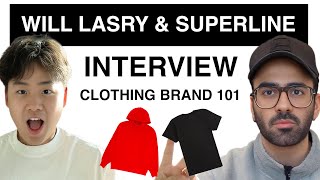
Will Lasry and Superline break down starting a clothing brand: when to use cheap US blanks versus ordering from overseas factories, how to build social media through daily posting and viral remixes, and why a $1,000 shirt sells on story and emotion, not fabric cost.
Chapters
What up, y'all? It's your boy E back again with another video. We're here with my boy Will. I call him the James Bond specialist because he gonna go out there and find out all the brands, where they're manufacturing it from. So we're just going to chop it up, discuss the different questions that we have for each other, and hopefully you guys will learn a couple things because I'm definitely trying to learn some things from Will.
Why do people use blanks?
People use blanks because they might not have the patience or the know-how on how to order from overseas factories, and it's an element of trust. They don't know the factory, they got to send the money ahead of time, and it's not like you're going to get the product right away. Versus whenever you're ordering a blank from us, we're going to ship it out that same day or next business day.
What's the difference between using a blank and doing something overseas with a factory?
So if you go overseas with the factory, you'll have a lot more options. You can customize the different colors of the fabric, you can do printing for a lot less, you can customize tags. However, whenever you use blanks, there is a lot less customization. But again, it goes back to that element of trust where you're dealing with a US factory or US vendor that's here, you know where they're at, you can pull up on them if they don't ship the goods. And secondly, it's just a lot faster, but you are going to be paying a little bit more.
How much can you customize a blank?
Think about a blank as essentially like a canvas. There's not so much that you can do to it in terms of changing the color of the canvas or the size of the canvas, but it's the different embellishments that you can put on top. So, you know, you could do a screen print, you could do a DTG print, you could do embroidery, but in terms of like changing the actual silhouette of the canvas, you can't do that, but you can embellish on top of that. Hopefully that makes sense.
Why do you think blanks became so popular?
So when I was in high school, there were different tables that you sat at, right? There was the Abercrombie Fitch kids, and then there was, uh, you know, the Nike kids, right? And everything was so segmented. I think when you go to high school now, all the tables are blended in, and I think it's because of this sort of DIY culture, right? Before, people didn't have the expertise. There wasn't a Will out here. There wasn't the James Bond that's gonna find you the crazy factories where bait manufactures, right? But now, because we have this content, people are learning. So I think the culture has shifted from let me go consume Abercrombie Fitch to how can I be Abercrombie Fitch? And I think that sort of shift in fashion has really allowed blank business to really propel and get bigger.
So blanks are like a gateway into the world of fashion.
Yeah. So blanks is essentially if you wanted to start out, it's this very stepping stone of being a fashion designer. If you're starting out, you're not going to have the thousands of dollars to hit factory MOQs, nor are you going to have the expertise on how to make tech packs, whereas blanks, you can just go buy a blank, get a vinyl cutter, get a TTF sheet. Shit, even if you don't have a heat press, you can use an iron-on patch. So it's a good stepping stone to getting to where you want to go.
I got you. And how did you get into the blanks business?
I got into the blanks business based off the fact that I was on house arrest. I didn't have anything to do. My dad was in the business. He was selling like terrible flea market shirts. And I was like, I don't want to be the guy known for selling knockoff Jordan merch. Let me go pivot this a different way. And I started to try my own brand. And then from there I failed, and I was like, you know what, let me go use everything that I've learned and give that free game out, and then in exchange try to advertise my blanks through that platform.
Gotcha. How did you build your following on social media?
In the beginning, I just made a really— a lot of terrible videos. I mean, if you scroll all the way down, you can see the first couple of them. They're literally like me on an iPhone just talking into the camera. A lot of people who want to get into the social media space, two advice that I have for you is one, You gotta be consistent. You gotta post and you gotta make content every single day. And it doesn't matter if you don't get any views, you just gotta keep doing it because it's gonna snowball. The second thing is, is you gotta be different. A lot of the guys that come out here and make the content for this sort of space, they're very proper, they're very corporate. You guys know me, I just keep it real and I'ma say what I say and I'ma do what I do. And people like that authenticity. So always be different and always be your genuine self.
In the beginning, when you started off in the world of content, what are the biggest challenges you faced?
Dealing with your insecurities. I'm not 6'5", I'm not skinny, I don't have a chiseled jawline, I'm not the best looking dude. So just going in front of the camera and even doing what we're doing, we're literally in the public street and we're recording a video and people are like, "These guys are crazy." But when I first started dealing with that and then dealing with not getting the views and the likes, it does strike a nerve because as much as I want to say I don't care about those things, I still am human. I am looking for validation. So when you're starting out, all that stuff, you just got to throw it out the window and just be like, yo, If I really want to do this, you're going to have to make 500 videos that get 3 likes and 3 views. Because guess what? On the 501st video, it might go viral. So that's the number one challenge is you got to get over that hump and you just got to get into it.
What do you think helped you grow?
So one of the first things is that I was consistent. I have this philosophy, it's called spam the chat. All we do is we spam the chat every day. I talk to Vivek and I tell him, hey, we need to be posting 2 to 3 organic reels that we created and we need to do it every single day. And the second thing is that a lot of people in my industry, they're a lot older than me. They're a lot more aged out. They're not on Instagram watching Shade Room. They're not looking at the newest rappers. They're not interested in Marnies and, and these crazy brands. They're interested in having a family. So they don't really consume the content that I consume. So I have a better perspective than them. So whenever you're doing content, make sure that you're attacking the white space. What is it that you can bring that's different than everybody else, and then how can you go and tell that story? And then you got to just do it every single day.
And how do you come up with all these ideas?
Uh, how do I come up with all these ideas? Uh, I think you just really got to have a passion for it, you know. At the end of the day, remember this: if you want to go create another wholesale page that sells blanks and you want to compete with me, guess what? I'm waking up every single day at 7:00 AM and I'm coming up with ideas. And not only am I coming up with them, I'm shooting them.
Why?
Because I love this. It's not about the money, it's not about the followers, it's not about the views. I genuinely have a passion for what I do in life, and I wake up every day and I love doing it. So that's the number one differentiating factor.
How important is it to be passionate about creating the content that you're making?
If you're not passionate, if you're not genuine, it's not going to resonate. Because even though you've never met me in real life, a lot of you guys on the side, feel like you know me and you know what I stand for and who I am, it's because you feel that authenticity and you feel that passion in these videos. So if you're not passionate and you're just doing it to check the checkbox, it's not going to go viral, you're not going to go crazy, and you're going to look like every other creator that's out there.
What is your process for coming up with viral video ideas?
So I have a couple different things. The first one that I'll do is I'll go see something else that's viral and then I'll recreate that in my own voice. So if So for example, there was a video that said 5 tax write-offs for photographers. Essentially I did the same video, but I just changed it to 5 tax write-offs for clothing brands. So that's the easiest way. At the end of the day, imitation is the best form of flattery. So if you're starting out and you don't have your own voice, go and copy a Superline video, go and copy a Will video. It's not gonna be as good as ours 'cause we've been doing it, but you're gonna learn and you're gonna develop your voice and then eventually you're gonna find out what your lane is and what your expertise is.
Good artists listen, great artists steal. That's it.
You guys can see that my boy Will, he's an international man. He got a lot of taste, he got a lot of culture. He's been around the world, right? What are some things that you do to develop your taste?
A very good question. I think you literally said it when you asked. It's being international. Traveling for me is a very, very big source of inspiration because it it keeps your mind open and it exposes you to a lot, right? If you look at a guy like Steve Jobs, the reason he was able to create so much, a lot of it could be attributed to the trips he took to India when he was young and his Buddhist lifestyle and exploring different ways of living that a lot of other people haven't explored. So he was creating a new iteration of human. It was like there's never been like an American who like was very into technology and then traveled to India, and then like it's just like this new combination that's bound to come up with a whole new set of ideas. So I think traveling is incredibly important to open up your eyes, give you more taste, and I think it's really important to buy what you like and what fits you well, as opposed to buying what looks good on somebody else and what's popular at the time.
So I guess you got to travel, you got to have experiences, and from there you'll learn and see new things, and then you kind of bring in what you like and develop your own taste that way. For a lot of our younger audience, right, let's say they're working an hourly job or they're at Amazon picking orders, right? What are some travel hacks that they can use to go and travel the world?
Traveling's become the easiest it's ever been. Like, you know, there's apps like Skiplagged where you can literally get prices on flights that are so cheap. And this is not a sponsor, it's just a great app. Um, so you can do that. You can book flights on points. So that's pretty easy. And nowadays, you could take a trip for 4 days and it's fine. Like, if you're working a, a week-to-week job and you have to be there Monday to Friday, you could take off like the Friday and the Monday, do a 4-day trip to somewhere nearby and get a lot out of it. Like, you're not stuck just because you work in a certain job, you know what I mean?
I think the other element of that is if you're traveling, think about it this way: if you're working a 9-to-5, you have 40 hours a week, right? You don't have a lot of time, you don't have a lot of money. But when you do go travel, are you going to go party with your boy in Vegas, or are you going to go to a trade show in Vegas? Are you going to go to Miami and pop bottles, or are you going to go to, you know, another factory and learn? So think about it this way too, is that you only have so many options to go travel and so many chances. Make sure you're not throwing them away and just getting zooted.
100%.
And you want to work.
I think, I think that every trip could have its business benefits. Like, if this is the world you want to surround yourself in, there's trade shows going on everywhere, and those are excuses to travel. So take advantage of them, you know. It's like, it's so important to do this while you're young because this is how you discover who you are and build your personality and build your cards, your house of cards.
And you can have fun. Like, me and Will, we're about to have a drink tonight, we're about to go crazy, but we also working and we also learning about factories. So that's another hack, is that you don't always just have to go travel for fun. You can mix in business and pleasure, but Guess what? You gotta make sure you do the business.
How do you get factories to reply to you?
So I'm gonna answer this the best way I know how, from my oregano business. Listen, if you go to the factory and you're like, yo, I just need 7 little spices of oregano, what are they gonna say? Next, go down to Walmart, go down to Kroger, get the oregano there, right? But if you go to the factory and say, hey, I need 20 pounds of oregano, guess what? Woo, woo, woo, woo, woo, woo, woo. They want your business. They wanna answer that phone call. So the number one way is volume. Volume. At the end of the day, everyone comes to these shows for one thing: to feed their families and to make a living. And the best way to do that is volume. A lot of people go on Alibaba and they do all of these inquiries and stuff, right? And factories never respond to that. What is the number one advice you have for a factory to come and respond to you?
If they're not responding, you're not properly prepared, because factories are looking to make money. They're looking for business. Simple as that. So what does properly prepared mean? It means Having a great tech pack, having a proper budget, and most importantly, have an MOQ, a minimum order quantity, that is high enough. If you are going at them with 20 or 30 units, they don't want to do business. If you're going at them with a few hundred units, which is their actual minimums, they might be interested. So that's the biggest piece of advice I can give.
So a lot of the followers out here, they're watching the, the, the videos of the factories, right? Why is it that these factories are asking for 50, 100, 200-piece Milkis? Why can't they just do one piece?
Well, there's a lot that goes into making a garment, right? So the way a factory is set up is everything is in a line. Okay. So first you have all the fabric that comes in, then it needs to be rolled out, then it needs to be cut, sewn, go to quality control to make sure that everything is intact, that it needs to be packaged and then shipped. So there's a whole line that's set up with a lot of employees that go into it. For them to set up the entire line, to tune all of the machines, the sewing machines, to follow certain garments, all for one garment, it's very intensive. Now, sometimes factories have sampling rooms where they can quickly do it for one garment for a sample, but to do like a run of 50 units inside a sampling room that isn't properly set up is very difficult. That's why a lot of factories will struggle taking less than like 150 MOQs. And even at that, it's a very small quantity. They're probably doing you a favor. In my opinion, if a factory tells you they can make 50 units of something, run. Okay? And this is why. Unless they are your best friends or a close family friend or an insane connection that owes you a big, big favor, there's no money in it for them. Why don't we break down the economics of it? Say they charge you $50 per hoodie for 50 hoodies. It's $2,500. What do they have to do now? They have to go buy fabric. They have to pay for like 7 or 8 different employees to get involved in that entire process. They have to occupy all of those machines. They have to package the product. They have to ship it to you. At the end of the line, over 50 units, they're going to be left with $0 if they're lucky and a lot of lost time. So in order for them to be accepting that kind of order for like $2,500 for 50 units, there's probably some pretty sketchy stuff going on inside the factory. That's number one. Even if you're in a third world country where wages are much, much lower, it's very sketchy for a factory to be taking on those kinds of units. And a lot of people who are placing 50-unit orders with factories don't actually know what's going on inside those factories because they haven't visited them. Come to a trade show, interact with these people, and you'll see that nobody here is going to take anything under 300 $200. Maybe if you bring them a nice gift, a bottle or something, they might say, okay, we'll do $200 for the first order because we know you'll do more after. But that's generally it. A lot of people want to start a clothing brand. What are some often overlooked steps to starting a brand?
So the first one is your skill set. A lot of people want to start a clothing brand and want to be a designer in their bio, right? But they don't know how to use Photoshop, they don't know how to use Illustrator, they barely even know how to use Canva. So You got to have the skill set to get there to where you can create designs on the fly. I mean, they said that Virgil was the fastest person on Photoshop in the world. And guess what? He's one of the best designers in the world. The second thing is going to be money. At the end of the day, it's a product-based business. Y'all over here saying, oh, I'm trying to start a clothing brand, I got $200. You can try, but at the end of the day, you're going to get drowned out by the guy that has $200,000. So whenever you're doing this, remember, If you don't have money, you gotta have skill set. If you don't have skill set, you gotta have money. But at the end of the day, you gotta have one of the two. You know what's they giving y'all? Free game. So a lot of my audience, they don't have a lot of money. They're working a 9 to 5, right? What is the one advice you have for someone just starting a clothing brand with no money?
Okay, perfect. Forget about the clothing. Biggest piece of advice: first, start with the idea. It's all about the story. So what kind of story are you going to with your brand, great. Now go out and make content about that story. And content could be something that ends up on social media, it could be something that ends up as graffiti on the side of a building, it could be something that ends up as a sticker somewhere else. But content is the creation of something that's going to tell your story. That's where you start. Once you build an audience doing that, say for example you're into skateboarding, you could film skate videos. You have an iPhone, it's free to film them. You can just start posting those videos and you can gain a following. Get enough followers, maybe take one t-shirt for like $30 that you buy like as a blank off your website, for example. Go to a local screen printing shop, screen print it. It's going to cost you like $50. And for $80, you have the first sample of your t-shirt. Now get those skaters to start wearing it. And then all of a sudden, people in the comments are going to start asking, what's that t-shirt? Then you go and you make your first t-shirts, you get your preorders, You produce the t-shirts once you have your pre-orders, so you have the money that's already come in, and all of a sudden you've created your first profit out of thin air.
So the number one thing is go create a following. So a lot of my customers are out here, they're trying to, you know, there's everything from the $9.99 shirt and then there's everything to the $1,000 shirt, right? What goes into making a $1,000 shirt?
A $1,000 t-shirt naturally is about a lot more than the physical product, right? Because you can go and use Loro Piana fabrics, you can use the absolute best craftsmanship, perfect work, amazing seams and everything. But at the end of the day, the t-shirt can only cost you so much to make. And in order to convince somebody to spend $1,000 on a t-shirt, it's going to take a lot more than the physical product, right? Because a t-shirt they can go and buy for $9 and it'll fulfill the same purpose. So what do you have to do differently to sell a $1,000 t-shirt? Well, it's all about your brands. What story are you telling associated to this t-shirt? How does that t-shirt make the person feel when they're wearing it? What does it say about them? If you see them walking down the street, you haven't even spoken a word to them yet. You're already interacting with them before you knew it. And you're seeing that t-shirt. What are you going to think when you see that t-shirt?
So whenever you're starting your brand, if somebody is wearing your shirt, they should know exactly what type of person you are and what you represent just based off of your shirt and your brand. And that's going to wrap it up, guys. Hopefully you learned something. I learned a lot from my boy James Bond. He'd be teaching me about class, style, culture. You know, I'll be lacking in that some of the times. Hopefully you guys learned something too.
You know, we stay giving y'all free game.










