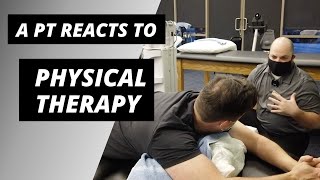
Physical therapist Will Humphreys gets treated for hip impingement and a labral tear after two prior surgeries from a climbing accident. He works with Dr. Brooks at ExperiencePT on femoral nerve gliding and glute exercises, reflecting on what it's like to be the patient instead of the clinician.
Hey, guys. So this is a physical therapist reacts to being treated as a patient. Do physical therapists make good patients? I don't know. I'm not gonna even ask my therapist because he's so nice. I'm pretty sure he would lie to me.
But the truth of the matter is, is that I go to my visits, I do my home exercises because I'm no dummy. I know for me to get progression, I have to do what I'm told to do. So I've been going to therapy for about a month. I've been going to Dr. Brooks at ExperiencePT. He's been a fantastic clinician. And so this video is going to be my description of what I feel like things are going as a therapy patient, being a physical therapist. My accident that I had is tied to hip impingement. I have hip impingement. I've had two hip surgeries through a mountain climbing accident. I'll put a link in the description above. And the ultimate instigator is something I'm embarrassed about. Seven months ago, I was riding a little girl's bicycle and I tore my labrum. You know, I'm gonna tell people that I, like, was defending my mom from a robber or like, you know, fought off a shark in the ocean to save my child's life. But the truth is, I was riding a little girl's bicycle with my family because there weren't any more adult bicycles, and I tore my labrum, and it's been an absolute nightmare. Some days I even need a cane to walk around. It's been so bad. I chose Dr. Brooks because he is someone I know very well, and I know him to be one of the best pts I've ever met. So, yeah, this is gonna be my treatment session and then my thoughts on afterwards.
Yeah, it's the grand finale.
Is that the big hat?
Yeah.
Oh, I love it. This is great.
You're the best, Jenny.
Anytime you get an impingement situation.
You have neurological tone that develops and will has a really tight iliopsoas. And so what we need to do is we need to improve his femoral nerve glide. And this is a great way of doing it. So where you're going to assist me, you're going to bend that knee.
And come up. And the key with this is. And you felt your pelvis roll when you did that. Right. So we want to keep your pelvic alignment here, and you want to bring it up until you feel the tension and then come back off of it.
You can also advance this by Doing a glute isometric, though, while you're performing the glide. Remember what we talked about with reciprocal inhibition? Right. So the more we activate those glutes, the more we reciprocally inhibit the iliopsoas. And so that's a good way of making that glide a little bit more advanced. So you can do the glute squeeze while you're using that strap to pull the leg up. So the more we can get it to release, the more mobility we get into that tissue, the better the hip functions as a whole, right?
Yeah.
So you get your watt going, we get sitting tolerated, you get your squats tolerated.
So I just finished my physical therapy treatment. I'm at a stoplight getting ready to go home. The treatment worked. It feels a lot better. I will say this is a two step forward, one step back kind of experience. But my thoughts on being a physical therapist in physical therapy as a patient are that it's absolutely like this message of hope for me. And when I went to therapy, it was like the first visit. Even as a therapist being educated by another therapist who specializes in this a lot more. It changed my mental perspective on it. And even though I still get down every time I go to therapy, it's an emotional pick me up. When the therapists focus on education and connection, when they educate me, but then they're connected and they're really concerned about my progression. I feel seen and heard, but at the end of the day, I feel optimistic and I go through the rest of my day more powerfully because I went to my physical therapist today. So, yeah, I think being a PT going as a patient after 20 years has been inspiring. It's rekindled my excitement and passion for what we do. I've got a long ways to go with treatment and I'll do another video updating my progression. But at the end of the day, if you're a physical therapist, physical therapist, assistant, occupational therapist, anyone who works with people who are recovering from injury or pain, just know that you matter. It's so important what you do. And I am really grateful that I can re recognize that. So I know a lot of you are probably probably stressed out and burned out. I've been there. But never forget that what you do makes a difference, that people like me and countless of others who are in despair, who are in the darkest times of their lives, which isn't me at this point, but it's a lot of the people we treat are absolutely need that light and the hope that you provide through connection and education. So, yeah, guys, tell me your thoughts. What kind of patient am I? Put it in the comments below. I'll see you next time.