5 Things Every Dog Trainer Should Know | LIVE
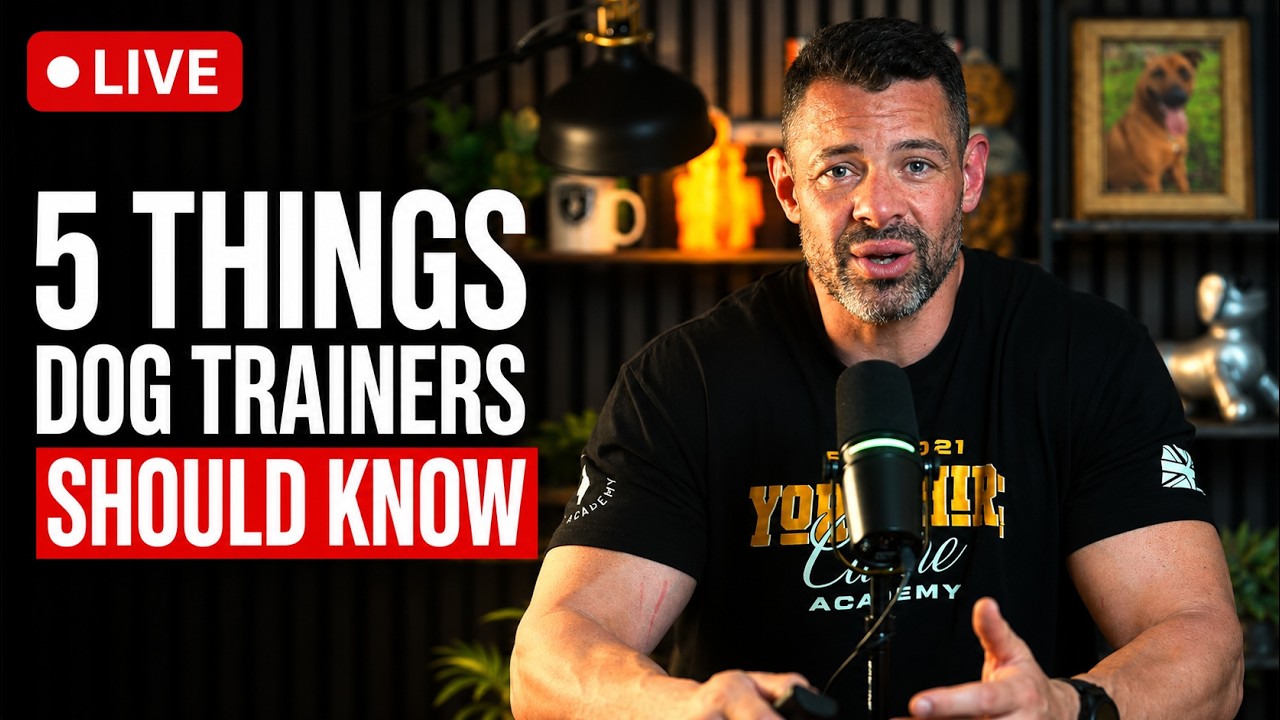
A veteran dog trainer who switched careers during COVID shares five core concepts for trainers: debunking myths about threshold work and punishment timing, advocating for giving dogs decision-making power, and explaining how e-collars work as learning catalysts when properly conditioned. He runs a 10-week Trainer Development Program and uses profits from training to fund rescue work.
Chapters
And then if I go with my mouse to the left? No, if you stay here and go screen share. Oh gosh. Sorry. Yeah? Yeah, that's fine. This one? Yeah. Okay. Linking on to window. That's good. This way? Yeah. Share that. Okay. And then you should be able to use your little mouseys. Mm. I can! There we go, you unlighted hickey. Okay. And it's 7 o'clock. Do I just start? Do I go or what? You can let people get warmed up, say hi and all that chat. You know the score. I'm going to try and put my watch on silent. It's giving me loads of notifications. Just check if we can hear you, the one in the chat. Yeah, okay. Someone give me an emoji or a numerical figure in the chat if you can hear what I'm saying. Something. Anything? All right, cool, cool, cool, cool, cool, cool. 5 yet, nice. Yep, good. Pink Hand, nice. Carp Yeti with a smiley, kind of a smiley face. Is that the fish carp? I don't know. Um, I'll give people just another minute or so because it took me ages to set up. So people may struggle as much as I do with technology. Get out my crazy timeline watch. 3 minutes past, I will start waffling like no one's ever waffled before. 50 seconds. Is anyone from anywhere You're from the mentorship program. Okay, okay. Might be lost on you, this one, but all good. Mr. Ratley, hello there, sir. Good man, good to see you. You already know all this stuff already too. Um, there'll be no like how-tos on here, so— high-tech guy, Mark. You know I'm not a high-tech guy. Chloe calls me— I don't know if I can say this, but the symbol bashing guy. So that's good. She just kind of shouted. She doesn't call me it. Okay, so I'm going to start. This is my first live. I'm a live virgin. So that's good. Good to see a few people that I know in there. Hopefully you'll be friendly and not— I did help with your wheelchair, Mark. Yeah, it's probably what I'm useful for. Being heavy. Um, obviously we do lives quite regularly in terms of dog training, as in clientele who need their dogs trained, but this is slightly different. This is more about people who want to be or aspire to be dog trainers, or maybe are trainers already but want to polish and hone skills. Um, so essentially the format will be I'm gonna try and tell you a little bit about who I am and why there might be a reason to even bother listening to me waffle at 7 o'clock at night if you're in the UK. And then I'm going to run through a few common misconceptions. I'm going to run through a few things that you should know, as it says on the screen there. And then there'll be a little bit where I tell you what we do in regards of training for trainers. And then we'll— the end, we'll have a little bit of question time. We'll leave it till the end just so we don't ruin my flow, because I am a live virgin and I could be terrible at this. So we will see. So without further ado, 5 things every dog trainer should know. Essentially, why, why have I even got reason to be telling you this? A little bit of background about me. This— I haven't done this my whole life. I'm clearly fairly old, I've got a grey beard. I had a life and career before dog training that I very much enjoyed. It was sport, professional sport. Both played it and coached within it. Um, so that was an interesting start for me. But obviously something like that has a very finite period in terms of you expire, and oh boy, did I expire. Um, we've got some good messages going on in the chat. Um, cool. So essentially what happened was COVID. Um, everyone will remember that as an event, and within COVID, my sporting contracts got torn up. I no longer got paid for the work that I was doing. You can imagine that was a little bit despairing at the time. Fell out with sport as a result of it. It proved kind of to be quite a fickle thing, quite an emotional thing for me because at that point it's all I really knew from the age of kind of 20 to 35. I literally— I miss lockdown, yeah, I miss the solitude of it. But essentially that's all I knew for 15 years. I did a little bit of bits and bats here and there. One of my good friends took me under his wing. I did some building and joinery for a while, and although I did enjoy it, it probably wasn't what I was passionate about, and it wasn't something that I wanted to get my teeth into, get the dopamine firing, and genuinely want and love to do a good job of it. Fast forward a little bit, Jacob Morgan Morgan was already a dog trainer. We were incredibly good friends. We'd worked together at a sporting club. He'd been a member of my gym. We knocked around together outside of those two things, um, had great fun, great camaraderie when we did. Um, and he left the place where he was training— that's obviously his story, I won't give you any background on that— but he invited me to start doing dog training with him. Um, I had done a paper qualification, and this is probably going to be the first point I'm going to make. Um, I'd done a paper qualification. My mum actually got me it for a Christmas present because I was always into dogs. I'd always had rescue dogs. I was always very, very keen to help dogs. So I embarked on a paper journey. It was actually online, um, knocked out the assignments, did pretty well on it. But at the end of it, did I feel like I could actually actively train a dog? Hell no. I knew a little bit, and the course was fairly nuanced towards, um, how do I put this politically, like positive means only. Um, they did accept that the other quadrants existed, which some people don't, which is fairly ridiculous, but, um, very much nuanced towards the positive means only. And the dog I had at the time, I got her when I was playing sport. She was called Rita, um, Staffy American Bulldog. She had bitten people, she'd bitten dogs, and in any given moment, she would not be interested in, um, the positive stuff I could offer. So I was very, very interested in what Jacob had to say, both from the perspective of my own ambition to be a dog trainer and also to help Rita. Um, Rita, Bamba Rita, still got it. She's 14 now. She's a good old girl, a bit of a grandma. Um, fast forward to now, and between us, we've trained thousands and thousands of dogs. I actually got a message the other day that was really heartwarming off someone who whose dog I helped train through our remote program. She's in Australia. I don't think she'd mind me saying, but she works a lot with rescue dogs. And through what we spoke about on the calls that we did, she's now gone about and helped about 700 of her own rescue dogs. So you really can't underestimate how far your touch can go. Like a small pedal in a— pedal? Small pebble in a pond can send ripples across an ocean, right? So that's kind of my background story. The rationale of why you might even care what I say is we've trained literally thousands and thousands of dogs. A lot of people out there who've got very loud voices are yet to provide any evidence that they train any dogs, never mind the kind of volume that we're doing. And it's not just the volume, but we're also getting good results with that volume. Yeah, so, um, Scott there saying TWI made him a decision to become a trainer, and Owen, who works for is he, he followed the same route. He did TWI first. We got on really well on the calls. We kind of recognized in him that he had some skills that would help us, and Bob's your uncle, he's now training with us. So there becomes a point where the dog training world is full of charlatans, maybe, shall we say, and you get told an awful lot of stuff. You get told. And I just picked a few examples here of things that you probably hear on the grapevine, things that might be sold to you as a fix for dog's reactivity or any number of problems that your dog may have. So I'm just going to pick apart a few of these before we get stuck into the things that I actually think do make, um, the cogs turn and are the real big dial movers. So Some factions of training will say that you should always keep your dog under threshold, i.e., the distance at which they won't react to the trigger, right? The concept and the theory I don't necessarily have, um, a problem with. The practical element, however, is almost impossible, right? So we, we get dogs on boot camps who'll react to dogs at 100 meters, maybe even 200 meters. Where can you possibly go where you can keep that dog under threshold? It's going to be almost impossible, right? So although the theory is there, um, it's unsubstantiable in— is that even a word? It's not, it's not possible or realistic in the real world, right? So yes, threshold work could work, it might work with some dogs, but logistically and realistically in true life, it's, it's not going to be the thing that gets the win, right? Um, unsustainable Sustainable. Yes, Mark. And it's not even in his first language. Um, on the flip side of that, you'll get what we would deem as old-school balance trainers. A lot of balance trainers use compulsion, which is essentially, if we're talking quadrants of dog training, negative reinforcement, i.e., pressure to do a thing. It's a really powerful tool, it's a really powerful methodology to be able to compel a dog to do something. I've put an example there of like the heel fixes reactivity. So you'll see a lot of fairly high-level sport dogs and they go on the PSA field or the IGP field or wherever it is. I don't know too much about that crap, but essentially they'll go on there and they look amazing. They do all this focused healing, they bite sleeves, they do outs, they do call-offs, they do all that kind of stuff. They jump over stuff. Brilliant. They can do things. And that's the key word. They do things very, very well. What you might also notice is when they travel to and from the field where they actually compete, the owner will stick the dog in a heel. The dog won't be at liberty, um, and this is also key because a lot of those dogs, when they're broken from a specific behavior, i.e., compelled into a behavior, and they have liberty of choice, they don't make good decisions. I'm gonna pause there because that's one of the moments for me. I saw a t-shirt recently on someone, it was a dog trainer, I don't know who it was, but their tagline was obedience isn't a lifestyle, and that rang so true for me. It's not mine, I stole it from somewhere, I don't know who it was, so if anyone does know who it was, then stick it in the chat and we can give them the credit. But essentially A dog that can't make good decisions at liberty will never be— have the privilege of liberty. And to me, that's not life. Um, so if you're compelling your dog into a heel to get past the dog, if you've got to stick your dog in a down because someone walks over, and if you— if they don't stay in the down, they'd react to them. Any behavior that you're compelling a dog— and it doesn't necessarily have to be pressure to do it with negative reinforcement, it could just be something, um, with positive reinforcement. So A lot of people's fix for a dog that reacts when the postman comes to the door, absolute classic, okay, we'll get the dog to go on place. Okay, they're allowed to do one specific thing. That's not making good decisions. That's taking all of the decisions away from the dog. That's giving them no agency over what they can do. So either compelling or positively reinforcing the dog into a behavior one specific behavior isn't a fix for reactivity. The other thing we've got a question as well is, does it even change the dog's emotional feeling towards that thing, or does it just give them something that's incompatible to reacting to the thing? Give me a thumbs up in the, in the chat, or, or a 1. I don't know, I think Jacob uses 1. We'll use a 1. Give me a 1 in the chat if that makes some sense, that compelling a dog into one single behavior Doesn't fix the response to the dog. Yeah, cool, thank you. At least 3 people, 4 people, cool. Um, okay, on a similar kind of, um, point to that, a lot of people will try and use distraction. I had a couple of calls with people today and their suggested fix by another trainer for fence fighting was scatter feed the dog. Essentially, that's distraction. Distraction. One million. Is that like better than one, or is that so far from one that you have no idea what I'm saying? So distraction can work, right? I would argue if you can truly distract your dog from being reactive, then it's probably not a seriously reactive dog in the first place. It's not— if it's making a decision between two things and it's picking something that you can offer, it's not truly reactive, Doc, right? It's probably finding entertainment in doing those things and what you can provide in the moment provides more entertainment or more motivation. We'll come to questions at the end, Mr. Ratby. So let's give an example of, um, a collie that's car reactive or reactive to traffic, moving traffic in particular. We see quite a lot of those, right? And I'm sure a lot of people here be familiar with those types of dogs. Those dogs are also often quite motivated to play, right? So it might be the advice of someone to go and play with that dog in the vicinity of traffic. Now, if the dog chooses to play, great, got no serious problem with it. But if the dog's so motivated to play that it almost put blinkers on the dogs, then we're actually detracting from the traffic being there in the first place. We're not allowing the dog to sit in a choice point to make a true decision about whether they maybe want to chase traffic and get themselves into trouble or not. So distraction can work. It's probably not going to change responses, and if we do use it, we'd have to be super, super savvy of how we use it. Hope that makes some sense. Also, um, gonna move on to the right-hand column. So you shouldn't punish a fearful dog. Um, no. Um, okay, so what— so the trouble with that is We get a lot of people who say, my dog's not, not aggressive, it's reactive and it's reacting from fear. The problem is that the outcome is aggression. So a lot of these dogs want distance from the trigger, right? So let's say, for example, it's boot camp day. It's Monday, one of my favorite days of the week. I walk out into the car park. I'm fairly tall. I always wear black, quite often wear a hat. I am some dog's worst nightmare in terms of a human, right? I walk towards that dog, the dog goes crazy, it barks at me, it lunges at me. Maybe it has no intention of biting me, but what it's trying to do is make itself look hella scary so that I move away. If we say we can never punish that and we'll, and we'll just akin punishment to stopping the behavior in the moment, we're probably not going to be able to get what we call prediction error. And prediction error is 100% necessary for learning. So what that dog may predict is that me coming over is gonna offer some harm, offer some sort of negative experience. Because the dog reacts and I shit myself and I run off, the dog breathes a sigh of relief. It's essentially negatively reinforced for it, probably positively reinforced— I can't speak— positively reinforced for it as well because they get the result they want, which is me to go away. They never see the point where I actually wasn't going to harm them. If I allow myself to stop that behavior in the moment, I open up a window of opportunity where I can show that dog that I wasn't going to harm them. So I think the, the— it's not a sound thing to say in terms of you shouldn't punish them. I just think there has to be a caveat that, okay, yes, we can use punishment with that behavior, but there has to be something that comes afterwards. So we have to then try and change and leverage the feelings that the dog has towards the trigger. If we purely use punishment and we suppress the behavior, we're very much relying on chance that then that dog feels better about the trigger. Hope that also makes sense. Give me a 1 in the chat if that makes some sense. We're going to talk a little bit more about teaching yeses and nos when we talk about what you should know. All right, beautiful. Some good— yeah, some dogs do get enjoyment from it, Tim. Yes, so, um, I will talk about that. It's a great point. It usually happens after the dog's been reactive for a little bit of time, but essentially they get positively reinforced because the, the person or the dog goes away. They get negatively reinforced because there's a huge sense of relief for the dog, and that's probably, if anything, more powerful. But then they can almost get addicted to it. Um, so the enjoyment, the addiction— obviously some of these dogs, if we're talking German Shepherds and whatever, they're designed to do that anyway, so they're probably getting some fulfillment out of it. So you're absolutely right. Um, Scott, my dog enjoys starting fights. Yes, don't let that happen. Um, so yeah, you're absolutely right, the dog can then even start to enjoy it, in which case, how do we counter-condition it if the dog's already enjoying the feeling of doing it. That starts to become a little bit tricky in itself. So the statement that you shouldn't punish a fearful dog is entirely false. There just has to be caveats and processes around it. The other thing to probably mention at this point, and this is topical in terms of, um, we've copped a little bit of heat recently about how we get results so quickly on boot camps. Um, people think we're using huge amounts of pressure to suppress dogs and stop dogs. If anyone knows about dogs and you see the before and afters and you see the dogs on the Friday, you will see non-flattened-out dogs. If you actually know fucking dogs, you will see them and be like, yeah, that dog's actually having a better time than it was having at the start of the week. But when we use punishment, if we're trying to stop behaviors, what we're trying to do by and large is leverage the social system, i.e., the connection between owner and dog. The way we do that is fairly specific. We're not going to talk about hows. But if I try and use fear in that moment, yes, I don't want to bring fear as an emotional system to the forefront of the dog's brain, right? I don't want them practicing fear more than, than they need to, right, or than they should do. Fear is not necessarily a bad thing. Sometimes it keeps them, keeps us safe. But obviously, if you're practicing a fearful behavior a lot, then the fear system becomes a predominant system. "My dog was happier day 3 of boot camp." Yeah, exactly. So we're not smashing dogs up, we're as empathetic. So like, this is going to come on a little bit in a future slide, but particularly here, everyone is entirely passionate about dogs. They absolutely love their dogs. I've got 6 dogs and I love nothing more in my life except those dogs. Maybe a few of my mates, not many. Should— you should punish. And this also comes from more of the compulsion style of training, right? You should punish or correct precursor behaviors. I don't believe they punish it anyway. I do, I do think they use correction more. So the difference between punishment and correction— punishment stops one specific thing, correction corrects a dog into a specific thing. Um, that's obviously one of the things that we talk about in depth when we do the courses that we do, right? But when we talk about precursor behaviors, so, you know, like, um, the dogs that put the hackles up and they go a little bit stiff, maybe, and maybe they puff their lips a little bit. There's a dog barking in the background. That's good, we got a reactive one. Um, when they do those things, some people will try and correct that or punish that. They think they're punishing it, usually they're correcting it, but semantics at this point. The trouble with that is that's not a crime. And the also, the other trouble with that is that you start creating taboo thoughts towards triggers. I am not allowed to look at a dog. That's a really sticky spot to get into. Another reactive dog. So I would be very, very reluctant to ever punish a precursor behavior. Yes, if we're using punishment and in the presence of a trigger, we need to catch it as soon as possible so that the amount of the aversive experience you have to deliver can be the least possible, and it's the easiest to catch, it's the easiest to interrupt. But it's unethical in my opinion. Obviously we decide ethics when we're talking about dogs. It's unethical to use pressure with precursor behaviors. Does that one make sense? Yeah, so carp yeti, but is that actual fish carp? Discipline with the pack, exactly. Obviously, the difficulty is we're not co-species, right? So we can't communicate as well as them. But if you watched— I've got 6 dogs, right? And they tell each other, they confirm boundaries all the time. It's really interesting to watch if you can get a whole bunch of dogs and you can watch them. We have them around the center. Jacob Morgan and I talk about his dogs interacting all the time. It's really, really interesting to watch multiple dogs, um, react or interact all the time. Um, this one's a funny one, right? Like, every dog is different. Everyone kind of wants, um, they want to believe their dog's unique, and I'm absolutely not going to agree with that. But we get a lot of people— we went to, um, Perth, Australia, and we did— we delivered a seminar there, and it's one of the more hostile seminars I've been involved in. And in that seminar, Jacob spoke quite unusually about punishment at length and the systems you need to put in place, the things that it can fix, the rationale behind it, and all these quite intricate details. For one, for a 2-day seminar, it was super, super in-depth. What we got off the back of it was a lot of people asking if that thing could fix their unique problem. And the answer was continuously yes, because the unique problems aren't as unique as we think they are, right? One of the arguments with, um, against using aversives or against using any type of pressure in dog training is you wouldn't do that to a child. And it grinds my gears. I send it— I say most weeks in front of our boot camp. But two reasons. One, I would do that to a kid. I prefer dogs to kids, so if I'm going to use pressure, I'd probably use it with a kid than a dog. But the other one is that they learn very, very, very differently to how we do. At some point in a child's life, or most child's life, we get the opportunity to explain things to them, right? So when I was a kid, I had reins. I don't even know if they're still fucking legal, but I had reins. I had a lead because I was a terrorist. I would have got run over, I would imagine, before the age of 5 had I not had reins. So, so be it. But if it's supposed to be cruel, I don't mind, I'm still alive. Um, at the age of 4, 5, 6, whatever it might be, my parents or my teachers could explain to me that, okay, you run into traffic, it might either really hurt Or maybe worse, apparently my TV is gonna turn off in 55 seconds, Susie. I don't know, so hopefully the staff member's listening because I have no idea how to fix that. Um, that'll be fun. So at some point we get the luxury of being able to explain to— the fuck do I do here? Um, I get the opportunity to explain to a child or whatever, an adult, that there's a certain problem with doing a certain behavior. Dogs exclusively learn by association. We never— I don't know where the remote is, but that's a great point. Um, help! You don't know where the remote is? You got 6 seconds. 3, 2, 1. Shit. Will it still be recording? Oh brilliant, they can all just see me flapping and sweating. I'll pause because I don't know what anyone's saying. You could be swearing at me, you could be doing all sorts of stuff. Hey, we're back. Um, do I need to hold that in case that happens again? All right, fine. Hey, shenanigans. This is the problem with doing it live, right? But yeah, so reins keep us alive and we can use management effectively until we get the opportunity to explain. Yeah, it was my— it probably was a set up. We get the opportunity to explain to that child, that adult, whatever, that the thing you're about to do could be costly or incredibly painful to your life. Dogs learn purely by association. They learn from appetitive or aversive stimulus, so they do something. And it's good, or they do something and it's not great, and they learn for the next time, right? They don't learn that time, they learn for the next time. So it's incomparable to say, okay, you wouldn't do that to a child. No, because with a child, at some point in the future, I'll have the luxury of explanation. You never get to explain to a dog. I think that's part of the romance bit of dogs. I think the fact that they are non-verbal creatures, I think that's why we get on with them so well, because they don't give a shit when we get home. That's just my personal feeling. They always seem to be happy to see you. They don't understand expletives. I apologize for swearing. I've just realized I didn't put the caveat at the start that I do swear a little bit. But essentially they learn by association, which inherently means that they all learn in the same way. So yes, every dog is different, and I love that they are very different. But when it comes to teaching dogs and when it comes to creating clarity and clarity is absolutely key to be able to liberate dogs, then the way that we teach that can be very, very, very similar. Does that all make sense? Tough shit if people don't like it. Yeah, fair enough. Yeah, I saw them. Does that make sense that they learn by association? We can't compare them to kids. Um, and yes, although they are all different, the actual mechanisms of teaching dogs is always going to be very similar. It's always going to look quite similar. Cool, cool, cool. Um, okay, my last one: the e-collar is a last resort. Um, I think that comes from the premise that people think the e-collar is the most aversive tool that you can use as a dog trainer. I don't necessarily agree with that, um, fundamentally anyway, but a lot of people see like a hierarchy of tools, right? They go, okay, harness is the least aversive, flat collar, maybe the second, Mindgale next, slip lead, slip collar, prong collar. Um, yes, Mark, I totally concur with you. And then they see e-collar as like at the top of the pillar in terms of like, right, okay, I need this to— this tool to bash my dog's problems out of them. Um, that's entirely backwards to how we use e-collars. Um, in terms of the way we use them, by and large, is we're very much, um, in terms of philosophy at YCA, we've got— we follow basically the layered stress model in terms of, okay, fulfillment is very, very paramount for us. The two main parts of fulfillment for a dog: really good play and then off-lead freedom. The chance to be a dog, a chance to run around, sniff, Pee on stuff, eat stuff you shouldn't. Hopefully it's safe. Roll in fox crap, whatever it might be. Go and be a dog. By giving them the opportunity to do that and coinciding that with play, often we see some of the triggers disappear, disappear entirely. I— there'll be people on here, Scott will know the story already. I tell a story about my Frenchie, Mr. Bumble. Yes, he's called Mr. Bumble. Bumble. Um, and he's a brilliant dog. Um, I didn't intend keeping him. I got him as a foster. I've never actually successfully fostered a dog. I've kept them all, which kind of isn't the idea of fostering, but at least they've got a home. Um, Mr. Bumble's a great little dog. He's quite spicy, but by and large, good little boy. He once strained a muscle in his leg. It wasn't anything catastrophic, but he went and he stayed at home for 3 days, and he was basically on crate rest. When he was let out of the crate for the little periods of time that he was let out, he started resource guarding completely random inanimate objects. He resource guarded the laundry basket, he resource guarded a slipper. I think at one point he resource guarded his own lead. So it's like, well, if you want to go for a walk, how the hell am I going to take you for a walk if you resource guard your lead? But essentially all these little behaviors, these obnoxious, like shitty little behaviors started creeping in and it was kind of a little bit of an eye-opener of like how much fulfillment plays a part. Because after the 3 days, his leg was better. He started coming back to work with me. He had his off-lead walks. We didn't play at that point because it's probably too intense for him. But all of those problems at home dissipated and disappeared entirely. I didn't do anything directly to address those problems, but the fact that he had full freedom again and the fact that he was trotting around with his 2 little buddies again those problems— excuse me, clearing the throat— those problems disappeared. So the way we look at it is, okay, I need to be able to give my dog as much freedom, as much fulfillment as humanly possible, so that they can have the most liberation or the, the highest level of liberty they can have. At that point even if my triggers don't disappear, they'll be far, far and away easier to deal with than a dog that has no freedom and can't play, because they will be a compressed dog. They'll have drives that they want to express, and they'll be tipping them into the wrong place. So we largely use it purely for proof in recall, again, the dogs off lead as quickly and as efficiently as possible, alongside then maybe some direct means of addressing the dog's reactivity. So the way we use the e-collar is absolutely not a last resort. If anything, it's probably a first resort. Um, you can probably tell with the passion in my voice how passionate I am about them. All 6 of mine are e-collar trained. They— whenever we go out on walks, they're not on leads. If I'm completely honest, there's about 1 out of 5 that can even walk on the lead. I could be resource guarding the remote. Yeah, I don't know where it's gone. Um, so yeah, most of them are crap on the lead because they spend so much time off the lead. Yeah, same. If I get my dog's e-collar out, I turn it on— I've got fancy ones so they make little musical notes when I turn them on— my dogs will literally run over and ram their heads in it. Now, does that mean— like, there'll be people on Instagram who go, 'Hey, look, my dog likes the e-collar.' They don't like the e-collar, they like what it's associated with. Like, they're not gonna— the only thing it's ever done in the end is issue a potential consequence. But it's the same way as picking the lead up off the side, right? So you pick the lead up, does the dog want to be on the lead? 6-foot lead, 8-foot lead, whatever the lead length might be, the dog does not want to be on the lead. But what does the dog associate the lead with? They associate with going outside and doing some cool shit. So you pair that enough times, then the dog's emotional feeling towards the lead becomes good. Exactly the same with the e-collar. So whenever I go on an off-lead walk, the e-collar goes on. Sometimes when we play, it goes on because around the center there's other dogs knocking around. It'd be disrespectful for me to allow my dog to potentially run over there. They never have, but it's there as insurance. So is it a last resort? Hell no. It's probably a first port of call if possible. Um, obviously if we're talking dog trainers, sometimes it's difficult to persuade people on that but from the perspective that, okay, that's your quickest, easiest way to get the dog off lead. Obviously lead reactivity is a thing, or leash reactivity if you're American, is a thing. Um, we can get them off lead, we can liberate them, they can have a huge sense of fulfillment, we can get pressure out of that steam pressure cooker, and we can ease the triggers. Um, Make a note of your questions because I'm gonna, um, we'll answer things like e-collar questions, like recommendations and what have you. Just make a note of those and I'll try and hammer through them at the, um, at the end. But yeah, uh, Mr. Bumble— don't want to waffle on about too much about Mr. Bumble. He loved having his harness put on, but my God, he did not like having it taken off. Um, in fact, there's somewhere a funny video of me taking off a Halloween costume. It was like a rodeo bronco. Um, this is another important point, right? We get people who speak to us all the time, and this is no direct disrespect to other trainers, but they will tell me, oh, we really like our current trainer, but we've been working for a couple of years now and we haven't got quite to where we wanted to. It is, it's eye-opening now to us who are by and large doing boot camps or TWI. TWI is now a 30-day program, which is our remote program. The boot camp is a 5-day program. So when people tell me it's taking months and months and months to train dogs, it's actually really quite eye-opening these days. Um, again, just tipping back to what I said before, like, there's people giving us a little bit of crap at the moment and saying that we're— the way we're doing it is by hammering dogs. I would invite those people to come and have a look, and I know for a fact that some of those people are hammering dogs themselves, but each to their own. Um, but fundamentally, not every single dog that we have in a boot camp is 100% fixed, cured, whatever, by the end of it. There may well be a genetic or a behavioral or a genetic and behavioral ceiling to how far they can get in a boot camp or the TWI program, but that ceiling will be the same as the people who are training over 2 years. So why not get there in 30 days or 5 days or as efficiently as possible? Um, there is a t-shirt somewhere, I think our good friend the Nut might have this on his t-shirt, or he's got a slogan of this somewhere. And it's— you get like— and it's maybe not even his, but there's like a statement where it's like, you get 12 summers with your dog. I think that's the average. That's really sad, right? So if I'm spending 2, 3 years getting my dog to the point where they're happy, I'm wasting like a quarter of their life. That's more depressing than only getting them for 12 summers, right? Um, so when you look at it from that perspective, we want to train dogs as quickly and as efficiently as possible. There's also other people out there, going back to the e-collar, who say, oh, well, you're looking for a quick fix. Yeah, fucking too right, I'm looking for a quick fix. I want the quickest, most efficient way, the most reliable way of getting to the point where a dog is happy. So if it's a quick fix, that's not in my sense, in terms of my personal opinion, that can't be a bad thing, so long as obviously we're using it with reasonable amounts of ethics. Okay, I threw this slide in there because, um, right now, obviously, hopefully some of you guys are dog trainers or aspiring dog trainers or dog trainers who want to polish your skills. At the moment, I think the, the social media platforms are a bit of a shit show. Um, I've seen recently really well-respected dog trainers clipping other people's, um, training material or whatever they're saying, talking over the top of it and basically badmouthing They're spending loads of energy on that stuff, way less energy on actually training dogs and maybe educating people as to why that might not be the right case. It's super, super disappointing, right? All it does is confuse the people who are watching it. So people who are potentially wanting to try and train their dogs are just getting more and more confused. Like, he says this and he's well respected, he's now taking the piss out of him. I even saw one the other day where it was someone hammering someone who'd hammered someone's video. It's like, right, how far is this gonna go? Like, it's absolutely ridiculous. Like, can we not all just be on the same page of like, everyone is trying their best to help docs, um, let's spread decent information? Like, and, and Jacob's done a marvelous job of this in terms of he's very, very— from the start has been very, very transparent about what we do and and, and to a large extent how we do it, with the caveat of some stuff that people could misinterpret and end up getting wrong, right? So people may disagree on methods, but I don't think there's anybody who would call themselves a dog trainer who's— has no empathy for dogs and the best interests of the dogs at heart. I just don't think that's true. I think there's people out there in the world who obviously abuse dogs but hopefully those are few and far between, and they're not dog trainers, they're assholes. I got a little bit passionate about that one, sorry. So many comments. Um, should you use the e-collar with a reactive dog? Yes, possibly. No prong collars? It did really— so like, um, just a point on tools, like, just so I can, I can obviously get on, um, with the presentation a little bit because I've I don't know how much I'm waffling. I don't know what time I'm on. Um, when we use tools as dog trainers, some compulsion-based trainers will use a tool to try and fix the behavior. The way we use tools is as a catalyst, or, or, um, in biology you would call it an enzyme. Basically a way of making an exercise better. So we've got certain exercises that we will know will be 1941. Man, I can waffle. We've got certain exercises that we know will be productive towards helping with reactivity, as an example. Those exercises stand true whether I'm using a flat collar, a prong collar, a slip collar, an e-collar, any tool you can possibly name, even like a harness. The difference being some of those tools might make the job easier and smoother, particularly if you've got a poison tool or something, someone, some, something that someone's tried and it hasn't gone well, right? Does that make sense? Give me some ones if that does make sense. It's like a delay. I go 1, 2. Yeah, that'll do me. 2 ones will be fine. 2 ones don't make a right. Um, okay, finally, I've taken a long time to get to this, haven't I? Like 40 minutes of me chatting absolute waffle, um, to get to actually like the meaty part of it, right? So 5 things. So I've kind of tried to debunk a little bit of tiramisu. Yeah, oh, don't say tiramisu, I could do with some. Um, I've kind of tried to debunk a little bit of some of the stuff that you may hear on the grapevine in terms of like, okay, some do's and don'ts that probably are actually false. So I'm gonna try and go through some stuff that you actually need to know as a dog trainer, aspiring dog trainer, or a dog trainer honing your skills in terms of actually getting dogs to the point where they make drastic improvements. Um, on that, as dog trainers, the proof is in the pudding. If you don't collect proof, if you cannot prove that you can train dogs, if you cannot prove you can take a dog from kicking the hell off to being social or worst neutral, then you've probably got no business being in the business, right? If you can't prove it and you can't put your money where your mouth is, get off the roller coaster. I don't even think that's an analogy, I just made that one up, but jump off it. Maybe like one of the peaks, the high bits of the roller coaster, jump off. Just don't bother. I've got the ultimate respect for anyone who sticks their work out there and says, hey, this is what I've done. And if, if they come under criticism, at least they've, they've had a dig, right? Okay. So reinforcing a dog, we've kind of been through this in the earlier one, but reinforcing a dog into doing something else. So there's, there's different differential reinforcements, right? And I'm going to use some fairly waffly language here because I'm going to assume that the audience knows a little bit about dog training. So differential reinforcement, i.e., reinforcing the dog for doing a a different job comes under some different guises, right? So you've got DRI, that's differential reinforcement of an incompatible behaviour. You're on the other end of the spectrum, there's some in between, you've got differential reinforcement of alternative behaviours. So an alternative behaviour might look something like the thing that the dog wants to do. So let's go on the extreme end of behaviour. I've got a dog that wants to fight dogs because it loves fighting. I can't let you fight that dog. What I can let you do is fight this toy. So if I can get that dog to fight this toy instead, then I'm reinforcing the dog for doing something that's alternate to the thing that they really want to do. Other end of the scale, I could ask him to lie down, or I could compel him to lie down. That behavior is fairly far removed from fighting the other dog, so it's an incompatible behavior. So in essence, I'm giving the dog a totally different job to the job that they want to do, or the activity that they want to do. That makes sense. Give me some oners, beauties. Mark, you're always on it. Um, but a little bit like we discussed with the points where people compelling dogs into behaviors before. It doesn't change feelings. So someone can give you an alternate job to do, but it doesn't mean I don't want to kill logs anymore. All it means is that I'm going to do this thing instead. Um, don't get a low-priced e-collar. I'll answer that question right now. Um, I've seen a lot of low-priced e-collars on Amazon and such that have really low reliability. So the same level of stim will output a different amount of stim. That's not— the dog can't then make contingency. You can't— it's not very ethical at all. So don't, um, scrimp on technology if you're going to use one. It— we don't know whether reinforcing the dog into a different behavior is actually helping the reactivity or not. Because we keep the dog in that activity until the trigger's gone away, right? So we only can know if the dog feels differently about the trigger if we give the dog an element of liberty. So anyone who comes to one of our boot camps will, will talk about what we call red light, green light. It's essentially, okay, the dog's at liberty, they've got agency, they can make choices. Here's the trigger, which choice would you like to make? And if they take option A, well, consequence A happens. If they take option B, consequence B happens. And very, very quickly, because it's so black and white— I'm waffling a bit— it's so black and white, the dogs learn incredibly quickly. That's entirely the opposite of giving them a different job to do. We give them no job to do. If the dog tries to heel, we try and get them away from the heel. If the dog tries to lie down, we try and get them out of the down. We try and give the dog as much liberty as we possibly can in a fairly sterile environment so that the dog can make an actual choice. If the dog has no choice, we don't know whether we're helping reactivity or not. Hopefully that makes some sense. I'm sweating. It's either hot in here or I'm nervous. Terrified. Um, this is another big point for dog trainers, right? So we used to do an awful lot of what you call day training. People would drop their dog off to us 9 AM in the morning, they'd pick their dog up 4 PM in the evening. They would usually do that for— okay, ask these questions at the end. Hard for me to concentrate. I've been knocked out so many times, I can't remember how many times I've been knocked out because of the brain damage and whatever. Um, so we used to do an awful lot of day training— drop them off in the morning, pick them up in the night. We would train them during the day. We'd do loose leash walking. This is before we were, um, as au fait with giving dogs liberty as we are now. We do loose lead walking, we do place, we do all the kind of things where getting dogs to do things, right? At the end of either 3 or 5 day Kickstart program, as we called it, we do a few one-to-ones with clientele. The transfer of skills from the day training that we did to the owners was always at best middling. So if we got the dog to 100% great and we could take them to the park and they could do all this stuff, we'd maybe get 60% of that with the owner. In a similar vein, we used to do an awful lot of what you would call like the border train, board and train, or residential training. That's where people drop their dog off with us. They used to come home with us. We don't do this anymore. We for a similar reason. But essentially, that dog became ours for 2, 3, 4 weeks. We'd train the dog, we'd front-load skills. We do the same thing, we do sessions afterwards with the owner to teach them how to tap into those skills. But again, the conversion or the transfer of skills from us to the owners was very, very low. These are the main reasons why we got rid of these programs. We now do the boot camp— the boot camp— the prank program. It's not a prank, it's a real thing, I promise you. The boot camp program where it's Monday to Friday. Within that program, I will literally bollock our trainers if they take the lead off the owner. If we do that, we're depriving the owner of going through, one, a stressful experience with their dog, which bonds them and changes the relationship. And two, learning the skills themselves and getting the opportunity to practice it and make mistakes under guidance. So we will literally bollock each other. I've been guilty of it. I actually did it last week. I took the lead off one lady last week. It's the first time I've probably touched someone's lead— oi oi— in a long time. And I felt guilty when I did it. But I felt it necessary at the time. But essentially, what will— I can get someone to do my push-ups. I can't do push-ups anymore. Um, essentially, if we take the lead off the owner, we're doing them an injustice. So there has to be more or less a safety reason where, okay, we might have two leads on the dog, or we grab the lead to stop a fight. We're not obviously going to turn a blind eye to that. You're right in terms of training the owner. So you as a dog trainer, realistically, you're a human trainer. You are coaching that person how to train their own dog. You are not training the dog directly. If you do, you're doing the owner an injustice. This is the part where— hello. Oh, thanks. Kelly's just opened the door for me to stop me sweating. Is it that obvious I'm sweating? No. I've gone a bit delirious apparently, so it must be an oxygen thing instead. Um, so yeah, you're doing the owners an injustice if you take that lead off them. So your job as a dog trainer is to become so good at coaching, have so many different ways of saying exactly the same thing and conveying the same message to the owner that you don't need to touch the lead. The remote program, like Scott says, is this exactly the same. It's literally remote. Scott's in America. He trained his own dog. Yep, he had us on tap. Yes, he could ask us questions every week, but he trained his own dog. I didn't train that dog for him. He did a really fucking good job of it too, by the way. But essentially, it then sticks with him for life because he trained his own dog rather than giving his dog to someone or doing a residential training program. So hands off the lead, coach the human. Get them to make their dog the dog they need them to be or the dogs they want to be and liberate the dog. Hopefully that makes some sense. This is a topical one. Has anyone heard of the IACP? I might ruffle some feathers with this one. Um, so quite recently the IACP, obviously a big, um, uh, they're pretty good, like they're obviously like trying to spread information and be great with do great things with dogs. I just don't necessarily think they've got everything right. Um, so the, the question in point that people say punishment must be instant and it must stop as soon as the dog stops the behavior— this is going to take a little bit of explaining, but I'll put it in these terms first, right? If we use positive reinforcement, so if we've got got a terminal marker like a yes or a clicker. Hopefully everyone knows what those two things are. I'm sure you do. Sure, you're all very au fait with, um, a lot of things I'm going to talk about. But if we've got a positive marker, the purpose of that is a bridge to reward, right? So I can say my positive marker and my dog can be at 50 meters, he knows exactly what that means. He— it might take him 5 seconds to run there With my 14-year-old dog, it might take 20 seconds for her to get there because she's a bit stiff and a bit arthritic. But she knows what it means. She knows it means she's done the right thing and she knows it means payment is coming. For some reason, people don't think you can do that with a negative consequence, i.e., punishment. But the way we use punishment, we also use a marker system for that exact same reason. So a few months ago when I was still training Fleabag a little bit, he chased after a herd of bulls. I shouted bad from probably, I don't know, it must have been more than 50 meters or yards or whatever, wherever you are in the world. He did a 180, he comes back and he's got his ears down, his little Akita ears or whatever Lucas wants to call them, looks all slinky, looks all shameful, and I told him please do not be an idiot. Don't chase cows. It gets us in trouble. You could get shot. They've changed the livestock rules, all this kind of stuff. And, but, and the words mean nothing to him, but the way I'm conveying to him conveys disappointment, right? But that was 5 seconds after the fact. But because I've used my marker, he knows which bit of that process was the bit where he made the error. So do I need to have the consequence within that 3-second period that everyone thinks is so important? Do I bollocks? The other thing I would say would be, okay, example of I'm trying to fight someone behind the TV there and someone's stopping me doing it and they push me back and they push me back and they push me back and I stop trying to make forward progression to the person. But I don't stop eyeballing them. 2 years? Don't know what the 2 years is for. Anyway, I'm trying to fight someone behind there. Someone pushes me back, someone pushes me back, but I'm still eyeballing them. I still have the intent to do the thing, right? I might have stopped, so it might look— if it might look like I've stopped training or stopped trying, but but I haven't actually been punished for that behavior. I mean, I'm not going to stop that behavior until the consequence actually arrives. Sorry. Yeah, I've got you. So that makes sense. So, so you use a marker system. The mathematics of both positive reinforcement and punishment don't differ. But then the methods that you can apply them don't necessarily differ. The mechanics don't differ. So why does someone suddenly think that the consequence has to stop. If anything, it's more effective after the fact when the dog's arousal's dropped rather than being in the moment. It's actually when they can probably learn more. Can they learn under high arousal? Yes, of course they can. If they didn't, nature would probably have eradicated them by now. Is it harder to ensure what they learn under high arousal? Yes. But once their arousal's dropped, once we've interrupted, we can depict our disappointment and use tone just like my friend Cap Yeti said. And so yes, the consequence can come after, but as a result, the consequence or physical consequence, if there is one, can be way, way, way, way less. I did give the bad marker, yes, but the actual punishment part of it, the aversive part of it, can come after, right? This is an interesting one. It's a suggestion from Jacob Morgan Morgan, actually. Actually, like, do e-collars need conditioning? Um, I have a pet hate phrase in the e-collar training world, and that is working level. The reason why I don't like it is because the working level doesn't work. Um, someone can maybe correct me, maybe I'm misunderstanding it, but it's a bit of an oxymoron in that sense. Um, GSD trying to grab the chickens. That's why I've got an electric fence around my chickens to keep them safe foxes and dogs, um, although I did end up with a GSD within it once. Um, okay, so the conditioning phase— what, there's not necessarily a problem with the conditioning phase, but if you do too much conditioning, essentially you desensitize the dog to the stim. Another habit that a lot of trainers have got is using stim before a marker. So they'll use stim, stim, Yes, pay. Stim, stim. Yes, pay. That gives the dog a very positive opinion of the stim. But what it does is negate the whole purpose of the stim long term, in which you're going to use it as pressure to do something or compulsion to do something, usually recall, right? But I would never stim my dog at a level that will motivate them to come back from something they are motivated to. Without giving a cue. That's total bullshit, right? So then if I'm going to do that, or if I'm not going to do that, then why would I teach them the stim before the cue first? It makes no sense, right? It makes it— it makes the stim appetitive in some senses, yes. But at some point I'm going to use it as a consequence that compels a behavior because that's the beauty of an e-collar. It means that I can issue a consequence at distance or pressure at distance. To overcome the dog's motivation to maybe chase something into a road. But I'm not going to use that stim without the cue. Okay, if you don't listen to the cue, the pressure comes afterwards, but then there's a teaching process for that. But the stim before the cue is nonsensical. It's called forward conditioning, if you're interested in that. At most, you would do simultaneous conditioning, like with the contact method of training. Colors so that the dog learns that the pressure goes away on the cue. I don't know what that means, Stephen, unless you mean marker, then stim, then yeah, that would be it. But it would be like your recall cue as your marker. But you definitely want a teaching period. But there is some funky ways of conditioning it out there at the moment, and people sitting in the conditioning phase for so long that all they do is create a whole load of desensitization to the e-collar. And as a result— yeah, you bang on there, mate— as a result, the comparative levels just get pushed up and pushed up and pushed up. And the other point would be, it's an unpopular thing to call it, but realistically, e-collar training is escape and avoidance training. We teach the dog to escape the pressure, and then we teach the dog to avoid pressure. That is very different to creating avoidance of something. So like, obviously one of the very first uses of e-collars was stock proofing. We wanted to teach the dogs to avoid stock. That's avoiding the thing. It's not avoiding the consequences as from ignoring a cue. It's very, very different. So we teach the dog how to escape pressure and then long term we teach the dog to avoid the potential pressure that way. Your recall will become almost obsolete. Your recall will be more reliable if the e-collar is not on. There is so many benefits to it, but people tend to skip that out, and all they try and do is edge. They've got about 900 different levels for 75 different environments, and they're constantly trying to just edge past the dog's motivation to do something for their recall, as opposed to creating avoidance of consequence and it just working every wear immediately. That makes sense. Your color training can get a little bit, um, fancy. I don't know, Stephen, if there's a replay, but I think it's going to be kept somewhere. I don't know anything about technology, of course, but I think it's going to live somewhere in like a box, like a void somewhere where it will be accessible hopefully for more than One day, unless I get banned, unless I say something really stupid, which is possible because it's kind of getting late and I'm not at the end of my slides yet. I could say something really outrageous like— I won't do it. It stays on here, look. Chloe's answered for me, so you will be able to watch it later. Okay, moving swiftly on. This is one of the interesting ones. This kind of pertains to people saying that we flatten out dogs during boot camps. There is a massive difference. What we get a lot of is dogs that are hyperactive, obnoxious, for want of a better word, ruling the roost at home and generally being like noses. I hope that's not too colloquial for people like Mark in Belgium. Um, but generally just making nuisances of themselves, right? When you actually train that dog, and when specifically as well when you combine that dog with a whole boat of fulfillment, the, the picture of the dog will look vastly different. They will stop being a knob and they will be calm and they will maybe even chill out in the house. Like, you'll all probably know, like, if you've got good, um, good fulfillment with your dog, you know how much better your dog is. Mr. Bumble, I'll go back to my example from before. He was fulfilled, he's fine. He's unfulfilled, he's kicking the crap out of people because they go near a laundry basket. Um, so people's perception of, oh, my dog's suddenly depressed, is usually wrong. Yeah, okay, I'm sure dogs can get depression, but they don't get it from the way that we train dogs. What they do get is a sense of calm, a sense of fulfillment. I'll keep waffling on about the pressure coming out of the pressure cooker. They're just better dogs because the training you put them through, the training then allows them to become much more fulfilled dogs. They get to do all the stuff they want to do. They get to express drives. They don't have that burning desire inside them. I've got burning desires inside of me. Can— yeah, that's okay to say, isn't it? If I don't get to express some of it at some point in some appropriate fashion, I may well express those burning desires inside me totally inappropriately. I don't know. Um, so there is a huge difference when you're communicating to clients about a calm dog versus a shutdown dog. We see very, very, very, very few shutdown dogs. We see some sulky dogs. The sulky ones are usually the ones that have never had any inevitability in their life. They've never had to do anything. They've never been told they can't do something. Those dogs may well have a little bit of a suck. That usually passes once they get used to the regime. It's not that they're depressed, it's that they've had a little bit of a culture shock, or even a culture suck. Hazel, much calmer after 3 or 4 days of boot camp, not shut down. No, she wasn't. Good dog. Good dog, that Hazel there. Um, right, I managed to get to the end of it. So the 5 things that I believe you should know if you're gonna train dogs, or you aspire to train dogs, or if you want to get better at training dogs and you want to be able to collect proof that you can train dogs so that your business can get better, uh Reinforcement gives them something different to do, but it doesn't necessarily change how they feel about the thing. Get your hands off the lead. Get coaching the people who should be holding the lead and who are going to hold the dog's lead for the rest of their lives. Punishment has the same maths as reinforcement. So long as we mark the appropriate moment where the dog has made the mistake, the aversive event can happen after the event. And I would argue it's maybe even better if it does. E-collars, they don't necessarily need the amounts of conditioning that people are tipping into them. I would certainly be very reluctant, unless you're working maybe with a deaf dog, of forward conditioning with that e-collar. And calm is not shut down. Just because your dog is not a knob anymore doesn't mean they've suddenly got depression and we need to get them on the Prozac. Do all those make sense to everyone? Give me some sort of— you can laugh if you want, you can put the middle finger emoji up, anything you want. Just give me some acknowledgement that you understood a little bit of that. Yeah, nice. Someone even typed the whole word yes with an explanation mark punctuation. That's like, they appreciate the time you took to do that. Appreciate you. Okay, fine. So those are some, some of the things that we believe we do a little differently to other people, and hopefully some ways of making your training better and more efficient for your— both yourselves and your clients. Oui, nice French for yes, I believe. Do you hold e-collar or tap the button? Mini Educator. Okay. Semantic question. I'll answer that question right quick. We tap and we do like a rhythmical kind of tap like this. We don't tap, tap, tap, tap, tap, tap, tap. The main reason why is because once you start using it as pressure, continuous stim can create almost an opposition reflex to what you're trying to achieve, right? So by and large, we're teaching recall with the e-collar. If I hold the stim, the dog can kind of bind up a bit, even if it's not immensely aversive to the dog. The dog can bind up a little bit and it can create kind of resistance to coming back, which is what we want them to do, as opposed to the steady tapping motion is much more friendly and much more— it's purely an anecdotal thing, really, but it's from what we see, it works far, far better than that continuous stim and creating potential opposition reflex. Hopefully that also makes some sense. Okay, you got some whys. Hopefully there's been some kind of reframing of potentially how you see, um, dog training. A lot of it comes back to that, okay, maybe we don't, we don't get them to do other things. We actually give them clarity by saying, hey, there's just some dos and some don'ts, and we combine that with as much fulfillment as we can possibly get into our dogs. Yeah, exactly, helping outside with the hickories. Hickories is great, isn't it? Um, this is the shameless bit. So this is what the, the dog trainer development program is built for. This is where, um, we run through the dog training element of, um, the program. So like, we've got two versions of this. We've got the dog training part, which I run myself, and we have Jacob's business part. He's doing wow-ish things in terms of getting people who can train dogs to actually be profitable at dog training. I used to, just as a little segue, I used to be really passionate somehow about not making any money. My ambition, and I actually fulfilled a little bit of this last week, was to have somewhere where I could train a whole bunch of rescue dogs and try and re-home rescue dogs. Last week we had 3 rescue dogs do our boot camp, and it was probably my favorite week I've had for a while in some respects, because I just got to see those dogs become a little bit different in that time. And hopefully then the propensity of them to get rehomed is better. Very, very fulfilling. Could I have done that if we didn't make any money? No. So yes, we do have to be a business that makes money, is able to pay the fucking amazing staff that come in and make sure I don't fuck the TV up in a live. Obviously all the admin staff, all the people that reply and basically tell me what I need to do. I'm basically like a robot that bashes cymbals and stuff. Just give me some super basic instructions and I'll attack it like the tip of the spear, but I'm nothing without anybody else, right? But if we couldn't pay all those people, I couldn't help the rescue dogs. Feel of myself incredibly, incredibly, incredibly, incredibly fortunate because I still get to be involved with the dog training side of it. I can't speak. Kelly even opened the door so I had more oxygen. Um, but my ambition— and I know like this rings true with Scott there as well, he's doing the same thing— but I want to help rescue dogs. We couldn't do that without having a business that can pay people and can put food on tables and food in my dog's bowls. I use them every day as studio dogs. So that's where I sit. I didn't used to be comfortable with making any money. He's obviously done so well at that side of it that it's kind of taken it well away from me. And I'm so, so grateful to him. Don't tell him though, because he's a bit of a douche. So don't tell Jacob that I'm really grateful to him, otherwise I'll never live it down. But super, super grateful for that. But we couldn't do any of it without the ability to actually train dogs. Works, right? So that's where the Trainer Development Program comes in. We've had a bunch of people go through this or do this alongside his business mentorship course, become better at dog trainers, and be so, so super successful off the back of it. We've also had a few people get jobs off the back of it at various places. Um, granted, a couple of them, the jobs with us, but they impressed us enough to get jobs here, so that's pretty useful in itself. Um, but it literally does— the whole success of your business comes down to proof. As much as Jacob's obviously smashing out the business stuff these days, he's very much involved with coming back to us and telling us that, okay, you gotta do a great job of these dogs this week because people have got to see how good you are and how much proof we can get. And obviously the proof is the rewarding bit anyway. So yes, we keep it. Yes, we keep videos of, but it's the rewarding part where someone will text Tony and say the dog's just been to the beach for the first time in its life and everyone is borderline in tears. It's wonderful. So obviously the proof is one, both useful for your business, but two, the lovely part of the job. It's really, really obviously rewarding. So yeah, there's a couple of just little anecdotes from people who've done the the Dog Training Development Program, also gone on to then capitalize on the advice Jacob's given him. Some life-changing stuff, some very profitable stuff. Some people making, I think I said, font's really small, but like $5K in a month. But obviously off the back of having social proof that they can actually train dogs and then implementing some of the ideas that Jacob's given them. So we've kind of scratched the surface, right? And this is the shameless part of it. If you want the information, the 95%, the other content that we can give you, the other knowledge that you can then apply to train dogs yourself, to have a successful business for yourself, we have obviously the Dog Trainer Development Program. It is 10 weeks. 9 of those weeks are online. There's a little bit of pre- recorded material for you to work through. There is calls, um, every week that you can join to ask questions. If you're an existing dog trainer, you can ask questions about dogs that you're training. If you're an aspiring trainer or a juvenile trainer, junior trainer, then you can obviously ask questions about the topic of that week. Um, then the 10th week is what we call our in-person week, our development week. Basically, you get the chance to run a boot camp or run a dog through the boot camp yourself. Um, you literally start from start to finish. You go through the motivational process, you go through the talk process, and you tell them about tools. You tell them about, uh, differential reinforcement. You might talk them through punishment. You do the e-collar stuff for them if they want to do that. You get the dogs off lead, and then on Friday you sit with them in the pub and they tell you how grateful you are. And that can be your first review for your own business. Really, really rewarding, really, really enjoyable week. The next cohort is the 17th of August. Chloe says if you want more details, you can— what the hell? Something. She can do something. We don't take many people on at a time. Obviously, it would reduce the quality that we could deliver if we do. I think at this time of writing, there was less than few— fewer than 10 spots left. Obviously, we— there's no way we could kind of try and teach 100 people all at once. We couldn't run a boot camp with all that amount of people. That is the price, it is £3495. We've been allowed because we're doing a live and it's my virgin live to offer a little bit of extra material for it. So you can do alongside the development week, which is the bootcamp week, you can do an extra week of shadowing that can be broken up, I think, into various days at different times, I believe. Maybe I'm not supposed to say that. And also after you finish it, so that, that extra week can be any time within 6 months of signing up for the course. And you can also do a free month of Jacob's membership. And mentorship. It's getting late. And then you can actually learn— once you can train a dog and you can gather proof, you can learn how then to actually put that into practice and have a business that is profitable. And you can have a very fulfilled job and hopefully a lovely life training dogs. Um, Chloe is in the chat physically, I believe. She's like typing, not actually in it. An age limit? No, no, no age limit. Um, Chloe's in the chat and she's obviously, uh, giving you a bit of direction in terms of if you want more information. Um, but yeah, that's essentially it. Come work with me, learn how to train dogs to a better standard, enjoy it, have a laugh. Um, it's, it's a great experience. The development is great. And then either you get a job off the back of it or you start your own business. Simple as that. I just want to say I appreciate you, actually, some of you staying to the end of my first Virgin Live. Hopefully I haven't bored the crap out of you. Hopefully you've learned something. There are many more things you could learn, and if you've got any questions I don't know what time it is. 17 minutes past 8. Let's do a good 30 minutes of questions. We'll go to like half past, right? So if you've got questions, I can't really tell you the hows, like with, um, the amount of detail we could go into there now. It'd probably be quite dangerous for me to tell you how to do some of this stuff as well. Um, you just say hugs. Oh God. Um, how often do we take on— so, but usually, obviously it's a 10-week program, there's usually a week off because I get really mentally tired. Um, but usually, so every 11 weeks unless we end up not in the country. I think there was a little delay with one of them because we were in Perth. But yeah, by and large every 11 weeks maybe, but someone could correct that. Um, any questions? Any at all? Even if it's about my hair, it's not looking great. I usually wear a hat, but someone told me that we got peppered for everyone wearing hats, so I was thinking, okay, well, I won't do it. I'll go sans hat for an evening, see where it goes. Um, a bit more. Okay, so just completed TWBI in Australia, maybe interested in the dog training program in the future, only since I live where e-collar, prong collar not allowed. Any suggestions? And that kind of comes back to what I was saying before, Jai, is it? Um, the tools are a catalyst, they make the exercise better, but you can literally do anything that we do without the tools. The, the downside of it is the speed that you can progress and the efficiency, essentially. But all you need to do is a lot more foundational work before you put the dog into really difficult situations. But absolutely, you can do it without tools. Um, we've— through like TWI and what have you— we train dogs in places like Finland where tools are banned, other European countries. Jane, a bit more info on the Hands-On Week. Yeah, okay, so it essentially mirrors the boot camp. You will have actual real live dogs, real live clients, real live customers. So we kind of put our reputation in your hands, which is risky, but that— by that point, we're always really confident that you're going to do a stellar job. And essentially what we do is pair you off with a dog for that week. You can rotate if you need to. Obviously, if you've got a specific type of dog you want to work with, you can always do a bit of swapsy, um, but you run them through every single day. So obviously Monday, what we tend to do is, um, check the dog's food motivation, check they've got a marker, do a little bit of tool introduction, and start the e-collar recall all the way through to Friday, where we go for off-lead walks in parks and go to Hickory's Barbecue Thank you, restaurant. It's making me really hungry. But you do every single aspect of it. I pick on people to do the talks at the front, in front of people. Obviously, as a trainer, like, the first time you train a client can be quite nerve-wracking. So we managed to get you in front of people waffling almost as much as I am now at the front there, so you can kind of get rid of that that stage fright part before you're in front of one of your own customers or clients. So it should be pretty useful in that sense. Is there an application or interview process? There is not. Maybe there should be. Chloe might introduce one. But so long as you're keen, I would say, keen to keep up, fairly self-motivated, obviously there's some material that you've got to watch each week off your own back. Most of it's sub-1 hour, and then there'll be like an hour's call, or sometimes it goes up to an hour and a half, 2 hours, does the call, in case if I get excited like I have now and go long, way longer than I expected. First time in my life. Um, so sometimes it's a little bit longer, and then there is a few, um, case studies/assignments that we would talk through just just to make sure you've got a good understanding of the material before you come to the boot camp and we put our reputation in your hands. No pressure. What about those at the other end of the world? We have to fly there for the week? You can, obviously. If you're in Australia, you can rendezvous with us in Perth. Adam's obviously there. We go there. I think we're going there again in November, maybe. I could be entirely wrong and have no idea what the fuck I'm talking about, but we're going back at some point. Um, so obviously you can rendezvous with us there so we can have a good catch-up and a good chat and shadow a boot camp together. So that's a possibility. Um, same will probably apply when we are in California. And obviously in terms of the South as well, Kelly's down there, she's whipping people into shape left, right, right in the center of the screen. I'm behind. Hey, I'm behind. I'm on the, uh, Oracle e-collars. Don't need conditioning, but are you saying you don't need to give a command? The dog disobeys and then you stim. You're saying you give the command if the dog disobeys you? No, no, no. So like, so some people will stim before the cue or the command. I think that's bullshit. The way we do it, we— you have to have a cue first, and there's only like long-term— there is only pressure if the dog doesn't do the thing in the conditioning process, or in the, in the teaching process, for want of a better word. The stim comes alongside the cue, goes away on commitment of the cue, but it would never come before the cue, if that makes sense. Always cue simultaneously or stim afterwards. Do you think an argument could be made that a relationship between dog and owner could be stronger when done successfully without tools? I'd like to see your rationale behind that, but, but, but what I would say is we get a lot of people who are adverse to using tools because they don't want to ruin their relationship. And usually those people who come on boot camp and say that, they have no real relationship with the dog. Um, I dine out on the fact that your relationship with your dog is better if you can deliver both consequences, not just the positive. Um, I think respect is genuinely a thing It is in relationships between humans. I don't see why it wouldn't be between humans and dogs. It definitely is between dogs and dogs. If the dog has respect for the owner, and that probably needs to have some sort of consequence in terms of instilling boundaries, I think that benefits relationships. It doesn't hurt it. Now, if you're saying, is it better if you do it without tools and you make things more personal? I would probably agree with that. Um, my like punishment reiterator for Fleabag, I either grab his cheek or I just poke him on the nose a little bit, but he knows. He's like, okay, I get it. Um, we need to start YCA New York for the East Coast Americans. Yeah, we do. Yeah, yeah, yeah, we do. Do you ever come to Canada? I can't speak. I can't spec. Do you ever come to Canada? Any plans to open here? Um, well, it depends. If Chloe pulls a finger out and dominates her strongwoman competition on Saturday, I think we're going to Canada then to watch it. Um, don't know where it is, if it is there, in which case we could meet you there and we could talk turkey about— I'd love— I think I love the idea of Canada. Um, okay, Alexander from the first ever program, could I get a year for the additional shadowing? Yeah, fair enough. Um, I don't know, you'd have to sweet talk, um, maybe Chloe or Tony for that. If I just go off piece and say you can, they would absolutely kick the crap out of me. They already call me the symbol-bashing turkey monkey or something. I don't know what it is these days. It's The animal changes weekly, I think. But if you ask them, they're the ones with the actual power around here, not me. Any more kind of dog-related questions or program-related questions, obviously? Oh, there you go. You've got it, mate. Screenshot that so she can't go back on it because she's she's a sod for that. She'll fucking just go back on her word. So just, yeah, snapshot it. You got it in writing, black and white. We enjoyed having you over here anyway, mate, to be honest. You're really good. Um, really good. Thumbs up. Go on, give me, give me some context of the thumbs up. It was like a I get to stay alive like the gladiators and Caesar and that, rather than a thumbs down. I could walk out the room and just someone just axes me, or it could be— oh, you know. 2 more minutes. Anyone got any actual serious questions so that I can stop making stuff up about Caesar? All good, fair enough. All right, I have no idea how to stop this, so this could just be live indefinitely. Maybe we'll just leave the room live. No problem. I don't have a serious question, but what are the names of your 6 dogs? That is a serious question. So dog, oldest dog Rita, she's a Staffy American Bulldog. My second dog that I got is called Blue, he's a Sprocket. I made that name up myself, but that is a Sprocker Whippet. He's called Blue. Um, I then got Cora, she's a little white French Bulldog. She's the only dog I've had from a puppy, um, or the only current dog I've had from a puppy. And then I got Mr. Bumble, who is also a Frenchie. He was supposed to be a foster dog, um, he turned out to be a spicy little so-and-so, so I didn't think it responsible for him to go anywhere else but my house. He's a lovely boy now though. Then Little John. Little John is a little blue Staffie with the cleft palate, very cute little boy. Also was supposed to be a foster. And then I've got— just before Christmas, I got the Fleabag, who is, according to Lucas, some sort of a Keita mix. There's probably a picture of him somewhere, so if you could all abuse Lucas for calling him that, that'd be great. 11-week GSD barks at strangers and dogs. Any advice? It depends whether the whether you think that's frustration-based or whether you think it's antisocial-based. But basically, time around people, time around dogs— that's a, that's a young enough dog for you to basically just go and like sniff out the dog through some situations and just like deal with it. Should be fine. My male dog is aggressive towards unneutered males. Is he just like, hey, I've got balls and you haven't, so F you? Can this be changed behaviorally or would new— no, unlikely that new neutering very rarely helps anything. That's a behavioral thing, right? That's probably a bit of a bullying thing. Can it be trained 100% behaviorally? Yes. I'm just going to say with that amount of confidence. I'd ask what e-collars you'd recommend, looking for one for a new 3-year-old working online, GST. The staff take the piss out of me for this, but I always say if you love your dog, you get Mind Systems. Um, they've got— they're incredibly expensive, Christ, they are, but they've got some really cool patents that just make, um, a little bit safer and a little bit more consistent to train them with. But if not, any decent brand like from Ecolotech, like, um, Mini Educator, or Fob Educator, any of those are good. Um, but my personal preference, if you love your dogs, Mind Systems. Ironically made in Belgium where they're in many states banned. Um, can't get him to refocus with food and don't want to overcorrect the pup as I want to do protection work with him eventually. I'm not a big believer in— oh well, it depends what you're correcting the dog fall. But not a big believer in like being able to overcorrect so long as it's fair and just. Again, refocusing with food, make sure you're using essential food if a puppy is pretty young, i.e., their meals of food. It taps into a little bit of negative reinforcement as well as positive reinforcement, but essentially gives them no choice. You can leverage Rigid and turn the screw a little bit, condition it with a marker as a puffy. If you've got a puffin, you'll be able to make that as close to reflex as you can. So then you will be able to refocus on the food. Any suggestions dealing with owners who don't really want to change their behavior? Yeah, all the best. That's probably one of the problems you're going to pick up quite a lot. Yeah, it's a difficult one, right? Obviously, if they've come to you, they've come to you to fix a problem. Um, if part of changing their behavior is part of that problem, I would just probably explicitly tell them that that's how it is, right? Um, Scott, should I still stim if I grab the remote but my dog responds before I stim? Yes, you fucker. So like that, essentially the grabbing of the remote has become the cue that you're gonna do that, right? Um, so it's a tough one. Depends what behavior you're doing. We'll talk more in depth about that one. Um, it's quite an interesting one, right? All right, I've done like 90 minutes. I think you're all probably absolutely fed up of listening to some bloke from Leeds talk crap. It can be a dumb question mark, but it can't be like totally off-piste. So you can, you can do this. I'll do this last one and then I'll stop waffling because I'm sure everyone's fed up of it. Can and will waffle, it's my favorite word. Stroopwafel. Um, it was a stroopwafel. You brought some of those over, didn't you? They're lovely. So go, Mark, type, type super fast. All right, yeah, it better be funny then if it's for a laugh. Yeah, can a 5-year-old boy get pregnant from— oh, come on, you can't. Um, do you have any rescue dogs? Yes, we do have a bunch of rescue dogs that need— Chloe, I don't know what to do, panicking. Um, I did laugh. Yeah, awful. Um, yes, we do. Uh, if you messages on Instagram or something, I don't know if that's the right thing to do, but we work quite closely with Canine Welfare and they came last week. They've got a few dogs. They're lovely dogs. Um, so yes, in a word, yes. If you fire us a message to the Instagram, someone who can use technology and actually speak to people and not be at all— can't even say the word, can I— at all, uh, something, we'll be able to reply to you and you'll be able to adopt a really lovely Lelê dog. We'll even help you train it. I'm gonna say that. Can I say that? I said that. We'll help you train it if you get one of their dogs. They are for life. Um, cool. All right, I don't know how to stop this. Zeus, end stream. It's been really nice to have you all. I appreciate the lack of abuse, and maybe we'll do one of these another time and you can actually abuse me. Smashing. Cheers, guys. Thank you. And if you watch the podcast, bye.
More from Jacob




I Wish Someone Told Me THIS When I Had a Reactive German Shepherd (Extreme Case Study)



Are you playing the wrong game with your dog? #dogtraining #dogtrainer #dogowner




Mabel's Incredible Reactive Dog Transformation #dogtraining #reactivedog #dogtransformation