Advice Every Reactive Dog Owner Needs | LIVE Q&A
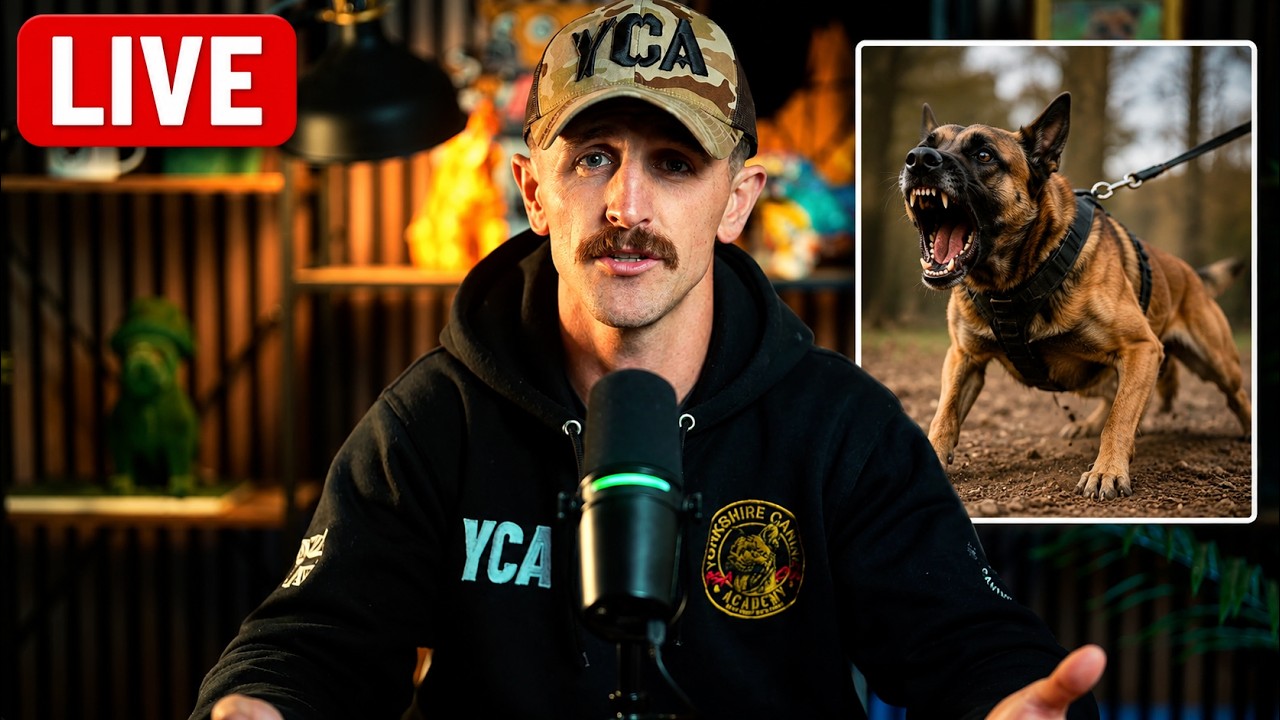
Adam from Perth K9 Academy answers questions from dog owners about reactivity, leash pulling, and resource guarding. He says most behavioural problems come from lack of exercise and mental stimulation, and recommends e-collars as tactile feedback paired with reward markers. The Academy offers 5-day boot camps, an 8-week online program, and free resources like the Behaviour Bible.
Chapters
Okay everyone, welcome! Good to see you all. Drop me a, um, a message in the chat box. Let me know where you're from. Let me know what struggle— what you're struggling with with your dog. Let me know where you're from in the world, what kind of breed you have, what age you have. Drop it in the chat, let's find out. And we're going to get to answering questions very soon. Just want to find out more about you and your situation. If you don't know me, my name is Adam. I'm the owner of the Perth K9 Academy, not the Yorkshire K9 Academy. I'm actually here in our facility in Perth, Western Australia, um, and just here to answer any questions that you might have. So Don't be shy, drop your messages, um, in the chat, and I want to know more about you, your dog, what problems you've got, and let's go from there. Let's hear it. We've got 7 people in with us so far, that's good. But don't be shy, jump in that chat box, let me know what your issues are, where you're from, what breed dog you have, um, and that way I can help you with any issues that you're struggling with. This is basically going to be a big Q&A, an opportunity for you to find out more about why your dog might be behaving the way that they're behaving. Um, are they doing it because they need training? Are they doing it because there might be some genetic stuff there as well? Just here to answer all the questions that you might have. A little bit more about what we do here. We do the same as the Yorkshire Canine Academy and also the South Coast Canine, but we run boot camps and we run an 8-week training program, and we just help reactive dogs all around the world and here in Perth. Um, I just want to find out more about you. No messages in the chat yet, but that's okay. We'll just wait around and see who else is going to pop in. We're really going to get started in around, around 4 minutes. Let's give people 5 minutes to jump in. Um, maybe finish up their dinner, finish up with work, and we can jump into all of our question and answer time. But for now, drop me a message in the chat and let me know exactly where you're from, what type of dog you have, and also, also what issues you might be facing as well. Like I said, guys, don't be shy. I'm here for an hour to answer any of your questions, anything that you might be struggling with. So feel free to drop a message in the chat. Here we go, we've got Lindsay Dover, 131. My GSD loses his head at people, cats, and some dogs. I'm in the UK. Lindsay, tell me a little bit more about your German Shepherd. And generally what's happening. Have you tried training before? Um, how are you just struggling because you don't know what to do? Have you been given the wrong advice before? Give me a bit of an idea. How old is your German Shepherd? Um, and what exactly do they do? We deal with lots of German Shepherds here. Um, it's one of our main dogs that we see. German Shepherds and Dachshunds are our common, common customers, we should say. And they all have very similar problems. We usually believe that— we do believe that a lot of behavioral issues in the dogs that we see, it stems from a lack of fulfillment. So a lack of ability for the dog to really, uh, fulfill their needs through exercise, play, being off the leash, um, and also clear communication as well. But drop me a quick message and just let me know what exactly you're dealing with, and that way I can give you some real feedback and some stuff to go away with. We do have multiple locations in the UK, uh, Lindsay. We have, uh, the Academy, um, obviously in Yorkshire, and we have the South Coast K9 down south. There's a brand new facility as well that's helping people all across country. So, um, lots of opportunities for you to get help with your reactive dog. But more, Lindsay, about why your German Shepherd may be acting that way. Anybody else, don't be shy, jump in the message box. I want to hear about the current issues that you're facing, whether that's you have a reactive dog, your dog pulls you, they don't come back, um, any issues that you're struggling with, drop it in the comments and give me a bit of an idea about what you're going through so I can actually help you with those issues. We're here for as long as you need to answer any questions uh, that you might have. So don't be shy, free training, right? An opportunity, um, to get the help that you want. And all you've got to do is drop that message in the chat. Like I said, we run boot camps and we run an 8-week program, um, here at the Perth K9 Academy. And basically what we do over that time, um, is we rehabilitate problematic and reactive or aggressive dogs and get them back to just living, uh, the life that they want, or what the owners want, should I say. Through being off the leash, being able to go back into public places. No more pulling, no more reacting, and just taking them to the cafe, going to the cafe and having a coffee with your dog. How nice is that? A lot of people can't do that because they've got a reactive dog, and but we give them the ability to do that again through the training. And like I said to, uh, Lindsay earlier when she dropped that initial comment in the chat, we, we believe that a lot of the behavior issues stem from a lack of fulfillment in our dogs, especially our working dogs like our, our German Shepherd. Um, so having the— a big emphasis on getting that dog off the leash reliably through having something like the e-collar there to back you up, and playing with your dog is going to have a massive benefit on their behalf, or massive improvement in their behavior. And then if you have the ability to communicate properly through telling them what's right and what's wrong, it's really going to change your life forever to be able to have that with your dog. Like I said, guys, don't, don't be shy. Jump in on the comments. Let me know exactly what you're going through with your dog. Are you dealing with a reactive dog? Are you dealing with an aggressive dog? Um, can you— have you never had your dog off the leash? Have you only ever had your dog on the leash in public places? Tell me what's happening, what you're struggling with, and that way I can help you. Lindsay, tell me a little bit more about your German Shepherd. Why does it lose its head? What does it do, um, when it sees people's cats and dogs? And that way I can give you some, some real feedback and help you with your, with your dog. We've had lots and lots of German Shepherds, uh, come through our center recently, uh, A good example of that would be a dog called Eileen. And this, um, this owner got the German Shepherd, got Eileen to be a support dog. She's a veteran, suffers with PTSD, and got her as a support dog. But there was no, no help from the breeder of what this dog may be like and the kind of training that it may need. And Eileen was just running this owner wild, right? Not being able to communicate with Eileen about what's expected, what's right, what's wrong. She didn't really have the knowledge to be able to effectively give that dog the outlet that it needs. So it was just ruining her life. It was barking, lunging at people and dogs. It was completely restless in the house, destroying all of her furniture, and it was trying to nip the kids. Not very, very aggressive, but, you know, it was mouthing, and these are small children. All these issues came from a lack of knowledge, but also it wasn't a hard fix when we gave the owner the right tools, right? The, the ability to communicate with her dog, to say, hey, this is the right thing to do, please do this. This is the wrong thing to do, don't do this. But then also giving the dog an outlet for its, for its drive, being off the leash and having the ability to play. If you've just arrived, guys, we're running a free live chat, so don't be afraid to drop your messages. Um, in the chat box. Tell me exactly what's, what's going on, what you're struggling with, and we can go from there. If it's reactivity, if it's aggression, uh, tell me exactly what you're going through. We have two facilities in the UK. We have one in Yorkshire, we have one down south, South Coast K9, and we also have one right here in Perth, Western Australia. We train dogs from all across the world, from the United States, Europe, the UK, Asia, um, South Africa. We've got clients, we've got hundreds of clients in Australia, if not more. And we do this not only through our boot camps but also through our online and in-person training programs. Lindsay, he is good at basic commands but pulls a lot on walks. Didn't have great experience at the vets. He nearly fed off the scales and vet grabbed him. Okay, all right, so putting on the leash, not very good at the vets. So with the vets, Lindsay, this is going to be something that you might need to, um, desensitize over time, right? Get your dog used to the vets, create a very positive experience. If your vet if the experience of your vet has only ever been your dog being in pain, receiving injections, um, for some dogs this can be quite a scary experience. You might need to go through some counter-conditioning processes with the dog to make them feel better about the vets. Also, when it comes to walking on the leash, and we're going to need to find something that motivates your dog to stay in the right position, but then also give your dog feedback that dragging mum down the street isn't always the best thing to do because mum gets a sore arm, right? Um, so you might want to switch over to something like a prong collar, a slip collar, to be able to give your dog, um, some feedback for dragging you down the road, but also having a highly food-motivated dog with a good reward marker, a word which is associated with food, um, to say, hey, that behavior is really good, walk by my side, but also don't pull me. If you are going to use equipment like this, please make sure you reach out to somebody, a trainer just like us who can help you with this. I've got a 10-month-old German Shepherd. 10-month-old German Shepherd, young fella. H1, what are you dealing with, young fella? Tell me about your 10-month-old German Shepherd. Another GSD owner here in the UK. My Ghostie is almost 18 months old. He's a really good dog, but he does have this thing where he hates having a collar put on him. My hands get chewed putting a prong on. Um, nameless city, nameless city, tell me more about that. Um, how much training have you done in regards to, um, his behavior? What experience does your dog have with the prong collar? Is this any collar? Um, is this a— if you put a harness on, if you put a flat collar on, or is it just a prong collar? Tell me more about your training experience as well. If you've only just joined, everyone, my name is Adam. I run the Perth K9 Academy here in Western Australia. What we're doing tonight is we're basically just answering any questions that you might have in regards to your dog's problematic behavior, whether that's recall, uh, leash pulling, reactivity, aggression. Um, tell me about what you're struggling with your dog, and that way I can point you in the right direction and tell you the best things to do to improve your dog's behavior. Lindsay, the last time he went, they gave him tablets before we had to pin him to the wall, and then granddaughter held his front paws to give him the vaccine. Um, Lindsay, so I'd like to know a little bit more about away from the vets as well, and what kind of, um, dog you have, why they're being reactive. Maybe tell me a little bit more about how often you walk the dog, what you do with your dog on a daily basis. But in regards to the vets, yeah, it does sound like you have a bit of a tough scenario there. Your dog doesn't have a good association with the vets, um, and it's probably only going to get worse, if I'm being honest, if you're taking them in there and physically pinning them down to the floor. So some vet handling skills is going to be very important, being able to touch a dog in certain places, reward them for that, for holding on to certain, um, body parts. Maybe you grabbing their paw, holding for a second, letting go of the paw, rewarding them, 2 seconds, rewarding them, touching different body parts, lifting their legs up, grabbing them from behind All stuff which we're just getting our dogs used to, which is going to prep them for going to the vet. If you have the time as well, making sure that we can also attend the vets when they're not going for an appointment and just going in there. Maybe you want to play with our dogs outside of the vets, pay them with food inside, and just trying to create a positive experience with going to the vets instead of being in pain and being pinned to the floor. Wonderland, Belgium Malinois owner here. Any tips on training recall? Yes, absolutely. So when it comes to our recall training, we want to be able to find something which motivates our dogs. So the thing that we go to straight away is using our dog's food. So taking our dog's daily food allowance and not feeding that from the bowl, but feeding them from a treat pouch instead. Once we've got a dog food motivated, we're going to teach them a reward marker. So a word that means they've done the right thing. We use the word yes. We're going to chuck them on a long line or a retractable leash, and we're going to use our recall command— excuse me— use our recall command. And once they turn around, we're going to say yes. If they don't turn around, we're going to tap them on the leash until they do, and then say yes and give them some food. So we're giving them a little bit of obligation. They're out on a long line, they're on a retractable leash, and we're saying to the dog, when you hear your recall, you have to turn around. Otherwise, I'm just going to tap you on your collar until you turn around, and then I'm going to give you food anyway. This is only going to get you so far, especially with your dog, Wonderland. What you'll want to probably look into is training your dog with an e-collar, finding somebody who can give you the right training and not using this tool wrong to liberate your dog and give them the most freedom, that they can have. You know, there's lots of people out there, lots of different conflicting opinions, but we've never found anything which gives the dogs as much freedom, reliability, and to really liberate our dogs as much as an e-collar. We run multiple training programs to put you through this, whether that's in person, online, whatever you need. We can actually do this for you, so don't be afraid to reach out. By the way, everyone, if you would like to know more about our services just generally boot camps, um, how you can e-collar train your dog. In the description below, there should be a few links there. Find out some more about us, getting in contact with me if you're from Australia, getting in contact with the English boys, um, if you want to do some training there in Yorkshire or down south. Yeah, it's any collar or harness. It seems that his default response is something that he doesn't like, is to use his mouth. He lets me stroke his neck, no problem. I think it's maybe an excitement thing. Um, so yes, possibly it could be overarousal. So trying to get our dog's used to having their collars on. Maybe every single time you bring your prong collar out, your dog gets so excited because they go, oh my God, prong collar's out, I'm gonna go for a walk. So instead of that, we might want to be presenting and getting our prong collar out at random times and just putting it back away. Also, the same as the vets, maybe your dog just generally doesn't like having this area touched, okay? Um, so in regards to that, we might want to be able to do the same as the vets and counter-condition and make them feel better about having their necks their neck touched. But also sometimes if it's you having to go for a walk and generally exercise your dog and they're biting you and end up hurting you, we might need to go through some kind of punishment process of your dog to just simply teach them that they can't bite Mum's hand, they can't just bite me all the time. He doesn't like people coming into my house other than who he knows. I walk late or very early to avoid, so my fault really. He's always on alert. So Lindsay, like, like I said, um, at the start, when it comes to our German Shepherds, we find that a lot of the time their, um, their erratic, defensive, problematic behavior often comes from a lack of having something fun to do. They become self-employed because they don't have a fun job. So we want to be able to give our dogs something fun to do. I want to be able to say, hey, you know how you like being a bit crazy and you like being up here? Well, I'm gonna let you do that, but we're gonna do it through tug. We're gonna play a really fun game. I'm gonna get you exercise every day through getting you off the leash, and then I've ticked your boxes. Sorry, I've ticked your boxes. I've scratched your back. So now you have to scratch mine. You can't be barking at my guests. You can't be trying to lunge and bark at dogs. And to do that, we can create clear communication, um, through training, through teaching a yes marker, through teaching a reward system. But then also— and don't get scared of this word, becomes a bit of a yucky word sometimes in dog training— and that's through teaching punishment as well. So taking some things off the table for your dog and saying, unfortunately, you actually can't lunge or bark and bite, um, that person. Who else have we got? We've got Down South. Yeah, Lindsay Dover, I need to go to work now, I came across you a bit late. No worries, Lindsay, have a great day. If you need any help with anything, please, um, don't be afraid to reach out. Wonderland, I'm from Australia, can I still do some training? Absolutely you can. That's where I am, Wonderland. I'm here in Western Australia and I have clients from all over Australia, from Sydney, uh, we have clients in Adelaide, Darwin, and they all do the training with me and we get dogs non-reactive, good off the leash, good on the leash, and dogs that you can take to the cafe and the pub. It's actually in the description below of this video. You can click and find out more about how to train with us to get that dream dog that you want. So, uh, one of my dogs got accidentally hurt, scared by tugging the toy. Connected that with me and is no longer playing with me with a toy. He just keeps jumping up when I try to initiate play, new toy. Stella, uh, I would love for you to reword that for me. Um, tell me what your issues are again and what you'd like to achieve. I believe that you're just saying that your dog is now scared of, um, playing with you. Um, so when it comes to our play, this is some things that a lot of people can get wrong in the way that they're doing, um, this with their dog and the way they're also playing with their dog, because it can be quite confronting in the way that people try to play with their dog. There's lots of pressure, they're standing over their dog, pushing the tug in the dog's face, and all this can be not very nice for some dogs. They're not very interested. What I'd like you to do is contact us. We even have a free course called the Behavior Bible. This is for everyone as well. It's a completely free course, it's online, the Behavior Bible, and you can find out so much about basic training. But one thing for you, Sella, is this will teach you a very good way of being able to play. And if you already have some fundamentals, maybe just reach out to us and we can give you a bit more of an in-depth process of how to get your dog confident again, get them enjoying playing, also that you can play in the right way. Uh, Nameless City, thanks Adam, that's something to think about. Thanks for doing this Q&A, it's so valuable. Anytime, like I said, I'm here to answer any questions that you might have. Aggression, general reactivity, leash pulling, e-collars, um, recall with your dog, house manners, whatever you like. I'm here to answer your questions. Young fella, my GSD resource guards my Resource Guard's my cat, how can I stop this? I think young fella's having a joke. Awesome, I'm in Brisbane, Wonderland. Fantastic. Um, if you're in Brizzy, we can absolutely help you. I've got, I think, 4 clients of mine at the moment all with reactive dogs in Brisbane. So we've got lots of people there who we help on a regular basis. Um, so how about jumping in the description maybe fill out a form, get in contact with me, um, and I'll be able to help you and guide you in the right direction. Especially because, where, uh, yeah, you have your Mali, right? It's a hard dog to train sometimes, especially if you haven't got the right foundations. Um, so let me help you. Jump onto the form, contact me, and I can guide you in the right direction in regards to how to really set your dog up for success, especially with your recall. My Aussie Shepherd loves dogs too much. How do I make him a bit more neutral? Um, SM, let's call you SM2. So this is— your dog is just a bit hypersocial. It sounds like you probably— I would like to know a bit more in detail about the problems that you're facing, but it just sounds like you're lacking a little bit of control. Um, is this on the leash? Is this off the leash? Give me a bit more information about where you're struggling with your dog. And where you're struggling with not being able to achieve neutrality. Is it off the leash? Is it on the leash? Is it incessant barking and frustration at your window? Um, tell me more about where specifically you're struggling with your Aussie Shepherd, and that way I can really give you some feedback in regards to how you can specifically help that issue. Um, I was just going to go back to this person might not be joking, so I wanted to go back to their comment. My GSD resource guards my cat. How can I stop this? I don't think they're resource guarding your cat, young fella. It might seem that you have some other issues there. Usually resource guarding is not the— is the source of many other issues that you're dealing with. So it's stemming from something else. So it might not be how we're directly going to attack that. But it might be what else you're doing in your spare time with your dog. So give me a bit of an idea about what you do on a day-to-day basis with your dog, and that way I can give you some better feedback on about how to approach that. Sela, thanks, I learned a lot from Behaviour Bible and the Play Blueprint. Always good. He was playing enthusiastically before he got hurt by the toy. How was he hurt by the toy, Sela? Give me a bit of an idea about what you mean by that. And it might be that you need to possibly, if he has a negative association with that, once again, maybe a little bit of counter conditioning, changing the toy or changing the way that you play. Seven Side K9, keep smashing it over the pond, PCA team. Thank you, mate. Appreciate that. It's nice to hear from you. If you've only just jumped in the chat, guys, we are here answering any questions that you might have. If you don't know me, my name is Adam. I'm the owner and head trainer of the Perth K9 Academy here in Western Australia. But it's not just here in Western Australia that we help people. We help people all around the world, primarily who are struggling with reactive and aggressive dogs, but not just that, also problematic dogs, right? Dogs who are causing you lots of stress in your house, dragging you down the street, not coming back to you when you call them, digging holes in your back garden. All these things we can also help you with. So drop me a comment. Let me know what you're struggling with. What are your pain points? Where do you beat your head against the wall going, for fuck's sake, I wish my dog didn't do this? Let me know so I can help you. A few Australians here. 2 from Brizzy, 1 from Adelaide. Roxy Wright, do you have anyone— do you have anyone in Tasmania? Uh, Roxy, unfortunately I don't know any trainers in Tasmania, um, but I have lots of clients in Tasmania. Um, I actually just got off the call about half an hour ago with one of my clients who finished up our online program for reactivity. It's called Training with Instinct, um, and she had 2 reactive dogs dogs who were never off the leash, and now they're non-reactive and completely off the leash. And we're having a bit of a chat about literally how it's changed her life and how grateful she is. So maybe if you are— well, you are in Tassie, and it sounds like you're struggling because you're trying to reach out to a trainer. Tell me more about the issues that you're struggling with, and I might be able to help you myself, um, either through this chat and give you some advice, or just actually help you, whether that's through our online course um, or however you need. So tell me a bit more, Roxy, what are you struggling with, um, with your dog? Wonderland, tell me a little bit more about the issues that you're facing with your dog. Obviously you've got your Mali and you're struggling with recall. Is that the only thing that you're struggling with, or is there anything else? You didn't have any reactivity, any leash pulling? Um, tell me a bit more about what's going on. Like I said, everyone, if you don't know like exactly what we typically offer in person, and what we do is we run boot camps. We run 5-day boot camps. That's in the UK at 2 locations, here in Perth, Western Australia. And we literally transform dogs in 5 days with— that's reactivity, aggression, recall, taking them to public places. And we also do that over an 8-week course for people all around the world. Tugging on a— Stella said that she's— her dog got hurt when it was tugging on a string, flung around, and somehow hit him. He yelped and he didn't want to play anymore. I changed the toy, but he connects it with me. I think you're— I think I might be misunderstanding that question, that he either— the toy connects with you or he is connecting the toy with you. Um, Sella, I would love for you to follow us on, on social media at the Perth K9 Academy, um, and I would like you to just send me a direct message, um, and this way I actually want to see some videos of you trying to play with your dog. So feel free, jump onto social media, the Perth K9 Academy, follow, give me a message, and I want you to send me a few videos of you trying to play with your dog because I want to see exactly where you might be going wrong, because there's so many different ways that we could try and fix this for you that we might be going back and forth for hours through Messenger. So send me, send me a few videos and I'll just get back to you and let you know where you're going wrong or where you might be going right as well. Any tips for in— or nameless city— any tips for indoor mental stimulation during the heat wave here in the UK? I'm currently playing tug and hide and treats, but my dog is bouncing off the walls and be— and not being able to walk him right now. Um, yep. So, name the city I live in. Probably one of the hottest places in the world here in Western Australia. We hit like 45, 44, 45 degrees, um, here in the summer. So I feel your pain. I know how hard it can be. What we do here in Perth is we walk really early in the morning and we walk late at night. So I know this might be hard, um, but I want you to get up earlier. I want you to, if you can, if it's possible, get up early and walk your dog, even if that's 5:00 AM, 4:00 AM, whatever it is. I do that with my dogs here in Perth. I get up about 4 o'clock in the morning and I walk my dogs before it gets too hot. Additionally to that, you're on the right track. You're playing with your dogs. I would just maybe, I don't know if you have already, if you've already downloaded the Behaviour Bible and looked at the way that we play with dogs, maybe changing the way that you play to get a little bit more from your dog, asking for obedience during play, um, upping the intensity in the way that you may play with your dog, um, to make them more tired. And then also, I would want to know how much your dog has done nothing before. Does that make sense? Because sometimes we need to teach our dogs the art of doing nothing. Not a lot of dogs understand how to just chill out, so you might also want to work on some tethering. To be able to just say, hey, sometimes you can't run around. I'm just going to tie you to a sturdy post in the house with your leash on, and you might cry for a little bit and you might whine for a little bit, but eventually you're going to realize, um, that you need to go to sleep. With doing tethering and crate training and getting your dog to relax, we do need to make sure that first, when teaching them to do that, we need to give them an outlet before. So like I said, scratching their back, ticking their boxes, so we can say, hey, actually now you do need to relax because I've already done some stuff with you. So although we want to give them an outlet— free play, scatter feeding, hiding food like you were doing, um, getting up earlier, getting out of bed earlier and walking your dog— we also want to teach them the art of doing nothing. I hope that makes sense. Another question: my dog is 7 years old, is that too old to train? He's pretty reactive with people but loves dogs too much. No, it is not too old to train. We have dogs of all ages, up to 12, 13 years old, which come through our programs. Um, the, the old saying, the wise tale, um, is that you can't teach an old dog new tricks. Load of shit. We can teach our dogs up to any age, okay? So from a very young dog, we, we train dogs as young as 6 months old, um, all the way up to as old as they get, 15, 16. We've had some Blue Heelers come through that were 14 years old. Um, so your dog's not too old. We just need to make sure we've got some good communication with them that they understand what we're asking from them. Wonderland, he's a 6-month— ah, the young little pup! He's a 6-month-old Belgian male, actually really good at training and loves new jobs. I think his problem— I think his problems at the moment are house manners, jumping on tables, super social, loves everyone. That's awesome, man. It's awesome that you've done so well with, um, keeping him nice and social, um, and that he's so keen on training. Um, when it comes to your recall, you're at an age where you could, if you find somebody who knows how to do it, help you condition an e-collar to get that recall where you want it to be. And then when it comes to your house manners, jumping up, counter surfing and stuff like that, we want to be able to use management to a degree sometimes to not allow them to get reinforcement from doing those things, but then also going through punishment with them. So basically saying to the dog, hey, do you see that table? You can't jump on it ever. And giving— taking that off the table for them, quite literally taking it off and saying, no, you can't do that stuff anymore, but you can do anything else. And that's like a lot of things, everyone. A good thing to remember, don't think of punishment as this nasty word. Don't think of it as a yucky word that we need to be scared of. It just means to decrease something happening, right, to stop something happening in the future. So all we need to do is think, if I don't want my dog to do something— this isn't all the time— but if I don't want my dog to do something, I might go through punishment to say to them, hey, I don't want you doing those things. The exact same as if you want your dog to do things, you're going to try and find a way to reward them, use reinforcement, right? So house manners, and we want to be able to say Sometimes I have to manage you when I can't attend and watch you do all those things. Maybe I'm making dinner, maybe I'm busy. But when I do give you free rein, I see you make those mistakes. I'm gonna give you, um, very clear feedback based on those mistakes. I hope that makes sense. I didn't jibber jabber too much. Turan, lots of lead frustration over here. For 4-year-old male intact German Shepherd who's in training with me for Urban search and rescue, help please. Okay, so I would like to know, Turan, more about what you do with your dog, um, on a daily basis. Lots of lead frustration there. Why is he frustrated? Tell me a little bit more about what's happening in your day-to-day life with your dog. Obviously you are committed, you're doing urban search and rescue, fantastic. You can see you're such a committed owner, but what are you doing with them on a daily basis? You've got, um, an intact German Shepherd, possibly a working line, like actual working line, um, dog instead of a show line Shepherd, who can be a little bit more challenging. So tell me what you do. Oh, oh, beneath. Yeah, our work together for search and rescue is amazing. It's the normal dog things we struggle with. Yeah, tell me more, Saram. Tell me more. Stella, thank you. No worries, anytime. Roxy Wright, you have an 8-month-old show line German Shepherd now reactive to literally everything. He is my third— 13th. He's at your 13th German Shepherd. How old are you, Rox? Sorry, that sounds quite rude, but how old are you, Roxy, to have 13 German Shepherds? Um, he's my 13th German Shepherd, but my first show line. I'm going through cancer treatment at the moment, so I'm non-verbal. It makes it hard to have a call. Okay, Roxy, well, I'm very sorry to hear about, um, what you're going through at the moment, especially when you are struggling with your dog. Um, So with your dog, we need to try and, like we said earlier, make sure that we're ticking your dog's boxes. Okay, what I mean by that is trying to find out what your dog needs per day. What do you feel like that your dog enjoys? We're having a German Shepherd, I can almost guarantee you, we train so many of them, they want to play tug and they want to be off the leash every single day. If you can tick those two boxes, which can be done in a very short amount of time, then we can start to hold your dog accountable for bad behavior. Okay, a lot of people overcomplicate dog training. I don't want to make it sound super simple, but it is quite simple, right? We want to be able to say to our dogs, I'm going to give you the best life ever, I'm going to take you out every day, I'm going to get you off the leash, I'm going to play with you, and then I need you to scratch my back because I've scratched yours. You can't be being a knobhead all the time. You can't be lunging at the dog lunging at the person, lunging at the car, that's not good and it's also dangerous. So I need to be able to say to you in a fair and consistent way, that's bloody unacceptable. And also when they make the good decisions to say, that's amazing, well done. So as well as fulfilment, we need a clear communication system, a good yes and a good no. And those 4 things, 3, 4 things will literally change your life. And if you don't know how to do that, reach out to us and I can help you because not many people know how to do it properly. Nameless City, he's got a decent place command and we enforce rest with a crate, but yeah, I guess I need to lose some more sleep to get him out early. Yes, I would definitely recommend getting him out before the heat hits, um, and he has a decent place command, we enforce rest with a crate. Yeah, great, then That's all I recommend to continue to do and see how you go. Get him out early, get him out for a good 20 minutes, half an hour, let him run around like a maniac, play with him once a day, and then you've scratched his back. So now you can teach him the art of doing nothing, I call it, the ability to just relax. Turam, lots of— wait, uh, here we are— lots of sniffaries and balance with off-lead time at night after we do our training sessions. I've been introducing some more tug and play, but I think he's not in tune with the windows opportunity. Okay, great. So, uh, when it comes to your Turam, let me just go and make sure that we are— yeah, lots of lead frustration over here. When you say lead frustration, are we talking about he's just a bit antsy and pulling on the leash, or is he being reactive? Um, when it comes to your last, uh, not a question but your last statement in regards to his windows of opportunity. This goes into Young Fella's question. Can you talk a bit more about how to build play motivation? So with your dog, Teram, I want to think about— well, I want you to think about, dependent on how much, um, on-leash time you're giving him, it might not be the right avenue to go down with him. Focus on your off-leash work, but then also I want you to possibly create a little bit of motivation through deprivation. I hope this makes sense. And this goes straight into Young Fella's, um, question about how to build play motivation, because nearly every reactive dog owner I speak to says to me, Adam, my dog doesn't play. And I say, bullshit, they do play. They just— they will play. They just have a better hobby at the moment. Because they're getting a very high level of arousal through being stupid and being reactive. So what we want to do is sometimes cultivate motivation through deprivation. A big way of saying, don't take your dog out for a leash walk, keep them inside, and say to them, hey, here's a window of opportunity for you. Open the window. Would you like to play? And they go, Not really. And you go, okay, no worries. And then we close that window. The opportunity is now finished. So we move on to our next day and the dog goes, God, that was a bit boring yesterday. Didn't get to do much. But then we come back again and we go, window open. Hey, do you want to play? I'll play a little bit. They have a little bit of time and they check out and we close the window. By only allowing our dogs a certain outlet at certain times, we create a little bit of boredom, which in turn builds motivation to then have a better hobby instead of being reactive. So this is a short way of saying sometimes if you're walking your dog and they're being reactive, we want to stop them doing that. The leash walk around the neighborhood is not going to give your dog any level or means of fulfillment, so stop doing it. Get your dog off the leash and play with them. And sometimes we might want to use deprivation, so stopping our dogs having that kind of, that certain outlet being reactive and walking on the leash and keeping them in the home and offering to play with them once or twice a day through the windows of opportunity. Whilst I'm trying to build my tug drive, should I stop playing fetch with the ball, which he's crazy for? Do— will your dog chase— sorry, should I say, will your dog play with a ball on the string? Trinity Kirkman. So when you're throwing the ball for them, will they play with the ball on the string or will they chase the ball on the string? Because we can incorporate a little bit of fetch and tug into that ball or that game that you're currently playing if they like it. But if they don't like the ball on the string, then just like what I said, we might need to stop doing that with them to create a little bit of boredom, to then give them the opportunity to play. And it won't take very long, especially, um, in your German Shepherd until they start playing. My dog is social when meeting normal dogs. When he gets jumped or aggressively barked at by hostile, hostile dogs or reactive dog, he even cowers or isn't sure how to respond and whines. So give me a little bit more of, um, an example of when this happens. K. Beng, is this on the leash? Is this off the leash? I imagine it will be on the leash because your dog doesn't have the ability to escape. If your dog isn't very confident and they're getting barked at and run up on, um, by another dog, they don't have the ability to run away, right? And we're keeping them on a short leash. Depending on the dog, that's either going to have a fight response or a flight response, or even they're going to freeze, right? Fight, flight, or freeze. Even us as human beings, if we get backed into a corner, then a lot of us are going to fight. Sometimes people try and run away, but some people will freeze. And that's what often dogs will do. They're too scared to fight, they can't fly because they're on a leash, so they sit there and freeze. They don't know what to do. So tell me a little bit more about where your dog is doing this. I'm just reading comments, sorry. Taram, so just to confirm, scratch the lead walking and play with him next while to build that motivation of, oh shit, this doesn't come out. Yes, absolutely, absolutely, Taram. What we want to do is we want to hide all the toys, have a toy box that he doesn't know where it is. Before we bring that toy out of our pocket, we're going to have a consistent word. I use the words, are you ready? 'Are you ready?' And the dog goes, 'What the hell is happening?' 'Are you ready? Are you ready? Are you ready?' And then all of a sudden I pull out a toy. 'Oh God, we're playing that game!' I play with them, I stop before they get bored, then I say, 'Finished.' This on a consistent basis, the dog will understand, when I hear 'Are you ready?' that's my opportunity to be crazy. That's my opportunity to have the best time ever. And I love having the best time ever because I can't go and bark at dogs anymore. More. And then when mum says finished, oh shit, I've got to behave now and I can't have that level of arousal. Um, so it teaches us to communicate with our dogs at a higher state of arousal when we're playing, which can also translate to reactivity as well. Nameless City Apparel: I'd love to get my GSD off the leash, but he's excited He's excitably reactive. Trainers around here are all positive only, and I'm too far to do the boot camp at YCA. Is it possible to e-collar train my own dog? Whereabouts are you? Name the city. Where are you? Are you in the UK? If you are, whereabouts are you in the UK? And there's two facilities there. Um, but if not, we can help you do this through our online training course. We have an 8-week training program, everyone. It's called Training with Instinct, and we literally transform dogs from all across the world. Um, from America, within Europe, the UK, South Africa, Australia. Um, I can't— there's so many places, that's just off the top of my head, that there are people there changing their dog's lives. Um, aggression, reactivity, e-collar training, the lot. So if you need help, everyone, jump into the description. There's going to be a way that you can contact us and find out more about how we can help you. Uh, Taram, yes, we have a word for that. So completely cut off all access to reinforcement— toys, sticks, outside of the window. Yes, do that. K-Bang on the lead, he's very obedient, so normally when he's unsure, he investigates. He's really curious when dogs are behind the fence. He won't back away and often call— and can often call off bluffs. So K-Bang, just to confirm, your dog is a little bit nervous on the leash. Is this right? They're, they're not— it's not reactive, um, it can just be, um, it can be very subdued and nervous when it gets barked at by other dogs. Is this right? And if it is right, there's a few things we could say there. But also, like I say to everyone all the time, unless you're just using your leash Um, you should be using your leash to get from A to B. Um, think of it as a means of transportation but not a way to exercise your dog. I haven't walked my dogs on a leash in literally— I'm not joking, I promise you when I say this— years. I haven't got my dogs on the leash in years because they get nothing out of it. I have a bully mix and I have a German Shepherd, and I hate walking on the leash. So do they. So do they. So I take them off the leash every day and I play with them., and just use your leash as a means of transportation to get into places. Uh, you're in the UK, you're in Essex. Okay, um, you wouldn't be too far from, uh, the UK South location, but just jump into the description, just reach out to us and see how we can help you, mate, because, um, if you're looking for those problems to be fixed, it's going to be— we can definitely help you with that. Next question: what are your thoughts on the out during play? My guy's possessive and loves to be the only one to have his toy, loves the fight and loves the big parade at the end. Do I let him self-out the toy or do I take it from him at the start of the game? So, Teran, will, will he out for you? If your dog loves, loves playing and has a lot of drive for it and it's even creating a little bit of conflict now You definitely need to be able to, when you say let go, for him to be able to let go. Once again, it's the same thing about reactivity, right? We need to be able to communicate about dogs at a high level of arousal. Yes, he will out the toy. Okay, great. Yeah, then let him get him to out the toy whenever you'd like to. Um, I like to pay dogs the, the toys. I have to pay the toys straight back to the dog after play initially when out in them. Then after that, you could ask for a little bit of obedience. Still let him parade it around like you said. Let him win. He thinks he's big and strong. He runs around. He's really proud of himself. Brings it back to you. Have another play. Ask him to out. Let him do some obedience. Reward him again. Have fun with it. It's great that you have such a good connection with your dog. Um, and like I said, if you need any help, just jump into the, into the, uh, the box below. Um, we can help you even with any in-person or online training. Once again, guys, if you don't know what I'm doing, you don't know why I'm here, I'm doing a live Q&A for you guys to be able to answer any questions that you have for reactivity, aggression, e-collars, recall, houseman, you name it. I want to be able to help you with the questions that you have. So drop it in the chat box and let me know what you're struggling with. Billy Chapman, been training with my 2-year-old Doberman for 7 months, coming on great, recalls going well. Off the leash other day and goes and attacks dog. Gutted. Okay, um, Billy, I don't want to sound like a dick here, but your recall, um, probably isn't going very well if he blew off your recall to go and attack another dog. Um, this is definitely an issue, right? We don't want him going and attacking another dog. It seems like maybe you lack a little bit of control. Um, no fault of your own, it seems like you've been putting the work in, right? But it just might not be the right training, um, the right train— style of training that you're doing, um, to lack that control— because you lack that control, should I say. Um, and also not allowing him to meet every other dog if you don't have the ability to control him yet. A few foundational things that you're going to want to stop that is going to be a really stellar recall. So having him to be able to come back to you, turn on the dime, and also having clear communication with him to be able to say, hey, when you try and go and attack another dog, um, for you to be able to communicate with him that that's not okay. The same way as I'd want you to have a reward marker to say, hey, that's awesome. But in Chapman, I been on your 2-day course. What 2-day course have you been on, Billy? Uh, we don't have a 2-day course, but tell me more. Maybe you're talking about the kick— is this the Kickstarter? Is the Kickstarter program? Tell me more. I'd love to know what you've done with us, and that way I can guide you in the right direction. Uh, Taram, he's not super keen on bringing it back to me. There's definitely some conflict there. But he doesn't get shitty or anything if I take it from him either. Do you have any thoughts on a two-toy swap? So, Tram, what I want you to do is I want you to put a leash on him, um, and when you do let him win, let him parade it, but you've got him on the leash. Pull him back to you, continue to play with him, and keep it like that so he starts to realize that it's a two-way system. It's— I can't just go on my own and start chewing up the toy or keep it to myself. The game only happens when I bring it to Mum. Have a little bit of a parade, but bring it back to me. Um, where, where were you? Do I let him self out the toy? Yep, just— and the two toy swap, yeah, you can, but because he's outing well already you wouldn't need to do the toy swap. He already knows what to do. So when he does out, pay him for it and reward him straight away to encourage the out more. Um, and if he doesn't, you can use pressure. I don't know what kind of leash you have. Give him a penalty to say, hey, when Mom says let go, you need to let go. Um, Billy, I don't exactly know what you mean that you've been on a 2-day course up at Harrogate. Are you sure that's us? Long leash? Uh, nah, just like a 1.2, 1.2 meter leash. Keep it nice and short. You can use a long line if you want. Um, most of the time we just use a reasonably short leash, play tug with the dog. As I'm about to let them win, I'm going to grab hold of their leash Relinquish the toy, let them parade around, bring them back. I would love— Roxy Wright— I would love to do the TWI course but not sure of the cost, and also prong and e-collar banned in Tassie. Bear is long-haired, GST, so collar will be hidden. He plays with it. So Roxy, your— the e-collar is not banned in Tasmania. Um, you're not allowed prong collars, but the e-collar is definitely not banned in Tassie. You could have some amazing results from your training Um, in regards to getting started, like I said, just jump onto the description below, um, and just have a chat with us, see how we can help you. Maybe we can give you a few tips, maybe you could do the TWI course. Um, and remember, you're going to get fantastic results because what you currently, from your understanding, is actually wrong. Your e-collar is allowed in Tasmania, and you'll have a dog that has incredible recall and also great communication as well. Um, so reach out to us, go in the description, click the link, and I'll have a chat with you. We've got lots of clients in Tassie who are doing really, really, really well. Teran, this is great, thanks so much. No worries, feel free to ask any more questions, guys. I'm here for another like 10, just 5 to 7 minutes. Sorry about that. Like I said, I'm here to answer any questions that you might have in regards to any problems that you're facing— reactivity, aggression, leash manners, um, recall, understanding the e-collar. Maybe you guys don't understand when we talk about e-collars what they're used for, why we use them, how it can help you. Is this you, Matt? Put that in the box. Let me know if this is you and you don't understand it. And maybe I can help you with that as well. Like I said, guys, don't be shy. Drop some messages in the chat. No question is a stupid question, only if you ask it multiple times. I'm kidding. You can ask, answer any questions that you like. SM2 says, yes please. Yes please. What, uh, is that in regards to, um, explaining the e-collars? If it is, I'm just going to go ahead and believe that you want to know more about e-collars. So the primarily, the reason that we use e-collars is to liberate— more about tools. Yeah, let's talk about e-collars. So primary, the primary reason that we are going to be using e-collars here at Perth K9 Academy and across the Board, um, back in the UK, is going to be to liberate our dogs. We are massive believers that we live in a society of under-fulfilled dogs, but they're not being walked off the leash on a regular basis and having the exercise and the fulfillment which they need. So we need to be able to find a way to do that. Motivation in our dogs— building motivation is fantastic, but building a reward system is fantastic. But what if we're, to our dog, only ever worth, let's say, $100 or £100, wherever you're from? That's our level of motivation with our dogs, £100 or £100. We take them out for a walk, they see another dog, and that dog is only worth in their mind £50 or 50 bucks. Then when we call them back, they're going to turn back on a dime and come back to us because they find us more reinforcing and more— there's more rewards with us, more reinforcement from us. But what if you go out and you're here at your $100 mark, and then you go out, and if you're in Australia, let's use this as an example, you see a kangaroo, who more than likely for most dogs is worth $300, okay? Your dog is not turning around because the motivation or the reinforcement they get from chasing that kangaroo is going to outweigh the food, the toys, any cheese that you have to offer. And if you're not from Australia and you don't know this, kangaroos kill dogs on a regular basis over here, and it's very, very dangerous for them to chase kangaroos. Over in the UK, very strong laws about dogs chasing sheep and getting to livestock. Now we need a way— this could be in the UK, think of the sheep being worth £300. We need a way to be able to trump our dog's motivation when they see that thing. If it's £300, we need to be £600. And the only proven way to do this— there's a lot of bullshit out there, there's a lot of conflicting opinions— the only proven way to do this is through the use of an e-collar. Think of it not to control— it's not a way to restrict our dogs or control our dogs. It is to liberate our dogs. Dogs, to be able to say, you can go anywhere, you can do anything, because I trust you. Because we can use tactile communication, okay? Um, I spent some time in the Army. I'm also an ex-professional boxer, and I use this example a lot. When we are— have a high level of arousal in human beings and adrenaline's pumping, the hormones are going crazy, we can suffer the same as dogs and animals from audio exclusion. We can't hear things very well. So no matter how much we're able to use our voice and how much reinforcement that we have, what if our dogs genuinely can't hear us when they go into that high level of arousal? Okay, just like me when I was fighting, I'm in the ring, when the first few fights when I was younger, when I was a kid, can't hear anyone, can't see anything, I can only see my opponent. I cannot hear a thing because my adrenaline and my arousal is so high I can definitely feel getting punched in the face though, right? And I'm not referring to an e-collar as a punch in the face, but I'm referring to it as clear communication, tactile communication. When dogs can't hear us, they can feel us, and this is what can keep our dogs safe. I like to refer to e-collars as a seat belt, okay? I think I'm a pretty good driver, but I always wear my seat belt because I don't know when some dickhead is going to pull out on me and I have to put my brakes on. But when I do put my brakes on, my seat belt is there to keep me safe. I think my dogs, my own personal dogs, have stellar recall, fantastic recall. But one day something is going to be out of my control. They're going to want to chase something no matter how much training history that I have. And my e-collar is there just like my seat belt to keep me safe. Taram, laughing my ass off. Yes, chasing a kangaroo or a cat is worth a lotto for my boy. Exactly. And how can we be more valuable than that? I just got a second Malinois 3 days ago. You're a brave man. 2 Malis. I'm only getting my first one in September, so brave man. When the new dog— when the new dog have a toy and my older dog tries to play and take it. Other puppy barks and snaps. Why are you— I don't want to sound rude here, Aswan— why are you letting your young puppy play with your other, your other dog? It can be— that alone, especially in the breeds that you have, is— it could be a recipe for disaster. Just play with— hide your toys, put them in a box, play with dogs separately. With tug once a day and then go and get your dogs the exercise that they need. But don't create, uh, problems that be there by letting them share toys, share bones. It's not worth it. That makes perfect sense, thank you. No worries, it's, uh, we're all about education and trying to better your understanding. My older dog does not mind. My old— okay, you said that twice. Okay, they bite the same, but you just— so, Aswan, I don't want to sound like a knob here, okay? But I'm gonna be a bit direct with you. You just told me that your dog barks and snaps when the other puppy tries to take the toy— the dog tries to take the toy. But then you told me that your older dog doesn't mind, or your dogs don't mind, they bite the same sleeve at the same time. Stop doing this, Aswan. I'm going to give you my very firm opinion that this is the stupidest thing that you're going to do with your dogs. You have Belgian Malinois. Stop allowing animals who are highly possessive in nature and want to bite things to share toys, okay? That level of arousal and the desire to possess things is going to end horribly for you, Aswan. Stop doing this. Play with them separately. And find somebody who can guide you in the right direction. Okay, don't do this. If you need help, jump onto social media, follow me at Perth K9 Academy and message me directly and we can have an in-person chat, voice messages. I can guide you through the process, but stop doing this. Tarun, my dog has recently been diagnosed with panus. I sound very rude or uneducated with this. Maybe I don't know what this is. I'm going to Google this. Ah, okay. A progressive— panus. For everyone, I didn't know this, I'm not a vet. Um, panus is a progressive eye disease which eventually leads to blindness. My dog has recently been diagnosed with panus. We're training up with Rex Specs. Any idea of how to create a strong positive association with with them. He's super uncomfortable with them at the moment. Um, the same way that you would muzzle train Turam, um, very simply, you give the dog— you put— you place your Rex Specs in front of the dog, then you're gonna create a positive association by having a good marker system and food motivation. So good food motivation, having a reward marker, presenting the Rex Specs, marking, rewarding, paying the dog. And then maybe placing it closer to the dog, placing on the dog, rewarding. The same as muzzle training and just getting them used to it. It's nothing bad. We're just gonna do this as a training routine until the dog just goes, oh, these things are really cool because they always get rewarded. Um, I'm just going to have a very positive association with it because Mum rewards me for having it near me or on me. Common in— sorry, another question. It's all right, so I'm— it's good. Like I said, I love these Q&As. I could be here all night, but I won't be. Um, it's common in GSDs. Medication is working well and he should retain perfect vision if everything goes to plan. Well, that's amazing news, so I'm very happy for you. Listen guys, I'm going to be here for— let's go 2 more minutes, okay? Ask me questions. Okay, but my older dog is not possessive, he just wants to play with it. I've been training him for a year. And a half, food, toys, he doesn't care. It's to play with me that's important. I learned this in your channel. Aswan, play with your dogs separately. That is the answer to your question. You've asked me this, or you've directed the same thing at me a few times wanting a different answer of how to fix this. Don't play with your dog, don't let both of your Belgian Malinois bite the same sleeve. Okay, it's going to end badly. If it doesn't, I, I'll, I'll eat my words, right? But more than likely, it's not going to end well. Play them separately, um, and just get them off the leash together. Okay, this is a big question. I just said I'm about to finish up. Layla asks, I have a very fearful dog. Dog. What's the best way to help her? She's a 2-year-old British Bulldog. She is scared of everything. Um, tell me more. When is the best time to introduce another dog to the house? A puppy. I've just finished a boot camp a week ago. I hope we may have hope we may get a second dog. Zig Zigs, I would recommend going to— I'm not— I can give you the advice, but You've just finished it. Tell me where you just finished the bootcamp. Was it South or North? Yorkshire or down south? Because all you need to do is reach out to the crew at South Coast. South, okay. So reach out to Kelly and just ask her opinion. She's there to give you feedback and help you ask questions. Contact YCA, contact South Coast, contact myself. We're more than happy to help you and guide you in the right direction. But first, best off going and finding the people who know about your dog already and understand your dog and their problems, um, to give you that kind of guidance. I hope that was okay. I hope that made sense. I'm not going to give you advice when Kelly can give you the right advice. Okay everyone, I am going to head off. I hope this live has given you, um, the information, the help that you need. Remember, just remember, if you are struggling with your dog, okay, if you're struggling with your dog's behavior, they don't grow out of it. It's not true. It's a lie. What, what is reinforced— and that's pretty much what's happening with all of your dogs if they've got problematic issues— what is reinforced gets stronger. So if you need help, go into the description now, reach out to me on social media, or go into the links below. You can apply to work with us in person for our boot camps. You can— yeah, thank you, Zig Zigz. Go to a boot camp, people. Boot camps will change your fucking life. Excuse my language. It's 5 days, you have a brand new dog. If you want to jump on an 8-week program, if you're somewhere different around the world, we do that as well. But 2 things: you can even message me directly at the Perth K9 Academy and ask me any questions after this. I'm going to jump on my phone and continue answering questions on there. So all— everyone who's on the chat jump onto my Instagram, message me on there, and I'll continue to answer your questions. If not, jump into the description, book a call, do a boot camp, change your dog's life. Thanks for attending, everyone, and I will see you in the next one. Enjoy.
More from Jacob




I Wish Someone Told Me THIS When I Had a Reactive German Shepherd (Extreme Case Study)



Are you playing the wrong game with your dog? #dogtraining #dogtrainer #dogowner




Mabel's Incredible Reactive Dog Transformation #dogtraining #reactivedog #dogtransformation