Fix Your Dog's Reactivity FAST (5-Day Training Breakdown)
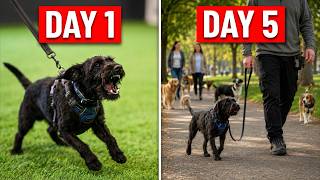
The video documents a five‑day intensive boot camp run by Adam of Perth K9 Academy in Yorkshire, aimed at transforming highly reactive dogs. Day 1 focuses on food motivation, marker training, and e‑collar recall. Day 2 introduces conditioned punishment markers, recall drills, and play sessions. Subsequent days blend red‑light/green‑light exposure, loose‑leash walking, and controlled redirects, gradually increasing difficulty with field work, park outings, and a pub visit for real‑world proofing. Throughout the camp, trainers demonstrate hands‑on techniques (tap‑on‑leash cues, prong‑collar guidance, tug games) and explain the rationale behind each tool. The latter half of the video features client testimonials describing pre‑boot‑camp challenges (constant reactivity, inability to walk, stress) and post‑boot‑camp outcomes (calm leash walking, off‑lead reliability, ability to sit in a pub). Participants discuss initial apprehensions about e‑collars and punishment, which dissolve after seeing rapid progress. The video concludes with a call‑to‑action for Perth owners to enroll in a similar boot camp locally.
Chapters
Hey guys, it's Adam here from the Perth K9 Academy. I am actually here in Yorkshire. I'm running a 5-day boot camp, and if you don't know much about our 5-day boot camps, it's exactly as it sounds. It's 5 days, but in those 5 days we completely transform your reactive dog. We get them back around other dogs, neutral on the leash, and finally being able to be off leash, living the dream. So without further ado, Let's jump in and let's have a look at our 5-day boot camp.
Okay then, mate, give us a little bit of a rundown of what you've run them through the paces of.
Monday morning, just got everyone in, bit of a debrief about what's going to be happening. I went over some food motivation, see if they were taking food, see how their markers were. Yep. Went into a few redirects after that. Once we've had a look, we started our e-collar workout, e-collar recall. So did a bit of that out.
A little bit of toolage to some dogs as well that weren't already.
Yeah, definitely. Maybe some apprehension from some people for the tools for the first time, but it's good to see everyone realize very quickly how much they can change their dog's life.
Yeah, 100%. Yeah. Day 2.
Day 2, early morning, went straight into some punishment. Yeah, conditioned our punishment markers. Started off like you always do, very neutral environment, doing it around. Had some chicken bones out, didn't we? Chicken bones. Oh, we had burgers. Yeah, burgers.
Yeah, I believe Owen opened my lunch, came to my burger packet, and there was just holes all over it. I was like, I can only imagine what's been going on with this.
Cool. Yeah, so introduced punishment, went out, continued to work on our recall, basically cycled through some punishment, some recall, wrapped it up there. This morning we went into a bit of a play example.
Okay.
Yep, had the dogs playing, a few different trainers working on a few different clients at the same time.
Dogs playing with dogs or dogs playing with people?
No, no, dogs playing with people.
Yeah, not yet, not yet, not quite yet.
And like we're saying before, like some, some Some dogs we tried to get them to play, weren't playing, so I had to flip the script in the moment and do something different. Yeah, beauty. Moved on to some red light, green light, actually got the dogs in front of dogs.
Just give them a bit of info on what red light, green light is.
Think of it quite simply as we're going to expose our dogs to the trigger and we're going to give them feedback. We're going to say, hey, the behaviour of which you are displaying at the moment is really good, or this is really bad. Make it nice and clear-cut for the dog and move on.
Beautiful, beautiful.
So we're just saying the word once and then we're just using a little bit of pressure, like a tap on the shoulder to say, "Oi, I said the word. Come over here and get the food." Oh my goodness. Bring him over there a little bit. Keep him away a little bit. And then I want you to just plug your leash on to the prong and just walk him over that way a little bit so he's away from the chaos of me. Oh my God, there's a guy! So we're just going to walk him around. If he goes to pull you in it, just give— you slow down, give him a little bit of a tap on the leash. And when he's distracted, you're going to say the word. So now, yes. Not bad, very nice. Walk him towards me a little bit. Say yes now. Yes. Move backwards. Good. Same thing, walk towards me. And as he gets a little bit distracted, now Yes. Good. Now, nice. Give him a walk around there. There we go. Yes. Don't even need to use the collar. Very nice. Done your own work. So I'm going to walk over a little bit. When he sees me, say it. Good. We're going to wait for him not barking. So we're going to mark yes when he's silent, just so we're not rewarding him, just so we're not rewarding him for the barking. Now. Yes. Good. Now. Yes. Tap on the leash. So that's it, that little moment, just that split second where he didn't respond. That's when you just use a little bit of pressure. Not to correct him or blast him, just to say, 'Oi, turn around, talking to you, come get the food now.' Good. And we're going to move backwards for the last two. So every time you say it, we're going to move back. Yes. Good. Tap. Very nice. Last one. Yes. Cool. All right, clip him onto his harness or his flat collar and then take him back. I'll cuddle you later. He's just like, a bit of play. Yeah, maybe you're right. I don't know, a bit of playing, I know. All right, who's next? Now, and just give yourself half a second before you tap that leash. Perfect. Very good. Now, nice. Now look at that. Is very nice. Skidding on the brakes. Oh, hello. He's very handsome. Chuck him in there. Is it he? What's he like? People just barks, barks a lot. That's all right, that's all right. The next minute So do you reckon we're gonna be grabbing the leash for this one and going— No, I want to be very gentle. Although he's sparking a lot and he looks like a tough man, I reckon he's a bit of a sook. You're gonna say your word, say it, move back, move backwards, and I want you to tap, don't pull. Ready? Yes. Good. Say it again. Perfect. Bring him to you. Very good. Let's say he doesn't respond. Don't think, all right, well, he's not responded, we're done. Just move back slowly and make it happen. So untie him from underneath his legs and just mooch around a little bit. Say it. Yes. Good. Get your hand out your pocket though. Now. Yes. Tap it. Bring him towards you. Lovely. All right, just before you head out, we're just going to do a little bit of walking around, and I just don't want you to let him pull you. Okay, so walk around. If he pulls you, come to a stop, little tap, just to get you used to not allowing him to pull into that prong. Good. Come to a stop, tap. Good. Two more, little tap. Good. Last one, come to a stop, little tap. Nice. All right, attach him to his flat collar. And then you can take him out. All right, next dog. Oh, people might go yes or yes. No, just hands by your side. Think of the word is the ability for us to say, hey, you did the right thing, come to me and get it. And they've associated it already, hopefully with your homework, with food. So we can just say yes. Walk backwards, help yourself with the leash. I still haven't grabbed my food. Now I grab my food and give it to my dog. I haven't got a rush. Now I've heard this is a very cute dog. Wow. Walk around, wait till she's distracted. Use your marker. Good. Now, now. Now, perfect. All right, cool. Um, whoever's coming out with me for recall first, get ready. But while waiting, we're just gonna have a little play. Clip her on the flat collar, give her it if she tries again. So when you, when you're moving it around, sometimes to help, move it along the floor. And you're going to make her chase it. And she's going to try once, and then she tries again. A little bit of play. I want you to work hard. So sometimes to induce it, what we can do to get a bit of play is we might throw it. We're going to run over and they're going to go, what's going on? We grab it, we steal it, run off. So we've got to induce it sometimes. They just want to play, that's fine, but we're gonna— yeah, you go for it again. Run after it. Oh, steal it. There you go. There you see. Whoa, now slow it down, play with her a little bit. Oh, see how that play was in her all along? But what did Dad need to do? Stop being boring. So sometimes you've got to get out your comfort zone a little bit. That's good, man. Now have a little bit of play with her. Nice, that's it. Move it away. Go back to the chasey again. Throw it, run after it. Go, run, run, run, run, run! Beat her to it, then steal it. Again. Even though you're tired, I want you to— I want you to get one more. Oh, there you go, there you go! Steal it! Move it, move it around, move it around. Move it around now. Try to get her to tug it. If she doesn't do it, it's okay. We're going to put it in our pocket. That's all right, she would. He's just gassed. That was good though, man. Well done. We are going to go back into some more Redirects tomorrow morning and some, um, more Recall. And tomorrow we'll also start Punishment. So once it— like I said earlier, it's a bit of a scary word for some people. If you might come from a background where you've never seen Punishment before, never heard about it, you've only heard some rumors online about how it can be bad for your dog, it can be a scary thing to go into. But But what you'll see tomorrow is that it's not too bad at all. And we can really get some amazing and great results through telling the dog no, basically. So we'll do that tomorrow. We'll introduce your dog to punishment. It's really gonna be no different to what you did in your redirects. Apart from you're gonna be a bit more, have a bit of drama. You'll be very disappointed. I always say to my clients, you wanna be like a bit Broadway and like a disappointed mum. If a teacher tells me off, I'm like, oh, fuck off, whatever. But if my mum sits me down, she tells me how disappointed in me she is, I hate it. I want it to stop immediately. So tomorrow you'll get something similar to that when it comes to punishment. You'll be quite surprised about how it all plays out. Later on in the week, we'll start proofing your e-collar work. Basically, that means we're going to get your dogs completely off the leash. That is the goal. But we at first have to teach them what it means. And then you'll have the pub on Friday. We'll take you down to Golden— Goldenacre Park. Is that what it is? Yep. I don't know if you guys have been following YCA for a while. Weren't always here. They were just down the road at a different property. So we'll take you down there. You're gonna be going down to a park that has lots of random dogs, and you'll probably— excuse my language— probably shit yourself a little bit. You're like, "Oh my fucking God." But we'll go down there, we'll get you around random dogs, go to the pub, get your dogs in there, have some food, sit down, and you'll be pleasantly surprised. You'll be like, "Oh my God, on Monday my dog was a fucking nightmare, barking at everyone, kicking off at dogs, and now I'm sat next to a dog in the pub." And you think it won't be you, and on a Friday it's you. Bullshit. Not my— maybe there, he's not my dog, but no, it will. We'll stay, um, on the flat collar and we'll just make her chase it. Oh yeah, good. Little bit of tug with her, nice and lightly. Do you play with other people? Anybody? I want you to move it around a little bit, make her chase it. And when she makes a little bit of a chase, we kind of open it up. She's, um, this is a good example of sometimes where we might— oh, I'm even tired now, first thing in the morning. So this is where we might use the stealing of the toy. She kind of gets there, she holds on for a second, and then she lets go. So when she does let go, we can steal it and make it move quickly to make her chase it. We can make her play sessions really short, and we could make it so that if at home you're practicing this and she does it a few times and then she lets go, we could end it there and go, you lost it, or you let go, so the game's over. And she's like, no. Good, nice, that's it. And even her just engaging like this, right? Yeah, she's not tugging on for dear life, but she's still very engaged, she's having a good time, she's having her needs met. That's nice, good. Just watch her feet. Try and untangle that leash now. Good, good. A little bit more. We're going to give her a little bit of a break. Terrible. Are you a break? Sorry. So now use the leash and just get her to, uh, relinquish it. You grab hold of the leash. Good. So with her, we can make the games quite short and also slow it down a little bit for her. For a dog like her who's very like erratic, right, she's got loads of drive and she just wants to really get stuck in. It's fucking hard of a dog like her, right? She's moving so fast and we're trying to get the tug that we're going to let her get hold of it and then we might just slow it down. Slow it down so we can get some good play out of her. Nice. Play a bit of tug with her now when she gets hold of it. Nice and slow. Move backwards a little bit. We've got a crazy fit dog, it's gonna be hard to keep up with them. So when they're playing tug, we can just slow it down. Oh, nice. Okay, now you're going to come to a stop and put it behind your back, and we're just going to finish right there. We're going to give you few little things to go away with. Yeah, yeah, just pass everyone. And then we, with time, we're going to decrease the amount of yes, but right now I think you can, you can take quite a lot. Well, this is nice, isn't it? It's very nice. Who are these dogs? Yeah, yeah, who would have thought, eh? Bit of training.
Need to remember to give them the good rewards as well.
Yeah, same thing. Come to a stop for a second. Cool. Give yourself a little bit of space that way. Let him go past. Good. And then once he moves a little bit, we'll follow straight behind. Yeah, you go straight past me. We're just not letting him get away with anything now, right? First time for his life down there and up here a little bit, he's been, you know, told no, told that he shouldn't do it. And this is the time and the space now where he's not doing the behavior. We need to pile on those rewards and be like, mate, You know, you can't do that, but as long as you do this, nothing happens. Because he's doing it out of fear, right?
Yeah.
A little bit scared. I know you're scared. I know you don't want to be like around these people, but you can't do that behaviour. And as long as you don't do that behaviour, the world's your oyster. Like, do whatever you want. Opens their eyes a little bit, do you know what I mean? Brings some clarity for the first time. Very nice. That's nice. I go like feet in line of feet. What we don't want to try and avoid doing is tapping and moving. So sometimes I will stop and pop, or, hey, that's bad, no more forward progression, keep walking. What works for the dog? Like, everything's gonna be a little bit different for every individual dog, but most of the time it's gonna be, hey, little bit of feedback, U-turn, okay, we carry on walking. Or you could pop the leash, come to a stop, take a second, Okay, now we're going to carry on walking. Good. You're a fast walker. Slow down. You're all right, that's good. Nice. You all right? Yeah. And just walking straight back. Think, think of it, it would be like a, a flick. Just remember, with your loose leash walking, in your head, just try to think pop, don't pull. So rather than pull on the leash and the prong collar, your slip collar, just close up, we want it to open and close. So it's the flicking of your wrist. So you always hear people saying pop, don't pull, pop, don't pull, because you're not going to get really any reaction from our dog if we're just pulling the leash. Bring him on down. And then all you're going to do is if he gets too far ahead, you're just going to walk and you're just going to go tap. So as you walk along, he gets too far ahead, Tap, turn around, and carry on walking that same way. Guard him back. Keep moving, keep going, keep going. Good, that's it, perfect. Turn around. Do you see that little battle there? If we give up on stuff like that, the dog learns, I can then just dictate and go where I want. And then what— we didn't put loads of pressure on, we just said, hey, you actually have to be on this side. Good. Turn around. Nice. Relax your arm a little bit. Good. It's good boy, Custard. No more barking, eh? Nice. Good. Relax that leash. Good. One more turn, then head back on He's got such a little bed. Yeah, on his cushion. Just so when everyone— give yourself like a 5-meter gap and then we'll just go out one by one. Just like Samau said, now you've got the foundations. Don't let your dogs get away with the reactivity anywhere. You can hold them accountable now. In the car park, in here, out on the field. Don't let them get away with it. She's got such like a swaggy walk. A bum, a bum-like kind of cup. Very pretty.
You're in the middle of a boot camp. We're literally halfway because it's lunchtime on the middle day Wednesday. We arranged for the weather to be a little more Perth-like for you.
It's quite nice.
How's it going?
Yeah, it's good. Everyone so far is pleasantly surprised of how far they've come in a short amount of time because big boot camp, 17 people, 17 dogs, they're a few spicy ones and The way that everyone's thinking at the start was, yeah, we're not getting in the pub. But hey, you can see already everyone's in there on their own, not going off. They're out here, not kicking off.
Did you hear the guy laugh on Monday when I said, when we go to the pub?
Yeah, yeah, I did.
And I literally questioned him and said, well, you'll see, my friend. But we get that a fair bit. Obviously, the Monday, Tuesday, a little bit slower, particularly Monday. People don't necessarily see where it's going.
I had somebody yesterday literally ask me, they're like, Custard's owner?
Okay.
They said to me—
Custard, go on then, who's Custard?
Custard is a very, very cute—
It's an amazing name.
Very, very cute, fluffy, Dachshund, or do you call them Dachshunds? Dachshunds, yeah. Dachshunds, Dachshunds. Very cute, very yappy. Yeah, talkative guy. Yeah, very talkative. And the owners just basically said to me, they said, is this gonna work? Because day one we've done the positive markers, done a little bit of punishment on day two, and they just said like, is it really gonna be where you say it's gonna be at the end? And I said, you just wait till tomorrow.
I've just seen you running around. You've trained every dog. I think my trainer's about a week off. They've gone, do you know what? He's got this.
Putting it in.
At one point I saw you out of breath.
Yeah, it was a little bit.
Yeah. Any dogs that you're particularly interested in? Any like interesting little habits they've got or niches?
I'll make the Bulldogs a pretty interesting case, but I think, like we spoke about earlier, he's just never been made to do something that he doesn't want to do. Yeah, gotcha. And for the first time in his life, he's been told, actually, you might have to walk this direction when you don't want to.
Some on the golf show ball.
Yeah. And opening his world up a little bit. That light bulb moment doesn't look like much to them. No, but it is in the big scheme of things.
Exactly. They're your foundation, right?
There was a few in there as well, you know, like first time, probably, they should walk in, they put their brakes on. I said, sounds a bit dramatic, but win the battle. Yep. Yeah, win the battle. Just a little bit of pressure and dog comes along very nicely.
Yeah, yeah, yeah. I think it's really important when you get a dog that potentially redirects as well, it's like getting, getting a few non-negotiables, saying, hey, sometimes there's some have-tos, right, in life. It's a good life lesson for the dog. If everything always goes your way, same as humans, isn't it? You know those people who everything's always gone their way?
They usually— Always got everything. Yeah, usually.
Yeah. I don't know if I can say that, but—
Ah, we can bleep it.
Usually fuckheads.
Suzie, can we bleep it? Can we say it or no? The Australian swear word.
I don't know if you invented it.
Did you invent it? Oh, I would just say it's very openly—
Popularised it.
Yeah, yeah. It's very, very popular. Yeah, fair enough. An expressive way of talking.
Yeah, but you can say good c*nt as well.
That's what I was about to say. Yeah, he's good. Sargey, good c*nt. He's a good c*nt. Rangy, pretty good c*nt. Pablo is good c*nt. Yeah.
Hadzee, good c*nt. Yeah, there he is. Look, good c*nt. All right. Any other dogs that have sparked your interest?
I think Loki's a good example of someone again who might have been a bit apprehensive of how far they can come in a short amount of time. And yeah, he's had his moments, right? He's probably been once again told no for the first time in his life and it might might have been a few times that we had to tell him, hey, you know, cut that out. But once again, on the field, in there, a million times better. Yeah, pretty good. Still 2 days, 2 and a half days to go.
I was surprised though, well, he went in the field, to be fair.
Have you found it?
Oh yeah, good. Yeah, yeah, yeah.
Anything different from every other week?
I've actually been pretty impressed with the standard of motivation and markers that they came with. We've had, we had— I was going to say, 2 preceding weeks where It was a little bit rough, if I'm honest, but they kind of turned it around in the end. But I was pretty impressed with day 1, actually. I didn't think there was going to be too many problems with any of the dogs because they'd done good jobs of homework, got good markers. They were pretty good.
Some interesting ones as well. We don't see many clickers that often, I don't. And then we've got a cheese as well. Yeah.
Which I've got mixed feelings about. They're not feeding cheese, so it's okay.
Yeah, it's just a high-pitched cheese, isn't it? Yeah, it is.
Cheese! Unique as well.
I mean, it works.
Yeah.
Yeah, it works.
Pretty good. Take it. As long as it's not the actual cheese. I've not seen you work that much. I've been impressed with it.
Oh, thank you.
That's probably the last time I'll ever say that.
Probably, yeah.
It's been good. Thanks. Save my vocal cords, 'cause obviously I talk a lot, so you gotta save the vocal cord fatigue. What's for the rest of the day and the rest of the week?
We're gonna go to Goldenacre. We've got the pub planned, some more Red Light Green Light. And to be honest, I don't actually know what we're gonna be doing this afternoon.
From what I understand, we are gonna go to Bed Quilts, which is like playing fields. So there's kind of 3 places that we commonly frequent boot camps. We try and scale it in terms of difficulty. Today we usually go to Bed Quilts. It's open fields, you can see dogs coming from a mile off. You can usually just see them at a decent distance, get reps in there. Tomorrow Golden Acre is the park just over there. There's a bit of a mix, but there's like a nice like route around it. And then Friday we go to Rounday, cuz we— there's a lake, we walk around it, some tight paths. Obviously the bit they find maybe the most difficult. It's like the end of level boss in a computer game.
Goes like this from here. Foundations are done, Foundations are done—
put them into practice!
Yeah nice sweet beautiful we shaking hands? We shake hand there you go why your hands so cold I don't know why yours're warm they're very big as well look like child's do that actually I don't want to even closer close it down at front little bit come to stop Okay, turn the other way and we're going to switch it around. Good. So we're just trying to get him a little bit re-socialized. So we've achieved quite a bit of neutrality, but the aim here is to actually get our dogs to understand that it's okay to be around other dogs and actually, like I said, go through a re-socialization. We're at the moment, we've achieved neutrality, but we want to get them social again if possible. Speed up a little bit. Keep his head forward. With Loki, even closer. He has got a muzzle on, so get him a little bit closer. Slow it down even more with Loki. Get that close again. When you hear him say, "Leave it," you can say, "Yes." A little bit closer. Go on, go on, go on, go on. A little bit closer. Say, "Leave it." Say yes. Good, let's keep walking. Close that gap slightly. Little bit closer for me. Very nice. That's okay. He's curious, isn't he? Yeah, lovely dog. I like him, I like him a lot. End of our 5-day boot camp. We got a few boot campers here who had a very good experience, so we're just going to go around, ask a few questions, and see how they enjoyed the experience. So I guess question number 1 would be, what was life like before? Why did you come to us? What were the issues that you experienced then?
Chaos, not being able to walk the dog, dog reactivity, and just aggression.
Um, similar, massive dog reactivity, human reactivity, having no guests at the house, my housemate having no other friends at the house. Yeah, constant stress and just worry as you turn every corner.
I was unable to walk him. Just because of how reactive he was. Obviously Alex had to be the one that had to walk him whenever we went out. Yep. He'd do like backflips and things when we were on walks.
Yeah, a cow on a leash. Yeah. Yeah.
It's just been, well, it was very stressful beforehand. Yeah. Obviously all based on reactivity.
Yeah.
All right, cool. Before starting, have you tried any training? Did you do anything or were you just trying your best through YouTube and online videos? What have you done before?
All of them. Videos, halties, harnesses, all recommendations by the idiot vet. And then prongs. I've tried everything. And then this was, this was it. This is what I needed.
Yeah, I've been to a different dog training company. Didn't go too well. Spent over £1,500 on that. I've tried tons of YouTube videos, even an online course to become a trainer to like implement that onto him. So yeah, I knew this was the, his kind of like last and best chance.
We tried basically every lead, harness, halti again, and just watching videos online, but nothing worked.
Yeah, all right. Apprehension or nervousness about coming? Like, were there any apprehensions about, um, like, I don't know, I've tried this before, why is this going to be any different?
I wasn't unsure about coming out, but after the consultation I was just completely like assured. It made me feel good, made me feel, yep, this is what I wanted to do. And I was a little bit hesitant about the e-collar, but actually I love it.
Why do you love it?
Because it does what it needs to do to communicate better with the dog so he understands what I'm expecting from him. So it's clear communication and it's a little bit less stressful for me. So I like the e-collar even though I had a, like, was apprehensive.
I like it. It works. Cool.
I was apprehensive mainly about just having everybody judge me and the dog for being like the worst one among the 12, 14, 15 dogs that were here.
17.
17 dogs that were here.
Wow.
Good work, guys. But yeah, so I was a bit— I was a bit apprehensive with that and like just general like nerves, but that was kind of gone after day 1, after the first half of the day maybe. And then similar stuff, I knew there was going to be some stuff about e-collars and prong collars and stuff, but I, I was just trying to stay open-minded because I didn't know enough about them. And I'd much rather him do what he's doing now than choke himself out in a slip lead every time he sees a trigger, which is— which was almost— well, no, it was 99.9% of the time.
Yeah.
And it was It's just nasty. You see someone in the street and you think you're choking your dog and there's nothing else I can do really.
I don't know how to fix it. Yeah, no control.
I'd much rather be like what we're doing now.
Okay, cool. And yourselves?
Apprehensive. Not necessarily about the course, but more Finn's behaviour.
Yeah.
And made a fool out of basically. We were worried he'd embarrass us like he does on normal walks, or did on normal walks, I say.
Let's go into how you feel now.
Loving life. Right. Just the massive change. Just being able to actually walk my dog to heel, relaxed. And chilled and walk in the park with Christ knows how many dogs today. Yeah, I was a bit squeaky, but I did it. I went through. But he listened and he understood what I wanted and communicated that well, and he didn't show me up a little bit.
I think I said to you earlier on today, it's, um, he's been very— it's very impressive to see him because from the how stressed you were the first day— I remember you were stuck with him the first day, I was like, we'll go to the pub, and you're like, uh, absolutely fucking not. And then he's asleep at your feet in the pub.
I've realised it's more me that's the issue, not him, I think, on certain things. But yeah, no, it's been great today. I've really enjoyed today, the pub, the walk, everything. It's been relaxed, it's been fun, and I've really enjoyed it.
Yeah, okay, awesome.
Like, on Wednesday onwards, obviously Monday, Tuesday is very essential. It's like slow building, you learn the tools.
It's very—
it's also so it's very safe, which is how it should be done. And then from Wednesday, Thursday, Friday, like, the progression's just been crazy, but Like, for me, just walking, walking with the dogs, anything less than 50 feet was impossible a week ago. Like, today he was around maybe 50— well, 17 dogs in our group. Yes, the other 100 dogs that were around Hay Park, multiple dogs off lead.
There was 2 dogs that almost went to approach him, and me walking him and patting him—
you walked him and pat him. Like I said to you, you're the first person other than my girlfriend and housemate in 4 years to pet him, which is massive. And walking him as well. Um, he's been great with Helen as well all week, um, except minus the hiccup on Monday, but that's been improved.
Yeah, yeah.
Um, but yeah, like, being in a pub just sounded crazy to me, and he even chose to like lie down— lay down today. Multiple times he laid down. Um, but yeah, one, two triggers in the pub, but even then, like, he hasn't— he hasn't lunged since Tuesday, and that was his instant go-to every time. That was what he'd do. And yeah, so hopefully I'm gonna be taking this a lot forward and everything's gonna be a lot easier going forward.
Awesome. Some of you guys, how do you feel now?
I'm in a bit of disbelief. Yeah, speechless. Yeah, it doesn't seem like the dog that we brought here on Monday. No, he's completely different, but in a good way. Like, we've taken him to pubs in the past and we'd had to sit outside and he'd just be so reactive towards anyone, any dog. And today, nothing in the pub.
He was just—
he was laid there.
It's like a weight's been lifted.
Yeah.
Strange to explain, but—
Yeah, but what was that? Even Wednesday, you were like, I think you were like, what the fuck? Yeah.
He's just— he's a different dog, 100%. He's a big lump, but he's just on phase now, it seems.
Yeah.
It's strange. You could see something from 3 miles away and his ears be up, but now he can just sit 3 feet, not bothered.
Yeah. Okay, awesome. One quick last question. What would you say to anyone who's apprehensive about doing a boot camp? Because just like me at home, when people come to me for training, there's so much conflicting information out there about what's right and what's wrong and what's good for each dog. If you could go back in time and talk to yourself, what would you say to yourself to convince you to come?
Just take my word for it. I don't think anybody needs convincing. Come to Yorkshire Canine Academy because it does work. It's, it's simple training with good explanations and you follow through with what you say. So, and like you, I'm in disbelief with my boy. So do it sooner. I would have done it much sooner than I'd left it this long. I would have done it much sooner.
Okay, awesome. Yeah, I'd say you should just do it. Stop like wasting your time. Like, I should have done it years ago, and I was choosing between this company and another company years ago, and I went with the other one. I shouldn't have done that. Should definitely do the boot camp if you have a reactive dog.
Proof's in the pudding. It's a clear example of it's working. Yeah, it's been 17 other examples this week.
Works spot on. All right, thank you for coming down. Um, like I said, I'm from I'm not from here, from Australia, but it was all very nice to meet you guys. You can just continue with what you're doing, and I'm sure you can reach out to— there's a support network anyway, so reach out to anyone if you need help. Um, but yeah, nice to meet you guys. All right, so there you have it. You just spoke to 4 people who have gone through the boot camp. There's 17 other dogs who are out there doing the same thing, and they got the exact same results. So if you're on the fence about doing this kind of training or a boot camp style, don't just take my word for it. Look at those people who've had amazing results.. If you're interested, click the link below and let's just get started. All right, that's our 5-day boot camp all done and dusted. I'm actually not in Yorkshire anymore, I'm back here in Perth at our facility. If you are a Perth dog owner and you finally want to have the dream life of your dog, then you can actually do our 5-day boot camp right here in Perth. If you want to find out more about that, all you got to do is click the link in the description and we'll give you all the information that you need to know. I hope you enjoyed the video, and if you're a Perth dog owner, I hope I see you very soon.
More from Jacob




I Wish Someone Told Me THIS When I Had a Reactive German Shepherd (Extreme Case Study)



Are you playing the wrong game with your dog? #dogtraining #dogtrainer #dogowner




Mabel's Incredible Reactive Dog Transformation #dogtraining #reactivedog #dogtransformation