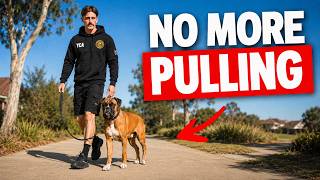
Dog trainer Jacob Morgan teaches a four-step method to stop leash pulling using prong or slip collars. He starts with play sessions and threshold work at the gate, then uses the "sweet spot" drill, positioning the dog's nose at your toes and rewarding compliance. A Boxer named Buddy who injured his owner showed rapid improvement after two sessions.
Chapters
If you're fed up with your dog dragging you down the street, having your arm ripped out, or if just walking your dog feels like a tug of war, then you're doing something wrong. I'm going to be completely honest with you, loose lead walking is fairly low on my list of priorities as a dog trainer. I actually consider it just a necessary evil. Society requires us to have our dogs on a leash, but walking on a leash isn't fun for you, and I can assure you it's certainly not fun for your dog. A walk for me has one simple function. To get you and your dog from point A to point B. But here's the biggest mistake people make: they use the leash walk as their dog's primary form of exercise. If your dog has a habit of pulling and you take them straight out the front door without using anything else first, you're setting yourself up for failure. You're essentially releasing a coiled spring or a jack-in-a-box into the wild. I see this constantly. People think if they just keep walking and their dog keeps pulling, eventually their dog will just get tired and stop pulling. But what actually happens is you just build a stronger dog. You build a dog that learns to lean into pressure. Let me tell you about the worst case of pulling I've ever dealt with. It was a boxer named Buddy. Buddy's owner is a young mum, and her struggle was very real. Buddy was a big, powerful dog, and he pulled her over on multiple occasions, causing actual physical injuries. He was reactive, and he was hard to deal with. She'd reached a point where she couldn't even walk him while taking her daughter to the park with the pram. It was just too dangerous. She'd seen multiple trainers before, and they'd tried all the usual tricks. Throwing cheese in front of the face, turning around, using a stupid front clip harness that, just letting you know, doesn't work. And she had absolutely zero success. When you touch the lead and your dog turns into a coiled spring, they're addicted to the anticipation of the walk. They drag you out the front door like a freight train. And if you're using a harness, you're just making it so much worse. Let me be very clear about this. Harnesses are designed for huskies to pull sleds. They're designed to distribute weight across the strongest part of the dog's body so they can pull more efficiently. If you put a harness on a pulling dog like Buddy, you're literally giving them the mechanical advantage to drag you down the street. When clients come to me with a dog like Buddy, they're usually using a flat collar or a harness, and those pieces of equipment have usually been poisoned. What I mean by that is the dog has learned to ignore the pressure. They just lean into it. The flat collar or the harness has become a cue to pull. If your dog is a chronic puller on a flat collar or a harness, they might hit the end of that leash 30 times in a 10-minute session. Over time, that constant compounding pressure on a dog's throat or their chest and shoulders is incredibly damaging. I actually consider that more cruel than using a different tool. I like to bring them onto something that I describe as having power steering, a prong collar or a slip collar. Think of it like horse reins. You wouldn't see a horse in a harness. You're going to see them in reins. The reins allow the rider to turn the horse left and right and tell them to slow down with very subtle movements. Where the head goes, the body follows. A prong collar or a slip collar works the same way. It introduces a novel sensation. The dog doesn't have a history of pulling against it, so they quickly learn to yield to the pressure rather than fight it. With these tools, I only need 2 fingers of pressure to communicate. With a flat collar or harness, your communication is completely limited. You're just an anchor. To fix Buddy, we didn't just put a new tool on him and hope for the best. A tool is just a tool. It's the method that changes the behaviour. We use a 4-step method to completely rebuild his understanding of the walk, and it starts before you even leave the house. If you're feeling guilty about your dog's reactivity, then I'm here to help. You're not a bad dog owner, you've just been fed the wrong information. But fear no more, that knot that you get in your stomach every time you grab your dog's leash, let's fix it. We've put everything that we know into a completely free programme, and it's going to help you solve absolutely all of your issues. Did I mention it was free? Step 1 is going to be play with your dog. Before you even attempt to walk, you're going to have to take the edge off your dog. Take them into the garden for 3 to 5 minutes of play. Play fetch, play tug, incorporate some basic obedience. Ask for a sit, ask for a down during this play. This burns off that explosive energy so they don't lose their mind the second they leave the house. Also, I'm going to let them go to the toilet now so they aren't dragging me down the street to look for a spot to wee on. Step 2 is going to be threshold work. You don't run a marathon by just running a marathon. You work up to it. The front gate isn't just a tunnel of fun. Imagine a force field across the gate. The dog is simply not allowed to pass through it until they are in a calm mindset. I don't ask for a sit, I don't ask for a heel, I just open the gate. When the dog tries to go through, I block them using the leash. I'm never getting into a tug of war and dragging them backwards. I just wait until they show some hesitancy, respect the open gate before calmly walking through. Step 3 is going to be the sweet spot drill. This is where it gets very clear for the dog. The sweet spot is your dog's nose level or just behind your toes. That's the position that you're going to be paying for. Say heel. And set off walking. As long as your dog stays in that position, things are easy. Grab your food and start rewarding. Now, if that nose creeps past your toes, you've got a few options. Try this. When your dog gets ahead, you turn around, a sharp 180, no warning, and head the other way. Let the leash do the talking and the movement show them that they're out of position. If the dog is choosing to ignore that or just pushing through, then you're gonna follow up with some well-timed leash pressure. Nothing crazy, just clear communication. The second your dog comes back into position and finds that sweet spot again, That's your moment. Mark it and pay them. That's how they learn. If they're out of position, things get a little bit awkward. The pressure comes on. If they're in position, they get rewarded instantly. Think of it like a bank account. Every time you mark and reward in that sweet spot, you're making a deposit. Early on, pay lots. Build real value in that position. Later on, once the dog gets a solid history of getting it right, you can start easing off the rewards. And lastly, step 4. Dogs are highly contextual learners. Just because you nailed the loose leash walk outside your house doesn't mean your dog dog understands the rules everywhere. You've got to take your dog to 4 to 5 different locations, you know, your parks, your town centres, different ovals, different streets, and just repeat this process. After just 2 sessions using this method and clear communications with the right tool, Buddy was walking perfectly on the leash. He was walking to heel right next to the pram, and his owner could finally walk her dog in peace. Stop struggling with your dog. Stop letting them drag you down the street. Get the right tools and start communicating clearly. Put in the reps. So If you're in Perth and you're tired of having your shoulder dislocated every time you take your dog out, hit the link below. We can fix this very easily.