Jacob Morgan Answers Your Reactive Dog Questions (Ask Me Anything)
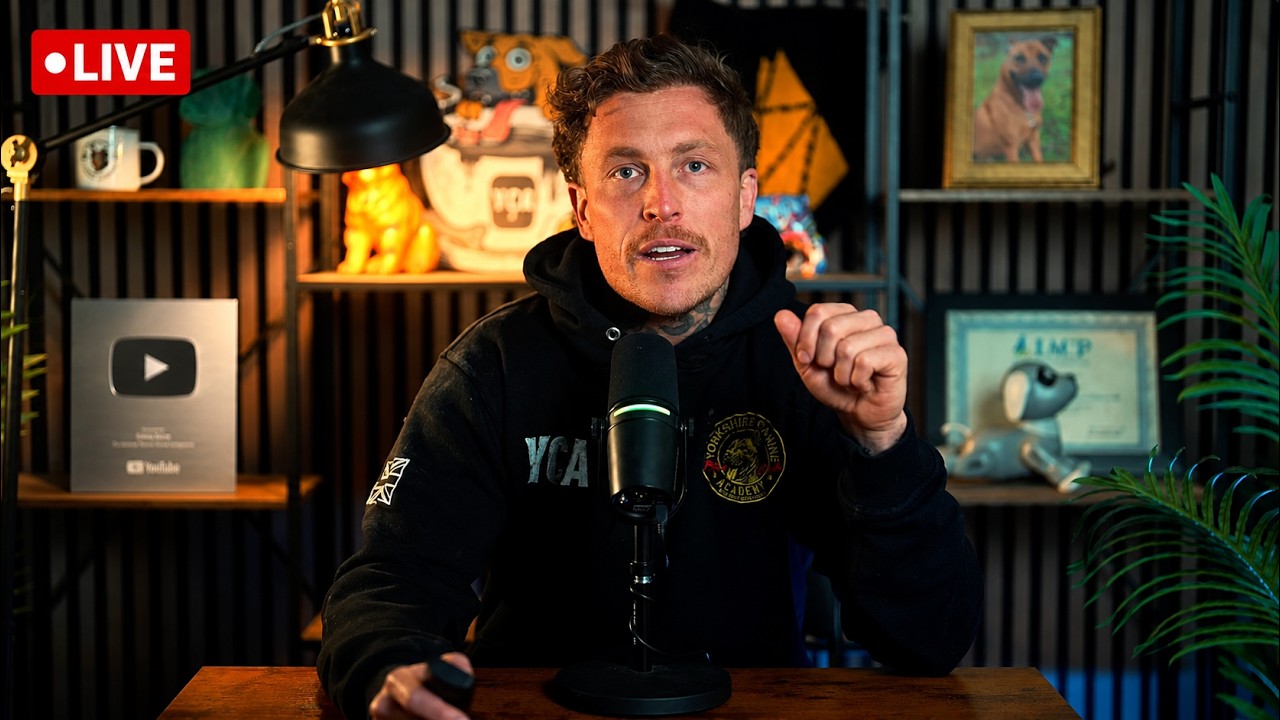
In this live AMA, dog trainer Jacob Morgan fields a rapid‑fire series of questions from a global audience about reactive dog behavior, separation anxiety, puppy raising, and his intensive "boot camp" training program. He repeatedly emphasizes two core skills for reactive dogs—a reliable recall and a well‑conditioned punishment marker—while warning against over‑complicating training with unnecessary cues. Morgan advocates the use of e‑collars (when legal) as a precise feedback tool, explains how to condition and phase them out, and contrasts punishment markers with simple corrections. He outlines his five‑day boot camp structure (10 am‑4 pm daily, group and individual work, high‑volume dog exposure, and post‑camp support), pricing, a money‑back guarantee, and lifetime after‑care via group calls, WhatsApp, and graduate days. Throughout, he addresses specific owner scenarios (separation anxiety, dog‑to‑dog aggression, barking, fear of fireworks, introducing dogs to children, and managing a growing family), stresses the importance of owner mindset, consistent homework, and early puppy habit‑blocking. The session ends with logistical details (centers, payment plans, e‑collar legality) and a call‑to‑action for interested participants.
Chapters
I think so. Anyone here? No. Okay. How long do you wait? There he is. Close that. Close that. Oh, there's 15 people here. All right, cool. Ask me a question then, team. Let's go. Ask me anything dog training. I guess, or anything you want. It could be anything, whatever you need. Sunny day here in Leeds, going up to 33 degrees. The boot camp has been out nice and early, been out, um, 7 AM, getting their steps in. God, I haven't done one of these in a while. Why tiramisu all the time? Because it's a dessert of the gods. It's a perfect combination of cream and coffee. A light dusting of chocolate. I've actually overdone it now on the tiramisu. I've not eaten it in a little while, so I'm probably gonna have a little bit of a break. It's like when you get caught smoking as a kid, your dad makes you do a pack of 40 or 20, and you never want to smoke again. Seven years old. I don't know, maybe. Got a crisp and fresh new tonic. It's not, it's not fresh. Well, it's fresh. It's not cold. It's left out in the, um, in the sun, unfortunately. 22 people talk to me. Let's go. Question about separation anxiety. Oh, by the way, if you've ever been on one of my lives before, I don't hold back. I'm going to give you— I'm not going to give you what you want to hear. I'm going to tell you what you need to hear. Question on separation anxiety. You want to get a dog and prevent it from developing, but we both work home. From home 90% of the time and still want to be able to go out on dates, etc. Yeah, just force yourself out. Just go for a walk. Tire the dog out. Put the dog in a crate. You just go for a walk. Simple as that. If you had to teach a reactive dog 2 things, what would it be and why? I'll teach them a recall so I could let them off leash so they could pick up Healthy hobbies. Teach him a punishment marker. Don't fucking do that marker. And between those two things, realistically, realistically, that's going to carry you like 90% of the way there. I think dog trainers just love overcomplicating things. Love overcomplicating things. Adding in a lot of unnecessary, unnecessary, unnecessary. I think I'm having a stroke. Unnecessary. Unnecessaries? Unnecessities? I don't know. Just to make themselves sound cleverer. All right, my dog is 8 years old and goes absolutely ballistic at other dogs. Tried with other trainers and they said it's not fixable. That's just how he is now. Anything I can do from your experience? Ellie, you want to tell me what you've tried? Thing is with people, the thing is with people, they think all dog trainers are like made equal. They most certainly are not. Anyone can call themselves a dog trainer and just go out there and you know have a half-assed effort that doesn't come from a place of substance or any experience whatsoever. And they're going to say something along the lines of you know this is too far gone, this behavior is too deep, too ingrained. Maybe you got some breed limitations, etc., etc. You know, I need to know what you've tried previous to now. Chloe's kicking off in the back room, so that's good. Back to Adam's question anyway. Yeah, I teach a recall. So I get my dog off leash. I do that via the e-collar, of course, give me that maximum level of insurance. And then I teach a punishment marker, or you're not allowed to do that marker. Yeah, we could look at play. Yeah, we could look at redirects. Yeah, we could look at reinforcing behaviors we do want. But ultimately, you know, when we grant a dog freedom and liberty, they're going to then have the opportunity to choose the most reinforcing thing to them. And therefore, we're always going to be as efficient as possible with our reinforcement when we have a dog that has agency and has been granted liberty, you know. So again, that's why we're going to kind of choose to those two things. There are other things that would come in. Then the next one would probably be like a play or trying to cultivate play desire and drive. But yeah. My dog just isn't reactive. He goes absolutely ballistic, like wrestling a bear. How can I calm him down? Give me a little bit more context, young fella. Yeah, am I remember your dog, Lula? You had a couple of other German Shepherds at the time, right? I most certainly remember. I'm pretty good at remembering clients. You're a strong lady, I believe, if, uh, if I'm not, if I'm not, um, if I'm not wrong. Um, Rachel, 5-month pup constantly charges at me, at me other dog. I don't know why you're talking like a pirate, but here we go. When we walk together, making it really hard to walk past. Walk both. I How can I stop this happening, please? Well, you need to start putting boundaries on your your younger dog because if you don't intervene, what's likely to happen is your older dog may correct them in a fashion that takes things a little bit too far, and we can build some animosity between one another, and that reparation it might be irreparable, to be fair. Um, tried to board and train with a force-free trainer. I can imagine that went well. Distracting with food from other dogs, that worked in the beginning, but now he won't take food anymore, not even cut-up steak. Ellie, I'm not gonna— I'm not trying to sound like a fucking dickhead here. I'm not trying to sound like a dickhead. A force-free trainer is just going to get you nowhere. You need to spend just 2 minutes on the internet and And just read some force-free dog training reviews, even when they're good, they just say this person was really nice. And we're now better equipped to start tackling our dog's behavioral issues. But no way will they say, oh yeah, they fixed our severe dog reactivity problem. Sounds nice. Sounds nice. And by God, I wish I could, you know, deliver the results we deliver just by distracting a dog with food. It's not logistic. It's just not logical. That makes no sense. How can you encourage a dog? You're simply trying to encourage a dog outside of severe, deeply ingrained behavioral issues, sometimes genetically fueled as well. You know, Emma, I'm sorry to hear about your other dog. Um, I have a 5 and a half month old Labrador and he wants to meet everyone, and because he, he's a bloody cutie, everyone wants to meet him now. How can I control that? Yeah, the The worst thing we can possibly try and do is try and control other people's behavior because it's just going to become incredibly frustrating. So, you know, a lot of the typical advice might be, you know, trying to communicate with that person to not give your dog what it wants. But the best thing is to take this into your own hands, be accountable for it, and put a better level of control on your dog. You can teach your dog a lot of impulse control through play when they're in the heightened state of arousal. You know, that will be beneficial. You can also teach your dog hey, we're not to jump up on strangers because of, you know, you might hurt someone one day when you get too big, etc., etc. And you can do that from a young age. You're actually better off stopping behaviors from an early age, um, you know, without allowing them to become more deeply ingrained and more embedded, you know, if that makes sense. Does that make sense? I've got a puppy. Your puppy PDF recently got a German Shepherd cross. How would you stop? How would you slouch biting as I do tell her off and create for a timeout? I'm also intrigued about socializing her, and she only has one what leg eye friend. What is it? You tell me, Sean. Default Sean. Listen, the puppy biting question is a is a end old age old question, right? It's a question as old as time, and I would deal with it deal with it in this order: one, make sure the dogs. Sleeping well enough, and is sleeping just the right volume per day, e.g., 18-20 hours quite a lot. Second little box we want to tick is: Are we fulfilling the dog via play? Are we showing our dog how to use their mouth? We don't want to completely stop them from using their mouth. If we've ticked that box, then we're going to move move on. You know, we get we exercising the dog enough generally. A lot of people really put a rod up their back by following the five-minute rule. You know, five minutes of exercise for every month your dog is alive. What's likely to happen there? You know, even a two-month-old dog, they can do a bit more than ten minutes. You know what I mean? They've been they've been running around with their. Littermates for hours on end up until this point, and then they come into your house and you're suddenly curbing their exercise by a large margin, you know. So of course they're going to be a little bit pent up. Things we've got to be careful of in regards to exercising puppies is like impact on joints. We want to limit jumping and so on and so forth, you know. But on a grassy field, we can walk our puppy probably a lot A lot further than we probably think, or contrary to the internet, you know. And then we might look to, yeah, you know, issue some sort of quote unquote negative consequence. Here's the thing with punishing puppies: a lot of people never tell their puppy no. They allow their young dog to develop into an adult dog that. Again, has as deep deeper set kind of behavioral issues, and then it becomes an unpunishable dog because you basically said to your dog, "Hey, you've been allowed to do this all your life," and now suddenly I've changed my mind. Now, tell I'll substantiate this with a quick story. I've got a couple of dogs. I've got three dogs at the moment. Um, since, uh, Kobe now lives with Maggie, one of the bosses here, and obviously Lenny's gone to the Schmutzner. But anyway, I've got 3 dogs. I've got a big sport dog called Stark. He's a bull herder type breed. Very strong dog, very motivated dog, very, um, strong-willed dog, you know. And, um, you know, as a puppy, he's very challenging to the other dogs in a way. He would push boundaries, right? I also have another dog called Darla, who's a Romanian street dog, who's pretty much the opposite type of dog to Stark. Not strong-willed, you know, quite nervous, a little bit sketchy per se. So Stark as a puppy Again, pushing a lot of buttons to the older two dogs, right? And so one day, Darla's going at she's asleep there on the sofa. Stark jumps up on the sofa and just basically like two foots are in the chest. You know, a bit like that scene off The Lion King when Simba's waking up Mufasa, right? Anyway, Darla letting Stark know. via the means of punishment that that behavior was not okay. And since that day, Darla— or sorry, Stark— has had a sense of respect of Darla that is still to be breached. And they have a great relationship, for the record. They play with each other. Sometimes, you know, I'll go into work and leave Darla at home or, um, and take Stark with me. And, and when they bump in, like when they see each other after not seeing each other all day, they're super excited to see each other. They'll sit and cuddle. They'll lick each other's ears. But Stark has a sense of respect over Darla, right? Now, here's what would have happened if Darla had not delivered that consequence to Stark in a young age. Stark would have developed as a dog physically, mentally, developed even more fortitude, and those buttons he pushed, if not corrected— now, I trusted her to make the right level of correction, to be fair. You know, most of the time, if we're not sure it's gonna, you know, result in in something fair for the puppy, we might intervene ourselves. I'm just I'm gonna come back to my original point. And if Starla had not done that from a to Stark at a very young age, there's a very good chance Stark as a developed one two three-year-old dog. Would be unpunishable by Dala. The level of punishment required to say to him, hey, you need to, you know, have some sense of respect for me. Now, I use the word respect in, in, in, in a way that I mean don't take the piss. I don't mean that he needs to bow down to her constantly, etc., etc. You know what I mean? Chances are if she'd not done that, I've At a very young age, we likely would have had a relationship where Stark would constantly push her buttons, and he'd get away with it too because he'd be too big and too strong. And a correction right by Adala probably wouldn't touch the sides on an adult Stark. And so that would have been very damaging to their relationship, and they wouldn't have had the relationship that they have today. You know. And listen, if then she had to go to a level to set them boundaries to an adult Stark comparatively to a puppy Stark, it would have probably required an intensity that would have created some lasting harm on Stark. You know what I mean? Like required a vet trip. And of course, like we would never want that in any way, shape, or form for a dog to be harmed. And so my point is here, once we've met all our dog's needs, right? Once we've met all our dog's needs, especially as a puppy, is it's fine to set some boundaries in. And I'm gonna be honest. I'm gonna be frank here. A lot of you that have issues with your adult dogs. is because you never set boundaries as a puppy. You never told the puppy, hey, it's not okay to bite me in the face because you're bored. Because look at it from this point of view, your puppy gets to you and they're going to try and establish, are you mum or dad, or are you a littermate? Let's find out. And they'll use their mouth to establish that. And if you say littermate, and then you, you raise a dog That is nervous, that is defensive, that is unsure about itself and and and what's going on around him. But then what's likely to happen? You will have inadvertently bestowed bestowed a responsibility upon them by not setting yourself as someone of importance. Does that make sense? Drop me a one in the chat if that makes sense. So when a threat comes along. Your dog goes, oh, I need to deal with this because this person I'm with, this person I'm with right now, they've allowed me to walk all over them since the day I met them. And so out of us two, to deal with this threat, it's likely going to fall on my shoulders. And then you, you have a dog that doesn't trust you because you let them come in and walk all over you as a puppy. And it's not irreparable, I promise you, it's not irreparable. So that's probably how a couple of you started out. Hey, I did it with my first dogs, you know what I mean? It's probably how a couple of you started out. Here's the fix, is this. You show your dog. I mean, there's a lot. There's a lot to it, right? You show your dog the thing that triggers their defense. You give your dog feedback. Hey, this is acceptable. This isn't acceptable. We do that via markers. We have a positive and a negative marker. Yeah, I like that. No, you're not allowed to do that, right? We could use any words we want. We could use clickers, etc., etc. We have to prepare those markers. We have to condition them. We have to give those words meaning. Dogs learn through association. We do that by setting boundaries and rewarding our dog away from the trigger initially. Then we show our dog the trigger, whether it be other dogs, cats, squirrels, humans, and we say, "Hey, you need to start trusting me because you as a human being." You understand that the cockapoo down on the house on the left at the end of your road, it isn't a threat. Your dog unfortunately doesn't understand that though. And so we put our dog in those situations. And the way we, you know, fix the reactivity is We have to trust is like a muscle; it needs flexed to be built. So we say, "Hey, you're not allowed to bite that other dog," and the other dog passes, and our dog goes, "Hmm, that other dog wasn't going to hurt me." No, it wasn't. It's what we call prediction error. We need to do a lot of that. You show our dog a lot of the trigger. You know, so we run a five-day boot camp, and it's very, very simple system. It's a very simple system. We teach a yes, we teach a no, we teach a recall, and we do those three things. We do play as well, to be fair. Quite a lot of play in and around the dog's trigger, which is typically other dogs. You know, that's our bread and butter is dog on dog reactivity. Do a bit of people stuff as well, and then then it's prediction error after prediction error after prediction error, and there's five days we. Work with dogs. They see more dogs than they probably have done in their life. Fair enough. The owner's been avoiding dogs for a sustained period of time because of the dog's behavior and reactivity. And you know, there are more than one ways to get to that situation, but that is the end goal. I'm gonna show you the thing. The thing is not gonna do the thing you think it's going to do. And eventually you'll become desensitized to the things. It becomes unimportant. You know what I mean? Let me check some of these questions, team. A lot of people saying, yeah, that's what I did. I have a cockapoo one years old. In the last three or four months, his food drive has gone downhill. Yet his vet has cleared any medical issues. I've been using food deprivation. What else can I do? Guns blazing, tell me your feeding routine, please, and I'll help you out. How do I do that? Dog reacts to me when she sees another dog and hates wearing the muzzle. Um, obviously your dog isn't comfortable with Being told no or being restrained. So you've got to get your dog used to being restrained. Use some back tying in the house. Use a leash in the house. You start setting boundaries. Again, we're on a YouTube live. It's not like a one-to-one behavior session, right? And so, you know, end of this live, I'll drop a link in so you can book a chat with someone on our team, and anyone can take us up on it. Chances are we'll then talk about boot camp and see if the problem you have we can solve. But let me give you a couple of reasons why your dog's going to redirect on you. A dog redirects because they lack restraint in other aspects of their life. You then present them to you then present them to something of very high value. The lead acts naturally as a form of restraint. They process their frustration by your inconsistent— caused by your inconsistency, um, by, you know, going into aggression. So frustration and aggression are very closely tied on the wheel of emotion. And so our dog can go from one to the other, like, very easily. Um, and so, you know, a A part fix to this is stop by is to start issuing restraint, fabricating restraint in and around the home initially. We can do some work via play to restrain our dog. We can teach you know a punishment marker around setup things, counter surfing, going into the bin and stuff like that. You know, the muzzle is like another form of restraint. You're basically tying the dog's hands behind their back, right? 5 weeks post boot camp, just came back from holiday, off leash on the beach, workshops, pubs, cafes, boot camp work for a human and dog reactive border collie. That the vet told me to put to sleep. There you go. Yeah, how doomed do we when vets are going around telling certain dogs, right? This particular dog here, Border Collie, worked with our South contingent. Vet said, you need to put this dog to sleep. You need to euthanize this dog. This dog worked with us for 5 days. Dog and owner, to be fair. We don't train this dog in five days. We train the owner to train the dog for the record. There's no point us. We don't do board and trains or anything like that anymore. We don't ever train dogs on behalf of people. We train people to train their dogs. That's how we get the best results because no point the dog being good for me. Dog's got to be good for you, right? You got to have the skill set to take away. This particular dog and owner trained with us for five days after being told to euthanize this dog, and you can read it there. With your eyes, off leash on the beach, walked in shops, pubs, and cafes. Dog was reactive to dogs and humans, and a vet told that particular person to put that dog down. Five days. Big problem. Five days. Dog trainers need to stop overcomplicating this shit. Would you start conditioning an e-collar on a five-month-old pup or wait till older black lab pup? 5 months may be a little early, but who's to say it's too early, right? There's going to be— it's going to be dependent how you e-collar train your dog. I think there are more— there are obviously different ways we can e-collar condition, and I think some are a little bit more complicated and will take the dog a little bit longer to figure out. Our method is very simple. You know, and again, for the record, that is, we put the dog on a line, we teach recall, we then put the, put the e-collar on the dog, we set it to a level that isn't low-level conditioning, but a level the dog would preferentially want to avoid if they were in like a sterile environment, that traditional like nag level, maybe a little lower. We recall the dog, we help as much as needed, but as little as possible with the leash. And add the e-collar pressure till the dog gives us commitment. We do a lot of that until we don't need to use the leash at all. We still have the leash on the dog, to be fair. We're just going to tap away, call the dog, tap away, dog. All right, and I'd turn this pressure off now. All right, then we might jump up to start proofing. I think that's a very simple way. I think it's very user-friendly way. That's why we do it. I think a lot of the low, low-level conditioning is totally unnecessary and actually doesn't Help the dog figure out the higher levels at all. I know there's controversy and deliberations online with that, but you know. I feed him three meals a day, gone through different types of food to see if he likes it, then realized very quickly that isn't the way to go. I currently feed him Wainwright adult. Change food to something a little bit more high quality, like Millie's Wolfheart's good food, not sponsored, by the way. And just switch to 2 a day. I presume he's eating nothing in between. I don't give him many treats. Ah, so it's not nothing. So it's not nothing. I don't give him many treats. I know this isn't ideal when his food drive has gone downhill. I used to use his food for training a lot more than I do. Putting the ball down. Yeah, just go switch to via hand if the vet's ruled out anything medical. How to help train sleep startle? I know how to manage it and it's gotten better very slowly, but I'm wondering if you have any experience with this at all. No, manage it. Your dog's not in a— so your dog is not in like a cognitive Place when they're asleep, so you can't train something that hasn't got the mindset to be trained, if that makes sense. So when your dog's asleep, there's no feedback or instruction you can give them. You know, we can't condition anything because of they're not conscious. So you manage it, put the dog in a crate, put music on, white noise on, whatever you need to do. Unfortunately. Guns blazing, whatever method you're using to feed your dog, you need to stay consistent with that method and then advance it as you go. I only used the e-collar 3 times 5 weeks post boot camp, and that was because it was windy and he couldn't hear me on the beach. Fair enough. 5 days seems really quick. My trainer said reactivity takes months to fix. How is that possible? Let me do some maths for you. Our boot camp is 10 till 4 every single day. The reason we switched to a boot camp is because of a lot of the time we were doing one-to-one programs with a couple of day— a couple of weeks in between. And to be fair, what we are finding is people in between one-to-one sessions, they're not doing their homework as probably to the level they should be. Sometimes they're even making mistakes that are making things worse. So then we have to fix up next session. And so progress looked like this. And when you have to— when you want to address reactivity, momentum is absolutely everything. And keeping a clean sheet is everything. Right, and making sure you're giving the right level of feedback continuously. You know, we do ten till four. Obviously, we like cycle through the dogs, and we do it in stints. And Monday, Tuesday is more individual, and Wednesday, Thursday, Friday starts coming into small groups, and then a big group. During that time, those five days, dogs can see more dogs than they ever have in their life, and they will have done in probably the last six months, and. more dogs with the right level of input too, in 5 days than you're going to over an 8 to 10 week training course or whatever. I don't believe reactivity— I used to believe reactivity is going to take months to solve. But like I said, it's the right level of input, the right level of exposure, volume of exposure. And so we can course correct over 5 days intensely. Way more efficiently than you know traditional one-to-one programs can. So if we've got any dog trainers here, they'll probably vouch for this and say like you know a lot of their clients that because they're not dog trainers, they got lives and shit like that. They're probably not doing their homework to the level of efficiency or intensity that they may need to in that two weeks between one-to-one sessions. And so we mitigate that by condensing the process. to fully train the dog in a week, right? It's not hard. It's not easy by any means, right? But it's not complicated. And so then, you know, by the time we've got to day 5, it's only really important the owner takes away what they need to remember from day 5, you know, because the e-collar is conditioned, the markers are all conditioned in that process. Of course, like, we give some pre-homework, to be fair. And we have a go-home support system after the fact. So it's not like everything happens in the 5 days, but I'd say 90% of it does. And again, another dog trainer here can vouch for me. They've probably done board and trains where they've seen significant improvement with a dog in, in 5 to 7 days, you know. How would you advise a Dutch trainer to apply your methods without e-collar? I would illegally use them on my own dog. Fair enough, not my business, but I can't advise others to do that. Fair enough. Does the long line ever come off? Honestly, mate, it really does depend on one, the level of success the dog has had in the past. Here's dog training in a nutshell. When we get a puppy Right? They're just like bumbling, primal-driven idiots. And they're obviously super fun and they're lovely and we love them. And so they're a little bit like men. They're purely driven by their instincts, right? And so when people think about training puppies, they think about it incorrectly a lot of the time whereby they think they need to teach their puppy to do things. Our job in raising puppies is to block habits from setting in, right? And so, you know, if our puppy never chases a pheasant, we'll never have to fix them chasing pheasants as an adult dog. Of course, like, mistakes happen, right? But good puppy raising is very, very boring because it's just a hell of a lot of management. there's very little input in terms of positive or negative that we might do with an adult dog. Very little. It's just blocking bad habits from cropping up that we then don't need to amend as an adult dog. And so the question you've asked me here around, will the long line ever come off? It depends how much bad habit has been implemented with that dog through its adolescence or its puppyhood and juvenile stages and this critical learning period, etc., etc., right? Now, if you've done a very good job, which typically people don't do because it is boring, people get a puppy and they let it do whatever the fuck it wants and they think, oh, I'm gonna— he's gonna grow out of it, right? They don't. They grow into things. And so when we have a puppy and we say to the puppy, you know, do whatever you want, like, we'll solve problems when you're an adult. Bloody, bloody blah. You're just putting a rod up your own back. Good puppy training is there's a leash on the dog a lot of the time, even if it's just a trail line. You know, even when we're going out for walks, the dog's crated. The dog is on a good routine. The dog is limited with how much bad habit they can pick up. So we don't have to do much course correction as an adult dog. Right? What does most people do though? They go, puppy, let me let it jump over everyone. And I did this with my first dog. So like no judgment here. And play around with all other dogs, like chase this and chase that, and bark at the neighbor's dog, and and go through the bin, and it's all fine, right? Of course, we don't want to be sat there punishing our puppy, telling them no every two seconds. So what do we do? We just put parameters in place where they can't develop those behaviors. Think of it like a video game, right? When you got a video game, I don't know, like Grand Theft Auto, or if you or if you're a bit more of a geek and you're into those like ah. PG games like Red Dead Redemption or The Witcher or fucking Fallout or whatever. The more you do something, the more skill points you get to that particular skill level, right? And that's the same with dogs. The more they do something, the more skill points it develops, and the more likely they are to use that skill as an adult dog. And then as an adult dog, we need to take— detract from that skill, perhaps using punishment, and build new skills like healthier ones that suit us. So as a puppy, what we mainly need to think about when we have a puppy, should I say, what we mainly need to think about is blocking our puppy from developing those unwanted, and then very little course correction. We just need to then start driving reinforcement into those new skills, and voilà! If I've not developed the skill over here. I just developed, you know, a new skill with a lot of reinforcement. Great, can do it without any or minimal aversives, right? But a lot of the time, it's going to be here. We might need to use some sort of aversives to take away the pleasure in what the dog gets out of this behavior in order for us to create this new cost-benefit analysis. Is this in our favor and the favor of the dog's safety, you know? No worries, guns blazing. I'm not in the UK. What's the next best thing in this boot camp from you? I don't know. Where are you, Nano Fruit? I might have a mentee in your country, but to be fair, if you're in Europe, we've had plenty of people come and, um, Also, I've like considered a boot camp tour, to be fair. So if enough people reached out from a certain country, I just take my team to your country. We would do the boot camp and then you know show you the support system and then leave. So what happens after the week is done? Are we just on our own? No. All of our graduates get access to weekly group calls. They get access to a trainer on WhatsApp. They get access to our. Full behind-the-scenes training material. We just developed a new go-home guide, the five things you need to do to make sure the results stick. We do a quarterly graduate day as well, and then all of our you know, and that's all free as well. That's not upsold in any way, shape, or form. Just get access to that as a thanks for being one of our clients. You know, so if anything does happen down the line, you move house, you get a second dog, your dog gets injured, God forbid, or anything arises that sees your dog's behavior regress in any way, shape, or form. You know, we've got you. At the moment, this is the only treats I use because of the food drive. Is the method I'm using a good way to combat constant barking? Should I wait till the food drive is better and use his food? No, because you're trying to stop something with food. Think about it. Think about it. Just think about it really simply. My dog's doing something I don't want them to do. Where does food come in? Where does food come in? I could tell them to do a non-compatible behavior, perhaps. But what am I going to do? Tell my dog to lie down every time they bark and create a yo-yo dog? No. What am I going to do? Reward him for not barking? So he barks and then goes, great, when I shut up, I get food. That's going to make him bark more. That's that's just spoiled the force free mantra in two fucking sentences. How can I reward a dog out of an unwanted behavior? Yeah, I can create— I can maybe condition some new responses. What's the point of dog training? To liberate your dog so they can live the best life possible. Because if you've taken an opportunistic hunter scavenger predator, you've forced him into a human world that's going to be very genetically limiting. And so our role as guardians of our dogs is to allow them to bet— just to teach them to be able to navigate the human world, right? Um, and so my Motive to train a dog is to give them as much freedom as possible. When they're in the house, I want them just free-reined. Now, we don't get there by giving freedom, for the record, but that's a different conversation. When I'm going out for a walk, you know, I want to use a leash next to the road. I want to take the leash off and allow them free rein. I don't want to be constantly telling my dog what to do, what they can't do. I want them just to make good choices. That allows my dog to, one, be happy because he's living a dog that is living a life that's closer aligned to his genetic makeup. But also, 2, me be happy because the closer aligned he lives his life to his genetic makeup, the less problems I'm going to have and behavioral issues. He's going to bark less and so on and so forth. And so when we're trying to get rid of behaviors, Right? I could use food, could use reward to create incompatible, incompatible behaviors to the unwanted, right? You can't bark, lunge, and growl where you're sat, right? That means my dog's good behavior and combating the unwanted behavior is conditional to being told what to Do, right? Meaning that if I don't tell my dog what to do, or my dog is not in my eyesight, or my dog gets away from me, or fuck knows, you know, he's gonna revert back to doing what he wants because the instruction is absent. And so I don't believe The answer to fixing these big issues that you all have is by telling your dog what they should do instead, because they're going to be bound to obedience for a long, long time. And in the absence of that obedience, hey, let's see what the dog does when I don't tell them what to do. They're just going to do, do the thing, you know. The second thing is, if I start rewarding the dog For not doing the behavior, stopping the behavior, should I say. I won't say not doing. So stopping the behavior. I kick off, I stop, I reward. There's a very good chance my dog builds a behavior chain and just goes, all right, I need to do the unwanted thing to do the— to get the reward. So counter surfing, we try and combat that with food, and we tell the dog to get off, and they do get off, and then we give a treat. Great. I get up on the counter to bring about an opportunity to get rewarded. We teach our dog to get off the sofa, and we say, "Get off," and then we reward them. Okay, I need to get on the sofa to bring about this rewardable opportunity, and we're inadvertently driving these unwanted behaviors. How do we stop a dog from panic attack from fireworks and gunshots? This could be a whole live on its own. But we want to build general resilience in that dog. The only way to do that is by putting our dog in a situation they preferentially not want to be in, and then holding them to that. Sounds really aggressive, but it's not. Just put them on a place bed, and then we start, you know, putting some fireworks on the radio or whatever, and they've got to stay there and tolerate that noise, realize they're not going to die. And then build up from there. Why a punishment marker and not just corrections? I would consider a correction to correct a dog into a wanted behavior. I consider consider a punishment marker to mean hey don't do that, but you can pick anything else you want. Now there's a time and a place for either or when it comes to reactivity though. We're going to opt more for a punishment marker because I want the dog to realize, hey, you can't do that, but there's plenty of other things you can do in life. A correction would be, hey, don't do that, you need to sit. And that's going to create the issue what we just spoke about, whereby the sit is conditional to my dog not reacting, if that makes sense. Now, the concept of trying to fix things with instruction or rewarding a dog when they stop doing things, does that make sense to To everyone listening right now, drop me a one in the chat if that makes sense to you. Drop me a question mark if it doesn't quite make sense, and I'll further explain it because if you don't understand this concept, I don't think you're going to stop your dog's reactivity. So just give me a one or a question mark, and once I see ten ones, I'll move on to the next questions. But otherwise. Oh, fuck off, Adam. Couple more ones or a question mark. Yeah, so all of our services that has a money-back guarantee here in Leeds, this is how we do it. You pay a deposit to work with us, and then by Friday, last thing on a Friday, you decide whether you want to pay the remainder of the balance or you want to get your deposit back, and we can shake hands and go separate ways. We genuinely just do do it like that. It puts pressure on us and our team to do a very good job to make sure our businesses are afloat. We don't, you know, and for all of our centers, if you don't have sustained results 2 weeks after your bootcamp, 6 months after your bootcamp, and you don't feel like we've done our job, you just reach out to me and I'll give you a full refund. Think, I want you to think about it. I'm going to be totally transparent here. We've got 4 centers across the world. We've got California, Perth, 2 in England. All our boot camps are full. There's 10 dogs in every boot camp per week. There's 15 here because we've got a bigger team, right? Let's say we had to refund one person across each one, one person at each center each week. Do you think it's going to come anywhere close in terms of putting us out of business? Nope. We can afford it, you know. And so, you know, granted, the numbers aren't anywhere near that. I promise you. Promise you. You do the homework. We'll come up with our side of the, you know, bargain. We want the results just as much as you do. We're not that type that's gonna, you know, we got a business we want to grow here. We got a business that wants to serve people. You don't— you're not going to be able to do that by ripping people off. Just won't. Second UK location is in Wadhurst, down south, East Sussex. All right, give me some more questions. I don't have much on today. I'm trying to escape the sun, so ask away whatever it is, whether it's just about your dog's reactivity or whatever. Yeah, we collar most of the dogs we train, um, purely for the reason it's the most reliable, consistently, um, intense way to give a dog feedback off a leash. Contrary to popular belief, we don't go around just nuking dogs. That would, that would just create a lot of panic. Dog wouldn't understand the e-collar. They wouldn't be able to be off leash, you know. So we have a conditioning process that we go through and the proofing process. We've got the lure coursing machine out today for the proofing process for the dogs that are on boot camps. Price of boot camp depends on which center you go to, what time of the year it is as well. And we're just changing our prices based on like holidays and stuff like that because we got like school holidays, 40 people want to show up, and then quieter times of the year, you know, it's not as busy to be fair. Um, it's £2,500 for the Leeds Centre, for the record. That includes your pre-training homework, obviously the boot camp itself, all the equipment you're going to need, including an e-collar, and then your lifetime support as well, which I think is a very fair price by the time you work everything out. And a boot camper told me this the other day, something like £32 an hour you're paying. It's not much at all. Myself and my wife are expecting a baby. How do we manage and prevent issues down the track? We've done the TDI course, Adam and Oz, and we're stoked with the result. Yeah, super simple. You start acting like you've got a baby in your house before the baby comes to the house. So there's loads of factors, there's loads of variables that are going to change when you do eventually have your baby, right? Including the place is going to smell different. It's going to sound different. It's going to have loads of different stuff. You might have baby gates up. You might have a cot in somewhere. You might have a baby changing section. I don't know. Loads of different stuff, right? You might have more people coming to your house, to be fair. You don't want all those factors to change at one time. And so any factor you can implement sooner rather than later so The baby is just one extra variable by the time it comes around, the better. So it doesn't change too much at once for the dog. Hopefully that makes sense. It's the best advice I can give. I'm taking my two Malinois to YCA on 70926. Be great to have you. How long after completing boot camp would you recommend to introduce my dogs to my young nephews? They haven't been able to. Oh, it depends. We'll give you a definitive answer there or thereabouts. It could be straight away, it could be a little while after. Depends if your nephews behave, depends like what type of reactivity your dog's got, to be fair, Scott. But you know, when are we opening a YCA in New York? I was thinking yesterday I might open just one more, just one more. That'll be it, one more. Maybe New York. It sounds expensive. California is really expensive. Wages are expensive. Advertisement's expensive. So expensive. Honestly, I think it's me and not the dog. I panic and grip the lead the second I see another dog. Can you fix me in five days? Yeah. So the the boot camp's difficult for the owners. It's intense. You you know you're working in front of people. You're working around dogs which you've been trying to avoid for a large majority of your dog's life, probably. And so it's mentally very challenging, but that's how you build mental fortitude— by putting yourself in compromising situations. And so you're gonna feel so much more prepared going back out into the real world having been put through your paces. When I used to play rugby, right, and I used to play at an okay level, they used to send us off preseason to like a military boot camp, the Marines used to do. Um, we used to do lots of hills, right? We used to get up at 5 AM. We used to run up and down hills that were nigh on vertical. Then you'd have to wrestle at the top. You weren't allowed to walk. Uh, you weren't allowed to put your hands on your hips. You weren't allowed to put your hands on your knees. It was very mentally challenging for us, right? Um, and the reason we did that, by the time we come down to playing a game in the middle of winter here in the In Yorkshire, which can get pretty cold. It was duck; it was water off a duck's back. You know what I mean? And so there's you know not not to this degree, to be fair. But there's the element you get from the boot camp. You're going to be nervous. You're working your dog that you've had issues with for a long time around people. But off the back end of it, a walk in the park becomes literally excuse the pun a walk in the park. You know what I mean? And I think that's one of the main benefits of the format we run. Are your boot camps all year round? Yes, they are. Depends where you go, Shadow. Um, currently is £2,500 in Leeds. That's your full week, your pre-training homework, and then your lifetime support after, as well as, uh, all your equipment included. I'm gonna be very frank here, and this isn't like a marketing gag or anything. The price is probably going to go up soon, just because the amount of people that are wanting to join the boot camps, we have to limit it. And yeah, we do payment plans and stuff like that. To be fair, I'm not sure if we have we have PayPal like Afterpay Affirm. It depends what, like, what you qualify for. That's between you and a firm. I'm working on barking at the door. I use all done, which is the end of the play cue. If he stops, I reward. If he doesn't, I punish with the e-collar paired with punishment marker. Is that a good way to do it? If you want the dog to just not do it in the first place, you would use punishment marker in the first instance. So if I want a behavior So if I want a behavior to stop a behavior, let's say curb a behavior the dog is sometimes allowed to do, I'll give them a chance to stop doing it. Hey, that's enough. Quiet. And then I'd punish not responding to that. If I want— if the behavior is something I never want them to do, so chase sheep. I'd just punish in the first instance. Another example would be I want my dogs, or I don't mind if my dogs sometimes chase squirrels. They enjoy it. They never actually caught a squirrel, to be fair. I can imagine it being extremely fulfilling for them. I enjoy watching them running around the trees, trying to climb trees essentially, chasing the squirrels down at Goldenacre Park down here. That's sometimes something I want them to occasionally do. And so very simply, you know, if they go too far, they're out of my sight or whatever, I'm going to recall them instead. I'm going to say, hey, Come back here. This is going to strengthen my point I made earlier. And I recall them, they come back. Great. That means we're not chasing squirrels right now, but you can next time. Fine by me. Now, if I never wanted them to do it, I would, you know, issue my punishment marker. Hey, we're never allowed to do that. And I'd use that sheep, which I have had to recently. Hey, we are never allowed to chase sheep. And I come in with my punishment marker. And the feedback that's required after, because of again, that's not sometimes we're allowed to. That's how we're never allowed to. So it really does depend, right? We're never allowed to bark at other dogs and start fights with other dogs, right? But you know, it's a negative reinforcement versus punishment thing, I guess. Yeah, so one of our boot campers here was crying Monday night as I felt like, yeah, Monday, Tuesday is tough. It's tough. But again, it works. I've told by trainers that my Parsons Terrier will never be off lead because of his breed. Is that true? Does e-collar work for all breeds? Yeah, another misconception is like huskies can never be off leash, but we've trained just like countless amount of huskies now to be off leash. And that's just one type of dog you would never want— you would never want to keep on leash all their life. Same with terriers, to be fair. Because you think about terriers, they, they generally lack structure in their native role. You take them to a barn, you let them loose, they go and fuck shit up, and then you you bring them back, put a little slip lead on them, and you put them back in the box, right? Very little structure and impulse control. And so confining one of them to a leash for their life, you're eventually going to get some sort of frustration-based issue. That's true to a degree with all dogs, but some dogs more so, you know, based on like the nature of their original role. A few of my dogs are friends. A few dogs of my friends are scared of my GSD because of the reactivity. They will more than likely get along after boot camp. Yeah, because your dogs aren't going to be fucking kicking off at them. You know what I mean? I'd be scared. I'm scared German Shepherds kicking off at me. You'd be an idiot not to be. You know what I mean? You'd have to have like some internal, like, self-survival mechanism, probably for fucking fried, to not look at a barking, lunging, growling German Shepherd and go like, hmm. And so yeah, when your dogs are lying quietly calm at your feet after having a good run and totally under control, chances are, yeah, your friends are going to probably be way more inclined to want to spend more time with you. Now, Are we sure it's not just an excuse because they don't like you? That's something we need to ask. I'm only joking. I'm just being— I'm just pulling your leg. But, um, yeah, of course. I do want him to bark at the door because sometimes the door is hard to hear. However, I've been told by neighbors he barks at home when the door goes and nobody's there. What would I do in this instance? Ah, I think you've answered your own question there, Guns Blazing. I don't know whether I'd be opening a centre in Scotland anytime soon, mate. Do you allow dogs in your boot camp without having to train to use an e-collar? I've trained my dog to standard ears today without e-collar. Yeah, sure. Does your Is that is that like a question for you? Like does your dog have issues or no? And again, it's a little bit like my puppy point earlier. Really just just depend on so many variables. A lot of those variables will never really like get to the bottom of. You know what I mean? We do have people come from countries where e-collars aren't allowed to be fair, so we do sometimes make those exceptions. But my point would be, if you've got your dog to a good standard, you wouldn't need the boot camp anyway. You know what I mean? Like an oxymoron, I guess. Unless your dog is reactive or whatever, and then any more for any more. Yeah, all good. Do a couple more questions if anyone got any. Oh yeah, yeah, yeah, yeah, yeah. And what what what does how does that anxiety symptomatize? That's got to be made up. How does that anxiety look on the outside? What does he do because of the anxiety? I guess I'm asking. Oh, and like tries to run off, or like it freaks him out. Development program—is that something where a payment plan can be set up, or does that have to be paid in one go? No, that can be a payment plan can be set up, I believe. Hi, Anya. Is Nina with you now? He runs off. Okay. You might know what I'm thinking. You might know what I'm thinking. I'm gonna telepathically tell him. Any more? Any more? Should we just wrap it up on that hour mark? I think we'll. I think it's a good time to wrap it up on the hour mark. Thanks for joining me. Hope you enjoy the rest of your Thursday. Um, I'm gonna put a link in the description for our boot camp webpage where you can find out a little bit more. Uh, you could always just send us an email, send info@yorkshirecanineacademy.co.uk, or— oh, there you go, team are on it. There's a Typeform there, so it's just a quick application form. It's basically like a self-assessment type thing. Interested in bootcamp? Fill that out, and then you speak to one of our training team. Genuinely, if they don't think bootcamp's right for you, they won't take you on to bootcamp. They're not going to take anyone's money that they're not going to be able to help. So it might just be worth having the phone call. Speak to one of the trainers. See if it feels good fit. Like I said, doesn't work; you don't pay. It's no risk to you. So we've done it for a long time now. So we'll continue to do it. We're pretty confident in the results we get. I'll faith by Christ. I found when I'm calm and confident and address the possible trigger, the owner. And address the possible trigger, the owner with the dog. My dogs are non-reactive. The chance of them being reactive together is higher. What's your thoughts? Make it a little bit easier when you have them out together. Dogs typically, when they're paired up with someone from their own social group, or God forbid I say pack, Are more inclined to be in a higher aroused state. You know what I mean? More likely to set each other off. My dogs, when they're all three of them together, they can get pretty barky in the in the house. I don't particularly mind it because I'm basically living in the woods at the moment. Just see if I missed anything else. Nope, I haven't. Okay, wrap it up there. I'm gonna end the stream. Thanks for having me. See you all in the next one.
More from Jacob




I Wish Someone Told Me THIS When I Had a Reactive German Shepherd (Extreme Case Study)



Are you playing the wrong game with your dog? #dogtraining #dogtrainer #dogowner




Mabel's Incredible Reactive Dog Transformation #dogtraining #reactivedog #dogtransformation