She Couldn't Trust Her Reactive Dog Off-leash… Then This Happened (Labradoodle case study)
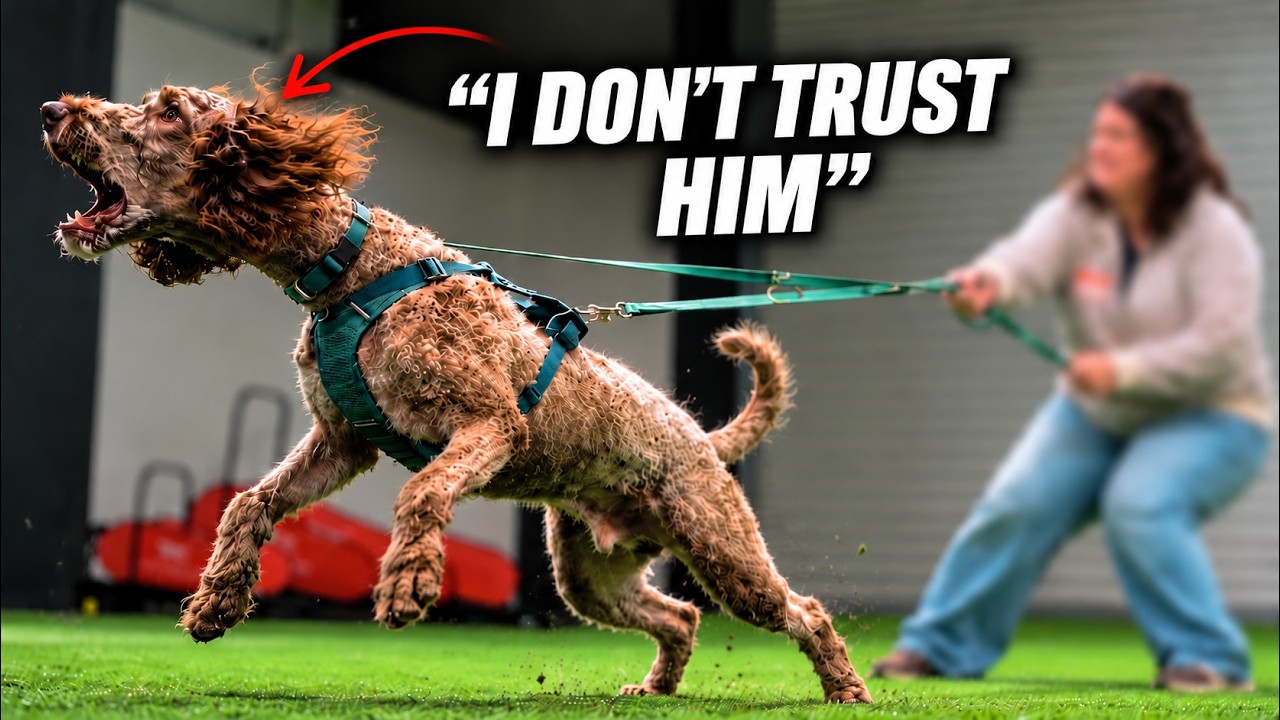
The video follows Christina and her highly reactive Labradoodle, Charlie, through a five‑day intensive boot‑camp designed to address the root causes of canine reactivity. Christina describes the extreme lifestyle changes she endured—early mornings, night walks, hiding behind cars, and constant fear—before seeking help. The trainers introduce a holistic "pyramid" framework (diet, health, rest, fulfillment, communication) and emphasize that reactivity is a symptom of underlying fear, frustration, and lack of fulfillment. Over the first three days they focus on building confidence for both dog and owner, clarifying communication (yes/no cues, action = reward/consequence), and teaching the owner to recognize her own reactive patterns. Practical techniques introduced include long‑line random recall, e‑collar cues, place command with a tether, and the "art of doing nothing" to teach calmness. By day 3 Christina observes Charlie’s breathing slow and his body relax, indicating genuine calm rather than appeasement. Days 4‑5 involve off‑leash work in public, where Charlie successfully recalls, plays with a stick, swims, and even smiles, while Christina reports reduced anxiety and increased confidence. The owner reflects on personal accountability—realizing her own behavior contributed to Charlie’s reactivity—and expresses excitement about future off‑leash hikes. The video concludes with a call‑to‑action inviting viewers to apply for similar boot‑camps.
Chapters
If you've got a reactive dog, you probably know what it's like to plan your entire life around avoiding the next reaction. You're waking up at 5 AM when no one is out, or walking your dog in the middle of the night. You've been hiding behind cars to avoid other people passing by, or driving somewhere quiet just to find some semblance of peace. That was Christina's life with Charlie. She had already spent months working with previous trainers, and although it had helped a little outside of the house, Charlie was still barking and lunging at everything in sight. She couldn't trust him around other dogs, and one day he even got loose and chased a person walking their dog. So any Freedom or peace for Charlie felt completely impossible. Over the next 5 days, we're going to show you what changed when we moved beyond obedience and started working on what was actually driving Charlie's reactivity. How would you describe Charlie in a nutshell?
Prior to coming to boot camp, I would say that he was just a very anxious, unsettled dog, not well adjusted whatsoever. The minute we would leave the front door, it was just a constant scanning, head on a swivel. He would see triggers, it would be lunging, barking, extreme responses that quite frankly would scare everybody in the vicinity. And so that's really what led us to seeking out help.
Did your family or friends say anything about your relationship with Charlie?
Yeah, there were multiple people who had told me that he should just be a backyard dog, that maybe I should rehome, just given that I don't have a backyard. Yeah, I felt that people were telling me that he was not going to be able to be rehabilitated, that it was kind of a sad case, and that I should We've
talked about Charlie and describing where he was at behaviorally, but what about you? What about the human and the leash? How were you feeling before training?
Extremely frustrated. I think that it really impacted the ability to bond with him. I became extremely— harsh to say, but resentful of the way that it was impacting my life. And I think that it in turn affected him because he was feeling that frustration from me with the constant trying to get him to behave in a way that I felt was socially appropriate. And I think that that prevented us from, you know, maybe trusting each other and enjoying each other and maybe even furthered the reactivity.
What was your big motivator for, like, not just knowing that you needed the training but wanting the training for him?
Well, I could see the anxiety and the reason for his reactivity. I wanted him to be able to feel calm and confident in his environment and to be able to, you know, because nobody wants to live with anxiety. I wanted him to be able to just enjoy the outside and be able to exist happily.
And did you ever let him off leash before training?
No, absolutely not.
Was there ever an instance in which he got off leash?
Yes, he backed out of a harness and kind of chased after an individual and a dog, and thankfully it didn't end in a bad way, but it was scary nonetheless.
Day 1, walking in, where were you at? Like, what did you feel walking into here on Monday?
Anxiety. Fear. Just, I didn't know what to expect because I knew that he would be with other dogs and I knew what he acted like outside of there. And I honestly thought he was gonna be the worst case that you guys had ever seen and that you guys would go, whoa, this maybe is outside of our wheelhouse. I thought just because that's, you know, my, my own reaction to that.
Yeah, it felt so overwhelming for you. Yeah.
But I felt that maybe others would, would also feel that same way.
My first impression is that she looks exactly like how she sounded on the phone. She was just absolutely desperate for change because she was beyond stressed out. by life with this dog. So much so that when she signed up for the boot camp, she signed up for the following week. So she truly dropped everything, put her second dog in boarding, and then commuted here 2 hours to be here that Monday. She knew that something had to change and something had to change now because the dog was on medication. Her family was telling her to give up on this dog, and she just wasn't there yet. And she truly on the phone had said, you know, can you guys actually help me? And I said yes. And she She said, then I will be there on Monday. Seeing the video, she looks as stressed out as she sounded on the phone. So that was actually really hard for me to watch because you could just see her fighting back the tears and just trying to breathe through that moment. On the other end of the leash, Charlie looks like your very typical anxious, fearful, reactive dog who medication has just completely failed. He doesn't show a whole lot of confidence. He's spinning around. He can't look at any one thing. He's concerned about the entire environment. Just blowing up and in constant motion. I think at the root of everything for Charlie arriving on day 1, it's all fear-based. He lacks a lot of confidence. Knowing his background, he hasn't ever had a whole lot of exposure, not enough structure. He definitely doesn't have any fulfillment. He's never been allowed to be off leash. He's very confined to short walks because of his reactivity, and all of that just rang true when you See his initial reaction to another dog. Our main focus this week is actually quite straightforward. We need to build both of their confidences. We want her to leave feeling empowered with the skills to navigate the world around her on and off leash so that she can continue to provide fulfillment after boot camp that is going to make him happy, balanced, and actually able to be confident and calm. And for him, You know, on Charlie's end of things, he, he needs a lot of clarity in his communication to be confident. And we need to really focus on play and the foundation of giving them something that they can interact and enjoy together as a team to build up their relationship so that the two of them just feel really confident being together, essentially as a team out in the world to have fun. Like, I want them both to leave here at the end of boot camp feeling like they are ready to just go enjoy each other the way that we we all want to with our dogs. If you're watching Charlie's story and it resonates with you, I want you to know that you're not alone. Reactivity, that barking and lunging, is just a symptom, not the root cause. Today we have a big day planned. I want to dive in a little bit deeper to our pyramid this morning because reactivity and aggression, those are symptoms of some sort of root cause, and there's a lot of things in which we can As far as puzzle pieces being put together that will work for us or against us. Diet tells us a lot about dog state of mind, but also it works for us or against us in our dog's behavior and energy level. Health is another thing. As Kristen just mentioned, you know, injuries can happen. Pain response makes a more reactive dog, makes a more aggressive dog. Health, injury, pain, All play a very big role in our dog's reactivity and aggression. So we always need to talk about that. We're observing your dog's movements. We're observing what your dog looks like in movement, because that can also give us indicators if there's anything underlying possibly going on that we want to talk about. And then ultimately rest, which you're going to get really tired of hearing us talk about, but that's often 90% of the time something that is not being focused on enough at home. Because we assume if our dogs chill with us that they're resting. There's a big difference between sitting on a couch watching Netflix and sleeping. Okay. When we come up the pyramid, a really, really big piece here is fulfillment. This is another avenue in which we focus a lot on because lack of fulfillment breeds frustration. A frustrated dog is a reactive dog. Frustrated dog is not a happy dog. We in this program focus fulfillment on 2 aspects: off-leash, because there is no breed on this planet that was meant to live on a leash, and play. And play is the one that, to me, one of the most powerful things, and we're going to get into that tomorrow. But I want you to think about these, these things of if there's any missing pieces, we need to fill these gaps in order to truly address your dog's state of mind, set them up for success long term, and eliminate that reactivity that we're experiencing. As we continue to go up to the top of the pyramid, communication is key. And it's always a really funny thing to think about, but our dogs don't speak English. We can talk to our dogs all day long, but they have no concept of words. So establishing clear communication Is really important, and that's what you guys started focusing on yesterday, is creating avenues to clearly communicate with your dog via tools and via rewards. Today we are going to get into the other side of this, how to stop a behavior that we don't want. So as important as it is to be able to reinforce desired behaviors, it's equally important to eliminate unwanted behaviors. And there's specific ways in which we can go about communicating that in a clear, precise way. Okay. Once our dog is doing a behavior that they don't— we don't want them to do, right? Counter surfing, barking out the window in the car, lunging, barking, growling at a dog on leash. That is no longer the moment to teach anything. When we talk about preventing unwanted— stopping and then preventing unwanted behaviors, we want to think about it in a very clear term. If it's not clear for us, It will not be clear for our dogs. The reason we say we break this down into yes and no is because it needs to be that black and white for our dogs. We can't reason with our dogs. Well, he only does it to little dogs, and it's only if the little dog's reacting first, and then it's understandable because the other dog started it, right? I can't reason that away. And our dog doesn't understand that, that, oh, you're fine with it if it's a little dog that reacts first, Then it's okay. If it's a big dog walking past and I decide to do it first, that's not okay. Way too convoluted for our dogs. So we need to think about this stuff when we're talking about clear communication in black and white. We allow your dog the freedom to take action depending on that action. It's very simple. It's either action equals consequence or Action equals reward. So a big piece for us when we're, when we're even contemplating talking about this is that we have all become reactive to our dog's reactivity. We can't help it. We've studied our dogs so much in trying to see the signs that we start to become reactive. Oh, they're locked and loaded. They're thinking about it. I know it's going to happen. Now you want to react. That's what we have to stop. Because we have to give the dog the power to choose. If we are constantly managing our dog's behavior, we are also breeding that frustration. That's very frustrating for our dogs. Power to choose is where we start to change their state of mind. We all have working breeds. We bred them to make decisions, right? Our herding dogs are control freaks. They love to make a choice. They love to try to control you or control your movement or control other things in life. We take that power away, we create a very frustrated animal. What we want to do now is just help guide our dogs into making a desired choice and not an unwanted one. I say all this because when we think about punishing crimes, it often swings to the dark side of, I don't want to punish my dog, I love my dog. I want my dog to be happy. Why would I want to punish them? Punishment sounds very extreme. And the truth of the matter is we can't compel a dog to stop either. What will change is if we leverage your relationship with your dog. So days 1 through 3 are pretty simple. We want to establish clarity in every client's communication with their dog so that ultimately they will have the ability and the skills to stop unwanted behaviors, also preventing them from continuing to happen, and then ultimately be able to reinforce desired behaviors at home and in public. For Charlie, he truly needed that clarity because a huge contributing factor in his life up until that point was the fact that his world around him was so confusing to navigate that it was just feeding his stress and anxiety to the point that his vet had put him on Prozac to try to address his state of mind, to no avail. So days 1 through 3 were really pivotal in his behavioral transformation. What have you gone through with Charlie prior to training with us?
Prior to this, I had a trainer where it was just one-on-one sessions. We would meet at a park, so there he would be around a variety of different triggers. He would experience over that, you know, couple of few hours, a little bit of desensitization with what we were doing. And so I would see a small change, but then we would, you know, go back into our neighborhood and then he would just ramp back up. The training that we entered That Charlie and I went through was a lot more obedience-focused. And so he became a really good dog in the home. But of course, when we went outside again, it would still be the barking, the lunging experience. And I became just so frustrated over time because I was inputting so many hours of training and I was putting all this work and effort into it just to, you know, not be able to see the results that I was hoping for. So my entire lifestyle changed. It was waking up at 5 AM, 6 AM, staying up until midnight, 1 AM, hiding behind cars, going into people's parking lots that I didn't I wasn't even a part of, you know, their, their apartment complex and trying to just find any outlet to get away from another dog or trigger that was on the street. Just entirely was the driver of my life, just his reactivity.
What about like driving anywhere in town? Was that a struggle to have him in the car?
Oh, absolutely. Yeah, he, I mean, he would try to launch himself through the dash. I have a small sedan, so unfortunately I, I don't have a crate where he can be in a small confines. He would just bark. He would see People on scooters, bikes, people walking by, motorcycles, even dogs in other cars, just constant barking the entire drive.
It's a constant headache.
Yes, absolutely.
What was it that made you wanna reach out?
The confidence that you had in your program. I think that you guys were really sure of what you were doing. I initially had seen, um, the Yorkshire videos. Yorkshire? Yeah. And it was a, a lot of, you know, things that I could relate to. It would be like, does your dog do this? Is your dog like that? So immediately I was hooked in because absolutely my dog hits all of those, you know, check marks. We're lunging. We're barking, you know, we're having bad experiences, we're trigger stacking, all those things. And so that got me to continue watching. Yeah. And then I was a little disheartened when I thought, oh gosh, I mean, that's in the UK. I can't go all the way over there. Then I realized that there was, um, a NorCal Sacramento, uh, location. And so I started researching that and found, um, you through— Awesome. Yeah. So
we just spoke last week. Why are you willing to literally drop everything in your life to be here this week?
I need change, and Charlie needs change. I can't live like this. He can't live like this. I know that— I feel internally he's got to be going through some inner turmoil, and it can't be— it can't be a good experience for him to live life where he exits his front door and then it's just a constant, you know, whirlwind to him. Everything is causing him to have fear. And so I wanted help getting him to a point where he could enjoy his life, and then in turn, so that I could enjoy my life again.
Yeah, coming in on Monday morning, were you feeling like, did I make a mistake, or I'm where I'm supposed to be, or did you still have doubts going into this?
Absolutely, I had doubts. Um, I thought he was gonna fail for sure. Not necessarily that I didn't think he was capable, but I didn't know if in 5 days I was gonna see the progress, um, given that I've been spending so many months attempting to train him and just not seeing really the progress that I was hoping for. So I did have doubts that he would get to where he is today on just day 3.
And so now that we've finished day 3, has there been a highlight or something that you're like, wow, I actually am seeing the changes? Like anything that you wanna share from your reflecting on just today alone, like the fact that you are only halfway through our program?
Absolutely. Yeah. When we were able to just sit in that small circle and seeing him relax, and I've noticed his breathing, it went from rapid breathing to when he was sitting down, you just saw his chest slowly rise and, you know, slowly decompress. And it's showing me that he actually is. It's not just that he's doing it to appease us and still having that anxiety. I'm actually seeing that he is changing his mannerisms and he's able to actually relax. So I'm seeing a significant change.
Well, speaking of which, that's awesome. Heading into day 4 and 5, is there anything specifically you're now feeling more confident that you want to tackle?
I really want to try off leash, but I I don't know. I'm not sure what— I can't even foresee what that looks like. Just, I'm still in the disbelief stage.
Yeah. Yeah.
So I'm loving that aspect, or the thought, the hope that we're going to get there. But I'm hesitant to get too excited.
Yeah, I gotcha. Yeah, I love it. So in thinking about the idea of even being able to have him off leash, have you tried off leash before this week?
No, no, no, absolutely not. I would not trust that.
So in the disbelief part, what is your biggest fear about letting him off leash?
I don't think that he's innately aggressive, but I worry that his behavior might lead to another dog having an issue. And so I think that it might create the perfect storm to, you know, put him in harm's way.
Gotcha. Stay tuned.
Yeah.
Dot, dot, dot.
All right, so this is our first time simulating what will be an off-leash walk. Okay. Off-leash walks are going to be massively important for him. He's a reactive dog. He's got a lot of stress and anxiety. We want to be able to provide a way to fulfill him genetically, biologically, however it is that, you know, we want to think about this. And he's got multiple working breeds in him, so he needs this. He needs to be able to sniff and explore and enjoy stimuli around him without constantly reacting to it. Right. So you're going to put the long line on. He is essentially free within that 10-foot radius, and you are going to essentially practice random recall. Dog's name, come. He comes back to you, yes, reward. Keep walking. In the event that he stops, or I mean ignores you, then come with your remote. He comes back, yes, reward. So the picture stays the same for him. It's just that practice. You can follow them, just maintain that nice distance and enjoy your walk. Ideally, this is the first time I just want you to go out and just enjoy a Okay, I'm excited. All right, e-collar in your hand. Yes. And you're off and running. Follow the black dog or just stay behind the black dog. Thank you.
Did you do anything off leash before? No, no, absolutely not. The trust was not there to be able to do that. Um,
probably would cause heart palpitations. I'd be absolutely terrified.
Come. Yes, buddy. Good job. The art of doing nothing is all about your dog's state of mind. Just teaching them how to be calm, how to exist in a space regardless of the distractions around them, and to be able to practice that at home and build that skill set. Dogs like Charlie are traditionally just free roaming around the house doing whatever they please throughout the day. Being able to then implement that structure at home makes a massive difference in making that positive impact so that when your dog encounters something out in public like their former triggers of reactivity, they are actually capable of remaining calm. Whereas before, without that skill, that's a big piece of the puzzle of reactivity— resolving reactivity— that's missing. We're gonna segue into something that is equally as important as everything else we have been learning this week, which is the art of doing nothing. This is a This is a skill that not many dogs come factory setting with, teaching our dogs how to be bored, how to settle, how to be calm. So we have to actively practice teaching our dogs how to, how to do this, literally. And I'm a really good example of that. I think if I was a dog, I would be like a Malinois because I don't settle well either. I don't, I don't do well doing nothing. But ultimately, we can practice that, right? So right now what we're doing is essentially the beginning stage of that. Hey, just hang out. You don't need to touch them. You don't need to reward them. You don't need to talk to them. You don't need to look at them. We're just showing them that, hey, you can just hang out in a room of people and be bored, right? I can walk around the room and pass your dog, and your dog doesn't need to interact with me or need to interact with anyone or any energy that's moving around them. That's really helpful. So Art of Doing Nothing teaches our dogs in another capacity How to essentially do nothing. So whether or not Mushu's been exercised, she's currently passed out on a bed right now because she has learned how to settle and how to be calm. So doing that at a moment's notice becomes really easy. So this stuff benefits all kinds of different things. But for us this week, our dog's reactivity cannot just be addressed on the leash. It cannot just be addressed in public in general. If we allow our dogs to do whatever they want mindlessly at home 23 hours a day, whether or not they choose to sleep, and then that 1 hour that you want to take them on a walk, you expect absolutely everything out of them, you're, you're all going to fail. So teaching and practicing the art of doing nothing is really important. Some things that it can really benefit us in our daily lives to enjoy our dogs even more are things like when we eat a meal, when we have guests When we have guests over, nothing's more embarrassing than the dog who won't leave your guests alone. When we're cooking, there are many household things that we can eat that our dogs wouldn't do so well with, so not having our dogs underfoot while we're making food is actually great for their safety but also our sanity. When we are working out, maybe around kids, maybe when you're cleaning. I use place command all the time when I'm cleaning because nothing's more maddening than vacuuming and you have a black lab right next to you just putting more hair on the ground. I at least want to feel like I finished the task before he starts shedding again. So ultimately, our goal is to practice emotional regulation for our dogs. So if you have an only dog, it sometimes gets really easy to just have them be free in our house because ultimately they typically are probably fine when it's just the 3 of you or the 2 of you in your house. Your dog might act more like this in general. That doesn't mean that you shouldn't practice teaching your dog how to be calm on command because the ability to put your dog into a calm state of mind is what really helps our reactivity. The way that we're going to do this, and the easiest way to practice this at home, is with place command. So right now your dogs are on place with you holding a leash and you're sitting right next to them, but that's not realistic, right? Raise your hand if you want to do this for 2 hours a day. We got things to do, we got stuff to accomplish. So the best way to start this, to practice this and implement this emotional regulation exercise at home is simply to use a tether. Makes it not optional. So ultimately, if you're gonna practice place command, it's helpful to have a dedicated bed for this. So then it's conscious for you that you are going to practice this. Your dog goes, oh, when she puts me down on this bed, I get my tether. Now all of us are in working training mode. The biggest thing about place command though is it is passive training. Day 4 and 5 is when the real fun begins. Because that's where we are taking the clients and their dogs out into the real world to practice in environments that they've either struggled massively, avoided, or never even tried. And we're building their confidence in being able to have their dog on and off leash. And this is where the magic happens, because as a result of day 4 and 5, the transition back home to their life, you know, with their dogs outside of us and our boot camp, that's how we build that long-term success. You've completed 5 days of boot camp with us. Going into day 1, we specifically say that by Friday we will have your dog off leash in public reliably with you around anything. Did you believe me when I said that?
No, no. I thought for sure I was gonna fail, or he and I maybe would fail. I did not think that I was going to be sitting here in this chair with my dog relaxed beside me. I didn't think that was possible.
So then Wednesday we go off-site for the first time. How were you feeling when we, when we did our first public off-leash skills session with, with him?
It was scary at first because I was still having those thoughts that of, you know, trying to prevent the incidents, and you're, you're also scanning, or I learned to scan similar to how he was doing. But when I noticed that I was in control and that, you know, he was responding really well, I eased up. And it got to a point where in between our little breaks, he actually was laying down, and I could see I think a, like an aha moment for me was really just seeing that his rapid breathing, it went from to just like slowly inhaling and exhaling. And I could tell that the changes were happening and he genuinely was relaxed in an outside environment. And I could just, you know, it clicked. It's happening.
Amazing. So then we, we push you even further, right? Now you're halfway through the course and we head into Thursday and all day Thursday we're training in public. How were you feeling about all of that? Just give us your experience on like 2 full days of having him out in the world around things.
Yeah, we've built so much trust, Charlie and I, in the last few days actually. My anxiety is not there anymore. I feel that I have the tools to, if there is an issue, rather than overreact or think, gosh, what am I going to do in this instance? I feel very confident that I know how to manage it and that in that one split second that he knows what I'm expecting of him and that we can move on like nothing happened.
Amazing. Yeah. I distinctly got to do your first off-leash session on Thursday. When I told you to drop that leash, what was that like? Like when I said, do not have your hand on that long line anymore.
It felt really liberating that you had faith, and in that I also was building my faith. And when it happened and he was recalling and I could see that, you know, he was enjoying his environment and that changes were happening, I could finally see the light at the end of the tunnel.
And what did you think he felt like when you, when you're just walking through this park and he's just off-leash exploring? What, what were I
think it was the first time I saw him smile, you know, his mouth was open. He was really just enjoying himself and his eyes looked really lively. It just, he looked very confident, things that I hadn't seen previously in other walks.
And how, how did today go?
Amazing.
Was he off leash?
He was off leash and he even played with a stick.
He did play with a stick. Did he get in the water?
He did get in the water, which he previously has really disliked water.
It's amazing. Yeah.
I'm on cloud nine.
Good.
I never thought I would be here.
So we complete Thursday, you head home, and then you meet us yet again in public this morning for what becomes a true on and off leash walk at a very busy park with a whole lot going on. Describe for us how you and Charlie were feeling having that experience in public.
I think we went into it confidently, which I'm surprised to even say that. Even the drive over Was calm. He's starting to relax in his seat versus like standing up or walking around the car while I'm driving. He's actually resting while I drive, and that's the first time I've ever seen that. So even just come, like, you know, our traveling to the, um, to the site was really exciting for me. And once we got there, I think that just the trust that we've been building over the last week, it really was solidified today with the things that we were doing. Just the walking off leash and being able to be in such close proximity to other dogs and engage in social behaviors and see that I can trust him and that he's going to respect and be polite and have good leash manners, engage well with other dogs. It was like the icing on the cake, you know.
Looking back on the last 5 days, whether it's training related or otherwise, are there any moments that you want to share that just made you feel really happy?
I think the stick. Yeah, I think playing with the stick. He He is not— he hasn't really opened up to play. He is really food motivated, but I've tried for various months now to try to get him to get into squeaky toys or rope toys or anything like that. And just to see him chase a stick that I threw happily was—
And to just be in public and not care about what's going on around you. Absolutely.
Yes, absolutely. Absolutely. Yes. Yeah.
Yeah.
I almost grew to expect that from Thursday to Friday, that it became Yeah. That's, I feel like that's how fast that he and I are progressing through this.
I love that. Yeah. If you could summarize sort of your big takeaways from our training philosophy and your experience in our boot camp, what would that be?
I think that for me, especially initially, it really starts with me. Previous to this boot camp, I, I put a lot of the onus on Charlie, like, oh gosh, like you're reacting poorly, this is on you. And I didn't really think that it was on me. What are the behaviors that I'm doing that are leading him to act this way? It was very eye-opening, and to hold that accountability, to know that if I engage, you know, better and correct my behaviors, that he can in turn trust me, be more confident, calm, and neutral.
I love that. Yeah. Okay, so after this, you guys are heading back home to resume your normal life. Is there anything that you're excited about or looking forward to now?
I want to try hiking off leash.
Yeah.
Yeah.
I love that. I'm in for it.
Done.
If your life revolves around avoiding dogs, worrying about the next reaction, or waking up at the ass crack of dawn because that's when no one else is out, I want you to know you don't have to keep living like that. We run our 5-day boot camps in California, Yorkshire, Sussex, and Perth. If you want to find out if we can help you and your dog, use the link in the description to book a free call and apply for our boot camp.
And if you're not ready for our boot camp just there's another link in the description to our free Behavior Bible course, which will help you get the foundation in place. See you in the next one!
More from Jacob

I Wish Someone Told Me THIS When I Had a Reactive German Shepherd (Extreme Case Study)



Are you playing the wrong game with your dog? #dogtraining #dogtrainer #dogowner


Mabel's Incredible Reactive Dog Transformation #dogtraining #reactivedog #dogtransformation