Struggling With Your Reactive Dog? Ask Us LIVE
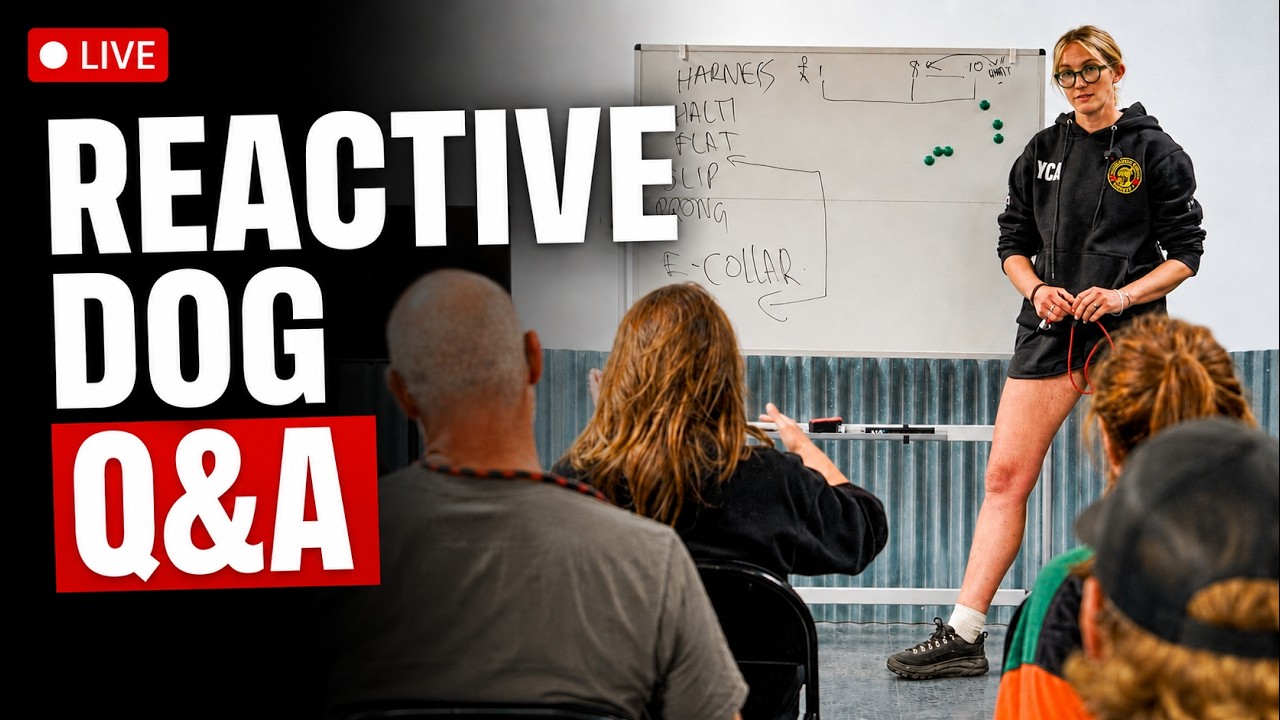
Kelly from South Coast Canine Academy answers live questions about reactive dogs. She discusses her 5-day boot camp model, which gets dogs off-lead quickly, and covers specific problems like car-barking, fearful dogs, and puppy mouthing. The academy offers weekly classes or intensive programs with a money-back guarantee.
Chapters
Hey guys! Heya! I'll just wait for a few people to join on because I'm a tiny bit early today. Let me know in the chat who's here. Let me know who you are. Let me know where you are. Let me know about your dogs. Helena's here. How's it going? Hopefully it's not hotter than the surface of the sun where you guys are like it is here today. It is roasting once again. For those of you who don't know or have never listened to the podcast, I hired a witch for the opening of South Coast to bring good weather. Ah, hi Jim and Coco! I hope Coco's feeling better after her surgery. I think maybe now since she's had her donut off. Coco is one of our, uh, graduates from South Coast, and she had to have a little surgery last week, so she's in recovery. But to be fair, she's not missing out on anything because she can't really do anything because it's so hot outside at the moment. Oh, getting there, good girl. Um, yeah, I paid a witch and I asked her for good weather, and she's done me dirty because it's way too hot, and it's been too hot here for about since the day we opened. We had rain today. I'm jealous, Helena. I wish we would have been here. Everything in my garden is dead. Every blade of grass here is yellow. Um, all right, well, we'll get started and then hopefully some more people will join on as we go. Obviously, uh, Jim and Helena know who I am, but for those of you who have never been on one of these before or haven't ever watched me ever I'm Kelly. I'm the owner of South Coast Canine Academy, and much like YCA, we specialize in reactive dogs. We work on 5-day boot camps, so you guys can come and join us, see if you have any— not see if— give us a call, have a chat to one of our team if you guys are currently like struggling with your dogs, if you're working through reactivity, or if you have questions. Book on a call with one of our trainers, and hopefully if we can't get you on one of our boot camps, you'll walk away with some useful advice anyway. Um, for those of you that have just joined, let me know in the comments who you are, let me know where you are. If you've got a dog and you've got questions, chuck them in the chat box and I'll answer as many questions as I possibly can in the next hour. Um, I will maybe chat a little bit more about our boot camps. So I'll talk about some of— since Jim and Helena are here, I'll talk about some of our previous boot campers, the types of dogs that we generally tend to work with. Um, if you've watched any of our content before, you'll know that there is no no breed, no age, no size that we won't work with. We will, however, only work with dogs that we feel like we definitely can help. Um, so if you're looking for that help, then I would definitely jump on a chat with one of our team. But Jim was here with Coco 3 weeks ago now, I think. Um, Coco was super reactive with other dogs and Jim had been struggling with it for quite a while. She was hard to get out, so obviously that meant that her life was getting a lot smaller because Jim was nervous of places that he could take her, other dogs that he was going to bump into, where he was going to go, what time he was going to go. So Coco's world was just getting a lot smaller, and he wanted better for her, and he wanted her to be out there living that life. He just didn't really know how to get there on his own. He had tried a bit of training before, but nothing up until this point had really stuck for him. Um, Coco did amazing over our— over the week at the boot camp. She came on leaps and bounds, and I think they've been— Jim would agree they've been having a really nice time since they've got home. He's been able to take her out to the reserve, nature reserve, that's behind his house, but he— was a no-go area for him before because he can, he can guarantee that around every bend there wouldn't be another dog. Um, Coco's off lead. It was so lovely to watch her the first time Jim unclipped that lead, for her just to experience that freedom. She was so happy, just in her own little world, sniffing, being in the environment. Um, and she also goes to work with her other owner, so now she doesn't have stress of worrying about other dogs being on site. She can just take her with her. So Coco's really back and part of the family now, which is really nice. Um, a couple of new people have just joined on, so hop straight into the chat if you've got questions. Like I said, I'm going to be here for an hour tonight, so I'll try and get through as many questions as I possibly can. If there's something that you want answered, if you're struggling with your dog pop it in the chat, give me a bit of context if you can, and I'll do my best to answer all of your questions before our hour is up tonight. Um, one of the main things that we really work on during our boot camps, like I was saying, it's— it was so lovely to watch Coco getting off lead and just being out in the world and being a dog and being free. Um, we really focus heavily on getting dogs off lead as quickly as we possibly can. Obviously, you guys here tonight likely all have dogs. We all know that our dogs unfortunately don't get to be with us for as long as we would love to have them. Their lives are short, and we want them to be as good as they possibly can be for as many years as they possibly can be. And to us, that means a dog that is free to go and live in the world and experience the world and live as free a possible life— as possible life as they can. So our courses are all very heavily focused on getting dogs off lead safely as quickly as we possibly can. They can be out there in the world, they have outlets, because dogs that that live on the end of a 5-foot lead, or for some dogs that have to live on the end of a 2-meter lead because they can't be trusted with any more freedom than that, really it's no life. You all will know if you're living with a reactive dog, you want to give them better but you can't trust them, and you don't want them to get in trouble, you don't want members of public to get in trouble, so you end up stuck in this trap where the dog's constantly next to you on a tense lead. They're pulling because they're not supposed to walk that slowly next to us. They're supposed to be moving their bodies in a more natural way and covering more ground and experiencing the environment that they're in, and we can't allow that as much when they're on the end of a, of a lead. So we really try and get dogs there as quickly as we possibly can so that that real outlet to be out there and just living their lives is there. I have questions from our channel to get us going. How to deal with dog yapping and barking in the car and in the crate when the indicator comes on and spins and kicks off more? That is wildly niche question. Your dog barks only when the indicator comes on in the car. Um, okay, so in terms of stopping behaviour, a lot of people will have a way to stop behaviour in the moment, but given the opportunity, if the same picture presented itself again, the dog would likely do that behaviour again. So the way we teach punishment. And punishment has become a bit of a dirty word in dog training in terms of people thinking that that just means retribution, that means beating the dog on a prong collar or using an e-collar or bashing them over the head with the newspaper. It's not that. It simply means reducing the likelihood, intensity, and frequency of behavior. So if what you're currently doing isn't doing that, then you aren't punishing. Um, in terms of dealing with it specifically in the car, I would want to load a punishment marker so I'm able to effectively communicate with my dog, hey, that's incorrect, I don't like it, stop doing that specific thing. Especially if it is that specific, to be fair, when the indicator comes on. So wait, huh? Yeah, I don't really understand the question about the indicator spinning, but it's probably that also that that noise has become a precursor to the dog doing the thing. So the dog hears the thing and then they're like, oh, sick, that means I just go nuts in the car. So something you could easily practice at home if you have a clear punishment marker with your dog: get in the car, turn the indicator on, you use your punishment marker to tell the dog, hey, when that goes off, don't do that anymore. And then you can start paying into behavior that you actually do like when the dog's in the car versus just them gobbing off The thing about behavior like that as well is like the dog will get a bit of a payout from it. Like, most dogs enjoy barking quite a lot, and a lot of dogs that are really under-fulfilled in terms of off-lead freedom, like I was talking about before, or being fulfilled in play— dogs have a genetic need, every single one of them, to do something, and we can help to fulfill those needs by getting them off lead in the environment, but also playing with them properly. I think play is one of the things that people probably sleep on quite a lot versus— not versus, like, also they don't really know how to play properly. We think just play to us is that classic thing of standing in a park or standing in the garden, tennis ball and chuck it, stick, whop it as far as you can possibly get it. Rinse and repeat, and the dog just goes round and round and round like that, and we think that that's play. And don't get me wrong, the dog probably is enjoying it, like, otherwise they wouldn't do it, but it's not really constructive, and you're not really draining the tank effectively there. There's no— there's no two-player game there. You're just the person on the end of the chocolate stick, you could just be a tennis ball machine. It wouldn't make a difference whether you were there or not. So you're not relationship building with your dog in any way at all. You're just the person throwing the ball. You're also creating a bit of a dopamine junkie where the dog gets the ball and then they get this big payout because they got the ball and it was amazing. And then they bring it back and they're like, great, now chuck it again. And it creates this bit of a crackhead effect. So things like playing chuck it isn't really something that we ever recommend. Whenever you're playing with your dog, you really want it to be a two-player game that fulfills the need of that dog. And don't try and pigeonhole your dogs into things like, if you're— well, if I'm not going to play chuck it, then the other classic game is tug. But maybe some dogs don't really like the tug. They don't like the conflict being that close to you. So when you're thinking about play with your dog, it's thinking about, yeah, I'm going to fulfill them in some way. It's going to be a two-player game so we can get that bit of relationship going. Um, and I am gonna play a game that— find a game that me and my dog actually enjoy playing together. So find out what things your dog actually likes, or what parts of certain games your dog actually likes, and build the game around that. Um, off-lead dogs keep running at my reactive dog and ruining months of progress in seconds. What do I actually do in that moment? Predominantly, change your mindset around that happening. Like, unfortunately in life— Elena Chin, the owner of the off-lead dog, Jim will definitely second that. Yes, to an extent you do what you need to do to get— keep your dog safe, but change your mindset around that. Unfortunately, yeah, there are people out there that don't have control over their dogs. And if you've put in those months of training and you have that clear communication system with your dog where you're able to give them appropriate feedback about when they're getting it right and when they're getting it wrong, then actually that's a great training moment because life's thrown you a curveball and you know exactly how to deal with it and exactly how to give your dog feedback in that moment. So stop thinking about it like it's ruining progress and start thinking about it like, cool, I'm prepared for this now. Like, I've got my proverbial and physical tool set, let's put it into action, let's go out and live in the world because the world is going to chuck you off-lead dogs all the time. So roll with the punches, be ready for it, go out and find those off-lead dogs, help your dog be able to cope with that. Think about helping your dog in terms of resocialization. Um, most dogs running up to your dog, like, most of the time— although yes, it is rubbish at the moment and most people that are living with dogs that have worked through reactivity or are working with— through reactivity have got some kind of PTSD there, because for some dogs that's how it all started. Um, but now you can, you can work through it. So keep yourself calm in the moment, keep your dog moving, don't become static. So a lot of people, when they see the dog running up to them, they're like, oh my God, what do I do? And your immediate response is to completely freeze and hold your dog there. And most dogs will really struggle with being still. If you can just keep your dog moving, likelihood is that dog is just going to get bored, see you moving away, and leave anyway. There are very few few dogs that will just keep on chasing you, chasing you, chasing you. So yeah, there's an element of advocating for your dog and keeping your dog safe, but also just keep yourself moving and think about it as a training opportunity rather than something that's ruining progress that you've made. Think about it as something that can make you— get you to even more progress, because now your dog has experienced the thing that spent all those months training for. Um, let me know if anyone else here has got any other questions, otherwise I will continue to waffle about things. Um, if anyone has just joined into the chat and doesn't know who I am or why they're here, I'm Kelly. I am the owner of South Coast Canine Academy. Um, we exactly like YCA specialize in reactive dogs, and this whole stream tonight is just a nice place to come for some free advice. So if you guys are living with a reactive dog or you have questions about your dog, then pop them into the chat. I'll be here for another 45 minutes, so I'll try my best to get through everybody and get through all of your questions. Don't get much for free anymore, so you might as well. Um, is it sometimes our perception rather than the dog's? Do you mean in terms— oh, hi Ginny! I hope that's actually Ginny. I thought you're gonna be on a train. Thanks for joining. Um, there isn't— there is not no credit to when people say you're your body language transfers down the lead. So try and keep yourself calm. And obviously that's easier said than done, but you, yeah, sometimes do have that bit of PTSD because if you are unfortunately one of those owners who has a dog who has been attacked properly by another dog, then yeah, of course, like, your perception of a dog running towards you is like, this could go horribly wrong because it has gone horribly wrong before. But most dogs are not that proactive. It will just be handbags at dawn, lots of barking, and then they'll be done with it. Or they'll run up towards you and you keep your dog moving and move away, and that other dog's just going to be like, uh, okay then, well, see ya, and off they go back to do their own thing. Um, is puppy biting a phase or can it become a behavior that results in biting a dog when it's an adult? Do you mean puppy biting on you or do you mean puppy biting on other dogs? One most common myth is that don't worry, your dog will grow out of it. And yes, while puppies do mouth on people Yeah, I would make sure that you're putting some clear boundaries in there with that puppy about when and where it is appropriate to put teeth on things. Yes, puppies will be teething and they will need to mouth, but putting teeth on you is never appropriate. You never want your dog to learn that that is a fun thing to do. So start young. He loves to He loves to bite in an affectionate way. I'm not sure what that means. Do you mean like cobbing or actual mouthing? I'm not sure there really is an affectionate way to bite someone when it is a dog, because yeah, when they're a puppy it's not aggression in the beginning, but it's also not appropriate to put your teeth— put teeth on your mom or teeth on your dad. So I would start young, build in some clear boundaries with play there. Um, so have a clear start cue and have a clear end cue for your game, and make sure your dog knows that there is an appropriate time and place to display that behavior. You can put teeth on this toy, we can silly with it together, but when I say it's done, it's done. And making sure also with a puppy in terms of mouthing, a lot of people have puppies and forget that they should be sleeping for around 20 hours of the day, and we're very reluctant to put puppies down for a nap. So make sure you're utilizing things like a crate, utilizing things like pen if you don't use a crate, and making sure that your puppy is getting plenty of sleep. Because then those behaviors like mouthing, putting teeth on you, even if it is in an affectionate way— which I don't think maybe it is an affectionate way, um, he's not trying to savage, seems like he likes the comfort— I just don't think comfort should come in the form of putting teeth on you. So he can do that. And if he's teething, absolutely, I'll find a way to help soothe that. Like, frozen things are good, like small— like a little frozen carrot or something like that. Um, toys that they can mouth and chew on, fine. But mouthing and chewing on people, I never want my dog to learn that that's cool. So yeah, make sure that your puppy's getting plenty of rest and make sure that you're giving them an outlet to do the thing and making it dead fun for you to do it together, but showing them early on time and place. And that will really help you as they get older, because when you have that beginning and end cue for a dog to start playing, you can just be silly with it. Like, you don't have to build a bunch of obedience with them, just the puppy but just make sure that it's when I say we can, we do, and when I say it's over, we're done, and you're gonna go to sleep now. So you start to play with that arousal and not be letting them get super overtired and then just making a bunch of silly choices because they're tired. Um, I socialized my puppy with every dog I could find. I thought I was doing the right thing. Now he's reactive and I don't understand why? What did I actually do wrong? Okay, so socializing isn't always— well, it isn't what most people think it is, um, which is just letting your dog meet every single person and every single dog that they ever see. Because one, if the dog's super, super social and loves that interaction, there will be a time in your puppy's life where they're no longer a puppy and they are a dog and you just need to get them from your house to wherever it is that you are going, so you can't stop and you can't say hi to everyone because today you don't have time, today you have to go to work, today you're on the way to an appointment, today you just don't want to do that, then comes the frustration because the dog's like, well, I always got to do it when I was young, I said hi to everyone and now I can't and now I want to, so let me go. And you're like, nah, not today, bud, come on, we're going this way. Then they're stuck on the end of a lead, and then they get frustrated, and then reactivity comes. The— also, also, the risk that you run with letting your dog meet every single dog you can find is when your dog is young, you want them to have as many positive interactions as you can possibly get in, and that doesn't happen with every dog because not every dog is going to be into meeting your puppy. Not every dog is a neutral, balanced dog. So you're only ever one bad interaction away with a young dog from them learning that other dogs might not be quite so nice as they think they are. So it isn't unfixable. It's not that you've gone drastically wrong. You just need you need to start thinking about addressing that behavior now and making sure that you are putting in clear boundaries with the dog about when it's appropriate, when and where, and finding appropriate outlets. Like, if your dog only ever has fun and plays and does stuff— and I know I sound like a broken record because I'm always harping on about it— but your dog only ever leaves the house and then as soon as they leave the house, the only place they ever find joy is in the environment or with other dogs, then you're completely irrelevant because you've never provided anything that they care about outside of the house. So work on your play with your dog. Be, be like, we can have fun and we can do stuff, and I know you want to do it, just do it with me. We can still have a good time together. Build a bit of, um, not motivation,— can't think of the words. Do you guys know what I mean? Probably do. Build your dog's drive to want to play with you there. Give them that outlet. Just give them it with you. Um, maybe a kong bite that isn't a real bite. Just for context, everybody, we would class any teeth meeting skin as a bite. So no, Elena, a Collie bite is not different. Uh, he's not trying to savage. I met a 1-year-old male and he did the same thing and it was all love fro. Do you mean love bro? Love bro. This dog, he was— oh, it was also all love from this dog and he was also super trained and trying to have him permission to play with me, but he, um, trying to gauge bite risk. Do you mean bite risk like genuine bite risk from the male, or genuine bite risk from your puppy? You mean if your puppy learns to put teeth on dogs? When playing. Dogs are very tactile in terms of how they learn. So if you know my Mal when he's fully grown, okay, so one, your Mal is always going to enjoy putting teeth on things because that's what he was bred for. So again, hate to sound like a wee broken record, but you're gonna have to find an appropriate outlet for your dog do that, and that is most likely going to be through play. If you are socializing him and letting him play with other dogs, make sure that those dogs are balanced, and if he takes it a step too far, that that dog will give your puppy an appropriate correction. He won't either go over the top and go absolutely ham at him for nothing or he's not gonna be that dog that will just take it and take it and take it and take it, and then your puppy never learns anything because you just let it go on and on and on and on. If that other dog won't give any correction at all and we'll just keep— don't say engagement because if Kirkie's watching this, he hates that word. Um, if that dog will keep taking it and won't give any correction at all, then you need to make sure that you have a way to step in there and referee that play and let your dog know when they're being too much. So that might mean that you have a line on the dog and you're able to separate and say, all right, that's enough now. Again, something I would teach through play, an end of cue play, end of cue, end of play 'You, it's half 5. It's been a long day to get here.' Um, an end of play cue, so you're able to say, 'All right, enough now, knock it off.' As they get older, you can build in cues like easy, where you teach the dog to toggle in arousal. So they can come up, and when they get a little bit too much, you can say say, okay, easy, take it down. Again, it's something you can teach through play. A dog, a puppy that young— I don't know how young your dog is, probably too young for that kind of stuff. So it's more going to be making sure that he's interacting with dogs that will give an appropriate correction. If not, then you need to be in there to referee that play and say, hey, you're being too much now, knock off. Um, but yeah, if you have a puppy, Mali, he's always going to enjoy biting things because it's what he was made to do. 13 weeks old. Oh yeah, so just have fun with your play, put a start and end cue on it, make sure if he's mixing with dogs— there's loads of flies in here. Um, it's making me feel very overstimulated. Uh, make sure that you are able to step in and referee if he's playing with other dogs. And depends what you— I'm like, I'm not in any way in sports and not the right person to talk to about it, but depends where you want to go with that dog. Do you want it to be a pet dog or do you want it to be a sport dog? Because the biting, putting teeth on things, if you want it to do work, probably need to be careful about what you're telling the dog not to do early on if it's something you do want them to do later on in life. But I am not the right person to talk to about that because I am not involved in dog sports in any way. So, um, if you want it to be a pet dog, then making sure that you're— you have clear boundaries from the get-go, that dog will need clear boundaries to know that there is an appropriate time to put your teeth on stuff. It's never appropriate to put teeth on me, but I'll give you an outlet, and it's when I say. Uh, Miles loves to bite. I've never let my two put teeth on me or any person, always appropriate toys. Yeah, value, Ginny, that's a better word. Yeah, always making sure that— it's the thing about dogs, right? Like, they— we— they are living, breathing creatures that they have needs and genetic desires to do certain things. And we have them as pets and we want them to live in our pet world, but quite often we neglect the fact that they have those needs and we try and pigeonhole them into just being couch potatoes or trying to fulfill them with just chucking balls down a field or walking them around a block for half an hour every day and just letting them sniff a couple lampposts and thinking that's enough. For the majority of dogs, it's not enough. We can say, yeah, there are certain things in our world that in our society it's not appropriate for you to do, but I know you want to and I know you need to. So I will provide you an outlet for that. Um, there just has to be a time and a place. My 18-month-old GSD now can redirect when I give him a leash correction, especially when he's frustrated or aroused. Is there anything I could do to stop it, or is there another correction I can use? Uh, I am not going to give you direct advice on redirecting over the snack because that would be very irresponsible of me. Redirection is something that you should always seek professional advice with. Um, in terms of fixing that redirection and stopping that from happening, you'll want to make sure that you have a clear punishment marker so that your dog knows that that is not okay, but you'll want to make sure that you're doing it with a professional. So if that is not us, then make sure that it's someone reputable who is going to deal with that appropriately, because you don't want that to get worse and you don't want to end up with holes from teeth on you. So not something to play around with without professional advice. If— don't know how long you've been struggling with that, but I would 100%— I think there's a link in this chat somewhere. Even if you choose not to work with us, eventually book on a call and have a chat with one of our team. We'll dig a little bit deeper, see what's been kind of going on there, and if it's something that we help you with, then we absolutely will offer you our help. So jump on a call with one of the team and have a chat. Let us know exactly what's going on. Let us know exactly the, the circumstances surrounding that, how long it's been going on for, all that kind of stuff. Um, and if we can help, then we absolutely will. But please don't try and find rando advice on YouTube or TikTok about that. Am I allowed to say TikTok on YouTube? I hope that doesn't get cancelled. Sorry, don't try and find random advice online because you could end up getting hurt. You're welcome. Um, this dog is super affectionate and we gave him lots of fun and play. I'm wondering if it's just teething. My Bernese did it and never bit anyone or came close, but different breed, I guess. Personally, I would never let puppy put teeth on me. I'll give you an appropriate place to put it, but teeth on people is never okay. And you never— with a dog like that who really enjoys that behavior, you never want them to learn that sinking teeth into a person is fun or appropriate because behaviour. As we— most people here will know, behaviour that gets rehearsed gets repeated. And if there is reinforcement there in, in any way, like for your Mal, there is going to be an element of genetic reinforcement there. When he's biting you and putting teeth on stuff, he likes it, so he's going to repeat it. You don't want that behaviour to get repeated, so make sure you're providing an appropriate outlet and put some clear boundaries in place as to when and where that is acceptable. And make sure that dog is getting plenty of rest, because that is— yes, it might be teething, but you still can't sink your teething teeth into me. You can put them into something that will help you with that for sure, but it can't be into my arms or legs. Or anywhere else for that matter. So make sure there's outlets, make sure that dog's sleeping enough, start working on your play from the get-go. It's going to be super important with that dog throughout its life. And if you start now at 13 weeks just having fun, and ultimately at that age just making sure that you're getting that dog out, seeing as many things as they can possibly see, experiencing as many sounds, sights, surfaces, and different environmental things as you can possibly get them to experience, making sure that they're seeing it all at that age and building that nice fun relationship with you. You know, like I was saying, especially at that old at that age, we're not encouraging it. Or out. And there's a strong no if it's more than soothing mouthing puppies do. Okay, but that's the thing about the no, right? If that no doesn't stop that dog doing it again, then what does that no mean? Is that if we're not reducing likelihood, intensity, frequency of behavior, you're not putting a stop to that thing that you potentially don't like. So you need to make sure that you're trying— if you're trying to get rid of that happening, dogs learn by consequence and association. So if no, just leads to you then getting given a toy, then that dog's going to be like, ah, sick, that's how I get you to play with me. I start mouthing you and then you run to the toy box and get me my, my squishy dinosaur. I love doing that. That's how I activate you into doing something. No, that's where those clear windows and boundaries are going to start to come in and be really, really helpful for you. Make sure that, yeah, there's a time and a place. Every day I will play with you and we'll have fun and we'll be silly with it. Like, it's not got to be this military thing where you're teaching all this obedience right away, because your puppy is just a puppy, they're just a baby. Like, they just want to have a good time, and you want to build that bond and have that just like nice silly time together. Absolutely fine. But I have two wild sons. I'm not an abuser, I promise. Um, just really making sure that you're working on clear boundaries there, because with a dog like that, a drivey dog like that, you're going to want to start as you mean to go on. So if the, if the teeth on you is something that you want to stop because that's not something you want to do with that dog, then I would make sure that you are not giving your dog any opportunity to rehearse doing that. If they're teething, that's fine. You could be, um, not sensitive to it. I don't know, guys, I've really lost words. Do you know what I mean? I can appreciate that's what you're going through, but that's not even the right term. I can understand— Christ, I can't believe it took me that long to get to that word. Okay, I can understand that you've got sorely teeth, but I'll give you somewhere— I'll give you something else to do to make you feel a bit better about it. Don't bite me. Makes sense. Um, especially with puppies here, like, start as you mean to go on. Don't let dogs rehearse things that you eventually don't want to be there when they are full-grown dogs. Um, it's all cute and it's all fun when it's all the nibbly nibbly and the jumping up and all the other stuff that seems all cutesy because they can fit in the palm of your hand and they're dead sweet and they're just little cute as a little button. But if they keep practicing that until they're like 6, 7 months old, then they had 6, 7 months of practicing doing something that you ultimately don't want them to do. He'll roll on his back with because he loves a chest rub, but he always has to have a nibble. So then you can utilize things like a house line. So just like a little thin line that you can put on your dog. I think you get them for probably like a couple of quid or something. Um, so when teeth goes on, you're able to remove your hand and say, hey, doesn't get you anywhere. It also doesn't get you to a toy, and you're able to use your lead to move the dog away to say, no, if you want affection from me, we can do that, but not while you're putting teeth on me. Like I said before as well, like, that behavior tends to come out when they get a bit giddy and they get a bit silly and they're needing to go down for a nap. So think about what that behavior is telling you in terms of how, how many hours sleep your puppy has had that day. If they've been up for the last 5 hours running around like a lunatic, here, there, and everywhere, doing this, doing that, probably time to go down for a nap. So use that as an indicator of like, oh, actually, maybe it's time for you to go for a little toilet break, little sleep. Um, my dog is 6 years old and has been reactive for 4 of them. Can you actually teach an old dog to be social again, or is it too late? It is never too late to teach your dog anything, but you have to think in terms of what I was just saying there, what's rehearsed. We did that, but he gets to 6, 7 months old, they've had 6, 7 months of practicing something. So if your dog has been going sick at dogs for 4 whole years you, yes, will be able to build a clear communication with that dog and say to them, give them appropriate feedback that says, that was right, that was wrong. But your dog has a history of doing that stuff. So when you think about behavior, I always think about it in terms of like a weighing scale. So Currently, now, this is the stuff you don't like. It's all the way up here because you've had 4 years of your dog doing that stuff, and the stuff you actually want them to do is all the way down here. So I am gonna have to work hard to balance that scale back out so I get my wins in of stuff I actually do like my dog doing. So this behavior starts to go away. I think that's probably the thing that people struggle with the most when they've been living with dogs that have been reactive for so many years, practicing the same reactivity on the same street, same dogs, every single day, day in, day out. And then they go home and they sit and they shout out the window all afternoon. What started, wherever it started, whether that be from frustration or from fear, your dog has got some kind of payout from it at some point. And then what used to be, I barked because I was scared, or I barked because I was frustrated, has now become a bit of a hobby for the dog because they're like, oh, I get this bit of a good feeling when I do that thing. So now their world shrinks because you can't take them anywhere because you don't trust them anymore. So things become novel, and then your dog's looking for a place to put energy because you can't get them out, you can't get them off the lead, you maybe don't play with them properly. So then they're like, well, next best hobby— I love shouting at stuff. So then they leave the house, and as soon as they're out there, they're just scanning the environment being like, right, what's the next thing I'm gonna go absolutely sick at? When you're working with an older dog— or not an older dog, a dog that has practice that for a number of years. It's not that the behavior can't be changed and you can't bring about change in your, in your dog's life. It's just that you might need to be working a little bit harder to balance the scales a bit there. Um, it's not just going to be a one-and-done situation, but there are also, you know, things that we do that help the dog to find new hobbies so they're not looking so much down that road to be like, I love shouting at stuff, what can I shout at? Because we get you off lead and we play with you properly and we give you all this other good stuff in your life that you can do. Just like, don't do that thing anymore. I love watching your content and the boot camp looks great, but my dog has a bite history. I feel like she's too far gone. We see plenty of dogs week in, week out that have come through our doors that have put teeth on dogs or teeth on people. A lot of dogs that are now stooge dogs and are staff dogs— of staff at YCA have a bite history. And there isn't a dog I have met so far that is too far gone or that has been fit in too many people. Again, like I was saying, dog has a history of doing stuff, right? So that behavior isn't just going to go away after an hour session. There's going to have to be some work that goes in there. But in my experience, I have yet to see a dog that is too far gone where the behavior can't changed. It's just about making sure that the dog has clarity. Most dogs have no clarity about what is expected, when and where. You have no way to give your dog proper feedback that they actually understand, and then everything just gets lost in this like weird gray space where the dog's like, well, I don't really know, like I kind of like doing that thing, and and/or putting teeth on people or dogs keeps me safe because their reactivity comes from a place of fear. So they're like, I need to nail that dog because if it gets over here, it might kill me. Like, dogs don't just fight and put teeth on things most of the time for like the sheer fun of it, because adult dogs are aware that that could result in retaliation and then they themselves might get hurt. They're doing it because they think it will get a result. So making sure that we have an appropriate way to give our dogs feedback to say, hey, you cannot do that anymore, leaves us a window of opportunity for prediction error where the dog sees they actually didn't need to do that anymore. Because hey, guess what? When you didn't try and bite that person, or when you didn't try and bite that dog, look what happened. You survived and you lived to tell the tale, and you're here another day. And then they're like, oh, maybe I was wrong. And that's where real learning can happen. Um, so that was a very long way of saying no, I don't think your dog is too far gone. And if you do want to book onto one of our boot camps, then get in touch with, uh, one of our trainers. I think, like I said, the link will be around here somewhere, down there in the land of YouTube, down here. Get in touch with us. If we think we can help you, then we will offer you a spot on one of our bootcamps. If not, then hopefully you'll walk away with some useful advice. Got to bootcamp, my dog had bitten. Yeah, Ozzy had bitten people before. Before, and he's out there. I think they're in— they're away on holiday this week, and he's out in the sea every day, loving life, running up and down the beach. So yeah, like I said, I don't think there are any dogs that I've met so far that I thought have been beyond help. I've been helping my girlfriend with her reactive dog. He's got stomach problems, so doesn't take treats, but he's toy obsessed. I've been using his toys as reward, but when do I take it off him? Because if he keeps it, then I don't have anything to reward him with. But once I've taken it, he's just waiting to get the toy back and not looking at anything during the walk apart from me. Okay, so you've got two problems there. If your girlfriend's dog has stomach issues, then yeah, it's super important to make sure that you're feeding them an appropriate diet that works with whatever their issues are. But you really want to start to build food motivation there, because yes, while it is a pro— like, it is best of both worlds to be able to have food motivation and toy motivation. For a dog, what it seems you're describing there, that toy motivation overrides everything. So when you're out and about the toy isn't actually a reward. The toy is just a distraction. So your dog just gets the blinkers on, the toy comes out, and they're like, all I can think about is the ball, I don't care about anything else around me. And although it may seem that like, yes, because they've got a ball in their face or they've got a tug in their mouth and you're playing this game and you've moved past 15 dogs and nothing happened, your dog didn't actually take anything in in that moment because they're so hyper-focused on what it is that they're doing. Same can be said for dogs that are like hyper-focused on obedience. Then you can get them past other dogs sometimes if you can get them into obedience and get them working. But the goal with reactivity should always be about changing feelings. We're not changing feelings there if the dog's not actually paying attention to anything else. You're just distracting them with something. So sometimes For a dog like yours who's super obsessed with the ball, just the plaster on the problem. Once the ball isn't there, then the dog's like, cool, I still hate other dogs. It's not really a reward, it's just a distraction. Same for people that hold high-value treats— chicken, cheese, steak— in front of their dog's face to get them past another dog. You're not rewarding good behavior, you're just distracting until the thing is no longer there. Same for dogs that get put in a lot of obedience. If obedience is something they really enjoy, they are just— um, sorry, my phone was ringing through my computer. I'm not actually sure how that happened. Um, they're just hyper-focused on a job, so they're not taking in stuff around them. So I would really start working to build that dog's food motivation and making sure that you have clear markers with that dog to give appropriate feedback. Um, the toy can be used as an outlet, and in very certain situations, yes, we might use it as a reward, but it sends their arousal so high sometimes, so it might not be appropriate. It would really be very dependent on the dog. So Those are all things to think about. My Coco wanted to chin any dog before boot camp, and she had a few dogs in her past, and Kel sorted her out. Oh, you sorted her out, Jim. You did the work. You spent the week here. You did all the stuff. She is the dog she is now because you put in the work to help her. So I gave you some, some teachings, and you did the rest. But yeah, Coco had a bite history, and one of her favorite hobbies was chewing on other dogs. And now she doesn't do that anymore because she's got lots of other lovely hobbies. Any tips on providing reinforcement or punishment for non-aggressive fear-reactive dogs? Is the approach more or less the same, or is it different for a dog who hides in a corner versus one who Lashes out, dependent on the specific dog in terms of like what we would do when and where exactly there. Um, but yes, you are right in terms of you will want to have a way to give your dog reinforcement for them to know what they were getting that reinforcement for, and a way to use punishment there where the dog actually understands that that was what got me that, so I won't do that again. Making sure that punishment is actually effective and the dog understands, one, what they're being punished for, and two, that the punishment is actually something that the dog cares about that will stop them from doing that again. Um, that makes it less reinforcing forcing for them to do that thing that they're just like, oh nah, just pick something else. Um, in terms of fear-reactive dogs, it's kind of like what I was— what is like what I was saying earlier. Sometimes take it— or taking things off the table for a dog like that is super important because they think in their little heads like, oh, I'm scared of that thing, I don't want it to come closer to me, so I will hide behind Mom, or I will seek, seek avoidance. If they're— are they doing any kind of barking at all, or they just completely hide away? Dog that does— has any form of reactivity that they think keeps the thing from getting to them, because in their mind they're like, I did the barking or the lunging and that kept that thing away, and that works. I didn't want it to come over here because it might have killed me, so I will do it again. And they get this big payoff afterwards, this big sense of relief. So they're like, oh, got it to go away, glad I did that, I'll do that again. Um, we want to take that off the table so the dog start to see that they didn't need to do anything, and then I can build confidence from there because they're like, oh, maybe it's not so bad. Oh, maybe I have my clear reinforcers with my dog where I can start to build confidence in an appropriate way. Um, in terms of like what if they are just completely avoidant of the entire thing, then you're really going to want to work on building the confidence of that dog like irrational fears of things for that dog, like little wins that that dog can get in to be like, ah, I'm big and strong and I can do tough things. Even the simplest thing, like a little bit of pressure for a dog that is a bit more nervy to even walk through a puddle. Like, that puddle isn't going to kill you, and I know nothing bad can happen. And I'm going to work with you to show you that you are going to move through that puddle and you're going to come out on the other side and not be dead. Then the dog's like, oh, I can do hard stuff, maybe I am a bit more confident. And I want to like breed curiosity and things and help to build that dog up if they are just hiding away from the world, so I can show them that they are strong and they are capable of doing things that scare them. Um, did I just go off on a complete tangent there, really? So yeah, if the dog is hiding away from things, then yeah, I'm probably not going to use punishment because I'm not going to punish— the dog hasn't done anything, they haven't committed a crime, so I'm not punishing anything. I really just want to work on confidence. But if the dog is doing anything like barking and then moving back then barking and lunging out at the dog is a crime. You didn't need to do that. That dog was never coming over here to hurt you. That person was never coming over here to hurt you. You can't do that anymore. But I also need to have a good reinforcement or way of reinforcing my dog, that something they are motivated to work for. So I'm able to pay the dog and be like, say, that was, that was right, I like that, do that more. And I'll help you work through little bits of things that you find stressful so I can build you up. Would all play fighting without a toy be a no-no, or is there a place for it? My Venus was 200 pounds, he would get rough, but he is never a risk. Um, no, like, you mean like personal play with you, like rough and rough and tumble around? No, that is not, not appropriate if eventually, but you need to be sure that you have a very clear way to tell your dog, we— now is the appropriate time where we can do this, the window is open for us to play together. And then the dog fully understands when you say that that window is closed, they are not allowed to do that anymore. Because if you don't have that, you run a very risky thing of the dog thinking it's appropriate to just jump all over and bound all over you and do whatever they want whenever they want. There needs to be clear windows there with that dog. If that is something that you want to do, I would build it with a toy first, especially with a dog that young. Build it with a toy first. Make sure you've got clear window to open your play. Yeah, I initiate it and I can stop it quick. I would build it with toys first before— when that dog is so young, make sure you've got clear window to open, clear window to close, and you're able to start toggling with arousal there. So tell the dog, okay, easy, like, take it down a notch, you're getting a bit too much. And if they are really kicking off, that you have a way to say, all right, cut it out now, we're not doing that anymore. Um, appreciate the advice and following along. Gonna be confidence-focused until they're confident enough to actually make mistakes. Thank you so much. You're welcome. Yeah, just making sure that you're helping your dog to work through small bits of things that they find stressful is going to be super, super important. So it might even be like getting onto an unknown surface, like a tree stump or a park bench. Doing that stuff won't kill you, but you can come out on the other side of it and not be dead, and I can help work through it. We can get through it together. Taking 5 days off work and traveling is a massive commitment, and 5 days really undo 3 years of explosive reactivity. Or am I better off just doing 1-hour weekly classes near my house? So the reason that we do the 5-day intensive workshops is that when you are doing a 1-hour weekly class, that's fine in that 1 hour, but the dog learns in that context, and then you go home and make bunch of small mistakes or things that we would have picked you up on for in a boot camp. I'm going to talk really fast because I'm really conscious that this gets cut off after an hour. We pick you up on those little bits through class, whereas like over a week those little mistakes build and build and build. Then you go back to your 1-hour session and you spend 30, 20, 30 minutes at the beginning of it unpicking all that stuff that went wrong during the week to then start again. So it just takes you a lot longer to get to the end picture. And like I said at the beginning of this, dogs don't live as long as we want them to live, so we want to do things as quickly and ethically as possible. So for us, the 5-day boot camps are the best way of doing that because we're able to get it done in a condensed amount of time to the point where you leave and you know exactly what you're gonna do when things come up outside of boot camp, when your dog goes back to the places where they have rehearsed being reactive for 4 or 5 years— that same house where they go and bark at that same single dog every day, that same road where they get to that corner and they gob off at that person that always stands there— you'll know exactly how to deal with those things and take that behavior off table. And also you'll have all the handling skills, you'll have experienced everything while you're with us. So we're not just at the training center— beginning of the week is a training center while we're doing foundational work, but then Wednesday, Thursday, Friday we're off-site, we're in real life. You're with us doing the things, getting rushed by fleet dogs, seeing free-range children in the park, scooters, bikes, cars, everything you're going to experience when you go home. You'll do it with us while we're there, and you'll be the one holding the lead. So when it comes to it and you get home and that stuff happens, you've handled it before and you know exactly what to do about it because you were there with us. And you're not going to make those little small windows of error between sessions where it's going to end up taking you months to get to the point where you want to be. I understand that, yeah, the work time off and travel is a massive commitment, but it's a very short space of time when you think about the fact that your dog's probably gonna hopefully live for 14, 16 years. 5 days, not really that long. I'd rather get it done and give my dog the best life I can possibly give them for as long as I can possibly give it to them. Um, so for us, that is why we recommend that versus and why we don't do 1-hour weekly sessions anymore. If your dog is confident around things, but dogs are a nemesis, what other confidence builders can you try? Uh, so Ginny, it'll be things like resocialization, like what we worked on during boot camp, letting, letting your dog know that dogs being in your vicinity is not a threat, and getting those little wins in there where they've had dogs them and nothing bad happened, but also recognizing your dog. Don't force your dog to be that social dog if that is just not who they are. Some dogs, yes, their, their reactivity comes from a place of frustration because they want to get to the other dog, they love being around them, they just want to play. Some dogs are like, oh, I'm not sure, I'd rather just like— like Ben loves working with you. She gets a lot of enjoyment from being with you, and she gets enjoyment from her sister. It's a dog that she knows. So don't try and pigeonhole your dog and be like, I have this reactive dog and I want them to be a dog that can play with every dog and be this like hypersocial dog, because that might not be who your dog is. But in terms of confidence building around other dogs resocializing appropriately so you can get those wins in and you can show your dog that, hey, dogs around you is no threat. Like, you didn't die, actually something pretty good happened. You got paid and then we just hung out and we were in the environment and that dog was there and you were there and that was fine. And then making sure that they go home and they can rest and they can really think about what they've learned during that walk or that time that you you spent doing that. Um, so that they start to— we start to turn the tables and like change emotion there. Like, for dogs that are reactive because they are fearful, or they have dogs that are their nemesis, taking behavior off the table to say, hey, you can't go sick at every dog. But then after that behavior has now gone away, helping them to change the narrative about other dogs. So like 'Yeah, fine, you might want to go and play with everybody, but I can help you to see that other dogs are not out to get you. You're going to be just fine just existing and being in the environment with them.' Um, and that includes multiple services, stairs, being at height, etc., are all non-issues. And those things— benches, fallen logs, and so on. Yeah, so like in terms of like her actual confidence, she's not a super unconfident confident dog. She just doesn't— Ben's not super confident around other dogs and other people. She's a bit nervy in those situations. So appropriate resocialization with dogs and people, not forcing her to get pet, not forcing her to be in that other dog's space, but showing her that those things being around is not a big deal. You'll be just fine. You might even get paid. Thanks, guys. I promise I have zero interest and, and her playing with others. Yeah. Um, it's a dilemma in my mind because as the man in the house, you get the cheat code with dogs. They know who's boss. But it's about everyone else being safe. I've never had a dog and kids. I sound like a proper dead broken record, but you really need to start making sure that you have clear boundaries, especially with your dog around kids, making sure that your kids— you're advocating for your dog around your kids, also making sure that your kids know it's not appropriate to just go off and start poking and prodding the dog while they're asleep. It's not appropriate to start riling the dog up. You play with the dog, your partner might play with the dog, and if the kids want to play with the dog once he's a little bit older and you know he knows a start cue, he knows an end cue, and you have a nice little game that you play together. You can get the kids involved in that way where it's play with a toy, but, um, personal play with a dog like that, it's just too risky for things to go wrong. So dogs are perfectly capable of knowing context, and like you said, I mean, not that the dog knows that you're boss, but just you have clear boundaries with that dog and you don't let them overstep either way, or one way or the other. You're able to give your dog feedback is what that is. It's not about being the alpha or being in charge of the dog, it's about being able to clearly communicate with them. Um, so younger kids are probably not going to have that, so you need to be there to supervise you lay the foundations and then you pass over to the kids to say, hey, when the dog wants to play, this is what we say to start the game, this is what we say to end the game, it's how you hold the toy. If he missteps and, and targets hands and things like that, that you have a way to combat that and that you've done it with you first before you get your kids involved in doing stuff like that. Um, just do it. I wish I did it sooner. Oh, thanks, Jim. We'd love— we loved having you and we love Okay, 3 and a half year old, yeah, look at that, year-old Catahoula mix spayed female. Danielle Frank, love ya, but that's a statement. Oh, Harper, we're in Southwest Florida, US, reactivity with territorial bent, nervous barking when others hug one another, owners talking outside to neighbors. Dog is hyped. Um, we are— obviously you probably know that we have a site in Perth. We are also opening a site in California. Um, that's pretty far from Florida, but we do have an online course which might be appropriate for you. So it, uh, how do we combat this seemingly resource guarding? We have shared entryway with other dog owners. Resource guarding isn't something that we specialize in, but, um, what I would recommend is just hopping on a call and giving us a bit of context about exactly what is happening there. Um, like I said, we do have an online online course, Training with Instinct, and that has helped hundreds of people that have signed up that weren't able to come and see us in person. Um, so depending on exactly what is going on, there might be something that would be helpful for you. In terms of commenting on resource guarding over the internet, again, like I was saying with redirecting, it would be very irresponsible irresponsible of me to try and give you advice on that without knowing exactly what's going on there, especially if that resource guarding has ever involved dogs on people. Um, so don't take advice off the internet. Speak to an actual trainer. Speak to one of us. If you don't end up working with us, please don't try and sort that out on your own. Um, don't mess around with things like resource guarding and redirecting. Hey, looking to get my dog to your boot camp. I can't schedule a call unfortunately, based in the UK. How can I sign my dog up for the boot camp in the UK? Where are you based? Okay, so if you're in the UK, we are based in Leeds. We are. And then I am down south in Waterhurst. There should be a link on this, um, YouTube somewhere down there. To book a call with one of the team. Um, but you, if you can't for whatever reason do that, just send a— send an email to Kelly. I filled everything out but said no available calls in July or August. Um, send an email to me, kelly@southcoastk9academy.co.uk, and I'll send you a link via that, see if we could book you on for a call there. Um, we— you can't just book directly onto a bootcamp. Like I said, um, at the beginning of this live, we don't just take on anyone if we don't think that we can genuinely help you. So that's why you do need to book onto a call first to make sure that you're a good fit for the bootcamp. And that we know we can actually help you. Ah, thanks. Yeah, that's me. Just email sender Adventure the Games. Thanks a lot. Just rescued a dog and need guidance. We sent an email. No worries, I'll look out for it coming through. Yeah, like I said, we don't just take on everybody, so if you have a dog, if you need help If you— hopefully you got something useful from this live. If you've just joined and you missed out asking any questions and you want to talk about your dog's reactivity or you're struggling— shouldn't you be able to train all dogs? We specialize in reactivity, so we don't take on things like resource guarding, we don't take on things like separation anxiety. Um, and because we offer a money-back guarantee, we only take on dogs that we know— we are confident that we will be able to help that dog. Behavior happens for a number of different reasons, and everyone has different behavioral issues, so we don't just take on willy-nilly everything if we generally think that we can help you. So no, we don't just train all dogs. Um, Does the team in Leeds still do the spot sport work? I'm only down the road and it's something I think my dog would enjoy. Uh, no, they don't do that anymore, but I would reach out to— I don't involved in sports, so I'm not actually sure who is up north, but reach out to Brad's @GTdog, greater than dog. Um, he's in the sport world, so I'm sure he'll be able to point you in the right direction. Mine is reactive only, really. I use the trainer and he can cope okay near dogs on lead, but for some reason he's really reactive to dogs off lead. Is that common? Dogs are reactive for a number of different reasons. Yeah, some are more reactive on the lead, some are more reactive off the lead. Predominantly, really, what we work through here is— and why we don't work on lots of obedience— is the work that we do is with the aim of giving the dog as much agency and as much freedom as we possibly can give that dog. So we don't work with— through lots of obedience and heel and down and sit and stay and all this other stuff, because because our goal is for the dog to be able to make choice and have agency to do things without loads of guidance from us. So if your dog is currently unable to make that choice well when he is off the lead, when he's at liberty to do whatever he wants— when he's on the lead, he's like, oh, I'm on the lead, I'm in my heel, I'm doing my job, doing my thing. And then as soon as you unclip, he's like, now I'm free to do whatever I want. What I actually really want to do do is go over and bark at that dog or bite that dog, um, then that could definitely be something that we could help you work through. So yeah, just send me an email and we'll have a chat. Um, good afternoon, keen to get a call booked in soon, just wondered what the typical cost is for a reactivity boot camp prior to the call so I can factor in my travel, accommodation, etc. And is it only at Leeds or do you mention an option for the South? Yeah, so we have boot camps here in Waterhurst in the south, and we also have the same boot camps up in Leeds. You can book onto a boot camp, um, with deposit from £250. At the moment, our current price for boot camps is, uh, £2,500. So like I mentioned earlier, we do offer a money-back guarantee, so we won't take on your case. We won't take on your dog if we don't genuinely think we can help you. You'll pay your £250 deposit to book onto the boot camp, and then you don't pay your remaining balance until you leave on Friday and you're happy and you're like, yep, that training worked. So, um, I forgot to ask, is the trainers cohort course still a thing at YCA? It is, yeah. That is, um Kaki's Training Development Program, just reach out to YCA on Instagram or by email. If there's a link in here, I don't know, I'm not the tech person. There might be a link in here, but it's, it's Kaki's Program, Training Development Program. So reach out to someone at YCA and they'll be able to point you in the right direction and get you, get you on a call and have a chat. If that is something that you're interested in. It's a very good course, so Kaki is a very good trainer. It is— the link is in the description. Next cohort starting soon. There you go, link is in the description. Everyone's so organized here. I'm not tech, but everything is sorted. Um, all right guys, well, unsurprisingly, I've rambled for a very long time and gone over. So unless anyone has any last questions for me, I am gonna let you guys all go for the evening. It was really nice to chat with everyone, had some really interesting conversations with everybody tonight. Um, I look forward to having a chat with some of you, maybe seeing some of you at one of our next boot camps. Like I said, the link, uh, to book a call is in the in the description. If you are struggling with your dog's reactivity and you're looking for help, then reach out to us. Let's have a chat. We want to know what's going on there, and we'll see if we can get you onto one of our boot camps. Going twice. Any more questions? All right then. Thanks for coming on, guys. I'll see you all soon. Bye!
More from Jacob




I Wish Someone Told Me THIS When I Had a Reactive German Shepherd (Extreme Case Study)



Are you playing the wrong game with your dog? #dogtraining #dogtrainer #dogowner




Mabel's Incredible Reactive Dog Transformation #dogtraining #reactivedog #dogtransformation