Struggling With Your Reactive Dog? Ask Us LIVE
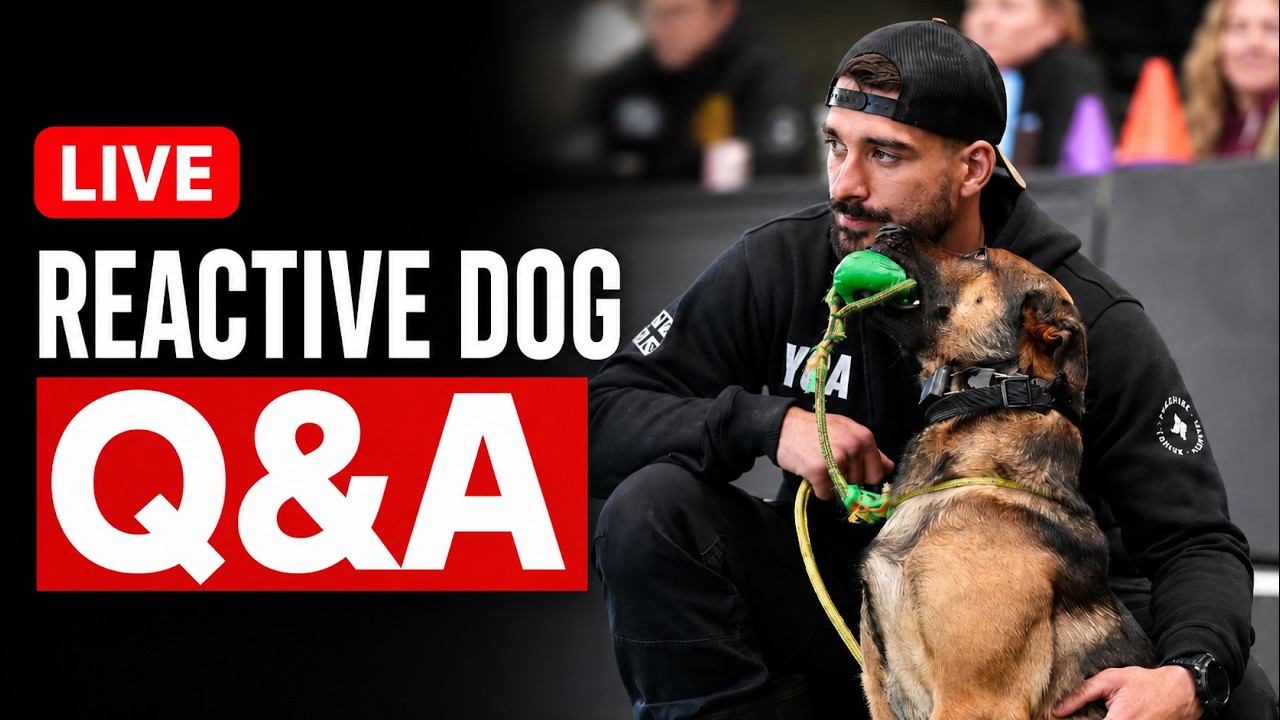
Jacob Morgan and the YCA training team answer live questions about reactive dogs, covering e-collars, conditioning techniques, and management strategies. They emphasize minimal-effective-dose stimulation, using markers instead of harsh pressure, and building recall through prediction-error creation to reduce reactive outbursts.
Chapters
All right. Good morning, folks. Can you hear me okay? I suppose I should really say good afternoon, really. It's just around the corner from 12. Just stick a thumbs up in the chat if you can hear me. Maybe nobody can hear me. Hey, thanks, Phil. At least I've got you, Phil. Hey, at least I've got you. Hey. Oh, hey, Ginny. How are you? You okay? Oh, everyone having a good Sunday? How's everybody's Sundays going? Good. I'm good, thanks. Drinking coffee in the garden, that sounds ideal. I'm currently sat in a small box room answering everyone's questions, which I'm of course looking forward to doing very much so. I say that as if it's a bad thing. It's not a bad thing, not at all. Good. How is Finn and Tia? Is it Tia getting on? Tia chilling with Aries. We'll just give it a few minutes, folks. Obviously I kicked off a little bit early, and then I'll start asking you folks for questions, um, and then I'll answer as many as I can inside the hour. Or I'll just sing to you guys. Why not? Or try and tell some funny jokes, which won't be very funny and probably get me fired or get our YouTube account banned. Oh, maybe I can do that. Although, to be fair, if Jacob hasn't managed to get us banned yet, I definitely won't. Yeah, I saw Joggergate. Me and Kelly spoke about that, and I think Kelly gave you some feedback. So yeah, but you'll be fine. Just a mishap of events. Please don't sing. You've never even heard my singing. How dare you? You don't know how good or bad it is. Could be really good. How do you know? I could have been like a child superstar. How do you know? Just don't want to change career. Ah, well, still time, eh? Done it before, can do it again. I do have a question. If you have to use the get the fuck back button, what do you use? Read punishment? Um, right, so Ginny, for you, as I mentioned on your WhatsApp group the other day specifically, uh, for anyone who's watching, by the way, who's not already a client, um, Ginny has attended one of our previous boot camps, hence why it's a very specific Question. Leave your chameleon setup on rising so that you have scalability there. I'm just going to leave you on a rising for life, to be fair. Fen's pretty good to the degree where obviously she doesn't need it so much. Punishment-wise, you just use your nag. Like, the higher level stim isn't required. The primary reason for that is over the conditioning process, what you would have done is create the situation where your cue alone should drop arousal, and then once arousal is dropped, you don't need as much physical interruption. So in terms of ethical, from an ethical standpoint, you don't need the higher level stim. It's about using minimal effective doses, as Kelly likes to say. It's about being able to ring through and apply a physical consequence because dogs learn through association. But there's no requirement to use high-level stim because, as you guys all know from having done the boot camps and having done a course with us, Punishment is not all about physical interruption or retribution at all. It's not about that, and that's what a lot of people think, and that's what a lot of people make the mistake of. I can see the viewer count going up. Cheers for joining us today, folks. Hope everyone's having a lovely weekend and a lovely Sunday. Start chucking your questions in the chat. I'll answer as many as I can. They can be dog training related, or you can just ask general questions about anything should you want to. I'm a great marriage counsellor apparently. Helena, if you have a question, ask it. Why do you guys do stim after command when teaching recall command instead of stim then offer the answer to turn off stim? That's a very specific question. Who is that? I feel like you're a little mystery shopper. Funnily enough, we were actually chatting about this this week out and about. So conditioning You, you essentially have 3 types of conditioning you can do: forwards conditioning, simultaneous conditioning, and backwards conditioning. Forwards conditioning, which is what you're describing in your preferential, like, way, um, is actually the strongest type of conditioning. So you're actually right. The only danger of it is if the dog's recall isn't strong, you might create a bit of an issue for yourself. So the reason as to why we follow the protocol of recall command and then stim as a cue, kind of backwards conditioning, is because it allows us to make the recall stronger and kind of maintaining the level of encouragement and reinforcement on top of the cue to build strength over it and then also kind of reteach the cue because it is not uncommon for clients to come to us and not actually have a recall. Or they think they have a recall and they don't. On occasion, you do get the dog that has the bomb— like, well, I said bombproof— has a very good recall, and we just need to bombproof it. And in those situations, we could use what you're describing, which is forwards conditioning. But on most occasions, we don't. Sorry, folks, I'm not feeling my best today, but I will get through. But very good question, Ginny. You removed your next question, Helena. You had a question. Getting a twisty spiral collar for Oz. They say not to use the wingtip, but the normal tips is the way the collar fits. All suggest would you wouldn't need such a high level stim. How would you put? How much would you put? Listen down, boy. Right, in regards to Ozzy and his contact points, you can get like all titanium contact points which are about, I think, 19mm. They're probably going to be a bit better for you using the twisty spike collar instead of using the wingtips if they recommend against them. I'm unsure, I've never used one of those collars before, I'm not gonna lie to you, Helena. So you can look at investing in those. They'll probably provide you better contact. In terms of moving stim, you don't need to move your stim levels at all. Don't do that. No, no, no, no, you don't need to. You already have 2 stim levels set. Retyping in English. I literally don't use the rising, maybe once or twice in a situation like the other day when she's doing— yeah, yeah, fine. When you punish big reactions and the dog stops but replaces it with little growls and grumbles under their breath, what do you need to do to those? Mindset also being addressed with play, etc. Yeah, um, to be honest, uh, HH Canines, we, we're not a big fan of punishing growls or grumbles at all, um, especially when a dog has bigger outbursts or reactions. Primary reason for that is The growls and the grumbles are communication. It's to tell you to like bugger off a little bit, and often what happens is if you punish that out of a dog, you end up with a dog that jumps from zero to one hundred, and that's when you end up with situations where people are like, "I don't know what happened. Everything just happened. It's never happened before." It went from zero to one hundred, and the dog just bit someone, and that's often because—not always, by the way—not always the case, but often because what's happened to that dog is they've had their Communication system, they growl or grumble to say, hey, I'm uncomfortable here, punish that out of them. So we only punish big reactions. We allow the growls and grumbles to stick around, and then exactly how you mentioned, we look to address the underlying root cause of everything that's going on. So we've already created prediction error and allowed us to close distance, having used punishment and utilized it in an ethical, good way. And then we look on changing the emotional response. So Whether it be a kind of insecurity towards people, we often utilize play to kind of make the association a lot better and build the bond between other people and the confidence around other individuals as well. We've actually released a video more recently on our YouTube channel with a dog called Pippa, who I had the pleasure to meet and work with. So I'm sure you can literally find that given that we're on YouTube already. She's not a big fan of people at all. She's very nervy, very nervous. She would bite somebody should you push her too far in terms of social pressure, and she tended to have a lot of a bit of a growl and a grumble. But what we did is we punished the big reactions, the outbursts that she gave when somebody came close. Then we were able to get close enough to then start changing her mindset and address her mindset and her emotional response toward people, which is helping her get rehomed. She's had 3 visits this week, so fingers crossed she gets rehomed very shortly. Why is my dog still reactive after long walks? Well, physical exercise is a very poor way to address reactivity because again, you're not addressing any underlying root causes. You're simply putting a blanket over the issue by utilizing Physical exhaustion, and some dogs when they are physically exhausted won't react and they'll just give up, but often some dogs still will, which is why SM2 or your dog may still be reacting. And really what we need to do is we need to take the course of action of, again, like Jacob and Kirkie talk about a lot, and like we talk about a lot on our webinars and some of our previous videos, is creating prediction error. with whatever the stimulus is that the dog is uncomfortable about, given whatever response they have, whether it be fear or frustration-based. And then we can ensure that they have a long walk and they're just nice and happy and chilled afterwards and they enjoy life. But yeah, that's how we would do that. Billy, my dog is hypersocial, can she come to boot camp? Can you fix this? Yeah, 100%. So we work with all types of dogs on the spectrum of what I often term sociability, although I still haven't looked up if that's actually a word or not. We have dogs that are all the way on the other end, one end of the spectrum, that are aggressive and really dislike people or dogs or both for whatever reason. We have dogs that are somewhat unsocial. We have dogs that are kind of really oversocial and tend to get themselves in trouble. So we work with everything in between. So a boot camp is most definitely suitable for you. So, um, I don't know whether anyone is actually present with me today given it's a Sunday, but I can drop you a link for a consult call And then feel free to drop in a link. Uh, sorry, feel free to book in your consult call and come see us in person and we can work with your dog. I'll find that in a minute for you, buddy. Um, about— yeah, but why do I need to use marker for punishment? Can't I just do it in the moment and use my word and do the process you guys talk about? Why do I use a marker for punishment? Can't I just do the moment? Can use my word and do the process. Eh, how about— sorry, can you give me a little bit more context around what you mean in terms of like— sorry, is your question in short, why do you need a marker? Oh, why do I need to rehearse it? Sorry. Right, so in terms of rehearsing it, if you were just to go out and attempt the punishment protocol, which I wouldn't necessarily suggest if you haven't run it through it with us, if you're talking about our punishment concept, maybe you've heard about it on a webinar, I wouldn't suggest you just go out and about and try it. If it's something you want to attempt to rehearse at home, go ahead. The reason as to why you want to rehearse it is because what you want to start doing is drilling in your marker in the lowest arousal state possible for your dog so that they start ringing through, ah, okay, when I hear that word All the all the crap stuff tends to follow, and I know I've done the wrong thing. And you can get the most effect out of the minimal effective dose possible, which means then when you go out and about and your dog hears that marker, they go, "Ah, I did the thing. I did the bad thing," or whatever you want when I say. And so they're much more likely to hear you in effect. Like a lot of people say to us, "Oh, when my dog starts reacting, I could wave a fillet steak in front of their face and they wouldn't hear me." It's like I'm background noise and I don't exist. And but the exact exact same sort of situation would happen if you don't prep in the absence of the trigger. We, we do a lot of prep with all of our programs in the absence of the trigger so that we have an opportunity, one, to teach the dog what we're asking for, and two, so that you have an opportunity— ah, perfect. That little link that's just dropped in there, the Typeform, and the other link is how you can book a consult call with us. So go ahead and do that. Um, and so one, you can also know what to do and learn how to do it, because if you just go out there and you choose to do it in the moment, the chances are you're going to have to use higher levels pressure in order to interrupt, your dog's not probably going to understand, and you'll probably— excuse my French— you'll probably fuck it up, and then you're going to create a really huge problem for yourself, and you'll probably use pressure inside of a reaction rather than actually being able to stop it. So that's often what we would suggest, especially doing it in a few different environments before you then go out and you combat triggers. So on all of our programs, whether it be one of our boot camps or otherwise, we always get boot campers to do at least 2 to 3 rehearsals in the absence of a trigger with a non-emotional thing. Because the reason that we also use something that's non-emotional is that you remove the risk of potentially building superstitions. So if you just take your dog out, you put it in front of another dog, and you whack them, what you might end up with is potentially creating a superstition around, oh, when I see that thing bad shit happens to me, and so now I really, really don't like that thing. I'm based in Spain and Norway, and Martingale and e-collars are banned both places. Should I just eff it or try and work without it? So there are other ways to work around, and I know we have plenty of people in regions where certain tools are banned. and we still manage to make it work if certain tools are restricted for us. I believe we actually have some mentees and stuff out in Spain too, who— and Norway, who we, who we, uh, who we help. So, um, my recommendation, especially on a public platform, wouldn't be to go and break the law. However, there are definitely ways in which we can help you, and we have helped people that are based in the same regions as yourself. So I'd actually encourage you to fill in one of those forms, let us know, and we'll be able to help you most definitely. Or take Herda's advice. Um, out and about, why don't— oh yeah, fine. Um, Hi, can you give me some advice? After a short drive, after a walk in the park, my dog doesn't like getting out of the car. When I finally get him out, he's aggressive and goes for me. Last night he bit me. Ah, okay. After a short drive, after a walk in the park, my dog doesn't like getting out of the car. So, um, there's a few different issues going on here, Shadow, um, but potentially what I would suggest is in the short term, given that we've only really got 40 minutes together and I can't address it fully and scope it out Is you could use the car, or getting out of the car, as a gateway to freedom, and you could use some negative punishment. And so what I mean by that is you go up to the back of the car, Shadow refuses to come out, you just shut the boot and you walk off, and then you go back and you try again. You're not going to put yourself at risk, e.g., you're not going to reach into the car, you're not going to necessarily try and make Shadow come out by getting handsy. What you might do is use a lead, so leave a lead trailing out of the boot, make sure it's kind of a good length of leash attached to a collar of some description, and if Shadow keeps refusing to come out of the boot, you're just going to shut down the boot, you're going to walk off, and you're going to come back and you're going to try the thing again. Eventually what Shadow is going to do is he's going to be like— Hang on a minute. I really like being with you because you're my person, and I also quite like being out of the car because I get to do all this cool other stuff, whether that be go for a walk, play, go in, eat, etc. Um, and at the moment what I'm doing isn't giving me the result of which I want, so actually I'm just going to get out the car. By the sounds of things, whatever you did last night— and I'm not sure exactly what you did— caused a lot of friction and a lot of conflict, which is then when you've ended up getting bit. Obviously, of course, I don't want you to end up in that situation again, which That's why I suggested putting a bit of a line in place and get used to kind of stiff-arming that long line. And that's why often what I would suggest is for a dog that refuses to come out of somewhere, I might just suggest using steady and consistent pressure to make them. But if there's the danger that Shadow is going to come at you with that, is I'd maybe suggest the alternative method, which is use negative punishment, which is, okay, you don't want to come out the boot, you don't get access to me, you don't come out, and you close down the boot. If that's not going to necessarily cause any issues. Nat's maybe suggested it could be pain. Maybe if it's a behaviour which has suddenly arisen, of course we would always suggest looking at the kind of lifestyle adjustments, be that diet, pain, kind of always making sure you have a vet check before addressing behavioural issues. But yeah, just something to consider there. Does he do it with any other thresholds, doorways, crates, anything like that? I saw a trainer that said just heel them and use e-collar pressure for punishing them back into heel. Got told by you guys that's not punishment in another live. Can you explain more? 2 trainers did this with me, now my dog still reacts. Yeah, so, um, heeling is not punishment, um, or bringing your dog back into a heel to prevent them from reacting is not punishment. It's negative reinforcement back into a behavior. So all you're doing is, again, like I mentioned earlier, I think in another reference point, is you're just putting a blanket over the actual problem. Like, a lot of trainers do use obedience to combat reactivity, and we see a lot of dogs who have really great obedience. They can be told to sit, they can be told to down, they can be told to focus on the handler. However, actually leave them at liberty, e.g., they don't have a command or cue in place, and I'll tell you what, they'll try and rip another dog's head off. So obedience doesn't fix anything. In fact, it actually makes the process more difficult a lot of times. So yeah, hopefully that answers your question. Punishment— so to put simply, by the way, Out and About, sorry, to answer your question simply, punishment makes things go away, makes behaviours go extinct. Negative reinforcement makes things happen. So all that you have done is you have built a dog that's very good at heeling and put lots of negative reinforcement into a heel. You have not punished your dog's reaction. That's why they still react, because if they didn't react, you would have effectively punished. Because they still react, you haven't. If my dog barks at the neighbour's dog barking, can I punish that? It's very disruptive and needs to stop, but I don't know if it's fair when the neighbour's dog is still barking. Yeah, difficult one. Given the context, if you know how to punish effectively and ethically, yeah, you could. The only caveat would be you have to ensure that you're consistent, because if your dog— if you allow your dog to bark yesterday but not today, and then again tomorrow but then not the next day, you're creating an intermittent reward schedule with them barking at the neighbour dog. You're going to cause yourself a huge issue with that. They're going to get Though you'll probably make the behaviour very strong. Alternatively, my preference with that sort of behaviour, barking in the home, would usually be to use an end of play cue. So with that, get your dog's play drive really, really strong. Have a start cue. So my start cue is ready, which means the game's alive, the opportunity to play is now. And then at the end of the game, when my dog still wants to play but I'm going to finish the game, I say enough. Enough. I drop my toy to my floor, and then should my dog go to get it, I use my lead to stop. So I always play with my dog on a lead, and I use the lead to stop them. That just means that I've made it happen. Enough means that we're stopped, means that we're done. So you can then start to do that, build a really, really strong end of play cue, and then when your dog starts barking at the neighbour's dog, you can say enough. And then that way, hopefully, if you have a strong enough, like, end of play cue, you can make it happen. If not, then you can actually utilize punishment only because the context of the situation and the series of events means that you're actually punishing your dog for not adhering to your cue, you're enough, rather than punishing for the barking behavior on occasion depending on how you do it, your timing. So that's something to consider as well. I've actually tried all that. Think the car is his comfort zone. Long line does not work, to be fair. Thanks for the advice. Shadow, when you, when you say it doesn't work Do you mean so? What, by the way? Okay, let's retract a little bit. What caused the bite? How did you get bit? If you don't mind sharing, Billy, with her being hyper social, should I stop all interactions for now? She occasionally rushes dogs, but can also walk past nicely at other times, so don't know when to trust her. It depends what sort of interactions that she's having. The the issue with a lot of hyper social dogs is they tend to have a social group. Or you tend to find other hyper-social dogs on a walk or doggy daycare and things like that, where the dog just gets loads of high-energy, high-intensity reactions. And they learn that dogs are really fucking cool, and all that they want to do is run around like mad chickens together. Mad chickens? That doesn't even make any sense. And that way they always expect their interactions with dogs to be a 10 out of 10. And it doesn't take long for her to find out you run into a dog that really doesn't want that interaction. And that reaction is going to be a -10 out of 10. So it's important to control the social interactions, not necessarily stop them entirely, but ensure that you are refereeing it and you are having onus of when to say, right, you can go and play, or no, you cannot. So that comes in with one, having your dog under control, whether that be through recall, the use of a lead. Um, her rushing dogs is obviously a danger, as I just mentioned. Yeah, but if you can sometimes walk past dogs nicely, I'd maybe suggest just utilizing a bit more management maybe before you can get onto a program. And my recommendation would be, yeah, utilize a program to help you guys out with that one. We've worked with many oversocial dogs before, so you ain't got a problem there. I have a 4-year-old dog Chihuahua who is— who I've had since 8 weeks old, and I've tried absolutely everything, and I mean everything, but I still can't get her to walk on a lead or harness. Please, can you help? Eh, what do you mean you can't get her to walk on a lead or harness, Beverly? Do you mean you put a lead or harness on and she doesn't move? Um, thanks. I made a cover for the martingale but still got comments from people who don't understand— who doesn't understand why I need that on a 3-year-old, 30 kg intact male Malinois who doesn't really like small dogs approaching him while barking and showing teeth. Yeah, there are other ways around it, Alano. I just suggest booking in a consult, booking a consult, chat to myself or one of the other training team, and we'll be able to get you some workarounds if, if you're getting some attention in the region of which you're in for using certain tools. Can I go back to the question of using bad after using the red button? You never use bad after the red button. Is it too far after the fact or the crime and actually will confuse, make unclear why once they are back with you? Right, so specifically in reference to your video, there was just a bad turn of events, really. I'll tell you what, I will, uh, regarding the video, I'll send you a full breakdown of what I would have done in that situation with a dog like Fed, um, personally. And then hopefully that helps clear up a few questions for you. Otherwise we'll get real into the weeds. Um, Jake, what's your approach if you're at work all week and then evenings taking son's training, etc., and still maintaining any progress you've made with a dog? 4-month-old His wife, etc. See see dog more. Jake, you got a Mal. Wake up early. Get them out. Get their filming in. Get their exercises in. Evenings and stuff. Also taking your kids to training. Taking your sons to training. I'd be taking your male Mal with you if you can, if that's an option, just for environmental desensitization, to be quite honest. All that you need to worry about, given that he's 4 months, is the mistake a lot of people make, especially with a high drive dog like a Mal, is you want to do loads and loads of obedience. Sit, down, heel, all this cool tricky shit. Don't worry about it. Worry about making him The most sociable dog possible. You can go anywhere and everywhere and he doesn't care. That's all that you want to worry about. So lots of people think socialization is letting him go and see everyone and letting him go see every dog. The opposite, for the most part. Um, you want him to see environments, know environments, know that dogs are there, know that people are there, and worry more about you. So my recommendation would be have a marker, have a really strong marker, positive marker that is, like your yes that you see us use a lot of the time, and start using that in distracting environments where you're getting his focus and attention so that he's like, oh yeah, you're really cool, the environment's all right, but you're awesome, and bring the value your side of the lead. And then that way, that's how you can stay on top and maintain your training. So in terms of maintaining progress, I'm assuming you're talking about obedience. Don't worry about obedience for now. As I mentioned a minute ago, obedience isn't going to help you when you've got a male that wants to chin people. Do you know if there are any graduated YCA dog trainer mentees in the Netherlands? Not off the top of my head, Nat. However, the only thing I can say from my perspective We do have a remote program. We've also had people visit us from the Netherlands, to be fair. We do have a remote program which we work with many people in the Netherlands that's very successful. So you could book in a call, chat to us, chat to myself or one of the other team members. And if we believe, to be fair, that you're not a good fit for us and we can't help you for whatever reason, you do need in-person training and a bootcamp's not an option for you, we will identify a trainer local to you who we may either recommend or say check those guys out. So that's what I'd say. I have to drive to a park as I'm disabled, so after the park run, if we go straight home, Shadow gets out the car okay, but if we go shopping after the park, he doesn't want to get out the car. If I have time to go to the park again, he's perfect. Yeah, yeah. So how did you get bitten? Shadow, how did you get bit? What did you do? I'm not saying it's your fault. Shadow obviously made a mistake, but how did you get bit? Out and About, sorry, autocorrect, barking in the hall, not balls. Eh, I must have missed your question, Out and About. I'll have to go back. Jake, thanks for the advice, it gives me room for optimism. I think it's doing pretty well in that regard. Good. Uh, Recon, got any trainers near London you'd recommend? South Coast Canine Academy. That's what I'd recommend. So we have a branch in the southeast of England, depending on whereabouts you are in London, probably an hour, an hour and a half away from yourself. I know that you've probably got to compete with the M25, but if you're with us for the week, you're only going to have to do that journey twice, or well, if you stay locally, that is. But you can go down there, we run boot camps from there, we run reken classes from there, we run kickstart days from there. So yeah, get in contact with us. You can still book training through YCA. As Helena says, SCA is fab. I've been down there many a time. I love Kelly, I love Sam, and then often I frequent those parts of the country as well too, so you might get to meet me if you're lucky. So yeah, book in a call, chat to us, and we'll be able to work with you. Out and about. What I can see is your question out and about regarding e-collars and negatively reinforcing back into a heel. I can't see anything to do with balls. Come on, folks, give me some more questions. Although I'm struggling with my cognitive function. I'll sing. I will sing. Ah, right. How do you prevent burnout as a trainer? Oh, that's interesting. Um, I don't know. I haven't experienced it yet, and I work pretty frequently out of choice, not, not mandatory. I just love what I do. I love seeing the results of which we get for people like Helena and Ginny. and all the other hundreds of dogs which we work with. That's what drives me. I read the reviews page, sadly, on a regular basis to see how it's changed people's lives. I love speaking to people that come to the socialisation— excuse me— socialisation classes or graduate days about what they've been able to do. And these are people that Haven't been able to walk their dogs at all. We had somebody the other week that hadn't walked their dog in over 2 years who's now able to walk their dog again. Um, actually, oh, awesome. Um, I've got to try and remember. Jacob told me a really wholesome story yesterday that he'd heard from a previous boot camper yesterday morning. Uh, they actually went to him personally and they thanked him, uh, because— Uh, that's it. walks with their dog had become like really, really unpleasant and they weren't able to walk them. They weren't enjoying life with their dog, as I'm sure is the story for a lot of people on this live this afternoon. And one of the partners' mum's died sadly, and the mum left them some money in their will and they spent that money on a boot camp. And now every time they go for a walk, they say thank you, um, to their, to their lost mum for the money, because now it allows them to go to pubs and cafes with their dogs and they have a great life together. So they actually went to Jacob yesterday, yesterday morning. They found him and they told him that story and they personally thanked him. So yeah, that's, I assume, why I'm not necessarily burnt out. I don't think I'm special. I just think I handle things a little bit differently, and Kirky's very much the same. He works all the time. Tony works all the time. Chloe works all the time. And even though they're not trainers, I think they just enjoy the results in which we see we get for people. So, um, yeah, I, I definitely missed a few other members of the team there. Susie works all the time. Susie works until very, very late at night, uh, God knows why. Maybe it's because she likes the results, but— or maybe it's just because she's crazy. And I'm sure there's plenty of the other team members that— we're a very devoted team, put it that way. How important is play for reactivity rehab? Like, how hard do you try to build it before accepting the dog isn't just into it? Can you still get good results without it? I'm assuming that's what you meant to put in brackets. Right, play. The thing, the analogy that I like to use is reactivity, especially the rehearsal lip, becomes a hobby for dogs. It becomes really, really addictive. And so if you were to compare that to a teenager that loves playing on the Xbox, what's going to happen is when you start to work on your dog's reactivity and you start to say, hey, you can't do this anymore, you're essentially taking away that teenager's Xbox. They're going to find their own hobby. if you let them, and that might be another undesirable behaviour. It might be worse, could be a little bit better, who knows, but you're obviously taking a risk with that. Or they could find good behaviours, but it's like 50/50. So instead, what we like to use, we, we like to implement play as a bit of an alternative, as an alternative hobby. I like to call it anger management. It's not really anger management, but you kind of get where I'm coming from. And it's in the same way, if you were to take away a teenage Xbox, would you want them to get into sport? and do something healthy, or do you want them to find drugs and alcohol? I know it probably didn't hurt a lot of us as teenagers, but some people it does. Sorry, that was a really insensitive joke. This is why nobody should let me on YouTube Lives. Yeah, so play is pretty important in that regard because it also allows you to do lots of other things. It's not just about that element of it in terms of fulfillment and implementing a new hobby. It also gives you a great opportunity to build in boundaries, teach your dog something, and of course have fun with your dog as well. That's the most important thing about it, is actually having fun with your dog and building a really good bond together. Like, I love playing with my dogs just because I like playing with them. So I think it's really, really important. I think it's a really underutilized tool in a lot of the dog training world. I think obviously a lot of people are becoming a lot more savvy with it. Maybe they're just stealing our ideas, who knows. Um, but you can still get really good results without it. There are some breeds and some dogs that just will not fucking play because it's not for them, uh, and there are other means to get them still really good results, and we've done that before. But often we like to use play for more reasons than just obviously the reactivity rehab element. Well, I suppose it all comes under the same umbrella. Ah, Ginny, thanks. Uh, thanks, Helena. Uh, Shadow, I had to raise my voice and told him to get out of the car. He gets out and jumps back in. Trying to shut the car door, he turns and bites my leg. He knew he had done wrong as he sulks in the back room. And told him to get out. Okay, all right. Um, so in terms of how your leg got bit there, Shadow, again, so in terms of you trying to shut the car door, was that— so you'd pulled him out of the boot and you were trying to shut it and you stepped in the way as he was trying to jump back in and then he bit your leg? Sorry, I'm still a little bit confused on how you got bit. Kind of try and give me a little bit more clearer context on that. Archie, but there's a key thing in your message, by the way, your comment, that probably tells me why there was added frustration. My whippet is super reactive to all dogs whilst out in parks and open spaces, even when we drive past a dog, but he's not reactive to all dogs while in close quarters like a vet's waiting room? Yeah, a few different reasons for that. Like, reactivity can be very contextual and environmental, so dogs you might find on occasion are only reactive in certain environments or with certain contexts. However, in certain environments where maybe they're a little bit more worried about what's to come, E.g., when they're at the vets, obviously they go into a consultation room and often they're getting jabbed or they're getting pushed around and restrained, etc. The chances are he was probably just a little bit more subdued given what the expectation is coming, and he's likely never had an opportunity to rehearse in that sort of environment. So why is there the requirement to? Whereas out and about in open spaces and in the car, he's probably done lots of it. which makes it really enjoyable, which is why he then continues to do it there. Why do you guys love the e-collar so much? Because it gets dogs off lead really, really quickly. That's why. We can get a dog off lead in 3 days safely with a bombproof recall. There are dogs that have never been off lead in their life that come to a boot camp, and within 3 days they're off lead. Imagine what that's like. Imagine being stuck inside your own house. COVID. How good was COVID when COVID actually finished? I know that some people enjoy COVID for the, for the rest, for the break, but how good was COVID when lockdown finally got lifted and you could go out and you could see family, you could see friends, you could enjoy parties again, you could go to the gym, you could go and do shit? How good was that? Your dogs, if they're stuck on a lead, are stuck in fucking COVID. It's horrible. Excuse me, sorry, I got a little bit frustrated there. Um, I wasn't getting frustrated at you, Marvellous Unknown, don't worry. But that's why we love the e-course so much. Uh, Ginny, the rest of the world, yeah, marvellous. Also, if you could only teach a dog 3 things, what would it be? Interest is one of the most important things to teach. Um, recall. So bombproof recall, a no, don't do that thing, and a yes, do that thing again. I'd probably say those 3 things for me are the most important, um, not necessarily in that order. I'd probably say the no is the most important thing, to be quite honest. Um, but yeah, recall, yes and no, most important 3 things. You could give a load— like most of my dogs, to be fair, Well, they know a few other things, but only know those 3 things. They don't do fancy obedience, they just know what to do, what not to do, and I can recall them. Ideal. Happy life. I've been working on play with my Samoyed. He's now playing full in the back garden. I'm failing at transitioning to play in the park. Advice has been withhold play, but he's not bothered. Any tips? So what you've done, Tim, is you've gone straight from the garden to the park, is what I'm assuming. What you could do is you could like mix in a really slow transition. So rather than trying to go straight from the garden to the park, is you could go from the garden to the street outside the home, to a little bit further away, to a little bit further away, to a little bit further away, to then the park, and you could see if that worked. With the use of also withholding play. But currently he's only playing in 2 of his comfort zones, either in the home or in the backyard, uh, or back garden rather. Um, so yeah, maybe try and do that instead. Gradually kind of work him out of the home, out into the public domain where he's going to feel less comfortable and less maybe intrigued in play given the environment status and how valuable that is to him, and then see whether you can work him more away from home. Yes, she just won't move and I tried every trick in the book. Beverly, my advice might be having you using a lead. Just move her. Just move her. So I've got a holiday stay with me this week and their owners might even be on here. Maybe they are. He's a big white shepherd called Sully who we've trained in the past, and his owners sent us an email to say, oh, sometimes, just let you know, he lies down on a smell that he really likes and he just won't move. He will move, you've just got to make him. And it's easy for me to say, like, I'm not the smallest fella, certainly not the biggest, but I'm not the smallest. And he's a big lad, but I just make him move. But you have a Chihuahua, Beverly. I'm sure you can make her move. Just make her move. I'm not saying you're across the room, by the way. That's not what I'm saying. Just gentle, consistent, steady pressure until she starts moving her feet. And then what you could do is if you have a marker, a yes marker, you can say yes and then pay her. Marvelous. You did the right thing. You started moving when I put leash pressure on. Can going for runs kids will be doing more for their boxing count as a job for the dog, or would it purely just be exercise as opposed to purpose? Jake, I believe you were the one with the Mal, weren't you? You could go for runs. The only thing that I'd be concerned about really, to be honest, is obviously the age of your pup, how far you'd be going, what sort of ground you'd be running on. And also, as I mentioned a minute ago, just utilizing physical activity can just create a really fit dog. So like, you could run yourself into some issues there, especially if he starts to develop some unsociable tendencies and become reactive. Maybe what I suggest is whilst the kids are boxing is just have him around. Like, if there's a car park or a busy road or like a reception area where you can wait where the kids are boxing, and he can just sit there and watch the world go by, and you can just regularly make payments. That's going to be more valuable to you than him going out for a run with you. Again, just becoming environmentally desensitized, like especially a boxing club, there's going to be lots of people talking, people shouting combinations, people hitting pads, people sparring. There's going to be lots of shit going on, and if he learns to ignore it, that's ideal. When explained, it means— oh good, I'm glad I explained something well because I have no recollection of that I've explained so far. Hey John, yes, I have a beagle. He is 1 year old, doing very well with his training. He is calming down a lot outside whilst I walk him. I still think he doesn't respect me. What gives you the impression he doesn't respect you, John? When working through the Behaviour Bible and being at the start of it with the work ethic development with food motivation, do I work on No pulling on the lead while in these very early stages? Yeah, to be honest, you guys are probably more— it's probably more beneficial to not allow your dogs ever to pull into the lead, to be quite honest. A lot of people make the mistake of like just letting their dog pull them to a lamppost or a smell and thinking, oh, that doesn't matter. But what it's actually done is it's given your dog a win. Like, if we were to look at an arbitrary scoring system, it's giving your dog a win. So they're at 1-0, 2-0, every time they pull to a smell. In addition to that, you just created like a frustrated lead puller and you create lots of frustration with it and motivation to do the behaviour. So with your food motivation, especially when it comes to charging the marker, you've got to actually use the lead as a reinforcement tool to bring your dog back to you in order to pay them. So that's kind of what I'd be looking more so at. Don't mistake not pulling in the lead for a heel. Not pulling in the lead and heeling are 2 very different things. Um, healing is a behavior. You have to stay here. Not pulling into the lead is just leash manners. Don't, don't pull into the end of the leash. Um, but the dog can still be at liberty. Uh, Yeah, I'm letting him grow first, and I suppose I can see what the club think about him being around. Yeah, see what the club think. Speak to him. Um, But I'm sure there'll be plenty of areas local to the boxing club where you could go and just sit with him. I don't know how old your boys are, but if you can leave them at the club whilst they're training, maybe you could go to a local cafe and just sit there with him instead, um, or go to a local park and sit there, or go for a little walkabout, go for a play or something. Well, when I am walking, he all of a sudden stops and I don't realize it, and then it's just like he wants to sniff. I do give him that time. He does Pull on leash less and less if he, if at all he does kind of lunge to play with other dogs and wants to hug them. Right, okay, fine. So that's not necessarily a respect for you thing. The lunging at other dogs, the pulling on leash might be a frustration-based thing. So it's something that I'd recommend fixing sooner rather than later, especially if he's a year old. Otherwise, it could grow into an even bigger issue. Um, should you need our help with that, I'd recommend booking in a consult and speaking to us more about it. But yeah, that seems like a bigger issue. When he did get out, he's aggressive. The long lead does work at times, but it needs to be 50-foot plus as he chases me down the street. Not funny, but neighbors think it is. Right, okay, fine. So actually getting him out of the boot with a lead does work, but he actually comes at you is what you're saying, right? Um, okay, Shadow, booking a consult call, 100%. Um, only because there are probably some other issues going on with that behavior. Obviously it's a risk to you, it's a risk to Shadow. Um, book a consult. Have a chat with myself, one of the other training team, and we'll then make a plan with you moving forward of how to rectify that fully and safely. But if your dog's actually actively chewing you, I'm not going to provide any advice in the next 12 minutes which is going to safely solve that. John, he is maturing, so I keep figure just keep practicing. Common misconception is that things will get better with age. For a lot of people, nah, it gets worse. It gets a lot worse, in fact. A lot of behaviours that are baked in by the time the dog hits 7, 8 months often will just get worse with the rehearsal. So if your beagle is already lunging at other dogs, even from a social sense, Even from an over-social sense, they just want to get to the other dog. They want to play with it. They want to find out what it's about. Of course, that's going to create one a lot of frustration, which could lead to an overspill. But likely it is maybe lunges into the wrong dog, and the wrong dog nails him, and then he becomes really unsocial because of that incident. So my recommendation for you would be yeah, get onto some training. If you just keep practicing what you've been practicing so far. No, no offense, man. No disrespect at all. But obviously, what you've been practicing so far hasn't fixed the lunging at other dogs. It's probably not going to fix the lunging going forward. So we need to find something that does. Beverly, my chihuahua is Beverly. Move her. Put her on the lead. Walk away. As soon as she puts the brakes on, she goes, I don't want to move. You're going to put gentle, consistent pressure on the lead until she moves, and then after she moves, you're going to be like, yeah, good girl, and then you're going to keep doing that. The problem is, for the last 4 years, she's had loads of rehearsal and loads of success at not walking with you when you put her on a lead. So the chances are you've got a long road ahead of you here, but make her move. You'll be okay, I promise. She'll be okay, I promise. It will be all right, don't worry. Um, but I promise you, you probably haven't tried that trick— just make a move. Saint of Bees, that's an interesting name. Um, my dog barks and defends against when I enter a room with my fiancé in it. The dog is pretty relaxed when he and I are home alone, but once dad comes home, it's playtime and I need to stay away. I hate to break it to you, that's probably not defending. Um, lots of people think their dogs defend them or are protective, uh, whereas it doesn't often result from that unless your dog's actually been protection trained. Uh, and even in some cases they aren't even like that. Yeah, you got it. Yeah, resource guarding. Yeah, your, your dog is resource guarding your fiancée from you. Um, they're— your fiancée and you are in your dog's pocket. You're in here, you're in there. Um, there's a little room for you in there. Um, yeah, so it's definitely something to get on top of, 100%. How you would do that, again, similarly to what I said to Shadow a minute ago, given I've got 9 minutes left, there's no real, uh, advice, sound advice I can give you to fix that issue safely. My recommendations in the short term as management would be house line is really, really important and restraint. And constraint is really, really important. So your dog essentially needs to learn that they don't get to pick and choose what happens inside of the home, especially between you and your fiancée. Um, the likelihood is they need to be completely separated from you both, e.g., when you come home or when Dad comes home, they don't get to be on the sofa with you. They're going to be on a crate— in a crate, sorry— or on a tether, and then you guys are going to sit on the sofa separate If you can find a tether big enough for your Heeler mix, and that's what I'd necessarily suggest. Chances are that might cause a bit of frustration. The dog's maybe going to kick off. Maybe you want to do some preparation in advance of that with some craning and some tethering in the absence of you guys being together, but that's maybe what I would suggest in order to prevent any harm coming to you, and then in return, no harm coming to the dog, and manage that situation for the time being. Because there's probably some other underlying issues that are going on there of which need to be resolved too. So my recommendation would be definitely book a consult call utilizing that link that's been pinned, speak to myself or one of my other colleagues, and we'll make a foolproof plan with you moving forward. That is what I'm trying to stop by walking him in the other direction with me. With me, yeah. So, John, Like, just doing some redirections are good and will maybe create more of a focus with you and less focus on the other dog, but it's not necessarily going to fix the heeling— heeling— the lunging. What essentially needs to happen is your beagle needs to be told, hey, don't lunge at other dogs, stop it, it's not fun, it's not okay, other dogs don't like it, I don't like it, don't do it. And then that is what will fix the lunging. And then also then on top of that, developing some refereeing cues with other dogs so you can say to him, hey, it's okay to play with other dogs, but now knock it off, stop it. And you can do that by utilizing play. Any other questions, folks? Anybody actually booked a consult call? Have you ever come across a dog where you come to the conclusion the owner and the dog are really not suited to each other? Just curious. Not me personally. There are on occasion dogs in which we meet where we think— or sorry, owners in which we meet, like, why did you get that dog? But the whole reason they're coming to us for training is because they're committed to that dog. So generally they are the right person and they are suited to each other, because if you're committed enough to do a program with us, you're definitely committed to your dog and giving them the best life possible. So that's the sort of thing in which we look at it from. Um, but yeah, there are definitely some, some ropey matchups. Yeah, 100%, but I'm sure you guys will have friends and family members where you look at their partner and you think, how the fuck did you two end up together? Um, I'm being wild today. Uh, John, understood. It's not too late to fix. Love the puppy. No, it's not too late to fix at all. We, we have trained 12— I think the maybe the oldest dog that we've had on the boot camp was 12 or 14. It was a lab, a black lab. I think she was 12 and they came to a boot camp. So it's never too late, ever. I will be. What's stopping you from doing it now? Why will be? Just, just click that link and book it. Um, Oz was a mistake but fixed it now. See, there you go, Helena. Uh, Shadow, next time he won't get out, I'll film it and post on Shadow's channel. Hopefully I can change his behavior. Feel free to film it and then bring it to your consult. So what happens, by the way guys, is when you book a consult, you'll get a video message from your trainer who you've booked a consult in with, just giving you some kind of prerequisites of the call. And that's your opportunity to then ask any questions and then send before footage if you have any of your dog and say, hey look, this is what I'm dealing with, can you help me? So, and then on the call we'll help you. I also like to let him just stand around other dogs and just be calm. Yeah, nice, good. If I do that, it's like I'm dragging her and like I'm using her to clean the path. So obviously don't do it on like a concrete street or anything like that, especially at the moment where the behaviour of her sticking her brakes on is so strong, because you, you maybe, maybe given her size May cause her injury. Do it on like some soft grass or in the home on like a smooth flooring, um, and work on it there in the absence of the big outside world. Maybe first in the back garden or otherwise, um, and then start to transition outside of the home onto concrete when you've got her more confidently moving. It will just be an opposition reflex to pressure. All dogs have something called an opposition reflex. Think about huskies and harnesses. They pull down into the harness, the harness pulls them back, they pull forward down into it stronger. So what you have essentially done, Beverly, is created a really strong opposition reflex with her. Every time she feels pressure on a lead, she fights against it. You've now got to create the opposite response. Given that it's been 4 years of putting up a fight, you've got a little bit of time of fighting against it. There might be a little bit of dragging at first. Obviously you want to encourage her to move her feet as much as possible. But try that. Alternatively, stick a lead on and stick a collar on inside of the home and just leave it on her. Don't have it in your hand or anything and just walk away. See what she does. Okay, he sits. Okay, I say he sit, he sits. I say stay, he stays. But when I say come, he runs towards me and rolls over at my feet. Is it because he's a ginger mally? How do I stop him rolling? Well, why do you want to? It's cute. I'm not going to say the latter part of your name. Um, afternoon, how are you? You okay? Um, are we okay to book a phone consult even when using the Behaviour Bible only, just not financially able to to do the TWI course? Yeah, you can do. The consult, to be fair though, is just going to point you in the right direction of maybe what to do next outside of the Behaviour Bible. In regards to course costings and financials and things, you can split down the cost of the course that you do interest-free, and all of our programmes come with a money-back guarantee. So for a lot of people, the concern is, oh, am I going to spend all this money and it's not going to fucking work? Whereas actually, we promise you guys, it's either going to work or you get all of your money back. It's either going to cost you nothing or cost you something, but you achieve everything that you want. So that's the way to look at it. So book in a consult. Why not speak to myself or one of my colleagues? Hope you smash the like. Hope you could smash the like. Oh, thanks, ATEEZ. Need help with a reactive bulldog. Oh, I love a bulldog. Tell me, '80s, tell me all about your bulldog. Um, John, sometimes just him being around other dogs self-corrects the lunging and the excitement goes away, or at least when it seems when he calms down while I correct him. Yeah, the only opportunity is there, John. You're allowing the rehearsal of it, um, in a lot of circumstances by what you said there. So Danger is you're making the behaviour stronger with that. Would you recommend playing Newton's Cradle to help us leverage the yes marker? I'm assuming you're talking about the chihuahua, Ginny. Nah, no, not at the moment anyway. I paid my course over 6 months, still paying it, so worth it. Glad to hear it, Helena. Found his owner unalive in the bath, which makes what traumatized when the law tried to retain him. His last owner was ex-sass, so he made Shadow a little bit nasty, which I didn't know. Well, that's really sad to hear, Shadow. Yeah, really unfortunate and a sad story. But sometimes it's not always because the dog was mistreated. Like you say, he hasn't had the best start to life, but still lots of life ahead of him. She the pin. Nice. When you're charging the yes marker, do you want it to mean the dog comes to you for it? So encouraging the opposite, the dog goes away from you for the food. Yeah. So H K H A K nines. That's why we slowly transition to the dog taking food from us and just doing yes to us. Understand what you mean in that, but that is simply in the early stages of charging the word yes. We want yes just to mean food, and as you can see, it builds a lot of like motivation, builds a lot of a little bit of frustration into the game. The dog gets a little bit giddy. There's movement involved. There's some excitement there, which is what we want the dog to be like when they hear food. So that's why the first couple of reps that you often see when we're doing the charging marker exercise are out to. the sides at 180 degrees, and the third one is then from us. Because then the autonomic response should be the dog hears yes and they come straight to you and they're like, where's it gone then? Because the food still comes from you. It's not as if the food is coming from the floor. Um, it's just being thrown out to the side. That's why it's important that it's mark, move, reward. So if you were just throwing food on the floor and then saying yes, obviously in your dog's finding it from the floor, your dog will probably think, oh, this food has appeared from the floor. It's really, really important that you say yes, the dog makes a commitment of some description toward you, and then you throw the food out to the side. So the food still comes from you. Helena, this took a turn. Yeah, it did a little bit. I think I upset some people. Hopefully I didn't. Right folks, thanks so much for your time. Lovely to meet some of you. Book in your consults. Book on now if you— oh well, if you haven't already done a program with us. Um, and I shall see you potentially next Sunday. Take care. Goodbye.
More from Jacob




I Wish Someone Told Me THIS When I Had a Reactive German Shepherd (Extreme Case Study)



Are you playing the wrong game with your dog? #dogtraining #dogtrainer #dogowner




Mabel's Incredible Reactive Dog Transformation #dogtraining #reactivedog #dogtransformation