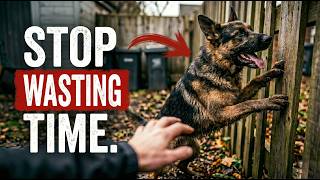
Jacob Morgan says 80% of dog problems disappear when you focus on just two things: a reliable off-leash recall and intense structured play like tug. Most owners waste effort on minor behaviors instead of addressing what dogs actually need: freedom and controlled outlets for their drive.
Chapters
If you're spending 6 weeks trying to teach your dog to sit on a mat while the doorbell rings, you're wasting your time. If you're spending months trying to countercondition your dog to the postman, you're wasting your time. You're spending 80% of your energy working on the things that only generate 20% of your dog's results. You're playing behavioural whack-a-mole. You fix the counter surfing and suddenly he's fence fighting. You fix the fence fighting, now he's chewing the skirting boards. You're exhausted, your dog is frustrated, and you feel like you're getting absolutely nowhere. And you're not, because you're treating the symptoms, not the disease. There is a concept in economics called the Pareto principle, the 80/20 rule. It was discovered by an Italian economist named Vilfredo Pareto. He noticed that 20% of the pea pods in his garden produced 80% of the peas. He dug a little deeper and found that 20% of the people in Italy owned 80% of the land. It applies to almost everything. In business, 20% of your clients generate 80% of your revenue. In life, 20% of your habits dictate 80% of your health. And in dog training, 20% of your actions generate 80% of your dog's behavioral changes. But most dog owners and honestly, most dog trainers have this completely backwards. They deploy all of their finite energy, time, and patience into 80% of the actions that barely move the needle. I see this constantly. People come to me with a dog that's bouncing off the walls, destroying the house, and losing its mind every trigger. And they hand me a list of 20 different microbehaviors they want to fix. He jumps on guests. He steals socks. He barks at the window. He pulls on the lead. He won't drop the ball. If I tried to tackle every single one of those issues individually, we would be training for the next 5 years. I don't do any of that. I ignore almost all of those specific issues in the beginning because those issues are just noise. They're the byproduct of a dog that is fundamentally unfulfilled. If you take all of that wasted energy and deploy it into just 2 things, recall and play, everything changes. Let's talk about recall first. A dog that can recall is a dog that can be let off the leash. A dog that can be let off the leash is a dog that can actually run, explore, and most importantly, be a dog. That is fulfilment. When you fulfil a dog, when you drain that chaotic pent-up energy, 80% of the annoying shit that they do around the house just vanishes. You don't have to train them to stop counter surfing. They stop because they're asleep on the sofa. You don't have to train them to stop barking at the window. They stop because their nervous system is finally regulated. And then there's play. I don't mean mindlessly throwing a tennis ball while you just scroll your phone. I mean structured, intense play. Tug. Something that involves you and your dog. When you play with your dog properly, you're giving them an outlet for their predatory sequence. You're letting them chase, bite, and win. But you're also teaching them impulse control. You're teaching them that they can be highly aroused but still listen to you. If you spend 20 minutes a day doing structured play and 45 minutes a day giving your dog off-lead freedom because you've got a solid recall, you've just solved 80% of your problems. Now, I know what some of you are thinking.
But Kirkie, my dog is reactive. I can't let them off the lead. I can't play tug with them because they get too aggressive.
That is exactly why you need to focus on the 20%. If your dog is reactive, the absolute worst thing you can do is keep them trapped on a 2-meter lead and try to micromanage every single action they do with the world. You're just building a pressure cooker. You need to find a way to fulfill them. You need to find a quiet field, put them on a long line, and work on that recall. You need to build that engagement through play. You have to drain the cup. Before you can start pouring new information in. This is why I'm such a massive advocate for the e-collar when used correctly. I'm not going to virtue signal and pretend that you can get reliable off-lead recall on a high-drive dog in a highly distracting environment just using a clicker and some hot dogs. You can't. The e-collar is an insurance policy. It allows me to give a dog liberty. It allows me to fully fulfill them, and once they are fulfilled, they're infinitely more receptive to learning. Stop playing behavioral whack-a-mole. Stop trying to fix every little symptom. Find the 20% that actually matters. Fulfill the dog first, build the recall, build the play, and watch the rest of the problems solve themselves. If you want to learn exactly how we do this, how we build that bulletproof recall and use play to transform behavior, click the link below. See you in the next one.