The Truth About Reactive Dogs Nobody Tells You | LIVE Q&A
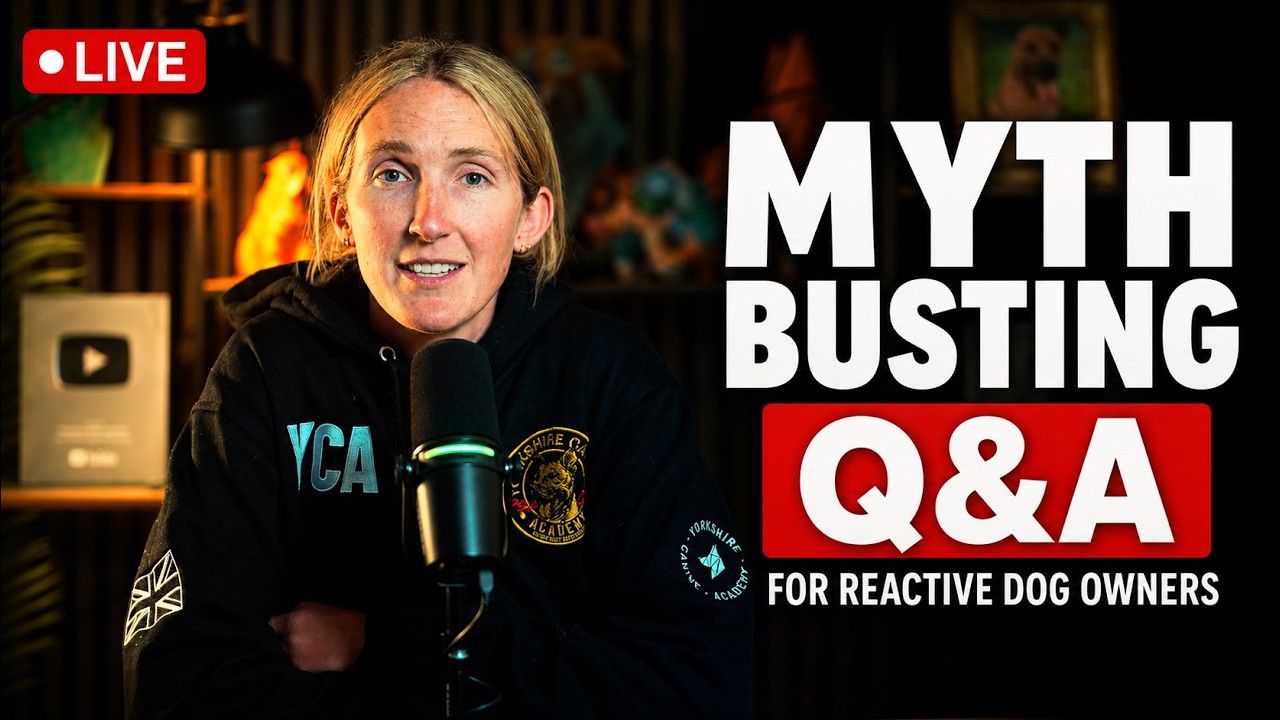
In this hour‑long live session, Kelly, owner of South Coast Canine Academy, welcomes a global audience of dog owners and answers a rapid stream of questions about reactive dogs. She introduces the academy’s focus on reactivity, explains how settlement training inside the home must be generalized to outdoor environments, and outlines the structure of their 5‑day boot camps (foundational work on‑site, followed by off‑site real‑world practice, resocialisation, and play workshops). Kelly repeatedly stresses the importance of a strong punishment/yes marker, balanced play as an energy outlet, and giving dogs agency to make choices. She provides case‑specific advice for a variety of breeds and issues (beagle settling, corgi reactivity to wheels, staffie/vizsla focus, cockapoo resource guarding, high‑energy labs, hand‑feeding wet/dry food, and lead reactivity). Practical logistics such as pet‑friendly accommodation, online courses, and contact details are shared. Throughout, Kelly adopts a conversational, supportive tone, offering enthusiastic yet measured recommendations while warning against unqualified DIY fixes (e.g., self‑taught resource‑guarding solutions, surgical castration). The session ends with reminders to book free consultation calls and to follow the channel.
Chapters
Hello everyone, I'm a minute early this week because I was 2 minutes early last week— 2 minutes late last week because I couldn't get the internet to work. Um, welcome, nice to see everyone here tonight. Uh, let me know, as always, let me know like who you guys are, let me know whereabouts you are. talk to me about your dogs. This is 1 hour of completely free advice, and everyone loves free stuff, right? So pop your questions into the chat, and I'll do my best to make my way through them all. Hello, nice to see you. Um, I will do my best to make my way through all of your questions before the hour is up, so if you have something that you want to ask, then chuck it in the chat and I will get to it as quickly as I can. Um, if anyone's here, I always start it this way so you can tell me if I'm telling you who I am, but you already know because you're always here. Um, for anyone that hasn't been on one of these before, I'm Kelly. I am the owner of South Coast Canine Academy, and we are a training center that specialize in working with reactive dogs. So if you are struggling with your dog, if they are making your life smaller, if their world is getting smaller, if you've tried other trainers before but nothing's worked, then we could be helping you get to where you want to be. We spend 5 days every week with 8 reactive dogs here And every week we're all out off lead in the park and in the pub afterwards for lunch by Friday. So if you have a problem, then let me know and I will try and give you as much free advice as I possibly can within this hour. Do you have access to accommodation as I'd like to come to a boot camp? Yeah, we do. We don't have any like specific accommodation here on site, but I do have a List of recommended accommodation nearby that is, um, all pet-friendly, all reactive dog-friendly. There's a bunch of varying, like, prices and kind of places to rent. Um, there's like hotels on there, things for under £100. Uh, if you guys want a bit more space, a bit of a garden, there's something for that. So there's a whole big list. If you email me, Andrew, at, um, kelly@southcoastk9academy.co.uk, um, then I will send that over to you so you can have a look. I have a beagle cross— beagle— beagle— it's 5 PM. I have a beagle cross Springer. He's no longer reactive, but he can't settle when we're outside or anywhere not at home. We've started tethering and crate training, but is there anything else we can do? So Sam, your dog, if they can settle inside the house where nothing is going on, then you've made good steps at them learning to switch off by themselves. But you need to start transitioning that training slowly outside of your house. So if you have a garden, you might think about tethering them in the garden, so tying them to something, an immovable piece of furniture, or even just having them on the lead next you, putting them into a down, putting your foot on the lead so that they can't keep getting up, wandering around, doing here, there, everywhere. There's going to be noises going on in your garden. I don't know how, like, sort of where you live, if it's like rural or if you've got lots of neighbors, kids, all that kind of stuff. There'll be things going on around, but it won't be too much harder than inside your house. And then slowly start transitioning outside of the house. So Lots of dogs find it easy in the home because lots of things don't go on inside your home. Like, you might have you and like your family members or your partner roaming around the house, but there's not a great deal going on there. Then dogs are super bad at generalizing. So one, they haven't had that much exposure to settling while there's actual stuff they care about going on, but two, they've only practiced it in one spot. So yes, it is good to start at home, but make sure that you start graduating outside of the house and slowly making it harder and harder. So don't go straight from your back garden down to the busiest pub garden you've ever seen in your life where there'll be people, kids, dogs, all that kind of stuff. Maybe I would tie it into like the end of a walk. So your dogs, you've already met their needs, they've been exercised, they've been fed, they've had water. There isn't anything else that that dog needs. What I actually want from you now anyway is to settle down and start to calm down. Sit in the park, find a nice quiet bench while we're in the— I say we're in the dregs of summer, but I feel like it could get another heat wave again. It's boiling out there again today, and I really thought we'd seen the end of it. So while it's still nice outside and not pouring down with rain and horrid, go and find a nice little shady bench, sit there, wait for your dog to settle. Don't give them loads of instruction. Put on the lead, let them figure it out themselves. You can get up, down, up, down, look over there, look over there, go up there, but We're not moving. I'm not going to give you anything. Nothing will happen. Just sit and marinate in the environment until you chill. If you want cheap accommodation, the Travelodge in Tunbridge Wells is cheap, about £20 a day. Oh yeah, that's where Helena stayed when she stayed with us. It is decent there, and there's a nice, um, the Travelodge in Tunbridge Wells, Andrew has a big green opposite, so really easy access to go and toilet your dog in the evening. After a boot camp, your dog will be super tired. Um, it's a big week for them, loads of stuff going on, loads of work, so they don't ever need a walk or anything after a day at boot camp. So they'll just literally need to go to the toilet. Hi everyone, greetings from Slovakia. Oh, how nice! Hello, well, welcome from afar. Can you pop your address in the chat? I can try. I think I should be able to use this also. This is where I spell it wrong. South Coast K9. Okay, there you go, Andrew. Chuck me an email and I'll send you over the link. Um, we have a 3-and-a-half-year-old Fijian boy. Ah, what's his name? Let me know. Looking forward. Are you planning to come to South Coast, canine? Obviously, if you want accommodation here, that's a stupid question. Ignore that. Just tell me the name of your dog. Me and my 2 and a half year old corgi. My 2 and a half year old corgi is a maniac outside. I love a corgi. He goes nuts when there are other dogs, moving cars, or anything on wheels. He's a sweet little guy though. Corgis are all cute though, eh? Okay, so inside the house, I'm guessing you don't have any issues. Like, there's quite a bit to unpack there, but when we think about dogs being reactive to moving things on wheels and stuff like that outside the house, there's an element of training there in which you want to say to the dog So you want to build a strong punishment marker so you're able to say to the dog, hey, that thing that you do when you go nuts at bikes, cars, scooters, anything like that, don't do that anymore. That's incorrect. I don't like it when you do that. But you also need to appreciate that that dog— that behavior probably comes from somewhere. The dog has a need to do something. So if you just take behavior off the table for that dog but don't give them anywhere to channel that need to do stuff, then you're going to start playing behavioral whack-a-mole where that behavior goes away, but it was just going to pop up somewhere else because your dog has energy to do something. You need to give it somewhere appropriate to go, and that's why we're so big on building play with dogs. The chase, the grab, the whatever part of that the dog really enjoys. They get something from it. I know you have a want to do it. It's socially unacceptable to gob off at cars and bikes and other dogs, but I know you want to. So you want to do it with me? We can do that with play. and you can build a great game there. Also really good for like building boundaries, building relationship, building confidence, um, and just like having fun with your dog. I think that's the thing that we all— we miss out a lot on— A lot? We miss out on a lot with our dogs is that we get so caught up in the like this kind of rigid system sometimes when we're training of like, gotta do that, don't do that, do, do this, gotta practice this, gotta get better at this skill, when actually like we all just got our dogs to enjoy them and have a nice time and have a nice life together. And play just gives you that like outlet even when you're like working through training, you're not quite exactly where you want to be yet, there's still work to be done. It's that nice time that you can just spend together, and it's just 5-10 minutes of your day where you, you and your dog are just doing something that you both enjoy and enjoying each other's company. So that was a very long-winded way of saying your dog needs a strong punishment marker, and play with that dog. Ideally, also get them safely off lead as quickly as you can, so you're giving them proper outlets to run and move, but also somewhere to put their drive. I've just taken on what I think is a Staffie cross Vizsla. I've been told she's about 3 and a half, fine in the house with my other dog, goes nuts seeing other dogs or horses on walks. I cannot get her to focus at all. So ideally, the, the thing about that is that You don't really want her to just focus on something else. What we really try and hone in on in the way that we train is giving dogs agency to make choices on their own without guidance from you. So it's not about, look at me this way, do something else, give them another cue, put them in a heel. Focus on something else, put your focus into the ball, look at me instead of looking at the thing. It's about the dog being able to make choice of, I know I'm not allowed to go nuts at dogs and horses, what about I try something else? What if I do look back at you? What if I do disengage and sniff the floor? I want them to be able to take in the dogs, to take in the horses. I want them to be able to look at them and know that they're there and choose Not to do the going nuts at them part, just pick something else. Um, so in terms of like focus on you, I wouldn't say— I mean, certainly if you were training with us, it's not something we would put our energy into, is like building loads of focus on you. It's just about building a clear communication system with that dog. where you're able to say to them in a way that they understand, that was right, love that, do that more. That was incorrect, don't do that again. Um, if you speak to anyone that's ever been to one of our boot camps, you'll know that that's what the week is really centered around, is one, getting the dog off lead as quickly and safely as possible, as we possibly can. But 2, giving them agency to just go out there and make decisions on their own without constant micromanagement from you, because that builds confidence in a dog, and that is a dog that can go out and be as free as they possibly can. So boot camp is for a whole week? Boot camp is Monday to Friday. So Monday, Tuesday are like Foundational days, those are the ones that you'll spend at our center if you're here in South Coast, or if you're here in Leeds, or if you're across the pond and you're in Australia, or this week if you're in California. I think this week, next week, week after, if you go to California, then we spend the first 2 days on site. Those are the days where we're giving— we're building that communication system with you and your dog, and we're making a start on getting a rock-solid recall. And then Wednesday, Thursday, Friday are the days where we go off-site as much as we possibly can so that you guys, by the time you go home, you've experienced all of those curveballs that life could potentially throw you when you get home, and you've been able to navigate your way through them whilst you're there with us to guide you. Because I think that's the thing where a lot of people Training doesn't quite hold up when you exit that clinical training hall or that church hall or that one, one hour a week in your back garden or your front garden or that one park. We try and get you— because then you go to a different park or outside of that training hall and life throws you an off-lead dog or a screaming child running past on a scooter, and you're like Never seen that before. Don't know what to do. Don't feel confident about this. So we try and spend as much time as we possibly can offsite, just being out in the real world and putting the skills that you've learned Monday, Tuesday to use Wednesday, Thursday, Friday. And on Thursday, we all go for brunch together in a garden centre. It's actually a lovely garden centre. It sounds very nana to say that, but they have very good breakfast in there. And then we all go to the pub on Friday together. We have never ever had a dog not come to the pub with us on Friday. So hop on a call, talk about your Staffie with us. If nothing else, you'll get some more free advice, and if we can't help you, we'll be able to point you in the right direction. So I think the link to book on a call will be in the chat. So Just fill out the form in the chat. It's half an hour, it's free, so might as well, eh? Um, he's reactive. Oh, this is Andrew's dog again. Uh, he's reactive to some dogs and can lunge, same with people, and haven't had visitors in 3 years. Wow. He fixates, puffs out his chest. Suggestions as to how I can get him to disengage, please. That's such a good name. That is also the name of my car. Um, you need to build a strong yes marker with that dog. If you're going to come on boot camp, this is the stuff that you are going to learn anyway, but the reason to why we build that strong punishment marker is to take the Lunging and fixating off of the table becomes less preferable for the dog to do that because they're like, I, I don't like it when you're disappointed in me. I'm not going to do that thing again. I'll pick something else. And that's where they can disengage from that thing and choose to do something else. And that's behavior that we can start to pay into. Um, Well, true. Definitely for the moment, if you're gonna— I mean, you haven't had visitors over for 3 years, that's really rubbish. I'm really sorry. Um, but if he is fixating and you have a lead on, you can use your lead in that moment. But just be aware of like using pressure, if you're not using it correctly and your dog doesn't actually know how to yield to that pressure, can actually send them into a reaction. So For now, if you are coming to a boot camp, Andrew, to be honest, I would manage that situation. Once you're at boot camp, we'll be able to give you the tools and the skills to navigate that when you go home and start making real actual change there. All right, no worries. Um, asked you about the nibbing from my dog while training, and you were right with a good mark. With a good no marker was the way. Thank you. I can now train and have fun. Ah, were you the person that had the puppy Mali? Let me know if you were. I think I remember who you were. That's really good though. I'm really chuffed for you. Well done. Glad to hear that you're out there enjoying, enjoying your dog again. So boot camps for— oh no, been that. Hope you're well, hope you're well, nice to see you. Herbie sounds like Ozzy was. Yeah, he does sound like a bit like Ozzy, right? No, she's a German Shepherd. Okay, so I don't remember who that was, but I'm very glad to hear that you're doing well. What's your dog's name? Um, yeah, I'm looking forward to meeting Herbie. Andrew, do you know what week you're booked on to boot camp? Oh, nice! Well done, Ariana. Well done, you. Well done for getting out there and doing something. Um, okay, anyone else has any questions, then pop them in the chat. Andrew, let me know what week you're coming to, um, to boot camp. I'm looking forward to working with you guys. Um, I had a couple of questions that I've woefully neglected from people that asked on Instagram earlier. Can you help a bonkers cockapoo and manage their resource guarding? When you say— if you're, if you're here, Darren, um, when you say a bonkers cockapoo, what does that mean? Like, is that outside the house, inside the house? And would be interesting to know what it is that they're resource guarding. Is it people? Is it toys? Is it space? Is it food? Um, very common issue to have with a cockapoo. Or spaniels, to be honest, very common. Um, we don't actually take on cases of resource guarding. We specialize in reactivity. And the one thing that I will say about resource guarding is it can be very tricky and nuanced. And make sure that if it is something that you want to tackle, you don't just go out onto the internet and find some random advice. and try and go it on your own. Definitely make sure that you are seeking the help of a professional if you're dealing with resource guarding, because if it goes bad, it can go bad, and you can easily get bitten. Um, and you never, you never want your dog to find success in that way if they're resource guarding. Um, so definitely make sure that you're seeking the help of a professional and make sure that you do your research. Make sure that that person that you're going to work with is able to show you proof that they have worked with a dog like your dog before with an issue like the one that your dog has, and they have proof of being able to do that before you go and pay someone a bunch of money for something just because they say they can. Um, in terms of managing resource guarding in the meantime before you find a trainer, Utilize things like crates, leads, or house leads if you need to. Um, it really does depend what your dog is resource guarding. Um, so if it's— let's say for example it's food, like if when your dog is eating, leave them to eat. So their food goes in a bowl in their crate Door is closed, they eat, they come out of the crate. If they would resource— if they would not eat the food and they would resource guard the food, then make sure that you have a line, a lead on the dog, on their collar. If they're just going to sit in that crate and resource guard, you have a way at a safe distance to get your dog out of the crate and remove the bowl when they are out of the room. But yeah, utilize things like management, crates, leads. If it's space, if they're going to you when you're getting on the sofa, make sure that you are making sure they cannot have access to that area until it's the problem, a problem that you're able to work on with a trainer. So again, things like management, baby gates, keeping doors closed, leads, crates, all that kind of stuff. Why do you keep saying South Coast Canine Academy? Has YCA been hijacked? No, we are a franchise of the YCA. So the canine academies that are currently are Yorkshire Canine Academy, South Coast Canine Academy, Perth Canine Academy— that's in Australia, not Scotland. Is there a Perth in Scotland? I think so. Perth in Australia, um, and California K9 Academy, North California. Um, that opens not next week, week after. I think it opens soon. So yeah, that's why I keep saying South Coast K9 Academy, because we are South Coast K9 Academy, and no, they haven't been hijacked. But we do do the same things that YCA do. So like YCA, we also specialize in reactivity. We run boot camps just like YCA. So if you're interested in chatting to us, or if you're interested in just half an hour of a free chat, get some advice with people, I think there's a link in the description there. So just hop on a call, have a chat with one of our trainers. Some trainers said Ariana does not play but herds the other dogs, and that play with other dogs isn't that important. What do you think about that behavior? I think that first of all, you're going to want to build some strong boundaries in play with Ariana there. So making sure that you have a strong End of play and a strong beginning play cue. So a word that says to your dog, the window of opportunity is now open, let's play. So for my dogs, I say ready, and then another is that window of play. I say enough. Once I say that word, you're not allowed to put your teeth back on that toy, you're not allowed to touch that toy, the game is over. That thing that you're doing, we're no longer doing that. And then start building boundaries in play. So making sure that your dog has a strong out. Um, you could potentially start toggling with arousal in play there. So having your dog, if they're super, super into the play, that is. If your dog isn't very strong in play, you're going to want to really build them up first before you start putting in lots and lots of boundaries and rules into the game, because the dog's just going to tap out. It's not fun enough. So you want to build them really, really high. And when you have a dog that's like, I just can't wait, all I want to do is play and I'll play for hours, that's when you can start setting those rules and boundaries inside your game and start toggling with arousal. So one way you can do it is to play, play, play, play, play, and then you can maybe ask your dog for an out, pop them onto a place bed, make them chill, relax. Don't close your window. Game's still available to play, we're just taking a minute to settle down. And then take— retake the toy, whatever your word is. I say yes, take the toy again, play, play, play, play, play, out onto your place bed. You could also work on some conditioned relaxation so you had a cue to tell your dog, hey, take it down a level. Um, but definitely building your boundaries in play first so you're able to then communicate with your dog when they are playing with other dogs. So you're able— you obviously have a strong punishment marker now. You're able to say to your dog, that was incorrect, don't do that, but also having a window of opportunity to say, okay, you can go and play When I say you're done, I say enough, your dog stops playing with the other dogs and you have a strong recall to call them back. Definitely building your boundaries in play first before you try and translate that over to her playing with other dogs, because what you don't want to happen is that your dog ends up playing with another dog, gets a bit too much, gets an unfair correction, or gets a correction, doesn't take it well. There would also probably be an element of like correctly learning socialization with that dog, but 100% play is the way. Teach your boundaries and play first would be my recommendation. Sorry, I really waffle. If anyone wants to stop me, just tell me sharp and move on to the next question. Oh no. We're gonna get a gobby yank doing lives. It's not very nice. Lady that runs California Canines is actually a really nice person. If I snip my God's nuts— you mean your dog's nuts? You're kind of aggressive in the way you ask these questions. Um, no, there's no Taking, chopping off body parts, there is no scientific evidence to prove that it has an effect on behavior one way or the other. You, it's your responsibility to train your dog, to show them, um, show them what's acceptable and what's not. Chopping off body parts isn't going to solve your problem. If you are going down the route, if you're dead set and it's something you want to do, I would always recommend that you speak to your vet about chemical castration first. But it's never something that I would ever recommend to a client, chopping off bits of your dog's body. isn't the way to change behavior. No. Um, hello, I completed boot camp towards the end of July in Leeds. We spoke briefly in the reception area. I have Danny the Hudson Yellow. I remember you! We're heading back this weekend for an advanced e-collar and recall. Ah, I remember you! Um, how are you getting on? I feel like I maybe saw a As you were in like one of YCA's stories recently with him, like just having a gorgeous little time, um, just being out there living, living his life. And you're right, he was a very handsome yellow love. Um, thanks for joining on, nice to hear from you. Let me know what stuff you've been up to since you left boot camp. What have you been doing with him since you left maybe you couldn't do before? Um, and so nice to hear that you're back off up to YCA this week to do some stuff. You'll have a good time, always a good time up there. Um, resocialization, do we need to prepare anything? The way we teach resocialization is very specific. Um, if it's something you're interested in, I would have a chat with one of our team Although I know you've already done a strong punishment cue with your dog and you have that with Ariana, a boot camp might be something that would be good for you. We do like a whole morning on Wednesday, we do a whole big play workshop, and over like Wednesday, Thursday, Friday, we focus real heavy on resocialization. So making sure Especially when we have dogs that have struggled with reactivity, whether it came from fear because they're like undersocialized down here at like a 0, or it came from being hypersocial because they just want to be with dogs and they're at like a 10. Throughout the week, we work to get either of those types of dogs back to neutral, but you never want to leave them just in that neutral space. Because then they're only ever one bad interaction from going the other way back into fear. We always want to try and push them to like a 7 or an 8 in terms of sociability, so that if they get rushed by the off-leash dog and it gets up their bum and whatever, they're like, it's not the end of the world and it's just that dog. It's it's not all dogs. And you can start to build them back up again. You don't want them to tip back the other way. So we focus really heavily on resocialization in an appropriate way that gets dogs comfortable with other dogs being in their space. Because we— everyone here knows it, everyone here that has a dog will have experienced it at some point or another. Like, when you're out in the world and you're with your dog You can do your best, and I'm sure lots of people that are here potentially do have reactive dogs. You do do your best to avoid places where other dogs will be, but at some point life's gonna throw you that off-lead golden retriever with no recall. Your dog is gonna have to be okay with that dog potentially getting into their space for a minute or so. And it not being the end of the world and them not flying off of the handle about it. So that's why we focus really heavily on, on resocialization, to get dogs to a point where, yeah, fine, they're, they're maybe not that happy-go-lucky Labrador that trots into the park and can't wait to see every single dog and is just thrilled to be alive that day, but they can be comfortable with dogs being in their space and knowing that You're not going to come out on the other side of it dead, and you don't need to kick off because of it. Thank you. When I say out, and she feels that we're finishing playing, she doesn't let go anymore. She hates out because there's a little chance I say enough and it's over. So when you're teaching her an out, you want to make sure that like 80% of the time that you ask for the out, it means. Yes. And then you restart the game again. So out, soon as teeth comes off toy, yes. Now they have the toy back. And like, let's say during a game of play you're gonna ask for an out 10 times, 9 of those times need to mean you're getting the toy straight back. So when you're teaching the out, you want the toy to go dead. Because it's boring, it's not doing anything, not activated. You ask for the out, they let go. As soon as they let go, the game starts again and the toy instantly then becomes fun again. And that's where you're going to start to build a dog that's less likely to want to hang on to the ball for dear life because they're like, nope, you're going to say that word and then the game's gonna be over and I don't want it to be over. Actually, out is a good thing because it means the game will start again and get more fun again. So practice it that way. Jeff here. Hello. 2-year-old Doberhula bitch. Doberhula? Never heard of that before. We're booked on to boot camp in October in Yorkshire. She's fed a wet-dry mix and I want to start hand feeding. Is there 100% dry feed better or just get messy? What are you— what food is it that you are currently feeding your dog in terms of wet and dry food? Because the first stage of working through that hand feeding process is making sure that your dog is on a really, really good quality, high protein food. A lot of the reason why dogs are like Oh, they'll, they'll eat their wet food and they'll maybe pick about with the kibble, but they won't eat it, is because the kibble sucks. Because the meat is higher content, it's kind of like a treat, right? Because it's more nutrient dense for them, it's more tasty, higher in protein, so they'll always go for that first. If you want to keep a 50/50 mix, then I would mix your dry food into your wet food and hand feed it that way, as long as both Parts are nutritionally dense for the dog and high quality. In terms of when you get here for the week, when you feed wet, are you feeding like tinned wet or are you feeding raw? There are some things we can do there, but in terms of like the beginning process of hand feeding, I would mix the kibble with the wet food so it all comes out together if you want to keep that 50/50 split. Because if you try and hand feed the wet and then try and hand feed the kibble when they're not keen on it, they're never going to take that kibble because they're like, ah, just hold out till I get some more wet food tomorrow. I don't even care about that other half. Um, and same again if you try and feed the kibble first, they're like, nah, I'll hold out till the wet food comes, thanks so much. Um, so let me know what it is exactly that you're feeding your dog, Jeff. And, um, I'll get back to you on that one. Danny's a different dog, still have some reactive leakage with him. He's a 3-year-old boisterous lab, so lots of energy and arousal, but living his best life now. 3 miles a day off-leash, perfect recall. Nice. The only thing I would say about a high-energy dog like that Is don't fall into the trap of exercising your dog for hours and hours and hours a day in an attempt to tire them out. Make sure that you're giving them— obviously, yes, an appropriate amount of exercise that they need so that you're fulfilling their physical needs, but giving them an amount that is Fitting with your life. So if you are the person that does like to go for a 2-hour walk every day with your dog, cool, sick, go for it. But if it's not sustainable to your life and you're like, realistically, I can't keep this up, like the dog has to get an hour a day and that's the time in which I have, then make it an hour a day and don't focus on just trying to keep tiring them out, giving them more and more and more and more, because you're just going to create an athlete. And then eventually it's like when you're on a— doing it— sorry, I don't know why that keeps blinging. I've got so many tabs open on this computer, could honestly be anything. Um, you give them more and more and more. It's like if I did a couch to 5K, when I start in the beginning, like 1K even feels like a stretch, right? And you're like, oh my God, I'm so tired. But then once you get to that 5K mark and you're comfortably able to do it, it doesn't quite meet your needs anymore. And then you're like, oh, I'm actually quite good at that now. Maybe I could go to 7K, maybe I'll go to 8K. So make sure that you're giving them an amount of exercise that's appropriate for your lifestyle, that's sustainable for you, and focusing with a high-energy dog like that on being able to get them to switch off, not just doing more. Practice doing nothing. Herbie can't settle outside the house. If I sit on a bench, he'll moan or bark at me until I get up, so about 30 seconds. A trainer we've had said Herbie's bucket is 90% full and can't relax or chill. So Andrew, one of the things that we'll really focus on when you're here with us is Obviously, like I said, building that communication, making sure we're getting that balance right in terms of fulfilling Herbie's needs both physically and like, uh, genetically through play, but also making sure that you are able to get him to switch off. If the thing about that is if you sit down and he's like whinge whinge whinge whinge whinge and then barks and then you're like Can't deal with this. Fine, we'll go. Then he's like, cool. That's how I get you to move. Next time I'll start there then. Whinge, whinge, whinge, bark. All the bark got you up. So next time I'll just bark at you because it's the quickest way to get what I want, which is to not sit here. Um, Vizslas are chatty caffees anyway, so you are going to get a bit of moaning there for sure, but He needs to learn how— he 100% needs to learn how to switch off. Once you know, like, I've done everything that you need me to do, I know you've been fed, I know you've been exercised, we've played, you don't need anything else. What you need now is that— is to sleep. How much exercise would you suggest? Depends on your dog. What kind of dog you've got. You do a good amount with Ozzy, Helena. Um, for like, let's just say like your typical dog, or even let's say for example my dogs. Like, I've got Chauncey, bull lurcher, who is almost a year old now. Um, and I've got Rue, 4-year-old Romy rescue. They get about 45 minutes to an hour in the morning Before work, and then I give them again about an hour in the evening before we go home, and I incorporate some play with each of them into that walk. So Chance likes to play more than Roo. Um, he'd probably get 10-15 minutes of play. Roo would probably get about 2 or 3 minutes, and I just weave it into my existing routine. But that again is for like me personally. I would say you should be aiming to Give your dog an hour of sufficient off-lead time per day and then about 15 to 20 minutes of play depending on your dog's drive. It's probably average for most dogs, but again— fly, sorry— depends on your dog. It's amazing what 5 minutes of tug will do for him. The walking is brilliant and I'll try and limit it. Yeah, nice. So like Play is just the best. I love it. It's just fun time to spend with your dog, and it's bonding, and it really does drain their tank. Like, off— there is nothing like getting your dog off lead and giving them that freedom to just go and be in the environment and go be a dog. But like, lots of dogs have a drive to do something. They like that bit of a tug and a tussle, or they like the Searching and sniffing, or whatever it is that you're doing with them, whatever kind of game your dog enjoys. They have a drive to do that thing, and you want to be able to put that energy somewhere. So yeah, just 5 minutes. Like, like I said with, with Rue, like, she enjoys it, but I had to build it. I built it with her to help her with confidence and to help us, like, bond and build our relationship. Um, but she'll still probably only play for about 2 or 3 minutes before she starts to tap out, so I don't ever really take it further than that. She just, she enjoys that little bit and then that's us and she's, she's good. Um, 2-year-old husky corgi mutt, how would you handle high excitability around triggers, children, and friendly folks? It's cute little dogger. My guess is punishment. With better correct timing even when overly excited? Depends what you mean by overly excited. If it's like jumping up, barking, lunging, then yeah, I would consider punishment for those things because that's just rude. But if it's just like whinging and whining I would much prefer to build play with that dog to build a good relationship with me and build a really, really strong end of play cue. So I have a way to say to that dog, hey, that thing you're doing right now, knock it off, we're done doing that, stop doing that thing. Because whinging and whining isn't a criminal offense. Like, punishment when you get it right is very, very powerful. You don't just want to go out there willy-nilly punishing this, that, and the other, because not all things are crimes. I wouldn't say that whinging and whining is a punishable offense. It was— it's something I would use my end of play cue for. So depends what you mean by excitability. Let me know in the comments what that looks like for you, and I'll be able to help you more. I wasn't able to walk him at all before boot camp. Oh, you did boot camp? Nice, cool. Where did you go? Um, obviously not here because otherwise I'd remember you, eh? So obviously you went to Leeds, or maybe you went to Perth, maybe you're in Australia. Um, hi everyone, I have a crazy fun 1-year-old beagle. So far so good with training, but outside can be challenging. I don't have a fenced-in yard. But I do play hide and seek with him in the house, treasure hunts. He's the perfect size for the house. Nice. What, um, when you say, John, when you say your beagle can be challenging outside, what does that look like for you? What things are you struggling with with him? Also, what's his name? How do you handle it when strong dogs insist on something and blocks your way, for example demanding the play? That's what you would use your play windows for. So make sure that all toys are off limits, they're all up and away, because all of those things have no value if they're just freely available to the dog. Doesn't sound like your dog has struggles with wanting to play anyway, but I keep all of my dog's toys away. And if you— if the dog is demanding play, that's a no-go from me. So I would use management in that situation. Nah, knock it off. Pop them in their crate until they've settled down a little bit, maybe 2 or 3 minutes until they're not being persistent and whiny. And then I'll be like, I've had a great idea, ready? And then I open the play on my terms. So you just have to show them, you, you don't get to choose when this starts and when this ends. It's on my terms. I pick and choose, and I'll 100% give you a window of opportunity every day to do it because I know you love it and I love to play with you. But you don't get to demand it whenever you feel like it. It only happens when I say. That, that kind of training, especially for a dog like yours, He really, really loves it. Can really translate into other areas of your life really, really well. Um, some lunging but getting better. He is Porfoss. He's about 14 months old. That's such a cute name. A lemon beagle. Very cute. I ask him to heal when he does that. Had a high-energy boxer and now a rottweiler. He's much better in his crate. Housebroken. The only thing that I would say about the healing thing, if he— the only thing that's going to happen there with the lunging, if you ask for an alternate behavior, you're not decreasing the likelihood of him doing the lunging again. You're just strengthening your heel. You're just giving him an alternate job to do. You're not actually communicating to him that you can't do that. So that would be something that you would want to Use a punishment cue for it to say, hey dude, no rude behaviour. You can't be lunging when at things. Pick something else. Putting behaviours over the top of things. So like, if you think they're going to pop off at a dog and you get, oh, I can get them to do a heel, or I can get them to do a sit, or I can give them an alternate behaviour. That's great, but that's management. And what if one day you don't see the thing coming? Or what if one day it just— dog flies over out of nowhere? Your dog can't make choice and know that certain things are wrong if you don't have a way to communicate that to them. They only know what to do under your guidance, and I don't really think that that's fair. That's just, that's just managing, micromanaging all the time. The dog has no agency there, and that can create a lot of frustration too. Because you're leaving half of the picture gray. You're only telling them the things you like and then just leaving them guessing what things are incorrect. Excitability as in extreme tippy taps. Cute, very cute. Sometimes spinning in circles and strong fixation. Yeah, I would make sure for that dog Get some play on the go, build some really strong foundations in play, build a really strong beginning cue, build a really strong end cue, and then start— once the dog's super into the game, start putting some boundaries in there. And then like tippy-tippy taps aren't crimes, spinning in circles not really a crime, and strong fixation. The thing about what's probably happening there Is that your dog has energy to do something. They want to play, but they don't get that outlet with you, and they potentially have played with other dogs. So then when they go out, they're like, oh, I have this need and I really, really want to do something, and the only way I can drain that tank is to play with other dogs. So you want to make sure that you give your dog a place to put that energy. Um, they're going to be less looking to drain that tank In into other dogs, and that's my answer for you. I ask him. I had a high energy boxer. Now three three what riles three what rock ba ba ba ba three rottweilers or a three-year-old rottweiler. Do you have Caroline? Had a boxer and now 3— oh no, I've answered my own question if I just read far enough. Had a boxer and now 3 Rottweilers and they are more solid off lead than on lead, perfect recall, etc. Does that make sense? Yeah, for sure. It's the— that boundary thing, right, of them not being able to do what they want because they're tied to a lead. Um, what problems are you dealing with when they are on the lead? I have 3. Sorry, I answered that question myself if I'd actually just paid attention and carried on reading. You made that very clear. Let me know what it is that you're dealing with when you say like solid off lead. What does that mean? Is that like with other dogs or with people? Um, what are you— what are the issues that you have with them on lead? I generally use a strong no and bring him back to me, and he likes to sit on my feet. Sometimes I go right up to him and say no until he stops carrying on. Socialization, I take him to PetSmart. He loves the car. Don't trust my beagle yet. The only thing I'm gonna say about your no is punishment by definition is stopping the frequency, intensity, or likelihood of behavior. If you say dogs don't know English, you could literally say cabbage to the dog, and if what happened with that word led to something that the dog didn't like, they would not do that thing anymore. If you're saying no And then same picture presents itself to the dog again down the road, another dog or whatever it was that set them off before, and they choose to do the thing again. Your no— I'm assuming you want it to be punishment— isn't punishment because it didn't stop the dog doing the thing again. So therefore not effective punishment, or your dog didn't see it as punishment. I think a lot of people struggle with that as well because they say no and then they use some kind of physical interrupter, whether that be The slip or a prong or an e-collar, and they— we think it's punishment because we're like, well, that must have been uncomfortable for them, so that must make them not want to do that thing again. But the dog chooses what they find punishing, and quite often that physical interrupter is just that, just an interrupter in the moment to get them to snap out of it and stop doing the thing right then and there. So It's not the punishment itself, because given the same situation presenting itself again in the future, the dog would still choose to do the thing. Therefore, what you were doing wasn't punishment. And that is what I will say about the no thing. Um, I walk on harness and a long lead where Herbie's normally at full extension, but when he's off lead, he normally walks beside me most of the time and is constantly looking up. Me checking— oh my goodness, I'm so sorry, that's so rude. That wasn't your question, Andrew, it's just near the end of the day and I didn't have— I only had one coffee today. Um, walk on a harness and a long line where he's normally full extension, but when he's off lead he normally walks beside me most of the time, is constantly looking up at me, checking in. Ideas? What is your problem there? Your problem is that when he's on the lead he pulls when he's off the lead he doesn't go and free roam enough? What is it that you struggle with there? One is slightly reactive on the lead. He was attacked 3 times by other off-leash dogs. That's really shit, sorry. And has become sensitive to some dogs. Always needs to see what another dog is doing no matter the distance. Is it just like looking Or is it always barking, lunging, snapping? What is it that you're actually struggling with there? Because looking isn't a crime. Like, looking at another dog isn't a criminal offense. You're allowed to. I want you to see. Just looking. It's just looking. I wouldn't consider that to be the biggest issue. I would maybe just work on something like a I leave it to keep him moving, especially if he's on the lead. Um, build something strong like that to help him disengage. Um, but no crime has been committed, so— but hard to get his focus back. Um, so then you would maybe want to use a strong yes marker so you're able to get his focus back to help him see You can just disengage from the thing if there is no other issues there. Um, then it's not my being clear to dog language. Oh, the beagle and the no thing. Sorry. So I have to learn how to properly correct the dog to not confuse him. Yeah, you need to learn how to properly communicate with your dog. Hey, that thing you're doing, I don't like that. Stop doing that thing. Um, oh, Doberman and Catahoula leopard dog cross. Cool. I wish you could send pictures in this chat because I would like to see a picture of that. If you can send one— I don't think you can, but if not, when you are up— you said you were going up to, um, Leeds, right? I'll get them to send a picture. Um, but off lead in the same situation, he's perfect. Yes, it's super common thing, right? Like off lead, he can just choose to leave, but he doesn't know that he can choose to just disengage there because he can't go too far anywhere because he's just on the lead. He can't choose to move away. So you kind of have to show him that he can just disengage and walk on, nothing happened. I have to go to school to learn the dog language. Just kidding. Well, if you are interested in learning, John, working with us might be a really good option for you. Um, definitely get you off to a stronger start and definitely make sure that you get your dog off lead beagling around with a rock-solid recall so that you're able to let him off and go and experience more life and show him more things as he gets older and moves through adolescence. You've got hopefully many, many, many lovely years ahead of you with, um, with that lemon beagle. And if you want to get him off lead and learn how to just give him agency to go out and make choice so you can go and live life with him, um, use the, the link down there and just give us a call. Let's have a chat about, um, about what it is that you want to get from your training. No time like the present. You can get it done in 5 days. That'd be nice. I trust him in the house but not off lead. We are in Gator Country in Florida. Oh, fun, in Florida. And well, we do have an online course, so— or if, uh, my geography is shocking, but if you're able to get to California and you want to do in-person training, you could potentially go to California. But we do have a really, really, really good online course, so that might be one for you out in Florida. So Some of my family are from Florida, actually. Um, my uncle used to live in Sun City and my cousins used to live in Brandon. No one cares, but you're welcome for that useless information. This is my 3rd beagle. First one lost due to divorce. Oh, sorry. Second one, a snake got him. That's really sad. I didn't even know you struggled with snakes in Florida. I thought it was literally just alligators. My auntie used to have a beach house and they like had to have a lanai built, which is like the American equivalent of a conservatory, because they like lived right near a golf course and like you would just walk out into the back garden and there would just be alligators there. It was wild. I have blamed. Oh, you can't blame yourself for nature, you know. Unfortunately, life— bad, horrible things happen in life. Don't blame yourself for that. Give this lovely lemon beagle a gorgeous life. Right, before we leave, I will get this question answered. Your issue is that you're Well, here's what I say to you, Andrew, is that I wouldn't worry about it for much longer because that problem will be gone once you've come to boot camp. Um, we will get you moving forward in the right direction, we will get that Bijler off lead, and we'll get you out there in the world living life. Um, and then maybe you can come back on here after your boot camp and you can tell everyone all of the stuff that you have been up to, like, uh, that lovely lady and Danny the Labrador. Um, okay, well, we are at 6 o'clock now, so if you guys have any more questions, then— I'm always concerned, the first one I did, that I was super into answering something or telling a story about something, and then YouTube just made me go bye-bye, so I never know how much longer I have left after the hour. If you guys have any more questions at all tonight, then run, don't walk to the chat box. Chat box. Chat box. Maybe before I start losing all my words, I am gonna say. Going once, going twice, going thrice. Okay, cool. Thank you so much for tonight. It was really nice to chat to all you guys. When are the STCs? I'm gonna do them, Helena. I've got an admin week— not— I've got an admin week next week. I promise, promise, promise I will sort them. And if I don't, you can text me. And you know, you say, when are the SCCA hoodies coming, Helena? I say, when are you coming back to visit us? Because we want to see that Aussie boy and you, because you are great fun. Um, I know Sam's already asked you when you're coming back, so that is my question to you. I'll sort the hoodies when you come back and say hi soon. Good. Potter has a YouTube channel. Oh, cute. Nice. Um, all right guys, well, have a lovely rest of your evening or your day wherever you are, because there's some fun people from all over the world here. So I don't know what time it is. Have a nice breakfast, have a nice lunch, have a lovely dinner. Um, and I will see you guys next week. Thank you so much for Hop on and like, rate, share, subscribe. Bye!
More from Jacob




I Wish Someone Told Me THIS When I Had a Reactive German Shepherd (Extreme Case Study)



Are you playing the wrong game with your dog? #dogtraining #dogtrainer #dogowner




Mabel's Incredible Reactive Dog Transformation #dogtraining #reactivedog #dogtransformation