This Dog Was Going to be Drowned. We Had 5 Days to Fix Her.
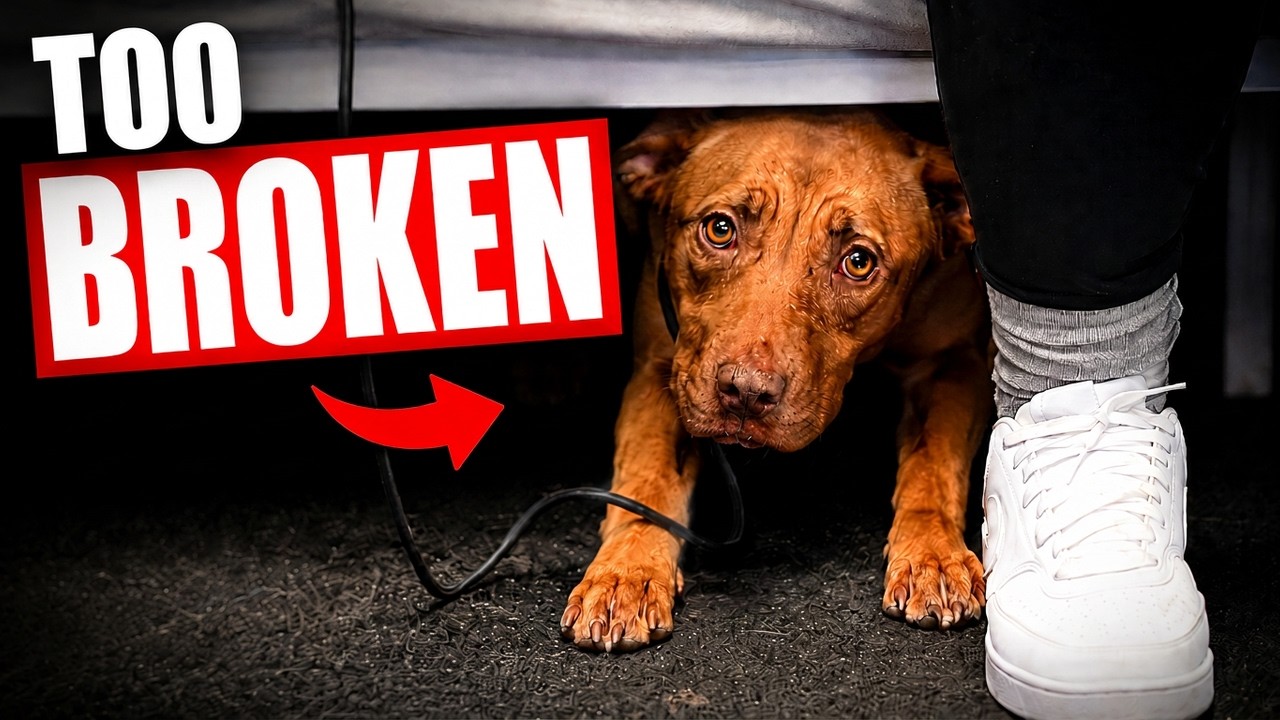
Rachel from the Canine Welfare Fund rescues Pippa, a 1-year-old Dogue de Bordeaux mix facing drowning due to severe neglect and fear of people. In five days, trainers use play-based methods and gradual exposure to transform her from reactive and lunging into a dog who can walk off-lead and sit calmly in a crowded pub.
Chapters
Meet Pippa, a 1-year-old Dogue de Bordeaux mix. Rachel got a phone call. "Come and get these dogs now or they're going in the sea." Think about that for a second. That was the alternative. So Rachel drove out at 11 o'clock at night and got her. When she went to collect her, Pippa tried to bite her. She had scars all over her face, a split in her tongue and even in her jaw, and had spent the first few months of her life being neglected and mistreated. She lunged at strangers, she backed off and came back at them again. She spent her whole short life learning that people just aren't safe. Without this week, her chances of finding a home were pretty much zero. I know what you're thinking, a dog with that history, that's going to take months, maybe even years, maybe even never. We had 5 days to take her from this to this. 5 days. That's not a typo. In this video, you're going to see exactly how that happened. Not in theory, not with a perfect dog, with this dog in just 5 days. If you've got a nervous dog, a rescue dog, or a dog that shuts down or goes off around people, this one's for you. One more thing before we get into it. We give 100% of our YouTube income to dog charities every single month. If you want to help dogs like Pippa without lifting a finger, doing nothing other than watching, hit subscribe. Right, let's get into it. So this is Pippa. I was fortunate enough to meet her a little bit before the boot camp and had a walk around the car park with her. First impressions of her, she's super nervy with people. Spoke to Rachel and inquired kind of like how she was with dogs. She's a lot better with dogs. So this week, obviously, we're going to be concentrating on building confidence up around people, probably a bit of general resilience as well. So her ability to cope with general stress is better because that will help with the situation around people as well. We say this a lot where— or we see this a lot where people think the dogs have been really mistreated, and quite often the dog actually hasn't been mistreated. It comes from other places. With Pippa, we know there has been some maltreatment in the past, particularly by people. So obviously her experience of people isn't great. We need to swing her mindset of that and show that actually most people, 99% of people are actually good. We're going to do a few little, um, tricky bits with Pippa. Spoke to Rachel about getting Pippa really involved with play at home, and she's done a lot of pre-homework with that because, as we know, play is really good at getting the dog jovial, getting into a nice happy mindset. You can't be anxious and happy and jovial at the same time. So hopefully we're going to leverage play as much as possible. She's got pretty good food drive, which is fine as an icebreaker, but it's very transactional. It's probably not going to change her feelings too much. So we're going to focus mainly on associated behaviors, create an affiliation with people, and then also some play. The biggest challenge is going to be not reinforcing what she does. So Pippa's had history of lunging out, nipping people, and there's some bullets to dodge. So obviously what we've got to be able to do is keep her underneath that threshold whilst we build our confidence, but not move so slowly that we don't get enough momentum in the 5 days that she's here. Success by Friday will be me giving her a cuddle, or at least being able to give her a smooth, and hopefully a lot of other people too. At minimum, we want her nice and tolerant when she goes to the pub on Friday. She's worse in enclosed spaces, as a lot of dogs are. So they're probably a real challenge for her. It'd be great to get her in there. If she can go to the pub on Friday, that's a huge win for us. I'm confident as shit, man. We're going to be right. And if not, I'll just adopt her.
So we've got Rachel here from Canine Welfare Fund, which is a charity that we work quite close with. The reason we want to help these dogs is because they need a home, but they're displaying behavioural issues. So we want to rehabilitate them and get them into the big wide world so they get a nice loving home. Why do you think it's important to work with people like us?
Because you can't throw cheese at everything.
Yeah.
We like to train the dog in front of us. So if we get a case in where it's been abused, it's been beat, the worst things happen to it, not every dog reacts the same. So we like to assess the dog and then go down the route of training.
So tell me about the two dogs that we've got in this week. We've got Pippa and we've got Fred.
Pippa is one of three pups that we saved from Filey. They were neglected, starved, not just not in a great shape when I went to go get them. She tried to bite two of us. Got her into my house. As soon as I got her in the house, I hand-fed her a little bit, she fell asleep on me knee within 10 minutes. But she's very unsure of people. She's quite charging, barky. Once she trusts you, she's an absolute beautiful dog. She wants to wear you as a coat. She's a little dream once she trusts you. It's just building that trust.
How are their personalities and challenges difficult for you? Like, what stood out to you about their behaviour?
So with Pippa, she's obviously a big risk of potentially biting Biting somebody. Dogs she's great with, not so much with the human. She will back off, she will run and lunge at you, then she'll come at you again after she's backed off. Very nervous girl. Yeah, very nervous.
So it's Monday now, we're just at the end of the day Monday. What are you hoping to achieve? What does success look like for you by Friday?
Hopefully what we did, we wrapped. I want to get them off lead, I want to get them trusting people, off lead, being around other dogs, ready to be rehomed, ready to go out into the world on the road. Like Pippa needs that reassurance. She needs that constant, there's someone there that she trusts. I want her to be able to just go off and be a dog.
Be at liberty.
Yeah. As we always say.
Yeah. Nice. So if everything goes well, how could this change their chances of getting a home?
Chances of getting a home when they've been on some training like this, it just goes through the roof. Like people tend to look at Pippa when she's charging and going at them and think, oh no, it's gonna bite me. Whereas she's had that training, she's had that input, she knows what's right and wrong now. Yeah, chances all go through the roof.
Well, that's everything. We'll check back in on Friday and see where we're at.
Just done a little session with Pippa there. We were going to do red light, green light, which is a game of which we use, um, once we have a solid yes marker and a solid no marker in order to reward good decisions and then obviously punish those bad ones. Pippa wasn't really giving us much in regards to proactive reactivity. Reactivity is a bad word for it really because it's about the dog being proactive with their behaviour, e.g., kind of going towards the trigger, being a bit exuberant, a bit obnoxious. Pippa actually She was showing a lot of avoidance behaviors and placing herself behind Rachel, as you'll probably see in some of the footage. Problem with that, the only way really to get a rise out of Pippa was to put her in a situation of which she should have never been in in the first place, e.g., go behind Rachel, try and touch her, place hands on her, put spatial pressure on her, which would have just been really, really unfair and set her up for failure. So instead, I transitioned the session into a bit more of a confidence-building session. So what you would have seen me do a little bit first is do a bit of treat and retreat. So that was me using food and throwing it behind Pippa initially, moved it to then in front of her, and then when she chose to— I didn't choose when— when she chose to then initiate a social interaction, I fed her from my hand. And at that point I was just drop feeding food into my hand and then feeding it across to her, trying to build a bit of rapport and break that social barrier that was there initially. It wasn't going to do much by way of making us friends but it was going to help break the ice. What really was going to help us make friends is what you'll see next, which is more with the play in which we did. And you saw me start with Rachel playing first, as Pippa has quite good play drive. Rachel got her going, and initially we started off with a full-up pole. And the reason for that is it gave us a good bit of distance between the handle of the toy and the actual toy. That way we can remove a lot of spatial pressure, and I don't need to be stood over the top of Pippa once Rachel hands me the handle, and then I begin to play with Pippa. And at that stage, I was taking a tug every now and then. Um, Pippa has quite a good grip, so at those sorts of times, I was just playing a little bit of tug with her. And then before Pippa felt too pressurized— obviously I was creeping up the toy at points in time— I was then handing the handle back to Rachel and letting her then continue the game. And then every so often, I'd jump in, I'd grab the toy again, I'd work my way down the toy. I wouldn't be standing necessarily face on the whole time. At times, I was stood side on trying to again relieve some pressure. I'm then letting Pippa tug at me, letting her win, and then being like, oh my God, you're so big, and then hand the handle back to Rachel. Once we had a good bit of rapport going and Pippa was looking somewhat comfortable— you see in some of the footage she's often playing with Rachel and giving me a bit of side eye— once she starts to relax and she's okay with me getting closer, I transition over to a rag toy. And then that way I can get a lot closer to her and then we can play. And what I can also do is I can let the toy slip through my fingers and I can let her have a win. So at no point in time whilst I was actually playing with Pippa was I trying to tear the toy away from her and get the win in. It's the start of our relationship, it's the start of our rapport build. If I just start being the— I don't know what word to use— the big cock or the big idiot, and I just come in, we've just started to build a bit of confidence and security, and I then start winning the game and tearing the toy away, I immediately become something negative. I'm putting a lot of pressure on her. She's not really the biggest fan of people at the moment. And then also I come in and I ruin her game because I'm just stealing her toy away from her. It's not the greatest way to start things. So as soon as we start using the rag toy, I play a little bit of game with her and then I let her win.
I'm like, whoa!
And then I get Rachel to re-engage in the game, start playing tug again, and then vice versa. We then swap the hand, or I then play for a bit. I play a bit of tug, I get her engaged, and I let go. So that's what you would have seen a lot of this afternoon. I've also taken her out, I've done recall. I was able to call her over to my leg, had a little bit of a snuggle with her, and then just a moment ago she actually made the option, or chose the option to come and approach me whilst I stood there doing nothing as well. So building blocks.
And just keep moving with it.
There you go.
Okay, what is your start cue going to be? Get her playing. Oh, clever! Nice! That's it, encourage her in. Tuk tuk tuk, give her a wrestle! Does she know a drop or an out?
Or she did mix with it, right?
Okay. Nice, get her really invested. Wow, clever girl. Tug, tug, tug, tug, tug. In a second you're gonna pass it to me, just for a fraction of a second. Oh, clever! Oh, good girl!
Clever.
I'm gonna let her win.
Back to you, back to you. Okay, when you're ready, pass back to me. Oh, she's so clever! Oh, oh, oh, oh, she clever! Go, go, go, go on, tuck, tuck, tuck! And again, pass to me. Oh, oh, clever girl! Oh, she's so clever. Fun, fun, fun. There we go, that's better. I want to really work on her like outs and leave so that we can start using it with me as well. And I can pause the play and get her listening a little bit. Pass back to me when you get a second. Good girl. Good girl. Oh, your grip's going a bit shit mad at me. You're tired. Okay, finish the game. Put the toy down. Say enough. Walk past it. Walk past the toy. Don't let her have it. Nice. Okay, from there I want, I want some really good outs so that eventually I can start doing it as well. It was nice that she wanted to re-engage with me even when she lost it. She wasn't like, oh shit, I don't want to play. She was still like, oh, I really want this, which is good. And we keep her moving, keep her engaged. We'll progress on that through, through the week. But that was nice. I'd like to Ideally, by end of week, I have the lead and I play with her and I— out, get it— and lots of fun, which she shows. She's showing some good signs of it. Look at her tongue. Oh, nice work. You can take her back up. Yeah.
What mode are we in here? We're in break. Yeah. Fine.
We're just having a stiff, aren't we, Pips?
Yeah. How's the rest of the week gone?
I've enjoyed it.
How was yesterday? You went to the pub yesterday, didn't you?
Yeah.
You're good, aren't you? In a bit. You are cute, aren't you? Here's an evidence on the kip-kips. Don't tickle your chin. Don't tickle your chin.
She's doing well.
Want some stinkies? Good girl. Oh, she is cute. And she likes her chin tickled. And a bit of her cheeks with her teeth.
We've spent a little bit of time together.
Yeah.
I've not had much interaction with her, but now it's going to show how to, especially for her, how to introduce her to potentially the person that's going to have her for the rest of her life. Obviously she's got good food motivation, which is great because we can utilize that. She's got good play drive. We've already seen that.
Yeah.
That'll be a big thing for her. Obviously neutrality first. So like she's not booting off at me. She's looking at me fine. Now we'll use her food motivation to try and make her a little bit more social. When we do it, I'm going to come in and just sit down there. She's a bit grumbly. We're not going to punish the grumble. We're just also not going to let her come over to me. So you just use your lead to bring her back into you. That's it.
Do I punish a bark and a lunge?
Bark and a lunge, yes. That would be our like line. If she went like into a big snarl, we'd probably punish that. But like the grumble, let that go. That'll go over time, just me spending time in her space. Yeah, but just use that lead to not let her come to me. That's fine. Obviously telling the person that's going to be coming in like how to do it, like I'm not giving her any intensity whatsoever. I'm not looking at her, I'm almost facing away from her, but I'm just spending a bit of time around her. That's it. If she makes some good decisions and maybe she looks at me and then she looks away, or she's a little bit inquisitive, you could use your marker and pay her for it and be like, yeah, nice, I like that.
Yeah.
But for now it's just habituation around people.
Yeah.
You could pay that. All right, now I'm gonna get up and walk out. Again, criteria on what we punish, what we let go. If she maybe has a look and goes like this and then looks somewhere else, we could pay that. If she decides to lunge at me on the way back, hey, don't do that. And then we'll just redo that until she just goes, all right, I won't.
Yeah, nice.
So now what I'm doing here, because she can be around me and she can kind of decompress a little bit, so now we'll make it a little bit harder where I may talk her on the way in. I may look at her when I sit down. I'm not going to leer over and make it too hard, but I am going to talk to her just to be like, hey, that's probably what members of the public are going to do. Yeah, they're probably going to come in and be like, oh, you're absolutely stunning, and she's gonna be like, whoa, too much too soon. Hello puppy, hello. You okay? Are you all right? Can I sit? You're gonna chomp me? Okay, okay, I'll sit there. You don't need to be scared, it's fine. I'm gonna feed you in a minute, hopefully. You'll pay that. So then I'm just like getting into her space and just doing a little bit of stuff. Like if I went straight over the top of her now, she's just going to go back. Yeah, they'd just be daft, wouldn't it? But sitting here and maybe talking to her and being like, hello Pips, Are you okay? It's not that bad, is it? There'll be some food in there in a minute. You pet that. You could make it harder for us, so I could go away now, put a cap on, I could get a little bit creepy with her, I could put a high-vis on, maybe we add another person into the picture, we could stand up and shake hands, we can do the whole high-fiving thing, we can do all that sort of stuff to make it harder and harder for her. We've already seen this week, the more time she spends around people, she's fine, and especially when people feed her, she's even better.
Yeah.
The ceiling for her is going to be really, really social, I would imagine, with people. She just needs to get over that hump that she's at at the minute. I wouldn't do this in the house first. I'd pick somewhere neutral, like if you got a back garden or a mate's back garden, or like a bench at a really, really quiet park or something like that. Yeah. I'd go there first because if you go in the house, there's that territorial aspect for most dogs where it's like, no, this is my house. Yeah, we're gonna stand up, we're gonna shake hands. You've got enough lead to stop her from getting up.
Yeah.
She's allowed to like get up and be like, oh, what are we doing? She's just not allowed to commit crimes, that's all. Ella. Oh, she wants to just get out.
Fine.
Lovely. You could pay her.
Yes.
Nice. So that like inquisitive bit of her like coming over to me shows me that she's like, what's going on with you? She's like, get this man away. Have a little bit of your food, please. All right, so now we're going to do treat and retreat. Yeah, so I'm going to throw the food away from her, and then I'm just going to breadcrumb— I'll do it now because she's interested— I'm just going to breadcrumb it closer to me. The reason we do that is because throwing it away takes her out of the stressful situation. A lot of dogs will get into the space of the person, they'll take the food, and then they'll go, oh shit, you're there, because they just appeared.
Pretty much what she does with Bryn. Obviously she's lived with me a couple of months now. But even when he does this with her, she's still— yeah, she maybe just don't like him.
You don't have to like everybody that you meet, do you?
Everybody, yeah.
So whenever she gets into my space and takes it from hand, I want you to use your positive marker as soon as she's taken the food. Yeah, to show her the exit. So I might pair like here, marker next.
Nice.
If you do that a few times, you'll show her where the exit door is. She's less likely to put herself in a situation where she then goes, oh my God, scary man.
Yeah.
So I'm feeding her away from me to start.
Yes.
Nice. You can do it like back of the hand, looking away. Oh, there's some food there. That's nice.
Yes.
Then use your lead if you need to. Fine. So how we'd progress it is usually like food at the end of the hand, dog takes it, it's the furthest away from here. Then we'd maybe roll it back in the hand, and then as she takes it, you give her like a bit of a fuss, just a bit of physical contact. That's it. So again, picking the right person to do it. I'm not putting intensity, especially when she's here. I'm just not looking at her at all. You would want to do this a couple of times. You could do it over the course of like, I don't know, a day, a couple of sessions like this. She's like fine to be around me. She's inquisitive now. She's probably paired me with something she likes, which is food. Yeah, we're not like forcing her into the stress because I'm not being too much. But she just needs to be around people more. Yeah, again, I think her ceiling is going to be very social because obviously when you guys picked her up, she was the same with you guys, and then over time you played with her, you obviously feeding her, doing stuff with her. Now she's like incredibly social around you. Yeah, thank you. Good girl.
You want some of this?
Come on, come and get it. You are a gannet, aren't you?
She was starved.
Yeah, fair.
There we go. That's nice, that's nice, Poppy.
Good girl.
Just a bit of a fuss, that's all. Okay. Hold on, hold on, puppy dog.
Good girl, good girl.
So now that she's like a little bit more relaxed, you can do some stuff like this because she may be more inclined to maybe come over to me. Yeah, like if there was a risk that she could get aggressive, we obviously wouldn't do this because it's like at face level, it's more intense. But because she's been fine around me, she's taken food, all right, maybe we progress it a little bit. Obviously your play triangle stuff that we've already done is probably going to be quicker than this. Yeah, but then depending on the person that's going to take her on, this could be easier to do. Yeah, yeah, just keep her food motivation really high, take it nice and slow, and just make sure that the person that's doing it knows what they're doing step by step. Yeah, even have her put away, talk them through it, make sure they're happy, then go out and do it. Yeah, so it'll make sense. Yes, lovely.
We get you around people. Yeah, you're good home.
Yeah, more people, that's what she needs.
If you're watching this and thinking, I want that for my dog, we run a 5-day boot camp. You come with your dog, we coach you through the whole process, exactly what you're seeing here. You don't drop your dog off. You're there every day. You learn it. Your dog learns it with you. The link is in the description. Right, back to Pippa. Hi!
Hi!
Did you?
Did you?
Did Kirkie win?
No. He looks remarkably clean.
Yeah, he looks a lot cleaner.
Kirkie, turn around.
No, a ball fell in the lake and it was off the ledge, so I had to go on my front and lean in, and we lost anyway.
Going then. Who's this?
This is Pippa. She is a 1-year-old Dogue de Bordeaux mix who came into rescue because humans are assholes, basically.
Some of them are, yeah.
Yeah, so we got a phone call saying, come and get these dogs or they're going in the sea.
In the sea?
Yeah, as in the wet ocean. As in the phyla. Yeah, in the sea.
Christ.
So I went at about 11 o'clock at night and got her a brother and a sister, right? She was the worst. They were all—
as in spicy worst?
Yeah, she tried to savage me about 4 months old. Yeah.
How long ago was that?
November last year.
Okay.
So she's— she was the worst. She's got obviously the split in her tongue, she's got the scar up her mouth and her nose.
Yeah, she's got like on her jaw as well, don't she?
Yeah, that we think— we think she's been—
oh yeah, she's been twatted or something. Yeah, yeah, yeah. The thing is like, obviously, I mean, you'll see loads of them, but people have misconception or preconceptions about rescues that they've always been mistreated, and probably a lot of them haven't.
Yeah.
But then you get the ones that genuinely have, and you can, you instantly know, don't you?
Yeah.
You can tell, you can see a mile off. So she's got okay with you though, fairly quick?
Initially when I went and got her, obviously she tried to bite me.
Um, excellent.
As soon as I got her home, I fed all three of them. Within 10 minutes she run my knee sock on.
Nice.
After that, she went the following day, she went to Lace. Lace, to be fair to her, she worked really hard with her.
Yeah.
I can see a massive improvement in her today.
Yeah, okay. Obviously I saw her maybe a month ago, was it?
Yeah.
And she's definitely less— she would, to be fair, when she— when you came, she was a little bit less nervy than she was at that point anyway.
Yeah.
But what was the thing she was struggling with most?
People. So she's good with dogs, like she's not bothered, she'll happily play. New people, she's very standoffish. Anybody coming into house, she's lunging, barking.
Yep.
That's calmed down with the, the treat and retreat.
Yeah, okay, cool.
But yeah, she's, she's been a lot more interested these last couple of days.
Yeah, she's wanted to. Yeah, yeah, yeah, I've seen that.
She's wanted to have a sniff and a nosy.
Yeah, perfect. Obviously the key point at that point is don't let anyone overpressure her, right? But you went to the pub today? You went to the pub the other day as well, didn't you?
Yeah, she's been twice now. Both times she's been really good.
Yeah, nice. People walking past pretty close proximity, I saw, weren't they?
Yeah, last time she got on the chair, didn't she? And she didn't really want to know where was this time she's opted to come out and have a nose if—
Yeah, she has. She's a marked difference in her. Would that have been the most difficult context that we've done this week for her then? Because it's indoors.
Yeah, the people coming in and out and moving around, she's normally quite, she's quite skittish and like, well, I don't like that.
Got you.
She's been really calm and relaxed about it these past couple of days.
Yeah, nice. She needs a home.
She really does need a home.
I know she does. And if I didn't have so many Latin dogs already, I would 100% have her. I think she's ace. I think she's ready to blossom.
Yeah.
Because I've seen her with you and she looks lovely, like.
Once you're in with her.
Yeah, I get it.
Yeah, that's what you get with her.
Yeah, she's mega. So in terms of like the type of person that you're looking for to take her, probably can't just be a novice, someone who's never had a dog before. What sort of person are you looking for to take her?
Someone that's obviously willing to carry on the training with her.
Yep.
And someone that is gonna be a big advocate for her.
Yeah, that's the thing.
She's not gonna go to someone that's gonna go, "Oh yeah, she's all right, stroke her." Yeah. I need you to stand in front of her and say, hold on a minute, she don't really like that.
Yep, you're a saucy genius. So someone who's got a little bit of strength of character to say, all right, I'm not going to let you touch my dog without— yeah, okay. What else?
I think she'd be good with another dog.
Yeah, I do.
Yeah, I think she does like the company of another dog.
Yeah, I also think just because of the type of dog she is, like, she's very social with dogs, she's ace, but I think she needs to keep her foot in the door in terms of keeping that social. I don't think it'd do any good to live in an apartment, obviously, and never see other dogs. I think that'd be a terrible idea. Keep the iron hot, if that makes sense. Keep her nice and social. Otherwise, you could see how she could go the other way with him. You are cute, aren't you?
She is a good girl.
You're 100% a bit of me. Doesn't mind a snack as well, do you?
A bit like me, like that.
I was starved for ages though. I know.
How do people get in touch with you if they're interested?
So they can go onto the website, which is caninewelfarefund.uk.
Yep.
Or drop us an email.
Yep.
caninewelfarefund@gmail.com.
Yep.
Or all social media. Yeah, all social media is Canine Welfare Fund. Compared day one to now, she's loads more confident.
Yeah, she is actually.
She's loads, like today I said to Lace earlier, like I've seen a massive switch in her, whereas Monday she were here like super glue, tail tucked under, not wanting to know. Today she's off doing, having a sniff around.
Yeah, doing whatever the hell she's doing now. It's like exposure therapy, isn't it? But productive exposure therapy. So obviously, like, when they're— yeah, obviously when you'll have seen it a lot, like, I'm just going home. Oh, fucking hell.
See you later.
You'll see it a lot as well, right? But when you get a dog that that's got a bit about it and chooses the route of reacting, they get the result they want, right?
Yeah.
So it's been able to fix that in the moment so that she's got an opportunity to do what you said she did a minute ago, showing curiosity and like, oh, so you mean I don't have to be scared of everyone?
I've slowly seen her like throughout these last 5 days like kind of tiptoe out of her.
Yeah.
And then all of a sudden she's like, actually, this is not that scary.
Yeah, it's not that scary, is it? You're not scary. Tasty treaties. You're very pretty.
See, she would have never done that on Monday.
Nah. Monday, Pippa had her ears flat, her tail tucked, and wanted nothing to do with anyone she didn't already know. Friday, she's in a pub, off lead, going over to people she'd never met before. She's not a different dog, she's the same dog. She just needed someone else to show her slowly, on her terms, that most people are worth trusting. The moment she started to believe that, she could not get enough of it. By the end of the week, I even confessed and had to say, if I didn't have so many dogs, 100% I would have had her. That's not a line for the camera. That's exactly how I felt and how it happened. If your dog is nervous, reactive around people, or just not the dog you thought you were getting, it's not the end of the story. It's just where the work starts. If you want to do that properly with your dog alongside people who've done this hundreds of times, the link for our 5-day bootcamp is in the description. And if Pippa is still looking for a home, Rachel's details for the Canine Welfare Fund are also in the description. See you in the next one.
More from Jacob




I Wish Someone Told Me THIS When I Had a Reactive German Shepherd (Extreme Case Study)



Are you playing the wrong game with your dog? #dogtraining #dogtrainer #dogowner




Mabel's Incredible Reactive Dog Transformation #dogtraining #reactivedog #dogtransformation