Why I STOPPED Using Harnesses on Reactive Dogs (Do THIS Instead)
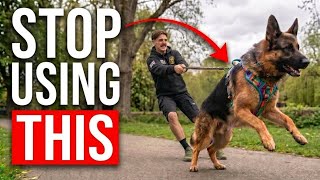
Jacob Morgan argues that harnesses often reinforce reactivity by giving dogs something to push against. He proposes slip collars, prong collars, and e-collars as alternatives, but emphasizes each requires proper conditioning and professional guidance to avoid making behavior worse.
Chapters
Be honest with yourself for a second. If your dog is on a harness right now and they're still reactive, still dragging you down the road, still kicking off every dog they see, how's that actually going for you? Because if the answer is not great, I want you to really hear what I'm about to say. The problem may not be your training. It might not even be your dog. It might be the equipment you've been told is safe, kind, and responsible. Here's the thing. There is an enormous amount of noise out there about dog training tools right now. Harnesses are good. Prong collars are bad. E-collars are evil. And I get it. I genuinely do. Because if you look at a prong collar for the first time, yes, it looks aggressive. It looks intimidating. And if you've spent years being told that your dog should wear a fluffy harness with little paw prints on it, being told to switch to something that looks like it belongs in a dungeon is going to feel wrong. But here's what the internet isn't telling you. When your dog reacts on a harness, they go into flight or fight mode. And on the harness, it gives them something extra to push into, something to lean against while you're doing your best impression of a water skier behind a 35-kilo dog with no brakes. There's no communication happening, no way to gently say, hey, that's enough, or reorientate the dog towards you. Your arms are fully extended, You're just hoping for the best, and over time the equipment itself gets poisoned. It doesn't just fail to help, it actively reinforces the reaction. That's why your dog is still reactive. That's the answer to the question so many have been asking. I see this all the time— owners doing what they've been told, still making no progress. 9 times out of 10, we change the equipment and everything shifts. Now, I'm not saying every dog needs a prong collar. I'm not saying you need to rush out and buy the next e-collar. What I am saying is that the tools we're going to walk you through today deserve a fair hearing, not a judgment based on what look like, a judgment based on what they actually do and how they're used correctly. And I want to be clear about something before we go any further, because this is important. These tools used incorrectly without proper conditioning can make your dog worse, not better. Worse. That's not me hedging, that's me being very straight with you. Every single tool we cover today needs to be introduced properly, built up gradually, and ideally done alongside a qualified trainer who knows exactly what they're doing. The tools aren't the magic, the training exercises are the magic. The tools act like a catalyst, they make the exercises more effective allowing you to communicate more effectively. And there's one tool in particular. It gets the worst reputation online, and it's the one that made the single biggest difference for many of our reactive dog owners. You'll see exactly why in a minute, because you understand what the tools are actually for. Once you see how they fit, how they communicate, what they're actually asking your dog to do, everything changes. Not just for your dog, for your walks, your confidence, your relationship with your dog. So whether you've been struggling for 6 months or 6 years, whether you've got a 10-kilo terrier or a 50-kilo shepherd, stay Stay with me, let's get into it.
Certain pieces of equipment are going to be able to either give us control of our dog, or sometimes going to be able to minimise control of our dog as well. What you'll find, and what I experienced as well when I was a dog owner, not a dog trainer, is the piece of equipment that I was using were poisoned. My dog was in a harness or a flat collar, they were pulling into it, they were being reactive in that piece of equipment. So if anything, it was a detriment to my progression. So I needed to try and find something that was going to give me better control of my dog. And for you guys, that might be very different for each one of you. What I went to when I was a dog owner and not a dog trainer for myself was a slip collar and a knee collar to get my dog off the leash. With you guys, we might be recommending that you use certain pieces of equipment to get the maximum result. If I'm in a harness or a flat collar and I'm trying to communicate with my dog that maybe I want them to come to me, maybe I want them to stop doing something, you're going to find that's very hard to do if we are in, for example, someone said a harness. I didn't hear a flat collar. Sometimes people are in halties as well. If we are in these pieces of equipment, sometimes it's going to be hard for us to communicate with our dogs. So what we recommend to you would be a slip collar, a prong collar, and these two tools are going to give us a very easy way to either communicate with our dog at a very gentle level and be able to, if we need to, to be able to correct our dog and tell them that that's not very good as well. When it comes to a tool that's very commonly used here and that you'll see a lot of us using will be an e-collar. And one of the reasons that we do this is because it allows us to give our dog the ultimate freedom when it comes to being off the leash. We talk about motivation a lot, on why that's important. But if we can imagine, you know, you are out and about, you're taking your dog for a walk. We all try our hardest to increase their food motivation and give them the way to come back. But eventually nature is gonna take over and external factors are gonna be more motivating, right? Even if we think our dogs have really good recall, one day they're gonna give you the middle finger and say, fuck, you know, fuck off, I wanna chase a squirrel instead. And it's been very hard for us to get them back. So something like an e-collar will be able to trump your dog's motivation to do something that you don't really want them to do. If you don't know, I'm from Australia. What I say to my clients back in Australia is, I think I'm a pretty fucking good driver, although my missus may disagree, but I always wear my seatbelt, okay? Because I don't know when some dickhead's gonna pull out on me, but my seatbelt is there to keep me safe. So let's say we got our dog off the leash and we think, you know what, I've worked really hard, my dog's recall is pretty schmicko. And then you take them out, bang, they see a squirrel, your dog's gone. You're throwing cheese everywhere, you put on the long line, But if we have something like an e-collar, which can vary in intensity from a little tickle to maybe a bit of a kick up the arse, the piece of equipment acts as our seatbelt. It is there to keep our dogs safe, to be able to stop them in their tracks and stop anything bad happening. With this week and the piece of equipment that we're going to be trying to get, possibly get you to use on your dog, we are doing so to have the maximum result in the shortest amount of time possible. And that might be a slip collar, a prong collar, more than likely an e-collar to get your dogs off the leash. Is there any questions about general tool usage, why we might use certain pieces of equipment, why certain pieces of equipment might be not very beneficial for you? Absolutely, it's only going to give you a little bit more control, right? Even if he is on the long line and he can't get away, the e-collar is going to be there as a communication tool to be able to say when he is distracted, hey, come back here so that you can have the freedom, although he's going to be restricted to a long line, but you have that level of communication there. So we're going to have our stopper. So depending on what one you get, you might have a double stopper as well. And we're simply just going to have that in the same position, if I can bloody get it. There we go. And then I'm going to pull my stopper down. And once again, so it's snug, you know, you don't want it super tight. Maybe you use a slip collar already and you find your dog's choking when you're taking them for a walk. More than likely this because it sits a little bit too low, okay? And obviously they're pulling you as well. But same position as the prong, we just pull the stopper down and that will keep it in place. I like to think of it as evenly distributing pressure across the neck, the same as we're going to have one contact point here, right? This is our singular contact point in the slip. We can do that across multiple areas through the prong and also like we all think, and myself, the prong is the most gentle tool that we can use in dog training, on par with the e-collar, but it is a very gentle tool. We can just use very little pressure and get a maximum result as well. Looks like a medieval torture device, but it's— more than often you'll find that it's a picture of like someone's put a prong collar on their dog, chucked in the backyard when they're a puppy, let them grow, get bigger, and the prong collar's just gone into their skin. Shit ownership, you know? But you can put it on yourself. I recommend that you do put it on yourself. Give it a good tug and you'll find that it doesn't really hurt. Yeah, do it. We encourage you to do it. Okay. So like the slip collar, prong collar, the e-collar, if you use an e-collar, we'll definitely put that on you. We might, we'll probably put on Owen as well. Turn it up a little bit higher though. Maybe 100 or something. Yeah. But feel free if you have any questions about this, because sometimes it is a little bit daunting, right? You might, your dog might be on a harness for its whole life and you see a prong collar and you go, oh my goodness. I dunno why I'm gonna use that, but if you have any questions about it, feel free. You might not feel comfortable right now to ask that question. That's okay. Come ask any of us and we can give you a very detailed breakdown of why a certain tool might be the best for your dog. But we'll figure that out through this today and the rest of the week as well.
So that's tools covered. And look, I know changing equipment feels like a big deal, especially if you've been told for years that what you're using is the right thing. But if you've been grafting away and your dog is still reactive, still pulling, still making walks feel like a punishment, the The equipment conversation is worth having. And remember what I said at the start, the conditioning is everything. If you're watching this and you're thinking about making a change, please don't do it alone. Work with someone who knows these tools, who can show you how to introduce them properly and build them up the right way. That's exactly the kind of thing we help with. Now, if you're watching this and something clicked, but you've still got questions about where your dog is at, why they're reacting, what that behavior is actually telling you, or what your next step looks like, that's exactly what the Behavior Bible is for. It's completely free. Every week we go in there live, proper Q&As, no faff. You can come in, tell us what's going on with your dog, and get a direct answer. The link's in the description. Come and join us. And if this video has changed how you think about tools even slightly, send it to someone you know struggling on walks. There's a lot of bad information out there, and someone in your life needs to hear this. We'll see you in there.
More from Jacob




I Wish Someone Told Me THIS When I Had a Reactive German Shepherd (Extreme Case Study)



Are you playing the wrong game with your dog? #dogtraining #dogtrainer #dogowner




Mabel's Incredible Reactive Dog Transformation #dogtraining #reactivedog #dogtransformation