Yohei Nakajima: How AI Agents and Building in Public Are Changing Venture Capital | Glasp Talk #57
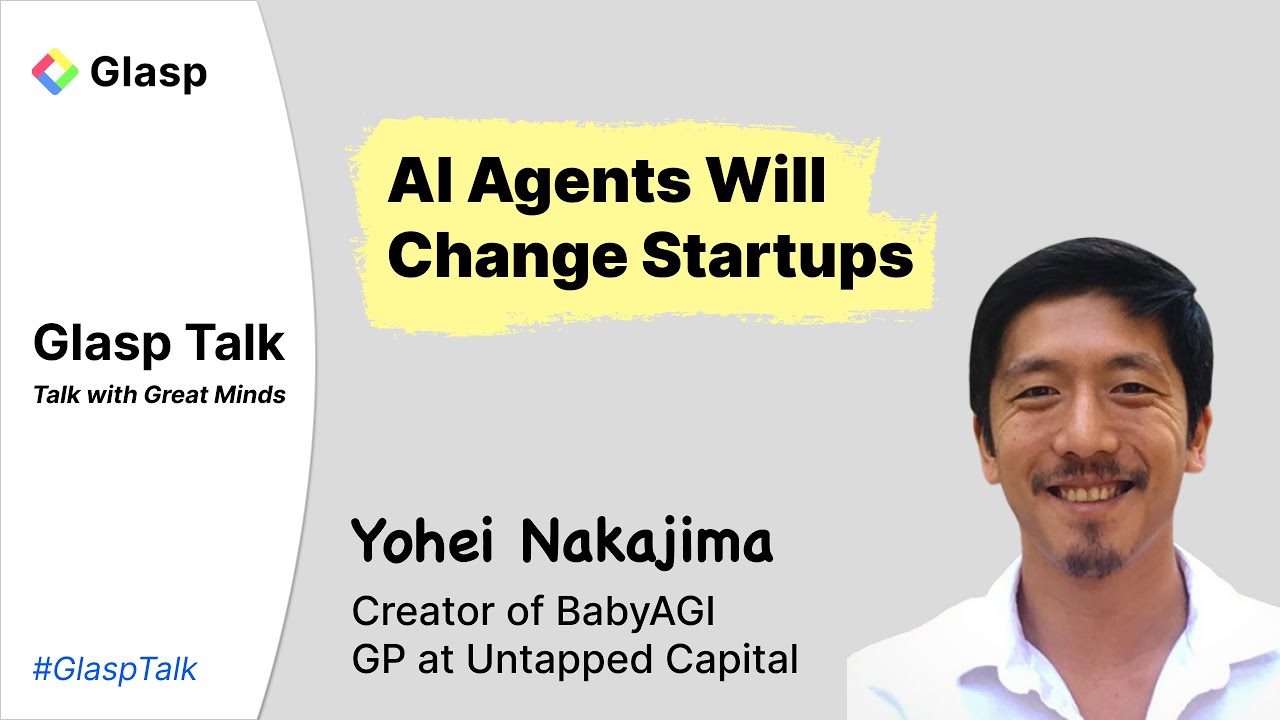
This content was created by Yohei Nakajima. This content was uploaded by Yohei Nakajima. This is a YouTube interview (Glasp Talk #57) titled "Yohei Nakajima: How AI Agents and Building in Public Are Changing Venture Capital" published July 31, 2025. It's a multi-speaker podcast-style conversation featuring Yohei Nakajima as the guest and hosts (labeled SPEAKER A and SPEAKER C). The discussion covers Yohei's work as a GP at Untapped Capital, the fund's outbound sourcing thesis, the role of building-in-public, his viral projects (e.g., BabyAGI, MiniYohei), his prototyping workflow and tech stack (Replit, ChatGPT, Replit Agent, APIs), idea generation, portfolio examples (e.g., Layers, VCPedia), views on how AI/agents are reshaping industries and venture capital (automation, data-driven diligence, SPVs), and advice on founder traits, product vs distribution, and fundraising strategies.
Chapters
Hi everyone, welcome back to another episode of Glass Talk. Today we are excited to have Yohei Nakajima with us. So Yohei is an innovator, artist, and a venture capitalist. He is a general partner at Untapped Capital, an early-stage venture capital firm that focuses on uncovering hidden gems in the startup world. With 15 years of experience, supporting early-stage startups. Yohei has collaborated with global giants like the Walt Disney Company and Nintendo during his tenure at Techstars and Scrum Ventures. And he's renowned for his building public philosophy, leveraging cutting-edge technology in transparent ways to accelerate learning, engage with founders, and fuel innovation. And among his most celebrated creation is BabyAGI, an autonomous task planning agent that went viral in 2023, earning widespread recognition, GitHub stars, academic citations, and a stage at TED AI. Today, we will dive into Yohei's journey through venture capital, his groundbreaking projects in AI, and his vision for the future of innovation and investment. Thank you for joining us today, Yohei.
Thank you. That was a great intro.
Thank you. Thanks so much. So first of all, you are a GP and a co-founder and a GP at Untapped Capital, and you started the fund in 2020. And, but we wonder what gap or opportunity you saw that inspired you to start your own fund. It also has the investment thesis, a mission, changed over time, especially after like a pre and post AI era? It's
a good question. One of the opportunities that inspired Untapped Capital was an exercise I did in reflecting on what strengths I had during my time at Techstars, especially when I was the director of pipeline. I was leading outbound efforts on early-stage pre-accelerator startups. I continued doing a lot of outbound at Scrum Ventures, where I was proactively reaching out to startups. As I thought about where I had a unique strength, doing outbound was something that I didn't see that many pre-seed venture funds doing. You know, outbound is a very well-accepted sourcing strategy in every asset class, including late-stage venture, but in pre-seed venture, a lot of VCs are still very very network and relationship driven. So that was the initial idea around it. In trying to identify, kind of create an identity or figure out what the benefit of doing outbound was, you know, we realized, you know, I realized that one of the benefits is that we can connect with strong founders that are outside of typical networks, right? Well, you know, a lot of venture capitalists, because they invest in their network, their networks overlap. So you have these you know, a handful of well-networked founders who are, you know, who are getting a lot of the attention, but there's a lot of great founders who don't have that network. And so our Fund 1 thesis was really around tapping into these founders outside of typical networks. The fund has evolved. You mentioned build in public. That was a, you know, that's something that evolved, that became part of our strategy throughout the fund. Most recently, I would say, you know, this this outbound strategy is now just one of the tactics we use in a more overarching strategy around being very top-down at a pre-seed VC. Again, so it's going against the kind of the classic invest in your network, you know, focus on building your network strategy, but more so really focusing on building a process to come up with kind of conviction and hypotheses around the future and then proactively reach out to and market to startups that fit that future. So that's kind of the evolution of Untapped and our philosophy.
And I was always curious, why did you name Untapped Capital? What's the definition for you means untapped?
I liked the word. Well, you know, we, as I mentioned, you know, we want to invest in, you know, founders outside of typical networks. Now we want to invest in ideas that are out, you know, that other people aren't thinking about. I think the word untapped is associated with kind of opportunities that other people aren't seeing, right? Untapped markets, untapped potential, untapped talent. And so Untapped, I feel like encapsulates a lot of like what we look for and how we try to work as a VC. And the name actually was, my wife came up with it and I felt like it was the perfect name for capturing what we were trying to do.
Interesting. Cool. Yeah, I like the name. Yeah. And since, you know, you are now famous for Baby— I mean, you are building so many AI projects, and one of the famous projects is BabyAGI and MiniYohei, you know, Ask Anything or something, and also Knowledge Graph and so on. But has that building in public changed the way you get the, like, your deal flow? Or when you look for traits in founders and also like operations in your VC?
Yeah. You know, since early on, a lot of the stuff I built was so that we could use it as a VC firm or that maybe founders could use it to help their business. And then some of the projects we build are more experimental where BabyAGI falls into it. But that's kind of the 3 buckets, kind of investor tools, founder tools, and experiments. are the 3 buckets we build in. I would say absolutely. I think, you know, I fell into this by accident, but what I found is that building publicly is such a great way to connect with founders and builders generally, right? I feel like it's fun to just jump on a call with other builders and just immediately nerd out on like the building side of things. And I feel like it creates a unique relationship with founders that's not just as kind of a venture capital And so what I love, especially, you know, through open source and through X or Twitter, I feel like I've built, you know, many relationships kind of just online through sharing projects with each other. And even today, I continuously, you know, will jump on a call for the first time with somebody where both of us know each other, have known each other for years. And it's such a fun way to kind of build relationships in today's age.
Yeah. And also, does that help you find LPs when you start a new fund, like Fund 1, Fund 2, Fund 3?
I mean, at this point, Baby AGI has definitely helped my name be more recognized. And when it comes to fundraising, of course, all that momentum and recognition and credibility is very, very helpful. And of course, I feel like at this point, most of the people I meet are in some way, you know, many of the people I meet are in some way someone I met because I was introduced to someone who knows me because of Baby AGI. And so Baby AGI is the gift that keeps on giving is what I say.
I see.
And I heard that like you did like 80 to 100 projects before making Baby AGI. So not sure if it's true or not, but how do you come up with those ideas?
It's a good question. I think Baby AGI was about project number 70, but I think at this point I have over 100 projects. Wow. You know, I think, I mean, I'm not, you know, I'm an idea guy, right? I come up with ideas all the time, you know, playing with AI. I think through playing with AI, there's a lot of ideas that, you know, I wish existed, or maybe I'm using ChatGPT in a certain way and I think, hey, this would actually be a fun tool. If this was broken out by it. And, uh, and I think everyone comes up with ideas. I think really the difference is that when, you know, I just have gotten into the habit of when I have an idea to just ask AI to build it for me and then see if it works. Um, but a lot of it is, yeah, it's inspired by, uh, what I see online. Um, some of the ideas are, you know, from other people. I think, uh, you know, Instagraph, which was one of my first knowledge graph projects, was I wasn't, you know, was that I had a couple followers who were telling me that I would like knowledge graphs after they saw me do Baby AGI. And I, you know, read up on what knowledge graphs were and then I just immediately built a project that weekend with it.
Do you, when you come up with some ideas, do you keep the idea somewhere or do you just go to ChatGPT or, or LibriVox and then ask, put the prompt to build, try to build?
It depends. Some ideas, if I have an idea, I might just open up Replit on my phone and just like type it in and just ask it to build it. If it's a more complex idea, sometimes I'll go to ChatGPT first. Or if I'm like unsure, if I have like a fuzzy idea, I might be like, hey, I feel like we could do this. And then I'll brainstorm it a little bit with ChatGPT, and then I'll just take it to Replit.
So in that sense, has your tech stack changed over time? I know nowadays you use Replit, and I saw in your recent project, you use Replit, BSend for email, and so many tools. But has that changed over time? And also, what tech stack do you prefer nowadays?
Yes, it has changed over time. I mean, before I started building with AI, I was, you know, I could do a little coding, but I was mostly using no-code tools. So my stack was Zapier and Airtable and, and no-code tool Softr was on top, sitting on top of Airtable. So, so it was a, that was a no-code stack. I started building with AI just around the time that ChatGPT came out, right? And at that point, I had just started using I started using Replit. I remember, I remember like loving Replit because in my prior attempts at using Python on my computer and using it in the terminal, I would run into things like having the wrong Python version or having the— and like, like that was just something I never really wanted to figure out. Replit just made that all easy. So, so at that point, my, my stack was Having ChatGPT write code and copy pasting it into Replit largely for their deployment. And then while you know that was back in 2022 that I started using Replit, and then they started building in you know AI kind of assistant features and then agent features. And over time, once the agent was kind of fully baked out, I noticed myself just using Replit Agent instead of using ChatGPT. So for a big chunk of time, Replit Agent was how I wrote built stuff. My tech stack did change when I was using ChatGPT and copy pasting into Replit. My, my go-to stack was Python Flask. And, and I, I, I feel like I, you know, got pretty good at understanding how that worked over time. Replit Agent, for some reason, tends to default more to TypeScript, I think. And so I've noticed that more of my projects are built on that. But when I'm using Replit Agent, I don't really look at the code at all. I kind of just have it built, built for me. So I don't really care about the stack. Um, as far as coding tools, I have started using OpenAI Codex. I do like the kind of more fine-grained, you know, doing PRs into GitHub. So I have a couple projects that I'll kickstart on Replit Agent and then maybe, uh, you know, start working on it with Codex at the same time or in parallel. Uh, and then you mentioned APIs. One of the things that often does inspire ideas or projects is experimenting with an API. So I remember, you know, when I got— when I started playing around with, you know, Hume AI, I did a project where I connected it to Twilio and gave ourselves a phone number. And I really just did that because I wanted to kind of play around with that API. And I've done the same for, you know, portfolio companies like VideoDB, which is a media-first API. I've done a couple things with FalcorDB on the knowledge graph side of things. I think most recently I wanted to try the X API and that kind of led to building VCpedia, which is kind of a Crunchbase that's built on top of Twitter data. But that project was, yeah, it was inspired by the desire to play with an API that I thought could be interesting to pair with LLMs.
Interesting. But when you use API, when you play around with APIs. And since you said you don't check code and so on, so how do you evaluate, oh, this API works good? And is it depending on the outcome you get? Or yeah, I'm curious about how you—
Oh, so I will often— I feel like I have a pretty good memory for startups. So I remember when I was thinking about doing a daily newsletter for VCPedia, I feel like I had seen Resend on Twitter a couple of times, and I felt like it was kind of an up-and-coming, you know, API-first email service. So I thought, huh, I, you know, and I feel like, you know, newer APIs tend to be kind of simple. They take advantage of the latest and greatest. So I felt like it was a good opportunity to try it. Also, I like the idea of just like supporting early-stage startups. And experimenting with them as well. It's kind of a fun way to build relationships with founders. It's just like using their API and open sourcing projects on top of it.
I see. And so do you have any ideas you're currently working on but not published, not released yet, if you can share?
There's always a lot of stuff I'm working on. At this point, I usually have multiple projects working in parallel and I kind of decide what I want to work on just based on how I feel. And actually, you know, a lot of projects, some projects don't even make it to completion, right? Because a lot of these are experiments. I'll just ask Replit to build it and then like sometimes it doesn't work the way I thought it would. And then I, you know, and then I'll just like move on to the next project. Most recently I've been working on VCPedia, kind of slowly fixing that. That's one of the things I've been working on. I have a bedtime store, bedtime podcast generator that I kind of put off because I tried to translate it into a whole bunch of languages and then now I recently resimplified it. So that's, I'm working on that now. I was working on that last weekend a little bit. But the biggest project I've been kind of, I keep coming back to is this unified CRM calendar, email client, note-taker, task management tool. And so I tried to build— That sounds like— I've tried to build that like 12 times. But yeah, every time I feel like I think of a better way to architect it and I just like start from scratch. But I'm hoping I'll get to a point that I like soon with it.
Interesting. Yeah, I can't wait to see it. But I was always wondering, like, since your project seems like more like prototyping first, then that is it, right? And so It's like, I see like it's a kind of small project. And but if you have infinite amount of resources, like talents, money, and so on, what would you want to build? Do you have some big idea? Because you are investing in founders and they should be— they should have a big picture, audacious, you know, like a vision. But if you have those amount of resources, what would you build?
That's such a good question. Um, well, the things that popped to my— one of the things that popped in my mind is what I described earlier, right? I think, uh, uh, it's kind of surprising that there's not really a good email client that's also a CRM that also is a task management. The only thing I can really think of is kind of Google Workspace, but it kind of feels like separate tools, and Google Contacts isn't really a CRM. You do see some sales tools like that, but I haven't seen that on like a personal side tool. And I feel like that would be difficult to do, but if I had infinite resources, that would be something I think would be really fun to work on because I've just been thinking about it so much. But man, I would probably build a— I don't know, there's a lot of small ideas I want to build. I thought, you know, be really cool is— would be cool is to Uh, uh, train a small local model specific to survival techniques and then creating a very rugged hardware that has access to it. I think that would do really— that'd be a pretty interesting project.
Interesting.
Kind of like a survival kit, but like a survival LLM, but it runs locally and like on a, on a, on a carryable device or something like that would be pretty interesting. I don't know. You'd have to power it though.
But that's an interesting idea. But in that sense, since you are, yeah, you know, you said you are VC by day and builder by night, you know, but have you, since you talk to a lot of founders and you built so many things, have you thought about becoming a startup founder, not a VC, venture capitalist?
I get that question a lot. I love being a VC, right? I remember early on, In my career, right? I think one of the career advices that really stood out to me was somebody said, you know, just ask yourself, what type of people do you want to be spending time with 10 years from now? And that was like, that to me was like a very eye-opening way to think about career. It wasn't about like, what do you want to do? It was about who do you want to be spending time with? And, you know, it was immediately obvious to me that like, I wanted to spend time with founders, like early stage founders, because they're always working on, you know, new interesting ideas. It's such a, you know, I mean, you have to have this conviction and passion to risk a lot and start a company. And so that's always been my North Star was I wanted to be in a position where I could work with founders. And so it was never, you know, and at least based on observation, being a startup founder is pretty busy and you don't necessarily get to spend time with founders as your job. You do it as part of networking. But as a VC, I get to meet interesting founders all the time. And I would never, I don't want to give that up, but maybe someday if I had infinite resources, I would start an incubator so I can launch multiple companies.
And also, you know how to use AI tools and you are building AI agent tools as well. So when you meet founders or when you are thinking about, oh, deciding if you should invest in the company or not, and what kind of traits or personality do you look for in founders? Is that a team, idea, market size? And what aspect do you see in founders?
Yeah, I think one of the things that we— I think we're kind of intentional and slightly unique for us, again, going back to the top-down, is that I tend to diligence kind of the market first, in the sense that I want to spend time talking to founders building in markets I generally like, I feel like are growing, that would make sense to invest in as a pre-seed investor. And then that way when I actually start talking to a founder, I can really just focus on vetting the founder more and how they think about the space and the problem. Once I start talking to a founder, I mean, you know, the more kind of obvious, you know, I think the classic things that people say, you know, are like grit, obviously, right? Like, do I think they'll get through the tough times, all that kind of stuff. And there's a couple things I probably look for. But a few of the ways I think about founders, especially for like an early meeting, I often think about how excited I am to share the founder, like introduce the founder to other people. And that usually, like if I'm excited, like if I sometimes will jump off a call and I'm like, oh, I can think of so many people that I want to tell about this founder. And that feeling has to come, you know, there has to be a couple things about the founder and the idea that make me feel that way. So that's one of the feelings I look for. If I were to work in this industry, is this a founder I'd want to work for, is a question I also ask myself. I think one of the important things as a founder is to be able to attract strong talent, and I think, you know, again, not universal, but right, if I, you know, as an investor, I want to be, you know, I consider myself part of the extended team, and I want to invest in founders I would want to work for. So those are a couple of things. And then of course, team dynamic, kind of founder-market fit. Like, does it feel like the right founder to be making an impact in this market? Again, it's a lot of feeling-based stuff, I think, which is okay at pre-seed because there's just not that much data. But those are some things.
I see. And since, you know, you've talked to a lot of founders, I think, so what market industry space do you see the most impacted by AI? or not impacted yet by AI or AI agent?
That's a good question. Well, the ones where we're seeing a lot of usage, right, is coding, like, is development and marketing. I think that makes sense, right? Development, because the people building the tools are scratching their own itch. And then I think marketing makes sense because, you know, writing content is something that LLMs are very, very good at. I think sales is another area where we're starting to see a lot of, a lot of activity because it's, again, it's, you know, word-based, it's scaled, it, you know, personalizing emails, those kind of things. It's, LLMs are very, very suited for. Where it's gonna be slower, that's a good question. I think our— I think, I mean, God, I want to say like people relationship-based businesses, but I think I'm just being biased in thinking about VC there. Regulated industries are always a little bit challenging because you have to go around the regulations.
Like healthcare?
Yeah, but I guess it is being used a lot in healthcare too. Um, that's a good question. I, I mean, honestly, AI is impacting many industries in some way or another, right? Um, I think for some companies at enterprise, for example, I think we're gonna see more internal agent use case first before we see external, especially for kinda larger companies where there's risk in external agents. Uh, I think that's something we're seeing today. Um, I think executive planning and management, I think, is still harder to do. I think we, even though it can reason, you still need to, you know, organize it, like figuring out how to organize the information within a company so that an LLM can help at the— help kind of plan at the highest level. I think that's— that'll be still challenging. And we're not quite there yet either.
Do you have— I don't know if you could share this, but, you know, do you have any example of founders or startups you have recently invested in or you thought to invest in or not?
I'm happy to talk about my portfolio companies. I think one of the fun ones I think that we recently did is a company called Layers, which is an automated marketing and ad platform targeting developers specifically. It's It lives in the IDE. So when you are ready to— when you finish developing something and you're ready to market it, you install Layers into your development environment. It will then read the code to figure out what you built, and based on that, it'll figure out who you're marketing toward. Based on that, it'll come up with a content strategy, and based on that, it'll start automatically generating content for Instagram and TikTok as kind of the first channels. And then based on engagement, it will suggest ads for you to run. And you can manage the entire campaign solely from the development environment without ever leaving.
That's so smart because developers don't want to— they want to focus on like keep coding.
And not only do they not want to work with a marketing person, they don't even want to go to a marketing app. They just want to stay in their development environment. And I just thought that was such a beautiful future that they had envisioned.
Do you— oh, I see. Interesting.
And you have seen many ideas, also you came up with many ideas. So what is a good idea in your definition, and what kind of idea— so yeah, what kind of things, aspect, so good idea should meet?
That's a good question. Uh, I do think You know, it's it has to start with the customer and the problem set to some extent. And if you again for a business, for a startup idea, but you know for me some of my projects aren't actually great startup ideas, but they're good ideas to go kind of viral. And to some extent because some of the building I do one of my goals of building is to, you know, is content marketing for us to some extent. Um, I think a good place to think about, you know, one idea that fits into both categories is like, what can you build today that would have been hard to build, you know, even a year ago? Like, what, what can you build, you know, again, if you were to ask that today, I would say, you know, looking at tools like VO3, I think it's much easier now to build interesting kind of like a movie generator tool. It would have been much harder to build a year ago. So I think if you're really starting from scratch and looking for ideas, yeah, I would look at, ask myself that question.
I see. Then, so yeah, yeah. So if there are startups, so investing in those like movie generator, but eventually, so Google or ChatGPT will replace, so would you invest in it? So if—
So yeah, again, okay. So I guess the movie generator idea fits more into like, I think it'll work well because That seems like a lightweight tool I could build in open source today, right? Because especially if I have, you know, if you use VO3, you can make a very, very, you know, you could probably write a single script that will generate a 5-minute film for you. So that's where that falls into. When it comes to actually investing in a startup, what I like to see, what I like to focus on is like, how much is like, how fast is the founder learning? Right, so usually when you start a company, you have a target customer segment, and there's probably a problem set, and your hypothesis is that solving that problem is a good business. And so that's what the, you know, that's what the startup is, is an initial experiment around a hypothesis. And as you try to answer that question, sometimes the answer is no, that was not the right problem set to solve, or there— or that is a problem but no one has money to pay for it, right? You learn these things, and then But you might uncover a different, more, a different opportunity. Or maybe you identify a more narrow ICP to start with. And so, you know, when you talk to a founder, when I talk to a founder, what I want to hear is how much they've learned through trying to solve that problem. And that can be in the form of customer development, right? I love when I hear a company that says, hey, we talked to 300 of our potential target customers and then decided to build this. Like, that always perks my ears. Right? Because they're taking the time to go talk to people. I also like product people who just build a prototype and put it out on the market. I mean, open source is a great way, but even if you're not open source, just getting it into the hands of a customer. And then what I want to hear is that like, hey, we pushed this out, we found that, you know, early users really like this, and, you know, we realized that these are things that didn't work as well, so we're going to go, you know, continue doing this, and we believe that it will continue to grow and and people will stay on longer and so on. So I, yeah, so that's kind of what I look for, I guess, is their speed at learning because the initial idea is easy, right? Again, if it's something like the video generator, but if you put it out there, if you try to get people to use it, then you learn something completely different than just like building it on a weekend and pushing it out.
Totally makes sense. And in that sense, there is a famous saying like a first-time founder cares about, focuses about like a product and second-time founders cares about distribution. Which is important in the AI era and also in the past, you know, people say, oh, execution is everything. But do you think, is it true or idea matters more? Do you have any take around this?
I mean, when it comes to success, I am firmly all, you know, I like the phrase, the, you know, success is 1% inspiration, 99% perspiration, right? Like the idea is really just the start, but it takes a lot of hard work to take an idea and turn it into success. So I do believe execution is everything, but that's a very broad term where execution covers everything, right? Just like, are you doing stuff instead of just sitting there thinking? When it comes to product versus distribution, especially in today's AI age, I mean, you definitely need both, right? Because you need people to use your product to become— well, to learn from them. Also because the bar to build stuff has become lower, and also because everyone's focused on AI, it's hard to get attention in today's market, right? There's likely, unless you pick a very small target niche, you know, for many companies, there are a lot of competitors out there. And like, so getting the attention of the right people, is harder, so it is challenging. Now that being said, I don't think you could say that distribution is everything either, because at least in today's market, people are still experimenting with different AI tools, and, and they're willing to switch AI tools for one that's better. And so just because you have people trying it doesn't mean they're gonna stay and stick either, right? So you also need really strong product to keep people in. And I think the result of combining the two and where I see companies really kind of breaking out and, you know, becoming a category leader is having both, right? You need strong distribution and a strong product. And when you have both, you build a strong brand, a reputable, credible brand. And once you've built that, that feels like a pretty strong moat because then you become the less risky option for people to adopt. And so it's so much easier for, you know, let's pick text-to-voice. It's easy for an enterprise, you know, somebody in an enterprise to say, let's use ElevenLabs because they have such a strong brand reputation, investors. And so that's, I think, where you want to go. But I don't think, yeah, again, I don't think just product or just distribution is enough. You need both.
I see. Makes sense. And so some people like investors say, you know, thanks to AI or because of AI, so startup raise one time, then they can build so many things and distribute more so that once they reach to product market fit, they don't need to raise money so that if you, as an investor, if you miss the first round, you are going to pay more. So is that happening? Is that true?
I do think there is a, it seems like the idea of what I've heard people call seed strapping, right? Just raise a seed round. And then just like basically grow that. I think that idea, I mean, just because people are talking about it more too, and the fact that people are talking about is a trend, I think it's kind of a self-fulfilling prophecy is that probably more people will be conscious of that as an option. That being said, I do think that, you know, there is often, if there is opportunity to If you can put $1 in and get $3 out, right, then why wouldn't you raise more, like, raise more money to accelerate that cycle? Like, to me, that, like, I feel like there will always be a core venture growth pattern for the, especially the fastest growing companies, where if you can figure out how to deploy capital and generate the return, then you will, you know, generate growth and you'll keep doing that. That being said, I'd like to see more seed strap companies, right? Companies that raise a little bit and then become self-sustaining and grow really large. Not to talk about venture capital, it does kind of— I think VCs, if that does happen more, will have to figure out how to value companies. Venture capital will have to change a little bit, because today we value companies based on funding rounds. But if you have a company that raises a small amount and then just grows by revenue, at some point we have to learn how to do— How do you value that? you know, revenue-based multiples, even at the earliest stages, perhaps, which is hard, but.
Yeah. Yeah, I see. Yes. And I was curious about the future of VC because I think you are one of the examples, but, you know, you automate so many VC processes, I assume, using AI agents. And, but do you imagine more VCs becoming automated or data-driven as you have, or adapting built-in public SaaS? And meaning, if so, Meaning if more VCs automate things with AI, what could be the differentiator for the VC? Because if they have the same process, you know, is that a brand that only matters?
That's a good question. Well, I don't think venture capital will, I mean, it's not going to change overnight. It's a very slow industry in terms of innovation. The life cycles are long. Funds, every fund is a 10-year life cycle. Any new strategy takes 10 years to prove. There's little incentive for people who've been successful for 20 years to change their strategy, especially if they've been successful. And there's few seats at the top, which means the turnover of like people kind of one generation of general partners, you know, leaving next coming up is also slow. So it is a slow to change cycle. That being said, yes, I do think VCs will increasingly become data-driven. And it's a trend that's been going on since before GenAI. You know, we've seen more and more, especially at later stage, kind of data-driven funds. I think we'll see a lot more VCs leverage AI agents either in different aspects of it, right? I know some people who, you know, like us, who use it for diligence. I know some people who are using it more for communication or for scoring companies, right? So there's a lot of different areas of VCs that you can automate. That being said, I don't think the way VCs diligence companies are the same, right? I think what you decide to focus on, what you decide to weigh, what kind of data you want to collect is different as a VC. And I think, you know, that's one area that's going to differentiate yourself. It's like, what are the questions you're asking the AI in the first place to come to your decision? And I think it's— VC is hard to automate because of It's not just about like increasing the odds of every investment. It's really about looking for outliers. And I think that is, I do think finding the outlier is just a harder thing to do with AI, right? Especially in like an immense power law where like you're going to invest, you know, if I see a, you know, AI scoring is a good example. I don't really use AI to score, right? If I look at 100 companies, you know, if I'm probably talking to 1 out of every 100 companies I come across, If you're talking about like idea, at the idea level. Again, it's hard for me to think that I could build an AI that would pick the same 1 in 100 that I would every time, right? And it's so important for me to, you know, it's so important for me to talk to the right company, spend time talking to the right companies that, yeah, again, even if every VC were to try to automate everything, I think a lot of VCs would still be very different. And to your point, I think branding, how we support portfolio companies, how we implement it is it would still be a differentiator. But again, I think it'll take time before we see, we'll say that a lot of VCs are largely automated, I think is still far, far away out.
But in 5 years, 10 years, would it be fully, would we have a fully automated agent fund or something like that? I mean, the fund is doing something.
I'd like to think I'm a candidate for building that. Yeah, maybe 5 to 10 years. Again, I don't think it would be largely the industry, but like as an experiment, I'd like to see a venture fund that's Largely automated in, I think, 5 years is possible. Again, it might not be good, but at least it'll be a first proof of concept. I think it will exist soon. But yeah, some of the challenges in venture though still is that there's not like a button you can press to subscribe to companies as easily, right? At least for the more typical rounds. But again, like right now, the later stage secondary markets, for example, a little bit more liquid. There's a lot of kind of marketplaces and platforms where you can buy secondary. So that might actually be somewhere we'll see the first kind of, I could see an automated secondary venture fund would be probably easier to build, especially if any of these marketplaces have or build APIs.
Oh, by the way, I recently saw an interesting tweet on Twitter. Sorry, X. And so that like, oh, this is SPV for SPV for SPV or something. That's crazy.
Yes. I think that was, that was today, right? The 3rd layer SPVs where—
Oh yes. Yeah.
Yes. There's a, there's an SPV and then somebody takes a portion of that, turns it into an SPV, and then someone takes a portion of that SPV and then you have 3 layers of carry, which is, which is just horrible. Yeah. If you come across a 3-layered SPV, you should never invest.
Is it common? Is it becoming a popular thing like SVB or SVB or SVB? Or is it just randomly occasionally happening?
I think it's probably happening more now, right? I would guess that it's happening for companies like OpenAI and Anthropic, right? Because those are typically hard rounds to get into. So someone gets allocation, they get a pretty large chunk because the funding rounds are so large. And then so they do an SPV to fill that. And then so even the second layer SPV, you can still get a decent chunk and you can build an SPV on top of that. But then, you know, even if you have a small allocation into something like OpenAI or Anthropic, so many people know about it that people feel like, hey, I could probably scrounge together, you know, a million from my friends who would want to put money into Anthropic. But at the later stage, I almost feel like, you know, it's Like, from my perspective at Pre-Seed, later stage is like expensive and, and, and, you know, less risky. But from a public stock investor perspective, right, at least hypothetically, these SPVs into late-stage companies are cheaper and riskier than their typical investment. So there is demand, right, to like get into the next AI company before they go public, assuming that they'll do well in the public markets.
And
but caveat, that's not where I invest, so I wouldn't take my advice on any of this stuff aside from the third layer fee thing.
Yeah, sure. Yeah. Yeah, thanks. And as a VC, so what kind of support do you want to give for founders but you couldn't have done it?
Like, what kind of support would I like to give founders but can't?
Yeah, but today? Yeah, but due to like, you know, resource limitation or something. Yeah.
I mean, I would love to have, you know, a full-on partnership, you know, kind of a staff to support companies. I think there's always more that you can do for portfolio companies. But that's not as exciting of an answer because a lot of venture funds have that. I would love to build an awesome portfolio support AI agent with access to a lot of tools, actually. I just haven't gotten around to it, but I actually feel like, you know, there's probably services like APIs. I mean, you know, I'll pick, you know, Norbert as an example. It's one of my email finding tools that I like to use. And I, you know, if I, if I have API access and I give that API to my agent, Now I can help all my portfolio companies find email addresses of anybody they want to, right? But you can now, if you start thinking about other APIs you could give an agent, I can imagine a, you know, kind of, man, I should build that, like an associate that you can ask as a portfolio founder for like help and it has access to APIs that the VC's already paid for.
Yeah, we'd love to use it.
Okay, okay, that's a good idea.
Seems like you are the one who really obsessed with like AI agent and how to leverage AI agents. But why AI agent and what intrigued you to leverage AI agents? Yeah.
I think one, I'm lazy and I don't like doing the same thing. I'm bored easily. So I don't like doing the same thing over and over again. So if it's a repeat task, I want to try to automate it. And so I've been, you know, even before I started using AI, I was a very heavy Zapier user just using no-code. I think at my peak I was running 20,000 Zap tasks a month.
Wow.
Like I just want, I love automating things. I love collecting data, all that kind of stuff, collecting and leveraging data. So I've always been about like if I have to repeat something multiple times, there's this like XKCD chart. I'm like, Depending on how long it takes, how often you do it, you can kind of calculate how long you should spend automating it. But I feel like that's always going on in my head whenever I'm doing repeat tasks. So that's probably what drives a lot of my desire to build and experiment with what's today called AI agents. But again, automation was always part of the way I worked from before. Specific to Baby AGI, and actually this will go back, I'm gonna go back to an earlier question you had about if I had unlimited resources. Baby AGI, initially I sat down with ChatGPT and said, I want to prototype a startup autonomous startup founder. And I described what eventually became Baby AGI. I said, as a startup founder, I wanted to figure out what it should like figure out, come up with a task list, store it, and then execute one task at a time. And then as it completes a task, I want it to think about any new tasks it should do and add it to the task list. Oh, and let's have it prioritize tasks during this loop. And that's kind of what I like initially typed into ChatGPT and that eventually turned into BabyAGI. Um, but I would love to, uh, I would love to build, uh, like an autonomous startup incubator. That would be really fun to do. Again, I think it's like maybe a little bit too early, but I, but there's probably some simpler business ideas you could execute on. And if you kind of build the muscle now, I feel like you could do something pretty interesting.
Interesting. Yep. So it sounds like a repeated question, but since Baby AGI, has your perspective on AI agents changed? Like the potential that has or things they can do, or are they the same?
I mean, it was always a very early experiment, and I like to think that, like, I feel like Baby AGI, like, almost falls into the research category, right? So one of the things I learned is that it's hard to communicate these things because they get hyped up very quickly. So I think some people were excited about the potential, but, you know, one thing I learned is, you know, again, through building multiple times, is that there's a lot of work to do to get them to work really well. Especially if, you know, to, to get to like a dynamic general autonomous agent, I think there's still a lot more things we need to figure out to get there. Um, so one of the things I think I learned, I, I think I've come to, uh, learn is, is, is that like the simpler, easier workflow agents are much easier to get value out of today. So that's probably an easier place to start. Uh, and then as you, and you probably wanna build those modularly so that you can start testing more dynamic flows. And I think coding agents are kind of right there. Uh, and then, but once you can start doing dynamic stuff, as, as long, as soon as it turns into kind of a longer-term task, I think a lot of the agents still break and aren't that good yet. So I think kind of next is probably more project planning, organizing data. So, um, yeah, so I think there's, there's, there's still a lot of, uh, opportunity to make AI agents better and more useful. But I do, but I absolutely am still gung-ho and believe in their eventual potential.
And recently I see a lot of news about context engineering. So do you think context engineering helps AI agents better improve?
Yeah, I mean, I think the idea of context engineering, right, is that assuming AI has access to all the data in your company and, and all your chat logs and everything that you've ever done, um, how to pull the right information to handle a task or how to pull the right information to, you know, provide an answer gets increasingly complicated. Uh, and so absolutely, I think context engineering is key, uh, is key to get, you know, building more, uh, reliable, uh, AI agents that can, uh, that, that are helpful in more complex environments. But I don't think it's, you know, context engine maker sounds like it's an engineering problem, but I actually think it's really more of like an organizational problem. Like you have to understand what are the key questions to answer? How should you organize the data? What are the kind of questions that might get answered? So it's really not just, you know, at least for like an enterprise use case, it's really not just an engineering problem, but it's a, you have to understand your company at like a deeper level almost.
Totally. Yeah. And in that sense, like in the age of AI, what will be the long-term moat? I think you get this question a lot, but you know, what could be the long-term moat for startup founders, startups or startup founders? Is it only speed or execution?
I mean, I think, yeah, I mean, earlier on, I do think speed and execution is really important, especially, you know, when you're trying to build something new. Kind of the rapid cycles help you figure out the problem you want to solve. I think as you start growing, kind of goes back to, you know, what I mentioned earlier. I think, you know, what you want to get to is building a, you know, reputable, trusted brand. I think trust is hard to build, but once you build it, it's a huge leg up. And I think that feels like a moat, kind of the trust piece. Again, moats is kind of a— it might not be the right phrase for it, but I think branding is important. And then Uh, and, and an idea I've been playing around with a little bit is this idea of, you know, well-structured, uh, memory or user data or, you know, user context, I think, uh, becomes, um, kind of a, a motive source, right? Uh, I benefit from— I go back to ChatGPT a lot because it has a lot of my historical context. So I really like that I can just refer to a previous conversation I've had. I can even just go in and say, hey, you know, I have to talk about X. Based on what you know about me, can you just like draft me some points that I would talk about on this topic? And it does a pretty good job. Interestingly, right, with network, with social networks, there was like the more people you knew on the platform, the more valuable the platform got. But with something like an AI, I think just the more it knows about me, right, the more valuable it becomes for me. So that's, I think, another.
Yeah, regarding memory, I like ChatGPT's memory feature, and that remembers about me what I asked and what I like and I'm interested in, so that like the answers can be personalized to the query and to my intention and my interest. And that's why, I mean, we are trying to build a memory not from chat history, but from like browsing data, like, I mean, like bookmark highlights and so on. Yes. Do you see this? And also recently, I see many people try to build in the memory layer, like a centralized memory bank management system or something like that. What's your thoughts on this memory layer?
One, I do think it seems like a good place to, like, there's a lot of, it seems like there's a lot of opportunity for improving how AI systems and agents worked at the memory layer. So I like a lot of these startups launching because I think these are companies, especially these open-source ones, are publicly sharing and experimenting how to build a memory system that makes AI agents work better. And I think that will be used to build various AI agents. I think separately from that, Right? Like each AI agent kind of needs its own memory. Separately from that, I think there's this idea of, I want my memory to be, like, I want like a composable memory where I can bring my memory from platform to platform. Kind of a platform for memory, or I think of it as like a memory cartridge. I would love for that to happen. I don't know exactly if it will, but I think that's a really cool idea. I think you could probably hack it to some extent, but—
Meaning hack it?
Means? Uh, I was actually thinking like if you built an MCP server that, uh, as a tool and you instructed the agent to always use the MCP server to always store the history of a conversation, you could kind of extract history from, from various tools, right? If I gave, if I had one memory system and an MCP server and I gave that MCP, it's like a memory storage MCP tool. and I gave it to my Claude agent and I gave it to my OpenAI agent, hypothetically, it would build a central memory system that, that the MCP tool is like automatically extracting history from. Yeah. That's one way of hacking it. Yeah. Yeah. Like having a separate memory system. And then maybe if I use a new tool, I can just connect the MCP into that memory. And if I ask a question, it can, it'll look into that memory to see if it remembers. Again, it doesn't feel as clean as like a fully baked-in memory system. But I, but I do like the idea that, uh, I like the idea of not having to like re-explain myself to every new AI tool that I use.
Yeah, me too. I don't, I don't— yeah, me neither. I don't want to explain again and again. Yeah, makes sense. And this is a little bit different topic, but I'm personally curious about, about how do you catch up with the new development and information and news nowadays? Because so many, I mean, every day when I open Twitter, X, and I see, oh, I launched this and oh, this is a new release and so on. And since you are busy and talking to founders and also building stuff, how do you catch up with this news?
Honestly, I mean, Twitter is incredible. I think that's what I use a lot. I do, I try to filter my feed so it's not as distracting and it's mostly Like, you know, because recently I think the algorithm changed and it started sharing a lot of kind of like more general posts, like these kind of videos that are meant to go viral that I would expect on TikTok. I just immediately said not interested. And so I quickly tried to filter those out. So my feed is mostly like founders, VCs, and AI content. And so I do spend, get a lot of information from Twitter. You know, I'll like stuff, I'll bookmark stuff pretty often, and I'll go through them as well. We do, you know, I do kind of regular, you know, kind of quarterly sessions with our LP telling them about AI trends. So at least once a quarter, I'm going through my Twitter bookmarks and like trying to like, kind of recollecting like what was interesting. And so I have this kind of like second feed, like the first feed is like my For You and I'm aggressively liking and bookmarking stuff that like immediately sparks my interest. And then, you know, on a regular basis, I'll go through that again. and pull out stuff that still stands out to me after a little bit of time. So there's kind of the 2 layers of filtering, starting with my Twitter feed. But yeah, basically, I mean, short answer, Twitter, X.
By the way, next to For You on X, there is a Following tab, right? And so you can only see following people's tweets. Don't you use that tab?
I don't use that as much. I like the For You a lot because I do Also discover new projects, right? I think you know a lot of I got a lot of my followers through Baby AGI, so a lot of the people who I've followed back are also in the AI space. And I feel like some of the founders, some of the startups I found, I'm guessing I found because you know somebody I follow or somebody who follows me happened to know the founder and like liked it or retweeted it, and so it showed up on my feed.
Do you use any like note-taking apps or a place to save something?
I use multiple. I mean, I use Airtable still as my core note-taking app for meeting notes. I use Twitter bookmarks as where I store my Twitter likes. I don't have— I don't use anything like Obsidian or Roam today. I was using Pocket a lot to store startups that I liked, but they shut down. So I built a little prototype, but it doesn't work as well. I would love a Pocket alternative prototype from bookmarking tool from Glass. I'd absolutely use it.
Thanks. Why did your prototype not work in Pocket alternative?
Well, that was mostly like, it's a tool I use all the time, 'cause Pocket is the bookmarking tool I decided on pretty early on. On for bookmarking startups. So I have a whole bunch of automations that automatically trigger. So if I like a startup website on Pocket, it automatically stores it on my Airtable. It scrapes the website, it adds a description. So Pocket is my, just happened to be my inbound, kind of my, the bookmarking tool I chose mostly because it had good, it had Zapier integration. I also like that I have mobile. So even if I'm on Twitter and I find a startup, I could open up the URL and I can press share and press Pocket, and then it would kick off my— it would trigger the automation. So I liked that it was a unified bookmark both on mobile and web. And then when they announced they were shutting down, it just seemed like, you know, it seemed like a tool that I could vibe code in a day. So it was mostly just triggered by the shutdown news, and I thought I should, I should prototype something today since I just saw that it shut down. It was a little bit of a challenge to myself to see if I could do it within 24 hours.
Yeah, I, to be honest, actually, I saw the news. I mean, Pocket is shutting down and we decided to build our own importer, like importing highlights from Pocket and so on, you know, bookmarks as well. But I was actually shocked by how fast you built your project. And I was using like a Casa, like, you know, those like CRUD code, those things. But You built way faster than me, and I was a bit shocked.
It was replication. I you know I didn't touch the code at all. I just described what I wanted. And again, Pocket is a relatively simple tool, so I think that was a very good vibe coding project.
Yeah.
Cool.
Yeah. Also, so how how do you use Airtable for meeting notes? So it's like meeting you said. you take note, meeting notes on Airtable, right? So how does it work?
Yeah, I have a notes table.
Notes table.
And then one of the columns is long text. And I put my notes in there. One of the things I like about the way I take notes, or I guess the way it's set up in Airtable, and that's surprisingly hard to do in a lot of other CRMs, is that A lot of CRMs don't let you attach both people and organizations to notes. Like often, like on a lot of CRMs, the note is attached to a person or note is attached to an organization. But I, for just for the way I think, I like the idea of being able to attach people or organizations to a note as a separate attachment. And so that, that's how I architected our, our Airtable CRM.
Interesting. Is it similar to like, it seems like Notion Can handle this? Probably do this in— Probably.
Yeah. I mean, I, no, I think Notion and Airtable are actually pretty interchangeable in terms of tool use. They both have a lot of automations. I think Notion's, you know, probably better if you want document style organization. Airtable to me, I probably think more in like spreadsheets and tables. So like Airtable to me just like felt more like a no-code backend database. Wait, let's see. Notion and Airtable felt more like a database.
Do you use Granola or any AI note-taking tools like a Zoom integration?
I right now use Fathom for Zoom. What got me to use it? I remember, oh, they had a Zapier integration, which I thought just made it easier. So my Fathom meeting notes can go can get picked up by Zapier and they get stored in Airtable. And then I can, you know, I can tag the, tag the users that my Fathom notes are in. And so I like, I like that it could trigger automations quickly for me, easily for me.
So, and what else like do you use Airtable for? Like what kind of other automations do you have?
It's
really interesting. I
mean, I use Airtable as Well, I, you know, I don't do this as much, but, uh, I know I still do it. Um, Airtable has these linked columns where, um, that, uh, that can convert a comma-separated, um, array into multiple entities in a separate new table for me. So if you go to Crunchbase and, for example, if you do, you know, let's say you search for series, you know, you can do search for funding rounds. For example, you can search for Series A funding rounds in healthcare AI in the last 2 years. And if you take that and export it from Crunchbase, one of the columns will be investors, and it'll be a comma-separated list of investors. If you upload that to Airtable and turn that column into a linked column, it'll automatically create a unique list of investors with, with the rounds tied to it. And then you can add a count column to it, which means you can count— it'll automatically count how many times each investor shows up. So you can see who have been the most active Series A investors in healthcare AI over the last 2 years. So you can do things like that data manipulation that's a little bit easier in Airtable than it is in Google Sheets. So I use that for that. I also just use it as a place to store data. So for a while, I was one of my Zap automations was anytime, and I think Product Hunt had a, I think had a Zapier integration maybe, but I was storing every single Product Hunt product in an Airtable. It's like a massive Airtable, just like every day it was just like anytime there was a new Product Hunt product, it would just store it in my Airtable. And I did some like keyword analyses like internally to like try to capture trends on what people were building on Product Hunt. So that was like a side project I did.
And,
and
what, how much do you spend for Airtable per month? I mean, I mean, also what tools do you spend the most per month?
No, not that much. I think Airtable is more expensive. It's like more of a per user and like our organization is not big. So it's, you know, it's not, it's not too expensive to run. If anything, Zapier got to a few hundred dollars a month. At some point, but again, it's not that expensive. I think I was on, I was probably like a $399 a month plan or something, and that was enough, which is still a lot. But again, I automated so much that it was like absolutely worth it.
Yeah. Is it common for VC or like founders using Airtable and manage everything, automate everything?
Well, I don't know if it's necessarily common. Like common, but it's also not uncommon. I know, I know a lot of people use Airtable and automations, and I know that Airtable has recently done a big push into AI. I have not played around with those new capabilities yet, but it seems like they're making it easier so you can kind of build stuff on top and use AI with Airtable. So, and I should probably spend some time playing around because I do like, I like the interface.
I see. And how about like outreach managers or salespeople? Is it common for using
I don't think so. I think for sales, there's a lot of functionality that comes with sales-specific CRMs that are very nice.
Okay.
Right. Unless you really liked managing it. Again, it's just, you know, everything from like enrichment and all. I do feel like if you're doing sales, a lot of the existing CRMs have a lot of functionality that's That's very useful, especially like also email integration, right? These days, like a lot of the newer CRMs, I mean, starting with Affinity, even Attio, Folk will automatically connect to your email and your calendar. I think that kind of stuff's really helpful.
Do you use any AI tools? I mean, I know you use Replit or something. Yeah, those are the AI tools, but do you use ChatGPT or AnswerPickle for daily tasks? Like an email?
Yeah, you know, defi—
defi-mint or something.
I use ChatGPT the most, followed by— I use Claude too occasionally, but ChatGPT probably like 70-30, ChatGPT-Claude. And then for fun, I also use Suno a lot, which is a music generator, but I do it mostly with my kids.
What's the use case of ChatGPT besides like coding? Do you ask them to create a post or type a check?
I use it a lot in my personal life. You know, I'll use it to identify, you know, I was in California, we were at a park and somebody said, hey, I think there's some like poisonous plants over there. And so I used ChatGPT, I took a whole bunch of pictures and I like had it identify all the plants for me. I was like, oh, this is a safe area, you can play with these plants. When we were on a road trip, I used it to identify trees so I could teach my kids about like the difference between different firs and pines.
Also, in that sense, what is the best use case of AI for growing kids? I mean, for kids or students?
I mean, I think there's a lot of opportunity in leveraging AI for education. I don't, I mean, I think we're kind of early days in seeing the experiments. I haven't really had my kids play with any, too many GenAI tools. We use like image generators and music generators for fun. We do it as like a group activity. For me, that's more about just getting them comfortable with AI. I have had my oldest started using Synthesia. Which I really like. I don't— I think that was from before GenAI, but it's an incredible kind of math science visual tool. We do use technology for education, but nothing too much from GenAI yet. But I suspect we'll start seeing more interesting stuff soon.
But do you recommend parents to use generative AI for kids? Because it's controversial, some escape problems, I would say.
Having them use it? Yeah. I don't know if I— I think that's a personal decision on when your kids should use different technologies. I think people have different philosophies. I'm not one to necessarily push mine. We tend to be on the, I guess, slower side, probably, in terms of kind of letting them jump in and use technology. But again, they're— I mean, I do it all the time, so they're exposed to it, they're familiar with it, you know, they can play with it with guidance. And again, you know, my youngest is still 3, so he's happy outside with a shovel and dirt.
Yeah.
So regarding the future of Envision, but do you have someone in your mind always like try to look up to? I mean, who you respect, who you want to become in the future?
No, I wouldn't say there's one person. Um, actually funny, I think I talked about this during, uh, um, my TED, but I have this little notebook, a stack of note cards, uh, and it's a pretty decent-sized stack now where one side of the card says somebody I've met or somebody that's inspired me, or it could be friends, it could be TV show characters And then on the other side is like one lesson that I learned from them. And so I have this like, it's probably like 200, 300 note cards. It has friends from elementary school, from middle school, like all the people who've inspired me to like be who I am and like what I want to take from them. So I wouldn't say it's one person, but it's just a blend of all the people I've met that have inspired me is what I aspire to be. But I think there's no one specific person that comes to mind.
But could you list some names if you can?
I mean, everybody from—
everybody.
I mean, there's hundreds of people, but I mean, on the more famous people, like, you know, Richard Branson, I think there's, you know, I think there's something about his story of starting a record shop with friends and just kind of letting, you know, growing that to a massive empire. I think that's a I think the way he did it seems very unplanned, right? I think he just saw opportunities and jumped around, so that really stood out and resonated with me. I'm a big fan of Jack Sparrow. He's got a little card there, right? His carefreeness is something I aspire to learn from. Again, I wouldn't want to be Jack Sparrow. I don't necessarily want to be Richard Branson, but again, you can see you scale this out to hundreds of people who've inspired you. inspired me.
Thanks. Yeah.
And so since you are constantly experimenting with new tools, ideas, and what current trends in AI or tech are you most optimistic or skeptical about?
It's a good question. I'm generally pretty optimistic about Like just the opportunity for AI to, uh, to make businesses efficient. Uh, I, I do think there will be challenges as we start incorporating these more and more, especially the more, you know, AI agent stuff and also kind of consumer AI. I'm, I'm not skeptical, but I do think it's important that we, uh, are aware of how, how and what AI tools we're using, especially for kids, for example, and how that impacts us. I mean, I think social media, if you go back, you know, to social media, there's obviously a lot of negative things about social media and the way it's impacted society. But also there's a lot of positives, right, in terms of giving people a voice that didn't have a voice before. Like, we've literally seen, you know, like revolutions happen like on social media. And so there's pros and cons of social media, but I think that conversation about what's good and bad about technology is really important. And I think it's, it's just as important, if not more important for AI, just given how powerful it can be.
You already shared so many lessons and insights already, but do you have any advice to aspiring founders or builders? If they— okay, people who are about to start a new project or company. Sorry, you—
Yeah, no, no. I mean, starting a company is challenging, right? Like, if you look at the most successful VCs and you look at the statistics, right, even the best VCs, like 50-60% of those companies don't actually return capital. Like, being a founder is very challenging, but of course it's also very rewarding to pick up— pick us, you know, pick people you want to help, pick problems you want to solve. So, I mean, If I were to give one advice, I think talk to your customers is probably the biggest one, right? I think that's probably the one that is most universal in terms of, right, like learn about the people you're trying to help. And if you do that enough, like you will gain insight that's unique to you. Because if you talk to the same 100 people today versus 2 years from now, they're gonna have different problems potentially. So just talk to your customers today, you know, and that gives you unique insight and build something around that.
Do they leverage the AI tools?
Oh, absolutely. You should be leveraging AI for sure.
Thank you. So yeah, this is the last question, by the way. So since Grasshopper is a platform where people sharing what they're reading, learning, and we want to ask this question to you. So what impact or legacy do you want to or hope to leave behind for future generations?
That's such a good question. Oh, I, I'd love to, you know, I think I have a lot of fun doing anything I do. And I would like to, I would like to help more people realize that they can also have fun in doing whatever they do.
Thank you. Thank you. So yeah, thank you so much for joining today, and we learned a lot, and that was really fun.
Thanks for having me.
More from Yohei


AI & Identity, from East and West, with Yohei Nakajima, GP at Untapped Capital and BabyAGI Creator

AI Agents, VC Insights on AI, and Building in Public, with Yohei Nakajima, Creator of BabyAGI