Daniel Yubi: how to launch a fintech in less than 6 months | E1
Daniel Yubi built Payable, a fintech that unifies payments and banking for B2B companies, in less than six months. He moved from law school in Mexico to product roles at Clip and Checkout.com before a hackathon sparked his founder ambitions. The Silicon Valley Bank collapse showed him why companies need diversified banking relationships, which Payable now automates.
Chapters
Welcome to the Tech Story Podcast, a place where we interview founders, successful entrepreneurs to talk about all things tech and growth. Today, I'm very excited to welcome this founder. He's a friend, he's a successful business founder, business owner, founder of Payable, a company which has an amazing API and software platform that allows teams to reconcile payments and make bank transfers. Daniel, thank you for joining us today. Would you like to share a bit of background about yourself and Payable?
Thank you so much, Charles. Very excited to be here. Actually, this is my first time ever doing in-person podcasts, so very excited to be doing this with you, Charles. And yeah, just thank you so much for having me here.
My pleasure. So Daniel, you're from Mexico, you're now in London and founder of a tech company.
What's the story?
How did this all happen?
Yeah, I would love if we would have done this podcast in Spanish. That would've been great and so much fun. Uh, so I'm from a small city called Cancun, so I saw a lot of people getting drunk, doing spring break, and I was that guy, always nerdy in the laptop. Uh, I did have some fun, don't get me wrong. Uh, but yeah, I was that guy that I always love how to do a little bit of, uh, yeah, just like Photoshop illustration. And then I ended up being a product manager. My first, well, actually before that I was a lawyer, which I have to just share. I used to divorce people, which is a different story and more than happy to share more about it. But yeah, I was a lawyer. I realized reading paper was not my thing. I would just prefer to always be on a laptop trying to build new things. And I did this thing called a hackathon. At the time I didn't know what a hackathon was. This is called Startup Bus. So it's 40 people in a bus driving to a location and then other buses are also going to this location so we can present a product. At the time I didn't know what a product manager was, what a programmer was. So a friend said to me, you hate your job, just do this thing and just go, right? So I was in Mexico City with 40 people. There was a bus from New York City, from San Francisco, from LA, from Chicago, all of us going to meet in Techstars Denver. Really exciting. So 40 people in a bus with a very bad toilet. I'm not going to lie. There was Wi-Fi. We had to just go in, think of an idea, just program it, market it, get traction in 3 days, meanwhile we're driving. And then in 3 days we'll present it to Techstars. Very excited that we got to second place. Our great idea was a polling app. How can you bring your friends so they can make decisions for you? I call myself an efficient person, but sometimes maybe I'm just lazy. So I just want to say, okay, if I want to eat a burrito or a taco, you know, maybe I can bring my friends so they can tell me, oh, do not get this, get that. The whole idea was a business model for this was maybe we can bring Nike so they can put their new, you know, type of shoe or model and they can choose any type of model they want to. It was so much fun. It was great. We presented in Techstars, we got second place, and I said, this is for me. So I ended up falling in love with product management. I just didn't know what product management was at the time. And I applied for this job at Clip. Clip's like SumUp, iSettle, like a MOA POS. So how can companies accept card payments or actually small taco shops? It was super cool. It was amazing. Imagine how do you convince a taco player, a taco shop, a taco guy in the street of Mexico City so they can start accepting cards, right? So they can increase their revenue. Adolfo and Vilas, the founders of PayClip, they believe in me. So I joined as a product manager. I was the first product manager in the Mexico office. The rest of the team was in Menlo Park. So I had access to how you build products from a San Francisco Menlo Park perspective. And I was like, oh my God, this thing called fintech, it's so amazing. That was like the beginning of my journey, how I ended up starting into product and fintech. Great.
And so Now you've founded Payable. How did you get there and what does Payable do?
Yeah, so before starting Payable, I was working at a company called Checkout.com. When you go into Checkout.com or Stripe or Adyen, you don't get more geeky in fintech than I did. This is literally card processing. So how can a company accept payments at its core via APIs? And one of the things I realized is accepting payments is easy, but understanding where your cash and money is, is pretty hard. As more companies are accepting different payment methods, some use cards, some use open banking, some use bank transfers, others use really weird things that happen in Europe. There is a very strong fragmentation in the payments world. All of these settlements are going to multiple bank accounts. The finance team has to wake up to go into these bank accounts and make sure they're getting paid at the right time. The treasury team or the finance team wants to make sure they understand their working capital so they can do payroll and just have a good cash flow. And all of this happens even though we're in 2023 through spreadsheets. I guess the reason why is because a lot of the fintech innovation and banking innovation has been for the consumer. You have the Revolutes of the world, the Monzos of the world. They created this neobank experience which is amazing for users. Then, you know, you have the BaaS, the Mac-as-a-Service products that says, hey, months of revenue, have to build everything in-house. How can somebody just have a plug-and-play to have a banking license? But as you go higher into these enterprise companies, they still have to use Barclays, Lloyds, JP Morgan. And now that Silicon Valley Bank is not around, you don't want to have only one bank account. You want to have multiple bank accounts. So on one side, you have a fragmentation of multiple banks. And on the other side, you have multiple ways to get paid. So how do you bring it together and just connect it to something which is your context, which is your, you know, users, suppliers, sellers, whatever you're storing in your database, which bring it together so you understand your cash flow, your, you know, your money in just different places. So you don't have to be using a bunch of spreadsheets.
That sounds really fascinating. And you mentioned Silicon Valley Bank, and I remember when it all happened, you did a great explainer video. Did your product help in any way navigate the crisis? Did you know anyone who was affected? And could they have maybe, you know, anticipated or done something differently if they were using Payable?
Yeah. So, well, many things there, right? I think one of the things is what the US regulation allows these banks to do, which is they only store— many people don't know this, but they are allowed to only store 10% of your money. So anything else that is not that 10%, that 90% can be used for lending purposes. So your money's not really there. You think your money's stored, but it's actually not stored. It's been used for making the US or the world more productive. So they also offer these way for you to protect the funds, which is like $250K in protection. But now what companies are really trying to do is to have multiple bank accounts. So when that happens with Silicon Valley Bank, people reach out to us and say, hey, we need to get an account. Do you know anybody in Lloyds or Barclays or know anybody in JP Morgan? And because we have those relationships, because that's our job, our job is to offer multi-bank connectivity. We know the people in these banks. So now what we see people want to do is say, okay, if I have a million, this is a very simplified example, but you have a million and I know I'm only protected for $250K. How can I have many banks or multiple banks so I can I have all my money protected. But it also means though, operationally is really hard because how do you understand where your money is, who are you paying to if you have money everywhere, right? So I think companies should have known that it's not good to have all your money or all your eggs in one basket. This could have been prevented. But I think also we were just in a very safe space as an ecosystem. But yeah, that's the main way how Payable will help. You know, how can we allow you to open an account faster? How can we give you to the right level of contact so you can talk to the right bank partner? And then how do you then use Payable so you can track all your cash and as well as automate bank transfers?
Yeah, well, I think we all know what the lesson here is. Use Payable.
Please do.
Great. And obviously, you know, first-time founder, What do you wish you'd known before starting Payable?
Oh, that is just a new podcast. That could be a whole thing. As a first-time founder, you don't realize how hard it is to build a company, how hard it is to have this cold start problem. So one of the things that we, my investors and I, we keep talking about this is Can the founder hire? The most important thing is the team. Can the founder hire? Can the founder build? Can the founder sell? Can the founder scale? And that is the trajectory of the journey of a founder, right? So every stage comes with learnings. And I went through the process of hiring the first person. I'm very excited actually today that today's Nick's anniversary as the first engineer that believed in us and joined us. It's so interesting because Raz was still on his notice period working with us. But yeah, like Nick was officially the first one to join us, like legally or contractually. So yeah, how do you hire the first person? You know, when you have nothing, no customers, no tech, no nothing. How do you sell that vision so they can believe in something that you want to build? And mostly when it's a new category, it's not that I'm saying, hey, we'll build Salesforce, but cheaper and faster. It's, hey, we see people using spreadsheets. Why? There should be a better way, right? Hiring is one thing. Then is building your team and company is very different than having a strong velocity team in a company you're working at, right? So I would say when I was at checkout.com, the marketplace team was really strong and fast. But when I see what we can do now is way faster. We have no limits, right? Your limit is the ability for you to believe in something you can actually go and do. But for that, you need to believe that. And also as a founder, you need to believe that, right? There's a lot of imposter syndrome. It's a lot of doubt. You sometimes ask yourself, like, why are people really with me? Is this a really massive opportunity? So yeah, this is just more than if you can guide me into what do you want me to focus more because it's been a massive learning on the whole journey of being a first-time founder from how to do the first sales, like the whole process.
Yeah, I can definitely relate to, you know, hiring your first employee. It's, they're effectively taking a bet on you and doesn't always work. But yeah, it's, hiring is tough.
Hiring is really hard.
It never gets easy.
And we hired before the, you know, a lot of people were let go in the last 6 to 7 months and we hired all these people before that. So it's even harder, right? We were hiring at the cost of everybody wanted to steal the best talent. And the current team is ex-Tribe, ex-Troolayer, ex-Retrae. Like, it's an amazing team. And yeah, it requires some level of understanding. At the beginning, I remember we wanted to hire someone and I felt it was expensive. And I didn't move forward. And I realized the opportunity cost of not hiring that person. Like you say, oh, Yes, it's $10K more expensive, but the opportunity cost of not having that person the next 3, 5 months because you found someone that is great is just crazy. And I remember I was talking with my CTO and Ross said to me, hey, we should move forward. This person can move the needle. I was like, oh yeah, but you know, it's like way above, you know, market rate. So I was like, no, no, no. But then you realize If you find somebody great that can join and scale the company and also scale with the company, go for it because you shouldn't be hiring for the next 2, 3 months. You're hiring for the next year, year and a half, right? And then ideally, all of them can go for the next 4 or 5 years. So, yeah.
No, I think great pieces of advice. Invest in talent and I guess retain talent. That's the next challenge. And, Obviously lots of lessons learned, but what's been your favorite moment so far?
It's really hard to say a favorite moment. I think it's been, I think it's just been so many, right? The first hire was amazing. The first time we signed a customer was amazing. We went to Lisbon and seeing the team, you know, believing in what we're doing, how we can be better. So I think as a founder, sometimes, and maybe this is wrong, but we, or I, have a paternalistic view of the world, right? I believe in a particular mental model that I want to mold my team in the way I think, so because I believe is the best way. That doesn't mean it's the right one. Of course I get challenged and I change my opinion, but I also have an idea of like, I think this is what we're lacking here. And when the team comes up from within something that you had in mind, that you knew it was wrong, and then suddenly they are saying, guys, I think we should do better in X, Y, Z. You say yes, right? Because the hardest thing about our job is to repeat many things multiple times so people get it, right? We raise money, which requires some level of loan of reputation of believing something great. And every month we are using that money to get to that opportunity. And that is just oxygen that we need to get to the next milestone. And if we run out of money, we run out of that opportunity to get to that milestone. And we get it, but not everybody in the company will get it. So if suddenly you have an opportunity to attain, to grab that moment where the company actually gets it so they can move faster, it's amazing. We got it. And then of course, you know, people get, of course, thinking about it again. You have to go again and repeat it. But yeah, it's hard to choose a favorite moment. It's, I've been blessed by the team that we hire and the, you know, team that, like the investors that I have, everybody that's been supporting. I remember when we signed the term sheet, I was like, oh my God. And then I realized, oh my God, we have to now deliver, right? So no, there's been so many favorite moments, I think. My favorite moment, I think, if I had to choose one, is to making the jump of starting something. I think many people say they want to do something, but very few do. So we are the ones who do, and now we have to go and try to get it to the other side. And I think that was just my favorite moment to say, hey, let's take the leap of faith. Then Raz joined, then Nick joined, Rosalie, then the rest of the team joined, and now we're trying to get through the other side.
I can definitely relate to, you know, first customer, first hire. The adrenaline that you get from that is—
That's amazing.
You don't get it from anywhere else. You know, obviously, been around, is it 2 years?
Yeah, well— 2, 3? No, actually, so it's tough. We incorporated the company a year ago. Okay. Then money was wired in April a year ago. So I will say literally a year. I think one of the things that's really hard here in the UK for anybody to think about starting a company in the UK is that there is this thing called 3-month notice period, which of course you are aware, which is a lot of people we hire join 3, 4 months later. So the team was assembled, some of it in August, then September, and then half of the frontend team joined in January, which is insane. So it's been a year of the, moment we raised funds, but it's been 6 months or so where we said, okay, we have an idea, we have a very simple MVP, and now we have a team we can go and we can run, right? I hate that delay. You know, of course I wanted to just have like this and then you go, but yeah, so it's been a year, I will say.
And team of 15?
Yeah, we're, yeah, 15. We're very excited about Carina. She's going to be helping us one day doing all these fun bits. She's leading product marketing, so she was a product marketing lead at Japply, so she's joining in May. And, but yeah, that will be 16.
Wow. I mean, congrats, because it took us 3 years to get to 16. So, you know, I'm just in awe at how quickly you managed to build this. And yeah, 6 months, I'm in shock.
But Yeah, I think it's really interesting. I think if I, you know, the way we thought about the company is a bunch of competitors appear around the same time. So we had to make a decision to say, if we want to win this, we need to move fast and hire fast and try to get there fast. I don't think treasury and financial operations is a winner takes all compared to Uber or open banking, I would say. But definitely there's a reason why we had to take this path. I think if I started another company, I definitely would have not done something in such a hot space. Then I would have taken a different approach to say very small, very focused, deliberate. And then as you're growing, then you are adding more people in. But it was a different approach just because of the nature of the market and where we were and the, I guess, competition that appeared in the last couple of months?
Yeah, I mean, we've taken the approach of going, I mean, maybe slowly and less capital, but milestone by milestone. And, you know, sometimes if you do get all the capital up front, that it means that you can just focus on hitting the milestones, whereas I do feel like sometimes if you are just raising to get to the next step, then ultimately raising can become a bit of a distraction. But there are pros and cons with everything, and there's no one way to build a business.
Yeah, it's hard. Look, I went through the process of fundraising and I don't like it. I love my investors, I love everybody I met. It's just fundraising is such a, it just takes a lot of your time and you are spending time not building, not talking to customers, not doing the things that really matter. So definitely I agree, the more you raise, the more you need to invest or allocate money, but then also the sooner you have to go and raise more money, which is always something.
Absolutely. And, you know, what's the plan if you've achieved so much in 6 months? I mean, where will you be next year and 3 years, 5 years?
What's the goal? Yeah, now we're really focused on growth and customer acquisition. We have 2 products. We're about to have a combination of these 2 products to give more value to our customers. What I mean is, you know, we can understand when money goes into the bank account., and we can reconcile those transactions, and we can then instruct the bank to move money for whatever reasons. That gives us this unique opportunity to really offer cash management treasury. You know, hey, I want to forecast how much money is going to leave my account. So from a product perspective, we want to really double down on, you know, helping all these companies that are getting out of Silicon Valley Bank going into all these accounts to really manage the money better. All our customers are now in Europe. We have one in the UK. We want to double down in the UK and go stronger to Europe. We have also as well the Nordics. Where we are going to be in the 3, 4 years, I don't know. You know, I'm from Mexico. So there's a question of should we go to the US because it's a massive market or should we go to LATAM, right? Or Mexico. There's pros and cons. In the US, people pay more. I saw a very interesting article the other day that from a fintech perspective, the US is the best CAC to LTV. Companies enjoy paying for fintech products. Definitely in Mexico, A lot of people will pay, but it's interesting as well because in Mexico there's no efficiency. So if you're starting a company in the UK or in the US, you say, hey, you are efficient to 40-50% because you can have a spreadsheet, you can have something, and then the delta could be like 60, whatever, of what we can offer on Payable. If you go to Latin countries, there's nothing. Like, it's completely empty space. There's nothing. And there are many businesses. So of course there are pros and cons. We don't know. There are some competitors in Mexico, but a lot in the US or some in the US. But that's one of the questions that we'll think about in the next year. I think our main focus right now is build product, increase market expansion in UK and Europe.
So I guess, yeah, key takeaway is global domination. But for us, it's similar. We sometimes do get pulled into directions from customers that are all over the world finding us through our website, and it's really hard to, to say no. But obviously we are thinking about how can we get there sooner, and obviously it requires some tweaks to our product, and everything's been roadmapped, and I'm confident that later this year we should be able to expand. But I guess that, yeah, the question is how do you expand in a strategic way which doesn't kill your business.
Yeah, it's tough, right? If you want to follow where the customers are and you want to follow the money, but then you also want to think about, okay, if I do this company and I follow this money, will I have this addressable market that makes sense for the business? And sometimes you know, sometimes you don't know. It's really hard to predict that, but that's what we're all trying to do.
Great. And as you're like growing a business, um, and as a founder, I imagine you've come across quite a few contracts and, and various legal documents. Um, I guess for first-time founders listening to the show, what sort of contracts can you share and, um, what tips and advice can you give about them?
Yeah, so I, even though I come from a, um, from a law background, I of course have no idea of anything in terms of contracts when I moved to the UK. Um, We've seen so many. So from the very beginning, right, if you are fundraising, you will get a term sheet, even though it's not a contract per se, but it's still a legal document that we need to go and review. I remember reviewing that and I was like, I have no idea what's happening here, right? Then, and it's interesting what we're saying, like literally every key milestone of a first-time founder that makes somebody get joy will come with a contract, meaning first timesheet. Okay, how is that going to work? First hire. Oh, he's super excited. Okay, how do we want to, you know, what should we add in here? How friendly, not friendly should that be, right? So that's one. Another one that we had to go through the process of, you know, what could be a good contract for an employment contract that is employee-friendly but also protects the business in some way. Then first customer, right? You want, and there, you know, everything depends on who you're talking, right? So you want to remove friction to onboard them as fast as possible. So you have a POC pilot agreement contract, and then you have a proper merchant service agreement. How do you remove everything so they can go live as fast as possible? And that's just, that's what I mean, every key moment that makes somebody either happy and hopefully not a lawsuit, right? But it's like, that makes you happy, should come with a little bit of a contract. So, but those were, yeah, those are the main ones, you know, first customer, first hire, how you raise money, they all came with a little bit of a moment of contract. Great.
And with those contracts, I mean, do you use software? Do you send out paper? I mean, how do you do that?
Depends on many contracts. It depends a lot. So I will say the process we have right now is very simple just because of the stage we have at the moment. We don't really manage a lot of contracts and most of the contracts we use already have a template. The first contracts, how we got them, we worked with a law firm who were the ones who helped me on the term sheet investment side of things. They had a template for the employment agreement so that they send that over to us. We put it on DocuSign and then we send it over to, you know, let's say whoever we're going to hire. On the customer side is the same. We got a pilot agreement, very simple one, and we send it over to the customer. I think the way we also work is we had a lot of NDAs. So it was like, okay, you want to see value of payable, send us all your data and we can show back how this works. And then the champ in the company can go and present that to the CFO, whoever the people find and say, look, Hey, who can help us? And same, normally in that case is we just wait for them to send the NDA so they can feel more comfortable that we're following their lead. But it's really simple, just a template that we got from somewhere, DocuSign, send it over, and that's it. I will say that we see, yeah, like a contract, I will say, well, I don't know, like we're not hiring as much now because we are trying to keep, you know, cash flow or cash really low-key, but yeah, I would say last year we're seeing way more contracts than we're seeing this year.
And is that just the market conditions that have led to less contracts?
Yeah, so I just, I would just say just Australia at the moment, which is not too higher and not too higher a lot, uh, just to keep money down. And most of the contracts now we see is the ones we're sending to our customers on the pilot agreement side of things. Uh, so yeah, we're just trying to double down And also because we have a very standardized process, we reuse the same templates. So it's not like we're seeing new contracts, if that makes sense.
Yeah.
Great.
And you talk quite a bit about contracts. Let's say you receive a contract to sign today. What would impress you?
Well, if it's an amazing deal that we're about to close, that would be the amount of money they're going to pay us. I think for me, a contract that is great is the one that is able to cover all aspects, but it's simple to understand. I think what is hard, of course, is lawyers try to make it really hard for you to really follow around, or at the top of the contract they mention something and then down the line in the contract section is not clear what actually means. I remember when I was reviewing my contract for the lease, for the rent, the way— I remember the clause— but the way they write at least for you to get out, the exit clause, It doesn't say, hey, Daniel, your exit clause is in 6 months. They use a really particular way of writing. It's like, can I leave in 6 months or it doesn't? I don't know, it's not clear. So I think what is a good contract, it's the one that is able to protect both parties. Sometimes somebody will have a stronger negotiation side, which is completely fair depending on who you're sitting, which, you know, seat of the table. Is easy to understand. I think that will make me a very— I will be impressed about a contract that can be done that way.
You know what, it sounds like you've described Legislate. And then I'm not just saying it because obviously I'm the founder of Legislate, but more so that contracts are text, PDF, etc. But that doesn't mean that it just has to be a PDF. And we always try to present the contracts as key questions and answers. What are the key terms? So that when you are looking at the PDF, it's easier to digest. If you want to see who the parties are, you can see that visually. And there's a lot more that we want to do so that when you can visualize your contracts, it makes it easier to understand the text. And then it also then means that you can actually simplify the text because you actually understand what it's all about. But yeah, I think simplifying contracts is really important. Yeah, for sure. And it doesn't just mean using simple language, it also just means using standard terms. We're big believers in standardized contracts because if everything is standard, you know, there's nothing to negotiate. So I guess that's our philosophy at Legislate. And obviously tech founder, also a YouTuber. What, how have you found, you know, are there any lessons from YouTube that have sort of carried over to payable?
Yeah, well, I think every company now is a media company if you do it right. So that's why we're very excited we're doing this podcast. Media is amazing. You know, media is the way for you to be in people's minds. People are busy. Even our BPO finance treasury, the stakeholders we're focusing, they don't have time. They want to be entertained. And for more risk-averse they are, if you find a way to deliver value, not like a TikTok experience, but close to a thing that will take you far away. I think being a YouTuber gives me that ability to make sure we can create videos quick and snappy. If I'm doing a video, for example, on the Silicon Valley Bank, I can do that in 30 minutes, 40 minutes, which is pretty fast. Of course, eventually it's 30 minutes of, you know, as a founder doing that rather than somebody else doing it. But it just delivers so much ROI. So Yeah. Um, I think also forces you to really think creatively when you are making a video. People don't want information linearly. They, they want information in a, in a way that if you have a intro problem solution, the way it works actually different. You want to say, depending on what type of content you usually want to say, the problem, dot, dot, dot. And then you go into intro, you're like, oh, And then you go into the solution, or if you're teaching something, you say, this is how you can do something, give as a little snap, whatever solution that is. And then you go into the problem and then you finish with that intro. But information actually does not retain on the solution problem, the intro solution, intro problem solution. So we always think about those things. Yeah, I think video has such a powerful way for you to think about it. I think on a B2B space, not a lot of people are really utilizing it. Sometimes you go into a website and yeah, you could see the VP of something, you know, being interviewed and you will look at it if you want to buy it. But do you want to, do you remember something valuable that you can teach somebody that then you will see outside? And I think that's the That's the fact, right? Is if you're go— if you go to a, a company's website because you are interested about buying something, are you not only convinced about buying it, but are you actually somebody that want to be the ambassador? Be like, oh, really interesting. I saw this thing about yesterday and they can deliver the value prop or they can laugh about it or whatever that is, right? That is the cool thing about, you know, bringing that video aspect into the B2B world. Look, we haven't done much. I think we're just starting. There's just so many things. It's about time. That's the problem. If we had an amazing space like this, maybe we'll be doing better. But, yeah. Also another thing as well is just you're able to just reduce, when you think about video, you don't want to be doing such a long time. So in the videos we've been doing for Silicon Valley Bank or LinkedIn, whatever, how we cramp information 2 minutes. Because people are really busy, right? So yeah, there's a lot of the learnings that we've been thinking about. Great.
And I remember when I saw your first video, you had that mic, or maybe a very similar mic, and we just knew we had to get it. Um, and, and since, yeah, we, we've sort of gone down this video rabbit hole of we should get really professional equipment, um, not just for the sake of looking cool, and— but, but I think when you can deliver a really professional experience It really provides a great platform to bring on great guests like yourself and really crystallize key lessons in a format which is not just easy to digest, but in a format which people want to digest. Do you want to look at a fuzzy video?
No. Or audio. Many people don't know this, but you would rather watch a 10p7 20p video, it's like okay quality video, but definitely you don't want to listen to bad audio. If you've ever been in the tube or any, and there's just a moment when the mic just breaks, it's like, oh wow, you cannot enjoy that, right? So yeah, it's really nice that Ledger Lay is doing this. I'm very excited to be here and I'm very excited about the podcast and I'm very excited to see all the founders are going to come over here.
Yeah, well, um, we've got a long list, and obviously the podcast started as virtual remote, um, and, and for some founders we will continue because unfortunately we can't bring the studio to New York or wherever. But, um, yeah, thank you for coming, and, um, yeah, I really, really enjoyed having you. Um, I guess we're nearing the end of the podcast. Um, you know, what's your, your favorite tech product that you can't live without Tech product that I cannot live without.
That's, does it need to be like tech tech or can be like something I have at home? Because I can give you two examples because if I give the answer to one, maybe they'll be like, oh God, but I have another one that is a little bit better. So I would say I love Superhuman. It's pretty good on making my time more efficient on sending emails. There's another really nice app called Cron. It was acquired by Notion, the multitasking productivity app. Cron is a calendar, which is amazing. It's like superhuman but for a calendar. But that's very cliché. So I will say that my favorite tech product, even though maybe it's not super techy, is my espresso machine. So when the pandemic happened, I love coffee. So I was like, oh my God, how am I going to get my flat white? I know it sounds really bad, but I wanted that. I live on that. Productivity equals coffee on me. So I started learning over the pandemic how to do latte art. So I got a Bambino Plus. It's not a super fancy machine. It's just a nice machine. Perfect. You can actually dial in the coffee, the milk. So yeah, I love it. I make— this is my ritual every day. I wake up, I walk my dog, then I put the— I grind the coffee, steam the milk, and then yeah, I ended up doing my coffee every day.
Wow, that's really impressive. I mean, I, I know a few others who've bought their coffee machines but, uh, never been quite as dedicated as you, I think.
Yeah, every day, that's literally like 5 minutes. It's just a moment that I have to literally stop and just think and then just do the, the practice on the moving the milk. Uh, but yeah, that would be my favorite.
Great. And I can— I, I love Superhuman as well, but, um, I'm very intrigued by Cron.
Uh, yeah, it's CRO. Owen.
Yeah, I'll have to check it out. Yeah, well, thanks a lot, Daniel, for, um, being on the show.
Thank you.
Um, best of luck. Thank you, Charles. Payable at superhuman speed.
Thank you so much. Thank you so much for having me. It's such a lovely time.
More from Daniel
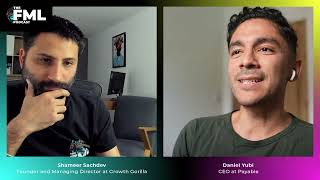
Humanising fintech through video content, with Daniel Yubi, Founder and CEO at Payable