Humanising fintech through video content, with Daniel Yubi, Founder and CEO at Payable
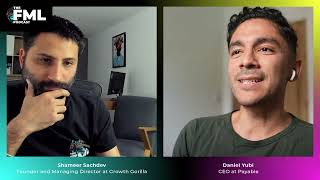
Daniel Yubi, CEO of Payable, argues that fintech companies should act as media companies. He uses YouTube, LinkedIn videos, and a newsletter called "The Invoice" to humanize B2B sales, believing performance and storytelling matter more than raw authenticity for keeping an audience.
Chapters
Welcome to the FML Podcast, the podcast on a mission to uncover actionable insights, explore the latest trends, and to catalyze your fintech's growth. Join Growth Gorilla's founder and managing director Shamir Sachdev and some of fintech's hardest-hitting marketers and leaders.
Welcome everyone to today's episode of the Fintech Marketers and Leaders Podcast.. We're joined by Daniel Ubi, founder and CEO at Payable. Daniel, thanks for joining us today.
Thank you so much. Super excited to be here. Amazing.
As I always start off, for everyone listening to the show today, could you just share a bit about yourself and your journey so far?
If anybody of you speak Spanish, I can say hola a todos. I am from Mexico. I'm a founder running a fintech company called Payable. I'm from a small city called Cancún. It's like, think about it, like ever meeting someone from Ibiza. I don't know. I've never met somebody from Ibiza, but Every time I say I'm from Cancun, people get like, how can you be from that little beach town? Spring break party. Funny enough though, I'm not a party boy. I used to be a lawyer before I moved into product management. I run product teams. I was very lucky that I was living in Menlo Park, San Francisco for quite some time. I saw how you run products for a bit over there in the US, moved to the UK, stayed there at Curve for a bit. I moved to Checkout.com, led product at Checkout.com, and then I started a company called Payable. What we do at Payable is treasury and cash management. One of the things we realize is now many of the companies are global companies, so they have many bank accounts across the world, and it's very hard for the CFO to see everything in a single place. So we are like the back office tool for the finance team. On one side, how they can reconcile transactions and see everything in a single place for the cash currencies, understand where is the money coming in, what are the payments that need to go out, and just everything done in a single platform.
I've got lots and lots of questions to ask you. And just to give the audience a bit of a hint, one of the things is, is that you are a YouTuber as well as you are a fintech founder. So I really want to get into that. Before we do, I think just in talking about your sort of, you know, your career and your journey, how did you make that move from being a lawyer into product management? You know, what, what kind of inspired that?
Yeah. Yeah. And we talk about being a YouTuber. I think something we'll probably touch in a bit is I believe that every company and fintech company should be a media company. Content, it's amazing. Content from a writing perspective has its own challenges, even video and YouTube and TikTok and Instagram, vertical video versus horizontal video, length of the video. I'm just very passionate about that subject and we'll talk about it in a second. I studied law because I like complicated problems. I think there are two types of problems in the world. You have complicated problems that are normally solved by engineering or brute force, like cash management or uploading a video. It is just an engineering problem that after you solve it, then it's very, very easy to replicate that, or sending a rocket to the moon. And then you have complex problems, which are more things that are very hard to solve, like love. Humans, cancer, things that are very hard to replicate. And I like law because in some aspect of it, you have the rules for a complicated problem, which is a brute force of understanding the law. But then you have the complex aspects of humans, just, you know, every case, even though it could be the same, it might be different because there was an error, human error, or the way somebody act in front of the judge or the jury. Is very different. So I really, really like that. Funny enough though, I was a very weird lawyer. Lawyers in Mexico are very paper-driven and they're not really techy. They don't really use laptops, to be honest. And I was that guy that was behind the scenes, always on my laptop doing illustration or Photoshop or taking photos. I really, really like photography, which is what brought me into the whole YouTube angle of it. So when as a lawyer, I did mergers and acquisitions, corporate law. I had my own law— not my own law firm, but I worked for a law firm I have my own office. I was very proud of myself. I had my own little space. And the last case I had as a lawyer was to divorce a couple. The client, he was like 63. She was around 40. She was younger. She cheated on a client. And my boss said to me, your job is to make sure she's out. And that was what I had to do. I made her lose the custody of her kids. There was 2 kids, one was like maybe 18 months old, so a baby. The other one was a bit older, like a teenager. And what I did was to win towards our customer, our client. So all her money depended on our client, meaning she didn't really have a job. She got loans for the lover. She will leave the baby to a friend to go and spend time with the lover. It was just such a telenovela, as we say in Mexico. And when that happened, it was very, I would say, sad and hard because when you're a lawyer, you are subtracting value towards someone. But when you're in tech, it's a zero-sum game. You are adding, like the, it's like if the tide rises, all boats rises. And I think that's what happens with technology. So I had a very miserable life because I was a lawyer and a friend of mine said, why don't you do a hackathon? And I'm like, what's a hackathon? I have no idea what is that. What is that? Because she knew I was a bit of a weird lawyer because I was on my laptop all the time. And I went on this thing called Startup Bus. So Startup Bus is a hackathon that happens in the US. There's one in Europe as well, where 40 people just meet, engineers, product managers, designers. At the time, I didn't know any of these things, what they meant. I was just the guy that doesn't know how to code or engineer. You're on a bus with Wi-Fi and then you drive for 3 days with Wi-Fi. Meanwhile, you code an MVP and then you present in front of tech stars. So imagine having 40 Mexicans from Mexico City driving to Tennessee. There was a bus from Chicago, from New York, from San Francisco, from Denver. All of these buses are on their way. My team got to second place. And it was a dream. I was like, oh my God, you know, we had an idea 3 days ago. We slept on a bus, we just coded the whole evening. We just didn't sleep. We just lived with Red Bull and pizza. And now we are presenting in front of, you know, people that believe this idea. And that's when I realized I was really excited to move into this new thing. And at the time I didn't know what that thing was. And it was called product management. I had the luck that a company called Clip, it's like a SumUp or iSettle or Square in the US. It's a mobile POS in Mexico and is the biggest POS or acquirer in Mexico. The office was in San Francisco, Menlo Park. The CFO and the CTO became my mentors. And yeah, I was the first product manager there for the Mexico City office. And that's what happened. That's how the whole story went. So that's another of doing product.
You worked out in San Francisco for a bit after that.
Yeah, yeah. So I was there in and out from Mexico City. So my main office was in Mexico City, but I would go to the Menlo Park office to meet with the engineering team. So I was spending a lot of time there. I've never really lived in San Francisco. I think that's changed a lot in the last couple of years. Our investors in Payable are based in the Bay Area, so I go Tried to go often just to, of course, go to San Francisco. But yeah, I didn't really live there. But yeah, I was immersed in the experience of learning how to build engineering teams over there.
And sort of moving into like the YouTube, your YouTube endeavors, when did you start working on that? You know, was that kind of going on at the same time doing all of this or did that come much later?
Yeah, YouTube happened as a parallel experience. I lived in Mexico City for a bit and then moved to London. When I was about to leave Mexico to move to London, that's when I started doing some YouTube. At the very beginning, I was not good. I still don't know if I'm great, but YouTube has a level of experience on how you need to go and create great videos. I just find it fascinating that I uploaded a video and suddenly people just learned something. Funny enough though, I had a chance yesterday to go to the Mexican embassy. So I was there with a bunch of other founders and a guy came to me and said, you're Yubi from YouTube. And I'm like, no way. He's like, yeah, I watch your YouTube channel. I call my fans the Yubi Fam. And I asked him like, how do you end up moving into or watching my YouTube videos? And he said that he wanted to move to London and he looked for anybody that moved to London that is from Mexico. And that was like the beginning of the YouTube channel. How does someone that comes from a very different background son-in-law is in London working in tech and now, you know, building a company. I think that the best videos on YouTube contain 3 things. I don't think all my videos contain these 3 things, and that's why I don't think I have millions and millions of subscribers. But I know that the videos that I've done with these 3 things are the ones that have a lot, a lot of views. So first is YouTube is about retention, right? So the best videos that will really win is that they have, or they are entertaining, inspiring, and they educate something. If you're able to do these three things, then you will do really well on YouTube. You can watch something that is educating but is boring. You know, those classic whiteboarding videos because you need to learn how to do something on Excel, right? That's not really great. But imagine you have someone that is traveling to a new mountain and is super inspiring. They walk so many kilometers to get there. Meanwhile, the character is like super exciting as well. And you like laugh because the ways— the way he's explaining things is very different or very comical. And then at the end of the video is telling you that these maybe mountain is the only mountain in the world. Something, something happened. Then you as the viewer, then you go to your friends, says, oh my God, I watched this video yesterday and I learned this new thing. And then you pass over that new thing that you learn. So the videos that have done the best for me has been those the ones that have these 3 things. When you're doing YouTube, depending on what you're trying to achieve with YouTube is to have a, like a snapshot of your life. And I think it's very fascinating for me because I can look back in my videos. Of course, I find them cringe and horrible because every video feels like a better video. You have a snapshot of who you were, how you thought, how you think. Yeah, just in the past.
I mean, look, being a YouTuber and a fintech founder is a very unique combination. Have you brought that into payable and what does that look like?
I believe that companies now are boring. If we get out into B2B sales, right? If we just think about consumer brands, which is the normal thing that you and I were going by, we could potentially, yes, buy from a brand because we like the brand, Patagonia, because they have a very ethical way of seeing things. But when we think about marketing, And the way you can really get close to a consumer is that consumers or people buy from people. So when you are seeing a video of a brand, you are mostly seeing a human being telling you something about that brand, that company. And then with love, then you can fall in love with the actual brand. But it is that feeling of connecting at a human level that really brings consumers into buying all the things. But that doesn't happen in B2B or B2B sales. We in the B2B world think we're like robots. So if you go into any of the old treasury providers of what we do, our accounting, or I don't know, even think about marketing, CRMs, all of these products, they just give you a functional solution of the problem they're solving. But how great that would be if you have a human being being excited, being human, inspiring, educating, and give you a different perspective of why they should use the product. And that's what we've been doing at Payable because I love video and because I believe as well people are busy. People don't have time to see a 3-minute, 5-minute video of an ad on anything they want to go and buy. Imagine you can have a 20-second really snappy video just like TikTok, but you see it on LinkedIn. Where you can just really move fast on why you should buy this product. An example of this that we're launching soon, to give a little context, right? So we connect to bank accounts, we tag those transactions, and then we can send them to the right ERP, Xero, NetSuite, whatever that is. ERP and NetSuite are great at certain things, but reconciliation and bank connections are not that great. At the fundamental level, this thing is boring. I'm excited about it. The finance controllers are excited about it, but my friends are hipsters, don't care about this, right? So what can you do to surface something interesting in a world where nobody really understands what's happening behind the scenes in the finance domain? Even the CEO, the CEO of a company has no idea what is actually happening behind the scenes for the financial controller. He cares about the outcome, closing the books, cash reporting or sending cash. So we said, okay, why don't we do something fun? 2 minutes, snappy and just really exciting. So what we did is we went to the city, the streets of London, central London, and imagine me just like now talking to the camera. I'm walking in my street next to the office and I basically said, look, this is my barber, this is my favorite sandwich shop, this is my bakery, this is my coffee shop. And I'm just walking into all of the places that I go every day. Very snappy, very quick. And I'll say, do you know what all of them have in common? They all use Xero. But the funny thing is, you're a lender, you're a fintech company, and you're still using Xero, even though they have 100 transactions a day and you have 1,000 a day. Why? And then let me show you what is the difference. And then we jump into the laptop and then walk you through every single step of how we are just better at making you use our product. Any other person would have just opened the laptop and said, let me walk you through why we're better than this, this, and that. Just boring. Like, imagine you're on LinkedIn scrolling, you see a guy saying, this is my barber shop. This is like, what is this guy talking about? Why? Right? So we need to bring that content aspect so it can feel more human and surface that connection of the product you're going to buy.
Do you think more fintechs will adopt this approach? Or do you think that a lot of them haven't recognized that, you know, going down this sort of personable avenue is an opportunity and they just haven't seen it?
Well, no, this has happened already. So I think the wave, I will just, not analogy, but I will explain how fintech happened, the waves of fintech, and then I move into the wave of fintech and content. So the first wave of fintech, I will say, was the Monster, the Revolutes of the world where They create a consumer-accessible banking experience. The way they also perform content is very accessible for consumers. Why are you spending FX fees when you're traveling? Use Revolut. Your bank is old and not great. Use us as Monzo. That's the first thing that they did, and they've done an amazing job actually of making sure that they are content companies as well. When these neobanks were created, many of the operators inside these neobanks realized how hard it is to build everything from the get-go. So then you have the second wave, which is called infrastructure wave. That's banking as a service. You know, how do you open a bank account really quickly for companies? How do you do KYC or KYB or know your customer? Like all those components, the Legos, so someone can build you know, build your neobank. Some of these companies have created some level of good content. GoCardless is amazing. They have really, really good content, at least from a blog perspective. Barrell.com, which is a famous company, they do have a podcast and they do some videos, which is also pretty great. But overall, I don't think a lot of the companies have done this because it is the operator not thinking from a consumer perspective. Is thinking from a B2B sales perspective. For us, we need to go and change that. And I really hope people do that because people buy from people. That's how it is. So if you are able to connect, even if it's something as I would say boring as KYC, like knowing your customer, but you add some level of content or how do you stand out basically? How can you stand out? That's just basically how, that's what content really gives you and you can do that. Because at the product level, it will be the same. Anything else will be margin compressions like price. So if you are able to create more value by the content you're creating, I think you, you should win.
With the content that you're putting out for your target audience, are you seeing them engaged in the content that you're producing? Is it yielding and delivering interest and customers? Or is it too early to say yet?
Yes and no. So yeah, we see engagement on the different channels that we're doing now in terms of content, not only video. So for example, a lot of the blogs that Karina, the product marketing manager or product marketing lead that is working at Payable, we're now on the top pages of Google on many of the blogs that we just wrote. When we write a blog, we not only write the blog, we also add a video of myself or someone else explaining the problem. And that's just great. Now, I don't know if you're aware of the reasons are aware, but Silicon Valley Bank went bust. So HSBC UK acquired them for the great amount of money of £1. And when that happens, they had to be a migration of Silicon Valley Bank into HSBC's bank accounts. And nobody was really explaining the process, how it will work. And we are now one of the the first pages right now winning on that piece of content. Then when we make a video, the financial controller now they get excited about the pain points or the problems. So one of our customers saw that we launched a video about some of the functionality and the financial controller like super excited as well and just very, very excited. Like actually very, very, very excited. And then third, these are very maybe different type of content, more marketing rather than content. We have a newsletter and the newsletter is called the Invoice. Which is like a pun, right? It's like a teasing of what we do. So when we launch, when we send that newsletter, it's kind of funny because you are receiving a newsletter called the invoice where at the beginning you freak out that somebody's sending you an invoice that you need to go and pay out. So we play with the content in a way that is like the invoice is ready, now you have to go and read it. So we play around with those different template changes. So yeah, we can see how the, like we're seeing the results. I think also from a video perspective, there's a lot of like content takes time. That's also something very important. If you are on YouTube, I've been there for 5 years now and I will say my growth actually happened in the last 2 years and then I stopped because I was starting the company. But content compounds. But for something to compound, you need the time to, to pass.
We talked a lot about sort of your ethos and approach to content production and value of content and personability. Obviously it's early days since you launched in May. How has your audience reacted initially to your marketing initiatives? And you know, perhaps as a wider question, you know, what does your marketing framework look like at the moment?
Always expand, right? We are a B2B enterprise company, so we serve enterprises. So our approach to go-to-market is maybe not the traditional monster revolut. The way I think about go-to-market is I will believe you have like two ways to keep it very simple. On one side is a spear, which is just outbound sales. You say, I want to win this account, and you go and make sure you try to go and fish and just try to get that account. Then you have the net, which is actual marketing, I will say, which is, hey, how do you try to capture as many fish as you can? Not all of them will be great. Some of them are going to be qualified and amazing. Some of them are going to be like so-so. And that was part of the marketing experience. So from a go-to-market perspective, the way we do things is we have a sales team. I'm still running sales and Luis and I were the ones who are making sure we can go in and win the right accounts. Then we have a marketing team as well, which is part of the Karina's team where we have different areas that we're trying to cover. One of them is the video aspect on LinkedIn, blogs as well. We try to really define our customer profile, ideal customer profile is, you know, companies that they raise around $50 to $100 million of funding minimum, they have around 300 to 500 employees as minimum, and then up to 2,000 employees. We can realize that because we know they will have different bank account challenges, they might be using NetSuite, and we utilize those dimensions or criteria to then try to create as much content as we can and be as specific as we can. I would say that's mostly it. We are now spanning into all the type of activities such as events, podcasts, yeah, just other type of events as well. So we can go and be more present where we can find our ideal customers. I think that the way the product will evolve is how do we then eventually maybe not from a marketing perspective, but more from a go-to-market perspective is have consulting firms or banks as distribution partners or channels so we can have a flying wheel effect of getting customers not only for marketing, sales, but as well as partners that are helping us go and grow together as both companies or as partners.
At the center of that, really, I suppose in all directions really, is ultimately your content. You mentioned Paddle. We had Andrew, the CMO, on the podcast a few weeks back and very similar in the sense of you're going after a very specific audience, fintechs of a certain size, etc. They're going after SaaS businesses of a certain size and pivotal to their marketing is their content that they're producing. And it kind of like circles back to what you were sort of saying earlier, which is every company or every fintech company to a degree will become a media company. Do you think that's true for all subsectors of fintech? And do you think that's limited to just fintech or do you think it'll be for brands outside of fintech space, other tech companies, etc.?
Yeah, no, every company should be a media company or create content because I think the challenge of content though is that in my view is cheap because I know how to do it or I have understanding of how to navigate it. So for me, it's like a no-brainer. Yes, it's a long-term plan. Even if from a tech startup perspective, a battle just acquire a couple of a year ago, a couple of months ago, acquired a company that is a media company that was just interviewing a bunch of other, I think, chief revenue officers from different SaaSs. But here's a very good example, because if you build content and you have a content company, then you have distribution, you have access to the right buyer or consumer that wants a particular product. And that is very valuable, right? I think the, the future of fintech in consumer space is that you should start as a YouTuber and then build a fintech company. An example of this, and this is something that I— is one of my mistakes, I just didn't see it in front of me. During the pandemic, or just before the pandemic, I made a video about how much money I made by buying Apple stocks, and it was in Spanish. The YouTube channel is in Spanish, and I made a video, I was using FreeTrade as my trading platform. Many of the comments, or all the comments, because my market is Mexico, I want a product, I cannot buy stocks, I cannot blah, blah, blah, and they were just complaining about the lack of solutions they have. And I didn't see it because I was so immersed in the UK culture where we have every single option here that I just didn't see that. And that was so easy, right? Because I have distribution. If I, if I want to learn something, I will have someone to at least try it out from a consumer perspective. So if you are a product manager or a salesperson on working for a company and you want to build something on your own, don't leave. Start building content about the things that you want to build and then get them to test it out, prototype, you know, create a community and then do the leap of faith of jumping to build your own company. That is very powerful that you can do for consumers or B2B sales because the world is so connected and is now so massive that there's going to be someone that will care about your content. Only, of course, if you make the content interesting. The subject that you're talking about doesn't matter. It's the execution that makes it interesting. And yeah, every company should do it, not only for fintech or any tech company.
I think we see that a lot in other spaces outside of fintech. I think there's a lot of, you know, solopreneurs that have started off with, you know, large followings on Twitter and YouTube, and eventually they've gone into productizing their brand in some way, shape, or form. But we don't see that so much in the fintech space. The question that kind of comes to my mind is, you know, where you're a creator first and then you are then creating a product and selling it into your audience. There's a large amount of authenticity because you are creating a product to serve that business. Whereas obviously if you are a product and then you're looking to build that media company around it, the task then becomes maintaining authenticity. I suppose that's a really difficult balance to strike. You know, what's Payable's approach or your approach to kind of ensuring that authenticity to make sure the content resonates with your target customer?
Well, I think I have to jump on two things. I think I'll give my personal opinion, my personal views of YouTube and authenticity, and then I'll answer PayPal as a whole. I have an actual contrarian view of being authentic and authenticity on YouTube. Actually, I don't think that's actually something that you should do because you are running a show, you are performing a show. You are an artist, you are an actor or an actress in front of the camera. You are enhancing yourself to sell yourself, your product, a vision, or an idea. And by that, you know, you are not going to be authentic. I'm not— I am an excitable person, but if I was speaking just as an authentic self, it will be boring because you cannot do that. That doesn't mean that you cannot be humble and show, you know, some aspects of how genuine you are. So if you are there and you talk about something that is very hard or emotionally strong for you, it can be genuine to cry about it. But to be authentic about who you are, I don't think that exists because it is a show. And even if it's just for an ad, for a podcast, for a video, you are performing. It is a performance. It's so fascinating because you see these vloggers on YouTube and people think that they are just like that, but it is staged. If you see a day in the life of something, it's not that you have that life every day. It's not— it's not— doesn't feel cinematic like that, right? And a lot of the vloggers, if you do want to have the aspect of, you know, the macronutrients of inspiring, educating, and entertaining. I don't know. I don't know. I think if I talk about something interesting in the day with you, maybe you get inspired. But through the whole day, I'm going to be entertaining, inspiring, educating. That'll be so tiring, right? So you have to put into a box, have a script, and make sure you batch it in a way that is for YouTube. If you were doing Instagram, or you were doing Twitter, or you're doing TikTok, will be completely different. So that's my view on authenticity. I, I don't think you can be genuine when you say you're sad and you can cry about it, but you're not going to be authentic, like actually authentic. I find it that, um, it's not true. The more authentic I was on YouTube, the less views I had. The more excited I was and the more punchy I was and the more snappy, all of these things, the more viewers I will have, just for How do you keep someone 10 minutes really watching, retaining? It's really hard just by being authentic. So that's one point of view. On the payable side is in a way of, okay, yeah, we want to sell something and we'll try to put something into the world. I think for us, just because nobody in B2B and fintech does anything, I think that if we just do a 2x improvement, Like some of the videos we post, Corinne and I, I'm not proud of them because I have a perfectionist self that comes from my YouTube background that I'm like, oh, the audio is not good. This is not 4K. It's like 720. But people are there because they have such a crappy experience. Even if I do 720 or 1080p for everybody, we're talking about the resolution of the camera. Is 4K because I'm using a nice little lens. People think about it, oh, that looks so pro because they're not on YouTube where in YouTube it is extremely pro, right? Audio as well. We both have nice mics because we are here in the content world. But even if I was using my headphones and I was like talking really quickly in the streets of London, that's just something completely different that nobody ever seen that. So I would say maybe in paywall, I potentially be more authentic in some way, you know, because nobody is doing anything. It's just very boring and dry, the standard in B2B content creation. But when you're in YouTube, there's just so much content and competition and fighting for eyeballs is so hard that you need to package it in a way that you can really win that consumer or whoever's watching those videos.
I don't disagree with your views on authenticity. I think content creators ultimately at the end of the day are forms of actors. You're absolutely right about the day in the life. I think if someone took a video of the day in my life, they'd get very bored about watching me about 10 hours in front of the computer.
So, and you know, it is true, right? Like people think the glory of being a podcaster, like, oh, you talk to great people, but then 80% of that is editing and removing arms. And imagine somebody watching that, it would be boring, right? So You cut the important things of the glory, but it is what you see is what you get in some way.
What's the outlook for Payable? Obviously, as I said, you know, in May you started, you went live, you started onboarding customers. You know, what does the next 12 months look like for you?
In BC, one of the things that happens is, can the founder hire? Can the founder build? Can the founder sell? Can the founder scale? A great team is super important. So that's why the first step is to hire a great team. And that's something we've done. We've got people from the best fintech companies here in the UK. We built a product that now is being used and is used for many fintech companies and they're paying good money, which I'm very proud of. Now what we are is how do we sell and scale? You know, how do we have the repeatable process? How do we go to different markets? How do we write a playbook? So when we go next year to do an extension or Series A, we can say, hey, this is how we're going to be using the money. If you give us this money, now we can scale the revenue by 10x or 3x or whatever x. And that's just basically the plan. It's funny because it's very simple, but it's also very complicated and complex because there's always human and market dynamics involved. But that's just mainly the focus right now is continue growing the team, growing sales. And if everything goes as planned, then raise next year to continue to grow.
Well, look, before I let you go, let's take you through our quickfire round. What podcasts are you currently listening to or you would recommend?
The Hidden Brain podcast is really, really, really good. The last one that I listened that really made me think was Tim Ferriss with Arthur Brooks. Arthur Brooks just wrote a book with— well, he's an amazing psychologist and neuroscientist, and he just dedicated his life of The Science of Happiness. So yeah, very fascinating podcast. I— it really made me think. Yeah, but my favorite part, because I would say, is Hidden Brain.
What's your favorite fintech company or fintech app that you can't live without?
Very complicated question because I am not excited for any fintech company right now because I think fintech has come to a point where Everything's the same, you know, everybody's building the same. Like what we're building right now is in a, I guess, like it's fintech, but it's SaaS. So we're like in a, in a kind of like two worlds. But if I go into like core fintech, I don't know, like why do you need a monzo for planting trees or a monzo for vets or a monzo for dentists? I don't know, maybe there's a big market for dentists, but it's not something that for me is exciting because It's just a go-to-market problem rather than actually an exciting product. From a product that I use every day, yes, I do use Monzo. I love it. Great bank. When I moved in the UK from Mexico, they were the ones who gave me a bank account, which I'm very, very pleased. I use Freetrade and Lightyear. I laugh because I have mixed opinions about this, but Lightyear has been a great product for buying stocks, and Freetrade is the one I've been using for many, many, many years.
What books are you currently reading or would recommend?
So I just finished one book and I'm reading another book, a very cool book called Trust from Hernan Diaz. It's a fictional book. It's a telescope type of writing. So it starts very broad, then it hooks you, and then the next part of the book goes into a type of an inception, deeper aspect of the connected story, and then it goes to the deeper connect the story, and then the end connects the 4 stories in a very elegant, sexy, beautiful way. It's about a couple and the stock market and how New York society, uh, works in the 1900s, 1800s. It's a beautiful, beautiful book, won the Pulitzer Prize. And now I am reading The Anthropocene Review from John Green. I find that very fascinating. It is a nonfiction book. He mentions that everything we do right now in life is based on 5-star reviews, like Amazon or Deliveroo or Uber Eats. So he mixes random things that are really important for him and gives a review about the thing and tells you the story about that thing. So for example, How were teddy bears invented? Or air conditioning. So, now I know why we have teddy bears in the world and how that happened, which is a very funny story. So, I found that very cool because this is nonfiction, you learn something, it's entertaining, as we were saying before, and sometimes it's inspiring. Amazing.
And then my last question, and probably my favorite, is what's one thing that I haven't asked that perhaps I should have?
I would have loved to explain more about my family. My grandparents and my great-grandparents was from Japan, and my dad's side, they do not come from a high economic background. I was the first kid that went to uni on my dad's side. Actually, my dad didn't really finish high school. So there's a lot of like these really interesting, I would say, drivers that made me who I am, but as well as how lovely and amazing my family is and created this weirdo Mexican Daniel, the Mexican side, and the Yubi, the Japanese side of my family.
Well, you've answered the question. Daniel, it's been absolutely great having you on today. Thank you very much for your time and all the best of luck with Payable.
Thank you so much. I had so much fun and thank you for inviting me.
The FML Podcast is brought to you by Growth Gorilla. To find out how our marketing growth how experts can boost your fintech's growth, head to growthgorilla.co.uk. And make sure to search for the FML Podcast in Apple Podcasts, Spotify, or anywhere else podcasts are found. Don't forget to click follow to ensure you don't miss any future episodes. On behalf of the team here at Growth Gorilla, thanks for listening.