4 Bluegrass Guitar Licks Every Picker Should Know

Aaron Jaxon teaches four bluegrass lead guitar licks over G-C-D, focusing on clean alternate picking and timing. He shows how these phrases use major blues scales and chord tones, then demonstrates transposing them up the neck so you're not stuck in first position.
Chapters
All right, welcome to Bluegrass Lead Guitar Vocabulary 101. So if you're learning bluegrass lead guitar, These are the kind of phrases that I want you getting underneath your fingertips early in the game. So what I'm going to be showing you today are 4 simple bluegrass lead ideas through a G, C, and a D chord progression, which is the most common chord progression that we play in bluegrass. Now, these are not just 4 random licks. These are 4 classic-sounding phrases that are going to help you develop 3 things at the same time. Number 1, authentic-sounding bluegrass lead guitar vocabulary, because this is a unique style of playing. Number 2 is clean and crisp technique. And number 3 is solid timing. But more importantly, learning these ideas is going to help you start to hear and to feel the way great bluegrass players play lead ideas through chord changes instead of just playing isolated licks. And you can get the tabs for each one of these ideas down in the video description and in the top pinned comment. If you're building your foundations as a bluegrass lead guitar player, These are the types of ideas that I want you working on. All right, let's go ahead and jump into the first idea. All right, so for this first idea, let me go ahead and count it in. That way you can hear the timing and the phrasing, and it'll sound like this: one, and two, and three, and four. Okay, let's do it again here. I'll count it in.
1, E and 2, E and 3, E and 4, E.
Okay. So the first thing to talk about here is where to come in. Notice that I came in on the and of beat 4. I did not come in right on the downbeat, unlike beat 1. 1, 2, 3, 4, 1. Doesn't come in.
One, and two, and three, and four, and one.
So that note—that's our one. That's our downbeat. That's a big thing to pay attention to there. I've taught this to students over the years, and a lot of times people would learn it, and they would want to come right in on the downbeat, which makes sense. But if you do that, it's going to throw this whole phrase off.
One, and two, and 3, E and a 4, E and a 1.
Okay, so that's, that's the most important thing. Come in on the and of beat 4.
1, E and a 2, E and a 3, E and a 4, E and a 1.
Okay, there. Let's talk about the technique here. Now, I'm not going to do a deep dive on alternate picking, alternate picking of 16th notes, how to use alternate picking in combination with hammer-ons and pull-offs. If you would like a lesson on that, I've got a long masterclass where I compiled a bunch of my YouTube lessons together in one place on foundational bluegrass lead guitar technique. You can check that out here, and I will also link to it down in the video description. But suffice it to say, pick strokes are important. So when you're playing these ideas—
down, up, down, up, down, pull-off, down—
very important, very important. Do not deviate from I know a lot of people don't like hearing that when I'm like a real stickler for pick strokes, but again, if you're in the kind of foundational stage of learning bluegrass lead guitar, paying crazy levels of attention to the pick strokes on what you're playing is one of the most beneficial things that you can do. Take this from someone who's been playing it for a long time, and I have taught hundreds of students. This is the thing that will take you to the next level in your playing. It does require a lot of focus and a lot of attention to detail. Yeah, I think that's a really good point. But I promise you, you will not regret spending time doing this.
Okay, so down, up, down, up, down, pull-off, down, and then just repeat that.
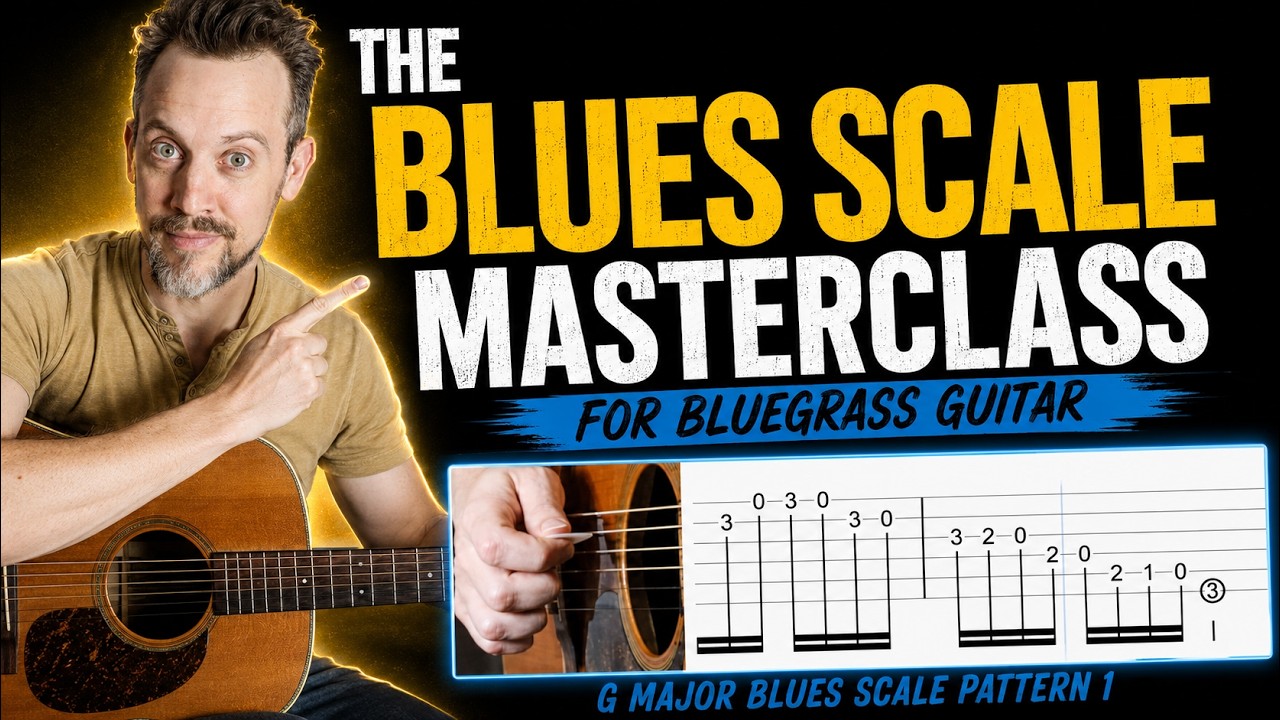
Okay, and then we just take that through. That— it'll stay the same on each one of those. Okay, and then now let's talk about the ideas there. So we're starting off with G, so right Right here, very familiar sounding bluegrass passage there, but let's talk about what we're doing there. So a lot of people are like, Aaron, is it scale tones or is it chord tones? It's both. It's not one or the other, it's both. So for instance, really those ideas come out of a G major blues scale, but we're also targeting the chord tones. And, uh, 1. So that right there targets our major 3rd and the phrase ends on that G, which is the 1 of the chord we're playing over. So we're targeting scale and chord tones. All right, and then we just play that twice, and then we go over to C and do the exact same thing again, but this time in C. So again, that— those ideas, that does come out of a C major blues scale. Okay, but again That targets our major 3rd of the C, and that ends on our C, which is the 1 of our C chord. So we're using scale tones and chord tones, but then we go to D. Again, that— those ideas are out of a D major blues scale. But again, the phrase is also targeting chord tones. There's our F sharp, which is our major 3rd D, and then ending on our open D, which is the 1 of our D chord. So we're going through that chord progression, we're targeting scale and chord tones relative to each chord. We play the changes the same way that a swing player or a jazz player or a lot of great country players do. So that's the first idea, and I wanted to go into some detail because really all of the other ideas that I'm going to teach you in this lesson are just embellishments on that.
So one more time, this first idea here: 1, E and a 2, E and a 3, E and a 4.
Okay, all right, so this next idea is essentially going to be the same thing, but I'm going to make it just a little bit more busy, and that's going to sound like this.
1 and 2 and 3 and 4 to C.
Back to G.
Okay, let me do that again and call out the chord changes as I'm playing through each chord change. One and two and three.
A 3 e and a 4 e and a G.
To C.
To D.
Back to G.
Okay, so again, it's nearly the same thing as the other idea. We're just making it a little bit more busy. So instead of just— we are—
so that's down, up, down, up, down, pull-off, down, up, down, up, down, up, down, pull-off, down.
Okay, and if you get confused by the pick I do have the tabs for you in the video description and in the top pinned comment, and I'll have all the pick strokes written out on that as well. So that's the idea right there. We're taking the idea that we did before, using the same scale and chord tones, but we're just making it just a little bit more busy. So one more time, this second lead idea through G, C, and D.
1, E and 2, E and 3, E and 4, E to C.
To D and back to G.
Okay, so now what I want to do, we're going to take the same 2 ideas, but I want to go up Um, on the neck there. Because a lot of times in bluegrass, um, we'll kind of get stuck down here using like the open, kind of in like in first position, you know what I'm saying? Playing ideas like, you know, or just because a lot of these ideas sound great in that territory, but it's easy to get stuck down there. So I really want to just take the same 2 ideas that I showed you and move it up on the neck. So let's come up here to lead idea number 3, and we're gonna go 1 and 2 and 3 and 4, E to C. To D, back to G. Okay, and again, what we're doing right there, um, you know, for, for, for G right there, so that's coming out of our G major blues scale up here, and then our chord tones, we're also targeting those. All right, and then here we see our chord tones, and then it's coming out of the C major blues scale, and then we're just moving that up to D. Same, same deal— chord tones, uh, major blues scale, and that. Okay, and then, um, yeah, so let me go through that third lead idea one more time here.
1 and 2 and 3 and 4.
C up to D, back to G.
All right, so again, like we did with ideas 1 and 2, um, I'm gonna give you idea 4 here, and it's just gonna be an embellishment on idea 3, and that's gonna go like this.
1, E and 2, E and 3, E and 4.
To C, up to D.
To G. Okay, so again, same chord tones, same scale tones. We're just making a slightly more busy idea out of it there. So there we go. There's 4 bluegrass lead ideas through a G, C, and a D chord progression. We did 2 down here, kind of in our first position and using open strings, and then we did 2 up here, kind of in 7th position, if you want to call it that, 7th and 5th position, um, using all closed positions. So now, in addition to this lesson getting you some great bluegrass vocabulary ideas, and you can start to see how bluegrass players will play through chord changes, we also want to practice technique and timing. So here's what I want to do. I'm going to play all 4 of these in time, and I'm going to play it along with one of my favorite tools to develop timing which is a train beat drum track. Okay, so that's gonna sound like this. Okay, so that's a great way to practice your timing with these phrases. Phrases. But now I want to play these along with the strum machine because in addition to playing them rhythmically in time, I also want you to hear the way they sound in context with the chords that you'll be playing these lead ideas over. And that's going to sound like this. Okay, so great stuff here. These phrases give you some really authentic-sounding vocabulary, but they're not just isolated licks. It shows you how to take these ideas and move them through a really commonly played chord progression in bluegrass. And in addition to that, they're great for developing technique and timing. So you're getting some great development in 3 different areas from just a couple of fairly simple lead ideas. So remember, when you're playing these, play them cleanly, play them slowly, Play them in time, and this is just going to be a tremendous thing to get underneath your fingers when you're developing yourself as a bluegrass lead guitar player. Thanks as always for hanging out, and I will see you next time.