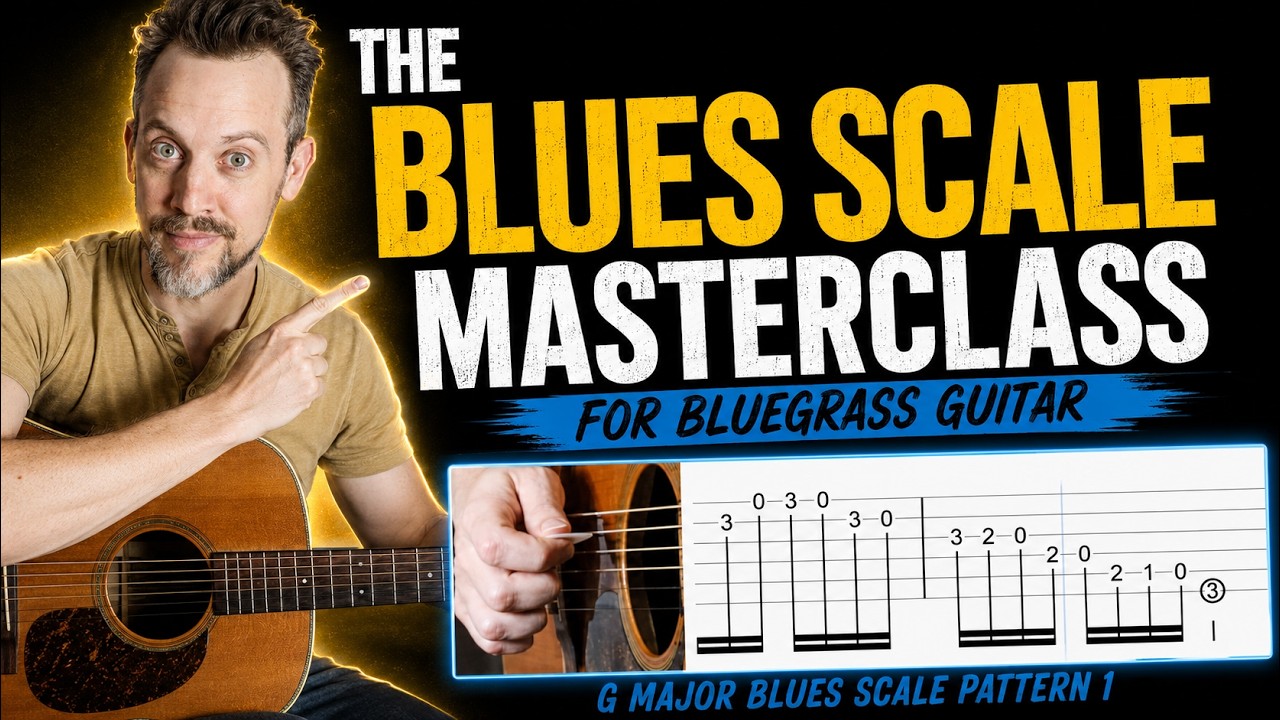
In this instructional video Aaron Jaxon explains how a handful of classic bluegrass guitar licks can be used to finish a wide variety of traditional vocal tunes. He begins by noting that many standards share an identical two‑bar turnaround (the last two bars of an eight‑bar phrase) and proposes learning a few versatile phrases instead of creating separate endings for each song. Aaron revisits three Tony‑Rice‑style licks—derived from minor/major blues scales and a "red‑haired boy" ending—demonstrating their rhythmic placement (typically on the "and" of beat 4) and counting patterns. He then shows how to insert each lick into the final two bars of two exemplar songs, Nine Pound Hammer (capo 2, key of A) and Little Cabin Home on the Hill, describing the basic melody for the first six bars and the lick‑filled ending. Throughout, he references linked lessons, provides tabs in the description and pinned comment, and uses backing tracks to illustrate the full‑tempo results. The lesson emphasizes a modular, repeatable approach that can be applied to over 75 classic bluegrass tunes.
Chapters
Have you ever noticed that a lot of classic bluegrass tunes have the exact same ending? Tunes like Nine Pound Hammer, Little Cabin Home on the Hill, Your Love Is Like a Flower, Bury Me Beneath the Willow, My Little Georgia Rose, I'm Goin' Back to Old Kentucky, I'll Never Shed Another Tear, I've Waited As Long As I Can. I could go on and on and on, but they all end in the exact same way.
They all end with this same turnaround: 1, 2, 3, 4, 1, 2, 3, 4.
So instead of coming up with separate endings for all of these tunes, what if we just learned a handful of phrases that we could apply to all of them? Well, that's exactly what we're gonna be learning today. So I wanna keep this lesson simple here. I don't wanna overwhelm you with, you know, 100 new licks that you have to go and learn. But at the same time I wanna make sure that I communicate how broad of an application that what you're going to learn today has in the context of classic bluegrass vocal tunes. So what I wanna do today is essentially combine these two lessons, and I'll throw those up on the screen right here, and I've got 'em linked down in the video description. Now, this is great because both of those lessons are pretty highly viewed, really popular lessons on this channel. And another lesson that I would highly recommend that you check out is this one right here, where I talk about the turnaround that I was talking about at the beginning of the lesson today. All that a turnaround is, it's the last 2 bars of the 8-bar phrase that we normally solo over whenever we're jamming on or playing bluegrass vocal tunes. Now, in that lesson, I give you some phrases like this, and it's a phrase that targets our 2 bars of our I chord to our V chord and then to our 1 chord.
So again, 1, 5, 1.
But today I want to go back over 3 classic bluegrass licks that I have shared many times on this channel. I'm going to show you how to plug them into 2 classic bluegrass tunes, but then we're also going to talk about how you can apply these to so many other of these classic bluegrass vocal tunes. So you can get the tabs for these licks and solos down in the video description and in the top pinned comment. Okay, so let's go back over these 3 classic bluegrass licks here, and the first one is this, um, okay, again, I have shared this in many different lessons on this channel here, but I'll play it again here, okay? And that's just as classic of Tony Rice lick as it gets. And what we're doing is kind of mixing ideas from a minor and major blues scale.
Minor, major.
Okay, so that's just a classic Tony Rice phrase. Again, I've shared that in many different lessons on this channel. Um, here's the second one here, and it's this. I'll do that again. Again, about as classic of a Tony Rice phrase as it gets. This is just like the old classic, uh, red-haired boy ending. Okay, I'll do that one more time. And really, with all of these phrases, whenever you're counting it in They all come in on the and of beat 4.
Okay, and so let's do one more here, and that's gonna go like this. All right, one more time here.
1 and a 2 and a 3 and a 4 and—
okay, so again, 3 classic bluegrass licks out of, in this case, G, or a G shape, or a 1 chord here. And again, the first one, 1 and 2 and 3 and 4.
All right, second one.
1 and 2 and 3 and 4.
And then our third one.
1 and a 2, e and a 3, e and a 4, e.
There we go. Okay, okay, so there's 3 classic sounding bluegrass phrases, which is a really cool thing. But now let's go into the next part of this lesson, which is the really cool part, and we're going to apply those phrases to 2 classic bluegrass tunes. All right, so we're going to put these phrases at the end of 9 Pound Hammer here, and I'm capoed up on the 2nd fret. You know, you can play Nine Pound Hammer in whatever key that you want to, but I like to play it in A. It's a good bluegrass key to play it in here. And so again, check out this video right here if you want a little bit more of a detailed lesson breakdown on some of these simple breaks to tunes like Nine Pound Hammer and Little Cabin Home on the Hill and Blue Ridge Cabin Home and all that stuff. But anyway, the kind of simple basic break here to Nine Pound Hammer is gonna go like this: 1, 2, 3, 2, 3.
2, 3.
2, 3.
2, 3. 1, 2, 3.
And so all we're gonna do is we're going to plug each one of those licks that we learned earlier into the last 2 bars, um, of Nine Pound Hammer.
So that's gonna go like this: 1, 2, 3.
2, 3, 2, 3, 3, 3, 2, lick 1. Okay, let's do the exact same thing, but then we're going to throw in, uh, the second lick that we learned earlier.
We're gonna go 1, 2, 3— Lick #2!
There we go. And then let's do the exact same thing, but this time I want to put in the third lick.
So we'll go 1, 2, 3, 2, 3, 2, 3, 2, 3, 2, 3, 2, 3.
Third lick. Okay, do that one more time.
One, two, three.
Two, three. Two, three.
Okay, so you see, with all 3 of those phrases, we just plug those into the last 2 bars. And when you play that in combination with playing, you know, a simple yet tasteful melody for the first 6 bars and then throwing in a little bit of lick, you know, a little bit of spice at the end of that, it makes for a really nice sounding bluegrass guitar solo. Okay, So now I want to play all 3 of those breaks to 9 lb hammer with each one of those licks up to tempo and with a backing track, and that will sound like this. Okay, so now let's do the exact same thing, but this time let's do it with Little Cabin Home on the Hill. Again, you can check out this lesson right here for a little bit more of a detailed breakdown of the basic melody to Little Cabin Home on the Hill. But again, like our basic kind of, you know, basic melody break to Little Cabin Home on the Hill.
1, 2, 3.
Okay, so again, we're just going to plug each one of those phrases into the last 2 bars of each one of those. Okay, so that's going to go like this: 1, 2, 3.
Lick 1.
Okay, let's do the exact same thing, uh, same break, but then at the last 2 bars we'll throw in lick 2.
So we'll go 1, 2, 3.
Lick 2.
Okay, and then let's do one more break to Little Cabin Home on the Hill, and we'll throw in that third lick at the end of it.
We'll go 1, 2, 3. Like, 3.
Okay, so again, there we go. And I think this makes for a really nice bluegrass guitar solo because we're playing a fairly simple yet tasteful melody for the first 6 bars, but then at the last 2 bars, we're throwing in some licks, we're throwing in a little bit of spice there, and the combination of the 2 is really tasteful. So again, let me play all 3 of those breaks to Little Cabin Home on the Hill up up to tempo and with a backing track, and that'll sound like this. Okay, so that was the really cool part. Now for the really, really cool part is, you know, what we've done today is I've given you 3 classic phrases. Again, I've taught these in several lessons on this channel, and, um, we applied them to 2 classic bluegrass jam standards. That's just what we did for today, but you can literally apply these phrases to the last 2 bars of— that I know of, it's in between 75 and 80 classic bluegrass tunes. Now I'm not gonna sit here and show you how to do that to 75 and 80 tunes in a YouTube lesson. We're just not going to do that here. But what I want you to do is I want you to take these phrases, apply them to these two tunes, and then I have a playlist for you down below. And the playlist, uh, it's a group of 20 different bluegrass tunes, classic bluegrass vocal tunes, that use this little 1, 2, 3, 4, 1, 2, 3, 4, that use that turnaround at the end of the phrase that we solo over there. And I want you to just go through and listen to those because, you know, jumping in and trying to tackle 75 or 80 of these is just too much. But if you'll go through and just listen to those 20, you'll start to hear this. And then when you do that, your ability for pattern recognition is going to increase. And then once you really hear this, you're not going to be able to unhear it. So what we've done today is I've given you just 3 classic kind of, again, G or G shape or one chord phrases that you can use over this turnaround. Remember to check out this lesson right here again where I'm talking about the same turnaround, but in that one I give you some phrases that target that quick, um, 2 beats of the 5 chord, you know, that kind of thing, or something like You can use those types of phrases, and those work great too. Even just being armed with a couple of really classic 2-bar— again, either G shape or 1 chord or G phrases— will take you a long way when soloing over these classic bluegrass vocal tunes. Because one of the iron laws of show business is this: finish strong. So even if you're out jamming on a tune that you're not super familiar with, but you know that this little turnaround is coming up If you're armed with a couple of these classic phrases, you can end strong, and ending strong always leaves a great impression. So remember, you can get the tabs for these licks and these solos down in the video description and in the top pinned comment. But remember, the point of this is not to learn a bunch of new things by rote memorization. I want you to get a couple of these phrases, get them down, commit them to muscle memory, unconscious competence, and then start to hear where this turnaround happens in a lot of these tunes and use your ear and use your creativity to apply these into a bunch of other tunes. All right, so that's going to be it for today. I want to thank you so much for hanging out, and I will see you next time.