THIS is Where Your Favorite Bluegrass Licks Come From
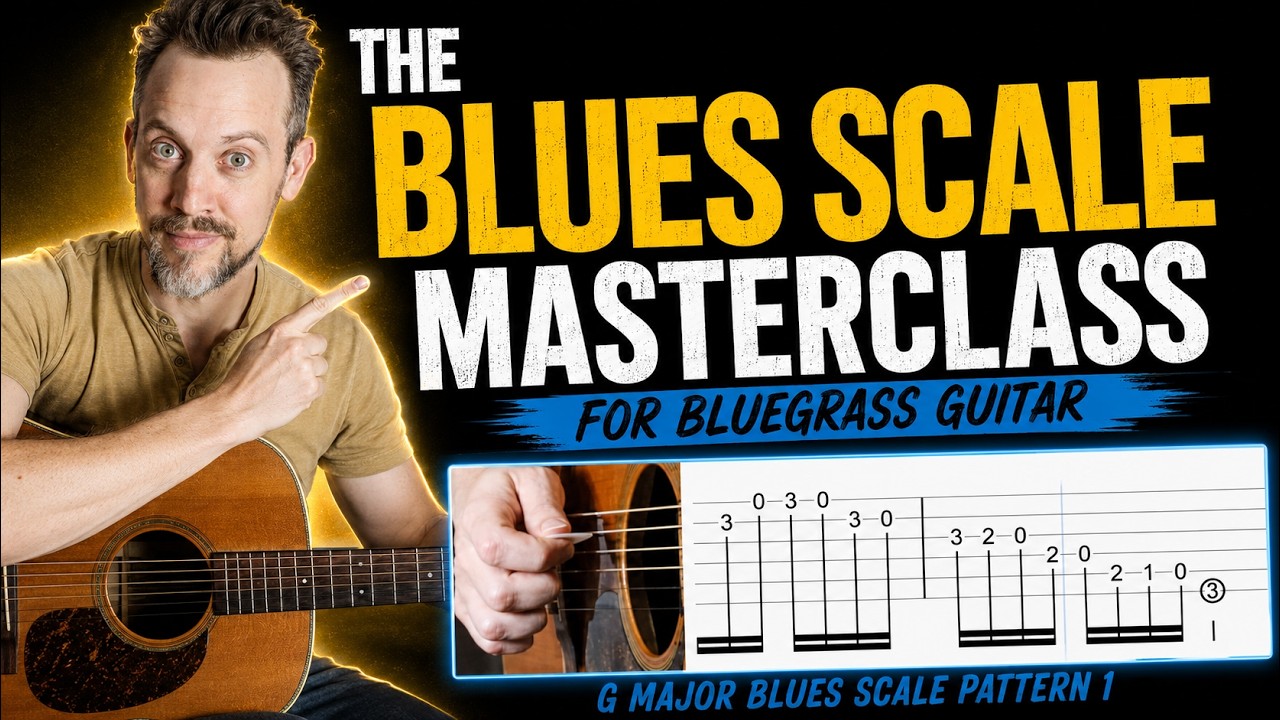
Aaron Jaxon teaches five major and five minor blues scale patterns in G, then shows how to transpose them to C and D using a simple pinky-or-pointer rule. He demonstrates how classic bluegrass licks from Tony Rice and Billy Strings come straight from these patterns played over a G-C-D progression.
Chapters
Hey there, it is Aaron Jaxon coming to you today. I want to welcome you to a bluegrass guitar scales masterclass. I'm going to be showing you how to cover and dominate the fretboard with your major and minor blues scale ideas, because so many of the bluegrass lead ideas that we learn and that we implement and that we steal from our favorite players are based around these blues scale patterns. This is a longer lesson than I normally share on this channel. Fear not, I do have everything organized into chapters and timestamped down below, so you can push ahead to any section that you want. A quick overview of what we're going to be covering today: I'm going to be showing you how to cover the neck with your blues scale patterns in G major and G minor. From there, I'm going to show you how to move those major and minor blues scale patterns around and cover the neck in C and D. After that, I'm going to show you how to use your major blues scale patterns and move them through a G, C, and a D chord progression. And we're going to end off by showing you how to mix your major and minor blues scale ideas and move them through a basic G, C, and a D chord progression. What learning this does is a couple of things. Number one, it helps you see where your favorite players are pulling from when they come up with their amazing bluegrass lead ideas that we all love and learn and want to implement in our own play. Number two, it's gonna increase your ability for pattern recognition because once you have these down, as you go through and you learn phrases from your favorite players, you're gonna see that it's not random. There's a method to the madness, and it's going to increase your ability for pattern recognition. Which brings us to number 3: it's going to help you come up with your own leads further on down the road. So learning these is not a substitute for learning the basic bluegrass vocabulary and repertoire. When I say vocabulary—phrases, licks, turnarounds, note-for-note solos—the musical ideas that make this style of playing unique and makes it sound like real bluegrass music. And the repertoire is the extensive traditional repertoire of bluegrass vocal tunes and bluegrass fiddle tunes. So learning these scales is not a substitute for that, but it is a great thing to learn in addition to your vocabulary and repertoire-based bluegrass content. Again, this is a longer lesson, and I've got the scrolling tabs on the screen, and you can get the tabs for all of these ideas down in the video description and in the top pinned comment. Feel free to copy the link to this video and save it and come back and reference it anytime you need to, because we're going to be covering a lot. But what we're going to be covering today is really going to open up the fretboard for you and help you come up with your own bluegrass leads down the road. All right, let's jump in. Because so many of these bluegrass lead ideas that we learn from our favorite players, um, are kind of based around these blues scale ideas. So just a couple of examples here. The classic Tony Rice Red Haired Boy, that is straight out of a G major blues scale. Okay, or maybe, uh, Billy Strings, Dust in a Baggie. Same deal, it's right out of that. Okay, or again, going to Tony Rice, you know, if he's doing, you know, his solo to How Mountain Girls Can Love, you know. That's straight out of a minor blues scale. Okay, or, um, you know, whenever he does Nine Pound Hammer, same deal. It's out of those major and minor blues scales. One other thing that I wanted to say before jumping into these scale patterns, one thing that is going to be very, very, very important when you're learning these is sticking to the left hand fingerings. That I use in these scale patterns. I really recommend not deviating from what I'm teaching you here when it comes to those left-hand fingerings on these patterns at all. Now, I will, um, indicate that down on the tabs. You'll be able to see which left-hand finger that I'm using for each one of these, but that is very, very important when learning these scale patterns. Stick to the left-hand fingerings that I'm showing you on these scale patterns. Okay, so this first G major blues scale pattern is going to go like this. Okay, so let's do that again. Okay, so I have used that one a lot in a lot of my lessons. I use it to teach technique, I use it to teach timing, I use it to teach a combination of, you know, picked notes and hammer-ons and pull-offs there. But that's a really important one to get down because, like I said, so many classic bluegrass patterns are based around that scale.
Okay, so that's the first G major bluegrass scale pattern there.
Now let's go into G major blues scale pattern 2. We're gonna move up here into kind of third position, and it's gonna go like this. Okay, one more time, G major blues scale pattern 2. Okay, so there we go. So that kind of corresponds with our, like, pentatonic pattern 2, but we're adding that extra note. And that's all that a blues scale is— it's a pentatonic scale with one extra note. If we were doing E minor That would be our E minor pentatonic scale, the blues scale, you know, that the old A minor pentatonic, and then the A minor blues scale. We're just adding one extra note, but if we do that and we want to move those patterns up and down the neck, we, we have to change a lot of those patterns, and it's almost like we're learning new patterns. That's why I do really recommend getting your 5 pentatonic scale patterns down first before jumping into this. One more time, G major blues scale pattern 2. Okay, so now let's go into G major blues scale pattern 3, and it's going to go like this. One more time, G major blues scale pattern 3. There we go. All right, so let's keep moving up the neck here. And let's come up to G major blues scale pattern 4, and it is going to go like this. All right, one more time, G major blues scale pattern 4. Okay, and now let's do G major blues scale pattern 5, getting up here, uh, on the neck. So we're gonna do one more time, G major blues scale pattern 5. Okay, and now what I want to do, we're going to do pattern 1, um, an octave up here, and, um, that is going to go like this. We're going to do— okay, so with that one, I'm, I'm calling it pattern 1 an octave up. We're not starting from the root note, from the G, like we did down here on the first one, but we'll, we'll, we'll, um, play it from this 12th fret here. And that's just a good pattern to also have under your fingers. Okay, so there we have it. There are our 5 G major blues scale patterns. And I, I'm sure you can already hear, um, the, the obvious um, bluegrass influence there. It's not even a bluegrass influence, it's that bluegrass— a lot of bluegrass leads that we play are influenced by these scale patterns amongst other things. So one more time, let me go through all 5 of those. Um, so we'll start with pattern 1. We'll do G major blues scale pattern 2. G major blues scale pattern 3. G major blues scale pattern 4. G major blues scale pattern 5. And now we'll do G major blues scale pattern 1 an octave up. Okay, so that was the G major blues scale patterns. Let's now do the G minor blues scale patterns. It'll be the same patterns, but we're going to move them up a little bit here. So with G major, we started down here for the— what we're gonna do for G minor, we're also gonna start on the root note, but we're gonna put our pointer finger here and we're gonna play this first G minor blues scale pattern. It's gonna go like this. Okay, let's try that again. G minor blues scale pattern 1. Okay, so now let's come up here and we'll do G minor blues scale pattern 2. 2, and it'll go like this. One more time, G minor blues scale pattern 2. Okay, and now let's come up to this next one. We'll do G minor blues scale pattern 3. One more time, G minor blues scale pattern 3. Okay, and then let's come up here and we're going to do, um, G minor blues scale pattern 4. One more time, G minor blues scale pattern 4. Okay, and now we're going to do a G minor blues scale pattern 5, and that's gonna go like this. I'm— for this first one, I'm gonna come up here on the neck and then I'll take it down an octave, but that's gonna go like this. One more time, G minor blues scale pattern 5. Okay, and then let's take that same scale pattern, let's go an octave down here. It's gonna be the same pattern, but instead of starting up here on the 13th fret. We'll start on the 1st fret and we'll utilize a couple of open strings here.
So we'll do—
all right, and then we're back home after that. Let me do one more time, uh, G major blues scale pattern 5 in octave down. Okay, and then we're back home after that. So clear— you'll clearly be able to hear, and especially like a lot of Tony Rice ideas, you know, like that one right there, right out of that. Or there's a passage that Billy Strings plays in Dust in a Baggie at the end of the solo where he does like a— and especially that's straight out of that. Straight out of that scale pattern right there. So, so anyway, you're going to be covering a lot of important territory here, and, um, that will be— this will become really familiar as you're learning these licks, as you're learning these solos. Clearly, if you've already been doing that, you'll see, um, where a lot of this stuff is derived from. Okay, so one more time, let me go through all, um, all of the G minor blues scale patterns. Uh, so we'll start with pattern 1. Pattern 2. Pattern 3. Pattern 4. Pattern 5, an octave up. And pattern 5, an octave down. Okay, okay, so now that we've got our blues scale patterns down for G major and G minor, let's move them around and play them over some different chords, because we're not only ever going to play over G, although we play over G a lot. So what I want to show you here, I'll give you a real simple rule on how to move these around here, but then I want to give you major and minor blues scale patterns in C, and the major and minor blues scale patterns in D. That way we've got G, C, and D, which is the most common chord progression that we use, or the most common chord shapes that we use in traditional bluegrass. So really, so for these blues scale patterns, if you want to move these around and play them, you know, in another key or over another chord, let's, let's say you want to do it in A. Find your A root note, which on the 6th string is going to be on the 5th fret. Now, if you want to do that very first blues scale pattern that we did, this G major— okay, so, um, what you'll do is put your pinky finger right there, okay? And that's going to be your, um, that would be an A major blues scale pattern. Um, or if you wanted to do A minor blues scale, put your pointer finger on that root note and use that one to start. So that's, that's the easy rule right there. So you find the root note, put your pinky on it to play the major blues scale pattern, and put your pointer finger on it to play the minor blues scale pattern. Okay, so I'm not going to tab that one out, but what I am going to do now though is, um, I want to give you the major and the minor blues scale patterns for C and for D. Okay, so let's find our C root note on the 6th string, and that is going to be up here on the 8th fret. Okay, let's put our pinky finger right here, and this is going to be C major blues scale pattern 1. Okay, so now we're going to come up here, put our pointer finger right here, and we're going to do C major blues scale pattern 2, and it's going to go like this. Okay, so now we're going to come up here and we're going to do C major blues scale pattern 3 right here. All right, so now we'll put our pointer finger up here on the 12th fret. This will be C major blues scale pattern 4. All right, so now I want to do that pattern 4 for the C major blues scale again, but now I want to do it an octave down, and that is going to go like this. Okay, and now we're going to put our pointer finger right here and we're going to do C major blues scale pattern 5. Okay, and then after that we're kind of back home here, even though we start from right here, from our root note, and not from this little relative minor. Again, if I'm saying stuff like that and it's confusing you, I really, really would recommend going through my Guitar Scale Fundamentals mini-course and going through the section on the pentatonic scale patterns. That's— that's— you really need to have gone through that before doing this. Okay, so anyway, and then we're back home. Okay, after that— so that was the C major blues scale patterns. Let's do the C minor blues scale patterns. Okay, so we're gonna bring our pointer finger over here and we'll do C minor blues scale pattern 1. Okay, let's come up here to the second note of that scale and let's play, um, C minor blues scale pattern 2, and we'll do— okay, so for this next one, I am going to go ahead— that's the 13th fret, and I'm just— I can tell that I'm going to be running out of frets here, so I'm going to take that 13th fret down an octave to the 1st fret, and I'm going to play C minor, um, blues scale pattern, um, 3 from down here. We're going to do Okay, so let's come into the second note of that one now, and we're going to play C minor, uh, pentatonic— I'm sorry, C minor blues scale pattern 4. Okay, and let's come into the second note of that scale and play C minor, um, blues scale pattern 5.
And we'll do—
okay, and then we come into the second note and we're back home to pattern 1. And there we have it. So that's our major and our minor blues scale patterns out of C. Let me do the same thing out of D now, okay? So that is going to go like this. We'll come up here and find our D note on the 6th string that's on the 10th fret. Let's put our pinky finger there and do D major blues scale pattern 1. Okay, let's now come right here with our pointer finger, D major blues scale pattern 2. Let's come up here, let's put our pointer finger up here on the 12th fret, and now we'll do D major blues scale pattern 3. Okay, so after that, we're, we're starting to run out of frets here, so we need to take this an octave down. So this is the second— I'm sorry, the 14th 13th fret. So an octave down would be down here on the 2nd fret. And this is where we'll do D major blues scale pattern 4.
And then let's come into the 2nd fret—
I'm sorry, not the 2nd fret, but let's come into the 2nd note of that scale. And now we'll do D major blues scale Pattern 5, and we'll do— and then after that, we're really kind of back home, even though we don't start on that note. I like to start on the second note, but you could also Okay, so there we go. Now, um, same deal, I want to do the D minor blues scales here. So we're going to put our pointer finger on the 10th fret and we're going to do, uh, D minor blues scale pattern 1.
Let's put our second—
our, um, pinky finger on the second note of that one that's the 13th fret, and I'm going to go ahead and take that down an octave. So the octave down would be the 1st fret, and this will be D minor blues scale pattern 2. Okay, let's come up here to the 3rd fret and we'll do, uh, pattern 3, D minor blues scale pattern 3. And then let's come up here and we'll do D minor blues scale pattern 4. And then let's come into the second note of that scale and let's do D minor blues scale pattern 5. And then we would come into the second note of that one and we're back home after that. Okay, so there are our major and minor blues scale patterns for both C and D. So now what we want to do is we want to take some of these scale ideas and we want to move them through a G, C, and a D chord progression. So I'm going to give you just a couple of examples here. So let's do this first one here. All we're going to do is that first major blues scale pattern through G, through C, and through D. That'll go like this. Let's come up here to C major.
Now up to D.
And then let's go back down to G.
After that.
Okay, so now instead of just using pattern 1, let's mix up the patterns a little bit here. Okay, so that'll go like this. We'll do Okay, so what I was doing there was starting off with our G major blues scale pattern 1. And then I went into C major blues scale pattern 4, and then I changed up just the ending just a touch, that way we could end on the root note and it sounds a little more musical. And then we came up to D major blues scale pattern 4. Okay, and then after that I came up to G major blues scale pattern 3, and same deal, I ended that just a little, just to give it, make it a little bit more musical there. So, um, there's, there's so many great bluegrass ideas based around that stuff. Obviously I've already shown you a bunch of examples out of G major, um, you know, pattern, uh, blues scale pattern 1, but you know, that, that I mean, there's just so many, you know, or there's just so many great examples. And then even up here in D, you know, Tony Russell Luke, which is, you know, you know, kind of in that same territory there. So that's how we can take those major blues scale patterns and run them through a G G, C, and a D chord progression, giving us some really cool bluegrass lead ideas. But now I want to take this just a step further, and what we want to do is we want to mix our major and minor blues scale ideas. Okay, so I'm going to give you a couple of ideas in G, and then I'm going to show you how to run those ideas through a G, C, and a D chord progression. Okay, okay, so first idea out of G, let's do Okay, so let's try that again. So you can see on the first half of that That's out of our G major pattern 1 and a little bit to pattern 2. And then once we get here, now we're in minor blues scale territory. And then we'll do— and then back to major.
Okay.
That's a great idea to start with there, and it just shows you how you can mix your major and your minor blues scale ideas. So another one is going to be this. Okay, so, um, I have shared this idea before. I use it in my 10 Bluegrass Lead Ideas Through G, C, and D that I teach a lot, but, um, I kind of wanted to show you what we're doing with the scale pattern. So this first idea here, you know, that's, that's kind of our standard sounding G run. But looking at this from a scales perspective, that's out of our G major blues scale pattern 4. Okay, but we're just taking this little— so again, speaking in terms of scales, that's out of G Major Blues Scale Pattern 4. But then what we're going to do, slide down to the 6th fret, and now— and then that's G Minor Blues Scale Pattern 2. So G major blues scale pattern 4, slide down minor blues scale pattern 2. Okay, so let's take that idea again. Okay, so now what we want to do is we want to take both of those ideas and move those through a G, C, and a D chord progression. So let's go back to this first idea here, and so we'll start with G and we'll do Up to C. And then we'll come up to D. And then we'll go back down to G after that. Okay, okay, so let's do the other idea here, and that's going to go like this.
We'll start in G and we'll do to C. To D and back to G.
Okay, so again, that's an idea that I've shared in my 10 Bluegrass Lead Ideas Through G, C, and D lesson. But what we're doing there on G, we're starting in G major pattern 4, sliding down to minor pattern 2, and then we're coming over to C. Now on C, it's, it's the same idea, but we're moving over a set of strings. So it's pattern 1, major blues scale pattern 1, and then we're gonna slide down to 2, minor blues scale pattern 4. So it's major blues scale pattern 1 in C, and then minor blues scale pattern 4 in C. And then we'll come up and do the same thing out of D. We'll do major blues scale pattern 1 in D, slide down to minor blues scale pattern 4, and then go back to G there. So that whole idea one more time.
Back to G.
I hope you've really got something out of this. I hope that you can see how these blues scales are a big part of the vocabulary of bluegrass lead guitar. So there was a lot in this lesson here. Feel free to take it slow, small chunk it, take it one pattern at a time if you need to. But mostly what I wanted to say here is these scale ideas that I'm showing you in this lesson are gonna be a great great complement to the other things that you're learning— the solos, the licks, the tunes, the phrases, all that kind of good stuff. You want to learn this stuff in combination. What, what these scales are not— they're not a substitute for building your vocabulary. They're not. But they're a great addition to the other things that you're learning that are vocabulary-based that'll give you some context as to what a lot of these ideas are based around.






