Bluegrass Guitar Licks Through E-A-B!
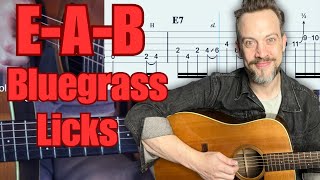
Aaron Jaxon teaches bluegrass lead guitar using E, A, and B chord shapes instead of the typical G, C, and D. He breaks down two full solos over Johnny Cash's "Folsom Prison Blues," showing how open-string slides, bends, and pentatonic scales create new licks inspired by Tony Rice and Doc Watson.
Chapters
Hey there, it's Aaron Jaxon coming to you today, and I'm gonna be sharing with you some really cool bluegrass licks and phrases out of E, A, and B. So much of the time in bluegrass, we end up playing a lot of these licks and passages and phrases out of G, C, and D because so many of the songs are based around those chord shapes. Even if we have a capo up on the 3rd fret and we're playing a song in B-flat, a lot of times we're still using our G, C, and D shapes. And so the way that we'll approach playing bluegrass licks out of our open E, A, and B shapes are gonna be a little bit different, and that's what this lesson is all about. Now, if you'd like to check out another lesson where I show you some really cool phrases out of our C, F, and G shapes, check that out right here, and I'll link to it down in the video description as well. So instead of just giving you a bunch of freestanding licks and passages, I wanted to give you these in the context of a classic tune. So what we're gonna be doing today is I'm gonna be soloing over Johnny Cash's classic classic Folsom Prison Blues. We're gonna have a lot of fun, and I'm just gonna plug a bunch of hot licks into this. So for this particular lesson, I'm actually going to be sharing a clip from a masterclass that I share with my Pickers Insider Circle group. Get up close camera angles of my picking and fretting hand, but you'll also see scrolling tabs that go across the screen as I play and teach each example. I normally only reserve these type of videos for my paid programs, but I wanted to share a little snippet of this one here with you today. So you can get the tabs for this lesson down in the video description and in the top pinned comment. Mostly, I just hope you have some fun with these licks. I hope you're able to add these phrases to your vocabulary and use them in your own playing. All right, let's jump into the lesson. Okay, so before we jump into the first solo here, let me go ahead and play that up to tempo and with a backing track, and that'll sound like this. Okay, so let me go ahead and play this first solo all the way through nice and slow here, and we'll throw the tabs up on the screen. And then I'll go like this: 1 and 2 and 3 and 4E. Okay, okay, so a lot of really cool phrases in here, a lot of really fun passages. So this first one here, so there's a couple of different ways that you can think about that. If you've seen my Blues Scales for Bluegrass, um, uh, masterclass that I've shared here in this group, you know that that's kind of out of like, uh, Major Blues Scale Pattern 3. Sliding up to major blues scale pattern 4. So, and then up here to like major blues scale pattern 5. That's kind of how I think about it. Okay, and then we're going to come down here and we're going to do some, uh, a kind of open string So that one's kind of hanging out of like— or, uh, but you know, do it doing that little minor to major third, which we do a lot in bluegrass. Okay, so that's kind of that first phrase there. And then after that, I'm going to come up to this very like Tony Rice sounding passage, but we're playing it out of open A. So we've got some options down here that are available to us that aren't normally available to us if we were playing like an A lick with a capo on the 2nd fret out of it, out of a G shape. So All right, okay, so, so we're able to end that where normally, you know, if we were playing that out of a G shape, we'd have to— we just wouldn't have the option of this like open 3rd string and like the open 4th and 5th. And that's almost exclusively out of our A minor blues scales and pentatonics. Okay, and then after that, I'm gonna go into this So again, I'm kind of shifting through those like E pentatonic patterns there. So like major, major blues scale or pentatonic scale pattern 3, up to 4, okay, up to like minor, uh, blues scale pattern 4, and then up to major blue or pentatonic pattern, okay. So just shifting in between those. And then now I'm kind of out of this, that little pentatonic shape, and I'm gonna throw in a little chromatic run. Okay, and then the chord progression then goes to B for 1 bar, and I'm gonna use this. Okay, if you've ever learned the 10 Bluegrass Lead Ideas Through G, C, and D that I teach, in Flatpicking Mastery. That's, you know, that's one of the ones that I like to teach, and it's great because it doesn't require any open strings. So I'm hitting B as my root note right there, and then kind of coming down here and kind of doing a little nod to like the, the intro riff that Johnny plays. And then I'm gonna end with, with a passage that I— something that I played in a similar way at the beginning of the solo. Okay, so there's just a little bit of analysis around some of those licks, but I mean, you know, mostly, you know, pulling from, you know, E major and minor pentatonic, you know, pulling from some, you know, A minor blues scale ideas, you know, just to come up with, you know, an interesting lead to this song. So one more time, let me go all the way through this first solo to Folsom Prison Blues, play it nice and slow, and we'll throw the tabs back up on the screen. It will go 1 and 2 and 3 and 4 and Okay, so one more time, let's hear that one up to tempo and with a backing track. Okay, so let's jump into another way of going through this tune and using some really cool licks and phrases here. So, um, this will be the second solo through Folsom Prison Blues. But before I teach it to you, let me play it for you up to tempo and with a backing track, and that'll sound like this. So same deal, let me go through the whole thing nice and slow here for you. We'll throw the tabs up on the screen, and that'll go like this. 1 and 2 and 3 and 4. Okay, so some of my very favorite licks and phrases out of E, A, and B in this little solo here. So this first passage is one that I just absolutely love out of E, and we'll do Okay, so this little— all right, so I kind of think of— and that's, um, you know, hitting our minor to major third and then sliding up to like a minor blues scale. So we kind of started off with a major idea slide up to a minor blues scale in E, up to a major blues scale, and then up to a kind of like Mixolydian. Okay, you could think of that out of that, like, you know, or you could also think of that like a more E Mixolydian, uh, you know, which is why it's good to know your scale patterns there. But anyway, um, and then we're gonna come up here to this kind of um, minor blues scale thing. And what you're going to do, we're going to take the— okay, again, Doc Watson, Billy Strings uses this kind of thing all the time. And what you'll do is you'll play that idea, I think it's 6 times total, and then on the 6th time, ended with like a Tony Rice sounding thing there. So like 1, 2, 3, 4, 5. Okay, and then from there, where the chord progression goes to A, we're gonna come down here and again use some of this, you know, and we've got this, you know, which is, you know, when I'm playing the Telecaster and doing a bunch of chicken picking. I love playing those little kind of— those kind of licks on the Telecaster, but you can make it pop by playing a hybrid style. When we're playing bluegrass, we really got to make each one of those notes speak, and so we have to pick or play that stuff with a pick. So again, that phrase Okay, and then we're gonna jump up here to the— and we're gonna do again throwing in some of those open E ideas that are available to us. Okay, and then when we go to B, we're going to throw in this one little phrase here that I just love. Okay, and that's again mixing major and minor blues scale ideas. That's kind of out of like Minor Blues Scale Pattern 3, but then we're gonna slide up to major. Kind of comes out of those kinds of ideas. And then again, we'll kind of nod to the main riff, and then we're going to come up here and do this kind of very bluegrass-y sounding— so like the G run but in E, sliding down to minor. And then end in— okay, so really fun ideas here in this second solo. Okay, so one more time, let me go through that whole thing, uh, nice and slow here for you. We'll throw the tabs up on the screen. We'll go 1 and 2 and 3 and 4. Okay, so one more time, let's hear that one up to tempo and with a backing track.






