Double Stops Demystified: Country Guitar Secrets Revealed!
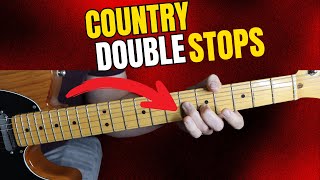
Aaron Jaxon breaks down the double-stop technique used by country players like Brent Mason and Vince Gill. He shows how to harmonize an A dominant-7 scale in thirds using pick-and-finger hybrid picking, then demonstrates three variations from quarter notes to sixteenth notes. Practice with a train beat backing track and transpose to other keys.
Chapters
Hey there, Aaron Jaxon coming to you today. So what I've got for you today is a lesson that I wish somebody would have shown me whenever I first started getting into this like country Telecaster chicken-picking style of guitar playing. I'm basically— I'm going to show you a double stop sequence, but then I'm going to show you how to play it using your pick and finger hybrid technique. And I'm also going to show you how to develop your timing. So we're getting some great soloing ideas, we're getting some great double stop ideas, we're going to get some great single note ideas, we're going to get some practice on our technique and our timing. So this is just like a, like a power smoothie of a country guitar lesson or something like that. Yeah, and as always, you can get the tabs for this lesson down in the video description and in the top pinned comment. All right, so what is this double stop sequence you're talking about, Aaron? It's gonna go like this. We're gonna do Okay, so one more time there, real slow. Okay, so really what this is, it's like an A dominant 7 mixolydian, if you will, scale harmonized in thirds. I'm not going to get too deep into the theory. This isn't really a theory lesson necessarily, um, but that's just kind of how I think about it. Um, don't get hung up on whether you should call it a mode or not call it a mode or anything like that. I'll talk a little bit more about this toward the end of the video, but for right now, just get this sequence down. Okay, and so what we're doing there, um, and for, for this one, the way I just played it, I'm actually doing middle finger on the 3rd, um, ring finger on the 2nd. I'm not having my pick touch anything right now. Okay, but when we're doing this little double stop, okay, so again, it's, it's essentially, it's almost like an A major scale, but we're instead of coming up and doing that a major 7 at the end, we'll do a dominant. Okay, because if we did just the standard major scale, that would end up sounding like this.
It'd be like—
which is fine, and we could use that in, in certain places, but it doesn't have the same grit, it doesn't have the same twang that— okay, that's the main again, whatever you want to call it, however you want to think about it, you are going to see these kinds of passages, these kinds of double stops, and you're going to see a ton of lead ideas based around this like dominant 7 scale pattern, so to speak. It's not only that, because this stuff is an art, it's not a science. So many people are looking for the magic formula. It's like, will you do Uh, flat 7 mixolydian scale combined with a minor blues scale, and that's country. It's— there's not a magic formula to this stuff, but you will see a bunch of these like double stops and a lot of these lead lines and solos based around this kind of dominant 7. I tend to think of it as mixolydian, um, passage. Um, for instance, for instance, uh, Brent Mason, Summertime Blues, he does—
all right, that pattern right there.
You could also play that like— and there we have it. He's playing that over G. Later in that solo, he does same thing. Okay, so that's one one idea. John Jorgensen, Hello Trouble, that little passage right there. Again, he's using that, he's using that dominant 7. It's got that like, it's, it's like a major scale with a flatted 7, however you want to think about it, but that's happening right there. Vince Gill, Liza Jane. Again, those lines based around that kind of thing. I could, I could go on for days here.
When Johnny Hyland does, he's using a different interval there, but that's still—
that's still that dominant 7 kind of Mixolydian thing happening right there. When Ray Flack on Uncle Penn does a—
all right, there we have it again.
Okay, so there are just a ton of ideas in this style that are kind of based around that. So that's why I'm showing you this pattern instead of like your standard major scale though. Okay, so that's one way of playing it. That's how we could play it as double stops. But now let's turn these into single note ideas. Okay, and so what I'm going to do for this one have your pick hit the 3rd string and your middle finger hit the 2nd. Okay, and we're gonna do— we're gonna play each one of those ideas. Um, you'll play each note one at a time, and then we can come back down. Going back to John Jorgensen, Hello Trouble, exactly what he's doing right there. It's that same sequence. I mean, it's played in a different place, but it's that same kind of dominant 7th sequence played as single notes. Okay, um, so that's what we want to do for this kind of second variation through this double stop sequence. Now for the third variation here. We're going to kind of walk into each idea.
We're going to do—
and if you want to come back down—
okay, one more time on that. Okay.
One of my favorite examples of that is the end of Ray Flack's solo to Ricky Skaggs' Highway 40 Blues, or the version of Highway 40 Blues Ricky did, you know, something along those lines. Although in that specific sequence. He's actually going through a major scale there, but, um, we can apply that to what we're learning here.
Okay, so here's what we've got.
We've got a great set of double stops. We've got some great single note ideas. And remember, for the single note— on the double stops, I just play those with my fingers. I do middle finger on the 3rd string um, ring finger on the second string for kind of like maximum pop. But whenever we do the single note ideas based around those double stops, I'll do the pick on the third string and middle finger on the second. And then, um, when we go to the other version, same deal. Okay, so Here is how we want to practice our timing on this. So a lot of this stuff is fun, you know, you guys have probably heard me in the bluegrass stuff talk about practicing with a train beat. They're just fun to play with and they're, they're great to practice with. So what, what I would recommend with this sequence here, that first one where we're just doing double stops, practice those as quarter notes, just one set per beat.
Just 1, 2, 3, 4, 1, 2, 3, 4.
On the first set where we change those into single note ideas, practice those as eighth notes.
Just 1 and 2 and 3 and 4 and 1 and 2 and 3 and 4 and.
And on the last one, practice that as 16th notes. Let's do that as 4 notes per beat.
Let's go, uh, 1 and a 2 and a 3 and a 4 and a 1 and a 2 and a—
okay, so the first set that are just just double stops, practice those as quarter notes. For the first set of single note ideas, practice those as eighth notes. And for the third set, practice those as sixteenth notes. So I'm going to go ahead and play that just with a train beat backing track here, and I'm going to play each one of those variations of this double stop sequence. Again, I hope I was able to kind of illustrate how often that you'll hear great, you know, country lead players doing, you know, either double stop ideas or single note ideas around this kind of dominant 7th scale, Mixolydian if you will, whatever. Don't get hung up on that, um, but they use ideas based around this stuff all the time. So if you'll go ahead and start practicing what I'm showing you today, your ear will start to acclimate to, um, to the way that these double stops and these single note ideas sound with this kind of dominant 7. And the reason why I think these players use these ideas is because when it comes to the music that usually features this kind of guitar playing, this chicken picking guitar. A lot of times we're talking about traditional country music. Sometimes we might be talking about rockabilly, you know, like early, early rock and roll. Um, you know, that, you know, James Burton played on a lot of Ricky Nelson stuff and he played on a bunch of Elvis's stuff. So the, you know, that traditional country, you know, maybe rockabilly, early rock and roll if you will, it, it features this guitar playing. And the thing about it is there's just you use a lot of dominant 7th chords in that music. Therefore, these little dominant 7th ideas sound good around that. So that's why I would recommend starting with this little passage. Now, this— I should have mentioned this at the beginning of the video— this is in A. We're using— we're not using any open strings here. So once you get that down, practice moving it around a little bit. Move it up, Take it up 2 frets, go to B. Okay, um, you could do it in D.
You can go down.
You just— man, that, that happens all the time. That's like a Brent Mason.
That just happens.
Happens all the time in country guitar. That's why I wanted you to start off with that. But anyway, you can move that around and play that in different places, try it over different chords, kind of move it around. You can move it through chord progressions, whatever you want to do to start getting creative with that. But I would start there, get that, get that sequence down, and then play it as single note ideas using eighth notes and single note ideas using sixteenth notes. And again, you're just— so many elements of country guitar you're practicing and getting a good footing on double stops, single note ideas, technique, picking finger technique, and timing. It's a great thing to start off with, and I really wish that somebody would have sat me down and showed me this whenever I was first getting into this style. So anyway, I want to thank you for hanging out today. Remember, get the tabs down in the video description and in the top pinned comment. Check out some of these videos to go a little bit deeper with some of this stuff, and I will see you next time.






