Fretboard Mastery!- The G,E and D Shapes Of The CAGED System
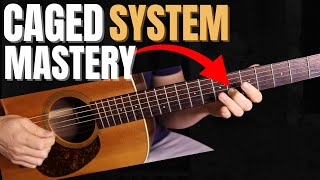
Aaron Jaxon breaks down the G, E, and D shapes of the CAGED system in C major, showing arpeggios and scale patterns for each. He uses a backing track to demonstrate how these shapes work musically and references Mark Knopfler's "Sultans of Swing" as an example of the G-shape in action. Tabs are available in the description.
Chapters
If you're tired of staying stuck in your playing and not having a great mastery of the fretboard, stick around because what I'm gonna show you today is gonna give you a great foundation for mastering the guitar neck like a pro. Hey there, it's Aaron Jaxon coming to you today, and I wanna welcome you to part 2 of my 2-part series around the CAGED system. So if you haven't checked out the first video in this series, it's this right here, and I'll link to it down in the video description. Make sure you start there with that video before jumping into this lesson. But what I'm going to be showing you today is I'm going to be showing you the G, the E, and the D part of the CAGED system. Now again, I covered the C and the A shapes in the first lesson in this series, so be sure and check that out if you haven't had a chance yet. But today we're going to cover the G shape, E shape, and D shape, and I'm going to be showing you the arpeggios for each of those. I'm going to be showing you the corresponding scale patterns that you need to know for each one of those positions. Now remember, this is just an introduction to the CAGED I'm only showing one major chord for this. I'm only showing C major, but this is where you have to start whenever you're wanting to master the fretboard through something like the CAGED system, which is a great way to do it. I just say that because so many times people jump in and before they have a mastery of just the basic major chord, they start what-ifing. It's like, Aaron, what about minor chords and minor arpeggios and minor 7 flat 5 arpeggios and minor 9 arpeggios? And what about this inversion and that inversion and this mode and that mode? What about chord harmony to the Dorian mode. And what about, what about, what about, what about, what if, what if, what if, what if, what if? And we all have the tendency to do that. I know you do. Just have to start with the simple major chord, the arpeggio, and the corresponding scale patterns before jumping into all of that other stuff. And the cool thing about it is too, especially where I mostly focus on bluegrass guitar on this channel, most bluegrass music is played with major chords. Not all. We'll use dominant 7th chords quite a bit, and we use minor chords too. But the thing about bluegrass is, is songs that have minor chords in them are noteworthy, which means that the vast majority of these songs just use major chords. So if you're a bluegrass picker, if you could just get a really good grip on your major arpeggios and corresponding scale patterns, you will have most of what you need for bluegrass guitar. All right, remember you can get the tabs for this lesson down in the video description and in the top pinned comment. That is enough talking and jabbering from me. Let's jump into the lesson. Okay, so like I said, today we're going to cover the G, E, and D shapes of the CAGED system. So let's start off here with our G shape, C major, and it's this god-awful, horrible, painful, and not particularly good sounding bar chord that I never use, and I hope you never do either. However, this position contains a lot of fretboard roadmap knowledge, if you will, that we need to know. So let's start with the arpeggio right here. That's going to go like this. We're going to do Okay, let's do that one more time, just the arpeggio here.
We'll do—
that one's kind of tricky to get your hands around, but again, you want to know those chord tones in that position. So what, what we're kind of doing, it's, it's almost like 3 different arpeggios all strung together.
Like this one, okay, this one, just that, and then this one, and they're all kind of strung together, uh, okay.
So there's just some great— you want to, you want to be aware of the chord tones contained in that position right there. Okay, obviously I mostly teach bluegrass flatpicking on this channel, but I'm a huge Mark Knopfler fan, as I'm sure you are too. But if you've ever listened to the Sultans of Swing solo, there's a part in that where he kind of, you know, um, so that's just some really famous ideas out of that shape right there.
But okay, so one more time, arpeggio. Okay, let's do the corresponding pentatonic scale, and it's going to be a very familiar shape. Okay, diatonic scale and blues scale. Again, very familiar shape Okay, so one more time. There's our arpeggio, pentatonic scale, diatonic scale, and blues scale.
Okay, so like I was doing, um, in the first lesson in this series here, we don't want to just learn these patterns and just learn these notes. I want to, you know, work on my technique and also our timing. We want to make it sound like music here. So I'm going to play this along with a Strum Machine backing track. It's not going to be very fast, but I'm— again, I'm going to play the arpeggio and all 3 associated scale patterns. That'll sound like this. So that was our G shape. Let's go into our E shape here, and I'm just going to go through this stuff here.
So our arpeggio, we're going to do— okay, and let's do the pentatonic scale. Okay, let's do our diatonic scale. Okay, and then let's do our blues scale.
Okay, so there we go.
So one more time. Again, this is out of our E shape, and again, we're in C major here. We're in C major, so our arpeggio.
Okay, pentatonic scale. Diatonic scale. And blues scale.
Okay, so same deal as I did with the G shape here. I want to not only learn these patterns and know the notes, but I want to practice my technique and my timing. So let me play that along with the Strum Machine backing track. Through the arpeggio and the 3 associated scale patterns, and that'll sound like this. Okay, so one more. Let's jump up to the D shape of our CAGED system here. And again, we're in C major, so for the arpeggio, I'm gonna do—
okay.
So with the D shape, that's, you know, we're basing it off of our D chord down here, and we're just taking that triad. And I guess we could do it down here, but I'm going to go ahead and do it up here.
Okay, and instead of just—
I'm going to add to help us cover a little bit more ground.
And so for our associated scale patterns where we've got— we could do, you know, some— but I don't want to do those because we already covered those in our C, um, in our C shape, and I covered that in the first, um, lesson in this series. So I want to do our associated scale patterns right here.
So there's our arpeggio, our associated pentatonic scale right here. All right, uh, diatonic scale. And our blues scale.
Okay, so one more time. Arpeggio.
Let's do pentatonic scale. Let's do diatonic scale and blues scale.
Okay, so what we want to do now, same deal as I did with the E shape and the G shape. I'm going to play each one of those along with the Strum Machine backing track. Again, this is in C major, and I'll do the arpeggio and those 3 associated scale patterns, and that'll sound like this. There you have it. There is an introduction to the CAGED system, just starting with C major. And I really would recommend anybody who's watching this, make sure that you get down all of these ideas just with the major chord first. Like I was saying at the beginning of the video, too many guitar students start obsessing over the whatabouts way too early. Just get down all of these ideas again, your arpeggios and your associated scale patterns. Get that down with one major chord first, with your C major chord first. And then once you've got that as your foundation, then if you want to do this stuff with minor chords or minor 7 flat 5 chords or dominant 7th chords. You can build on that, but you want to start with the major first. Remember what this is— this is fretboard roadmap. This is really, really, really mastering the territory of your guitar neck. This is a great thing to learn in addition to the vocabulary-based stuff that I teach on this channel, and by that, licks, phrases, tunes, note-for-note solos, all of that good stuff. If if you will learn the vocabulary and get a really good grip on the layout of your fretboard, it's going to put you in a great place. Remember that you can get the tabs for this lesson down in the video description and in the top pinned comment. I want to thank you for hanging out today, and I'll see you next time.






