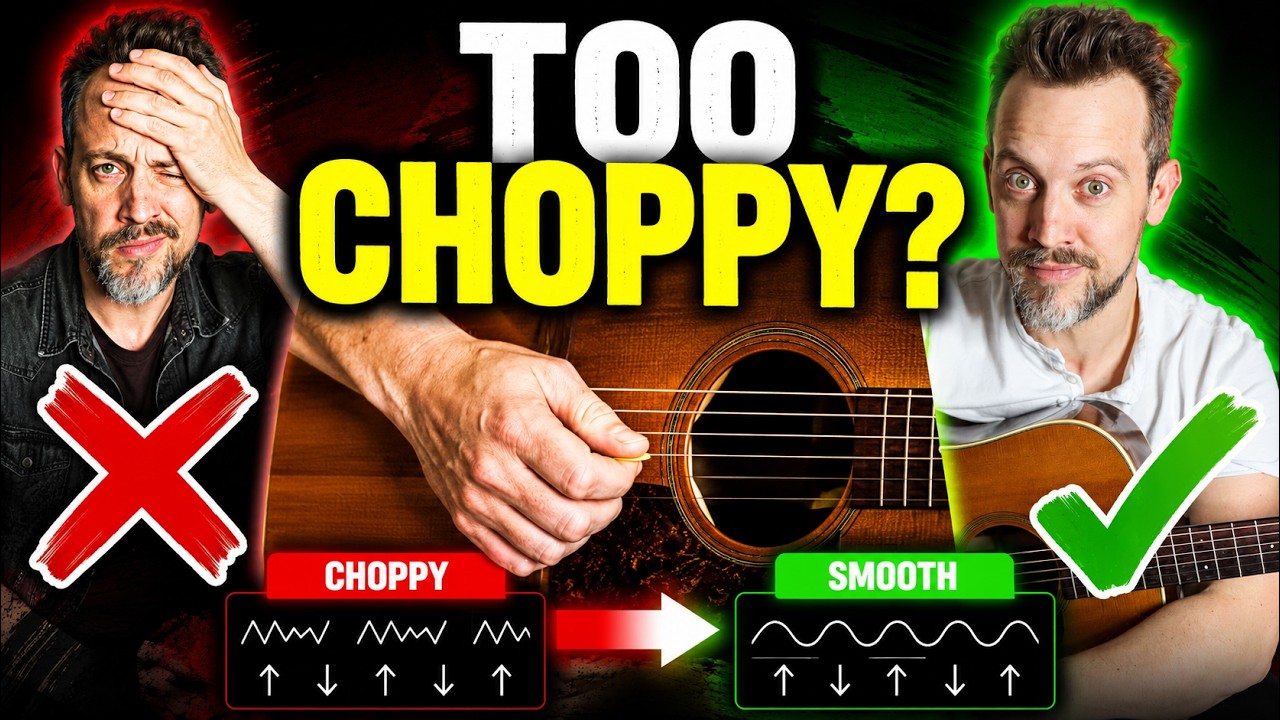
In this instructional video, Aaron Jaxon (Speaker A) teaches bluegrass lead‑guitar crosspicking using straight alternate‑picking rather than the traditional down‑down‑up (DDU) approach. He explains why crosspicking mimics banjo rolls and occasionally fiddle shuffles, then demonstrates three specific alternate‑picking crosspicking patterns built on a G‑major triad (root‑inversions on the 4th, 3rd, and 2nd strings). For each pattern he details the pick direction sequence, highlights the string‑skip in the second pattern, and shows how the third pattern combines elements of the first two. He then outlines three core practice principles for clean, smooth crosspicking: (1) play the patterns at a very slow tempo, (2) practice with TrainBeat drum backing tracks (or any metronome‑like tool) to lock in timing, and (3) aim for a resonant, ringing tone by minimizing hand tension. After the practice section, he applies each pattern to classic bluegrass tunes – a Mark O'Connor passage from “Dixie Breakdown” (pattern 1), the B‑part of “Beaumont Rag” (pattern 2), and the B‑part of “Bill Cheatham” (pattern 3) – demonstrating how the patterns sound at slower tempos and with backing tracks. He reminds viewers that tabs are available in the video description and pinned comment, encourages moving the patterns across the neck using different triad inversions, and concludes by reinforcing the three practice ideas. The lesson aims to solve the common problem of choppy, unclean crosspicking for bluegrass guitarists.
Chapters
One of the most challenging techniques to master for bluegrass lead guitar is crosspicking. People have a really tough time getting it clean and smooth. So today I'm going to show you 3 different crosspicking patterns. I'm going to show you how to practice them to make sure that they're clean and smooth, and I'm going to show you how to apply these patterns to 3 classic bluegrass tunes. Alright, so let's talk a little bit about crosspicking here, and I want to get this out of the way at the top of the lesson to let you know what this lesson is and what this lesson is not. So for what I'm going to be showing you today, we're going to be using alternate picking for all of these examples. Now there is a tradition in this style of using what we call down-down-up crosspicking. I think it goes back to George Shuffler, who who played with the Stanley Brothers. And essentially what it is, is instead of using alternate picking, we will, you know, take an example like this and play down, down, up, down, down, up, down, down, up. So, okay, and again, that is great. Like I said, it kind of goes back to George Shuffler. You would hear Clarence White use it, Tony Rice would use it sometimes. You'll hear Billy Strings use it a lot. I am not going to be focusing on that today for a couple of different reasons. The main one is this: I just kind of suck at down-down-up cross picking. It's never felt natural to me, and for me, uh, it just feels a whole lot easier to just use straight alternate picking. Like, going back to that example, if I was going to do the down-down-up, to me that just feels a whole lot easier if I just— just feels a lot easier to just use straight alternate picking on that. Another reason why I want to focus on alternate picking though is because even just practicing these crosspicking examples just as exercises makes your alternate picking a whole lot more clean and smooth. I am just going to be focusing on crosspicking using alternate picking patterns. So aside from that, what is crosspicking? Why do we do it? We primarily do that to kind of mimic a banjo roll. Going back to that example that I was playing a minute ago, that's sort of mimicking a banjo roll. Sometimes we'll do that to mimic a fiddle shuffle, like in Beaumont Rag.
So it's kind of mimicking a fiddle shuffle right there.
So that's why we use that technique in this kind of music. Again, to mimic a banjo roll most of the time, and sometimes to mimic a fiddle shuffle. So that's the technique that I'm gonna be using today, is just straight alternate picking. And that's the reason why we do crosspicking on the guitar in this style, is to mimic a banjo roll and a fiddle shuffle. But where the challenge comes in is that a banjo player has 3 picks. We only have 1, so this technique is challenging. And you can get the tabs for this lesson down in the video description and in the top pinned comment. Okay, so let's jump in and learn 3 crosspicking patterns here. Okay, so for these 3 examples, I'm just going to be playing a straight G major triad right here, just kind of root inversion on the 4th, 3rd, and 2nd strings. And so this first crosspicking pattern is going to be this. We're just going to do Okay, and that is pretty straightforward there. The idea is pretty simple, but the execution is challenging. It's just down on the 4th string, up on the 3rd, down on the 2nd, and then come back and do up on the 3rd. And then we'll just repeat that 4 times. You can repeat it as many times as you want to, but that— okay, so So that's our first pattern there, just—
okay?
So let's do the next pattern here. This one's gonna get a little bit more complicated, and it's gonna go like this. Okay, let's do that again here. We'll do— do that one again, and we'll do— Okay, and so what we're doing on that is down on the 4th, up on the 3rd, down on the 2nd, and then we're gonna swing back into the string skip and hit up on the 4th and then down on the 3rd, up on the 2nd. It's straight alternate picking, but there's that little string skip in there that makes this challenging. Down. Okay, and what we're gonna do on this pattern, do that twice. All right, and then after that we'll go back and essentially do the first pattern that we did. Okay, so again, this whole second pattern here, and this really helps us mimic a banjo roll. Okay, so that's the second cross picking pattern, um, that I want you to work on there. And then let's do one more here, and with this one we're gonna do— okay, okay, so we're gonna start And on the, um, 3rd string, we'll do a downstroke, come back and hit the 4th string with an up, down on the 3rd, up on the 2nd. And that's essentially the pattern there. Okay, so again, kind of mimicking a banjo roll and also a fiddle shuffle in certain places there. So those are the 3 patterns. Pattern 1, pattern 2, and pattern 3. Okay, so those are the patterns right there. Now here is how to practice those patterns and make them really clean and really smooth. Number 1, for most people is just to play slower, like a lot slower, okay? I will take slow and smooth over fast and sloppy any day. I mean, this is, you know, kind of Lead Guitar Playing 101 here, but sometimes it does need to be reiterated. For most people, playing slower, playing like a lot slower, okay? Number 2: use a TrainBeat drum backing track to practice these. I know I sound like a broken record, and I have talked about that a lot, and I've done several complete lessons on that on this channel. Here's a couple of them right here, and I will link to them down in the video description. It's my favorite thing for developing timing for bluegrass flatpicking guitar. All right, so real quick, I'm going to turn on my Bluetooth speaker here, and I'm going to play each of these patterns, and I'm going to play it along with a TrainBeat drum track. I'm not going to play it fast. I'm going to do about 70 beats per minute with each of these, just so you can hear what playing slower and what playing along with the TrainBeat, um, backing track with these patterns is going to sound like. And that'll sound like this. All All right, pattern 1. 1, 2, 3, 4.
Pattern 2.
Pattern 3. Okay, so there we go. And you can take that at whatever tempo. If you need to go down to 40 beats per minute, feel free to do that. It does not matter. But you want to play it slow, and you do want to play it along with the TrainBeat drum track or any other type of tool that's going to help keep you on time. A metronome, it, it's, it's not my favorite thing to practice with. I like the TrainBeats better. But anything that's going to help keep you in time. So play slower, practice with those TrainBeats. Those are great for keeping you in time. And then the third one, and this might be the most important one, is when you're practicing these, you want to go for a resonant ringing sound. So I'll just take Pattern 1 as an example here. That's what I want. I don't want this. Okay, so part of that is having tension in your picking hand, Part of that is also having tension in your fretting hand there. You want all of those notes— you see how when I come to the end of that, all of those notes are ringing? It's almost like I'm hitting a sustain pedal on a piano. Okay, so you want a resonant ringing sound. Again, because with a lot of these patterns here, with most of them, we're mimicking a banjo roll, because one of the coolest things about the banjo. It's kind of like that one verse on Little Maggie, listen to that banjo ring. We love hearing all of those strings ringing out, um, simultaneously. It gives a really cool resonant sound here, and we're trying to mimic that here on the guitar. So have awareness of that whenever you're practicing this. Play it slower, try to minimize tension, and again, you want all of those notes ringing out nice and clean.
Okay, that's what you want, not this.
Or if I'm doing, uh, you know, like pattern 3, we don't want—
that's not what we want.
Okay, isn't it ringing smooth sound? And for the first 2 ideas I was talking about here, playing slowly and playing along with a train beat will probably help you get that sound. But if not, just bring awareness to that. Try not to have much tension in your picking hand, in your fretting hand, and you just want those strings ringing out. I will take that any day over just a bunch of sloppy garbage there. Okay, so there's 3 different crosspicking patterns that you can practice, and there's 3 key ideas to making your crosspicking clean and smooth. Number 1, play slower. Play a lot slower. Number 2, use those TrainBeat backing tracks. I'll link down to a playlist in the video description. Use that to help you stay in time, to keep your playing even and smooth. And then number 3, deliberately go for a very resonant ringing sound whenever we're doing crosspicking, because most of the time when we're doing this, we're mimicking a banjo roll. And remember, with these picking patterns, you can practice these anywhere. For the sake of time, I'm not gonna go through and show you every single inversion, but we did this triad right here, you know, take it through G, C, and D and do like your different triad inversions. You could come up here and then just rinse and repeat with each one of those picking patterns. You could come over here to the, uh, uh, first, second, and third strings, you know, just using those different inversions. So you don't just have to stay in this one place. You can move this around, use it with open strings. There's limitless possibilities here, but those 3 basic patterns are really important and they're a great thing to practice. Okay, so now let's take all 3 of those patterns and apply them to some classic tunes. So for pattern 1, I want to show you a little passage, uh, this comes from Mark O'Connor. This is a legendary version of the Don Reno banjo tune Dixie Breakdown that he played and I think won the National Flatpicking Championship when he was like 14, which, you know, kind of depresses all of us mere mortals here. But it's a little passage that I want to show that essentially just uses that first crosspicking pattern, and that's going to go like this. Okay, let's do that one more time. Here, and I'll do it real slow. Okay, so again, just using that first pattern that we learned here, the And of course Mark doesn't stop there, he keeps going and does it anyway. It's a, it's, it's a crazy arrangement that he plays, um, so I'm not going to show you that whole thing here, but that one passage is great to practice and it does use that first cross picking pattern that we learned here. So let me play that, um, just a little up to tempo here and with a backing track. Okay, so for the second crosspicking pattern, I want to show you a little bit of the B part to Beaumont Rag, and that's gonna go like this. Okay, so this is almost mimicking making a little bit more of a fiddle shuffle.
Okay, so— okay, and then again, it's just doing that second pattern.
That's a little trickier because there's a string skip in there. So that takes a little bit of practice, but this is a great example of that pattern used in a classic tune. Let me play that a little up to tempo, and that'll sound like this. Okay, so one more here, and this is from a version of Bill Cheatham that David Greer taught on the old, um, classic Homespun instructional VHS tape. I think it came out in the '90s. I had it when I was a teenager, and it's just a cool little cross-picked version of the B part to Bill Cheatham, and that's going to go like this. Again, this is using that third cross-picking pattern that I showed you, and it goes like this. As we go through that B part, you can hear how we're using that third cross picking pattern that I was showing you. Then we take it up an octave and do the same thing. So it's a challenging thing to do, but taking it slow, practicing with a tool like the Train Beat backing track, deliberately going for a ringing resonant sound will give you the sound that you're looking for there. So let me go ahead and play that B part to Bill Cheatham a little up to tempo here. So there you have it. There's 3 crosspicking patterns that you can practice. You can move them all over the neck and practice them with different triad inversions. Remember the 3 ideas that I was talking about to make to make it smooth, to make it clean. Number 1, play slower. Number 2, use a tool like the TrainBeat to really help smooth out your timing. And then number 3, deliberately go for a resonant ringing sound. You don't want this. We want— bring awareness to that whenever you're practicing this crosspicking pattern. And then from there, we applied all 3 of those patterns to some classic tunes. So remember, you can get the tabs for all of this down in the video description and in the top pinned comment. I really do hope that this lesson helps you kind of solve this problem because this is a challenging technique, but when done well, again, smoothly, cleanly, is a really cool effect and sounds beautiful on a flat-picked acoustic guitar. So I really hope that this kind of helps you get to where you want to be with regards to crosspicking. As always, I want to thank you for hanging out, and I'll See you next time.