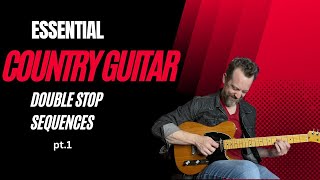
In this instructional YouTube lesson, Aaron Jaxon teaches a widely used country guitar double‑stop sequence based on a G Mixolydian scale harmonized in thirds. He demonstrates the core pattern using a pick‑and‑finger hybrid technique (pick on the 4th string, middle finger on the 3rd), then explores several practical variations: playing the notes singly, “walking” into each note, and executing triplet pull‑offs to the open G string. Throughout, he references classic country players—Brent Mason, John Jorgensen, Albert Lee, Ray Flack, Johnny Hyland—to illustrate how the ideas appear in real solos. Jaxon emphasizes that the pattern can be transposed to any key or string set, encouraging learners to experiment across the neck. The video also promotes a free 30‑minute chicken‑picking crash course with downloadable tabs for deeper study.
Chapters
Hey friend, and welcome back to the channel here. So today what I want to show you is, um, a really commonly used double stop sequence that you'll see a lot of the greats of country guitar use over and over again here. So we're— this, this lesson will kind of like kill two birds with one stone here because we're going to talk about some essential double stop sequences, but we're also going to talk about how to play those with a pick and finger hybrid technique, which is two of the most important things to get down for learning country chicken picking guitar here. So can't wait to share this material with you here. Hey, also, if you would like a a free 30-minute kind of chicken picking guitar crash course. Hit the link in the description to this video, and, uh, it's just a— it's, it's a fairly short video lesson, but I've jam-packed a lot of material into that. And we're going to go through and talk about a lot of the essential things to get down for country guitar, like double stops, picking finger technique, um, string bending, double stops with bends, how to mimic pedal steel guitar, and you'll get downloadable tabs for the whole thing. So again, hit the link in the description to grab that. And, uh, all right, let's shoot into the lesson here. Okay, so what I'm going to show you here is— and really what this is, this is a G Mixolydian scale harmonized in thirds. Now, if when I go into theory talk right there, if you're like, Aaron, I don't know what any of that stuff is, that is totally okay. If you know what that is, great. This is not a theory lesson. This is a kind of intro to country guitar technique lesson. So if you know what that is, great. If not, don't worry about it, just learn the pattern here. So what I'm going to do here, um, let me just jump into it here. And for this example, um, really for all these examples in this video, my pick is going to hit the 4th string and my thumb— my thumb— my middle finger is going to hit the 3rd string. Okay, so it's going to go like this. Here we go, here's the initial sequence. We're going to do Okay, so that's the initial sequence there. Now that's a little different from what I played at the beginning of the video, which is— it's the exact same scale, but instead of just going vertically up and down the neck, I did it like this.
I went—
okay, so both of those are great, but I want us to stick with this kind of— I guess it's not technically vertical, but we're kind of going up and down, up and down the guitar neck. It's, it's harm melodically vertical or whatever. Okay, nerd speak. All right, so, um, let's do that one more time here. We're gonna do Okay, and again, that's a G Mixolydian scale. Now I have chosen to do Mixolydian because, um, y'all, just in years and years— I mean, I've been playing this like country guitar for well over 20 years now, and in just all of these years of playing learning, studying, recording, performing, and teaching country guitar, I keep seeing that a lot of these country ideas played by, you know, the great, you know, the greats of, you know, the Telecaster, um, are a lot of times are based around a Mixolydian scale as opposed to a major scale. Again, not to get too deep in the theory, but like when you hear Brent Mason do something like a That's based around a Mixolydian scale. Or when you hear John Jorgensen, like when he plays Hello Trouble and he does like— it's based around a Mixolydian scale. Or even like Albert Lee, when you hear him play like— that's also based around a Mixolydian scale. So I want, I want to get you used to playing this particular sequence of double stops. One more time, the basic pattern. Pick on the 4th string, middle finger on the 3rd string. So here's the cool thing, that's the only sequence that you've got to learn here for this lesson, but I'm going to give you, um, some variations on that. So now what we're going to do is instead of playing those as double stops, we're going to play each note one at a time. So we're going to go And now we'll do the exact opposite coming back down. We're gonna hit, hit the 3rd string first with your middle finger and then the 4th string. So a real great example of that is listen to John Jorgensen's solo to Hello Trouble from the Desert Rose Band.
He does—
okay, which I'll do, I'll do a lesson video on that in the future. But anyway, so one more time, again, same double stop sequence, but we're hitting each note one at a time instead of playing them as double stops. All right, so now let me give another variation here to you, and what we're going to do is we're going to kind of um, we're going to kind of walk into each idea. That's kind of the best way that I can describe it. It'll go like this.
We'll do—
okay, so again, that's going to be And then we'll just do the opposite coming down.
We'll do—
okay, so again, the whole thing. And a really good example of that is, um, the solo that Ray Flack plays to Ricky Skaggs's country version of Highway 40 Blues. At the very end, he does like— with that one, he's actually using the major scale on that one, but that idea— so that's a great little idea that you can use in a lot of different places. Okay, so let me give you one more variation on this here, and this one's fun. So what we're going to do here with this one— this— these are triplets. They're like, um, they would typically be played as, um, double triplets or 16th note triplets, or like 6 notes a beat. Don't worry about that for right now. What we'll do is we're going to do, um, Okay, so again, the double stop sequences are the same, but what we're doing now is we're doing— so again, picks hitting the 4th string, but then we're doing— and we're pulling off to that open 3rd string, and we're doing that twice, and we're just repeating that on those double stop sequences because we can pull off to our open G, which is a really cool, really kind of flashy sounding, um, idea. Um, there's a lot of great players that use ideas like that, but a really good example of that is, um, if you listen to Johnny Hyland's solo to Truck Driving Man by the Don Kelly Band, he does like a Something like that. There's a lot of great chicken picking guitar players that use ideas like that. So one more time, let me go through each one of these here, and we're going to do— so let me start off with just the basic double stop pattern.
We're going to do—
and now let's play each note one at a time. Let's kind of walk into each idea. And now let's play them as triplets.
Do it coming back down.
Okay, so again, that's just a really good introduction to a very commonly used double stop sequence, which is the— which is like a harmonized— a Mixolydian scale harmonized in thirds. A lot of chicken picking guitar players, you know, that's a— that's a Mixolydian idea.
So is it.
Okay, so And then there's a couple of variations on there for you. Now I'm doing that here, uh, out of G, but feel free to move that around and practice that in some different places. You could come down here and do it in F, you do it up here in an A, you can move it around a whole lot. You can do it on other strings, like down here you could do it You can move that around and practice it in some different places. And again, if you want to do the idea that I was doing at the beginning here, it's the same idea, but okay, I just like the one that goes straight up and down the neck because it's easy to add variations on that. All right, cool. All right, well, thanks again for hanging out today, and remember, if you would like a quick little half-hour crash course on that. It's a short lesson, but I've really packed a lot of information into that little free country chicken picking crash course. Hit the link down in the description to get that. You'll get that video lesson, and then you'll get printable and downloadable tabs which are yours to keep, and it'll really help you lay the foundation for developing some really cool country guitar chops. So again, thanks so much for hanging out today. I will see you in the next lesson.