#130 Adam Spector: Execution Beats Strategy and the Freedom of Delegating the Chores
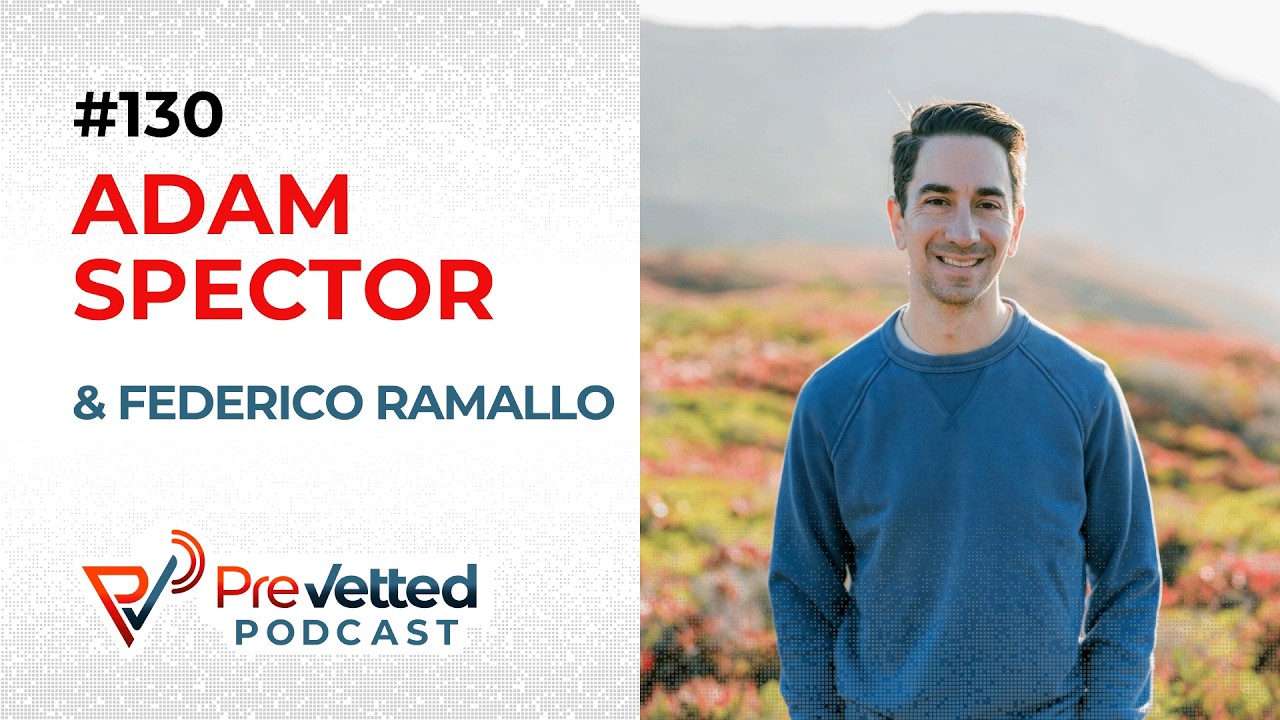
In this Pre‑Vetted Podcast episode, host Federico interviews Adam Spector – a four‑time founder, early‑stage investor, and CEO of Chore, a back‑office outsourcing platform for startups. Adam explains Chore’s mission to free founders from HR, finance, compliance and equity administration so they can focus on their core product. He argues that in fast‑moving markets, especially with AI, execution trumps elaborate strategy and that founders must obsess over their vision while moving quickly. They discuss the personal cost of founder distraction, the importance of family, friends and work‑life balance, and how delegating chores (even mundane ones like laundry) buys freedom and time for higher‑impact work. Adam shares his investment thesis for the Autopilot Fund – looking for obsessed, dedicated, hack‑y founders who can prototype and ship quickly – and reflects on how AI both lowers barriers to entry (reducing defensibility) and accelerates execution for those who wield it well. The dialogue also touches on the trade‑offs between building a unicorn versus a lifestyle business, the value of humility and feedback, and the overarching message to find one’s North Star, outsource low‑value tasks, and work hard to achieve lasting impact.
Chapters
Welcome back to the Pre-Vetted Podcast, where we spotlight extraordinary people and remarkable talent reshaping our world. Today we're joined by Adam Spector. He's a 4-time founder, operator, and a prolific early-stage investor. Adam is the founder and CEO of Chore, a company built to remove the back-office admin tax so founders can stay focused on building. He also hosts the Entrepreneurial Excellence Podcast, where he interviews multiple-time founders about the decisions and actions that drive great outcomes. And as a general partner at the Autopilot Fund, he invests in early-stage companies that helps organizations operate better. He has a clear eye on what makes founders and products defensible, especially in an AI-shaped world. Adam's personal thesis is simple and sharp: execution beats strategy and focus compounds. Adam, welcome to the show.
Federico, it is great to be here. Thank you for that very warm welcome. I'm not sure I can live up to all the things you said, but I will do my best.
I am honored to have you here today, and you're very humble. So for people knowing, meeting you for the first time, What do you do?
So what does Chor do or what do I do or both?
Well, we can start with you and then we can, we can talk about Chor, right?
Yeah. So for me, like as an individual, as you mentioned, like I feel like I have many things I'm doing all at once on a regular basis. So my day-to-day is I'm the CEO and founder of Chor. Chor is a back office services company. We essentially run the HR, finance, compliance, and equity for startups. The high-level thesis being founders of any type of business should be focused on their core thing that they love the most. And anything that distracts them from that hurts their overall business, right? It can be a tech company, but it could be everything to like, let's pretend that there's a pie company too. So let's say you have a pie company and you love making baking pies, right? That's all you love to do. But next thing you know, you're hiring a team. You have to manage an office or a, you know, a storefront. You have to deal with paying taxes and benefits and all these other different issues that come up when you run a company. And suddenly what you were doing was you just wanted to bake pies. And what you find yourself doing instead is running admin to keep the company running. And that, that is actually how most companies fail, is the founder who is the driving force and the visionary loses that focus because they are distracted by all the back office admin. So we can dig into more of that. But, but yeah, so founder, spend a lot of my time on that, do a decent amount of early stage investing. I have my own podcast, as you said, um, and maybe most important, I'm also the father of 2 wonderful young boys.
Amazing. Amazing. I think that in the world that we're living, being able to have a family, a complete family, being able to be present with our kids becomes much more important.
Very much so. And I, I would actually, I would add, by the way, being present with your friends too. It's very easy to drop into things on a, be in a digital world and ignore the real life in-person meetings that are too infrequent in the post-COVID world. that we live in, but more and more important in the AI world we're entering.
Right, right. I mean, with social networks, how the synthetic work, you know, content we're experiencing, you know, having impersonal, personal relationships become much more important. I agree.
Right.
Yeah. And the, it's not only important for the kids, it's also important for the family. But it's also important for the founder because you need that balance where, I mean, it happens with my wife. I mean, my wife is my co-founder and basically the way that I feel it is, doesn't matter what happens with the business, you know, we're still together. Doesn't matter what happens with the world, you know, we're still together. We have each other, right? And that gives you the peace of mind to go and chase the dreams, right?
Yeah. And I think it's really important for everybody to have that level of stability in their lives. And it's really tough when people don't have that base of stability at home or in their lives. Like, you obviously want to show up the best that you can at work every day, or at least I think that's obvious that you should show up the best you can at work every day. But if you are unhappy with life in different ways, or if your living situation is really stressful, It makes it very difficult to do other things at work or for your team that are critical. So solving for that is the first and most important thing, and then everything else falls into place.
Right, right. Because then you have the, you know, your support network, your core family together, and then when you reach success, which is more likely with that foundational support, then it feels better because you have somebody to share it with, right?
Absolutely. I mean, if I, I would hope to never be that rich billionaire who has no friends and no family, my family hates me. Like, that sounds terrible to be that. I mean, you know, I, I'd say like Elon Musk, who is no doubt in my mind one of the world's best entrepreneurs, and as an entrepreneur, we should look up to him in many ways. I don't get the impression that he is a happy individual. I don't get the impression that his kids love him in any significant way. Many of them hate him, at least publicly, what I've read. And many of his former spouses hate him as well. Is that a life that I want? You know, like, you know, no. But at the same time, like, he's made a dent in the universe in the way that very few people ever have. So I could say there's some benefit to that, but it's a real trade-off. Let's put it that way. When you make such a dent in the universe in a positive way, you also sacrifice a lot. And certainly Elon Musk has sacrificed a ton for the impact he's made in the world.
Yeah. I mean, on every high-performing role, you know, people sacrifice the family, sacrifice the friends, you know? So I admire all of the things he accomplished, right? But I wouldn't want that in my life, right? I wouldn't want that, you know, lack of family, lack of foundational support, right? So I'd rather aim for myself a little bit lower of, you know, a little bit more balance, right? Because I think that leads to a happier life, right?
Totally, totally agree.
Yeah, yeah. So you say execution is greater than strategy. When did you learn that lesson?
Probably a combination of obviously the various, the 4 different startups that I've done and my time at Twitter. So I worked at Twitter as a product manager and there were lots and lots of meetings about strategy, lots and lots of meetings about strategy and plans, where we were going in the next 6, 12, 18, 24 months. And so much time time wasted in these big team meetings that felt like they were draining. It was just a bad— it was a terrible use of time to get everyone synchronized up and to make these big grand plans. And maybe you need to do that at a really big company, but my view is when you are a smaller company, at a minimum, what matters far more is executing and moving quickly to execute. And that is A rare— that it's much easier to do strategy work, sit there like, I'm going to write a document and we'll discuss it. It feels like you're making progress, but actually executing and making that progress and seeing and putting that product into market and testing it. Are people buying my product? Are they excited by my product? All of that is far more powerful and valuable than any sort of strategy, especially because in the world we live in now, things are moving so fast. Whatever strategy you put in place for 12 months, like we can talk about AI and where I think it's going, but like if I have a strategy for what Shore is going to look like in 12 to 18 months, I know it will be wrong because AI will have progressed so much faster probably than even I can imagine. So I just want to execute every day well and just stay on the top of being as forward-looking as possible. And that's it.
Right, right. I mean, coming from a bootstrap company, right? A small bootstrap company. I think that strategy has its place, right? I mean, you can, you want to set a vision for the company. You want to set a, and that vision should allow you to make decisions, right? Throughout the execution. But then after that, you know, the world, the world is full of ideas, right? The only difference between those ideas and successful startups is execution, right?
Yes. But I would argue that's actually the difference between most successful people and and people who fail to get further is there are lots of people who have ideas, right? Everyone listening to this might have ideas. And of course, the people listening to this are different than most people in general because obviously they want to improve themselves and think about what other people have done. There's a lot of people who sit at home, they play video games all day. They are a little depressed about where they are in life because like, oh, it's unfair. I haven't been able to progress and move forward and do these things. But let's be honest, like You're— the opportunity's there and you're making a proactive choice as an individual to either talk about how unfair the world is or go do something about it. Go take action, go execute on something and build something, build something interesting. Say, you know what, I'm gonna get off my butt and start trying to build. Let's be clear, like people look at my background and resume and say, oh, Adam's been so successful. And I have, but I also feel like I have so much further to go. I haven't played a video game in like 8 years. I love video games. They're wonderful. They're tons of fun. Played one in like 8 or 9 years. I don't have time. I'm too busy building and learning and growing myself and my team. And like, there are too many other things that are worthwhile if I want to move forward with the world versus be a laid-back participant who watches it pass me by.
Right, right. I mean, my wife loves, she loves this idea of going to a cruise, right? I cannot tolerate the idea because for me, it's you get into a big boat and you become a passenger, not a participant, right? You're just laying down there doing nothing, right? And getting pulled over from one place to another, right? And it's basically that idea of, you know, you just become this passive element in the world, right? Of course it has its place. So I'm kind of, you know, opening up to the idea, but—
Yeah, look, if you wanna really relax and, and not have to think about anything, a cruise is probably a wonderful opportunity. That's that for a lot of, but I, I actually really do think for a lot of people in the world, that is generally their mindset every single day is they essentially wanna be a passenger. on a cruise ship, and people like you and me want to be the captain of the cruise ship and make decisions about where it goes. There can only be so many captains, but the beautiful thing about at least the entrepreneurial world is everyone can be a captain if they're willing to work hard enough. They can be a captain of their own company or certainly of their own lives, but they have to make that choice proactively to take action. And become the captain of their lives.
It's not a zero-sum game. No, everyone can win. There are plenty of opportunities. Right.
There's so many opportunities in the world. Everyone can win. Everyone should win. I want a positive-sum game where everyone in the world achieves the success that they expect of themselves. But no one's giving you handouts. The world does not exist of handouts. You have to work hard for it. And if you're willing to work hard, the opportunities will come.
I completely agree. The other thing I've seen happening is you build something, whatever it is, and then people start criticizing. I mean, it happens to Elon Musk. It happened to my company, probably happened to your company as well, or to you, you know, and I find it interesting because it's easy to criticize, you know, from outside doing nothing or having accomplished anything. It's easy to criticize, right? But it's hard to build whatever we build and whatever decisions we make, we make it with the limited information, limited resources, and limited time that we have, right? And there's a lot of trade-offs to make those decisions, right? So, you know, why you didn't do it a little bit better or a little bit, you know, taller or a little bit, you know, another color or whatever it is, right? But we make those decisions, we can change them, right? But it's in that movement. On building, on creating, that we can make those changes.
Correct. And once again, if you are someone who is not building, then it's too easy to criticize. But you don't know the pain that goes into the decisions that are being made and the reasons behind those decisions. So have a little, have a little compassion for the builders out there. You're obviously, when you build a business and make the decisions about that business, you're doing the best that you can for all of your stakeholders, your team, your shareholders, and of course, your customers. And some of those decisions are ones that customers might not like, but you're doing the best you can.
Right. And there's ways to give, you know, positive feedback to do better, right? Because sometimes there are things that, you know, as founders, we don't see that it's an issue on our product, our website, or whatever it is, right? But there's a way to to provide it in a positive way rather than just criticizing per se, right? Yeah. So tell us a bit more about Chore. What problems were you seeing that made you start it?
Yeah, I mean, look, the problems that I saw are pretty simple. Going back to that pie example, this is across history, small businesses in the world and frankly big businesses have always had the same issue where they have There are essentially 3 key parts to a business. A great product. Let's call it you have wonderful, most delicious pies in the world. You have an ability to market it. You know how to tell a story. You are able to get your local community excited or customers across the web excited, whatever it is, to buy your product. So you have to be good at sales to some extent, right? Even if you have the best product and no one knows how to buy it, you won't have a good business. But then you have this 3rd part called running the business. And that 3rd part has never been optimized. Most companies still run back office operations the same way they did 300 years ago, 400 years ago, when, when the first modern corporation started, the East India Tea Company. And that was just some guy, almost only a guy, um, with a ledger be like, oh, you work this much, here's your money. You work this much, here's your money. That's the same thing we do today. It's true. It's more modern. We do it on a, on a website. But like, it's the same thing and it's still an internal team doing that. And to me, that's insane. We've come so far where you and I are able to do this podcast recording. We didn't have to go build our own podcasting software or go in person to a podcast studio. We can do this all virtually because we've outsourced that work to Riverside to go build the podcast, to build a virtual podcasting studio. We paid them a fee. For their technology. Same thing with AWS. You don't go— no one builds their own servers in their garage anymore. Like, that's what happened 25 years ago. No one does it anymore because AWS exists. Another example, you and I don't have our own personal power plants because power plants exist. We don't need to generate power, even though power is critical to us to be able to do our jobs, right? We need electricity to do our jobs, yet we don't have to build our own power plants. The reason for all these is you've outsourced that work. To experts. You said you are the expert, you can do it better than I can, and at scale, you're going to be better than I will ever be. And I'll pay you a little bit more. If you were a, like a steel smelter or something, right? Where you're using a huge amount of electricity, it might make sense to have your own power plant because you really need that to be so specialized and you can use it 100% of the time that it makes sense to do it. But for most companies, you only need a small amount of power. You don't need to build your own. You don't, for your own home, you don't need a power plant. It's the same thing with operations. You don't need to hire a full-time person to run back office work, but you also as a founder shouldn't be doing it yourself because it's not your core competency. It's not what brings you joy and it's not what will push the business forward. And so that is the whole thesis behind why this company exists.
Right. Yeah, I mean, I've seen that we have a lot of services, a lot of products and services that provide us a lot of base comfort, if you like. But you talk about electricity, it's a complex problem to solve, right? And that allows us to build on top of that, to build and focus on higher hierarchy problems.
Well, yes, and I would actually, it's not actually complex to build electricity in some ways, actually. So I'd push back. I'd say the world is more filled with, the world is all about specialization. You specialize in what you do better than other people. That is how you win. So even using it, maybe a more simple example, maybe you like Coca-Cola. Well, like you could go make your own Coca-Cola. It would take a lot of time, energy. It probably wouldn't taste the same, things like that. But you don't because Coke has so perfected the formula of how to do it, how to produce it, how to get it to you in a low cost. It doesn't make sense for you to spend time recreating Coca-Cola. And it's no different for anything else. Everyone specializes in our ability to use tools that are specialized, makes us able to do all the other things we enjoy more. So maybe a more specific example. You and I are doing this recording on a computer, right? You have a computer at your house. I have a computer at mine. We have computer monitors. We have microphones, cameras, all these things. You and I have not built any of these tools. And yet we are able to buy these tools for a relatively speaking low cost, and that enables us to do things we enjoy more, such as having this conversation on a podcast. But we need the specialization of these computer companies and the electricity company and all these other folks to enable us to do what we do. And so my whole thesis is every company should be that specialized and therefore delegate all the other things that are not directly impacting their business. Same thing goes with back office operations. Why would you do that when you're not building your own computer, you're not making your own electricity, all of those things?
Right, right. Yeah, I think that the, um, you know, when I started found— when I founded my own company, I didn't know the level of complexity to run the back office system.
No one does. Everything— everyone thinks it's easy and it's not.
Right, right. And it's not. Yeah. And the amount of time that it would take me has been, you know, More than I was expecting. Um,
and I think, you know, what would you have done with that time if you had that time back? What would you have reinvested that time in otherwise? Where, where would you have spent it?
Right. Well, I mean, I grew from small operations to a bigger operation where I could detach of the business. So of the operation of the business and not only on the, on the back office, but also on the daily operation of the business. So, uh, kind of answering your question, I could use that time on 2 things. One is I can't Take more creative or high-risk endeavors because now the business, even if I fail, the business is working. So then I can use that to take higher chances, higher risks, right? Whether it's creating something new or it's, you know, you can do more creative jobs, right? And then the other one is focusing on the high value of a business, right? So all the, what Whatever task is complex enough that nobody on my team can solve it, then I can solve it, right? And then those are the 2 big, big things that you can do because now you have the time to do it.
Correct. And that is where everyone should be focused on doing the things that only you can do. This is just a general life story. So our company's called Chore 'cause it's about like doing the chores to some extent. And the thing is like another example I would give for people is like, I don't like to do laundry. I don't think that's a chore to me. I don't enjoy it. I don't think it provides value, but I need to have clean clothes, right? Like, I think I would be really hard to do business if everyone thought I was stinky all the time and my clothes were really dirty. So what do I do? Well, I take all my laundry to a wash and fold location near my house. So I outsource my laundry work to someone else. They are experts doing laundry. Presumably, presumably, I hope they love doing laundry and they get joy from it, and I pay them. I don't, you know, I pay them money to go do that, but with that money, I'm getting time back to do the things that I love more. I get time back to spend it with my family. I get time back to build my business. And so to me, it is a very good ROI to spend money on someone else delegating away this task that I don't enjoy, that I'm not good at, and it does not drive my life or my business forward.
Right, right. You, you buy freedom.
Yeah, absolutely. And freedom, that is what money is for in many cases, to buy you that freedom. And it gives me then the choices of what I want to do with my life. But I, but to be clear, I think everyone has those decisions to make. Too many people are penny-wise and pound-foolish. So they want to be really careful about spending their pennies, but they don't look at the bigger picture.
Right.
So the thesis being you could save money by not— I could save money by not outsourcing my laundry. work, right? I would save cash, absolutely. But I then have to spend all that time doing the laundry, and it would make me unhappy. It would not mean that I wouldn't have— I would have less time spending with my kids. I would have less time doing the work that I really enjoy and building my business. And so to me, yes, I'm spending that money there, but I'm reinvesting all that new time that I have into doing the stuff that will help me get to a bigger exit or make more money elsewhere. And too many people forget that point where you should let everyone specialize in what they do best so you can focus on what you do best. This is an interconnected world we live in that leads to overall, the overall income pie growing. Restaurant. I mean, you can use all these examples, right? Like I can cook at home or I can outsource it and get a restaurant to cook me food. Some people enjoy cooking, so it's a great thing to do and it's a great way to wind down for some people, but for other people it's really annoying. So if they outsource their food getting made, they have more time for the other things that they enjoy. And so once again, it's all these just choices. And so my big push for all of your listeners is think deeply about where you're spending time, what you don't enjoy doing, and anything that you don't enjoy doing, outsource it and delegate it. There's someone else who will do it for a price that is lower than what your hourly rate should be.
Right, right. And then you, you have more happiness in your life, you have more purpose, and now you can spend more time on what matters most to you.
Yeah. I mean, I mean, sorry, I keep beating a dead horse here, but like the, the, I don't wanna look back at my life when I'm close to death and say, man, I'm so happy that I have an extra bit of extra cash. But I wasted, you know, I don't know how much time it takes to do my laundry every 2 weeks. Let's say probably, probably my laundry plus my kids' laundry. I bet it would take me 4 or 5 hours. So I don't know, that's 5 hours every, every 2 weeks, 10 hours a month, uh, 12 months, 120 hours a year times however many years I have in my life. I don't want to look back and be like, man, I'm really proud of all this time I spent doing laundry. Like, that's not nothing to be proud of. Whereas like, I could look back and say, man, I'm really proud of how I built my business into something big that can help pay for my children's education. That's more meaningful to me and much something that I'd be much more proud of than a little bit of extra cash, but missing the bigger picture about what I could invest in and make a lot more money on with that new time that I have.
Right, right. And being able to have that time means first understanding what is important to you and then Delegating the rest.
Correct. And, and everyone's different. Some people love doing laundry, they find it very relaxing, so more power to you. But there are other things you don't enjoy doing. And so once again, like, figure out what those things are and delegate it. Get it off your plate. Life once again is too short to spend any time doing things you don't love. It's not worth it. Number one, it's not worth it. Number two, it won't lead to the big outcomes you might hope for in your life. Right? You want to have a really successful quote unquote life, however you define success, you need to work hard at it. And the way you work hard at something is you put in a lot of time getting good at it, being well known in your space. And the way you have all that time is by delegating away the things that are a distraction.
Right, right. I feel blessed of being tired of doing things that I love.
That is a blessing. Absolutely.
Yes.
Like Federico, that is a huge blessing. Congratulations.
And when me and my wife think about our time, we think that we live a privileged life because we have the freedom to make decisions, to use our time to whatever we want to set it up, right? Sometimes it means that I have to work harder some weeks or whatever, but I also have the time or the freedom to pick up my son to school and we can do ice cream together because that's something that I enjoy doing with him, right? And is it cheaper to buy ice cream? Maybe, but it's something that I enjoy doing with him. I train with him on— we're preparing for a tournament this Saturday. I train with him in karate, right? And we go jogging and it's a lot of time that we spend on that, right? And I enjoy it. It's good for us, for our health. And I find that it's a privilege that I can have that time with him.
Yeah, that's a huge privilege. And that means you've set up your life in a way where, once again, those other tasks that you maybe don't do your own laundry. So because you don't do your own laundry, you can spend time with your son learning karate and being good at that together. That's a privilege. But it also means because you've set up your life the right way, you can afford To, to remove those things that are a chore. And as you move up the stack in life, there are more and more things that you can remove, right? I mean, like some people, I'm nowhere close to this person, but like some people fly private jets. Why do they fly private jets? Because it removes the pain of flying commercial and having to go through security and all the other things that take a lot of time when you fly commercial. That's one last pain in their life. It means they, why do they do it? It means they get to whatever destination they want to get to faster. And it means they have more time to do those things they care about. It's everyone's life. Every, I don't care how much money you make, whether you're flying private jets or you're working minimum wage, everyone can make those trade-offs in life and make those decisions. And my one request would be find things that, things you do not love, outsource and delegate them and do more of the thing that you love, because that is what will lead to your ultimate happiness and success.
Right. And it's a reinforcement loop, right? I mean, when you're doing something that gives you more happiness, then you know about the 4 hamburgers, right? The 4 hamburgers of happiness.
No, no, I don't actually.
I can tell you that story because I think it's interesting and it's kind of on part of what we're talking about. So you have 4 hamburgers, right? One hamburger is the one that you eat, you enjoy right now, right? That gives you a lot of immediate pleasure, right? But it's bad for your health, right? I mean, if you eat that continuously, right? I mean, you can think of any fast food joint, right? It gives you immediate satisfaction, but it's bad for your future health, right? So if you go to the extreme of that, then you get into the drugs, right? It gives you immediate satisfaction, but you are sacrificing your future happiness.
Mm-hmm.
Then you have the hamburger that it's It doesn't taste really good, you know, cardboard hamburger if you like, but it's really good for your health, right? So you are sacrificing your immediate satisfaction for future happiness, right?
Mm-hmm.
Because you're going to have future happiness with that right now. The third hamburger is let's make a hamburger out of fat, right? It tastes cold fat, right? It tastes really, really bad and it's really bad for your health, right? So it's neither good for, for you don't get immediate satisfaction and it's really bad for your health, right? for your future health, right? So it's both ways, right? Now, wouldn't it be great if we find this ideal hamburger, right, that you can eat, gives you immediate satisfaction, you can enjoy it now, right? But also it's good for your health. So it also gives you future happiness. Mm-hmm. There's something interesting that happens if you're doing something that gives you satisfaction right now, but also has a purpose, right? A purpose that has, that it's of significant importance for you. Again, that satisfaction increases, right? And even if you don't have satisfaction right now, sometimes you're doing chores that are not, you know, the best, but it works towards your future happiness, your purpose. Then, you know, that pain diminishes, right? Or you can move forward. It doesn't matter, right? Because the purpose is the one that gives you that happiness, right? But that relationship becomes important. Right. So that's the ideal hamburger, right? So you can delegate those tasks that don't give you either immediate satisfaction or purpose. So you can focus on your purpose and you can have more happiness in your life and that reinforces towards becoming more successful in life.
Yep, absolutely. No, I love that. Love that explanation. And it makes a ton of
sense. Yes. Yes. I'm glad that you like it. So So, uh, tell us a bit about your, uh, podcast, Entrepreneurial Excellence Podcast. You know, what, what did you learn from that? Go ahead. Yeah.
Learned what makes for great entrepreneurs. We've done about 120 or so episodes. Um, probably the key learning is the best entrepreneurs are the ones who are the most obsessed with their focus, their product, what they're trying to build. They care deeply about outcomes, um, and they almost can't sleep because they're just so focused on what they want to get out the door. So it's just obsession, right? To the detriment of other things, but obsession.
Right, right. Yeah, I, I agree. I mean, I think that makes a great, great entrepreneur. I mean, I, when you're, when you're talking about that, I relate it to myself and I feel, um, the, and then, you know, what we're talking about is after you went to that extreme of obsession, then pulling a little bit back so you can have more balance in your life. Because, you know, the way that I see, I used to think is, you know, it is running as fast as possible right now. I'm thinking more if it's a marathon. So yeah, we want to run fast, but also we want to, you know, balance the speed so, you know, we don't burn ourselves out.
Yeah, exactly. And that's— you do need to find balance. Although once again, a lot of the best entrepreneurs not only find— they balance for sure, but they find a different level of work or sort of a different gear than most people. Like, so maybe an example would be we just had the Olympics and Olympians, you know, you and I can go run a race or something, right? Like I can run a race, they can run a race, but Olympians can do it for so much longer because they're so much more practiced at it. So to them, running it or skiing it or whatever analogy for the Winter Olympics you want to use, their pace is so much different because they built up that muscle in ways that you and I, sort of regular people, don't have. So an example, in my case, I work basically 6 days a week and I have for probably 15 years.
Right.
Most people think that's crazy. They're like, oh my gosh, that's insane. I'm like, that's just normal. Like, it feels weird when I don't work 6 days a week. It feels odd to me. Am I an Olympian of working? Maybe. Maybe it's also unhealthy. But it's what it takes in my mind to be successful, and I built that muscle. So to me, it's not abnormal. It's actually the norm to work that hard.
Right. I mean, we just— what I've been trying to say with being a marathoner is that we have to find that rhythm of pushing ourselves, but not too much. So we build up the training and then we can keep it towards the long term, right?
Right.
Yeah. And what's normal, what's not normal? I don't care what's normal. It's what's normal to you, right? pace can you sustain, right? If you go too fast, faster than what you can, then you're going to burn down, right? And that becomes counterproductive for the company, for yourself, and for your family. So you have a big responsibility to keep that balance, right?
Yep, exactly right.
So I wanted to ask you a little bit about the Autopilot Fund. What do you look for when you meet a founding team?
One, that level of obsession is most important. Like, are they obsessed with the idea of what they're trying to build? Number 2 is their dedication to that. And then number 3 is how creative do they seem with it? Like, in other words, like, to do something well, you almost have to be hacky. You have to figure out a million different solutions to the problem you're going after. And how do you really target the market? And how hard will you really work to get that done? A lot of founders come in. I'll give you an example. I had a founder pitch to me. They kind of got into my calendar because they were a friend of a friend. Um, I don't usually take sort of cold meetings anymore. They pitched me and they're like, what do you think? Like, are you going to invest? And I was like, no. I was like, basically there are 2 non-technical founders and they had a part-time technical founder who was part-time, still working full-time at that person's job. And I was like, why haven't you— you just talked to me for 30 minutes. I have not seen any product. I haven't seen what you've built. I haven't seen anything. And we live in a world today where you should be able to vibe code at minimum, vibe code a great example of your product, maybe not a full working version, but a vibe-coded version of it. And if you were unable as a founder to figure out how to go build that yourself today, even if you're non-technical, then there's zero chance I would invest in you because you have to be willing to do that at this point to build something great. You maybe still need an engineer. Maybe that's questionable, actually, by the way. But like, let's pretend you need an engineer to maybe really make it great. Right. But most important though, you need to have the skills and willingness to make this a reality. Once again, if you're truly obsessed, using this example still, if you're truly obsessed as a founder, there is zero excuse that you don't have a demo of your product that you're already selling to customers and getting it out the door. Maybe you're doing all the work in the backend with human labor and with services and people. Fine. But you should already have a— it takes no time to spin up a website in a basic And if you can't figure that out, then you are not an obsessed founder.
Right, right. I mean, the vaporware had a time. A few people were successful with that to raise funds, to find a few clients. You know, I remember that from the 2000s. That shows my age, right? It had a place, but at that time, you really needed a lot of initial investment to start building something, right? Building a website was really hard at the time, right? Now, as you said, you know, we have so many tools available to, you know, go and build something, right? So yeah, that's interesting.
Yeah, so that's what I've learned is you have to, yeah, you gotta build stuff now. Once again, going back to my point of like strategy versus execution, you have no excuse not to be moving quickly, building something, showing it, getting in front of customers. I don't need to see a deck that you put together and hear why you're 2 nice people. That is not fund-worthy, that is not investment-worthy in any way.
Right. And why do you ask about whether AI increases or decreases defensibility?
I think AI in many ways decreases defensibility because it's so easy to build things now. It's so easy to compete. At the same time, for the people who know how to use AI intelligently, it also increases your ability to move faster and therefore own a bit more of a market. And it is building product now is in building a moat is a little bit about your long-term play to build up a, to build up a suite of products and tools that work together for a low enough price that you are able to have a clear kind of outcome and solution that is defensible. But that means you have to build quickly, move fast, get product out the door. And have it work well. And in the age of AI, there's no excuse not to have all of those elements.
Right. Yeah. I thought it was more about that AI was, you know, would allow, allow you to build instead of buy, right? Instead of getting a SaaS product. It does.
But yeah, it does. But I mean, there's always been a world of build versus buy. And in fact, now it's much more, I can build more things and buy fewer things has been the big change. But I don't think that's going to be the case for everything. There will still come a point where it doesn't make sense to go buy or build your own back office operations. It might, if we stay really expensive at Shore for forever, it might make sense to build your own. But there's also lots of the world where it doesn't make sense to do that. Just outsource it, right? Just because AI exists doesn't mean you don't need servers and you can't reproduce servers with AI or all these other, everything really. And so, but AI also makes it very easy. Like there's these companies that are growing, you know, at $1 million in new revenue every single month. like $1 million in new ARR every month, month after month after month after month. That's amazing. That means they hit on something amazing. However, if it was that easy to come up with that idea, it would be that easy for someone to copy you and break you down. So you need to build some sort of defensibility as fast as possible, which is layering on new products and services.
Right. And that's where your comment about Operate, you know, uh, speed execution becomes much more important than strategy, right? Yeah. Yeah. What are your thoughts about, you know, founders that are looking the next unicorn versus, you know, founders that are looking more of a lifestyle business and, you know, everything in between, right? What are your thoughts about those type of, of, um, you know, goals?
Both have a place. Both have a place in the world. It depends what sort of founder you wanna be and what kind of business you wanna build. It's, it's really hard to build a successful Doesn't matter what kind, like stop, period. It's hard to build a business. It's even harder to build a business that's going to be worth hundreds of millions of dollars. It's really, really, really hard to do that. And you have to get really lucky. You, no matter how hard you work, you still have to get really lucky to do that. But you can maybe not build a company that's worth hundreds of millions of dollars and build a company that pays you a really nice salary every year and gives you and provides for a great lifestyle. That is also a wonderful thing. You control your own destiny. you have this extra income stream, hugely valuable and something very much I think most people should focus on. Arguably, most companies should go build something like that themselves.
Interesting. Did you hear about the story about the fisherman and the American, right?
No.
Okay. I'll tell you another story. Usually I'm the one interviewing and hearing stories, but now I'm sharing. So anyway, there is this American, it could be an executive, you know, it doesn't matter. But the story that I heard is an American and he goes to a small town in, let's say, Mexico, and there is this fisherman selling fish and the American says, well, but you could do so much more. You could get more boats and then you could have employees and then you could build this network, right, of franchises and you can scale the business, right? And the fisherman answered, well, yes, I could do that, but I'm making good enough money to bring food to my family. And then at noon, I wake up at 5:00 AM, but then at noon I can spend the rest of the day with my family, right? So for that fisherman, that was happiness, right? That was the goal, right? For the businessman, the American, he wanted more and eventually was unhappy.
And by the way, and I mean, that's a great story and it's exactly the right same, going back to that example I gave with a pie shop. owner, right? It's a lot of people in business think their job is to scale their business and make it bigger. And it's very hard to fight against that pressure. But the moment you start doing it, you start adding complexity and you lose the reason you did your business in the first place. And that leads to unhappiness and frankly, in many cases leads to failure of that business. So for a large majority of people, they should stay very small. They should be small enough that they don't have to have essentially any employees or very few employees. And that's all they should focus on.
Wow. That's very interesting hearing that from you because it's a very deep insight.
Thank you. I just, it's, don't— growth in many cases equals, this seems weird to say, growth can equal sort of death of your company. Be, know who you are, know what kind of business you really enjoy and what you want to build. Build that company for yourself. Don't let investors, Don't let bankers, don't let the outside world tell you that you need to make your company really big to have validation about who you are or the value in life. If you build something that can pay your bills and you control your own destiny, that is glorious. And just stay with it. Right. Unless you want to build something big and like there's an ego component to it and all these things, right? Like, Chor is a good business. We're not great. We're a good business. And I do want to make it big and I have an ego for sure. And I know that about myself. But it's risky to play that game. Like we take more risks than we would because we're playing that game. And that's a trade-off I'm willing to make, but most people shouldn't take that trade-off and make that trade-off. And I don't even know if it's the right thing for me and Shore.
Right, right. I mean, it's, we make those decisions, we move forward, but there's always these tribulations of, you know, did I make the right decision? You know,
Well, you never know. It's always difficult, right? It's easy to second-guess.
Yes. Yes. But having your north, understanding what it's— and I can share another story that is related to this is what is happiness, right? I mean, happiness is walking towards a mountain that has personal significance for you. It doesn't matter what the world thinks, right? And it's not about getting to the mountain, getting to the top of the mountain. It's about the walking towards the mountain, right?
Yep. It's the journey is more important than the destination.
Yes. Yes. So even if you, you know, you can set goals for you and your company and then you can work towards there, right? And then you can achieve it and then you can say, okay, now that I'm here, I can set another mountain and keep moving forward. Right. And, and yeah, I mean, we always have this ego. We want to do more. We want to, you know, have a bigger impact in the world. Right. But at the end of the day, it's having this balance of all the things that matters to us, family, friends, business, and our time.
Well, look, and you and I have that goal in life, maybe to push forward and move more. A lot of people don't. That's super fine too. Like there is no judgment about which path is better. There are so many different paths for everybody. And that the only path that's best is the one that makes you happiest and leads to your overall satisfaction with what you've done with this one precious life that you have.
Right, right. Um, the other thing that I learned through this is, uh, the ability to get feedback. I mean, I, uh, when we train karate, we try to, and, and again, I'm obsessed about quality. I'm obsessed about a lot of things. We are obsessed on achieving the forms, right? The movements, right? And we always get constant correction from our sensei, right? Like, you're doing it wrong, you're doing it wrong, you're doing it wrong, right? Yes. But having the humility to take that and keep improving towards this impossible goal that we're never going to achieve perfection, right? There's always something to do a little bit better, right? I think that's the other part that becomes important in this entrepreneurial journey because that becomes rather than ego-driven, humility-driven towards a goal that is a perfection that we're never going to achieve and knowing that and accepting that and moving forward.
Yeah. So true. So true. Hard to accept that, but yeah, it's true.
Yes. Yes. So we're running out of time, but I truly appreciate you being here. Any final remarks before we wrap it up?
None beyond find your North Star, find what you enjoy, and then work hard at it. Like that's hard work is recognized across the globe. I don't care what culture, country you live in, you name it. If you work hard, you will be recognized and you will, you will achieve many of the goals and outcomes that you want in life because of your willingness and ability to work hard.
Amazing. Adam, thank you very much for joining us today.
Federico, it is a pleasure. Thank you for having me. I appreciate it. Hopefully this is valuable to your audience.
I think so. Yeah. I hope it's going to inspire them.
I hope so too.
More from Adam



7x on Paper. Break Even in Cash. Adam Spector on Staying in the Game After a Sale.


#207 - Why Smart Entrepreneurs Stop Hiring and Start Doing This Instead | Adam Spector