From Back Office Bottlenecks to Billion-Dollar Thinking with Adam Spector
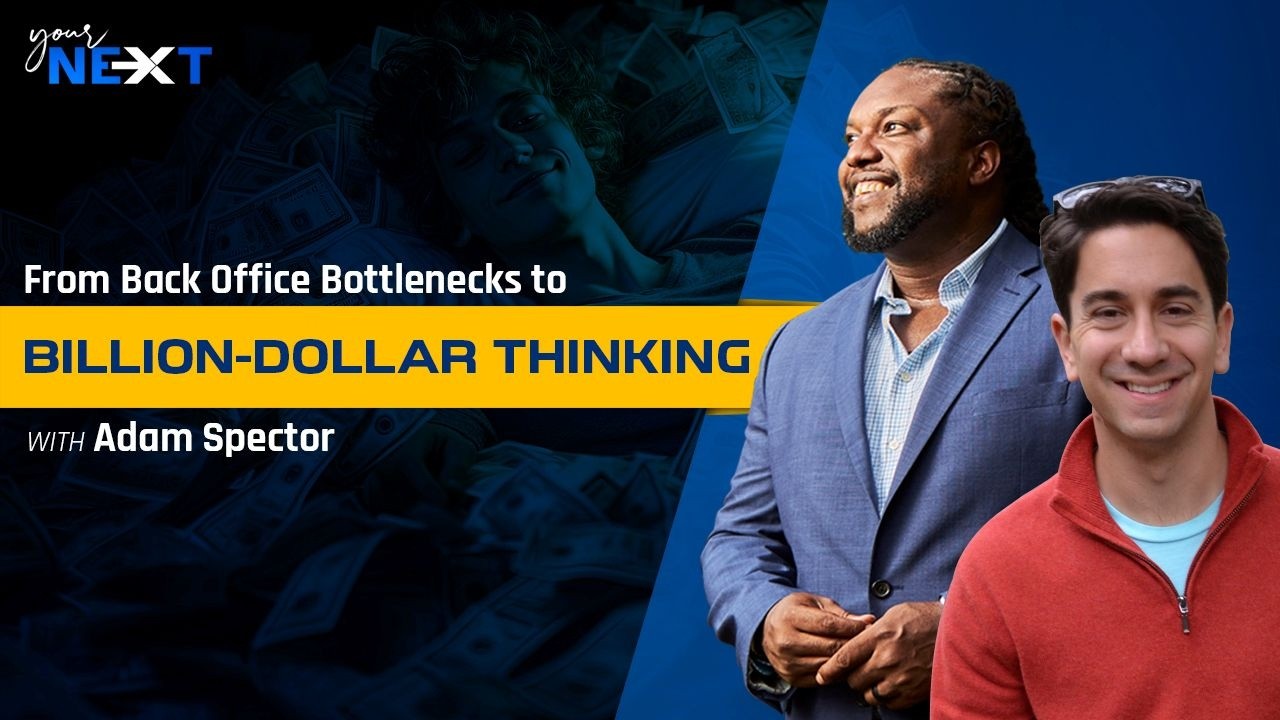
In this episode of "Your Next," host Jerome interviews Adam Spector, a four‑time founder, CEO of Chore (formerly HireChore), and early‑stage investor with roughly 200 private investments. The conversation opens with a geographic and cultural primer on San Francisco versus the broader Bay Area, highlighting the region’s status as the AI epicenter. Adam recounts his path from a tech‑obsessed kid reading Wired, through a JD/MBA, to a 2008 move west that landed him a job in Mountain View and an early exit at a company later acquired by Symantec. He reflects on his founder experiences, the importance of speed and rapid iteration, and his philosophy on risk‑adjusted investing—balancing appetite for risk with deep founder relationships and extensive reading. Adam shares a nuanced view of AI: a short‑term pessimist about job disruption and societal upheaval, but a long‑term optimist about transformative benefits. He advises new graduates to prove they can build, not just list credentials, and stresses that the bar for talent is constantly rising. The core of the interview centers on Chore, Adam’s solution to back‑office “chores” for founders, which combines AI, offshore cost arbitrage, and U.S. talent to deliver HR, finance, compliance, and equity services at a subscription price (~$17/mo plus $1,700 for small teams). He illustrates the ROI by comparing the $2,000‑per‑hour value of a founder’s time to the modest outsourcing cost. Throughout, Adam emphasizes time as the most precious resource, the need for delegation, and the belief that anyone with a laptop and internet can pursue big ambitions. The episode closes with a rallying call that the world is an oyster for those willing to work hard, focus, and leverage the tools and ecosystems available today.
Chapters
Hey everybody, and welcome to Your Next. I'm your host, Jerome, and we are bicoastal today, baby. I'm in Greensboro, North Carolina. I got Adam with me. He's in San Francisco. I keep wanting to say the Bay. He says San Francisco, so I feel like there's a difference between the Bay and San Francisco. I'm sure he'll teach me about it. We were talking real estate among a bunch of other things. Adam, so good to have you on the show, man. Thanks for making time for us today.
Jerome, absolutely my pleasure. Excited to be here. Um, we'll have a good time.
So what's the difference between San Francisco and the Bay? Talk to the uninitiated.
The difference is San Francisco is the center. Well, a few things. One, San Francisco, if you actually look at a map, San Francisco is almost like the middle of the Bay. And essentially the Bay is literally— there's a San Francisco Bay, right? Be really uninitiated. there is one of the largest natural bays in the world called the San Francisco Bay. You have to go through this small little gap called the Golden Gate, which we have this beautiful bridge everyone knows about. That is the Golden Gate Bridge because it's the Golden Gate and it's the gate to the bay. Once you get in, it's a massive bay. The bay has all these towns and cities that are around it. You have San Francisco, you have Oakland, you have Berkeley, you have San Jose in the south. So you have all these cities that are around the bay, and the bay is really big. I mean, to drive around the whole bay, Man, even without traffic, I bet it would take me 3 hours probably if I was going to do the whole thing without traffic. With traffic, and there's always traffic here, I bet it could easily take you 5 to 8 hours if you were trying to do the whole thing around with traffic. I would actually check that out sometime. I'm curious, actually. But so it's big, right? And if you look at the Bay itself, San Francisco, depending on how you look at it, is kind of the center of all that. So San Francisco is this weird little almost island where San Francisco is also surrounded by water on 3 sides. So everyone always talks about like the fog and all these things. And it's true, the weather here is weird because you've got the bay on one side, kind of the bay on 2 sides almost. And then you have the ocean, Pacific Ocean on the other side. And so like we're surrounded in water on 3 sides. And then 2 bridges go over. One bridge goes over to Oakland and Berkeley. One bridge goes over to a place called Marin. Um, and then the airport's nearby. You got BART, you got train stations, everything's coming into the area. Um, so that's one way it makes it different. Weather's weird here. Like it's way colder. You go, if I go 20 minutes south or north, the weather could be beautiful and warm right now. And you know, in San Francisco right now, I'm looking at my, my watch, it's 58 degrees, right? We are, we are recording this middle of May. It's 58 degrees right now in San Francisco. And I'm in probably, I'm in the warm, I live in the warm part of San Francisco. Okay, it's 58 degrees. I bet if I go once again 20 minutes south or north, it would be 10 degrees difference. It still might be cool, but 10 degrees difference. And if I go 30 minutes kind of east heading out away from the Bay and away from the ocean, it might be 20 degrees different. So like, that's one area where it's different. The other big thing about the Bay, to not overdo this point, is— or San Francisco— it's the center of the AI boom. And let's be like super clear about things. Like, AI, hate it, like it, whatever, is reshaping the world's economy. And the world's best AI companies are all headquartered in San Francisco. So that is what is making this place just insane right now.
Wow. Wow. So what brought you to the Bay?
I was always into tech. So I was, I was this kid who was like always into tech. I was sitting there like reading Wired magazine back in the day, right? This is like the, I was not the coolest kid. I was not like not the not coolest kid, but like wasn't the coolest kid either. And like, you know, I'm reading Wired magazine and like, oh, this tech stuff looks really cool. These things are really awesome. I want to be part of that. Um, and I still took the traditional path. Like I went to college, then went to grad school, got a JD and an MBA, did all the traditional path sort of things. Um, but I really wanted to be in tech. So I got actually a tech job in DC, which is where I'm from. Got lucky to get a tech job right before the world fell apart in 2008. Um, uh, and then about a year and a half into that, I was like, I need to start moving west. Like, that's where I always wanted to be. I had ended a really serious relationship that I was in, so I was like kind of free. Um, got lucky to get a job at a startup out in San Francisco, or actually in Mountain View at the time, not in San Francisco. Um, and they moved so fast. Like, literally I interviewed them. I remember like what, you know, I left my, walked out of, they were like, can we interview you? Of course. And walked to the parking lot, sat in my car for the interview. It wasn't like a video interview cuz we didn't really have that stuff then. Doing phone interview, sitting in my car. They're like, great. You know, maybe at the end of the call or maybe like an hour or two later, they sent me a note being, we want you to come to San Francisco. We want you to come out to the Bay Area to interview with us in person. Can you be here next week? So like, you know, I told my job, I'm like, I have to take off for 2 days or something. Flew out, interviewed out here at the company and actually ended up interviewing with a few other companies too. I got lucky, got a few other interviews, but interviewed at that company specifically. Um, the next day I guess I was flying home and I'm like literally boarding my plane to fly back to DC. My guy who became my boss calls me, says, you're gonna have an offer by the time you land. So by the time I got off my flight back to, from SF to DC, landed, job offer in the inbox, boom, signed it. They're like, can you be out here next week to start? And I was like, no, like I wanted to, I wanted to drive across country and all that other stuff. Cause I was like on my bucket list. It still is frankly now, but they're like, we need you to start now. Boom, flew out. That was 16 years ago. Haven't looked back.
Wow. And so you've had an exit or 2, right? Yeah.
Yeah. Um, one of my companies exited, uh, that was great. The company that I worked for, the one that I just mentioned that story, after 18 months, uh, 18 months of me being there, they had an exit. So I was just a, you know, relatively junior employee doing business development, like strategy work. Um, but they exited. Like, it was amazing. Like, you know, I'm getting paid a good salary, working with really smart people. And then like, boom, we get acquired by Symantec, a big company, for $400 million. And like, my equity turned into like the equivalent of like a small car. Like, not like winning the lottery, but like, I don't know, 18 months in, I'm getting like, you know, a $30,000, $40,000 bonus. It's like, heck yeah, welcome to Silicon Valley. Like, this is what it's about. And now, I mean, we're talking about how it's crazier nowadays, but like, That was amazing. And ever since then, it's been one thing to the next. And I'm not, you know, I'm a 4-time founder now. I've had the privilege of investing in about 200 different startups as well. So like doing my own early-stage investing, that's gone well, had some exits. Um, it's, you know, if you want to make a lot of money and be intellectually stimulated, you should go to the places where there's a lot of money being made and there's a lot of smart people. And that's the Bay Area, but San Francisco specifically.
So we're just going to skip over 200 investments?
Yeah, we can talk about that too.
How does—
or what I'm doing now, I'm CEO of a company that's doing great. So whatever you want to talk about.
Well, I'm just curious, like, that's a large number and most people are happy to invest in one company. They might feel like they did something if they buy the SPDR because they're like, oh, I own all of these companies, but 200 private investments is a different level of game playing. So how did you feel confident in making that type of play?
A lot of confidence comes down to probably 2 things. One, a certain level or appetite for risk. And I do think you need— look, I'm not the biggest risk taker in the world. I'm probably much I take more risks than the average person for sure, but I also don't take as many risks. I'm not crazy enough of a founder where I'm like, I'm going to go down to my last dollar and potentially go broke. I'm not that crazy, but some are. Elon Musk is a great example of that, right? He almost went broke multiple times and put it all on the line because he believed and was going to work his way out of it. I'm not that insane. I'm a good founder, but maybe I'm not great because I'm not willing to put it all on the line that way, but I'll make a lot of bets. Um, and, and so that's one thing. It's like, I'm willing to take some risk, and risk equals reward, but not— you gotta be smart about it, right? If you're gambling on, you know, call share or poly market, like, that's not taking risk-reward really smart in a smart way. Um, I'm doing it though. Like, the investments I made, the way I made it, I think, smart or willing to take the risk is I'm meeting these founders. I'm sitting down with them to chat about their business. And like, oh, these are signals that are like, this guy's a badass. Like, he's an amazing founder, and this idea is a good idea. And therefore, I want to be a part of that. And that enables me to hopefully make smarter bets than most. And that's number one. And then number two, so one, you get to know the founders. Then you start getting deals from other friends as well, because your friends are like, hey, have you heard about this company? This is awesome. And so people you trust, and you're kind of in the ecosystem. And then the third is I read a lot. I read about, I mean, I would, Jeremy, I'll talk to you about anything and I'll probably have at least some knowledge about it. Um, because I read a lot, and so I think that enables me to make smarter bets.
What makes a founder somebody worth betting on?
Dedication and insane focus. So like, how, how truly focused are they on their vision, their idea? And essentially, what is their level of willingness to go make something new become reality? Remember, if you're a founder, I don't care if you're starting a pie shop, Or the next AI company, you have to be willing to work harder and in a different way than the average person. If you can do that, you'll, you'll at least achieve some level of success. Doesn't mean you maybe will be a billionaire, but you can achieve some level.
Now, I was looking at something and I feel like you talk about going fast is like a strategic advantage. Is that— Yeah. Is that accurate?
Yeah, I think it is. Um, even more so, it's always been the case, but even more so in today's world with AI. Um, there is no time to wait around for things like, so I, I don't, everyone needs to take control of their own careers, take control of the job they're doing and, and get outcomes. And the reason you want outcomes is cuz you can test those. Those are testable, right? So I can test when I create a new product, I can test, is it achieving the outcome that I care about really quickly? I can get it in front of my customers and I can iterate so then I can test it, right? Let's pretend I'm building a new product for you, Jerome. I build a product and you say, oh, like, I don't like this part. Like, great. So if I'm moving quickly, the next day I can come back with a new version for you. Like, hey, is this better? You're like, ah, it's getting there, but we need another iteration. Do it the next day. Compared to most companies, they might say, oh, Jerome, we'll get back to you in a month. So now you have 12 iteration cycles versus what, 300+ in a year if you're doing it daily. Big difference.
Ship it. Ship it.
Yeah, ship it and get feedback. With AI today, there's no excuse. Another example, my EA is great, but I kind of told her, I was like, hey, look, I'm pretty sure I can automate some of the stuff that you're doing that you don't like doing. So she helps create a daily meeting note for me of all the meetings that I have. I have basically back-to-back meetings most days. Of all the people I'm meeting, when I'm meeting with them, why I'm meeting with them, if I've had previous conversations, all this stuff. Do research on them, all of it. I spent, I don't know, 2 hours with AI, with Claude in this case, building it out. It works actually pretty well now. Literally every day, All my notes, all my meetings, everything's aligned. It researches if I previously met with someone, checks my email, does stuff in our CRM, looks them up on LinkedIn. All of it does it. And now she doesn't have to do it. And by the way, when it's done, it will copy it into my CRM so I can keep a record of it and update the deal as well.
It's scary in a lot of ways, but scary— and it's funny because like scary can be exciting and scary can be terrifying.
This is terrifying, but also exciting. But yeah, it's both those. It's terrifying and exciting. The powers that you have now are both.
You don't just see AI as a productivity engine though?
No, but keep going before I go too deep here. No, I don't. It's not just a productivity engine.
That's all I'm giving you. You don't see AI as a productivity engine, do you?
I'm in San Francisco. I read a lot. I'm what I might call red-pilled on AI stuff. And I am a short-term pessimist on what AI is going to do to society and to people, and a long-term optimist about it. And so what I mean specifically is I think I think AI is going to create massive disruption around a lot of jobs, careers, society in general, right? Or even if all it does is it gets rid of 10 to 20% of white-collar jobs, that in and of itself will be a massive disruption to everything. And that creates political instability on top of whatever instability we already have in our country. And that will create some real problems for us. On the other hand, I also think we can do magical things with that. Like, my EA looking at all the different notes and copying that in to create a document for me to read every day is not the highest lever work for her, nor the most exciting. I also think we're going to solve lots of health challenges. People can live longer. We're going to live in a world of abundance, but we have to get to that point. And That transition period is going to be— rocky is probably a generous term.
I sit on the board of the School of Business at North Carolina A&T, and one of the questions that we've been talking about for the past 18 months is what does AI mean for new college grads? Specifically in business. And my question is, are we preparing them for jobs that won't exist when they graduate? Do you think you see where the puck is going as it relates to business and AI and entry-level employees?
Sort of. So maybe I'll answer that 2 ways, right? One, I've actually— one answer to where the puck is going. So let's pretend I had a crystal 8-ball. for a long time with early-stage investing. I have a pretty good track record. I don't know if I do anymore because AI is progressing so fast. It's very difficult on a short-term basis to really know where it's going. I can tell you macro things about where it's going, the new progress and stuff, but on a micro level, from an investing standpoint, it's very difficult, which I also think makes it difficult for jobs. But to answer your question specifically, yeah, I think it's actually really— I don't I think anyone graduating from business school or regular college, whatever it is, you're not learning skills most likely at school anymore that are overly relevant to your career, if they ever were, right? Like, I went to business school, law school. I'm not sure if anything I learned in any of those were directly relevant to what I'm doing today in a major way. But what I would say to people, and I do think this is the key thing, you now have The power of like the same powers that I have as a multi-time founder who's been around a decent period of time now. And you can do anything. So your job now is to show that you can go build. If you want to get a job today, don't just apply and like cross your fingers that someone's going to say, I need someone junior to go figure it out. Go prove to them that you've already figured it out. Like, come to me and say, hey, Adam, like, I checked out what you're doing and here's what I built. I'm like, oh, heck yeah, that's dope. But if you think you're just going to apply for the job, good luck. It won't happen.
There's no differentiation.
None. The way you stand out in today's world is you prove that you can build things, not just that you know how to use AI to rewrite your resume and have it auto-apply. That's not going to get you anywhere.
So the bar is being raised.
And yeah, as it should be. I mean, like, hasn't the bar always been raised, right? Like, if you were, if you were applying for a job, um, pre-Google or something, or let's go even further back. If you were applying for a job once computers existed and email existed, and you were like, I'm gonna hand in my resume typed up on my typewriter, who's probably gonna get the job? the person who probably applied online and knows how to use computers. So yeah, the bar's always being raised.
This seems like it's rising faster than it's ever rose before though.
It is. No, I mean, the data is actually pretty clear, right? So if you look at the data, I wrote a post about this recently, or not really, maybe 8 months ago. The speed or pace of— so when the internet came out, I think it was like 20 years before maybe a billion people had the internet. It was actually pretty slow to be adopted. Then you look at when mobile phones came out. Actually, you can go back further, even electricity. Electricity was like 50 years. Internet was 20 years. Mobile phones was like 10 years. AI is 3 years to a billion people. The adoption rate curves are faster. And it's getting steeper, right? So it's becoming exponential, right? Before, it might be linear to some extent. Now it's going straight up and down, and you can't keep up. I don't care how deeply you are embedded in the ecosystem. There's a new release every day. It is almost impossible to keep up, and that is daunting and frankly anxiety-inducing. So
How do you— I keep coming back to this 200-company investment thing, right? Because like foundationally, it sounds like— well, tell me, what is your thesis, right? Because you're having to apply that across all of these different investments. And I mean, I imagine it's changed over time because you didn't do all of them in the past 6 months. But like, what is the thesis that allows you to deploy capital at that level? Because you position yourself as an angel investor. And like most people don't last very long as an angel investor post-exit.
Totally. I mean, well, so a few things. One, I would almost say position myself more as a founder and CEO. Like that's my day-to-day job by a long shot is I've run 4 different companies. I currently run one called Chore. We do the back office chores. That is my day-to-day, right? Like that's what I spend the most time on. Um, the deal side, when I see deals, it's very specific ones. So, um, as I mentioned, I'm doing more late-stage investing nowadays just because I don't have a crystal 8-ball anymore. And so I can say, hey, look, I feel pretty good Anthropic is going to continue to do well. So if I can get invested in that, that's sort of interesting. Um, it maybe has some good outcomes. Um, but with that said, like, I'm also doing— I actually weirdly have done 3 early-stage deals recently. Um, all were— one was in a really good friend who was moving ridiculously fast. He showed me all the stuff he was doing, and I was the last money in in his current round because he's moving so fast. I'm like, dang, dude, you're doing great here. Um, another one was in another friend who's also moving ridiculously fast and building amazing stuff, who I've gotten to know pretty well. And the third was in a company that my buddy is a VC, um, and he loves this deal, and he created a sort of special purpose vehicle called SPV. to invest in this company, and they're doing really cool things. And he was like, this is my favorite deal I've seen in forever. So I just trust him.
Yeah,
I mean, the company's cool. Like, I like the idea too, of course, but like, the company's cool, the founders are amazing, but I don't know the founding team. I just trust my friend. And then I did my own research and I was like, yeah, like, I can see why this could be huge.
Love it. So let's talk about Shore, right? Because there's I think the same thesis is being applied against that. How does Chore work?
We literally are— imagine having a fractional chief of staff to go do the chores. I don't know about you, but by definition, I don't want to do chores. Like, that's almost like chores are a negative word pretty much for everybody. Um, you don't want to do a chore, right? So if I can either avoid chores or hand them off, I will do that all the time. The funny thing is in business, a lot of founders believe that they should do the chores because no one else is going to. They can't ask their head of sales to go do a back-office task on payroll and fix that or take out the trash. You want your head of sales selling. So the founders end up doing the chores. They're kind of like the janitor. I used to joke that I was the janitor at most of my startups because I was just taking care of all the random things that no one else was going to do and they shouldn't do. I created Chord to do those chores, to take care of all the things that you shouldn't do as a founder. So that's, we literally run all of HR, we run all of compliance, we run all of finance. So accounts payable, accounts receivable, bookkeeping, taxes. Um, and we'll also do equity for startups that, that give you equity out. It's all the things. You hand it to us, you never think about it again. You get back to doing what you do, what you started your company to do that brings you joy. And hopefully brings in the money as well.
Payroll, taxes. Like, I think some people would tremble at the thought that they outsourced that.
What I would say to those people is your company will never achieve the outcomes or vision that you want or expect if that, if that makes you tremble. So I get it. I get that people have trouble handing that off. And what I say to those people is, you are hurting your own company by not handing it off. You are hurting yourself as a founder. You have to learn how to delegate. Elon Musk, I don't love his politics, but he's a great entrepreneur. And as an entrepreneur, do you think Elon Musk If some, like, yeah, you're laughing cuz it's like, you know what I'm gonna say, right? Like, come on. If the head of HR, you know, he's the head of HR at SpaceX. If she, if she or he comes in to Elon and says, hey Elon, something broke with our payroll. What, what do you think we should do? He'd be like, you're fired. Like, get outta my face. I'm trying to get to Mars. Like, I'm super focused on getting to Mars and you want me to figure out like why payroll's broken? No. He hands that off and delegates to other people. So why, why do you think because you're a small business, you should be any different?
Because I'm more important. Like, I think that's the answer, right? Like, if, if I don't do it, who else is going to do it? Is the— sure.
Now, now there's a solution. That's, that's the whole reason I started the company is because there wasn't a solution forever, but now there is. Now for, I mean, we started, I think, $16.99 a month, including taxes. And you'll literally have someone hand it all off. Now, that's not zero, I get it. But like, if you're a business that's investing anything and trying to make yourself successful and have a little bit of cash, like, and you have a payroll, like a team and things like that, $1,700 to including bookkeeping to do this is nothing. Like, your time is worth so much more. Like, I, I'll give you an example, Jerome. I try really hard to say I'm only gonna do things that are worth $2,000 an hour. Mm-hmm. Right? I can't go charge $2,000 an hour for my time, but I use that as a rule of thumb for what I will and won't do. So by that reasoning, Chore is worth 1 hour of my time a month, basically. So am I willing to give— am I, can I make better use of my 1 hour doing other things? Or, cuz to be clear, Chore's gonna do, you know, even for a small company, probably 5 to 10 hours a month of back office work at a minimum. I won't do the work. It's not worth it. It's not worth me spending 10 hours. That's $20,000 worth of my time.
Every month.
Every month, right? So if I take my $2,000 an hour times 10, $20,000 an hour, or sorry, $20,000 of my time that I'd be spending on back office work versus delegating it and outsourcing it to experts who do it better than I can for $1,700. To me, that's a no-brainer ROI.
And would you— is this— can't be. This is AI. Is this outsourced to like a third world country? Like, how on earth can you provide that level of value for that fee?
Great question. Combination of all 3 things. You didn't say the third, but like combination of 3 things. We definitely use a lot of tech to help make this right and do it well. Once again, like, you're never— as a small business owner, you're never going to own and build this tech. Why would you? It's not your core business. So you're not going to do that. Um, 2, we do have overseas people helping us. Like, absolutely, we're arbitraging the fact that it's lower cost in other places. Um, and that enables us to offer great— a great product at a very competitive rate to American companies and founders. Um, and the 3rd one is we, we have great team members as well in the US to help really make sure you're getting a high quality outcome as well. So it's kind of a common— it's like a hybrid of things.
You're taking the best of all the parts.
Ideally.
Presenting it to the founder to solve a problem that is nagging, but it's a true impediment to value creation.
Correct. Well said.
And that was— you were solving your own problem? Is that how this started?
Yeah, I was. I, I This is my 4th company. The 3 companies before that, I was the founder doing all of the back office work. And it's like, wait, do you want me doing this work or do you want me doing sales or product? The 2 things that I, I think I'm really, really good at. I was forced to become good at operations cuz no one else was doing it. And I was like, well, this is crazy. Like this is hurting my company's outcomes because I should be spending all, you know, you ask what makes a successful company, it's having that focus every day as founder. It's like sitting down and being like, How can I make the best version of my product? How can I sell it a little bit more to all my customers? And I want every entrepreneur to have that opportunity to build their billion-dollar dream, and they will fail if they have to go do this stuff themselves.
This is— it's really interesting to hear you talk about it because, like, the passion around this is Is very evident. The, you say product. So somebody out there might be like, well, I run a services company. Don't I have time since I'm running a service company? Isn't that different than creating some SaaS product or some widget? And I know what you're going to say, but I got to ask, like, is the service business any different than a product?
No. I mean, it's still about your time. Actually, in services, it's almost even more so, you know, if you're a lawyer, law firm, you know exactly what your time's worth. Do you, can you, can you make, if you have 5 to 10 hours a month of this work, and that's like on the small side, right? Most companies, a minimum is probably 10 hours a month, just random things that come up. Um, can you make more money with that? Basically 10 hours, right? An extra full day every month to do stuff, to do work for your core business, to make money doing what you do best, what you're great at, what you hopefully enjoy, or also go spend it with your family, go work out, stay healthy. Like, what's, what is, what is all that worth? Are, are you gonna get an award when you get to your, your funeral because you saved a little extra money by doing all this extra back office work? Or are you gonna get an award because you were the best father ever, or get an award because you were always there for every game? And yeah, it costs you $1,700 to outsource some of that work to someone else to do it, but you actually won because you invested that time into things that were important to you.
I love this. So you, on your LinkedIn profile, you talk about time. I won't steal the thunder on the punchline, but maybe the backstory and then the punchline would be a great way to kind of round this episode out.
Yeah, look, time is your most precious resource. Um, we— every second Like, this time I'm spending with you and your audience right now, we can't get that back, right? It doesn't— I can't go back in time. I can't get it back. So every second I have to make a proactive decision about where to spend it. And if that means it's spending it on work, if it means spending with my kids, if it means spending it on podcasts, if it means spending with my team, those are all decisions that I control. I gotta make. Or if it means I'm sitting in front of the TV, whatever that decision is. That is my choice and that is how I choose. That is how you direct your life. And so each person listening, you make a decision every day. Do you want to blame someone else cuz you're not as successful as you could be while you sit there and watch TV? Or do you wanna step up and work every single night until you get to the place that you think you can, that helps take you to the next level, right? Most people don't wanna do that. Most people wanna blame someone else and like sit down and not like work hard. Let's be clear, in San Francisco, most people are working what's called 996, 9 hours, um, 9:00 AM to 9:00 PM, 6 days a week, right? Actually used to be a Chinese term, but now it's become something in San Francisco again. And these companies are working nonstop. They're in the office basically 7 days a week in most cases. I, I don't, my company Chor, we're fully remote, so I work from home all the time. But like, I, my schedule is super prescribed. I literally work 6 days a week. I've been doing it for 15, 16 years. I drop my kids off at school, get home, make myself a coffee, get in front of my computer, work until they get home from school. We eat dinner, put 'em to bed, get back on my computer until like 10 or 10:30, go to bed, rinse and repeat 6 days a week.
Locked in.
I'm not perfect. And to be clear, like that, that builds a good company. Doesn't necessarily even build a great company. There's a lot of other, you have to have luck and a bunch of other things to really make it work. Um, and to be clear, and I don't need to do that the same way anymore. I like it. But, but once again, time is that I gotta choose where I spend that time. I don't have to do that if I don't want to, right? Like then part of my time needs to be spent hiring other people I can delegate things to so I can spend more time with my family. Um, but once again, so I'm, I'm just kind of going over on this point, but like time is, you get to choose. Yeah. Every day, every single person, where and how do you spend your time? The world is your oyster. I literally have a— you used to have Google, right? You have the world's knowledge at your fingertips. Now you have Claude or OpenAI. You have the world's PhDs at your fingertips. There's no excuse to not go build something if you want to, or to be great at what you want to do.
That makes me Smile.
Good.
Adam, if people want to learn more about Chor or your books or whatever you got going on, what's the best way for them to do that?
Pretty easy. Find me on LinkedIn. I'm pretty active on LinkedIn, so I think it's just like either Adam Spector 2 or something like that on LinkedIn, but just type in Adam Spector. You'll see me. Adam Spector in San Francisco, founder of Chor. On X as well, I think at @ASpec00. And just, you know, online, drop me a note or of course hirechore.com, hirechore.com, hire a chore because you hire a chore to do the chores. Why do them? So yeah, that's how you can get in touch.
That's hilarious. I imagine kids are out there if they're riding with their parent right now, they're like, I want to hire chores so I don't have to do the chores.
I hope so. Like that's— but, but you know what? In some way it's funny you say that, but like the truth is like that's the innocence of kids, but that's what parents should be saying too. Like, why, why wouldn't you say that as a parent, right? So, you know, one example I'll give you too, that's just my own personal life. Um, I don't like doing laundry. Um, my wife doesn't want to do my laundry. Um, we have a washer and dryer in our house. So I, what do I do? I walk my laundry to the laundromat nearby and I give them my laundry and I pay them to do the wash and fold service. Like, it's not worth it for me to spend time doing it. I don't enjoy it. And I'd rather— that, that is a good use. I'm investing my money in paying them to do that chore so I can spend that time with my family instead. Same thing with what we do. We do it on the business side at HireChore, but like, that's what we do.
It is such a universal concept. It applies across all the different problem sets. So Adam, this is beautiful, man. Thank you so much. The final question, I always wrap it up with this. What's— because we talked about a lot of different things.
Totally.
What's the one thing you want the listeners to take away from the episode?
I mean, probably the one thing is the world is your oyster. Like, I believe in the sense of like, you can do anything if you put your mind to it. We are lucky to live in the United States with all of its problems. We're lucky to live here. And if you want to make something a reality, all you need to do is go do it and work hard at it. And I truly believe like, those are possibilities. It's hard. It's not easy. There's other people who are luckier than you are and start off in different places, but it doesn't matter. If you work hard and focus, anything can happen. I mean, we were talking to start and maybe go back to that. I have been lucky enough to invest in founders who have companies that are worth billions of dollars now. These are people I know that are friends of mine. I'm a teeny tiny investor, so my amount has been very tiny by comparison, but some of these people are Probably close to billionaire status now. That's insane. Like that is winning the lottery. And what did they do? They worked hard. They came to San Francisco and said, "I have an idea, and I'm gonna go work really hard to make it happen." Like I'm gonna be super focused and dedicated. You know, so people sit there and buy a lottery ticket instead of just saying, "You know what? I'm gonna work really hard." You don't even need to come to San Francisco to do it at first. You just need a laptop and an internet connection. I don't know. Like spend your time if that's what you want. Make it happen. These are people who are normal people, literally, who are now billionaires. It's insane.
Wow. The gap, the gatekeepers are gone. The crack is gone. Only you are holding yourself back. That's perfect segue into the way I end these episodes. Adam, thanks again. To our listeners, your dreams should be real. We'll catch you on the next episode.
More from Adam



7x on Paper. Break Even in Cash. Adam Spector on Staying in the Game After a Sale.


#207 - Why Smart Entrepreneurs Stop Hiring and Start Doing This Instead | Adam Spector