The Operational Pattern Every Winning Startup Shares
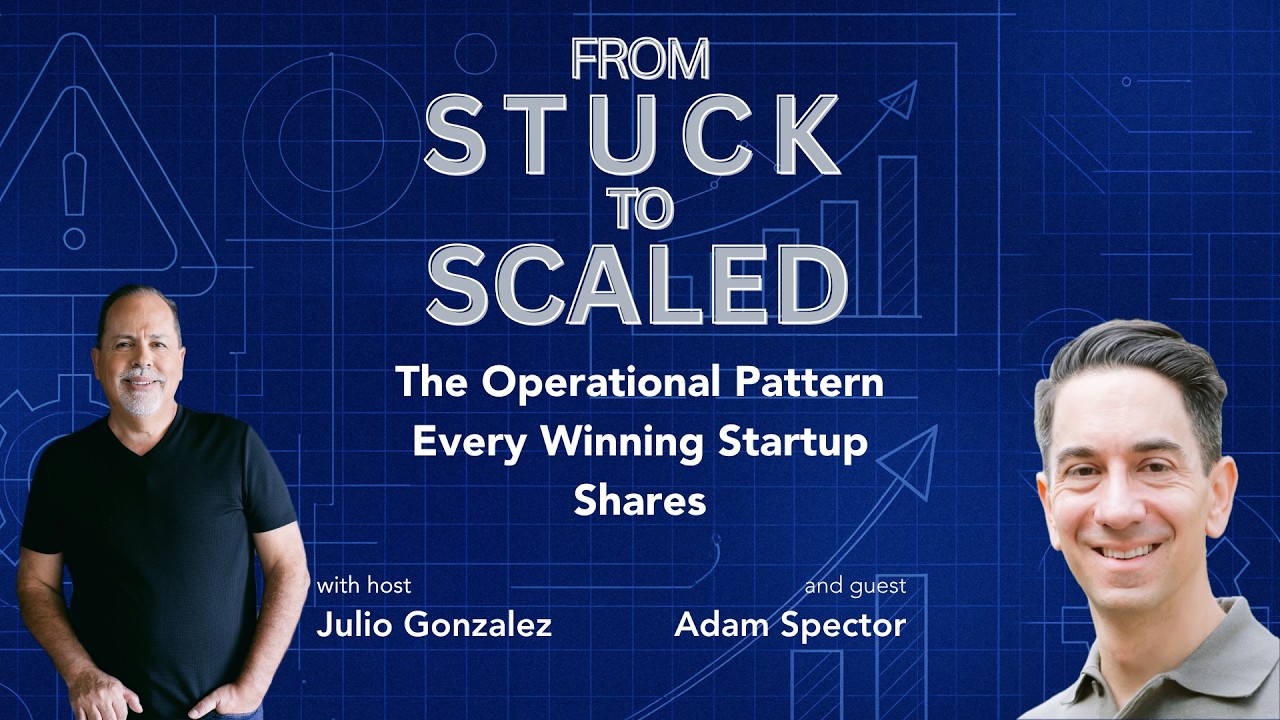
In this episode of the From Stuck to Scaled podcast, host Julio Gonzalez interviews serial entrepreneur and angel investor Adam Spector (founder/CEO of Chore, former leader at Twitter and Symantec). Adam explains why founders waste countless hours on low‑value operational tasks—a phenomenon he calls “ops debt”—and how that hidden inefficiency can cost a startup up to 500 extra work hours per year. He argues that founders should treat their own time as a $2,000‑per‑hour asset, delegate everything that isn’t their core super‑power, and outsource non‑core functions (HR, payroll, compliance, finance) to specialists or contractors, using the classic pie‑shop analogy and the Cheesecake Factory/Costco case study. Adam outlines a practical framework for auditing and cleaning up ops debt, including a top‑20 checklist of essential back‑office items, simple process documentation (5‑minute videos or bullet‑point sheets), and the use of AI to automate repetitive tasks such as document organization. He discusses scaling milestones (team size, revenue thresholds) that create new bottlenecks, the importance of culture and clear delegation, and why a fully remote, globally distributed team can be more efficient and cost‑effective. The conversation also covers how AI is reshaping expectations, the challenges of training teams on AI tools, and actionable advice for founders: hire an ops partner like Chore, build a short priority list, and read The E‑Myth. Throughout, Adam emphasizes relentless focus on the founder’s unique value, disciplined delegation, and continuous process improvement as the operational pattern shared by winning startups.
Chapters
Welcome to From Stuck to Scaled: Growth Strategies for Small and Mid-Sized Businesses, your guide to navigating growth, transformation, and success in today's ever-changing business landscape. Each week, we'll dive into proven strategies, real-world case studies, and actionable insights designed to help small and mid-sized business owners scale smart, lead stronger, and grow faster. Let's get you unstuck and on the path to sustainable, scalable success. Now, your host, Julio Gonzalez.
Welcome back to From Stuck to Scaled. I'm your host, Julio Gonzalez, and today we're talking about my business operations. We're going to explore the critical operational mistakes that cost founders precious time, how to recognize and tackle ops debt, and the key systems that successful startups have. So let's dive into it. Our guest today is Adam Spector. He's a seasoned entrepreneur and angel investor with a remarkable track record of investing in over 200 startups, including 14 that have achieved unicorn status. As the founder and CEO of Chore and a former product and operations leader at industry giants like Twitter and Symantec, Adam possesses a wealth of knowledge when it comes to transforming operational chaos into scalable systems. He's on a mission to help founders identify and eliminate ops debt, the hidden inefficiencies that can rob them of hundreds of productive hours. In today's conversation, Adam will share critical insights into the common operational patterns among winning startups, practical frameworks for scaling without overhiring, and bold strategies that challenge conventional wisdom about execution versus strategy. Whether you're a founder or a business leader looking to enhance your operations, prepare to gain actionable takeaways that can accelerate your growth journey. And let's welcome Adam to the show. Hey Adam, great to have you here.
Julio, it's great to be here.
Tell our listeners a little bit about yourself and your business.
Yeah. So I'm a 4-time founder. I've had the privilege of investing in over 200 startups as well. So I've done a pretty significant number of early-stage investing. I have a podcast called Entrepreneurial Excellence. And then the rest, I don't know. I live in San Francisco. So for better or worse, I'm sort of deeply red-pilled on AI right now. I have 2 kids whose future I hope will be better than my world. is too. And, you know, I'm privileged to be able to be on calls like this with folks like you.
So both you and I work in the operations space, so I'm sure we're gonna have a great time talking and geeking out on that. But after, you know, all the businesses that you've been in and your startups, you know, what stands out as a recurring theme?
What stands out as a recurring theme is pretty simple. People waste a lot of time on doing stupid things. So literally that's what stands out is even founders who theoretical their job is to be as focused as possible building their business, they waste time on stuff that is irrelevant and distracting every single day. I view it as many cases as like the TikTok or Instagram of business. So my company, it's a chore. We're called Chor. We do a lot of the chores. We do the back office operations, HR, finance, compliance, equity. I come across founders who say, oh, I need to do that work myself. I'm like, what are you talking about? Like, what world do you live in that you think that is something you should actually own, right? You theoretically started your business because you think you are worth it. You bet on yourself, right? That is literally almost the definition of an entrepreneur. You bet on yourself, which I love. That is what you should do. You made that bet. And now that you've made that bet, you're now gonna tell me you're gonna wait. You bet on yourself because you're hopefully world-class at something. You have a superpower, right? I don't care if it's in baking pies or making AI, whatever your superpower is. And now you're saying to me, well, but to be a good CEO, I need to make sure payroll runs. What are you talking about? Payroll does need to run, but it doesn't mean it needs to be you doing that work.
And it doesn't have to be you setting The, the process either. And I bring that specific example up because I have a friend of mine, um, you know, I've been coaching him and, you know, he's by trade an accountant. So he's very fixated on the accounting of the business. And, you know, one of his first goals for Q1 was to, you know, document all his accounting processes to make sure that his people are doing it right. And I'm like, why?
Yes.
You know, have them document it, you validate it, if anything. But it's your job to set the outcome. You know, how it gets done is a whole different conversation, but set the expectations, inspect what you expect, right? The old adage. But leave the work to somebody else that frankly is at a lower pay grade, right? Because your money, your time is that much more valuable and you need to invest it in business-generating activities.
Yeah, I love business. That's a great term and way you put it. And that's exactly right. I mean, so I try hard. I don't always do it right. But I try hard to think of my time as being worth $2,000 an hour, right? I can't go charge that for my time, but I try to think of that as the value of my time. And it's the heuristic I use to decide whether I will say yes or no to something. And there's some things that I have to do, but largely there's things I don't have to do. And so even a simple example, I had to take a— I had to go speak at an event earlier this week, and it was about a 45-minute drive from where I live to go to this event. During rush hour too. And I can drive there. Sure, my company would have paid the mileage on my car, but like it still is an hour and a half of driving. Uber was going to be $50 to $90 each way, right? So let's call it— let's make it expensive. Let's call it $200 round trip, which it wasn't. It was less, but like still $200. So it's an hour and a half and $200. Most people would say, I'm going to save the $200. I made what I think was the right decision and said, you know what, I need that time. And guess what? I brought my laptop, I tethered it to my phone, and I worked. Literally, I worked the entire way, both directions. Um, that was far higher ROI than me sitting in traffic and looking at the road in traffic.
100%. And a lot of founders don't get that, you know, because they, they see just, you know, the, the $200 charge But it's so much more than just that charge.
Correct. Because this is what people also fail to realize. You are making every day— the reason you have money, I don't care if it's your own cash or investor cash or whoever's cash it is, it exists to invest in the future of your business. That is why you got the money. It's not so it can sit in a bank account making a very low amount of interest. It's there to invest it. So for me, my investors, and actually we don't have investors at Chor, so it's literally my own money. Like literally, if I save that $200 and not spend it, that's money that I will pay to myself at the end of the year. But I think I will get paid more money because I've invested that hour and a half in doing something that was utterly critical to the business that only I could do. And that's the thing that you always gotta remember. It's like, okay, you know, when you make an investment on a public stock, stock you might buy. You're deciding right now, I'm going to make an investment to get more money in the future. Why would you think differently about yourself as an entrepreneur in your time? I don't understand it, but yet so many founders make this mistake and actually end up failing because their bank account just goes slowly down. Maybe not as fast because they're not spending as much, but it's not going up because they're not investing.
Right. Absolutely. I love this concept that you have of ops debt. Talk to me about ops debt.
Yeah. So I mean, like the operations debt is another thing where you have founders doing their own work. They are making mistakes, right? Once again, you started your company. I'll use the canonical example from The E-Myth Revisited, which I'm sure you've read.
100%.
Yes.
My favorite book.
It's a great— look, the thesis is super simple. Everyone is— if you're an entrepreneur, you should read it. But like, it's about— they use the example of a pie shop, right? And it's a pie shop owner who loves making pies. They're great at that. They open a pie shop. Next thing you know, they have overhead, they have people, they have to manage all inventory, all these things, and they're terrible at doing that job. That's not why they— they were great at making the world's tastiest pies. And now they have to spend this time managing a whole team and it all falls apart. And that's the classic story every single time. So what's the operational debt? Pretty simple. Let's use this pie shop owner example. The pie shop owner now has to figure out, how do I run payroll? I've never done payroll in my entire life. I don't know what to do. So So you make up a system, your best guess. It's probably wrong 'cause you've never done it before. And then it's like building up debt. Oh, and you then maybe you forgot to pay your taxes. You forgot to, you know, you have to take some money out of the wages for your team to pay certain things. All these things that you would know if you knew how to do it, but since you don't, it becomes debt. And then it becomes, guess what? The debt needs to get paid and the debt could shut you down if you can't pay it. So why would you incur the debt unless you absolutely have to? And truthfully, the only reason to incur debt is once again, to make an investment in the future. You should not incur debt because you don't know better. Like, that's not a good reason to go into debt. Go into debt because you're investing.
So how do you address operations debt with your customers?
We come in and clean it up. So we do a full audit of everything that they are doing, how they were doing it, why they were doing it. We clean all of that up. We review what they did, how they did it. We say, hey, look, I see you put this payroll system in place. We can do it the same way you want, you've been doing it, but we kind of recommend this other way that's faster, lower costs, and will get better outcomes for your team. And largely our customers will listen to us, right? That's actually like why they hired Shore, was to be the experts. Because customers once again recognize, I love making pies, like I'm not an expert at building a payroll plan and SOP. Like to your friend's example, like Your friend could go build that, but he should have his team do it. But even then, his team might not be experts unless, like, unless the company is like a finance company or something, and then sure, that's their expertise. But yeah, we come in and we clean it up. That's what we do at Troy, and then we run it for people.
I was gonna say, you, you take on a lot of that work, um, you know, within your company. How do you work with those customers to determine what you should be doing for them versus what they should be hiring?
A few things. One, it starts with trust. They have to trust that we're good at what we do, so we prove it to them. Then over time, they'll hand us more and more because there is— I have a trusted team who can do this work. Then 3, I hope they listen to podcasts like yours and understand, like, you basically should not— like, look, I obviously feel strongly about this, but we are in a world today where you don't want to hire more people. I get I actually don't even understand. I don't— I have a big— I have a pretty big team and I love my team. They're wonderful. At the same time, I do not want to grow my team. Like, I don't get joy from my team being bigger. In fact, I'm embarrassed that it's as big as it is because it means we are not as efficient as we could and should be. And let's be honest, anyone listening to this who's been a manager before, run a team, it is time-consuming to talk with people about their lives, what's going on. They get sick. They have a family member who's sick. They have to be out on vacation, you name it, right? Life comes up and that's what makes humans humans and they're wonderful in that way. But man, like if you're a business owner, an entrepreneur, I would do everything in my power to only hire people who are working on my core product. So once again, to use that example of like the pie shop owner, my core product is other chefs to help make great pies. I would try to hire an outsourced team to run the shop. I try to hire an outsourced team to clean the shop, You name it, I would literally try to do everything I can to only hire chefs to make the best pies. And then we can refine how we make those pies, how we do it at scale and keep our product quality high. And the only people I ever have to manage are the chefs, 'cause that's what I know best. So my advice to everyone is like, hire no one. Hire outsourced consultants or teams or companies that do that one thing really well. That's—
Yeah, and that's where I love case studies and, you know, people, you know, oh, I don't want to be reading these boring stories about how companies, but, you know, precisely to your point on pies, you know, a lot of people don't realize, and I don't know if it's still the case, but at one point, the Cheesecake Factory cheesecakes were being produced by Costco because Cheesecake Factory was in any city that there was a Cheesecake Factory, there was a Costco. So Costco's had, you know, a significant bakery, you know, within their facilities. So they outsourced, you know, that production. They gave them the recipes and everything that they needed, you know. So all of a sudden, you're not counting on this whole kitchen staff to produce all of these cheesecakes. Now you handed it off to a specialist, right? And it's, it's those stories that to me bring so much value to these conversations, you know, when you're having that, that conversation with the founder. You know, do you really need to be manufacturing this specific component or whatever the case may be? And there's a time and a place for everything. Maybe in the beginning you have no choice, right? You know, as a founder, you're doing everything. But at some point, you know, you have to start, you know, contracting, you know, certain manufacturing and, you know, outsourcing activities, you know. And those conversations are, you know, super important for those founders to really understand. where that value is. And that's why I love that $2,000 price tag that you threw out.
Well, and yeah, look, you got to hold your contractor's feet to the fire, right? You should have had— like Costco, like Cheesecake Factory should have very high expectations of what Costco is going to produce. And they should have been all over making sure the expectations were very clear. And they probably were. But after that, like, yeah, like let Costco figure out how to do it for the right price and even lower the price, but keep the quality at the level that you would expect. And that's what every founder should be considering. And by the way, I don't think it has anything to do with size. A lot of people say, well, we're small, we can't afford that, but when we're big, we will. No, it should start on day 1, literally day 1 when your business starts, find a way to hand this off to other people. It is worth it all day long. Another example, maybe that just makes it really clear to people, I hope, it's like, I'm sure you have a cell phone, right, Julio? So you have a cell phone. It's critical to your life and business. I'm sure. Would you go build your own cell phone, or do you let Apple or Google or Samsung or somebody do it?
Yeah, absolutely. It makes no sense to build your own cell phone.
Why would it make sense to run your own operations? Like, or frankly, anything that's not your core product, right? Like, you— the only thing you can do better than anyone else is the one thing you're great at. Make your pies. That is the only thing you— you will never be better at making cell phones than Google. Heck, you might not even be better than, you know, the Costco example is a really good one. Like, the Cheesecake Factory is called the Cheesecake Factory, and yet Costco can do it at a higher scale for a lower price and maybe higher quality than the Cheesecake Factory can actually do it. So Cheesecake Factory did a smart thing, I'm guessing, in your example, and they said, let's really figure out what is our ultimate purpose as a business. What are the key things that we need to be great at? Oh, it's making hot food in the moment in time. Not a cheesecake that can be made offsite.
Right.
And that's where they realized their real business was, was as a restaurant, not the cheesecakes. And so they outsourced it. That is the right decision. You find specialists who are great at what they do, and that makes essentially capitalism work. And it means we can have all the things we love for a lower price. If we tried to make our own cell phone, most of us wouldn't have cell phones because they'd be too expensive.
Yeah, definitely not. Um, talk to me about your 500-hour questions.
Yeah, I mean, like, the question, like, when we do the math on how much time it takes for an average sort of early-stage business to run operations, it's, you know, you're talking probably like between 20, 30 to 40 hours a month of work to run, to do this work. It's significant work because there are issues that come up. People are like, oh, my payroll's on autopilot, it just runs. I'm like, well, yeah, like, until it doesn't. I literally spoke with somebody today, they have 35 people on their team. They use a big PEO, well-known big PEO. Their payroll breaks on a regular basis. She was like, yeah, like the CEO didn't get paid. Okay, now what do you do? And she was like, she's like the COO, almost like chief of staff. She was like, then I have to call this payroll provider and figure out why the heck payroll broke and fix it and then rerun it manually. So the point is like all these things add up and it's just, it's multiple small things like that. They're like, wait a second, I'm trying to work on getting a new sale. Or getting my new pie out the door or whatever, and I'm gonna get distracted because my team said they didn't get their payment for today. Like, it's Friday, we're recording this on a Friday, right? If today's a payday for people and payroll didn't run, is that what you wanna be doing at 5 PM is calling up your payroll provider, be like, hey, payroll didn't run, and they're like, too bad, we can't run payroll right now, it's Friday afternoon, you're gonna have to wait, we can set it up, it'll have to run Monday, which means your team won't get paid till Wednesday. And you're like, crap. And now your team's all pissed and you're like, but I need to get this new proposal out to my customer too. So it's all those things that happen, but when you do the math, it's 500 hours a year. And that's, that's a lot of extra time of work. Like, that's like 2 or 3 months of extra work time that you could be doing to build your business. And like, that is a meaningful percentage of a year that you'd be wasting on this work.
Yeah, I mean, if 5— if you had 500 extra hours You know, you could absolutely, you know, make your business, you know, perform like no other. It is that prioritization, you know, and you have to be willing. And to your point on trust, you have to be able to trust that the work is being done.
And look, that's— but that's every part of business, Johnny. You have to trust so many different things for everything you hand off, right? You and I on this podcast have to trust the internet. We're doing the internet. We have to trust the internet's going to work. Right? We have to trust the system we're using to do this. We're trusting so many things every day. And yes, but then all that extra time you have, yes, you should use it to make your business better. Or I mentioned I have kids. I can use that time to go spend a little bit more time with my kids and my family. And so my wife doesn't get mad at me and something bad goes wrong in my marriage or something. That would be a bad situation because what? I'm spending more time. I have to run all my operations myself? No. Obviously, I hand off chores operations to our own product, and I don't have to do it. It just runs. It's huge.
So how do you— you've kind of alluded to this earlier. Talk to me a little bit more about how you handle that intake from— Intake of what? Figuring out what activities they need to pass on to you, any workflows that need to be followed versus something that you would implement You know, what's— what does that assessment look like?
Yeah, so we do, we do a deep assessment of all like sort of this top 20 sort of things that we know every business needs to do. Like, how do you do onboarding? How do you do offboarding? Do you have business insurance? When does that business insurance renew? Do you have the right coverage? We'll also do a full audit of all your documents, right? Do you— if you're a Delaware C-Corp, have you registered in Delaware? Have you paid all your fees in Delaware? These sorts of things that it's like the basic things that people forget because You know, you're a founder, you have a lot going on, you have mail coming in, you have emails, and you just, you miss stuff. And those are all the things that we go through to audit and make sure you're on top of where you need to be as a business.
So you're listening to the From Stuck to Scale podcast, and we're speaking with Adam Spector about operations and efficiency really around operations. So Adam, you've been in 14 You said 14 unicorns. Talk to us about those 14 unicorns. What made them unicorns? And were there any specific operational areas that made them different from others?
I think probably the biggest one, look, in the end, to have a company become a unicorn, you need to be really good at delegating work. So all those founders that are the founders of those companies were great at delegating. So that's number one. You have to be good at recruiting. You have to hire a good team of people you can delegate to or be willing to hire great contractors like Tore to delegate things to. But it's also a bit of luck. Like, let's be— look, I live in Silicon Valley. I've had 200+ investments. 14 unicorns is a great number, but it's small in a percentage basis to some extent of the total investments I've made. The secret to success in many cases is a relentless focus, which once again goes back to frankly delegation. So a founder has to say, where am I going to relentlessly focus that only I can do? I can't delegate someone else being on this podcast with you. And so other people have to do other work for me and take on other bits of things that they're doing. And so the secret really is relentless focus. great at delegation because you have to be. If you're relentlessly focused, you're delegating. Like, an example I use all the time is, you know, I imagine lots of entrepreneurs, at least from a successful— want to be like Elon Musk, right? Forget his politics maybe, but like, you want to be like Elon Musk, um, the world's richest man. Um, I think most people would say, yeah, he's relentlessly focused. And I think you and I would probably both agree that if someone came to Elon and it was like, let's say the head of HR for SpaceX was like, Hey Elon, should we use payroll platform A or payroll platform B? He'd be like, you're fired. Like, get out of my face. Like, I'm trying to get to Mars and like build data centers in space or whatever he's up to right now. And you want me to make a choice between 2 payroll providers? I have no idea. It's not my area of expertise. Why are you wasting my time with this? Why aren't all of us that same way? And the best founders are like that. They're like, this is utterly ridiculous. Like, I've They've set up a culture though where that, like the head of HR at SpaceX would never go ask Elon that because they know the culture. And so that's what founders need to do. Like, is that a decision I need to make? No. So you go own it. You're the owner of that decision. Your job, your optimization strategy or optimization function, if you wanna think of it that way, makes your payroll run well and it doesn't cost us too much. Good, go do it. I don't need to worry about it then. And so that's what— that's the best founders and the unicorns are like that. They have a clear optimization function for themselves and everything else is secondary and they set up a culture that does that.
Yeah, I think there's a big gap in that founder mentality because they're not hiring the right talent to be able to delegate effectively. They don't have the right documentation in place to be able to delegate effectively and therefore you can't make the decisions that, you know, that are going to be the right decisions because you don't have enough information. And therefore comes back to the dependency on me. So that to me is, you know, foundational. You know, what do you need to do to lay down the foundation, you know, on culture, right? And I love the definition that I got on culture one time. It's how you make decisions.
Yes.
You know, more so than anything. So if you have a proper foundation for your organization, a strong culture and strong delegation, you should be able to just push that off and let people do their job.
Yep. And look, and this isn't perfect, and people always worry, well, it's difficult to do, it's hard to set up. And what I say is like, look, even if you think it's hard to set up, just record yourself in a 5-minute video explaining what you do. It probably won't be perfect, but if you have smart people on your team, it should be enough for them to get started. And then what they should then do is come back and say, hey, like, I tried the process you suggested. I don't understand these 5 things. And say, oh, here are the changes you need to make. And then you go from there. And actually, it's funny, like, I don't know how much you do with AI, but I built a bunch of things with AI and it does that. So I give it kind of a bad maybe explanation for what I want. I do my best to be pretty clear, literally the same way I would with a teammate of mine. And then tries to run it and then like it does it or it doesn't do a great job. It makes some mistakes and, hey, can you change this and do it differently this And you just refine and refine and refine until it just understands it. And it takes a few iterations, but once you get it started, you just hand it off and you're good to go. And hopefully then it's built a system where it can just continue on, you know, maybe tweaking here and there, just like you'd have to tweak a person. So I mean, once again, AI and agents are somewhat the same to me in certain scenarios.
I love the video suggestion because, you know, when I talk to my customers around process, I tell them, you know, it doesn't have to be be a 50-page document. 10 bullet points on a sheet of paper, you know, that gets you started. And then you mature the process from there. And you're approaching that, you know, with a video. So that's a great alternative. One of the things that I see, and I'm sure you see it also, is there are different times, thresholds, priorities, all kinds of different Descriptors and however you want to put it, at different stages of business. What do you see as some of those trigger points where a business evolves, where you see it evolve into a bottleneck and then you break through, bottleneck and you break through? So what are some of those bottlenecks that you see?
I mean, usually it's size-related, right? Like when you're under 20 people, you kind of still know the whole team. when you get past that, it's getting harder and harder to really know everyone personally and to really imbue the organization or every single person sort of with the culture that you wanna set. So you need to find other ways to do that that keep everyone in a cultural mindset that works for them. And so, you know, 20, 25 is one milestone. Some people look at it as a revenue milestone. Some companies hit like about $1 million in revenue and they kind of cap out and how do they get to the next level? And that's usually like 3 to 5 Million, and then they have to find another way to get to the 10, 10+ million range and then 20, and it's changing as a business each time. So there's always milestones like that where you feel like you're stuck and it's like, what do we need to do to get there? And sometimes it means you have to redo your team. Sometimes it means you need to make some changes. And that's tough when you have to make those decisions. So we've gone through that at Shore. I try really hard to treat everyone with the respect that I would wanna be treated with myself. if I have to go through those situations. But your obligation is to the long-term of the company, and that's what I think people sometimes forget as well. But yeah, I mean, it's— there's different kind of team size and revenue milestones that change kind of how you have to run your business, right? When you have 5 customers, you can send the invoices all out yourself. When you have 15, You might wanna start outsourcing that to someone who's better at it. 'Cause we have customers who literally, we found almost like $100,000 in unpaid invoices for them. Whoops, they just, they were growing too fast. And the customer, probably not even maliciously, the customer just forgot to pay, didn't get a follow-up, missed it. Whoops.
So part of those growing pains from a leader perspective, you know, given you've started, at least 4 companies, what are some of those mistakes that you've made that you've learned from and hopefully not repeated with each new company?
Oh man, I'm probably still making the same mistakes, who knows? But I think some of the big ones are you want to, once again, treat your team with the respect they deserve, right? In the end, You can't guarantee people will stick around. And the work we do at Shore is like kind of difficult sometimes, and you're dealing with challenging founders, frankly. But I'm really proud of the fact that the large majority of people at Shore would all say that we have one of the best cultures they've ever been a part of. That's number one. Number two, for me personally, I don't have time to be a micromanager, so I don't look over everyone's shoulder. I don't care to do that. I have no interest in doing it. That's another one. 3, I'm actually a really strong believer, and this is sort of a position that most people disagree with, in fully remote companies. So we are a fully remote business. I think that's a better way of running a business. And here I can tell why. The short version is basically you can hire great people anywhere in the world nowadays. The internet enables you to hire the world's best people globally. If you want, my customers don't care where my team is located, right? They're buying us, they know that, right? If they wanted someone in person, that would be a different company, but they know with us, they just like, I need someone to run my operations for me. They want it done well at a high quality and they want it done for a good price. That's most things in the world, right? And guess what? There are great people all over the world where I can pay a really fair price for them and they're hopefully excited to be working at Shore. And because I can, because their cost of living is so much lower, it enables me to have my prices be at a certain price point where we can then offer Chor to our customers at a price point that they're like, oh, this is a great deal. And they stick with us for a long time. So I think having a global team is, companies are crazy if they don't take advantage of the fact, but it changes how you manage. You have to work harder at building culture and talking asynchronously. So there are some differences. So those are probably some of the top, I don't know, 3 or 4 things that we try to do.
Can't get through a conversation without talking about AI. So how's AI changing your business?
Yeah, look, AI is— because I live in San Francisco, AI has been something that's been on my radar for a long time, right? I was building big data company. companies with big data, machine learning companies, before AI was ever a thing. And I've been trying to talk to my team about this on a regular basis too. With that said, it's really hard to get the average sort of teammate interested and excited by AI. In fact, I think a lot of people are scared by AI and maybe legitimately so. With that said, what's changing is the expectation for what you can accomplish on a day-to-day basis has gone up. And if you think I can keep doing work the same way I used to do it and it's gonna be okay, I think you're deluding yourself. And no, but I mean, I know it sounds funny, but like a lot of people think that way. They're like, well, like I don't really know how to use AI. I do a good job at my work. So like it's okay. I'm like,
yeah,
no, it's not really okay. Like it's not okay. And once again, there's a— but what people don't get is it's like, oh, Adam as a CEO is saying this, that we need to get better and faster, and he's— I'm giving you all these tools to use to do that and try to train you. Um, they think it's coming from the CEO. What they don't understand, and I think a lot of people don't understand from the CEO's perspective, is this isn't just because like I want to jack up our margins and, and be more profitable. Like, that's— that would be nice, sure, but like that's not why I'm doing it. I'm doing it because if we don't do that, where we can become more efficient, more effective, and therefore essentially lower our price We will lose business. We will be out of business at some point, and then myself and all my teammates won't even have jobs. And like, that's the issue that people don't recognize. So what— how's AI changing it? We— I think our goal a year ago is that we'd be 50% more effective and efficient by the end of this year than we were 2 years ago, and we're sprinting hard to reach that point. So essentially, you do double the amount of work that you did 2 years ago. In the same amount of time. I'm not asking people to work harder, just work differently.
And, you know, one of the things that I haven't brought up in, in really any podcast where AI has come into the fold— what are you doing about training around AI?
Oh man, so we've tried so many things to do this properly, and it's really difficult. Uh, what we've tried is we've done— we do AI show and tells. We try to ask people to present every month. We've tried doing that. That worked okay, but only a few people presented. We tried, hey, show on— it doesn't have to be work-related. Show off anything that you've built and what you've been doing. That's one thing you can do. Another one, and this is kind of where we've landed a bit more because I'm kind of tired of frankly trying to like push my team to build things and do stuff. I just say, I'm gonna build you AI tools that will have AI in the background And you will just use these new tools. So we're building some really cool things that have essentially automated some of the work that people would be doing otherwise manually. So an example, these are some public ones. As an example, we have a— we— so you probably get this as an optimization guy, an operations guy, um, having all your documents in a single location that are easy to find is one of those simple things that actually is really required to have a good business. So you can run the math on this. If you spend 1 minute extra a day looking for a file, just 1 minute extra because you don't know where it is, like, is it in my email? Is it in my Drive folder? Is it in DocuSign? Wherever it is, waste a minute a day, which isn't very much. I think it's like 6 hours wasted a year. I don't know, like, life's too short. I'm gonna waste 6 hours a year for 30 years of my career? Well, I don't even— I should be able to do the math, but like, That's like a lot of extra hours you've wasted literally just looking for files. Yeah. That's terrible. So we at Chord, we literally have automated this. We create a full diligence folder for every one of our customers. We rename every single one of the files that they have. So it's not like abcd.pdf, it's offer letter, Adam Spector, date executed. And it's put in a folder called like inner diligence folder, HR folder. Now you can find your files. And that's AI'd. We used to do that manually for our customers because it was still valuable, but now we do it with AI. And there's a bunch of other cool things we're doing. So that's what— so long-winded way of saying we have moved towards we're just going to build the AI products for our team and say, here you go, here's the amount of time we think it will save you, please use this going forward.
And that's a great approach because that way you're, you're taking You're getting the objective that you're looking for and you're taking away that insert uncertainty, not uncertainty, uncertainty from the employees and how they should approach it.
Yeah, because people, we got the feedback like, hey, like, I don't know how to use it. I've never used it before. I don't have time in my day. Are you going to pay me more to like learn how to use it and stuff? I'm like, I don't know. It's hard. Like, what do you say to that? Like, I understand why someone's like, I don't have time. Like, I'm already working really hard to do my job. and now you're telling me to go learn AI, but I don't really know even what that means. I understand that feeling. What I've tried to tell people to some extent is like, look, forget that it's your CEO saying this to you. Just go read the market. If you don't find a way to learn this yourself, I hope you don't lose your job with me, but with your next job, you won't have a next job. Every job today is going to ask you, how do you use AI? What have you built? And if you don't have a good answer because you didn't have the time, I don't know. Like, I don't— and granted, like, I'm a founder, I work harder probably than most people, but like, I don't have a lot of time. And this past weekend, I automated a bunch of things on the marketing side, and I automated a bunch of things that my EA does. To be clear, I told my EA I didn't want her doing some of this work anymore because it was essentially copy and paste work. Wasn't a good use of her time. I still want her to do other things that are higher level and higher leverage. I literally just set aside a whole day on the weekend. Wasn't great. I wish I could have spent it doing other things, but I also want to remain relevant as a company and as a founder and a leader, so I made the time.
Well, and you invested in the company, you know, and it's something that's going to save you countless hours, you know, going forward.
For me, yes, but I'm saying even for the individual employee, like, this is where they should invest in their own career. Forget even doing it for the sake of my company, Chore. Don't learn AI because I tell you to. Don't learn AI because it's gonna help Chore. Learn AI because you won't have a job. Your next job after you, there's no chance you can interview for a job in today's world, I don't think, without having a clear explanation for what you've built with AI and how to go do it. So if you wanna have a future career outside of Chore, you need to be learning how to use AI.
Adam, as we get to the tips portion of the podcast, you know, for a founder listening right now, you know, that feels that their life is chaotic, you know, they don't have the processes, they don't have Chore engaged, you know, what's the first thing that they should do, you know, to start getting their operations back on track and just, you know, continue that flow into, you know, some other actionable tips? I
mean, the easy answer is just call Chor and we'll take care of it. We'll literally get started on Monday and have it all off your plate going forward. But to not talk my own book too much, but I mean, truly that is what you should do is you just like go do some research online really quickly, be like, who can handle, run my operations, my HR, my finance, my compliance work? Who's gonna run that for me? Call up those companies, spend an hour talking to some salespeople at those companies and literally just hire one. Just like make a decision, hire one, get it off your plate. That is truly the first thing you should do. If you don't wanna do that, then the second thing you should do is try to go build it yourself. Now, to be clear, you're never gonna be able to build all the things that we've built ourselves in the services that we offer. I think the idea that people can build, copy other companies and just in their free time go build that product of some sort is a little crazy. But you can build some of the things. As I mentioned, there was no good tool or product to go automate some of my EA's work. So I just built it. And you know what? It took some time, but I now have a new skill and a new superpower to go run those things. So that's the second thing I would recommend people do. Those are the— the third one is actually— the third one is maybe an important one too. Sit down and write out your list of like your highest priority, highest leverage items. Write a list. What are the top 5 things you want to be doing today and then this week? And then this month that matter the most. If operations isn't in the top 5, then find a way to get it off your plate and spend the majority of your time in those top 5 things that are actually critical to the business's long-term success.
And I'll throw a 4th one in there because you mentioned it earlier. Go read The E-Myth. It's such an incredible book. I think it was originally written in like 1979. E-Myth Revisited was republished late '80s or something like that. There's been a couple of other versions of it come along, but it's still such an important book. You know, I read it when I was working in the corporate world and I used it, you know, within my corporate job. Yeah. You know, so it is the recipe book for entrepreneurs. So everybody should read that book.
What scares me though is given how long that book's been around, how many people are still making these same errors that were made 30, 40, 50, 100 years ago? Like, okay, maybe 100 years ago you have an excuse to not be able to do this. Today we literally, we've had Google for, we've had Google for 30 years almost, right? But we've had AI in our pocket. So we had all the world's knowledge in our pocket for 30 years. We now have a PhD in our pocket for the past four years. You have no excuse not to be like, how do I solve this problem? And it says, here, go delegate it to these people and get it off your plate. Do you know what's what? What did Einstein say, right? The definition of insanity is doing the same thing over and over again and expecting a different result. There are there thousands, if not millions, of entrepreneurs who've made these failures, who failed their businesses have failed because they made these same errors before. You are a fool if you will replicate their failure. Please don't do it. The world is better when there are more entrepreneurs. Be successful. It's hard to be successful, but it's not actually that hard if you know what to focus on.
Yep, 100%. Thank you, Adam, for coming on the show. I really appreciated our conversation. For those of you listening, thanks for tuning in. I hope Adam's insights on operational excellence resonated with you as much as they did with me. Remember, it's not just about the hustle. It's about making smart strategic choices that propel your business forward. As you think about your own decisions, consider Adam's tips. Conduct your own ops audit. Eliminate those low-value meetings. Focus on building systems before hiring. These small changes can unlock significant time and efficiency. Join us next time and let's keep the momentum going as we transform challenges into opportunities. Until then, keep scaling. Thanks again, Adam. Take care.
Thanks, Leah.
You've been listening to From Stuck to Scaled: Growth Strategies for Small and Mid-Sized Businesses, produced by Optocution LLC. For more information, tools, and resources, check out our website, www.redefinepossible.co/podcast.
More from Adam



7x on Paper. Break Even in Cash. Adam Spector on Staying in the Game After a Sale.


#207 - Why Smart Entrepreneurs Stop Hiring and Start Doing This Instead | Adam Spector