Andy Kurtzig: Two Generations of Entrepreneurship [Entire Talk]
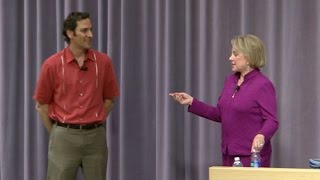
Sandy Kurtzig founded Ask and Kinandi; her son Andy built JustAnswer. They discuss what they learned starting companies, how to price products, and why listening to customers and holding firm values matter.
Chapters
What I thought I'd do today for about 10 minutes is compare and contrast some of my experiences as a first time entrepreneur in starting Ask, and now as a second time entrepreneur in starting Kinandi. And I think you get a flavor for what Kinandi is all about. First of all, I was given strict instructions for my sons not to embarrass them or the family. So the first thing I want to do is embarrass them, of course. So is Ken here, by the way? I guess he's not here. He's late. No, Andy's the one who's always late. But Andy, you're going to hear more from him later, so I won't tell you too much about him. But Ken Kurtzik, who's my other son, is also a very successful entrepreneur. He's the CEO of Irius, which is an environmental sustainability consulting company. And they do work for companies like Delta Dental, Schwab, PGE and Salesforce.com and other companies like that. So that sort of rounds off the family in all three being entrepreneurs. So I guess there's a question about whether entrepreneurship is genetic or whether it's learned. And you guys can have to guess from that. The first time around when I started ask, I was 23 years old. I was a woman. I had no business experience and no management experience. I didn't even have an mba. And my degrees were in math and chemistry from ucla and I had an aeronautical engineering degree from Stanford. And that was my qualifications. And I had no money. I had $2,000 total, which is all I really had to start a company. And my product that I really wanted to do was do manufacturing and financial management software on a minicomputer. And this was a market that was owned by IBM at the time. So I was going head in against IBM. Everybody that I talked to with my idea said I was crazy. They said, there's just no chance that you're going to succeed. I mean, even my parents could understand it. They thought that it was about time for me to start a family, not be starting a business. And. And when Andy was born, they were even more astounded that I wasn't going to stay home like most women at the time would stay home and raise their children. And I think my children were probably not quite sure what to make of it when their mother went to work and all the other mothers were at home going to PTA meetings. So my children really had no choice in the matter at the time. And I think that if you ask them now, although I'LL let them speak to this. They're probably kind of happy that I'm a business person, because when they call at midnight when they want to have somebody to talk to, they'll call me with their ideas and say, mom, I want you to listen to this idea. And I often have to say, well, Andy or Ken, depending on which one is calling. Do you want me to answer that question as your mother, or do you want me to answer that question as a business person? Because as your mother, of course, I think you're wonderful. You're the greatest kid in the world. I think that idea is brilliant. But as a business person, I think it really sucks. So, you know, you have to sort of give them a chance at this. So where was I? But not having an MBA actually had some advantages because I had notebook sense to really confuse me when it came to sort of looking at my street smarts, if I had any at the time. I wasn't confused by things about product pricing, and I wasn't confused about raising money. I just had to sort of go with my intuition. And the first. When we first got our product out, one of our customers asked, okay, how much is it? Oh, I forgot to think about pricing. And so I had no idea because clearly we put our software on a disk at that time. I think it cost $10. Now it probably cost a penny for the disk. And so that was our cost of goods. So how do you charge a product that costs A dollar or $10 or whatever the price is? So I just sort of threw out a number. I said, $50,000. And the customer had no reaction at all. So I said, per module. Still, the customer just sort of sat there, no reaction. So I said, per year? And he sort of flinched. So I said, but you are one of our first customers. We really appreciate your business, so we're going to give you a special deal today. And that was really how we got the pricing. And I know that now at Harvard Business School, there's a case and they call Flinch method of pricing a very acceptable method. And I'm sure that if that case is taught here, I think it is. Heidi's shaking her head. Stanford also teaches the Flinch method of pricing. So I guess I don't have an mba, but I did get some recognition in the pricing model. The other thing that's really important when you're an early entrepreneur is to think about how you name your product. Naming a company then we didn't have Internet, so naming your company so that it was Internet recognizable was not the issue. Our company was called Ask, which had some advantages, except often before we were well known, you'd say ask and it sounded more like Ask, which was a problem. But naming. But once you got recognized, that was okay, that got under control. But naming your product was a problem. And so I decided that I would name the product Mama for manufacturing management made sense. And after all, I was a mama. There's my proof. And I went to sell this to these males at these manufacturing companies and they said, no way. I mean, we're not going to be able to sell or buy a Mama product. So I listened to my customer. Very important thing in business, listen to your customer. And I said, well, okay, no problem. We'll call it man man, also for Manufashing management. And it's amazing. Men have no trouble, had no trouble calling the product Manman. And it was such a recognizable name that still today, people know the Manman product. They may not know Ask, but they know Manman. So the other thing is, I said I had no money and I clearly, I didn't even know what a venture capitalist was at that point. And even if I did, no venture capitalist was going to give me any money. We already established I had no business experience. I was going in a. Into a market straight after IBM. And I'm still a woman and I like being a woman, so that wasn't going to change. So I had to finance this company. $2,000 obviously didn't get me too much. We did get HP to let us use computers at night. So we'd go to their offices down in Santa Clara and we'd work from 12 o' clock at night till 6 in the morning on a computer they let us use. But we still need a little more money than that. So we financed the company by getting deposits from our customers. We took a 20% deposit on the hardware that we actually sold to the company. We bought the hardware from Hewlett Packard and then resold it and the software. And these 20% deposits were the total of funding that Ask ever got. And that took the company to the point that we were profitable. Clearly, my entrepreneurial first venture was scary. I gave up a good job at General Electricity. I did. I was, you know, very. There was a fear of failure, but I believed in myself. I believed that this was a good market, that we were ahead of the market. You always want to be ahead of the market. People were just starting to think that the minicomputer can do something. And it's not too surprising because the first minicomputer that we were successful at programming had only 15 megabytes of disk and a 16k of total memory. So just imagine that today. I mean, I think the JPEG is clearly more than that, so. And our first real customer is Hughes Aircraft. So we got all this data and our programs on a computer that size, but we were ahead of the trend. And we became the first company to develop a complete manufacturing and financial management software for a minicomputer. In fact, we were one of the first companies to have packaged software. And in, in spite of everything that we did wrong, we became pretty successful. One of the things that we did do right and was key to our success is that all of our first employees came were students, bright eyed, bushy tailed, young, energetic and smart, out of Stanford. So we came over here and we recruited heavily at Stanford. And sometimes we got really, really desperate. And if we got desperate, we'd go across the bridge to that school over there, California, and pick up a few kids over there. I noticed my son did wear red today. Coming from Cal, that must have been a big thing for you to do, to wear red. But I'm happy you understood the position. That's perfect. Okay. But we had a lot of fun. We worked very hard, we played hard. We were totally customer centric. We listened to our customers. Our customers told us what should be in the product, and that's how we designed the Manman system. Also, stock options were an interesting thing. Although all of you I know think stock options are the greatest thing in the world. Where at that point none of us thought stock options had any value. We did have stock options, but most of the employees at that point put their stock options on a board and just use them for dart practice. Because clearly no one ever thought these options would be worthwhile. By the time that the options started coming off the bulletin board and the practice range for DAR practice, a lot of the investment bankers started hearing us and they bought us and they started circling the wagon. And we did go public, a very successful offering in 1981. And most of the rest of the story is history. We grew a company at about 700 million. And I retired. Well, I retired before that. I retired first at around 150 million, I guess, and wanted to spend more time with Andy and Kenny so they knew who their mother was. And I did that. I brought in a CEO, but did not. I failed at CEO 101. And so I brought somebody in that didn't cut it. So the board asked me to go back, which I did, and grew the company up Again and then said, okay, I've done that, been here, time to go again. I retired and brought in another CEO and that didn't work. And the board came back and asked again. I said, you know, third time, that's not going to happen. And so I demurred and the company was subsequently sold. But today there's still over 500 companies worldwide that use the man man system. So what are the takeaways? Takeaways are believe in yourself, be willing to work hard and long hours, be passionate about what you're doing, and try to be ahead of the market if you possibly can. And I think also when everybody else is going a particular market, like right now, everybody's trying to go into the B2C commercial or social market. That's probably the time the pendulum is swinging too far that way and it's time to start thinking about what's the next market can be. And we think the next market is going to be the B2B social enterprise market. So that's something to think about. So how are my experiences at Kanandi different than my experiences at Ask? Well, for one, I think I have even more fear of failure. And because this time around, the expectations for us are so great, everybody thinks that we're in the right market, we have the right management team, we have the right employees, we have experienced people and that. So the expectations are so high that we, you know, we really have a lot of pressure on us for that. We have the A team. As far as investors, Kleiner Perkins with Ray Lane and salesforce.com, which is obviously the leader in the cloud computing area with Marc Benioff, who got me involved in this whole thing to begin with. And also Wilson Sonsini, I don't know if any of you are familiar there, sort of the number one lawyer. It's really scary when even your law firm thinks that you're going to be good and want to invest. So this time around, there's really a fear of failure. But again, there are some similarities. First of all, there's a paradigm shift. There's a shift from client from client server computing to cloud computing. I'm sure you're all very well aware of that. And there's also a very big shift in the way manufacturing companies are organized. It used to be that manufacturing companies were vertically integrated, they were insular, they were monolithic. And the kind of systems that Ask Manman did and that Oracle does and SAP did that were very oriented toward a vertically integrated manufacturing company. So it's perfect for the old way of doing businesses, but the new way of doing business, the social enterprise, where companies are more global, they're open, they're social, they're lean, and they're agile needs a whole different kind of system. And so I didn't go back to start at Kanandi to do what we did before, to do what Madman was or Oracle or SAP. I went back to the whole social new, the new platform, which we have trademarked as social manufacturing. And this is a whole different way of thinking. It's really bringing the aspect of agile, open social to a manufacturing company. And manufacturing companies today are very horizontally constructed. They want to be close to their customers. The companies that are succeeding in today's market and tomorrow's market are those that can respond very quickly to customer needs, that can respond very quickly to the needs and the supplier's needs or supplier events in the market. When there's a tsunami, they have to be able to respond quickly to changing their focus on who they're ordering from. And so this is the whole trend that we think is the trend of today and the future in having systems in this broad range. I once again, am working 18 hours a day. We have a great team. Many of them are here today. We're having fun. We're very passionate about what we're doing. And there is one more thing that is very much in common with the way we did it before, is that we're trying to hire the brightest people. We would love to hire the brightest people from Stanford, engineers, computer science and liberal arts for the marketing area. And if any of you feel that you'd fit this bill, that you'd be interested. There's a lot of Kanandi people, I think, here. How many? Canandi. Raise your hand if you're from Kenandy. Great. So just find somebody back there. That's Rod standing up and Peter, I think, is around there. There he is, raising your hand. Because we would love to, you know, we don't want to be desperate. We don't want to go across the bridge. So keep us over here on this side. Okay. And that's really a lot about the similarities. I think there are a lot of similarities. There are some differences, and only time will tell how Kanandi does. We have a very good start. We have money. We have. Obviously we have a good market and we have a lot of support and it's a lot of fun. We're having a great time as a team. I'd like to. Now I kept it to 10 minutes. I hope it was 10 minutes, because I have to give 20 minutes to Andy because, you know, he's slower. He said, cal. And this is exciting for me. It's the first time I've actually given a talk with my son. I was going through some pictures, and I found baby pictures of him. When I started to ask, I was going to embarrass him. I decided maybe I was a little too far, so I didn't bring them today. But he's really been an entrepreneur, a serial entrepreneur, since he'd been a kid. The first time I knew I had a problem on my hand was when we were at a party, and it was a big party, and they had got a lot of balloons that they had for this party, Most of them, just to sort of tell you how to get to the entrance of this mansion that we were actually at. And Andy and Ken were about the only two kids that were there. I don't know why they happened to be there, but I do remember that it was mostly an adult party. And we're getting ready to leave. The party is winding down, and Andy goes up to the host, unbeknownst to me, and asks the host if he can have the balloons. I had no idea what he was going to do with these balloons. But he goes around and collects all these balloons and goes across the street to a park and starts selling these. He saw these. It was Sunday, and he saw that there were a lot of kids across the street and there were all these balloons that were going to go to waste. And so he took these balloons and he went across the street and he started selling them to parents who had little kids. And that was the first time I realized I had a problem on my hands. And he continued to have one after another of ideas that he would be doing all of his life. When he got to college, I think he was a junior or a sophomore. And he would read every single entrepreneur book out there, saying, some of them were titled the eight People who Didn't Graduate College, who Were Successful. Fred Smith of Federal Express and Bill Gates and Steve Jobs and Larry Ellison. And they didn't finish college. So one, he comes to me and he says, mom, I want to start a company. I don't want to finish college. And here's this book that's proof that this is what I should be doing. And I, of course, said, no, you finish something. You start. I don't care what your grades are, but you get your degree. And he went on. He did finish. I don't think he went to class at all. The last year, except to locate the room to take his final. But he did graduate from Cal, started two companies while he was at Cal and got a degree. I saw the degree. I made sure that I actually saw the sheepskin. Well, it wasn't sheepskin. They're cheap over there. I think it was his paper. But, you know, he even got a respectable gpa. I don't know how, but it's probably easier over there too. Hey, this was your idea. Anyway, Andy found his passionate just answer, and it's not surprising. I mean, it clearly fits his personality. It's helping people where at the same time, it makes money. Two things that really. What's there not to like about it? Two things that really hit home to him. He's always been really very oriented toward helping people and seeing what he can do. And it's really an amazing concept. Anyone in the world can get a quick answer 24 7, 365 days to their questions. I think Andy will probably talk more about the details of the company. But these experts that answer the question are not just Google searches. These are real people that are vetted. They're credentialed, they. They're degreed, they're licensed. And there's a peer review to make sure that these consultants are absolutely. Or experts are absolutely the best in the world. And there's about 10,000 of these experts that answer questions in more than 700 categories. And there's millions of people in over 200 countries that actually sign on to use the JustAnswer system. QuadCast just ranked JustAnswer with more traffic than FedEx, Zynga, and the NBA, which is really kind of amazing to me. I didn't know that statistic until you told me, but I'd like to, without any more ado, introduce my son, Andrew Kirtzig, and have him tell you his story.
Close. Can you hear me? Everybody hear me? Yeah.
Yeah.
All right, great. We're pulling up a new slide deck here, and I want to start. Just PowerPoint. There you go. Perfect. And how do I click to the next one? Perfect. Okay, so I want to start by saying on Justanswer, we sell answers, and there's a lot of people out there in the world now that are selling speeches online. So I want to assure you all that I did not buy my speech online today. So with that out of the way, I want to start by thanking insert host name here. Just kidding. I want to thank Heidi for having us here, and I want to thank all of you for coming to see us Talk Today, my mom was just talking about. This is the book that I read in between my sophomore and my junior year. And I wanted to drop out from college because I saw all these superstars, Steve Jobs, Bill Gates, et cetera, that had dropped out of college and been super successful. And so I had all these ideas. I wanted to start them and she convinced me to graduate early. So first, from that year, between my sophomore and junior year, I graduated in a year and a half. I doubled up on my units. I also started my business and I also changed majors, by the way. I was an engineering major and I switched to business, which is way easier. You should all know. So just giving a quick history. So the first thing I started while I was a student at Cal was a company called Answer, and that was software for the newspaper industry. And we grew, and then I grew that after I graduated for a couple years and then that was acquired by one of our customers. And then I started a new company called Ebenefits, which was software for the newspaper. I'm sorry, that was software for web based software for HR. So it's kind of like salesforce.com and in the cloud, but for HR. And we had funding from Draper, Fisher, Jurvetson. Thank you. And from NEA and the investment bank WR Hambrecht. And we had huge partners in adp, the biggest payroll company in the world, and. And Marsh McLennan, the biggest insurance company brokerage in the world. And we grew that and then that got acquired. And then I started Just Answer, which is the website where people go when they want to talk to a doctor, a lawyer, a mechanic, a veterinarian, any kind of expert online 24 7. We even have super smart engineers like you answering questions on there. So this is what we are. We're 117, I think, is the latest. We even have a laser. That's cool. Number 117 is what we are in Quantcast. So I was trying to figure out what I want to say today to all of you. And so guess what I did. I asked on JustAnswer and I heard from a few different experts. Here's one expert put together for me. He slapped my name, my picture in the middle of a book. Confessions of a Serial Entrepreneur. Why I can't stop starting over. Another expert sent me something interesting. When I think of you and JustAnswer, one of the things that I think most about is how amazing and rewarding it must feel to you to be so instrumental in inspiring entrepreneurs all over the world by bringing JustAnswer directly into their homes and offices. You have provided these experts with the opportunity to not only help customers and to touch or save their lives, but to also save their own lives. And so we've got 10,000 experts, some of these folks making $40,000 a month. These are entrepreneurs that are making a living working from home, working from home in their bunny slippers or in their underpants or whatever they want to do. They can make a lot of money, or from Hawaii, wherever they are. So just answered, all the experts are answering questions from people, millions of customers in 700 categories. And it's kind of like ebay, except for they're selling the stuff in their head instead of the stuff in their attic. So by the numbers, I should also say it's harder to get into Justanswer as an expert than it is to get into Stanford or Harvard, too, or cal. So we've got 24, 7, 365 days a year, which is particularly useful for some of you when you're pulling an all nighter for a final or something. We've got Experts standing by 24,7 to help you with any number of things up to 700 categories. So since Justanswer is all about questions and answers, I'm going to tell you three of the most common questions I get about entrepreneurship and the answer to those questions and the lessons learned. And usually when you ask a question on JustAnswer, it costs about $20, $30 a question. This one's free for you guys today. So question number one, what do you do next when you have a business idea? I'll start with a multiple choice question, even question. Option A, do you patent it? What do you think? Who thinks you should patent it? The first thing you do is go and patent it. All right, Option B, do you write a business plan? Who thinks you write a business plan? All right. Option C, do you go out and find investors? Maybe. No. Option D, do you perfect the technology? Or option E, do you find out if customers actually want it? Who thinks that's the answer? Yes. Good. Great. What's that?
How about call your mother?
You could call your mother too. That's right. See if she wants to buy it. She's got a business too. They have questions. So that's what I did with my third company. My first two companies, I feel like they were successful and they did reasonably well, but I feel like I could have done a lot better if I had done this earlier. And so with my third company, I had a different idea. I wasn't just going to go out and Pick my favorite idea out of the hat that I had tons of ideas. I was actually going to spend a month programming the website because I'm a programmer as well. And I was going to spend a month marketing the website. And then I was going to see at the end of that two months if customers actually liked what I was doing or not. And if they did, I'd do more. And if they didn't, I'd move on to the next idea. And so justanswer was actually my third idea. If you're interested, I can tell you the other two ideas. One of them is kind of embarrassing. You guys want to hear the other two ideas? All right. So the first idea, not too bad, although it was kind of dead on arrival. It was called File Fun. And I spent a month building this website. And it was a site where people could go to trade files like MP3s. And this was right as itunes was getting ready to launch. And so the idea was as soon as itunes launches and people are buying $1 songs if they wanted, then sell them for say 50 cents, they could do that on filefun.com. so I built the website up and then launched of itunes and I read the licensing agreement and didn't work. So the digital rights management was all worked out. You can't sell, buy and sell files, but I was hoping maybe you would be able to. So that was idea number one. Two months in, shut it down, started a new business. Second business, a little bit more embarrassing. I built a dvd. No, I'm just kidding. I didn't build this idea. I didn't build a DVD rewinder. My second business is called Darester, and this idea was an auction for dares. And the thesis behind this was that I saw ebay and how successful ebay was being out in the marketplace, and I thought, hey, they're doing a great job in the consumer goods market. There's this huge untapped market for an ebay for services, for anything in services. And so the thought was, hey, what could get a lot of viral traction and people excited about in the services market. And I can have an auction for these things and it'll be great. So I spent a month building a website called darester.com and I launched it.
And.
And the idea was that somebody would come and say, hey, I want a pie to go into my boss's face. And I'm willing to pay $50 to have you throw a pie in my boss's face. And then somebody would say, yeah, I'll do that. And another Person would say, I'll do it for 49. And the next thing you know, your boss is getting a pie in his face for 50 cents. That was the idea. After two months, I quickly realized, based on seeing what the customers actually did with it, it was not the kind of business I wanted to be in. I'll leave it at that. They were not doing in their boss's face. I'll just say that. So that was Darester. How did I come up with the idea for Justanswer? I started justanswer now in 2003 when my wife, Sarah, was pregnant with my first daughter. I've got three kids now, two daughters and a son. And Sarah had a lot of medical questions. She's actually a hypochondriac. Sarah's a hypochondriac. And. And just so you know, being a hypochondriac and being pregnant don't go well together. So she called her doctor, like, every day. What's this? And I feel a little rash here. And all this I feel kicking in there. And everything is something new. And her doctor, you can imagine, got fed up really fast and said, well, hey, Sarah, that's great you got so many questions. Why don't you just make a list of all your questions and bring them to your next appointment in a month, and then I'll answer all your questions then. We don't want to wait a month. She's freaking out about this stuff. So that's where the idea for JustAnswering came from. I built a website where Sarah could talk to a doctor anytime she wants 24 7. And since we've had lawyers and mechanics and veterinarians and accountants and all these different experts, and that's where JustAnswer came from. So I should say maybe JustAnswer was born. So lesson number one. When you have a business idea, the first thing you do is go out and see if customers want it. And here's a funny little cartoon. The customer is always right. We've talked it over, and we've decided that you must not really be a customer. And I should also say it's not just when you're sort of deciding if a business idea is good to begin with, that you should see if customers actually want it. You should actually do that every day, forever, for the life of your company. So we have a new version of our software coming out every week, every Thursday night with tests we're trying and experimenting, see if customers actually like it or don't. And if they do, we do more of it. And if they don't, we yank it and we learn from it. So it's a constant, iterative learning process about what customers really want. You don't just stay with the product you launch. You constantly have to make it better, better, better, better. And so here's somebody that's really figured out what customers want. You got pancakes, you got sausage, it's on a stick. It's even got chocolate chips in there. I don't know if they actually figured it out or not, but it seems like they're probably listening to their customers. I'm sure there's a target for this. Actually looks pretty good though, doesn't it? Anyway, so question number two. Are you an entrepreneur so you can become rich and famous like your mother? That's a question I get sometimes, especially at places like this. So for this one, I did a little research on my way over here. That's why I was a little bit late. I stopped by the Stanford Hospital and I was able to get access to MRI scans of entrepreneurs there. And so I was able to get an MRI scan of an entrepreneur. Get famous, make a lot of money, make more money. Vacation, lunch. No, I'm just kidding. This is not a real entrepreneur. This is a real entrepreneur. A real entrepreneur. A real entrepreneur you're talking. Think about how you share your mission so that you get people excited about your business. Think about how you can make a bigger difference. Think about your team, about hiring, about customers, about core values. And while I was in there, I should also say that I did peek into a different file and I found this one. A venture capitalist. Sorry, Heidi. And I found another one too. Oh, I mean, sorry, that was another speech. UC Berkeley. Sorry, that was the other speech I gave last week. So it's really important that you're passionate about making a difference in the world. It's my favorite thing about JustAnswer is that we make a real human, tangible difference in people's lives. So already while we've been sitting up here, we've helped a guy get his car off blocks. We've helped a lady with a problem with her pregnancy. I get letters all the time from customers that say, you saved my 7 year old daughter's life, for example, or things like that. That's what we do all day, every day, is we help people like that, whether they have health insurance or not, whether they can afford a lawyer or not, whether it's four in the morning or not, whether they live too far away from a professional or not. Now they have a place to go to get real professional help online 247 whenever they need it. So with that said, here's just answer, here's the Royal Ball. I should also say I'm not only passionate about making a difference in the world, I've got my own personal slice of the vision. And many people at JustAnswer do too. My slice. And this is what drives me. It's not about money, it's not about some of the other stuff. It's about making a difference in the world. So my daughter, the one that inspired JustAnswer in utero, ended up getting type 1 diabetes when she was 11 and a half years old. And so this is one of my passions outside of work, is finding a cure for type 1 diabetes. And it's also one of my passions within work. And so I've launched an endocrinology category in collaboration with Jamie's doctor at UCSF, her endocrinologist, Dr. Adi. And we've got a bunch of other endocrinologists in there, and they're answering people's questions about endocrinology, for example. And so that's part of my passion. And here's what I do outside of work. In fact, this Sunday is the Royal Ball. It's a big fundraiser that my wife and I started four or five years ago when we were heading out the door to go to a diabetes fundraiser. In our suits and ties were tuxes at the time. And our daughter, the one that has diabetes, says, why can't I go? It's a fundraiser for my disease. And Sarah said, you're right, you should be able to go. So we started our own fundraiser called the Royal Ball this year. It's called Destination China is the theme and sponsored by yours truly. Thank you, Mom. And just answer. And it's an event this Sunday where kids and adults go to a FundRaiser. And for us adults, it's like all the typical adult fundraisers in his auctions and all that kind of stuff. But for kids, there's treasure hunts and there's face painting and there's Chinese dragon dancing and all kinds of crazy things like that. And so you get the best of both worlds. So this is what I'm passionate about in life and I'm able to do through my work make a difference here as well. It's not just endocrinology, it's not just me. There are other people at the company and outside of the company that are passionate about what we can do for the world. So, for example, our general counsel, Emily Porter, is passionate about access to justice because of justanswer, the right outcomes happen before. Just answer. Because it cost too much to go to a lawyer or you have to go drive there and wait in line and stand in the lobby for an hour. Before that, many people were taken advantage of, and today still many people are taken advantage of by their spouses, by their employers, by their landlords, whatever it is. They didn't get access to the information they needed. And now they can talk to a lawyer 247 anytime they want and get real help. And that's legal. I've talked about endocrinology. The same thing is true in the environmental world, where we're helping people keep their things longer. People keep their cars longer, they keep their gadgets and their computers longer. They keep their washing machines and their appliances longer. Because it's so easy now to talk to an appliance repairman or to talk to a Ford mechanic, or to talk to a tech support engineer to actually fix your computer or fix your dishwasher instead of throwing it away every time it breaks and buying a new one every time. And then finally, on this topic, I'll say it's very clear to me from all the letters we get from customers that we are saving a lot of people's lives. People that don't go to doctors for some reason or another. Now they've got a way to go and talk to a doctor. And so we get letters like these, you saved her life. You saved my son's life. He was on super bowl evening. And that's just not doctors. It's also for pets. Doc, you saved my dog's life. Or for tax, I won my tax audit, et cetera. And so lesson number two is make a difference. It really matters that you focus on making a difference, not making money, not a lot of the other stuff, and not just a little tiny difference. Try to make a big difference. You guys are super smart and your talents need to be used towards making a big difference. You, you can do it. So question number three. Do you need a company mission and values for this one? There are three lessons I've learned here. I'll start by saying that my grandma. I'll start by saying my grandmother has a funny line that she told me a few years back. She said, andy, in this world, anybody with half a brain can get ahead. And Andy, you have half a brain. I took it as a compliment. So I talked about our mission. This is one of the things that I didn't believe. I thought all this stuff was touchy feely mission values. Both my first two companies, frankly, we had a mission statement. We had values. We didn't believe them. We just sort of wrote them up and put them in a drawer and never thought about them again. And I now realize I was completely wrong. Our mission, you've already heard the summary of it, but to be really clear, our mission is to help people by providing the number one online platform for people to access quality experts online 24 7, quickly, conveniently, and affordably. And by doing so, we can improve the world. That's our mission statement. I believe wholeheartedly that you need a mission statement. And the reason you need one is to attract people to come to your company for more than just the money. And you also need values so you can figure out what kind of people you want to be attracting and what kind of people you want at your company.
And.
And so our values took an interesting turn. When I first started the company eight years ago, we were looking for two things. People that were smart and people that were fun to work with. And that's all we looked for. Smart and fun. Smart and fun. Smart and fun. And then we hired a guy who was super smart and super fun to work with and didn't get anything done. So we evolved the smart and fun to smart, fun, and get things done. This is about five years ago. And so those are the. The summary of Our core values are smart, fun, and get things done. We actually got a pyramid of 15 specific things that sort of fall under those three basic buckets today. But it's really important to have value so you know what kind of people you want to have at your company. So lesson number three is mission and values matter. And in summary, first, find out if your customers want your idea. Second, make a difference. And third, mission and values matter. And before I open it up to questions from all of you, I'm going to inspire you with a few questions we've gotten on Justanswer over the years that I thought were particularly interesting. I'll say. So question number one. Can I attack my neighbor with a sock filled with poop? Somebody paid for this? I should say people pay for each of these questions. This One, they paid $15 for question number two. Can I live on the moon? He wants to know, is there any law that says I cannot build my own rocket, launch it, go to the moon, and live on it? That's question two. Question three, what are the ways to kill a leprechaun? Question four, Does a zebra have a belly button? Good question. I was actually curious what the answer was. They do. And Then my favorite, is it really illegal to have sex with my sheep even if it's consensual? This is a legal question, I think, anyway, so I'll leave it at that. Now you can all ask your own questions. We get lots of crazy ones like that. So thank you. All right, do you want to come up too?
We have about eight minutes for questions, so I'm going to help moderate mostly because I'm going to repeat the questions because we don't have a mic out there today. So questions for Andy, questions for Sandy. Yes, back there.
How did you develop pricing for questions?
How did you develop pricing for questions, Andy?
Yeah, the French method is a little tougher on the Internet, but actually that's kind of what we did in a way. We tested it, we looked and we did demand pricing and we tried high prices and low prices and tried to see what would work and what didn't work. And we are fortunate. Unlike in a B2B kind of situation where we have millions and millions of customers so we can try different prices and see what customers work and what prices work and what prices don't work. So that's how we figured it out. And I should say prices are different in every single category. So it's not just one price for the whole site, but lawyers charge more, unfortunately than mechanics, for example, and even Porsche mechanics charge more than Honda mechanics.
Great, thank you.
Yes, you had a question.
How did you attract the user base?
Just answer for me. It's been eight years. We've done a bunch of things. So when I first started, I just did a little bit of ppc, Google, Yahoo, those kinds of things. And we've grown that. And we still do a lot of ppc. We've done a lot of SEO now. We've got a lot of word of mouth now. We also have a lot of partnerships now. So we've got exclusive deals with folks like Dr. Phil and Car Talk and people like that where they go to those websites and you can actually talk to a mental health expert or a mechanic or whatever it is for the different category. So that's how we're generally attracting people. Word of mouth, some social things like that.
What's your recruiting process for the experts?
Good question. It's actually really hard to become an expert. I said it's harder to get into, to just answer as an expert than it is to get into Stanford. There's an eight step quality process. So the first thing you do is you fill out an application, you take a test, then if you pass that and this is a test specifically to the category that you're applying for. So it's not just one test, it's a immigration law test written by immigration lawyers with trick questions in there too, designed to weed out people that don't know about immigration law, for example. So we've got like 700 tests. If you pass the test, we like your application, then you submit to a background check to make sure you are who you say you are. You have an active license to practice law or medicine or whatever it is. If you pass that, then you're admitted in what we call stage one. Four stages total. And while you're working your way up the stages, you're getting peer reviews from experts and reviews from customers, kind of like ebay and you work your way up. And also we've got a secret shopper program where we've got all these people that are secretly shopping these different experts and seeing if they're doing a good job. We've also got an expert quality advisory board, about 30 different industry luminaries, Harvard trained lawyers and Yale trained doctors and people like that that are actually helping us review all these experts. And lastly, we've got a patent pending algorithm that's constantly looking at all the data about all the customers and all the experts to see who's the best and who's the worst. And Those are the ASEPs. In summary, are you ever afraid that experts are going to go outside your platform and start giving away their identification and stealing your business on their own? How do you ensure that they remain anonymous and that relationships aren't going beyond your platform?
You have to repeat the question. Okay, I'm remembering because I didn't repeat the last question. I'm in trouble now. The question is, are you ever worried about experts leaving your system, getting customers.
Going around you, going around you to get access to customers? At the beginning I worried about that some when we were just getting started, and I think that was an issue when we were just getting started. But today it's not. For starters, all the communications happen on our platform and if somebody were to say, hey, here's my phone number, call me off the site, we would see that. And for these experts now, like I said, some of them are making $40,000 a month. It's not worth trying to make $100 on a customer by going around us to lose your $40,000. The other thing too is it's not worth it even for lower volume experts because then you got to get their credit card number and there's all these Extra things, really? Is it worth it for 50 bucks or 100 bucks? Not so much. So they usually, when somebody does somehow find a way to track the expert down, they're actually more often than not say, go ask on Justanswer and ask for me there.
Yes. How many of your customers are repeat customers? Question is, how many customers are repeat customers?
Yeah, so we're getting a lot more and more and more repeat customers over time. And that's part of the benefit, I think, of having so many different categories. So we get customers that come in and ask a tax question, and then they think, oh, I've got a legal question too, or I got a knee problem, I want to talk to a doctor. And so we've found that we get more and more over time. And then we also have a subscription offering. And so we push a lot of customers that are asking multiple questions over to our subscription offering, where for a low monthly fee, they can ask unlimited questions.
Yes.
How do you handle liability if your.
Expert how do you handle liability if.
Your experts are wrong? Yeah. So we've got a number of different layers, including, as I mentioned earlier, really, Rockstar general counsel. But there's a number of things. So first of all, we're a platform. Kind of like ebay is a platform, kind of like Craigslist is a platform. We're the platform where people are asking and answering questions. Kind of like AT and T is almost a platform. When you call somebody and you threaten them on the phone, you don't sue AT and T, you sue the person who threatened you on the phone. And Craigslist and ebay and all have defended this model over and over and over again, this whole platform model. And so we're in the same bucket, essentially. It's on the experts to make sure they're giving good answers. And there's also a bunch of other things as well, like insurance and acts of Congress and stuff that help us beyond even ebay.
Yes. Next step, other countries, other languages, people.
Without access to Internet.
What's the next step? Where do you go from here?
Yeah. So we're growing very fast internationally, and so we'll continue to grow fast internationally. We've got 700 categories. We're going to continue to add categories, and then we're just going to continue to get better and better at what we do. A lot of our growth over time has come from just getting better and better at what we do. This is a hard business, I will say. I mean, that's why it's taken us eight years to get here and that's why a lot of other companies have tried in this business and not done well. It's not like Google where you can sort of sit back and wear your white gloves and change the algorithm and more cash flows in the door. On our site we've got customers asking easy questions and impossible questions and experts with good days and bad days and we're in there making it happen, connecting people, making sure they're getting good answers every single time. And so there's lots of opportunity for us to continue to get better and better and better at that and really try to provide first class service. We can do that because we have all this money to spend on it and infrastructure and technology to make sure that when you talk to a veterinarian you get first class service on our site and not just for that particular hurt knee of your dog but for life.
And with that I want to thank you both for joining us here. Thank you very much.
More from GHION.AI


O processo de reconhecer limites, mesmo quando a vida parece exigir sempre mais.





Depois de tantas histórias, aprendizados e pausas necessárias, o @interior_iza está de volta



