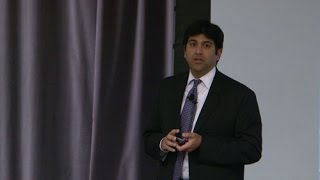
Aneesh Chopra walks through how government open data and public-private partnerships spark innovation. The Alford brothers built a 401(k) fee analyzer from Labor Department data. Dr. Van Sickle created a GPS-enabled asthma inhaler. Katie Stanton organized SMS 911 for Haiti after the earthquake.
Chapters
that we have a philosophy in Washington that if we're going to tap into your entrepreneurial spirit, we have to be responsive and kind. Because it turns out Washington can contribute to your entrepreneurial capabilities. We can release data, we can engage in standards activities, and we can invest in pre-competitive R&D collaboration. To manage all of this, we need the capacity, and so we've been recruiting people from the entrepreneurial sector into our agencies. Example 1, people that are building value on their own data. The Alford brothers from San Diego found out that 401(k) management fees vary tremendously based on the size of the company. If you work for a small business, you could pay 5%, 7%, 8%, 10% management fees. You work for Stanford, you're probably paying 1%. They cumulatively added it all up and said $4 billion of excess management fees are going to companies, not into the pockets of folks in their retirement. How did they find all this out? Open data. The Labor Department collects the management fee information for every 401(k) plan in America. And thanks to President Obama's Open Government Directive, we gave them that information in machine-readable format and got them the data they need to plot their diagrams and prove the the problem, and now they've built a startup hiring 30-some-odd people and growing, making a business out of closing that arbitrage, creating an arbitrage. Dr. David Van Sickle lives in Madison, Wisconsin, about an hour north, does not have broadband in his house, identified or built a chip on an asthma inhaler that calculates— it's a GPS chip, tells you where you're located and the time you pumped your asthma inhaler. By crowdsourcing that data, he finds environmental factors and encourages you to better manage your— where you are and what you're doing so that you can avoid uncontrollable asthma. In his little prototype, he cut uncontrollable asthma by over 50%. Folks, people with uncontrollable asthma cost the healthcare system $3,000 a year. Data lowering costs, improving value. Dr. VanSickle. Bob, Dave, and Andrew are 3 random dudes here in Silicon Valley who worked for a company and found out about this open data business, looked for the largest file available. The largest file available was the Federal Register, which is the newspaper in legalese that tells you what's happening in Washington every day. These guys grabbed that data and turned what was only accessible to lawyers in Washington into a pretty simple to use and easy web experience so that you and I could actually figure out what's happening in technology today. I actually use this. It's a heck of a lot better than reading the Federal Register in the normal way. Well, after they won the Apps for Innovation contest at the Consumer Electronics Association, 3 months later, the Archivist of the United States, or AOTUS as we call him, picks up the phone and calls these guys and says, "Your design is a hell of a lot better than my federalregister.gov. Could you take over the site?" And they did. Bob, Dave, and Andrew came to the 75th anniversary ceremony for the Federal Register where they filmed the National Archives movie. What was it, National Treasure? That's pretty cool stuff. They're sitting there on stage. Bob, Dave, and Andrew, got to give them some love. Professor Wolski had an idea to create an Amazon cloud for universities, was successful in scaling it. His first customer was NASA. His proof of concept was funded by the government and now he's launched a startup and he's become a wildly successful entrepreneur in Eucalyptus Systems. Katie Stanton, I love Katie Stanton. Katie Stanton came out of Google, came into Washington to work for us in the administration. Katie is now at Twitter, but during her tenure in Washington, you remember the crisis in Haiti? Folks, when Haiti went— when the earthquake hit Haiti, they lost any functional 911 service. No functional 911 service. Within 3 weeks, Katie organized a group of 40 entrepreneurs, nonprofits, innovators, many of whom are living here in Silicon Valley, and they created an instant 911 system. Folks could test text message their problems to 4636 at no cost. That information was sent on the web. Entrepreneurs then allowed to find Creole to English translators, turning Creole to English, disseminating those messages throughout the recovery program. And wouldn't you know it, 40,000 messages were translated. Average turnaround time from when someone posted a problem to when they were addressed by a first responder, 10 minutes, in a world where they had no 911 system. And our friends in healthcare, my friend Peter Levin, a startup successful entrepreneur, created the Blue Button program that allows any veteran to download a copy of their personal health data safely and securely. Over 300,000 members of our active duty military, our VA, and our Medicare populations have now downloaded their data. Because in 90 days Peter and his entrepreneurial team came together and built the prototype, and now it's been wildly successful. The President mentioned it in the State of the Union. Arian Malik was a vice president at Relay Health. It turns out doctors couldn't email health records between each other because it violated patient privacy and security. Arian came in to run a 90-day project to get the private sector to agree to a technical specification for safe, secure email called the Direct Project. It was so wildly successful that one year to the day when we launched it, 95% of the vendors in the industry have pledged to adopt the protocol, a protocol built by Arian and his team. This is the story of Washington. These are the people that were gathering to build it, and it is our goal, our hope, that this infrastructure that we're building will support you as the innovators of the 21st century so that you could solve the health, energy, education challenges, become wildly financially successful at the same time, and help your country.