Cameron Teitelman: Acceleration Through Community [Entire Talk]
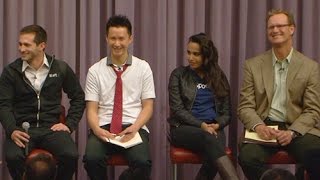
Cameron Teitelman, founder of StartX, discusses how the Stanford accelerator program uses community to help entrepreneurs move faster. The talk covers StartX's model, its connection to Stanford, and stories from founders who went through the program.
Chapters
So all of you know that this is the DFJ Entrepreneurial Thought Leader lecture series, and it's brought to you every week by the Stanford Technology Ventures program and by basis our wonderful basis students here. And it is generously underwritten by DFJ and you can find it online at Ecorner Stanford Edu. Today we have a really fun, fascinating panel. This is a panel of folks from StartX. How many of you in the room know what StartX is? Great. And for those of you who don't, you're going to be very educated in a few minutes. I want to start by introducing Cameron Teitelman, who is the founder of StartX. It started out as a, essentially as a project that he started as a student here when he was a student in the management science and engineering department and then ended up spinning out into a very exciting venture. So I'm going to hand it to Cameron to introduce the other panelists.
Hi, everyone. I'm Cameron Teitelman. Tina, thanks for the warm introduction. Just a couple years ago, I was sitting in your seats. I'm very honored and privileged to be here. So our panelists today are some very, very impressive people. Way more impressive than me. So they'll have a lot more to say than I will. Our first is Joseph Huang, a good friend of mine. He was in a very early session of StartX. The second session, his company, Wi Fislam, does indoor positioning. And I'll let him talk a little bit more about that. About? Oh, he can't say. But about a year ago, his company got acquired by apple for around $30 million. A couple years after founding, these guys were out of the PhD program at Stanford. And so I'm sure he'll be happy to talk about his StartX experience. And then we have Sidha Saxena. So Smita was a math and computational sciences master's student at Stanford, was in the first program of StartX, and actually went through another program at StartX a couple years later. Her first program was a financial advisory company that sold. And then she. Well, I'll let her talk a little bit about the other ones, but she reformed another company and went through. Then we have Milt McCall. Milt's one of the EIRs that went through StartX and he was with us for about a year. His company is really fascinating. It puts the iPad in the operating room to monitor blood loss. And Milt, I'm not sure if he'll say this, so I'll just say it for him, but he was an undergrad at Stanford and he was a medical school student. And while he was in medical school, he won two Super bowl rings for the NFL, for the 49ers. And then he founded a couple biotech companies, did a few things like managed the venture fund for Stanford's athletic school, and now he's founding this company.
I also want to add that he was a classmate of mine at Stanford Medical School. So go mill. Great. So let's start out. You assume, of course, that Everybody knows what StartX is. Maybe you could tell us a little bit about what it is so that we all have a shared understanding.
Yeah. So at the core, StartX is a community of high potential founders out of Stanford. And as an organization, we organize them to help each other. We do this in a bunch of different ways. And one of them is we have an accelerator program. It's basically a 10 week program where you have to have at least one Stanford founder on your team. You come in, we figure out what you want to learn, and then by the end of that 10 weeks, we help you learn that. We also help develop specific skills that in our initial research setting up the program, we found Stanford alums did or had learned to be successful. So in the initial stages, when I was actually in E145, which is tomorrow, a class that Tom Byers, who started STVP put together, I went out and talked around 220 Stanford alums to figure out what made them successful. And out of that research we figured out some patterns and some skills that they had developed that made them successful and a certain type of network they had formed around themselves. And so StartX is an attempt to educate entrepreneurs who are building companies out of Stanford, help them develop those skills and manage the extended network that develops.
So let's pass the mic to these other folks because it would be really great to hear why they chose to be at StartX. Clearly the three of you on the panel could have started a company anywhere. Why did you decide to take part in the StartX program?
Great. So we'll start with my story. So as Cameron mentioned, we were in one of the very early programs and so we were just grad students, Software in Computer Science 2011. And we were in the process of starting our own company and maybe didn't quite really understood what it really entailed. And we had applied to StartX mostly because other entrepreneurs had told us, hey, this is a really interesting thing to do. But once we had got in, it didn't take very long to realize this is an incredible, incredible opportunity. And if nothing else, Just an opportunity to spend your day to day with some of the other top entrepreneurs from around Stanford and future leaders and visionaries of Silicon Valley I think is priceless. And maybe we didn't even appreciate that enough when we started.
Cool.
Yeah. So to kind of echo Joseph's thoughts again, I was also a grad student and I also didn't do my undergrad at Stanford, so wasn't really familiar with the whole idea of startups. I came out to Stanford and was taking classes and you kind of get sucked in. That's all everyone talks about. And everyone's like, when are you going to start your next thing? And so I took a class to learn how to code and we had a product and had no clue what to do to start a company. And so we were actually part of StartX's first class. I remember our interview was at, I think it was Tressiter. Really nerve wracking. I mean, you have seven minutes to explain your business. And we built a little project in class and we had to kind of make it sound compelling. But Cameron was really nice and all the mentors are really great and they saw something and I think that's kind of their job is to take something very raw and mold it into a company that eventually got sold. And even in terms of the practical matters, like how do you structure your company, what are the legal matters, other entrepreneurs who've been through it, what are the pitfalls? How do you even think about fundraising? When should you be fundraising? These are all questions I didn't even know I should be asking myself before I got into StartX. So I mean, I guess it helped me the first time and then I came back the second time and it's been just as helpful and this is a bigger company, so it's been exciting.
So my introduction to StartX really was a little different. I had been in industry for 25 years, I'd been in startup companies, I'd been in venture capital, so I was pretty familiar with the whole process. But I'd come back to Stanford and do some mentoring at the Stanford Bio biodesign program. And ironically they were short a business student that one quarter. And the guy who leads it, Paul Yock, asked if I would actually be the business student on a team. I thought, well, that sounds kind of fun. I actually never went to business school, so I'm not sure how I could have qualified for that. But I ended up meeting the co founder of the company at the end of the course. We ended up sort of deciding to start a Company not based on that project that he had, but a different one he had going on. And the next thing I'd say a few months later, he asked me one day if I'd be the CEO of the company. And so it's been two and a half years and it's been a great experience. We were fortunate because he knew about StartX. I had been around Stanford for years and knew nothing about it. In fact, I'd been trying to start something like this in the medical side at Stanford, but being an alum and having a bunch of people trying to help me, I realized it's really the students that get things done. So somebody like Cameron, it took someone like him to actually get this started that I was able to join into it and be a part of it. It's been a great community and I feel like, you know, I feel like I have something to offer some of these other, I'd say younger students or alumni. On the other hand, many of them teach me stuff. I knew nothing about iPads and software and all this. I'm learning up to my ears on stuff now.
So, Cameron, maybe you can help us understand the relationship between StartX and Stanford. I have to say I've been here long enough that I remember the days when Stanford was allergic to the idea I of having any sort of incubation or acceleration programs. Basically saying, listen, Silicon Valley is one big incubator. Why do we need something like that? So maybe you could tell us about how this came to be and what the relationship with Stanford is now.
Yeah, so I'll start with how this came to be and I mentioned it briefly. So I built two companies when I was at Stanford. Two completely different companies. One was a private equity company and one was an advertising company. And I, I learned a lot about entrepreneurship, specifically through the MSME program. I took E145, I went to all the ETL classes, and when I was building my company, I found that I needed to learn a lot of really practical things. And I kept kind of hitting my head against the wall trying to learn it, trying to learn it. And then I would go and talk to my friends or I'd go to a networking event and find some mentor. But it's seemed really inefficient. I got this really solid foundational education, but after that it didn't seem like there was much support. Even in Silicon Valley. I go talk to investors and to be honest, Silicon Valley is a great place and it's a very, let's say, meritocratic and honest place, but there's still people who will do shady things. And so when I was talking to other friends who had built companies, there was a lot of issues they saw in Silicon Valley. So what I did is I did what I learned in Steve Blank's class here is I just got out of the building and started talking to customers. And after talking to hundreds, this theme emerged where after a couple years, they finally figured out how to be effective in Silicon Valley. And so the people who built $100 million companies or $50 million companies figured out, hey, if I have the right support system around myself, I'll be successful. And they wish they knew it earlier. And then people who failed would say, I wish I had known how to build the support system around myself. Because when you're in a large company, you can go to hr, you can go to legal, you can learn all these different things. So after talking to them, it was very clear that there was this big missing educational need. And there's this problem where if you could just structure the resources of Silicon Valley, the existed in a certain way, the process for building your company out of the university could be 10 times more efficient. And so the idea with StartX wasn't to, let's say, create new entrepreneurs. It was to increase the speed of innovation and decrease the friction with people who will be. They might be successful anyway, but if we could move the needle on people who weren't successful to be successful and to make the successful people even more successful, that adds to solving problems in the world. And so Stanford, the relationship with Stanford initially, and you can look back on this, people were wondering, why are these guys doing what they're doing? Is this an incubator in the classic sense? Are we going to waste students time by supporting them if they shouldn't be supported, if they should be thrown out into the wild in Silicon Valley? And it was very clear from my research that it was something that was needed. And so we pushed forward, we built something, we launched it to our customers, we iterated on it. And a couple years later, Stanford has said, hey, this is great. This provides a lot of value to our community. So initially, we were legally separate from Stanford University as part of the student government. And then after a couple years, we spun out of the student government as a legally separate entity. We set a lot of relationships on campus. And then earlier this year or late last year, Stanford was after talking to President Hennessy and the CFO of Stanford. President Hennessy is the president of Stanford. For those of you who don't know, they decided that they want to financially support us to help us grow even further. So now they're giving us around a $1.2 million grant a year to help in our operations. And then separately we have a fund with them and the fund is a non discretionary fund that any company who goes through StartX, any participant can pull 10% of their funding round from the fund. And so I think like any startup, like we consider StartX a startup, we had a kind of rocky start where people didn't really understand us, but now we've kind of broken through, which is great.
It would be super to hear from the folks on the panel about maybe some interesting example of something you gained out of this. I mean, it's particularly interesting for the folks who came with very different backgrounds, either folks who had come out of classes where you were taught a bunch of foundational material or even milt, you were a vc, so you had a lot of background. What sort of benefit are you getting from being this type of experience?
There's too many great things about StartX to give you one answer. Maybe I'll just start. So first of all, we got there and as Cameron mentioned, we were one of the very early sessions and so we didn't really know what to expect either. But it only took a couple weeks before we realized this isn't your typical startup accelerator. We'd done some research to try to understand what a startup accelerator was in Silicon Valley and what really they do. And for example, we would walk in and surrounding us there were more, first of all, there were more graduate students than undergrads. There are people there building game changing technologies in very, very interesting businesses. And it wasn't just a bunch of people making Facebook for cats. And I touched on this earlier. In hindsight, the greatest value we got was just spending day to day with some of the top entrepreneurs from Stanford at that time who are going to become future leaders and future visionaries in Silicon Valley. And I got to sit in a chair beside these people every day.
Let's dig down into that though. Did you spend time discussing your problems with them? The challenges was there formal programming where you were working together?
I think it's incredible how much you can absorb and learn when you're both trying to tackle raw startup problems at your desks beside each other. When we had a sales problem and it was just, hey, these people aren't responding the same way we thought and they some other jetlord, gameclubs or anyone sitting across the table would say, hey, we ran into that situation we tried this, it worked well. We tried this, it didn't work well. People had gone through recruiting, people had gone through patent strategy, pricing, the whole thing. Company, I can go on forever. All the things you really need to do when you build a company. There's just great minds around you and it's not just people who are there trying to tell you their stories because they're building their companies too. I can go on forever. I don't know if you want to.
That's great.
That was perfect.
Yeah. So as Joseph mentioned, StartX attracts great people. And for us, I think it really, at least for my second company, spot on especially, really laid the foundation of how we built the company to start off with. So when I sold my first company, I took some time off and I reached back out of Cameron being like, hey, look, I think, I think I'm ready to get back into the startup space. I may do another startup. And so he was like, yeah, sure, come out, check out the new StartX space. And I did and I was blown away. It was massive. There's so many more teams, as Joseph mentioned that it was this whole collegiate atmosphere, which was great to see. And through that process I found my new co founder, which was great. Again, he was kind of the same stage that I was at Late Nights talking about the problems that we were excited about. And through that we also found our lead Investor Again, another StartX mentor who really liked us, fell in love with the idea that we were working on and was like, sure, I'll back you. Put together a seed round for us. And again, through StartX, we found our first employee and our next four employees as well. So what StartX, I guess, really serves as a really good filter for the kinds of people you want to be working with and the kinds of people who can help elevate your business down the line. And also at the same time, it's just really fun people. I mean, it's very rare to find smart people who are really driven but at the same time have personalities and are interesting and friends. I mean, I'm glad, Joseph, that I met you and that we get to hang out together.
Thanks.
And so from that perspective, it's been great for building memories as well as startup.
So I can remember the first thing I learned the first day at startup. I'm an early riser and I got up as usual early to get to work and I walked in the door and I saw a few people there already said I've never been. People beating me to work in the morning. But I actually recognized these were students that had been there all night long, and they're just leaving in a few minutes. So I learned that the culture is very different, obviously. But I'd say I thought a great example was I was sitting at my desk, and StartX has a bunch of tables, and all the founders sit around them. And it's a big community is what it really is. And I was chatting with the person next to me who was our director of engineering, said, gosh, we're having trouble with Apple. They have these iPads, and we can't figure out how to make this work. And all of a sudden, somebody turns around and says, oh, we did that last week with Apple. We met with this guy named Joe, and here's his phone number. Call him and he'll fix it for you. So it's this kind of collaboration community that really makes things helpful there. And on the same hand, I've been working in the medical device industry for 25 years. I mean, some of the companies, they have a startx med group, and I remember having a lunch session one time. We just started talking about the FDA and how to deal with the FDA. And I spent 25 years dealing with the FDA. Nobody can ever deal with the FDA, but there are some tricks to and working with it, and there are sort of things that are helpful to know, and so I was able to share some of that. So I think that whole part of being able to help your co founders is really what's incredible about the place.
So I'm curious, Cameron, how do you pick people? I understand that these days it's harder to get into Stardex than it is to get into Stanford. So what's the process of picking people? Because clearly the community folks that you have under that roof is very special, and that that's a huge part of what makes it valuable.
Yeah. So to preface that, we're a 501c3 nonprofit, and we have an educational mission. And so what we want to do is we want to empower as many entrepreneurs as we possibly can. And so when we were initially starting, a lot of the reason why Stanford didn't want. They were allergic to this idea of an incubator is they didn't want people who shouldn't be building the companies to be building companies. Actually, they didn't want PhD students to just do it because it was cool. They wanted them to, if they were going to build a company, to do it because they were really passionate about the problem that they were solving. A lot of people in the 2000s were getting funded just like money thrown at them. And so they wasted a lot of their time just working on problems that weren't useful, like Facebook for cats. And so one of our core criteria for accepting people is that they have an intrinsic passion for the problem that they're solving. They also have to have an ambition to, to solve it at a large scale. So motivation and passion are our number one criteria. The second is team dynamics. So we don't just accept excellent entrepreneurs, we want them to be in highly functioning teams. Entrepreneurship is very lonely, it's very hard. A core part of the value we provide we actually have kind of like an in house therapist, psychologist, like the D school at Stanford does. But one of the core values we provide is positive psychological motivation. Because a lot of times when you're by yourself coding alone in the basement or building alone in your lab, it can get isolating. And so providing people with a community of peers they can benchmark against, that they can talk to about problems, they can talk to investors about or mentors provides a lot of value. So having that core team that you trust, that you love working with and that complements your skills solves a lot of problems that companies face. And I think Noam Wasserman At Harvard said 70% of companies fail because of team dynamic issues. So team dynamics is number two. The third is ability to build and build quickly. So just like Steve Blank's concepts and the lean startup, you have to iterate quickly, even in the medical device, even in the medical industry. We try to push companies for this. So they need to be highly technically proficient in what they're building in order to iterate quickly. So we actually do technical screening and technical interviews on biotech companies, on stem cell companies, on IT hardware across the board. And the final and least important criteria to us is the idea. And that is weird to people sometimes. Why is the idea the least important thing? Well, it's important that our founders, and especially the CEOs have good strategic minds so they can talk about the problem and lay out and break down and reduce the problem that they're tackling in an intelligent way. And then when challenged on something, incorporate that and listen well. And so sometimes people can't listen or founders don't want to listen and they're too stubborn to listen. And that doesn't work. You can't iterate if you don't do that. So they need to be thinking through the idea correctly. However, everyone knows, well, people like you know, who understand this space, the initial idea, you start with Always changes. But it's important to us that the problem they're trying to solve always stays true because they're intrinsically motivated by it. How exactly they're solving it can change. And that's the framework we use.
So how long do people typically stay there? I know that one session is three months, it's a quarter. How long do people do? They say 1, 2, 3. Kick them out.
Yeah, exactly. Most people stay one. There's a couple teams that stay multiple quarters. So, for instance, our medical program is six months long because there's a longer iteration cycle for medical companies. Early on, we had a company, a great female founder named Karina Pickart, who built a braille labeler, a more cheap and efficient braille labeler, and that was a hardware company. And so she stayed on three sessions because the product iteration cycles are longer. So usually we say, well, you can stay on if you're going to become part of the staff and help the next founders. You can stay on if you really need help. And then we actually do kick people out if they're not making tough decisions.
But, Tina, there's one. There's one more aspect about this too, which is Stanford and StartX are these communities that are really powerful. And it's not how many sessions you're enrolled in StartX that makes a difference. It's the connections and bonds you form and utilize with the people who you connect with and bond with while you're there forever that matter. And we're still getting help from people in StartX today, as well as people we interacted with at StartX while we were there. And I don't think that's ever going to end. So technically we're in an infinite number.
Of sessions, so that's a really good way to look at it. I'm curious about the transition out. Is that an easy transition? Does it feel like you're sort of leaving the nest, or is it something you're getting kicked out? Or is that a really seamless process as you go from being in StartX to then basically flying on your own?
You want to take it or milk, go for it.
So I'll answer it. So we actually were there a little over a year ourselves and we really felt like it was helpful for us. But what happened to us? The company got a little bit bigger and so we ended up needing our own space. That's always helpful, I think, just because, I mean, that's part of the issue. But I think what Joseph mentioned is even the moment we left, you're still connected. Everywhere from physically, you come in and visit and be part of it, but through the Net and things, I mean, I would say we're looking to hire people. We send the word out and the next thing you know, we have startx people telling us things. Or we have somebody coming by Friday that's an expert in marketing. As we're getting ready to launch our product from, you know, a camera and sends out a message, there's somebody that's here that would like to help. So it's this constant communication that goes on, I think that really makes StartX so different.
Yeah.
And I think, you know, again, similar to what you said, the constant communication definitely helps. But even when we transitioned out, I think it was great that our office is right beside another starting company's office. And it's great, you know, we get to hang out, still solve some of the same problems. And the community kind of comes with you. And, you know, we try to have events after as well and stay connected. And it's been being alumni, I guess, is not as different as being still part of the program. You still hang around and are involved.
Great. So the community lives on. So can you talk a little bit about the business model? This is interesting. In a lot of accelerators or incubators, they take equity. They're all different ways in which this work. Can you tell us about the business model for StartX?
Yeah. So one of the, let's say what people say is a big differentiator of us is that we charge founders nothing. We don't take any equity. There's no cost. It's completely free. So the question is, how do we sustain ourselves? It's crazy, right? Well, the core idea behind StartX is a collaborative community of founders that helps each other. And so we didn't want to charge for that. We didn't want to put up a barrier to get excellent people in. And these guys can talk a little bit about that. And so what we do is we figure out what our founders need help with and who they can get help from and go to them and ask them to pay us to be able to help them. And it's kind of a weird thing. So we, we have partnerships with companies like Microsoft and Intuit, and on the medical side, Johnson and Johnson, Genentech and J and J. VC firms like Sequoia Capital is a partner, and Greylock and DFJ is a partner as well. And so they help us. Well, part of it is they believe in the values of our program and our mission. So they want to support Another part of it is they want to get in front of these founders. And so we've always been really stubborn in never creating an exclusive partnership because we want to have a level playing field for all of our partners and that's part of our revenue. We've actually the only, let's say donation based revenue we've ever taken is from the Blackstone foundation. And then we had a large grant from the Kauffman foundation in the past to produce a work product that's half our revenue. The other half's coming from Stanford right now. So, so what we're saying is we're going to bring in excellent people, we're going to help them learn from each other and we're going to give visibility to people. And that visibility is basically what people pay for on the partnership side. And on the university side we're going to say, hey, look, Jerry Yang never gave a percentage of his company to Stanford. Stanford didn't own anything. But both President Hennessy and the university had a great relationship with him. And so he ended up building a building here. And so what we're able to do for Stanford is drive donations through basically engagement and we're able to help them with their fund, with our fund, basically. So yeah, that's our business model.
Great.
It's working well.
Super, super. So who is there? When this started? I remember it was students, right? Students could, it was almost like taking, instead of taking a quarter abroad, they could take a quarter at this accelerator to work on their projects. Now I understand that most of the people who are participating are graduates and even alumni. So Milt, I know how many years you've been out of school. It's same as I have. So I'm curious, what was the reason why you switched from really focusing on students to alumni?
When you say participating, do you mean the staff, the people?
No, I don't mean the staff, I mean the startups, the founders. Right. It used to be that it was students. Students who were working on companies in their dorm rooms would come and spend a quarter. Now it's folks who are graduates.
I don't know if that's exactly accurate. You know, when we were in the program, it was a mix of both students and people who had come out from further alums of Stanford. For example, in our session there was Lark who was making sort of a sleep tracking iPhone accessory Diffbot was making. They're sort of using computer vision to solve unsolved problems in web parsing. There was, there was a number of people who added incredible value to us personally as well as to our company as well as to the communities. And these were already, they were already Stanford alumni when we had gone through the program. And then today, I think you still have a mix. I was taking part in the StartX community events and things. We still have many people who are students as well as probably the same mix of people who have more industry experience to offer.
Okay. And I'll clarify the initial intention with StartX. So our first summer we took people who are currently in school and people who are graduating, and then the following fall we were wondering, can we actually support people who are still in school? Is it possible? And through that we had a company, clear Ear, Lily Chuang, who was spending 70 hours a week on our company on top of school and she was finishing up her classes and she just needed some support and so we were able to help her. And when I was building my companies at Stanford, I was spending 80 hours a week on my company. And so what StartX really is for are people who are going to dive into building a company. They're going to do it regardless of whether we're there or not. That's actually something we vet for because they're so crazy passionate about the problem that they're solving that they're going to do it. And so if people are still in school and they're spending full time hours and working really hard and spending time at StartX or spending time with the company, we'll bring them into the accelerator program. Now that doesn't mean we don't still support other members of the community. Now one thing we do, for instance, is anyone who applies to StartX, anyone. We get feedback from all the judges online and in person and we do office hours for anyone and we sit down and spend hours, hundreds of hours, giving feedback because it's extremely valuable. You don't really get that. You go to a vc, you pitch, they say goodbye because we love you, it's me, not you. And they don't really give that hard feedback. And so we do that. And then what's happened is we had that segment that's like leaving the university, working full time in the company. And what we've done is as our brand has grown, we've gotten more and more people later stage. And so the percentage of non students has grown, but the absolute amount has stayed relatively the same. And what we're doing moving forward is we're moving three blocks off campus to this 12,600 square foot building that the person who designed the D school at Stanford is designing it and it will be moving in there in two weeks. And so over the next three months we're actually spending that doing this thing called, this initiative called OpenX. And we're trying to take our accelerator program, what we've learned from it, what we've learned from supporting the extended community and open that up to more earlier stage and students. And so we're working with STVP and the GSB and having lots of events there and trying to focus on saying, okay, well we kind of nailed this segment of the population. Now let's provide value to more people. We're a non profit.
Terrific. So in a minute I'm going to open it up to questions from the audience. So start thinking about your probing questions about StartX. So clearly a huge value comes from the community of folks who are working there. I understand you also bring in a lot of mentors and coaches. Maybe you can talk a little bit about what sort of people are involved in helping and what they get out of it.
Yeah, absolutely. So there's kind of four things that we provide. One is community, which these guys have talked a lot about. Two is mentorship. And we have a bunch of different mentorship structures from serial entrepreneurs who are lead mentors to an advisory board. For instance, on the medical advisory board of a company, they'll have a doctor and a CFO of a hospital to experts, hundreds of experts. I think we have around 500 that can come in and get on phone calls, do office hours, that sort of thing. But I'd actually pass it over to these guys. They're all mentored. And in fact, we bring our alums back to mentor the other founders. So maybe you can talk about what you get out of it and what your mentors get out of it.
Sure, yeah. So there are plenty of people who offered great, great help to us. I'll just pick out a couple. Jay Borenstein was our lead mentor when we were through the program. You know, he's a professor here. He was a grad student in computer science just like we were. He started his company sort of not, not really knowing what to do, just like we did. And you know what was really interesting, I think, was that StartX is able to pair you. I'm not. I think it's because they have zero percent equity. It's sort of, they don't have an incentive. They're not purchasing mentorship. Right. You, when you find that mentor who's exactly was you in your footsteps several years ago and built a successful company, it's A perfect match. You want to get help from them, they want to help you. And I think when you sort of open it up, you have a 0% equity, you have this really interesting dynamic, you get super tailored help. And we couldn't have done anything we did without Jay Borenstein's impact, and he's always been incredible.
And you've sold your company now, but you come back and help out other Starx founders.
What you did, I think, yeah, a lot of companies will come back and help, and I think it's just so tremendous. Even while we were running Wi Fi Slam, the minute it was possible, as soon as I had tried sort of this mentoring other companies going through the program, I realized I had way more to gain from me sharing what I'd learned and lessons I'd learned with them than perhaps even they have to gain from these lessons themselves.
Talk about that.
Yeah. So I'll give you a couple examples. First of all, it's really hard to be objective with your own company. When it's your baby, when it's something you're working on, you want to get perfect. And every hour of the day you're trying to, you know, while you sleep, you're trying to figure things out. And sometimes you just can't think clearly about it. But when you're sitting there and it's another company, maybe they're not in your domain, maybe they're not. They don't have the same background as you. And you're looking at it, you're like, but that, that doesn't make sense. Why would a startup, why would you want to do that? And then you, you walk out of that meeting and you realize, why am I doing what I'm doing? This doesn't make any sense. Right? But it goes much further than that. I think it's really inspiring. As StartX continues to raise the bar for people they bring in, you'll get to mentor teams that learn lessons that they've learned while they're building their companies. And it helps you too. It's sort of like two basketball stars comparing notes at the All Star Game. You can't possibly learn everything on your own. And they, as part of the mentorship process, they have to report their progress to you. And sometimes they'll show up and they'll say, hey, we had this really interesting sales tactic and we went in there and it worked great. And it's worked three times out of four and you'll say, hey, let me take notes. This is really interesting. And sometimes they'll just inspire you. Sometimes you're starting a startup is like a roller coaster, as I'm sure you've heard a thousand times. And sometimes it just takes another team pushing as hard as they can to overcome adversity for you to say, all right, I'm going to strap in, I'm going to do it too. And so it just. I could go on forever, as always.
What about Milt? You've mentioned a lot of.
Yeah, so I learned in life early on that there's nothing free in life. And although they don't take equity, there is a commitment. And the commitment is you're part of the code. And the code is you help out your fellow co founders. And every founder is extremely busy. They work 18, 19 hours a day, a week. We pull all nighters there. I haven't pulled all nighters since medical school. And here I was pulling all nighter at startups one night. And it's just part of the code. Yet at the same time, when one of your founders next to you has a problem and it's something you can help out in, it's your obligation to stop what you're doing and help them. And it is a very interesting culture here because it works. It works because that's what everyone expects of you when you go there. So they help you and you help them, and that's what makes the system work.
Right. So I had the pleasure of sitting on a board actually with Joseph. Right, yeah. So I remember. And these are also words of wisdom from Joseph, I will admit this. So it was a company, they were presenting and they were getting reamed by all of us. And I felt terrible because, I mean, here's the founders. I mean, obviously they're very passionate about what they're doing, and we just disagree and. And then a comment was made. And this has always stuck with me. It's like, if you tell someone you want to build a rocket ship, no one's going to ask questions. If you tell someone you're going to paint the shed, suddenly everyone's going to be going on about what color. And so that's exactly what's happening. And then you kind of start thinking about, well, wait, I've been in this situation before. When have I been painting the shed? And no one pointed it out to me. So it's moments like that when you feel like, okay, great, I'm at the right place. And this is, you know, I'm learning just as much as these guys are learning. And I'm really glad to be part of this whole process. And I think StartX does a great job of kind of making that happen because they take into account how I've worked in the past, how the other mentors have worked in the past, how we're going to have rapport with the team. And having few teams and having alumni that are engaged kind of really makes it easier to make that happen. So I really appreciated that part of it.
And of course, something that's a core staff value, and a core value of StartX is feedback. And constantly getting feedback from people around you, your mentors, your customers, most importantly, is essential. So we get a lot of feedback from our mentors and a lot of what our mentors say. Well, one, there's an affinity, like this person was me, and so I want to help them. Another is they actually learn a lot. Like, technological innovation is so fast and there's so much new stuff happening that just by mentoring guys like Joseph, you learn so much. And then a lot of them come to me and say, oh, I learned this. I'm going to bring it back to my company now and talk to my co founders about it. And so these mentors are there because they want to learn, they want to help people who are in their shoes. And there's a lot of people who want to get involved in Stanford, who want to get involved in StartX just for deal flow, for instance, or just to get stuff out. And we actively vet those people out, and we constantly are getting feedback on them. And so if people misrepresent something and they are bad actors in this community, then they're out.
Are they allowed to invest? If you're a mentor, can you invest?
Not during the program. So if you have an active mentor relationship with someone, you can't as a mentor, they actually have to agree to something that says they can't even tell the founder they're interested in investing while they're mentoring them. Now, after the program or after the mentorship relationship, we allow the founders to make the decision. We say, hey, if you want them as an investor, here's the steps you need to go through to make it an appropriate relationship. And then we warn if someone's mentoring you, they have inside information that they could use against you in a negotiation. So just be careful about that. And then we are again, actively evaluating our mentors to make sure that they won't do things like that. Interesting. Thank you.
So I bet there are some questions. Who in the audience wants to start? Yes.
Hi. Cameron, Joseph, Smedeta and Milt. So we were also at my company, Vergence Labs, was also a StartX alum company. And yeah, one of the StartX I want to say is very awesome and one of the things that we got out of it is that we learned when we started we were trying to build sort of a lot of similar but different products at the same time. And actually advice from Cameron helped us focus on making this product which glasses that can capture your point of view experience. So we've been able to focus get that manufactured, had it even worn by Macklemore, got investment including from Tim Draper. So I want to say thank you to StartX. And also my question is for companies that are participating in StartX, what are the recommendations for how to to learn the most from that experience and then for Companies that are StartX alums, what are the best ways to Give back to StartX Community?
Can you just repeat the question briefly?
Yeah, the questions are as a StartX, as a participant in a program like StartX or in StartX, how do you get the most out of it? One, and then two, as an alum or a community member of StartX, how do you continue to get value and contribute value? Do you want to quickly?
Yeah, so I'll answer the first one first. The one thing I think I tell every founder that enters the program that I wish I knew when we started to sort of get as much as you can out of the program is take the time to get to know the other founders in your session. It's really, really easy to be heads down. Like if you're an entrepreneur, you love working on your startup and you will do that every day, all the time and it takes a while. You're only in the session for 10, 12 weeks and that first couple weeks no one really knows anyone. They run events. But go out of your way to get to know these people. They're all super fantastic. And if you do that, you'll get blown away by who they are and you'll have a better sense of how you can really help them. Everyone is trying to do a lot of stuff and, and some things are just really, really easy for you because of your background and really, really hard for them because of their background. But it doesn't matter because if you can save them three weeks of time with two hours of your time, you just create a really, really interesting bond that will last perhaps forever.
Sumita, do you want to answer the second question? Sure.
Like how can alumni contribute to work at StartX? I think the best way we've talked about this already is mentoring and staying in touch with the community. Making sure that if there are other companies kind of in the field or somewhat related to you, that you can reach out and make sure that you're helping. But I think overall, generally speaking, time's your worst enemy. As a startup, you're always trying to solve problems as quickly as possible. And this kind of, again, touches on Joseph's point is that you really want to get to know the founders, whether they're alumni or the existing class, to make sure that you're solving problems in a, a way that other people have already tried it and found an optimal solution. And so that way you can collaborate, make sure that you guys are reaching your goal together, but at the same time making the most of the program.
Any other question?
Yes, Bruce, it sounds like you're building.
Up an enormous amount of social capital within StartX. That's right.
Have you started to track one caitably.
How StartX founded companies or mentored companies.
Are doing versus some of the other.
Incubators in the Valley? Yeah. So the question is, how do we quantitatively track the success of our founders and our companies? So again, our core metric is what they learn and how what they learn translates to impact in their company. And so we do track that. We track how many skills a founder learns. They come and they say, hey, I want to learn what this, I want to learn this list. And then after being ripped apart by alums and mentors, they're like, okay, actually, I need to focus on this list. And then we help them develop those skills and then we ask them, how did that actually impact your company? Now that's on the nonprofit education side. And there aren't really other people that are doing that. On the, let's say, against for profit accelerators metric is usually funding or average funding per company. Our average funding per company is around 2.1 million per company. That makes us the number two on that metric, which for profit accelerators use. That makes us number two in the world, right behind Y Combinator, ahead of Techstars, 500 other accelerators, let's say. And so our companies have raised, I think, 350 million. There's 12 acquisitions. And 85 or 80% of our companies are still going and funded. 10% have gotten acquired and 10% have shut down. So in the startup world, those are great numbers. And our core thesis is if we can empower high potential entrepreneurs and help them develop skills to reach their potential, then they'll build successful things. And part of that potential that John was talking about over here was helping them focus, helping them throw Stuff away if they need to throw it away. And that's all about helping them critically think about the problems they're solving.
Terrific. Another question.
Yes.
So my question is geared mainly towards.
Cameron, but I was curious, in the earliest days of StartX, especially while you were a student here, what was it like trying to establish these relationships with mentors, entrepreneurs, without really having just tangible metrics to show or much substance? Really go off and show off, but yet.
Yeah. So the question is, at the very early stages, when I was starting, how could I. What was it like building a network and building these relationships, relationships to build StartX without anything? And I didn't come from a background where my parents know a lot of people. I was kind of a unit of one. And so what I did is one of the most important things when starting a company, which is figure out if you're solving a real problem very first thing. And I, with overwhelming evidence I had identified it was a real problem. Seventy founders had uniquely said the same thing, that, yes, I did this, and I'm so glad I did this. I wish I had done it sooner, but I'm unique. And 70 people said that. So it's like, okay, there's a problem here. And so with that problem, then I could craft a solution or a very clear, concise explanation for what I wanted to do and more importantly, why. And so then when I went to people and explained it, they got it like, oh, that makes sense. Here's the data that backs it up. And so they agreed. Now the question is, okay, even if they agree that's a problem, why would they think I can do it? Well, that goes into salesmanship and some other things. But basically what I did is what we teach StartX founders to do. I went to one founder I thought was great. I asked them, who are the other founders you think are great? And they told me five people. I went to all those five people and I said, what other founders do you think are great? What mentors do you think are great? And I went to those five founders and five mentors, and then I went to those mentors, talked to them and said, hey, which mentors do you think are great? And through that, I got warm referrals and connections into hundreds of people. And then you start drawing this kind of mesh network of who thinks who is great, and then telling people, hey, we're going to do this thing. When it happens, you want to be involved, and here are the other people who are going to be involved. And so it's kind of like building a Marketplace, startup, where it's kind of chicken and the egg problem. And we had discussions about that week over week. So it was getting one, getting the other, and using them to get more.
Terrific. Another question. Yes.
Can you share how many jobs have been created since starting?
Yeah. So I think the number. The question. Oh, the question is how many jobs have been created? So the last tally was roughly around 500. And so there's. I think that we have a different number now, but it's roughly around the 500 number. I don't know the exact stat right now.
So what are your goals going forward? You have built something that is incredibly impressive. I mean, I remember when this was an early seed of an idea and you really had a lot of headwinds when you started out. So you've really done an incredibly impressive job and clearly folks appreciate what you've done. What do you see as the goals going five years down the line?
Yeah. So the initial vision of StartX was there's 40,000 companies that have been built at Stanford. Collectively, they create $2.7 trillion of annual revenue. That makes it the 10th or 11th world's largest country. The people who are the most successful leveraged the group around them to be more successful. So the core vision of StartX was if in the past all those 40,000 people or companies were helping each other, they could have created a lot more impact. So the next step with StartX is saying, okay, well, if we can leverage the entire Stanford entrepreneurial network to help itself, that could materially increase and improve both the skill development, the access to information, and the access to people. So right now, we've supported people five years out of school, a couple people like Milt, we've had a CS professor go through the program, Monica Lam, a bunch of medical school professors. And so the idea is, okay, well, let's take this from this specific stage we're at of really supporting companies in this extended community to really helping the entire Stanford alumni entrepreneurial community getting value, providing them value, getting value from them for the other founders, and then use that as a test case to potentially go to other universities or be a model other people can replicate. Now there's a lot of universities from Harvard to MIT to other places who have called us, reached out to us and tried to replicate components. And yeah, just like the Epicenter is trying to create. Create more entrepreneurial engineers all over the world and all over the country. We'd love to provide a platform for universities and ecosystems to have a structured way for networks to help themselves.
Terrific question.
Yes, conventions, real world solutions to problems and such.
So it's not technology for technology's sake.
But creating maybe a solution for, for instance, on something as big as global warming and such. I know that's huge, but. So what type of criteria are you looking for outside of just the engineer come in with an idea to develop.
That'S going to really create a real world solution? Can I jump in there?
Can you repeat the question? Okay, sounds like the question was what criteria are there to make sure people are solving big problems for the world? And I just want to. When we were in there, we were the second session, I think they didn't have nearly as much leverage to sort of bring in great entrepreneurs, but even us going through our session. To our left was a company who had found a way to transform skin cells into beating heart cells so that they could do live screening of drugs and things. On my right was a company who had drastically transformed the economics for solar heliostat technology using AI and robotics. And I mean, here we are, we're just doing indoor positioning for smartphones. We're the ones that like, really. And I think it's just inspiring when you sit beside these people, you ask yourself, hey, could I be doing something greater too? I think everyone motivates everybody. And so maybe it's not just the criteria, maybe it's just the environment.
And I just want to reemphasize what Cameron said earlier about StartX. In terms of picking companies. They don't really look at the idea so much. It's really about the team. Because what you find out is it's all about pivoting. I mean, so many ideas. I was my very first company and we started One Direction and within a year we were in a completely different direction and we ended up being very successful. But it's not necessarily about the idea. It's about the people getting together and leveraging the thinking process and a bunch of smart people that work really hard. It's amazing how successful they can be together if they're working collaborative.
Back there. Speak up really loud.
How much cross pollination is there between teams? Like, do you recruit people from other.
Teams that are not doing as well into your company and vice versa?
Do you lose numbers if you're struggling.
To other teams that are doing better?
Sure. The question was, how much cross pollination is there between teams? Are teams recruiting from each other? Guess that's fair representation. So I think the common theme for the whole night has been StartX accepts great founders and you have people of great caliber. Who are coming in, who want to work on great ideas. There's generally, again, good rule of thumb that you could basically say that obviously you don't go out there and steal anyone else's employees, but teams break apart sometimes and things don't work out, and StartX is a great place there to find where you want to fall into. So, for example, for us, when I first went to StartX, I was actually working with someone else, and we ended up not working together. Similarly, now my co founder was working with someone else, and they also didn't end up working together together, which is, again, having an environment like StartX, which is very safe and supportive. It's perfectly fine to experiment and things don't work out and you move on. Charles and I ended up working together on Spoton, and it was great. I mean, at that point in time, it just clicked. It made sense. We were like, we're supposed to be co founders and now we can move on. So in that way, it is partially true that it does create relationships where there wouldn't have been otherwise.
Yeah. So one of the core things we focus on is reducing the barrier for people to help each other, and that's trust. And so we have certain community norms around not poaching employees and not doing things that are shady again. But then we also spend a lot of time building trusted relationships between the founders and creating rules around engagement. And what that does is it allows us. We actually one session went from 15 to 30 companies, and the work for the staff went down. It's like, oh, interesting. And it went down because we focus on providing mechanisms for founders to teach each other and reducing the barrier. And so, yeah, the core value we provide is creating trust between founders so they can help each other. Yes.
Do you know what the breakdown is of participants coming From STEM backgrounds vs software Humanities backgrounds.
That get into the program or that apply? So, yeah. So I'm not sure about the applicants. We definitely have way more. Way more STEM backgrounds than humanities. And we also have way more STEM people apply. And we don't really look at people's backgrounds as a. Let's say we do look at people's entrepreneurial backgrounds. Have they tackled hard problems before? Have they tried to solve some inefficiency training just out of their pure frustration with it? But we haven't had as many soft majors go through the program. We definitely have had some. We've had some people. There was one founder who was building a company kind of like a mint.com but for minorities, instead of using a web Platform using cell phone, just texting. But yeah, we've had them, but definitely not. Definitely not as much. Another question. Yes.
One question is, you said Stanford doesn't take any equity. How does.
Is there any licensing deals?
You know, Stanford, I mean, if.
To some extent.
So the question you asked is StartX doesn't take any equity and you're asking if there's any licensing deals with Stanford. Is that the question? Yeah. Based on the ideas within the.
Is the question whether Stanford has any IP interest in this?
Yes.
Okay. Yeah. So StartX is a legally separate entity from Stanford and so there's no issues with licensing and we don't take any IP. So if a PhD does research at Stanford and uses material resources, Stanford independent of StartX owns part of that IP. And so that's kind of an independent process from StartX. Yes.
It would be interesting to hear from each of you if there's a single personality trait that attributes to a funder's success.
So the question is, is there any personality trait that you've seen contributes to the success of a founder?
So Tom Stennison was asked once, it took him about a thousand times to figure out how to make a light bulb and he didn't say he failed 999 times. He said, you learned 999 times how not to build a light bulb. And I think that's really what's key about entrepreneurs. If there's one thing that you have to be able to deal with failure because that's what the whole learning process is about. And I think that's what the support of a place like Starbucks offers for you. As somebody mentioned earlier, entrepreneurs and startup companies are roller coasters. And you're going to spend a lot more time on the downside of that roller coaster going than it seems like you're on the upside. So I would say, if there's one thing I would say about it, and this comes from being a venture capitalist and being in startup companies myself, is there just has to be perseverance. I think that's the one overriding characteristic.
So I think this might be a little bit more random, but I think for me the most valuable characteristic was empathy. I never thought this would be important coming into doing a startup, but I think it's been incredibly helpful when it's come to recruiting, to finding investors, to finding my co founder and keeping relationships. Startups are very rocky and what that ends up doing is it ends up making you question the kind of decisions you're making and who you're working with and having empathy at those points of time and not really pointing fingers and taking a step back and talking through things can be very helpful and instrumental towards making sure that grow this thing out before beating it to death in the beginning.
Yeah. Perseverance and empathy are far and away my number one and two. Same reasons.
I think I have a slight variation of that, which is actually, it's kind of like it's sad. It's the combination of perseverance and empathy. What I was thinking is, as a founder, you have to be okay taking risks and failing and thinking of that as learning, just like Milt said. And you have to have this. I call it humble confidence. And it's this trait where you're strong and you can inspire people to follow you because you're not afraid of making tough decisions or taking risks. But at the same time, you're constantly listening and you're constantly trying to learn and become better and using every single opportunity interaction to learn something. And so you're both humble and extremely confident.
On that note, going to have to call this to a close, but please join me in thanking this fabulous panel.
More from GHION.AI


O processo de reconhecer limites, mesmo quando a vida parece exigir sempre mais.





Depois de tantas histórias, aprendizados e pausas necessárias, o @interior_iza está de volta



