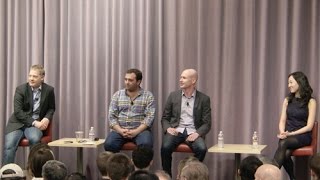
This content was created by GHION.AI . This content was uploaded by GHION.AI . This is a YouTube video titled "Ching-Yu Hu: Challenge of Scaling Culture" created on March 7, 2013. It features Ching-Yu Hu discussing the challenges of scaling company culture at SkyVox, an aerospace company, as it grows from a small team to a larger organization. The talk highlights the company's approach to maintaining transparency, collaboration, and innovation by hiring diverse talent and fostering an open environment.
Chapters
And you know, one of the challenges that we faced has been learning how to scale the culture. You know, when it was just 12 of us in a small Palo Alto office, we always had a pulse on what was going on just by the sheer number of hours that we spent together in very confined spaces. And I was the only girl and 13 guys. But you know, how do you think about scaling, transparency and collaboration and creativity when you're now 85 people and you have new engineers and new executives and new advisors and you've never worked with any of them before? And one of the things that we realized was that we had an opportunity to completely change what it meant to be an aerospace company. So traditional aerospace, they're very risk averse, they're very bureaucratic, and they're largely beholden to meeting the SPECs of the US government. And at SkyVox, we like to say we're bringing the Silicon Valley approach to aerospace. And we're building satellites like Silicon Valley companies build agile software. And we're always using the latest and greatest technologies and just iterating really fast. And one of the ways we've tried to reinforce that culture is just to hire people that are just from very diverse backgrounds, give them an environment to innovate that's kind of unencumbered of traditional aerospace. And so if you walk through our office, you'll walk through our engineering bullpen, you'll see aerospace engineers that are working on space qualified hardware and they're sitting next to software engineers that are building out data mining and computer algorithms. And from the engineering bullpen to our class 10,000 clean room where our system engineers are integrating components on our two satellites, you might trip over a dog or get hit by a Nerf gun. And another thing that we were really focused on was learning how to scale our transparency was really important to us. And so every Sunday night, Dan sends out an email to the entire team outlining the five challenges, five goals and accomplishments for the past and following week. On Mondays, we have our all hands where we celebrate anniversaries for all our employees, introduce new ones, and give updates across the departments. And after each board meeting, we actually brief the entire board package to the entire team. And so it was really important that we are briefing the board exactly what we're briefing the employees, so everybody knows what our key milestones, our challenges, our risks, even our cash position. And we're moving so fast that we can't afford to have restricted information flows. So we always err on a full disclosure. And finally, if you look at the people at Skybox. We've just been really, really fortunate just to have just an amazing collection of people from RF engineers to UI software engineers. And if you look at why they actually joined Skybox, it wasn't because of pay. I mean, some of our employees uprooted their kids from high schools to relocate across the country. They dropped out of their PhDs. And we really were able to hire people on the basis that we would provide them a very unique, once in a lifetime journey to revolutionize the way that businesses make decisions and people view the world. We were able to hire people based on the fact that we could give engineers the opportunity to build software and hardware and infrastructure to build something that actually goes into space. It moves at 7,000 miles per hour and beams down to terabyte of data per day. And I think we're just getting started. And we still have a very long way to go to prove ourselves. But I think that the four of us will look back in about 10 years and will really judge how well we've done based on how we've scaled our culture. And I think if we get that right, everything else will follow.