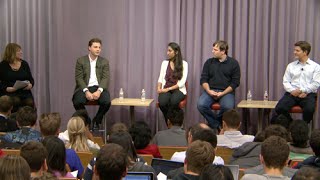
This content was created by GHION.AI . This content was uploaded by GHION.AI . This is a YouTube video titled "Chuck Eesley: Stanford Innovation Study Findings" created on November 28, 2012, presenting findings from a study conducted by Chuck Eesley on the impact of Stanford University's entrepreneurial activities. The study surveyed 143,000 Stanford alumni, faculty, and staff, revealing significant economic contributions, including 39,900 companies and 5.4 million jobs. It also discusses the influence of entrepreneurship courses and business model changes on startup success.
Chapters
So this all started for me a few years ago when I first arrived at Stanford back in the summer of 2009. And like all of you, you start seeing these examples and hearing these stories about successful entrepreneurs and alumni and faculty going on to start companies out of their research and their technology. And so I began to wonder, what's the overall impact of all of this? If we were to sum together the aggregate of all of this entrepreneurial activity that Stanford is producing through students, through alumni who have passed through Stanford and been exposed to the entrepreneurial environment or been exposed to some new technology through faculty, what would the aggregate results of that be? And so I set out to do a survey of all Stanford alumni, faculty and staff. And so this was a large undertaking, obviously. We sent the survey out to 143,000 Stanford alumni. So this covers across the schools across graduation years. So we got responses from alumni going back from the 1930s up through graduates from 2010. And so we got back out of these 143,000, we got back 27,000 responses. So this is both from entrepreneurs and from non entrepreneurs. And so if you use that data, which took a lot of time to crunch the numbers and add all of this up, you wind up with 39,900 still surviving companies have been created over the decades by Stanford alumni and faculty, which have created 5.4 million new jobs and annual worldwide revenues of $2.7 trillion. So Stanford on the whole, is having a large impact on the economy, both locally and globally. And Stanford is, on the whole, importing founders into the state of California. So just under 35% of the newly admitted students at Stanford are from California, but 45% of the alumni founders wind up founding their companies in California. So I just want to highlight two other quick results. And then there's a lot more in the report, which you can download from the website. But two other interesting results just to kind of pique your interest. One is, you know, as students, you may be looking out at the various programs and business plan competitions and courses and wondering, should I get involved in these? Should I work on my startup on the side? What should I do? And so we asked people who responded to the survey. These are graduates going back in time. Which aspects of Stanford did you interact with and were important in founding your venture? And so we gave them various options for taking an entrepreneurship course, participating in a business plan competition, and so on. And so, as you might expect, those who were innovators, who produced some sort of patent, new business process, new product, and those who were Entrepreneurs were slightly more likely to take these entrepreneurship courses. But the surprising result came when we looked at those who founded a company within three years of graduating and who had managed to raise venture capital in their firms. So 25% of the innovators and entrepreneurs in the aggregate had participated in an entrepreneurship course of some type. But 60% of those quick founders who had been able to raise venture capital within three years had taken an entrepreneurship course. And similar results for the programs and business plan competitions, STVP center for Entrepreneurial Studies and the D School. The other interesting result comes around. We asked the founders if they had changed their business model. So we asked them, is the business that you're running now very similar to the business model, the vision that you had in the beginning? And we gave them several categories. Did the target customers change? Did the revenue model change? Did the sales channels change? And so we found that 60% of the founders indicated that they had changed the business model from the beginning. And in particular, only 13% said they had the same target customers as they thought they would in the beginning. So, you know the classic thing, look to your left, look to your right. If you look to your left, then probably if you're all founders, the person to your left is going to wind up changing their target customer from what they think it would be. And if there are 200 people in the room, then perhaps only 26 of you are going to wind up choosing the right initial target customer in the beginning. So we also looked at the performance implications of this, and I'll tell you just briefly, a couple of interesting results. So when you look on the whole, those who had changed their business model have slightly lower performance than those who stayed with their initial vision. The differences aren't large, but median revenues of 150,000 compared to 200,000. So, but when you look in particular at the software and Internet firms, those who had changed their business model in some way wind up having higher revenues than those who did not. So about 500,000 median revenues compared to 200,000. So I think that this shows that one, it's perhaps more about the insights into the correct business model that you get than about a particular number of times or whether you've changed the business model or not. And the second thing is that there may be some industry differences where, particularly for software and Internet firms where uncertainty is higher, then there may be more benefit from these changes.