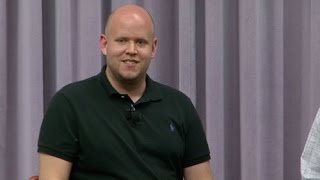
Daniel Ek explains how Spotify manages teams spread across global offices. He covers open office spaces, frequent travel between locations, virtual town halls, and using OKRs to keep everyone aligned.
Chapters
Because Spotify is an interesting company. You have a pretty sizable office in Stockholm. You got a pretty sizable office in London. You're building one here on the West Coast. You've got a team in New York. And how do you manage and lead a group that's scattered over two and a half continents and four offices? Yeah, first off, it's incredibly tough. Even with all the modern technologies we have of video chat and Skype and phone calls and all those things, the fact that you have proximity, just the amount of discussions you can have by just sitting next to someone, matters a lot. So what I do, first and foremost, I sit out in a sort of open office space. I don't have like a particular room or anything. I just sit outside because I love hearing what people are talking about and engaging in conversations. The second thing is I travel a lot, so I spend a good amount of my time in all the cities you mentioned. So I'm here six, seven times a year. I'm in New York every month. I'm in London a lot of times too, and I'm in Stockholm. So in my case, I don't think the physical presence can really be replaced yet with sort of video or anything else. So. So first and foremost, a lot of it is just meeting people, sitting down, talking to them and talking to the team. But I also think we do things where we have virtual town halls where we, every two Fridays, I, depending on where I am in the world, stand up and kind of talk to the company about what we're doing and people can ask questions. Spotify is a pretty big company. We're like 500 people. So it's a lot of people, but it's really been one of those things that we've always had across our company. We want to share as much information as possible. And even if you look inside of Spotify, you'd find that pretty much all of our metrics are available to everyone because we think that by empowering people with data, they're going to make much smarter decisions. And a lot of that really is by sharing information. And. And I'd say the third thing is actually a thing John Doerr taught me, which is this process called okr, which is a very simple management methodology that a lot of companies use. Google, Facebook, Spotify, Zynga, and a lot of others, which is really, really simple. You put up an objective that you want, for instance, the whole company to do, and you focus on three to five key results, and those have to be measurable results. So in the case of Spotify, it could be grow the amount of subscribers by 50% this quarter. That would be a great target, by the way. Everyone sign up? Yes, exactly. Then we've solved it. And that way it kind of distills throughout the organization. So everyone in the company knows what the the company's target is for the quarter. But then also everyone can relate to that as they make their own targets and can kind of map that against the overall target, but it's hard work.