David Eagleman: A Brainy Approach to Innovation [Entire Talk]
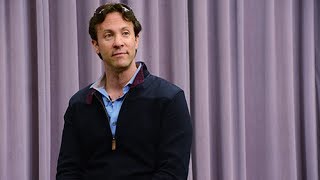
David Eagleman discusses how neuroscience shapes innovation, from sensory perception and brain plasticity to virtual reality and entrepreneurship. He explores the role of science fiction in driving scientific breakthroughs and how understanding the brain can unlock new technologies.
Chapters
I want to start out with a question for you about the role of science fiction in science.
Yeah, okay, good question. First of all, thank you so much for being here. I really appreciate it. So I just mentioned to you earlier, on Friday, I became the scientific advisor for Westworld HBO show. Does anyone watch Westworld here? Okay, so that really got me thinking about this question about the how close science fiction is to the practice of science in the laboratory. Because what's going on with Westworld is they think ahead 30 years and they think, okay, well, past silicon, past the next technology, how would we build a brain? What would that be out of? And so on. And what's cool is they get to be rooted in what we know about science, but also to have wings and to go and think a few steps beyond. And really, when practiced correctly, that's what science is. Science is about making these leaps, leaps that are actually illegal to make, that you can't even make. But then you look back and you see if you can build a bridge to what we already know. So science and science fiction, there's sort of this interesting place where they overlap, where I think the best kind of science gets done, where you generate possibilities and see which ones might be true.
So the way I hope to structure our time together is that I'm going to ask a bunch of questions at the beginning related to science and your research, and then move into questions about entrepreneurship and about how you're applying this. And then I'm going to open up to questions from the audience so you can start thinking along the way of the type of burning questions you have that you might want to ask toward the end. So we have a lot of engineers who are in the room, and these engineers deal with sensors of all different types. They're light sensors and pressure sensors and heat sensors and chemical sensors. And you are an expert on sensors in the body. What does an engineer need to know about the type of sensors we have in our body and how the brain processes them?
So this is a topic that I've been so interested in for many years, and I've started to take sort of, sort of an extreme view on this, which is I think that all the particular sensors we have for electromagnetic radiation and air compression waves and molecules floating in the air and so on. I think these are all plug and play receptors and that the brain is sort of a general computational device, and you can plug whatever you want in here, and the brain will just figure out what to do with it. And when you look across the animal kingdom, you find all Kinds of weird and interesting peripheral devices that are plugged into animals, whether that's heat pits or magnetite, so they can align to the magnetic field of the earth or electroreception or, you know, any kind of thing that, you know. Like the star nosed mole has this nose with 22 fingers on it that it feels around and constructs a three dimensional model and so on. You've got all these different peripheral devices. And so the thing that got me really interested a while ago was this issue of can we build new peripherals? Can we build a new sort of thing where we're plugging information into the human brain via an unusual channel? So one of the things that we did in my lab, you probably know about this, of course, is the. We built this vest. I actually brought a demo along here so I could show you guys. We built this vest where we can, I can capture sound. So as I'm speaking, this is picking up what I'm saying. And then what I do is I wear this vest that picks up all of.
Most speakers keep their clothes on.
Yeah, not this one. By the end of the talk, it'll be the full Monty. Anyway. Yeah. So what's going on is the sound is getting picked up and translated into patterns of vibration on my body. Each of these are vibratory motors. And so what's happening is as I speak, the sound is getting captured and turn into patterns of vibration. And deaf people can come to understand the world this way and they can come to hear the world through patterns of vibration on their torso. And so this is, you know, if it sounds wacky, it's essentially like the way a blind person can read a braille novel and, you know, cry and laugh based on the information coming through their fingertip. Right.
So.
So it's the same sort of thing, essentially. We're taking the inner ear of the cochlea and putting it on the torso. And the part that's been of great interest to me is there are 53 million deaf people in the world who are severely or profoundly deaf. And so we can just cure that now for under 1000 bucks. Whereas the only other solution for deafness is a cochlear implant, which is $100,000 in an invasive surgery. So this is something that's going to change the whole world. So I'm very jazzed about that. But I'm also interested in this issue about sensory addition. So if you're not deaf and you put on the vest, can we feed in new kinds of information to the brain and have you have A completely new kind of sense, a sixth sense. So we're trying all kinds of things. We're feeding in information about drones or factories or stock market data or weather data or Twitter data. We're feeding in all kinds of information streams into the body this way and seeing how you can develop a new sort of sense. And anyway, so this is where we are with that.
Well, it's super exciting. I'm wondering, is it like an echo? I mean, if you're talking and then you're feeling it on your body, does it feel like an echo of your voice?
So when a baby is learning how to speak, they babble, they say things, and they hear it with their ear. And it's exactly the same. You say it and you feel it on your torso. So it is like an echo, the same way that you hear what your own speech is. But we're very good at canceling out our own speech. You don't really pay attention to it. Anyway, it's the same thing. This is, by the way, a really important way that deaf people learn how to speak is, you know, they not only, like, watch your lips as they're feeling it, but they vocalize and feel what they're saying, and that's how they know what they're saying.
Yeah, super interesting. Do you think that there are senses that we have that we actually haven't characterized yet? I mean, we've got our five senses that we all know about and we learn about since we're little kids. But do you think that there are some senses we haven't even characterized?
No, with the exception of. Some colleagues of mine made this thing called the north paw, which just is a compass that's hooked up to a vibratory belt that tells you where north is. So people get really good at being able to tell where north is, but after they take off the belt, they're much better at it than they were, which tells me that there's some little whisper of a signal in the brain anyway. Maybe we have a little bit of magnetite, not known yet, not clear yet. But we have a little whisper of a sense being able to tell north. And after you train up on that and correlate the signals, and then you're better at it.
Oh, super interesting.
Yeah, that's great. But in general, we're really cut off from the world in a sense, in the sense that we've got these peripherals that we know and love, like our sight and sound and vision and our touch and smell and so on. But in fact, our perception of Reality is really constrained by the biology that we come to the table with. The example I always use is the electromagnetic spectrum. That's what color is. You look around, you see all this color in the world, but that's less than a 10 trillionth of the electromagnetic spectrum. You've got cosmic rays and X rays and gamma rays, and you've got all these different frequencies of electromagnetic radiation that are totally invisible to you. And all you see is this little bit that we have receptors for in the back of our eyes to pick up on the rest. You've got thousands of cell phone conversations passing through your body, and it's completely invisible to you. Why? Because you don't come to the table with the proper biological receptors for picking up on it.
Well, could you imagine a time where we would train ourselves to be able to just listen to the cell phone?
Right.
I call, coming in, oh, it's my mom.
Yeah, that's precisely it. It's the question of, what if we built new peripheral detectors? What could we pick up on that we're not picking up now? Because as it stands now, we're extremely constrained in our reality. Now, the issue is, and some of you have heard me talk about this before, but the issue is that we get used to our completely limited reality, and we start to believe that's the whole world out there. We think that our subjective world is the objective reality out there, which is so goofy because it only takes a minute to start realizing, oh, my gosh, I could be sensing this and this and this. The example that I use about this often is just imagine for a second that you are a bloodhound dog. They've got a big snout. They've got 200 million scent receptors. They have wet nostrils that attract and trap scent molecules. They have slits in their nostrils so they can take big nose fulls of air. They have floppy ears to kick up. Their whole world is about smell. So imagine you are that bloodhound dog and you're following your human master one day and you stop in your tracks and you think, God, what is it like to have the impoverished little nose of a human? Like, how can you not know that there's a cat 100 yards away or that your best friend was on this spot six hours ago? That kind of thing. So because we are humans, we're totally used to being in this particular, you know, sensing of the world, and we think there's nothing else. But in fact, there's so much more we could be sensing, and that's exactly what we're doing. With this.
So what's really fun about my reading your work and thinking about your work is that I'm reminded of David Foster Wallace where he does this sort of, you know, what is water? Right? You guys might know the story. The two fish are swimming and the older fish comes by and says, you know, how's the water, boys? And they go, what's water? And you are one of those people who thinks about what the water is, the things that we take for granted. And one of the things I think is particularly interesting is that you think about the way different senses are experienced by us. So why is it that we have these different sensors? Why does it feel so different than sound? And why does sound feel so different than touch? And what does touch feel so different than? Taste? Can you talk a little bit about your thoughts on that?
Yeah, I can tell you my hypothesis on this, which is the weird part about the fact that these all are so different seeming to us on the inside. The weird part about that is if you look in the brain, you see a bunch of neurons, the cell types of the brain, and they're all popping off. Every neuron in your head is popping off about 10 to 100 times per second. And if I showed you a little piece of the cortex and you see and I said, is that the visual cortex or the auditory or the somatosensory or the olfactory, you'd say, I don't know, it looks exactly the same. And as a professional who looks at this stuff every day, I would have no idea what it is. Why? Because it all looks the same on the inside. So why does smell and taste, why do these things seem so different? And I think it has to. My hypothesis on this is that it has to do with the structure of the data coming in. So vision, you have two two dimensional sheets with data coming in. Hearing is a one dimensional signal. Your fingers are picking up on this high multidimensional signal. You've got all these different signals coming in. And I think that they are different because of the structure. What that means to me, if this is right, is that when we feed in a totally new kind of signal, like let's say stock market data here, as somebody experiences that for months and months, my hypothesis is they'll start having a new qualia, as it's called, a new experience. That's not vision or touch or taste or smell, it's none of those. It's this other thing. And the thing is, we won't even have a word for it in language, because language is all about shared things like, I know what vision is, you know what vision is. So we communicate across the gap of our brains and we say the same. But if I'm experiencing something that you've never had any experience of, I would say, look, I'm experiencing shmagegy, and you wouldn't know what I'm talking about.
Oh, that's schmagegy.
Yeah. And the interesting part is if you try to explain vision to a blind person, they, at some point they'll even start pretending like they understand you, but they can't. They'll never understand you if they're born blind, because they've never had that experience of capturing photons from a distance and putting together this colors which are completely made up by the brain. So anyway, you can't explain vision to a blind person in the same way that I couldn't explain Shume Gegi to you. And the only way you would ever know it is if you wore the vest and also fed in stock market data. And the presumption is that you would start experiencing this completely new qualia because the structure of the data is different. It's not like these other ones. It's this other thing.
Do you think that at some point we'd be able to read other people's minds if we were getting neural inputs from someone else?
This has been an interesting area in the field where people have been using, for example, functional magnetic resonance imaging, brain imaging, to measure all kinds of things and then try to see if we can figure out what somebody's doing. And a lot of people talk about mind reading, but it's only really with the visual cortex that we can do that pretty well, which is to say whatever's hitting your eyes, you have a sort of distorted picture of that on your visual cortex here. So you can use brain imaging and read that you and show people a lot of pictures, measure a lot of that and put together a neural network and figure out what they must be seeing. So it's called mind reading, but it's actually unfortunate. I think that's kind of where it ends and being able to read minds in a different way, like, oh, I'm hungry, I'm thinking about a burrito with guacamole on or something. There's no possible way that we're even close to that because it's a very different kind of thing because it's not laid out in this nice pattern. The way vision is, where it's essentially a television screen back here, you know, distorted.
Well, we do try to use pet Scans to look at and sort of intuit what we think people must be experiencing. Right. So sort of. I wonder if you could read it out.
It's super duper limited, and it's for several reasons. One is that our technology stinks right now. So FMRI is the hot thing that we all use in our labs and we publish lots of papers on it, but it sucks. It's not. It's, you know, all you're measuring is where the blood flow goes, which is a proxy for where the neural activity just two seconds ago. And you're measuring these chunks that have millions and millions of neurons in them, both excitatory and inhibitory neurons in them. So to crack the neural code, what we actually need is to be able to measure individual neurons in real time. And billions of them, 100 billion of them, essentially, that's what we're going to need to be able to crack the neural code. So FMRI stinks. So that's the first thing when it comes to. I'm thinking about a burrito. And that reminds me of my aunt who's from this place, and she once said this to me. But there's no connection there with what we're measuring in fmri. Yeah.
Okay, so we've got a bunch of engineers who are going to be working on this now.
Yeah, it's a good problem to work on for the future.
So you think about sensory input, but the brain is also a motor output system. Right. So can you imagine using these tools for actuation as well as just for sensation?
Yeah. So something like this is about building up more sensation, getting more sensory data in there. As far as getting information out for that. We need better ways to read the brain. Obviously we have things like electroencephalography, eeg, but that also is a stinky technology. Essentially, we're measuring from the outside of this giant, bony armored bunker that Mother Nature has to protect the pink computational substance of the brain. We're measuring from the outside, and you just can't tell that much. Here in Silicon Valley, I interact with a ton of companies that all say, oh, look, we can measure eeg, we can tell this whole thing, but in fact, you can't tell very much with eeg, and we never will be able to. So FMRI is better because you can actually see what's going on in there, but it has low resolution spatial and temporal resolution. So we need better ways of getting in there. But people are working on that. We're all working on our own pet projects and ideas and. And I think as the field creeps along. There'll be these punctuated moments where we have better ways of looking in there. And then we can really start, hopefully get down to the level of resolution where we can crack the neural code. And there's like 20 Nobel prizes that follow on from there. But one of the things that I'm writing about in my next book called Live Wired is about brain plasticity. And one of the things I think is interesting is how our brain drives the body. And it can do so very flexibly. So I can. When I go from an infant to an adult, I'm driving a very different kind of body. So you get this 3 pound control center and then this huge, monstrous robot that gets driven around. But I can get on a bicycle or a surfboard or a skateboard. I can do all kinds of things. My brain has no problem just adjusting and driving different things. So I think it will be no problem at all for us to be able to drive other kinds of machinery with our brain, whether that's driving a big crane or taking my robot for a walk on Mars, where I'm controlling it or whatever. There's no need for the thing to even be attached to me. And I hypothesize that we'll be able to drive it at a distance because Mother Nature came up with lots of great stuff, but she never came up with Bluetooth. And so there's no reason that when I'm controlling this limb that it couldn't be detached from me. Cool.
So I know there's a lot of enthusiasm for virtual reality, which is a wonderful way to control sensory input in a really sophisticated way. Do you do work with VR and how does that relate to your research?
Well, I'll tell you something that just struck me recently about VR. So many of you have probably done something like this. I did this thing where in VR. So this was at a conference. I watched several people before me do it, and then I did it. You get in this thing, and in this VR world, you get on one of these window washer platforms, and you end up going 500ft in the air on this window washer platform. In virtual reality, in fact, you're just standing on the ground at the conference, okay. And then you're at the very top, you're overlooking the city, and suddenly the front rail breaks off and falls off, and you're looking over this thing, and then you hear this voice telling you, step off the rail. Well, it turns out I watched a bunch of people do it, and they were too scared to do It And I thought, there's no possible way that I'll be too scared to do this. But then I was. I was too scared to do it because it was so unbelievably convincing. But here's the new part. The new part is we've never in our evolutionary history had this situation where I was in two places at once. Here I am standing above this 500 foot view of the city and I'm also in the convention center. And I knew that both things were true at the same time. And that is a completely new phenomenon that you can be. And so I had to finally convince myself I know that if I step to my death it's okay because I'm in the convention center. So anyway, I think there's a lot to be mind there about consciousness and how we understand our identity and where we are and so on like that. I'm also doing stuff with the vest in VR, by the way. This is more for entertainment, but the idea is we're putting a haptic stream into the vest so that as you are playing a, you know, as you're playing a game where you're, let's say, shooting and so on, you, you're feeling you're getting shot on the vest and you know, when somebody's behind you or above you or behind you. And so it's a very cool, it's a very cool sensation. And then when you play VR without the haptic vest, it sort of feels thin. Yeah.
So let's talk about then being an entrepreneurial scientist. Right. Most scientists are there writing, publishing papers and they look at their contributions as intellectual value. You are taking what you're doing to the next level where you're saying, okay, how do I take what I've learned to really affect the world? And the vest is one example. Can you talk about different ways in which you're looking at the potential for applying the things you're learning?
Yeah. So I would love to talk about this because I actually just made this change sort of two and a half years ago. So I've been running a lab my whole career. I've got almost 120 academic publications in science and nature and so on, and maybe six people on the planet read these things. It took me a long time to figure that out. And then you get caught in these Little World War 3s, in the literature, where people and nobody actually cares what the debate is, even though it seems to you in the moment like it's the biggest deal with the right answer. So I started getting more Interested in figuring out how do I make the rubber hit the road and build things that can affect 53 million people, for example. So two years ago, this was an interesting moment for me actually because I got invited to give a TED Talk on the vest. And right when I went out there to give this talk, I received two letters from the NIH and the NSF rejecting a grant that I'd put in on the vest saying, and I'm not making this up, one of the grant rejections said it's not incremental enough. But what they meant by that is it's like this really, it's this very forward looking thing. And what I need to do is show this and then show this and then spend the next three years showing that. Anyway, at the same time I got those two rejection letters, I went out to ted, I presented the vest, I showed what it could do, I showed videos of things happening with it and all these VCs were there.
I was gonna say how many checks were written exactly.
Well, I got to take my choice. I got to talk to everybody and then say, okay, you seem like you'd be the best match. And so we got funded and it was a real change for me. It was a real eye opener for me. So now the way I see it is there's a spectrum of scientific questions where government granting is useful for some kinds of those questions and VC funding is useful for other kinds. So now I'm sort of keeping a foot in both world and really trying to take advantage of the big leapy questions that are perfect for VC funding. So I started this company, Neosensory, about the vest. And that's going like gangbusters. We just closed on office space just down El Camino.
Great.
Super. It's a beautiful space and it's just so much fun. We're building lots of different things. We've got contracts with lots of other companies now, most of which I can't talk about actually, but we've got cool contracts and things going on in collaboration with other companies who like our technology. And, and I actually have three other companies that I'm doing now. I kind of went nuts. I started spinning off companies because it was just so much fun.
So let's talk about that. Let's talk about. And I want to hear about the other companies. But how do you start three or four companies at once? What does that actually look like? I mean, this is a class on entrepreneurship.
Great.
That probably is not something we would recommend. I know, okay, so don't try this at Home. So what I'll tell you the trick.
That I got really good at. Washington, starting the company, getting everything going, having the ip, patenting the IP and whatever, and then hiring a CEO or in some cases just a COO to lead the daily stuff that I'm not particularly good at. I'm getting better at it. But CEO isn't what I was born to do. I was born to be more of the idea generator. And so it's been a really straightforward thing now that I've figured out the trick to it for myself. So that's how I do that.
So what's a typical day look like? Because you're writing books, you're starting all these companies, you're doing your research.
Yeah, and I'm teaching here also. So I show up on Tuesday and Thursday mornings here to teach. And then what I do is I go to the offices for Neosensory. And we're expanding rapidly. We've got about 20 people now, and we're moving up to 30 pretty quickly here. And so I'm just trying to manage, stay on top of all the projects, do the scientific feedback on everything, sort of the big vision stuff. And, yeah, then I try to find moments to write books. What I do, actually is I write my books on airplanes, because I'm on airplanes all the time, and I'm a killer on airplanes because there's nothing to do because you're in a seat and you can't make any phone calls and you can't go anywhere. So you just work on one of those things. You write books.
Okay, great.
That's good. At one point, I considered buying a ticket across the nation and back just so I could get somebody booked in it.
That's a good idea. So what are the other companies?
So one of them is called braincheck, and we developed. You take tests on a tablet or on a phone, and we can very rapidly measure what's going on under the hood. So perception, reaction time, decision making, cognition of various sorts. You just play these very simple games, and in five minutes we can get 14 different measures of. You know, it's essentially a very clear cognitive snapshot of how you're doing. Then every two months, your phone pings you, tells you to take the brain check again, and we can tell when somebody starts turning the corner into mild cognitive impairment, which is the stage before dementia. Now, the reason that's so important is because once somebody is fully demented, it's too late in terms of any sort of pharmaceutical interventions in the stage of mild cognitive impairment. Which is on the way there. There's lots of stuff that can be done to slow that down. The problem is no one ever comes in to the neurologist or the neuropsychologist until it's too late. And it's because people have a million ways of making excuses that it's been a tough year, I'm not getting sleep, whatever. The thing is, until it's way too late and they come in, it's too late. So what we're doing is setting up with hospital systems so that everyone can have this at home. And the hospital system provides a continuance of care and the patient at home can get somebody who cares about their cognitive snapshot every two months. So that's brain check. We're also using that for concussion. So we're in lots of high schools and colleges in the athletics. We just signed a big contract with ESPN actually, also for their big tournament. So that right at the sidelines you can test somebody and figure out if they've got a concussion. Because when somebody gets concussed, they're very particular cognitive deficits that they present with. And so we can tell that right there at the sideline.
Very cool. I know you're also really interested in the interface between neuroscience and the legal system. Yeah, and I think it's really fascinating, right, the idea that the legal system treats everyone as if they're cognitively the same and yet that isn't the case. And what are your thoughts on that?
So, yeah, I mean, that's exactly the issue is that we imagine that incarceration is the one size fits all solution. But in fact, the brains that show up in front of the judge's bench can be very different from one another. So yeah, this person's got schizophrenia, this person's a psychopath, this person's tweaked down on drugs, and so on and so on. And this suggests different routes forward for all of them. The important part is that bringing neuroscience to understand what's going on in the legal system doesn't let anybody off the hook, it doesn't exculpate anybody. But what it does is it tells us how to build a forward looking legal system, one that cares about actually solving the problem instead of simply using jail as the only tool, which provably is criminogenic, meaning it causes more crime. Because once you put someone in jail, you break their economic opportunities, you break their social circles, you give them new economic opportunities, new social circles. And so people end up coming back into prison them that way. So we can Be much smarter. And many of you probably know this, but maybe not all. America has the we're number one in the world for our incarceration rate, for the number, for the percentage of our population that we put in jail. There is no country in the whole world that puts a higher percentage of its population in jail. Which means is this actually the smartest thing that we could do? Obviously not. As I said, it causes more crime. So anyway, there's so many smarter tactics that we can take and this is a big part of where the intersection of neuroscience and the legal system come into play. And by the way, one of my startup companies is on this.
Okay, so what is it?
Well, it turns out there's one county that does something really smart, which is instead of arresting someone and putting them in jail right away, and then they have to wait usually up to 48 hours to see if the prosecutor's going to prosecute that case or release it as a no action case, there's one county where the police officer arrests somebody, calls up a 24,7 prosecutor hotline, talks to the prosecutor about the case, tells them the elements of the case, the prosecutor listens, okay, let the guy go. There's not enough there to press charges, so the guy gets let go right there. Instead of being put in jail for 48 hours, which is enough to lose your job, lose your spouse, things like that. And it saves millions of dollars a year. So we're trying to spread this around now. So we built this software that, it's the whole secure cloud based software interface that allows counties to run their legal system where that's part of it, this new intake system. And the whole thing is one piece of software instead of what currently happens, which is the same paperwork gets written up four times in most counties.
Could you imagine the braincheck program also being used there to do an evaluation?
Maybe it depends on what the person's getting stopped for. But I am very interested in using this for something that the cops in California are very worried about, which is with the legalization of marijuana. Everyone in California is in favor of this, except for the cops who feel like, geez, that means there's more people who are going to be driving high and we've got to worry about that. The problem is there's no breathalyzer equivalent to alcohol when it comes to somebody driving high, you know, because many gummy bears or so on. So anyway, what I'm proposing is using BrainCheck as a very fast test. We're making a 30 second version where you can Tell just very liberally, should somebody be behind the wheel or not? And the cool part about it is there are actually lots of reasons why somebody shouldn't be behind the wheel. It may not be just marijuana, but something that's polypharmaceutical or they're fatigued or whatever. But the thing is, we can just tell if they're above or below this line. And that gives probable cause to the police to say, we need to take this person off the road.
Very interesting. So who wants to ask the first question? And my focus is going to be on students. Where are students with questions? Yes.
So, first of all, the westbowl thing is really cool. And it seems like you're pretty rapidly moving into this area of celebrity scientists, shall we say, like Stephen Wolfram and Neil DeGrasse Tyson, who have a really large public voice. And that's really awesome because it brings science to the masses. But one of the challenges associated with that is both making it timely and exciting, accessible, and not putting forward some information that can not only be misconstrued, but can lead to something. People making conclusions, informing companies on things that you wholly do not agree with. So how do you kind of hedge your bets there while at the same time educating the public and spreading the message that you want to spread?
Yeah, thanks for that question. It's really important. I'm teaching this class now called Public Communication of Neuroscience. And my general feeling on this is it's actually, it's this middle road between, as you said, you know, getting people to care about something and not having misinformation about something. There's this middle road where you do both pieces. Right. It's actually a wide road. I've never actually found that. That challenging. So you can look at my books in the. What I do with my books, just as a side note is I have lots and lots of references, so I make sure that everything is super carefully referenced with the papers from the literature and so on. I don't know if anyone's seen my television show the Brain, but, you know, I'd like to think anyway, it's very entertaining, but it's all completely nailed down stuff like there's nothing in it that's controversial or hard. And I think that it's not actually a challenge to get on that road. So one has to be. And this is what I'm teaching in this class. I mean, it's 100% important to make sure you're always on that road and not off saying something that's not accurate. Something like that but anyway, it's just not that hard to stay on the middle. And if you ever want to come to the class, it's on Tuesday and Thursday mornings. I can tell you or anyone else who wants to show up to class.
So I want to sort of build on that, though, because you sort of implied that we know how the brain works there, like there's nothing controversial. So where do you see.
I meant in terms of the studies.
The studies. But I'm curious, where do you see the biggest mysteries these days? Listen, I did my PhD in neuroscience, and I always joke that if someone had told me at the beginning that we don't know how the brain works, it would have saved me a lot of time. So, curious, what mysteries do you really wish we could unravel?
So I wrote actually the COVID article of Discover magazine back in 2006 called 10 Unsolved Mysteries of the Brain, in which I outlined what I thought were the 10 biggest mysteries. The interesting part, the reason I mentioned that that was 2006, is because they are still just as mysterious now in 2017. So I would say two things that are both important. One is that. So, for example, I wrote this textbook on cognitive NeuroScience, which is 674 pages of unbelievably dense stuff. And the thing I want to say is that it's not that we don't know anything about the brain, because we know a ton about the brain, we know a lot about what's going on, but if you compare it to the uncharted waters ahead of us, it's still uncharted waters as far as we can see. So I just want to make both points. It's not that we don't know anything, because we know a lot. And it's not that we know at all, because there's huge amount that we don't know. The big questions to my mind are things like consciousness. We don't know why it feels like something to be alive and to be conscious, because we can build physical stuff, which is all the brain is. It's 100 billion neurons, and neurons are extraordinarily complicated and so on, but it's nonetheless stuff. As far as we can tell, every neuron is driving every other neuron and it's all a machine of a sort. And so the question is, how do machines come to have their own experience? Why does the taste of feta cheese or the smell of cinnamon or something, if I built something out of Tinkertoys and if I gave you 100 billion Tinker Toys and asked you to put them together in any configuration you want. At what point do you add one more tinker toy and you say, ah, now it's experiencing the beauty of a sunset, or the redness of red, or the pain of pain or something like that? Not only do we not know how consciousness works, we don't even have a good theory that gets us there. It's not like we can say, oh, I carry the two. No, it's experience. So that's a big giant mystery. But there are lots of them about. Why do brains sleep and dream? I mean, we spend a third of our lives in this doppelganger state, and we don't exactly know what that's about. That's weird. What is intelligence? We know that it's something. And probably most people in this audience were like, among the most intelligent in their high school and their hometowns and so on. But gosh, we don't know exactly what it is. Is it about simulation of possible futures? Is it about squelching distractors? Is it about blah, blah, blah? So anyway, there's lots of things. What are emotions? Our lives are lavishly colored with emotion. We only have a very rudimentary understanding of that kind of thing. Anyway, the list goes on.
It's job security, right? I mean, I could have looked at it that way and said, okay, so one of the things that's so interesting about neuroscience and other areas of science as well is that very much is affected by the type of tools that we have to study it. Right. You know, sort of looking under the light for the keys. Right? Oh, we now have this new tool. We're going to study everything through that lens. If you had a new tool to study the brain, what would that tool be?
So this is something I spend a lot of my time on. I'm consulting for a friend of mine named Brian Johnson who runs a company called Kernel down in la. And the idea is, what kind of new neurotechnology can we build that can really allow us to see into the brain eventually not only read, but write? Also, what would that neurotech look like? And so I've spent a lot of my time examining new incipient ideas for neurotechnology and where that's going to go. And, you know, here's what I would say. The kind of thing that we need is something that can, as I mentioned before, read at the level of individual neurons spike by spike, and can measure billions of those at once. That's not going to be electrode implants, which is what a lot of People are sort of spending their time with. Because you can do that in animals. You can stick a. But it's totally medieval and you can't do that in humans. Neurosurgeons aren't going to do it because there's risk of infection and death. Customers aren't going to do it because you don't want to go get a head surgery. So you can better interface with your cell phone. So what we need is something that is non invasive and has really good spatiotemporal resolution. And so I'm looking at various things involved with, for example, nanorobotics. I mean, this is at least eight years off. But the idea is people are working on, can you do three dimensional, atomically precise printing of little molecules? And if so, can you build little robots who just swim around and impregnate neurons and then send off radio signals? You build a mesh network out of this. This is stuff that's super cool. It's probably, like I said, it's almost a decade off before we even have a capsule that you can swallow like this. And then it's a long way off before you would know that it's safe to do and so on. There are all kinds of things happening with optogenetics. It's not clear how you can use that in humans yet, whether it's a useful tool, but it might become that. So there are lots. And then there's ways of sneaking up electrodes through the vascular system. Your brain is shot through with this whole tree like structure of blood vessels and you can sneak up in there and listen to what's going on through the middle instead of through the outside. And I think that's a very interesting route for the future. So anyway, there's all these things that are just at the starting point right now, but this is what I'm interested in.
It's an interesting question because if you really could listen to all the cells, would we actually know what it was saying and would that be. I mean, because there are 10 times as many glial cells in the brain as there are neurons.
Yeah.
So this.
Yeah, but the glial cells aren't popping off with information that's carrying information rapidly. So the glial cells are doing important stuff for sure, and maybe even informationally relevant stuff, but at a different time scale, if it's doing that at all. The neurons are the ones that are carrying information rapidly. So you can do stuff in the world and react and so on. And I think if you could actually measure what the neurons were Doing, I mean, it would take an enormous amount of data, bigger than most of the computers that we have even on this campus. But yes, we could then crack would probably be an undergraduate who would crack the neural study at that point.
Okay, who wants to do an independent study? Okay, next question. Yeah, hi.
First of all, thank you for coming here. I'm an undergraduate at Georgetown University. University. And I would like to ask you. You know, it's quite obvious that we're very glued to our screens these days. And yet it doesn't seem to be technology that enhances our senses. But it is argued that it makes us into more, you know, zombies. Zombie behave more like zombies. Is there neurological explanation as to why we're so glued to our screens?
Yeah, I mean, the reason you're so glued to your screen is because everything you care about is there. I mean, you have a few friends around you and you've got thousands of friends right here and you've got the entirety of humankind's knowledge in a rectangle in your pocket. So that's pretty cool. I'll tell you my opinion on this, which actually I'll tell you two things on this. One is that it's proven very hard to do good experiments on what the meaning of this is, whether it's bad for us or good for us. And the reason is it's almost impossible to find a good control group. So in other words, how old are you? You're 19. So if you look for 19 year olds who didn't grow up digital like you did, you can't really find them unless they're Amish or they're terribly impoverished or something. And those aren't good control groups to you. And you can't compare you to the previous generation because there are a hundred other differences just in terms of nutrition and pollution, but there's a million other differences. So the thing is, what everyone's trying to answer is what does it mean for a 19 year old to grow up digital? How does that change the brain? But it's not an easy question to answer. If you ask my opinion on it. I'm actually a real cyber optimist about this. I think that your generation is going to be smarter than my generation because of the following reason, which is that to make changes in the brain, you need the right cocktail of neurotransmitters to be present for things to actually stick, for neuroplasticity to happen. That cocktail, neurotransmitters that correlates with engagement, with curiosity. And this is something even the Ancient Greeks had noticed they outlined seven different levels of learning. And the highest level of learning is when you care about something, when you're curious about something. So when you want to know something, you look on Wikipedia right away. You get the information in the context of your curiosity. In contrast, when we were in school, we got a lot of just in case information, just in case you ever need to know these 10 dates in Mongolian history. Here you go. But you're getting a lot of just in time information. And that makes a big difference from the point of view of neuroplasticity. It makes a big difference in terms of being able to remember and recall things as you need them. And what I think it means is that if you had some way of visualizing the entirety of the world's knowledge, what people growing up now can do is enter from whatever angle they care about, whatever resonates with them, whether that's baseball or dancing or whatever. The thing is, you can enter. We all know what it's like to get lost on some Wikipedia thread, and you end up start over here and you end up on something. You have no idea what the relationship is, how you got there. But the point is, you're surfing through the world's knowledge that way. And I think it's really terrific for it to be individualized like that, so people can do that. So I have quite high hopes for next generation.
That's terrific. Great.
This is about building on how you mentioned about consciousness and the tool to understand how consciousness works and so forth. We typically divide the world in a deterministic manner. We think that things tend to happen in a certain formulaic manner, and we're trying to find that formula that actually creates a deterministic relationship between what we think is going to happen next. But what if the brain actually doesn't work in a deterministic manner? Maybe it is a stochastic or a random phenomenon somehow. What's your thoughts on that?
Could you please repeat the question?
Yeah. The question is, what if the brain is not deterministic but stochastic? It has randomness in it. And the answer is that may well be. There may be all kinds of processes at the molecular level, at the atomic level, at the quantum level that are doing that. Exactly. So there's no need for it to be deterministic. The question of consciousness is a separate question from that. Whatever's happening here, deterministic or stochastic, why does it feel like something? In other words, if I open my garage door with my clicker, I can describe everything that goes on. But I don't think that it has consciousness of something. It's just doing its thing. It's just following its circuits. Or if I program something awesome on my computer, it's just running through zeros and ones. So the question that still stands, whether it's deterministic or stochastic, is why? Why do we have experience? Why aren't we zombies that do. Everything we talk about in neuroscience is about, oh, you know, like, this stimulus comes in, and we react this way and so on. But why couldn't all that happen without any experience of it at all? Anyway, that's the question, which is a separate one. The question you asked is a totally open and perfectly good question, which is, do we know which way it is? I'll just say one thing on that really quickly, which is interesting, which is that the question of free will. Do we have freedom to operate, or are we just machines that are extraordinarily complicated and interacting with other extraordinarily complicated machines in social networks and so on? And the question is, do we have any freedom in how we operate? Turns out that whether we are deterministic or whether we are stochastic makes no difference, because it's not freedom in either case. So this is something we all wrestle with, is what would it even mean to have free will? Because we certainly feel like we do. We feel like we make choices. It might all be an illusion. But if we were to try to find what free will looks like, stochastic behavior doesn't save that at all. It's just as random.
It's just complicated.
But it's just as randomness is not free will. If I'm just tossing dice, then it's not free will.
Free will, yeah. Excuse me. I'm gonna go on to the student. Okay.
We can talk afterwards.
Mila, I can imagine your braincheck being used at DUI stops leading to more incarceration of people driving under the influence of marijuana, for example, or fatigue drivers that could replace the incarceration of people who were arrested before for possession of marijuana, which could lead to some outcome. Maybe not. But do you worry about your technology in general being used for evil or being used against. Especially since you're coming up with such innovative new technologies.
Please repeat it.
The question is, can any technology you come up with be used for evil things? And am I worried about my technologies that I develop being used in the wrong ways? I will say that, in general, we always have to keep our moral compass ahead of our technologies. We always have to make sure that we're leading in the right direction. In the case of the things that I'm working on now, I don't have any concern about that. In the case of somebody being taken off the road who is below some very liberal threshold where they are, they absolutely shouldn't be on the road. That actually helps the world, I think, instead of hurts the world. And people won't necessarily, almost certainly they won't be incarcerated. Instead they'll be taken off the road until they're able to drive again, which is a very different sort of thing than increasing our incarceration rate. And as far as the vest goes. So I think about this question a lot. Thank you for asking it. About this question of how could somebody use this for bad purposes. I haven't been able to think of anything yet. That's an evil bad thing to do that's any different than using cell phones or computers or whatever. So. But this is an important question that as all of us develop new technologies, we always need to stay on top of that. Yeah, thanks for the question.
So you mentioned that your devices will enable the human body to pick up on like a whole new variety of wavelengths, frequencies. The human brain, however, is designed to prioritize only essential information.
Right.
Like that essential information that will form an your minimum viable product. So with a whole new stream of input signals, are you worried that the brain will eventually over saturate and eventually cause something that we can describe as.
It's a good question. So let me answer that. The general story is the brain is extremely plastic and it shifts its real estate to take care of whatever the most informationally relevant stimulus is. So if you go blind, if I just put a very tight blindfold on you for 90 minutes, we can start seeing activity in your visual cortex that's responding things like touch and sound and vocabulary words and so on. So there's very rapid shifting and takeover in your brain. And it all matters, as I said, it's about what is informationally relevant. So depending on the kind of information you're feeding in your brain will put some of its resources to that. The interesting part is what we don't know, and I think maybe this is the heart of your question, is if you expand the territory devoted to something, you have to shrink a little bit the other things. Does that make you worse at hearing or seeing or so on? We don't know the answer to that yet, but I don't think so. I think that we've got so much territory devoted to vision and hearing and so on. It doesn't really make that big a difference when you share that territory a little bit more. So ask me this again in a year and I'll be able to tell you because we'll have a lot more data. But I have a suspicion that we might be able to add a seventh cent and eight sense and ninth sense and we still won't run into the limits. In other words, all I can say right now is we don't know what those limits are. Before you start feeling like, oh, my vision's a little blurrier now or something, we just don't know what those limits are. But I have a suspicion there's plenty of room.
Well, so it's like learning different languages, right? It's not as though you learn another language and somehow you lose your original.
Exactly right. Exactly right. And that's a good example. And you know, medical students, I moved here from the Texas Medical center and I'd often teach them. And I noticed that one of the things I was worried about was this constant volume idea of the brain, which is, if I learn one more fact, something's going to fall out. And happily, that's not the way it works. Instead, everything is about networks of association. And as you learn new facts, you fit them into these giant networks and of other things that you know, it's the same thing with other senses. We're fundamentally multi sensory creatures. And so, you know, when I pick this up, I'm feeling it, I look at it and I listen to it and I'm touching it. And so as you feed new senses in, it's going to mesh with other senses in interesting ways, which means that it might not even have to take up much territory at all.
Interesting. So I want to ask you, though, I love this idea. I had no idea that just being blindfolded for even just a short time, the visual cortex starts processing other information. How long does it actually learn to integrate a new sense? So for example, the vest, how long, how many hours do you have to keep it on before you become fluent?
So about a month, but that's probably the longest. So in other words, we start training people on these. What we have are these games where, for example, the phone presents a word to the vest and then you see two things on the screen, two words, and you have to guess which word you felt. So first you have no idea. So you're making a guess, you're at chance performance. But people start improving right away. And then over the course of the next month they just keep going up and up and up. The reason I mention it is because there's no moment where you say, oh, I got the trick, because it's way too complicated. It's 20 millisecond frames and 32 motors. But instead your brain just gets really good at learning that that takes the longest. Other things that we've done are essentially instant. So we're doing this with blindness. This is a project that we're doing in collaboration with Google, where Google happens to have LIDAR set up in all their offices. So they've got this laser radar so they know where everything is in the room and where everybody's walking around. So we brought a blind person there and hooked up the vest to that stream of information so the blind person could feel where other people are. So if you're moving around me, I'm feeling where you're moving. As you get closer, I feel you stronger and weaker and I can feel where everyone is. That actually turns out to be better than our vision. We've got this field of view anyway, so it's just like the Force. I mean, they're just like Luke Skywalker. They can feel where people are moving around and we can give directions to people and they know exactly how to navigate through the thing. Anyway, the point is there was zero learning curve with that. They just immediately got that. And so it depends on the application. We've got lots of different applications, but that's. Some of them are interesting.
So I can imagine though, but with vision, it's clear you're mapping the visual field. Okay, that's pretty obvious. You're like projecting it onto my body with sound. What is the map? What does it look like?
So the trick is what we're doing is capturing the sound and turning it into. We're capturing all the frequencies and each one of the motors is representing a different frequency from low to high. And so this is precisely what your inner ear does. It captures sound, which is just a one dimensional input on your eardrum. And it breaks it up into all different frequencies and sends that along different data cables to the brain. So that's what I mean when I say we're turning the cochlea into the torso. We're just capturing all the frequencies. And so that's the part that people need to learn. But again, it's similar to the way people learn braille or something and pass their fingers over bumps and then they learn to cry and laugh and so on.
So I can imagine someone even as they're getting older and are losing their hearing. Maybe you can augment by wearing A vest. So that as I get older, instead of having to get hearing aids, I could just wear a vest.
So it turns out we've solved that problem. We've built a. Thank you for asking the question. We built a wristband. And the wristband has a microphone, and it listens for the phonemes that people start to lose as they get high frequency hearing loss. So people mix up F and T and S and these high frequency phonemes. So the wristband captures the phonemes and buzzes to tell you which phoneme it was. So I call this sensory cross boosting. Because the idea is that your ear is still doing most of the work at the lower frequencies. And it's just getting some information about the high frequencies, and it puts them together. People can learn this. The learning curve on this is maybe five minutes.
Wow. Amazing question. Yes.
Since you've indicated that you've written science fiction and you're also a scientist, I'd like to ask you a question that's sort of in the border between. Do you see some point in the future where it will be possible to download the content of the brain into another body or some other type of an element, maybe a robot or something, so that the mind will be able to have a continuity even as the body decays?
Okay, thank you for that great question. The question was about, can we download our minds and do another substrate and live forever, that we live in the matrix or whatever? This is an open question. Until we do it, the computational hypothesis of the brain says that the stuff doesn't matter. The biological history that we're lying on top of doesn't matter. What matters is the algorithms that are running. And if that's true, if it's really just a matter of the algorithms, then yes, then we should be able to download that onto silicon or whatever comes after silicon, and be able to run that. And what's been very interesting to me lately is this concept of Mother Nature had to build this out of the stuff that she had lying around, which was cells. But it's possible. I mean, if you want to actually scan the brain and make a good 3D representation, that's a zettabyte of data. A zettabyte is equal to the total computational capacity of our whole planet right now. So it's an enormous amount of data. But the part that interests me is could we actually figure out the fundamental principles and replicate a brain in a much more efficient manner, in the same way that when you look at a bird and an airplane, the airplane is just a much More efficient way of doing it. You can get across the ocean rapidly that way, carrying 300 people and so on. So we figured out the principles of the bird and made the airplane. The question is, could we figure out the principles of the brain and put it onto some substrate? Obviously, the substrate needs to have plasticity, meaning it's constantly changing with every new input, every person you meet, every word you hear. It has to be subtly changing or else you don't have any memory. But the computational hypothesis might be true, and we just don't know until we actually try it. And the really weird part about it. Sorry, the very last thing. The weird part about it is if we download your brain and we say, hey, how you feeling there? Did it work? And if you say, yeah, I'm feeling pretty good. I'm a little cold in here, whatever. We still don't actually know. We still don't know for sure that that is conscious, that that is. And let me just say one last thing. There's this very interesting moral, philosophical question about if we copy your brain and then we start this, simulate this program, and then we kill you, that's murder. But if we kill you the second before we transfer it, then it's just a transfer. Then it's depending on which way it goes. It's like, oh, yeah, we just transferred your brain over to here. So anyway, there's all kinds of interesting moral conundrum available there.
Wow, that's something to think about. So I want to ask you a very practical question as my last question that wasn't practical. Well, exactly. Exactly something that we can apply tomorrow. Okay, so we've got a lot of young people here who are looking at you and saying, wow, I want to be this guy. I want to be sitting up here talking about all these amazing innovations and bringing these great ideas to life. What advice do you wish someone had given you when you were a student?
I hate to say this, it hurts me a little bit, but I feel like I wish someone had told me to get out of academia a little bit earlier. No, and I don't mean, like, as an undergrad or graduate student, but I mean, I ended up then following a path of assistant professor and associate professor. I did that for a long time until I started realizing that you can do things that have major impact. And so that's one thing. Let's see, what else. I mean, the main thing is to. I know this sounds cheesy, but to follow your interest in a way that is hard both in academia and in business, probably hard everywhere. Because you have all these structures that you're trying to fit within. But if there's something that interests you, just make sure you find some way to follow that. Whether you're doing that in writing, or you start a book, or you make a television show about it, or you're studying in your garage and you're building stuff or whatever it is you're doing, just make sure that whatever that thing is or those things are that are, like, really fundamentally interesting to you, that matter more than the stuff you're doing day to day. Just make sure you're pursuing that. Have some way to follow that.
Fabulous. Please thank me. Thank you for.
Join me. Join me in thanking you. Thank you, guys. Thank you for being here. Thank you. That.
More from GHION.AI


O processo de reconhecer limites, mesmo quando a vida parece exigir sempre mais.





Depois de tantas histórias, aprendizados e pausas necessárias, o @interior_iza está de volta



