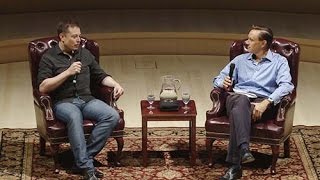
Elon Musk argues that companies should pursue usefulness optimization: maximizing how useful their work is, not necessarily changing the world. Small improvements that reach many people create real value, like the area under a curve. A clear purpose attracts top talent who want work that's intrinsically enjoyable, financially rewarding, and meaningful.
I'm curious, what do you see from your vantage point as the benefits of a purpose driven company? Meaning when you have this thing that every employee and customer knows is the purpose of the company, how do you see that flowing through to benefits for the company?
Well, I think having a purpose certainly is going to attract the, the very best talent in the world. Because if people can, if there's something that's intrinsically enjoyable and the financial rewards are good, but then also it's something that's going to genuinely change the world, then I think that's a pretty powerful motivator. But I don't think everything needs to change the world. I mean, honestly, there's lots of useful things that people do. I think really it should be a usefulness optimization. Like, just say like, is what I'm doing as useful as it could be?
You're talking about the goal of an.
Organization or a goal in general. Yeah. And you know, just even if something isn't changing the world, if it's making people's lives better, I think that's, that's great. And you know, if, even if something's like making all people's lives only slightly better, but it's a large number of people, then kind of like the area under the curve sure is quite good.
So that mathematical first principles of point utility and numbers integral. Yeah. Okay.
I mean one could say is some app really making people's lives better, but if it's affecting a lot of people, even in a small way, then yeah, the sort of area is good.