ETL: Chris Redlitz and Beverly Parenti, The Last Mile and Ray Harts, Healthy Hearts Institute
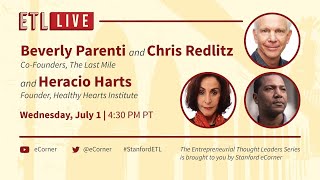
Chris Redlitz and Beverly Parenti founded The Last Mile, which teaches coding and entrepreneurship to incarcerated people. Ray Harts, a program graduate, built Healthy Hearts Institute while inside. The program has expanded to multiple prisons and trains inmates for tech careers.
Chapters
Hi everyone. I'm Tina Selig and I'd like to welcome you to the Entrepreneurial Thought Leader Lecture Series Revisited, presented by stdp, the entrepreneurship center at Stanford School of Engineering. Today, I'm really excited to welcome Chris Redlitz, Beverly Parenti, and Ray Hartz back to etl. Beverly and Chris are the co founders of the Last Mile and an organization that aims to break the cycle of incarceration by providing education and career training opportunities in prisons. Founded 10 years ago, 2010 at San Quentin State Prison, the Last Mile has become one of the most requested prison education programs in the United States. And Ray Hartz was a participant in the Last Mile program at San Quentin where he crafted a plan for Healthy Hearts Institute. And since his incarceration, he launched and leads this venture. Chris, Beverly, Ray, welcome to etl. Really delighted to talk to you since your last visit 7 years ago in 2013.
Thanks for having us. Great to be here.
Really a pleasure. So we're going to do something fun this week since you were here seven years ago. We're going to talk about what's going on now, but we're going to also play some short clips from your last visit to help tee up the conversation. Now, I have to tell you, I am a huge fan of the Last Mile. In fact, I've got my Last Mile sweatshirt on right now. The talk you gave seven years ago stimulated me to start volunteering in the program. And from my vantage point, it has been incredibly remarkable to see the program grow and expand. So I want to start with a short clip with Beverly talking about what motivated the launch of this program. So let's start with a clip about what inspired this at the very beginning.
And my first reaction was, why would I want to spend my free time because I have so little of it anyway? Why would I want to spend my free time working with prisoners? But he had that passion and he actually asked me not to make any judgments about something I knew very little about. So reluctantly, I committed to do research about incarceration and also to go and visit the men to experience firsthand what he was so passionate about. So first was my research. Well, I wanted to find out more about the issues facing the prison system in California today. And what I learned from my research made me realize that even a small scale effort could make a difference. So here's some of the learnings. In California, we spend more for prisons than higher education. The average cost per prisoner to taxpayers, $45,000. The rate of recidivism exceeds 60%. So by the Time. Many men are released from San Quentin. As taxpayers, we've already invested nearly $1 million for their incarceration. But without rehabilitation, many of them will return. That's a bad investment. If we could reduce recidivism by just 5%, billions of dollars could be saved in the next 10 years alone.
Wow. Really, really impressive. And I think that this was such an enormous opportunity to do something. So what have you learned over the last 10 years of running this program, Chris? Beverly?
Sure, we've learned a lot. Certainly that was very early on the program. You know, Ray was there, and we're going to talk about that a little bit later. But you know, I think a few things that we've learned about how to operate a program in prison because both Beverly and I had never had any experience in prison before, just visiting prison, let alone running a program in prison. And what we learned is how to work with corrections. You know, I come from the startup environment as a venture investor and everything is very, very, you know, zero to 60 very quickly. And you know, corrections doesn't move that fast. So we realized that we had to do things very incrementally and building relationships top down within corrections. So now we have, we're in, you know, six states today. We have great relationships with the Department of Corrections and with the governors of each state. And I think that's really important. The second thing we learned is how to deliver a program that can scale because San Quentin is very unusual because very close to San Francisco and as you've done with your class, brought your students up to mentor in San Quentin, which is phenomenal, but most locations are remote. So today we basically run all of our programs remotely. We have a studio in San Francisco where we broadcast live into the classrooms and they have a learning management system there that they can log into. So utilizing technology has really allowed us to scale the program.
So one of the things that I find very interesting is you started out teaching entrepreneurship, right? Of course, that's what you knew. You're in the world of venture capital and then you ended up pivoting to decide to teach coding. What motivated that change?
What really motivated the change was market demand. And at the time, remember this was almost a decade ago, we realized that there would be a shortage of 1 million software engineers by 2020. That's what was predicted by 2020, which is where we are today. So we decided to teach skills, marketable skills, because our mission is to provide marketable skills that result in gainful employment. And it was all a test. It was just could we possibly take teach software engineering without the Internet. I mean, we created all these challenges. So software engineering, great jobs, high market demand and great pay. And those were the things that really drove us to start a coding program as a test.
Very, very interesting. Well, I want to bring Ray into the conversation and I know that, you know, one of the most important things you did was to give, paint, help people paint a picture of a future that was different than their past. And I' to turn to Ray, who was a student in the program. You did a magnificent job during the last ETL session, sharing with us your one minute pitch. Now this was something that I know was a very important part of the entrepreneurship training is not just coming up with the idea, but figuring out how do you pitch it to people to get them really excited about what you're doing. So I want to play the pitch that you gave seven years ago and talk to you about how this venture has essentially evolved since then. So let's play your one minute pitch.
By show of hands. How many of you have witnessed either a parent, a child, a friend, or maybe your spouse struggle with obesity? You don't have to raise your hand for this one, but think about it. Did you ever feel helpless in their struggle? If you have, you're not alone. Many people who have lived in a low income community like I have, where the obesity rate is above 50% have experienced the same feeling of helplessness. That's why today I'm doing something about it. Good evening. My name is Horacio Harts and I'm the founder of Healthy Hearts Institute, the co op that will bring health and fitness back into our neighborhoods. HHI will turn empty lots into gardens and transform neighborhood food deserts into green nutritional oasis. We will turn abandoned buildings into LEED certified fitness centers and provide our members safe places to exercise. Our goal is to get us back to the good old days when the community was ripe with nutritional foods, kids were outside running and playing, and the obesity rate was below 17%. So join the Healthy Hearts Institute and let us empower the beat of your hard. Thank you.
Yeah.
That was super great pitch and you had did it without any preparation. You just pulled it off. So how did, can we start out with just how did the program, the Last Mile program influence you, Ray?
So first of all, thank you for having me back, man. It's crazy to look back seven years ago and see where I was at then and where I'm at now and how the program has evolved. So thank you for having me here. You know, if I think Back about how Last Mile influenced me. I think about my mindset at the time when I first encountered tlm. And, you know, I had. I was just a year to the house, meaning I only had a year left before I'd be released. And I had spent the last seven years really focusing on educating myself, preparing myself to start my own business. So when I met Chris and Beverly through the buy of Smile, you know, it was pretty exciting just thinking about how I could leverage what they're teaching and to create my own business.
So.
Yeah, it's amazing. So how is your venture doing? Because you got out and you actually decided to pursue this idea. It wasn't just an academic exercise. You're now running Healthy Hearts.
Yeah, it's doing well. You know, over the last few years, we've grown. It took me a little while to get it started, but in 2016, 17, I got my first grant and I turned that into organization. So we launched a community garden, started with 10 beds. We got 20 garden beds and about 2,200 square foot of growing space. We're teaching mindfulness classes, nutrition classes and cooking classes, gardening classes, and we're feeding about 170 families twice a month with the food we grow and with our partnership with the Contra Costa County Food Bank.
Fabulous. I mean, really, really great. I couldn't be more delighted. And it's interesting to think about. Teaching in prison has a lot of challenges. I know that. I've done a lot of classes, a number of classes with the Last Mile where I brought up Stanford students. We did actually one course which was taught jointly between Stanford and San Quentin. No Internet access. The power goes out. There's lots and lot of challenges. In fact, right now there's a much bigger challenge with the COVID crisis that's happening at San Quentin. It's interesting to start thinking about, given all the constraints, what are the metrics you use for success? And I want to go to a clip from Chris talking about the key performance indicators, or how are you going to measure whether this program is successful given all the constraints. So let's play this clip and then talk about how that's evolved over time.
So we started the program, but we have to have, as you learn and talk about startups, what are our KPIs, how do we judge the success of this program? And the first thing that we had to understand and appreciate was does it resonate with the men in prison? Is this something they want to learn? And can they really absorb the applications that we're presenting to them because they have no Internet access, they have no access to technology. And will the correctional system adopt what we're trying to do and be open enough to understand what we're trying to accomplish?
So really good question. And so I'm wondering how your KPIs have changed over the last 10 years, Chris?
Yeah, they really haven't changed that much. I mean, the three that I mentioned then were, you know, is it going to resonate inside? And that was the time when we were launching the entrepreneurship program. So the bigger question when we launched coding in 2014 was even a bigger question. Is there going to be interest in that and can we actually do it? That was a big question. So those KPIs certainly have remained the same, you know, as we expanded. You know, now we're in women's prisons and youth facilities and we are constantly conscious about our curriculum resonating properly within the institution and making sure that what we're teaching is really employable, you know, remain be employable skills. The second part was will the community participate? You know, will people come in and volunteer? Will they, you know, do things whether or not they financially donate and support it that way? And that, as you have said, because you have been a phenomenal volunteer, Stanford has been really engaged. So we've had really, I think that the number is almost a thousand volunteers we've had over time. So we checked that box for sure. And then the third one was, you know, with companies hire and, you know, early on the question was, are they going to pursue the ideas that they did in the entrepreneurship program as Ray has done, or as we expanded into coding, would tech companies hire? And that's absolutely the case today. So, you know, the KPIs remain the same, the goals are a bit different, but our KPIs definitely are the same.
Yeah. So Ray, did you. Were you aware of what the KPIs or the metrics or goals were? And how did that resonate for you as someone who was in the program?
Yeah, I was aware of. I think Chris had mentioned them early on in the classes and he mentioned his thoughts about what it resonated, you know. Yeah, it definitely, I think that's the one that sticks with me the most. It definitely resonated to have someone like Chris come in and then some of the distinguished guests that he brought into the program was like super inspiring. It exposed me to a different world. Kind of like, I think I'm reading this book, Ta Nehisi coast between the World and Me. And it kind of creates that parallel right where I come from and then where Chris comes from. So this program kind of bridges that gap. Right. So I think that it definitely resonated with me. Off to the races with it.
Great. So I want to encourage people who are watching, the Stanford students, as well as those people who are watching on YouTube, to ask questions. The Q and A app is open and feel free to ask anything you'd like. We're really eager to respond to the things that you're curious about. One of the things that you brought up is getting support for the program. And this is not inexpensive to run a program like this. I know you've had to get a lot of very extensive computer equipment and to build all sorts of internal tools and lots of other resources that need to be available. I'm want to play a clip about how you thought about building alliances to support this program and then to talk about the other sources of support that you've been able to get over time. So let's play our fourth clip looking at how you start bringing alliances in early on.
So all of our funds and support will become privately. I think when we went to Sacramento the first time, we finished the meeting with Matt Cade, who was the Secretary of Prisons at the time time, I think he was waiting for us to have our hand out. And my hand was this instead of this. And it made a big difference. Right. So we can get a lot further by doing it outside of that. And we really want to show that you can marry private and public effectively without taking public funds. So that's really been our strategy.
Great. So I'm curious, Beverly, Chris, what have been the most interesting or most successful sources of support over the last 10 years?
Yeah, at the time when we did that event, it was all privately funded. There was a resistance early on, from our perspective to engage public funding because we want to make sure that we established the program, we had success metrics that we could actually present. Today. We have support from both public and private. And as I mentioned in that comment, it's really important that we have this public private partnership in every state that we're in, because it's not only it's great to get public funding, but it's even more powerful to bring in private companies because not only they bring their funding, but they also bring their employee base and they allow their employees to participate in this, which is really valuable today in today's market.
I know you've had a lot of really interesting, innovative companies get involved, you know, come to visit and hire folks. I mean, one of the things I'M most excited about is, you know, people can actually outsource their coding to the prison program to the Last Mile. So the men who were there or the women in other prisons can actually be doing projects and have referenceable projects that they could put on their resume when they get out. Can you talk a little bit about that?
Sure we can. And I just wanted to mention just some of the funding groups also. I think it's really important to mention that google.org is a big funder of ours. Stand Together is a big funder of ours. Chan Zuckerberg, bank of America and it's really, as I said, important to engage the employee base as part of that proposition. So I just wanted to call out those. I don't know if there's anybody else you want to mention. Obviously California Department of Corrections and Calpia, which is Princeton Industries, are major partner of ours as well.
Well, Cal PIA is part of the story of the development inside as well, but they are the ones that actually it's Prison Industry Authority. They helped fund the original coding program at San Quentin, which is a cte, or career Technical Education. And not only do the students learn these amazing skills, but they also get milestone credits towards their sentence. So for every six months that a student inside San Quentin successfully completes a cohort of the Last Mile, they earn seven weeks off their sentence.
Wow, that's amazing.
It's unbelievable.
Yeah. And I understand that a lot of people work inside prison and they get paid a minimum amount, but the folks who are in the Last Mile actually get paid a significant wage for the work they're doing for companies.
That's right. Yeah, that's true. You know, unfortunately, because of, you know, the pandemic that is closed down today. So TLM Works is what it's called and it's on hiatus because of the pandemic, so we can't actually operate it. But you know, the hourly wage inside for our program is a little over $20 an hour, which is one of the highest wages paid in prison in the US So it's something where the participants can save and have money when they get out, which is super important because today Ray can certainly attest to this, that when you get out of prison, the government gives you basically $200 and potentially a bus ticket and that's it where here they actually have savings that will help them re establish, get an apartment potentially and get started.
Just to put the $20 in perspective, the average prison wage is 32 to 95 cents an hour.
Amazing. Really remarkable. So, Ray, I'm curious, when you were in this program, what did other people think about this program who were in it and those who were not in it? Was this looked at as very elite opportunity? How did other people view this within the system?
So I was the second cohort to go through there. And so, you know, it hadn't exploded yet. I think people were, you know, it was gaining traction at that time. People starting to become more aware of it. But I can speak to the participants ourselves. Like, we were super excited, like to have this opportunity. And then, you know, as it progressed and we did our second demo day, I think people became more excited about participating.
That demo days are incredible. I mean, you know, what an amazing amount of excitement to see these ideas come to life. There's a question from one of the students, Tere, and it says, you know, what were some of the barriers you faced when you started? Healthy hearts, I'm assuming, outside of prison? And how did you overcome them?
Oh, man. You know, some of the barriers, I think was just getting myself out there, letting people know who I was and, and sharing my story and having access to capital, that's still a barrier. Being able to hire talent, that's something that's super difficult just because where I'm at, there are a number of things, but the main thing is to live with purpose. I really feel like I live with purpose. And when times seem hard, I lean on that. When I see other organizations, and I'll speak on this real briefly just because of the times that we're in, when I see other organizations that are non black and they receive like four times the amount of funding I received in half the time, or they hire talent to build off the team, like highly skilled people come out and volunteer to build their team. Or you see, when I get a newsletter and it's well written content, they have videos to boot. Like, you know, I wonder, like, why don't I have something like that? Like, why. Where's. What's the barriers for me? Where I don't, I don't. I'm not able to create that type of support so I can get this type of. So my community can get the support that they need. So when I look at those type of barriers, especially, you know, the highlight right now is just talking about all the Black Lives Matter and you see all these big brands speaking about it. But when I think about, like, what I've experienced personally, it makes me think about like, is this a part of structural, structural racism? Right, That I. I'm not receiving that. So those are some Barriers. And I'm just going to speak my truth, Right. I could sugarcoat it and say, like, Ray, you're not working hard enough. But. And then as entrepreneur, you have to figure it out. It doesn't matter if you're black or white or whatever color you are. If you're an entrepreneur, you have to figure that you have to overcome these things. Right? And you got to stay the course. And for me, I'll say to any entrepreneur, like, if you're doing something purposeful, then lean on that. Like, if you have purpose and you're living through purpose, lean on that and you'll be able to overcome whatever obstacle it is, no matter what.
So I'm curious, have you been able to tap into the Last Mile network outside of prison? I know there have been a lot of people who have graduated from the program and are out in the world. Has that been a valuable network?
Yeah, definitely. There's folks that I reach out to all the time. Like, a lot of, you know, to be completely honest, like, a lot of the people that I know that are outside of my community, some way we're tied through the Last Mile, if not directly, indirectly. Right. And so that's. In that sense, definitely. That network has definitely helped me, like, even on a personal note, being able to go to one of Chris's friends, Winery Hourglass, with Jeff Smith. Just been able to go there for my 45th birthday and take my family to experience something that we never get access to. Like, everybody in my family, this is a year and a half later they still talk about. This was a moment. So this type of place, this type of network, like, it exposes us to different things. So, yeah, I definitely lean on my TLM network.
Wonderful. So we have another question from another student, and I encourage others to chime in with other things you're curious about. Jessica asks. You know, she says government can infamously be infamously challenging and slow to work with, but they're necessary to have a legitimate impact. Do you have any advice on working with bureaucracies to produce effective results? You know, what has been most effective and what kind of clues can you give others?
Yeah, you know, I think really it's building an incremental relationship. What I mean by that is that you can't. If I went in to CDCR 10 years ago and said, I want to build a technology center inside San Quentin to teach coding, they would have said, there's the door. Right. So you have to start very early and develop relationships. And also, this is not just government, but it's Anything when you're trying to develop a business is fine. Champions that believe in your cause. So we had Matt Kate, who I mentioned in my talk 10 years ago. He was the Secretary of Prisons at the time. He and I connected and he understood the cause. Chuck Patillo, who is the GM of Calpia, understood the cause. And so we really built those relationships. And now, you know, we do have a tech center in San Quentin. As you've been in there. We have. We took the old print factory, gutted it. We have five classrooms, soon to be eight classrooms. So it is really a flagship facility that many states now come and visit and see what they can do. But I think really starting those incremental relationships are really important.
One thing I would add to that is that there are all these processes and procedures that are in place today that have been in place for a long time. I would say doing your research and understanding what the proper protocols and procedures are within whatever the type of business or program you are trying to implement in that governmental agency and start working within the realm of what is available to you, and then establish yourself. And then as you decide to change and add, you will have already situated yourself within the agency or with the relationship. And I think one of the things that they said about us early on is that we learned how to fit in and make incremental change, but we didn't come in and try to change everything overnight.
I think it's really interesting you found some really strong advocates who were able to allow you to get in the door and then you demonstrated success. I mean, I think that's the other thing is it's not just getting other people to support you. You need to demonstrate some early success that then everyone wants to be associated, like, oh, that worked. I want to support that. I mean, over the six years that I've been working with you, it's amazing. The accretion of more resources and more people. The more you accomplish, the more people are willing to get on board. Speaking of that. Oh, go on, Bev.
Sorry. And they learn to trust you. And trust is so vitally important in those relationships.
So one of the things that's super interesting to me is how you've expanded this program across the the state and the country. And I think it would be really powerful for people to understand this isn't just at San Quentin anymore. This is something that is expanding and you've really created a franchise. So how has that worked?
Yeah, so it is really built around the franchise idea. Even though we are a nonprofit, I wanted to mention that Ray actually is a nonprofit. And kudos to Truly was our law firm who all their pro bono work to help Ray get that started. So I just wanted to mention that. But yeah, it is really a franchise. We have a brand, we have a curriculum, we have a way of delivering. So we really package something that is very easy now to lift up in a particular state. We're doing two new classrooms that'll be launching very soon. And for us to be sort of from approval to operating, we can do it within 60 days. So we can do it very quickly. But it is really built around the franchise model. And the thing that's also evolved is reentry, which Beverly can mention too. That's been a component that we didn't have 10 years ago that is very much of a component of our program today.
And also piggybacking off the last question about getting involved with government and how do you do it? It was actually the governor of Indiana, Governor Eric Holcomb, who reached out to us when he learned about the Last mile in California and said we need the last mile for the Hoosier State as part of our next level initiative. So he sent a crew out, they came in, they looked at the program. Within six months we had our first program in Indiana at the Indianapolis Women's Prison. Today there are five facilities in Indiana which we're very proud of. We also have programs in Oklahoma which are funded by Chan Zuckerberg, the Lobeck Taylor Foundation, George Kaiser Foundation. So local funding, along with big funders like Chan Zuckerberg, we launched in Kansas, again, the department reaching out to us, Kansas Department of Corrections and Michigan, which is also help funded by google.org, but again, I met the head of the Department of Corrections. The Lieutenant governor came in for our launch in Oklahoma, Governor Stitt came into our launch. And so those are our five original programs. And the sixth one, which is not open today, it's not programs but states. The sixth state to be launched is in general, North Dakota.
North Dakota.
Wow.
Well, so we've got a bunch of questions that have been pouring in. One of them that a lot of people are super curious. Can you talk about the logistics of teaching the specifics of teaching coding in prison? How does it compare to what happens in a traditional class in a university?
Yeah. So as I mentioned before, we have live broadcast into each classroom at least once a week in our learning management system has all of the. In this particular program, we teach primarily front end coding. So a lot of JavaScript and it's two six month cohorts. So the whole program is a year. The participants do not have direct access to the Internet, but we do have connectivity to the classroom. So all of our content is cloud based. We push it updates on a daily basis through their LAN that is distributed through their machines. So every day they get fresh content and you know, that's really it. The big difference is they don't have Google. So what we do now have is we have something called account or academic support reps. So we have folks that are dedicated to specific locations where I'm a student, I can provide or produce a ticket, put in the lms. That question goes to our service reps, they answer that question or help out and send that back within 24 hours. So that's their sort of arm length Google. Everyone on that ASR team are all graduates of the program.
Yeah, it's interesting. I mean we had some fascinating challenges teaching a class remotely. And one day a week we would have a live lecture. We were able to put together a link, a digital link between the prison, between the TLM classrooms and in my classroom at the D school at Stanford. And so we had one class where literally they, you know, students were on one side of the screen on each side. And then once a week the students would have a team meeting with their partners and they would do it via Zoom. So when we were able to, they had to be monitored, but they could be in a special room where they had access. It was very cool. So Ray, there's a question for you which is about what are the very specific marketable skills that you used and that you gained during this, this training? What'd you go? These are the things that I learned through this program besides giving a fabulous pitch.
Well, you know, I think that was really the biggest thing that I learned was being able to succinctly talk about my idea and then the network, that access to the network. And you know, I think when you think about starting a business or anything, you have to, again, this is, you have to tap into something that you care about. And I think that's kind of innate. Right. And you have to have this drive for it. And so when you are introduced to, you know, opportunity, you know, then you can take advantage of it. So I think like being able to talk about my business and understanding the power of relationships and networks, transparency. Because when you, when you come from a prison, like, you know, you don't want to tell everybody that you've been to prison. Right. And Chris and Beverly did a good job of encouraging us to be transparent, like. And that I think that was, you know, it might not say a hard skill, but that's definitely a skill, skill set and awareness to do that. Right. That was some good insight that they provided.
Very interesting. So someone else has another question for you having to do with. First of all, they say they love your shirt, so got a compliment on your fashion choices. I know we're all wearing black today. That's great. That's super, very powerful. So the question is, what piece of advice would you give to aspiring entrepreneurs about starting something? And given the what you've learned and the challenges that you faced, what advice would you give those who are eager to start something themselves again?
Find something that has purpose. Right. So when times get hard, you know, you could, you can lean on that. It'll help you through the marathon. Right? Continues the marathon. The other thing is I practice. I made a habit of making self care a practice. Right. Getting up early in the morning, stretching for 20 minutes, meditating for 20 minutes, drinking water and cough or not coffee, but tea in the morning, reading at night. Those are, you know, just develop some good habits to make your day a little bit easier. One of the other things, things that I try to do even throughout my day is breathing. Just take some time throughout the day, take a deep breath. I practice like looking at an object maybe a few feet away and paying attention, observing the space between me and that object. Then I think about, you know, all the space in the universe and it kind of centers me and it gets me back focused. So I say, you know, self care, have some purpose and just keep going. Just don't quit.
It seems like a tremendous amount has to do a mindset shift that there's the knowledge, there's skills, but an important piece is just changing your attitude towards yourself and to the world and to the opportunities around you. So clearly we have inspired a lot of people who are watching. And Abev and Chris, some folks are asking about what sort of volunteer opportunities are there? How can people get involved from the community to support this effort?
Sure. Okay. Yeah. So the volunteer opportunity is something that's really valuable to us. You know, we have a small team today. We have 30 employees. But we do have a, like I said before, really robust volunteer group. The best thing to do is reach out directly to infohelastmile.org someone we pay attention to that someone would respond to that within 24 hours. You know, so because of what's going on today, we don't have in prison visits normally sort of pre Covid that was a pretty regular cadence for us. But we do have, as I mentioned before, we are remote into classrooms. So those classrooms that are open today, we can do that. And you know, there's help with curriculum as well. So we're constantly evolving curriculum. Today we do front end engineering. We're going to be launching an IT certification program. And something we just announced last week is a music and video production program that we're going to be launching. And this is going to be huge. We're going to be teaching folks to be audio technicians, video editors, and we're also going to be going across the country discovering talent. A good example of talent is Ear Hustle, which many of the folks, if they haven't listened to it, should listen to it. That was came out of San Quentin, out of a small studio in San Quentin. So we're building a studio in our tech center as a prototype so we can discover talent and teach additional trades as well. So those are, you know, if people have expertise in any of those areas, we'd be happy to talk to them.
That is so fabulous. I know you guys already have a deep connection to the music industry, so what a great sort of build out of this program. I hadn't heard about that. Very, very exciting. So there are a bunch of questions about your business model. There are questions about your funding model. And someone said, do you think that you could make it into a for profit and maybe take a percentage of the income of, you know, people who participated? I mean, have you thought about different creative funding models for this and, and what is working and what's your, what are your thoughts going forward?
Yeah, I mean, we, we really looked at this coming from the venture side. When I look at companies, I look at performance first. Right. So once you invest you or when you're looking at a company, you have to see sort of performance metrics. And so it's important for us to do that. So we really created some performance metrics that we relied on and we got funding. We don't spend a lot of time fundraising. We spend more time really focused on results. Could this be a for profit? Sure, it could be. We really haven't considered that seriously. But, you know, the challenge in nonprofits is that funding is fairly short term. Normally your commitments, maybe two, maybe three years. But when you're venture funding, you're funding out for 10 years. Right. Or at least five years. So it allows you to plan and grow a little more realistically if you're a for profit. So the model could work. We are, you know, we're sort of dedicated to the mission. And I said before that the companies that are bringing us money are also bringing us a lot of effort, and it's very meaningful. So if you went the for profit route, you may lose that. But, you know, if the model would work there, potentially we just haven't gone down that route.
So it's interesting. One of the questions was for me, and it says, what have I learned working on this program and how does it change the way I work as an educator? Well, I must say it has really made me much more empathetic. I have had to really understand that people come from really diverse, different backgrounds. And one of the things one of the men said when we were doing a check in with our students, and he said, how would you feel if you were judged by the worst thing you have ever done? And I just realized that everybody has things in their life that they're proud of and things that they're not and things that have affected them and that we need to treat everyone with compassion right now. As a teacher, when we're having students all over the world, some in very different conditions, my experience teaching at San Quentin has made me really understand the range of places people might be right now and the situations they might be dealing with. And so it makes me much more sensitive to that as I'm trying to teach. So I have a lot of questions. Another one just came in. The one that came in is, how do you balance depth, providing more service to those you work with versus breadth, reaching more people?
So that's really interesting. You know, from day one, we decided that we wanted to prove what we did worked, and then scale it as far and wide as we possibly could because of the systemic issues in society and how we could make a change. So having more people in a specific facility versus having as many facilities as possible is really our goal because the ripple effect of the work is just something that is just community focused. Changing families, changing communities. Role models. Ray is a role model in his community. Guys who've come home and women who've come home who have jobs as software engineers. No one in their community ever even had a computer or was on a keyboard before. And here they are being role models. So those are the types of things that. That make us believe that scale is so vitally important. And we continue education once our students are back in a position where they can attend boot camps or continue their education. So it's more about reaching as far and wide as we can right now, being the best we can everywhere we Go and having the model just keep expanding.
One thing we have done going deeper is we've gotten much deeper in reentry, so in job placement. And there's programs like Next Chapter that we've helped spawn and we've had support from folks in the Valley like Andreessen Horowitz, who launched a cultural leadership fund. So those things are going deeper, educating inside. It's really important for us that we had pre and post gate in a sense where we continued that relationship. So that's going deeper for sure.
So Ray, I'd love to have your thoughts on this. I mean, obviously you have this program in prison and then you go out. Do you think about what kind of programming would be helpful to you as you through that transition, but also afterwards, I mean, Chris, you mentioned there are some new opportunities. How does TLM fit into the larger ecosystem of support for those people who are reentering after being in the system?
So if I understand your question right, it's like, what type of support? Do I think TLM could provide different support? Is that correct? So if that's the question, I think they're working on it with the reentry piece. There are specific things that the guys need once they get out. Like, and people are taking different paths. You know, some people are going out, they get the coding education and they're finding jobs or they're looking at, you know, starting their own organizations, you know, to become entrepreneurs. And so I think like, there's different needs that different folks have. And so, you know, just creating this network where cats can communicate with each other and then share their, the resource resources that they learn on their own. Because if you're out, you know, I would suggest don't just rely on TLM or if you go to Stanford, don't just rely on what you learned at Stanford. Like you still have to go outside and venture out and figure it, figure things out. Like, there's a world opportunity out there. Don't limit yourself. But as far as like tlm, like, yeah, build this network so people who do find other resources can use those resources as well. So that's my great.
So I want to ask the last question to Beverly and Chris and that is, you know, 10 years you've been doing this. What would be your vision and your goal for this program for the next 10 years?
Yeah, so as Beverly said, scale is important. I mean, we have a short term goal. Within the next four years, we want to be in 50 classrooms and we want to make that, you know, within at least 10 states. But we also want to have a broader program. As I mentioned, we have three programs that we have or launching soon. So the goal really is to become the de facto platform for education in prison. Because we do have a platform that we built a lot of it. What we've done proprietary, so we, we've used a lot of tools but you know, the security of the system and make sure that we don't have breaches. We put a lot of time and effort in it that's specific to prison. That's, you know, saying it's five years. We constantly iterate that. But that's a really difficult thing to do. So really it's growing what we're doing. We really think that other programs could build on top of of what we're doing. So almost in an open source environment that other programs could build on top of our platform. Yeah. So that's really how we see the next 10 years.
So today we are in 21 classrooms in six states. So getting to 50 in four years we think is highly achievable.
I absolutely trust that'll happen. And my guess is you're going to far exceed that goal. It has been a huge honor to talk to all of you again. Ray, Chris, Beverly, I've learned so much from you and you've created really, really meaningful opportunities for me to contribute to the program. So thank you so much for such a fascinating discussion and I'm sure that there will be students who are listening, who are going to be reaching out about ways that they can contribute. So thank you very much to all of you.
Thank you.
Thank you so much.
We really appreciate everything you've done to contribute to the last Smile. Thank you so.
My pleasure.
Thank you for having me.
More from GHION.AI


O processo de reconhecer limites, mesmo quando a vida parece exigir sempre mais.





Depois de tantas histórias, aprendizados e pausas necessárias, o @interior_iza está de volta



