ETL Speaker Series: Adam Pisoni, Abl Schools
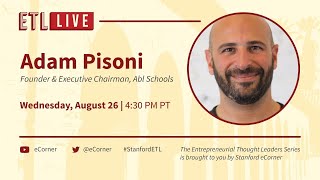
This content was created by GHION.AI . This content was uploaded by GHION.AI . This is a YouTube video titled "ETL Speaker Series: Adam Pisoni, Abl Schools" from August 27, 2020. It features a discussion between Rachel Jolkowski and Adam Pisoni, a tech founder and education reform advocate. The conversation, part of the ETL Thought Leaders Revisited series, focuses on the challenges and opportunities in the U.S. education system, particularly around equity and systemic change. Pisoni shares insights from his work with Abl Schools and discusses the impact of COVID-19 on education, the role of social enterprises, and the need for systemic reform.
Chapters
You. Welcome to ETL Thought Leaders Revisited, presented by sdvp, the Entrepreneurship center and Stanford School of Engineering, and a special welcome to our live audience on YouTube. Please remember to post questions throughout the conversation for me and our guest Adam today via the YouTube chat box. I'm Rachel Jolkowski, Director of Marketing and ednotorial@ CBP, and today we are so excited to welcome Adam Pizzoni back to etl. Adam is a tech founder. He co founded Yammer in 2008, overseeing product analytics and engineering, where Yammer scaled to 500 employees and was acquired by Microsoft for $1.2 billion. That's all great and all impressive and fantastic, but I'm especially excited to have Adam here today because of his current focus and his unique perspective on fostering equity in the US education system. In 2015, Adam founded ABLE, which aims to help schools create equitable access and opportunities for all students. Adam, we could not be more thrilled to have you back at etl. Your return feels especially relevant right now. We're living at a time when US School systems face deep uncertainty, and we're also living in a moment when sparked by the murders of George Floyd, Breonna Taylor, just this week, the shooting of Jacob Blake, and far too many others, our society is reckoning with socioeconomic and racial inequities. And so we're really grateful to have you with us today to help inspire our audience and give some tactical tips about how to really think about fostering equity in really big institutions and really be able to create systemic change. So welcome, Adam. Thank you so much for being here. It's good to be back, so let's dive in. There's a lot to talk about with US Education before we get into able. Paint a picture for us of US Public, public education. What's the state today, and how is inequity manifesting in the US Education system?
Yeah, I mean, when I started ABLE five years ago, it was because I believe there were inequities in the system that were resulting in students not having the same level of opportunity as their peers. But in a lot of ways, having been at ABLE now for five years and having seen the data within districts across the country, it's in many ways radicalized me, which to say it is hard to find a district that doesn't have pretty extreme inequities. And I'm not saying something that the best leaders don't already know as well in terms of how it's manifest. I mean, the way I look at it is imagine two students who were identical in every way, who had the same aptitude and the same potential and the same upbringing and all of that entering sixth grade and they have eight semesters or wherever to go or more. And by no choice of those students, there are decisions that are being made by their guidance counselors, by their principals, by their district leaders, oftentimes unknowingly, that would so radically change the trajectory of those two identical students that one would go to Harvard and one would drop out. And the inequity piece is that those differences in decisions that are made for students, I'll give you some examples, tend to fall along demographic lines or socioeconomic lines. They tend to fall along racial lines or gender lines or again, you know, socioeconomics. So, and that's what seems unfair. It's not that every student would do equally well or poorly in a school. It's that the only way to explain some of the differences that we see in schools across the country is these dividing lines on things like race and gender. I'll give you just one example that I might have given actually last time, but I think is a, an informative one. And then I'll switch a little bit just to the state of education, but. So there was a school within a district we were working on working with, and before we had gotten to them, they had seen a pretty wide achievement gap. And their belief was. Well, part of the problem is that, you know, a lot of students don't understand the value of school. They don't understand what the purpose of all this is. So if we can make school more relevant to their jobs in the future, then they would be more likely to apply themselves. And so they created what are called linked learning pathways or career pathways. They created two of them. One was, I think tech, one was health. And those pathways came with additional requirements for those students. So seventh graders, or rather ninth graders are coming into high school and guidance counselors were looking at these transcripts and saying some of these students are too far behind to take the required remediation courses or, you know, retake courses or support courses and still take the required courses for these pathways. So they took this group of students, of which it was a double digit percentage of the student body, and they just put them in like a third pathway that didn't have a name. Well, all of those students, a large percentage of those students ended up failing out because the resources of the school weren't oriented towards that pathway. They were oriented towards these other pathways. So that was an extreme example maybe, but it's one example where we see over and over that even the programs designed to help students of color or students of low socioeconomic status often hurt them because of the way they bifurcate the resources. So you ask the state of the education system. I mean, I think we are in such a pivotal point where the education system all up is deemed by everybody of all parties to be not working for all of our students and, and be currently underfunded. Or rather, given the money that we're putting in, we don't feel like we're getting the value out. And the pandemic is really showing how important the educational institution is in our country beyond what we thought. People tend to think about education as curriculum assessment, about teaching the skills students need to learn. But I'll tell you that teaching content, teaching skills is not the number one or even the number two most important goal for most schools. Number one is safety. For every school. People are entrusting their children with a school, and that means a lot of things beyond just, you know, school shootings or something. I mean, schools feed millions of students a year that can't otherwise afford to eat. They provide mental health services to millions of students a year who otherwise wouldn't have those opportunities. That is such a large piece of what school is today. The number two part of school isn't education either. It is helping the economy by making sure the parents can go to work. And you know, there's. That's a. And schools are the largest employer in almost every city that they're in. And number three is educating students on, on. On content they need to, you know, be successful and the skills they need. But what we're seeing here, I think, is a breaking point where we're going to see, I hope, some major changes coming in the next years. I think people didn't realize how important education, the education system was for a functioning economy and society. But I think we as a country have to decide the kind of education system we want. So what I'm seeing is a coming breaking point. What I don't yet know is the direction we'll go. And specifically, you know, the, the, the way in which I think I was most radicalized is when I got into Able, I thought that what the problems were could be solved with policy or programs or funding things like that. But what I came to believe after watching the last few decades of people trying to fix education through policy and program and funding is that the problem with education is not the education system. It is actually it's a cultural problem that we as a society have not decided that we want to educate all our students. And in fact we, we have an individualistic society that, that rationally believes that we should be fighting for our own children's best education. And we're in a bit of a, almost a death spiral where parents currently believe there's not enough good seats in good schools for, for all kids. And so they're going to fight for their students to get the good schools and resources. By doing so, they are making the whole system worse, which is creating, which is becoming a self fulfilling prophecy, making fewer good seeds. And as long as we're on that spiral, then every time we introduce a new program or funding stream or whatever, it ends up getting sort of twisted to benefit a smaller set of students. The things those parents are doing are rational. I don't think any of them are bad or, you know, but I think this is the breaking point that we face in education. I think we're really going to have to decide the kind of education system we want in the next couple years as we come out of this.
Well, I appreciate you laying that out and I think for our listeners out there, I think many of them are motivated to create change. And we have a saying at STVP at the bigger the problem, the bigger the opportunity. And certainly there are lots of opportunities in the education space. And I think what's so interesting about what you laid out is that it's not something you can take piecemeal to solve necessarily that what you've identified as the interdependencies between education and almost every other major facet of how our economy and how our personal lives work. So I want to shift gears a little bit to talk about what do we do about this. We've got this huge problem. What do we do now? And so I want to turn to a clip from your 2018 talk where you lay out the problem with something you call islands that are solutions to some of these systemic issues. So often we've seen innovators disrupt from without a system. So we see lots of new innovations in the education sphere in person and now online, especially with COVID Let's take a look at your 2018 talk and then dive into that.
People look at the education system and they say it's totally broken. It's so complex, it's not helping students and it's really hard to change. So I have all these ideas. I want project based learning and competency based and I want social emotional, but it's too hard to do in the old system. So what people do is say I'm going to do it elsewhere. I'm going to go off and find, find an island. Or I'm going to start my own school. I'm going to start my own private school or a charter school. I'm going to prove what's possible. Their belief is that if they can prove what's possible and that it's better, the world will change. And that is the misconception. That is one of the cardinal mistakes of Silicon Valley. That's not how businesses or institutions or the world changes.
So I think what we hear about, especially in Silicon Valley, but really across the world, what we often hear about is these really novel, bold island solutions. So what's the alternative? What else can we do if we want to do this?
Yeah, and just to clarify one thing, I'm not against islands. I think islands, as I probably said in that talk too, islands are a necessary component of change and that we do need exemplars, we do need people to show what's possible. My point was, and I think the danger for entrepreneurs is that belief that the island is all that is sufficient. And this is particularly true when you're dealing with institutions. I think that when you're dealing with the, the consumer space or things that are direct to consumer, it's a lot easier to make leaps or get people to make leaps. But when you're dealing with institutions or companies or B2B, it's a lot harder. Because as I said in that talk, you know, people buy the present, not the future in a lot of ways. So the challenge for an entrepreneur, the first thing is to decide do you want to make an island or bridge? And they're both valuable endeavors. But if you're looking at improving a system, one question you should ask is, are there already a lot of violence and, and has that changed anything? And if there are and it hasn't, then it's possible that the problem is in islands, that there aren't exemplars or examples. Because a lot of times the system isn't changing, not because there aren't examples or the people within that system don't want to change or don't see the future. It's because they're stuck. Because education itself is an incredibly complex interdependent system that's held in dynamic tension. There's no one thread you can pull that that magically fixes it. And as I said earlier, you know, it's also held in place by people who have a very, very strong interest in keeping the system the way it is in a way that benefits themselves. And so I think the lesson of if you want to move towards institutional change or scale, then the real challenge is to paint the picture of the island, to say, you know, to capture the imagination of your audience who wants to get to the island. But then through listening and empathy, say, but I understand where you are today, and so I'm gonna help you take a step and then another step, and I'm gonna paint the picture and we're all gonna celebrate where we're going, but also I'm gonna recognize where you are. And that can only happen through deep empathy and listening. And it can only happen by the way, by aiming your tests, your experiments, your early customers at the middle customers, not the early adopters, because you'll get the wrong feedback when you do that. And that leads you to sort of build an island and the more entrenched a system. And by the way, a lot of the easy problems have been solved as far as digitizing or bringing things online. So we're left with a lot of really hard, much harder problems. And with those types of problems, the difference between your early adopters and your later adopters is massive. And if you validate with early adopters, you may not learn anything valuable. You may not learn actually what the problems are, but what your late adopters will want to adopt or buy, or the factors that the reasons they make decisions. So go build an island if you want to build an island. There's nothing wrong with building islands. But don't be fooled into thinking the island is all that's necessary to get everyone to your island or to change the system. And if you want to change the system, you got to figure out how to scaffold from those islands to those bridges.
So let's get a little bit more specific because I think our audience and myself are following you abstractly. Great. Let's get someone from point A to B to C to Z, and then we eventually can get to Z and have this wonderful vision of what a future state might look like. But talk us through maybe a specific example. With Able, what does that look like? And what do you mean when you talk about the middle of the market?
Yeah. So with Able, when I was doing my research for the company, I saw a lot of violence. As I mentioned there, there was a lot of people who are doing really good and important work that providing, I think me and others examples of where we think the system should go. There's a lot of private school or not. There are certainly private charters and district schools that are doing amazing Things. But then when you looked at a large urban district, for example, or just say, like, where are the majority of the students in this country? They're not in those progressive districts. They're in larger, you know, urban districts or in some cases, rural districts.
But.
And when you looked at their set of problems, they understood that curriculum needed to improve, that. We would love to see social emotional learning. Like, they had those beliefs, but they were kind of stuck in a lot of the operational complexity of their school. Like, every time. In this specific case, what I saw is when someone from the outside said, why don't schools teach social emotional learning? Why can't they just do that? You know, the way that a school principal or a superintendent receives that is, wait a minute. This is yet another program. I have 50 programs. And how does this fit into that existing tapestry of policies and programs? Oh, and by the way, is this. Is this in class? Is this separate? How does this impact my students who have special needs or, you know, all these other factors? And so it's not that they didn't see or want that. It's that you had to go to them and say, I understand the operational complexity of what you're trying to do and where you're trying to go. So if I can simplify that operational complexity and help you, or another good example, actually, this may be even a better one as it relates to this conversation, this idea that we just need to introduce new things into schools. If you're a principal or superintendent looking at your system saying, my system is inequitable, then introducing a new program doesn't just make it equitable. And so you also want to understand what is it about my system that is inequitable? And if I were to introduce a new program, how would I do it in a way that doesn't just exacerbate that inequity? But that is not something a lot of entrepreneurs think about because they're thinking at probably a smaller scale or their own children, and they're like, this is great. You know, and so I think we, you know, we don't. We never believed. I never believed what we were doing was going to fix education or solve all the problems. And that was an important piece, too. And in many ways, I look at what we're doing as just a piece of the bridge that hopefully is linking up with other people who are. Who are doing amazing things in islands. But what we want to do is help district leaders begin to recognize and address those inequities so that they can implement programs we didn't create, you know, other people are working on, but do so with a lens towards equity.
I think that that is so helpful to hear, especially that oftentimes with the way that we've heard entrepreneurs approach islands that are radical innovations that really fundamentally change society. You have to imagine this totally non existent, implausible, impossible universe. And that if you're working perhaps in an existing system, it's important to know that moving five steps in a certain direction that would be an improvement is, is a lot of work and that it's okay to be motivated that way. That's what I'm hearing from you.
And you know, during this pandemic, for example, people are rightfully recognizing that this move to remote and this has thrown so many things in the air that it is creating a real opportunity to reimagine school being less place based. There's all sorts of amazing things. But right after the pandemic hit, if you were to talk to principals and district leaders, they weren't thinking, how do I reimagine school? You know, one of the larger districts in the country we work with said we have lost contact with over 100,000 students. We have no way of contacting them because they're homeless, because we don't know their parents information. These are students who rely on us for food and mental health. And that is our primary concern. It's not what kind of curriculum, you know, we teach or can we even get to these students to help them. And if you're not empathetic of the true challenges they face, you never get them. You can get a small set who doesn't face those challenges. And if you really think about it, doing that only exacerbates inequity. Because if all you're doing is going to the people who don't have the broad set of problems your majority faces and you're just helping them get further. You know, you're just, you're probably making society worse in the process. That's an exaggeration. I do think again, islands are important. We need islands to show us what's possible.
So talk a little bit about that process. You've talked about empathetic listening. You've talked about making sure your sample set of potential customer interviews or customer discovery involves a wider set. What does that look like, especially if a school system has lost touch with people? How do you find the right people to engage with so that you're building a system that's informed by those who need it the most?
Well, again, I think that you look at in the case of education, but it could be anything. And you ask yourself, where are the majority of the people I'm trying to impact? And are they in those little things or are they. In our case, they're in these big districts. And can. How do I contact those people, connect with them, and do so through empathy? Before I started Able, I was just kind of going through people saying, I have nothing to offer you, but I'm looking for information because I don't want to be that person who's coming to you telling you, I have all the answers. You have more information than me. You've been doing this longer. Help me understand the system and your challenges. And then over time, I began to offer, here's what I think. But even then, I would say, I'm sure I'm wrong. Please help. You know, instead of, you know, part of the schizophrenia, maybe, of being an entrepreneur today is there's, like, two pitches you need at all times, especially in the early days. One is to your, like, future employees and investors. And that is the. Like. It's amazing. And we're doing this big thing, and it's all great, and I know all the information. But then the other is like, you're trying to learn from these customers who won't react well to you, telling them they have all the information if they're the experts. And so being able to go empathetically to them and say, you know, I'm especially in the case of being new into a sector of which I was in this case, if you're in, you know, extremely. I also think, and I actually wish I had done more of this earlier, if you are trying to go into a sector, you know, really bringing on people early on who understand that sector very, very well, and it's difficult as an entrepreneur because you'll run into this sort of like, well, I want to bring them on, but they don't understand what I'm trying to do, and they're too entrenched in the system. But it doesn't matter. They understand it better than you. And if you're not humble enough to recognize that your first employees should be someone who understands that new sector or someone's. And they may drive you crazy, but it's so important to be able to not only gain respect from the people you're trying to learn from, but to empathize with them. And again, this is. It's very different. Everything I'm saying is almost only applicable to institutions. B2B Consumers is a whole different animal. You're just like, direct it doesn't. You know, you just get to the people you can go after. Early adopters. All that works fine, and there are a lot of opportunities there, but it is. Institutional change is often difficult unless you go to the institutions you're trying to change.
So with that in mind, I want to ask one question about COVID 19 as well, because a lot of your insights into the education market through ABLE were about meeting people at a place they understood and then moving them incrementally forward. And we're living at this time when no one understands anything. So how is. What is Able doing, and how are you modifying that approach to keep supporting schools?
I mean, in some ways, radically, and in some ways, what we were doing was already applicable. The sense of a fundamental level. What ABLE does is operational approach to equity. But a big part of that is. Is helping schools develop what are called master schedules that are more equitable and drive more excellence in their students. The master schedule is what that process determines. What courses are offered, who teaches what, how students are grouped, all these. All of the decisions pretty much that are made outside the classroom that impact the potential, the opportunity and success of the student. It's a critical function. And under the COVID world, that is so insane, because normally schools begin in January, maybe March, developing these master schedules for the next year. But in March of this year, they were like, whoa, everything's out. And so suddenly, they're in a world of not only having to do in a very short amount of time what they normally do in six to nine months, but they have to do multiple ones, because we don't know, are kids all coming back to school? Are these going to be hybrid? We're probably going to switch. And so we need to be able to have an eye on what that is. And we have new constraints, not just the old ones, but how many students is each student in contact with? You know, how do we decide how to group these students together, especially if it's hybrid and some are coming in and some are not? And so our work is sort of in two pieces. One is the reimagining school piece of which there's a lot of interest today because they're recognizing this as an opportunity. And the other is the sort of equity and operational pitch, which is whether you're reimagining or not, you have to come back in a way that. That is going to not just maximize the excellence, but also the equity piece of that and dealing with. But I think this is a real opportunity because I said earlier about how parents often drive Parents are rationally making decisions to benefit their kids, and yet that can often have negative consequences. Covid provides the best excuse for a district leader to say, you know what, I know that we've offered French five for whatever, but like those six kids that had that, we need that teacher to teach English right now and to remediate because students who are falling behind. I also think one of the most dramatic changes we're going to see this year is many, if not most districts are not going to do standardized testing this year, the traditional type of standardized testing. And there's so many good and bad directions that can go. You know, a lot of the people who push for standardized testing were the people who really cared about equity because they wanted to measure the inequity. That's a very noble reason. But we also know that standard accessing creates perverse incentives. So there's all these ways in which school has an opportunity to rewrite. And what we're trying to do is if one way our work has really changed is we've become a bit more consultative heavy because there was no way to productize that quickly the challenges that they're facing. And so we're relying on the fact that we can work more closely with our customers to learn through these challenges and productize them as we go. And we're holding less precious. It has to all be SaaS revenue, and we should never that kind of thing, which is really hard to do as a startup. And in many ways, I think that speaks to one of those tensions between social enterprise and enterprise.
I think that that's a great transition into one more clip from your 2018 talk that talks a little bit about values and the tensions with social enterprises. Before we watch that, I just want to speak to the YouTube live audience. Please remember to post questions in the chat box and we'll start taking them in just a few minutes. So let's turn to this clip where you talk a little bit about values and the tensions involved in running a social enterprise.
Somebody asked me once, is there any proof that having values that are aspirational help you be successful? And I had to be honest with them and say, not only is there no proof, but there's only counterfactuals there. Look at the most successful companies, they're not the ones that express the highest values. And so my answer was, if they're truly your values, then you'll be willing to fail and maintain them. That's what it means to have values.
So what does that mean? Tell us more about that.
It Means what I said I was reflecting on this before this talk, this label of social enterprise. I would not be surprised. I'm certainly hopeful that in 10 or 20 years, people look back on this time and they say, what are these social enterprises? And they're confused by it because they can't imagine a world where the norm would be that the vast, vast majority of creativity and resources and companies and money and all of that were going to these things which weren't social, whose pure goal was, or who's. Whose highest goal was increasing shareholder value. And what we expected in 2020 was that a very, very small in comparison set of social enterprises and nonprofits or whatever would clean up all the problems created by the vast majority of, you know, other companies. And I think someday we're going to look back and say that was just a crazy thing. Part of the challenge there is that I think for a long time, and maybe if I was alive or if I was doing this 50 years ago, I think that too, that people thought that there was no tension between profit motive and doing well, you know, do do well by doing good. And yet it's just getting increasingly hard to explain why under the current system, so many people are being left behind, whether that's students or adults or communities. And we used to say that's just because there wasn't enough, the market wasn't free enough. But it's just getting harder and harder to justify that. And the existence and the need for social enterprises, if anything, shows the fallacy in that. The challenge for a social enterprise is that you still need, you still need money, you still need funding, you know, you still need these things. And you're playing in a, in a world which doesn't have really good sort of language for the needs of a social enterprise. And so you end up, you end up in a strange world in terms of how you balance that tension. The tension is real. You know, you. There are times when the decisions that you need to make for rapid growth, for example, may be different than the decisions you would make if your pure intention was impact. And I think a lot of times entrepreneurs try to ignore that or hide it. Part of it is the cognitive dissonance of raising money in that context of like, when you raise money, you have to tell the story about the economic opportunity. And if you're raising from impact investors, you have to tell both stories. But it's hard to know which one takes primacy. So there's that cognitive distance or a lot of entrepreneurs, they just sort of like pretend there's no attention. And I found it helpful to admit there's a tension to my company's attention and allow us to hold that tension, talk about that tension, and know that we're not going to be making decisions all one way or another. And by not agreeing on attention, that then we really run the risk. You know, if we truly. If I sat here and said there's no tension, it's actually more likely that I would end up moving in the direction of pure economics because, you know, economics drives itself in a lot of ways. But by naming that tension, I think there's an opportunity to do better.
I want to dive into that a little bit more. I know a lot of the students we work with and people in our audience are relatively familiar with the idea of how do you measure financial performance? But for those who are interested in thinking about going into social enterprise or creating not an enterprise that wants to do good and measure against that in this quantitative world, what do impact investors look for and how should social enterprises be measuring in ways that aren't financial to balance that tension a little bit?
It's a really great question, and it's not an easily answerable question because finances are easy to measure. Uh, they're, they're singular. They're, you know, we have clear measurements, but when you talk about impact, it's so dependent on what are you trying to impact and who. And a really good example of that is we've worked with a number of organizations in education, and when we've asked about impact measurements, they tend to come and talk about test scores or, you know, impacting. That seems obvious. That's what we're trying to do. But here we are on the administrative side where we work with superintendents and, and the impact we're trying to have. First of all, measuring test score is very, very lagging indicator of some of those things. And second of all, we have all these proxies we're trying to improve around equity and around. And I think we can see that even some of the past measurements around test scores hid some of the inequities. So if your goal is to impact inequity, you can show a school rising test scores, but actually having worse, you know, less equity. And so I, I think that the key is not that there's universal measures, but more that you as the founder, make some early decisions and adjust them over time about what is the impact you're trying to have and how are you driving towards that, how are you speaking loudly about that to your investors, to your company, and allowing them to hold you accountable. Now, the most likely people to hold you accountable to that are your employees. And the way that you make sure they do that is by hiring people that really care about the things that you're trying to impact and telling them that that's your goal and you will, you will tend to hear from them if they, if you start to drift away from that. And I find that like a healthy tension that is difficult as a leader, but a super healthy tension. So because a lot of, I think as a CEO, that is the hardest thing to balance is you. You have these schizophrenic like, I've got to drive the business, I need to drive revenue, I need to raise money, I need to this. I'm also trying to have impact and really understand my customer. And in the case of K12, I think where this is hyper exaggerated is if you were to ask what is the fastest way to make the most money in K12? You could find things. You could definitely find some various things. But if you were to ask what are the most pressing problems they're facing? Those are like a very narrow Venn diagram. And if you just chose the things in the intersection, then you're leaving out so many things that need addressing that clearly any kind of social enterprise, like if we are trusting social enterprise to help fix education, it cannot do that unless it has a loose definition, unless it has a broad definition of financial success, because there's just too many problems in education that are not going to lead to unicorns. And so, you know, if we don't accept that as a possibility, then we just don't fund or attempt any of the things that are in the outside of that vendor that, you know, middle of the van.
And I want to, I want to put a pin in one thing you said at the end there, which is that what I'm hearing from you is that financial success, particularly in technology ventures, is often measured by unicorn status as opposed to small growth financial sustainability, which might be more, more attainable for a social enterprise. Am I hearing you correctly in that?
Yeah, I think that's that. And it's interesting because where we get even more schizophrenic is it's almost like if you're not going to be a unicorn, then the question is, why aren't you a nonprofit? And the bright line that we tend to draw between for nonprofit to me doesn't make sense. And again, in 50 years from now, we may look back and be like, that was very confusing. And yet so many people, I think lack the imagination to understand the spectrum. What I mean by that is, you know, oftentimes when we look at nonprofits, we would freak out if a nonprofit attempted to charge a lot of money to achieve sustainability often. But if a for profit was charging money, achieving sustainability but not growing fast enough, then we're like, well, that's not a real company either. And so there's this huge kind of middle gap of problems that are best solved by sustainable solutions, but nobody will fund them on the for nonprofit side for these strange reasons. And at the fundamental level, and this is what I believe is one of the fundamental problems of our country today is that and I one of the fundamental problems is that the people who are the set of people who decide what problems are funded and who get the money to solve those problems and decide what solutions are worth attempting to solve those problems come from narrow backgrounds and have narrow sets of ideas. And they're very good people. All the people I've worked with in social enterprise are very good people doing good work. That is important, but it's too narrow. And until we have a broader set of constituents who can decide what problems are worth solving and what solutions are worth entertaining, then we're going to bang our head against a lot of problems. We just won't ever solve them because we're thinking too narrowly about it. And this is one of those examples because a lot of the social enterprise is around this idea that you can do well by doing good. And so we should only kind of invest in unicorns or whatever equivalents in your field. But what about that middle sphere? And if we're really going to solve problems, shouldn't we figure out a way to fund them? But it's not clear who would.
I think that's a fantastic kind of call to our audience, actually, and the students we work with. We thought maybe we would just talk about challenges in education, but really you've identified two big opportunities for us to really reimagine big systems. Funding, investing systems, education systems. I want to turn in the time we have left to the audience questions. So let's see what people are thinking about.
I want to reiterate this is very important as I walk a fine line here. The people funding social enterprises and doing them are good people doing good work and solving real problems. We just need a broader set of people and that is a real problem to solve within funding spaces. How do we find the space to solve a broader set of problems for a broader set of funders and broader set of entrepreneurs?
So first question from the audience. Adam, thanks for being here. Again. It seems like political affiliation is related to individual preferences for the education system. Can education be agnostic to political affiliation?
I mean, that's like asking at the moment. Can anything be agnostic to political affiliation? The goal of education should be to be agnostic political affiliation. But you know, we live in a world where we're arguing about black lives matter versus all lives matter. And it makes it very, very complicated. And education. What I will tell you is this. And if you're interested in this, there's a really great book called the Teacher wars which describes the history of US public education from 1850 till now and essentially lays out the fact that. Not me. I don't know about all countries, but pretty unique to America. Our education system has been politicized from the beginning, the very beginning. Education gets dragged into political debates. I'll just give you one example. Teaching is a very low paid profession. We know that. Right. And people have talked about some of the reasons that they should. Teachers should feel lucky to have such a, you know, an impactful thing. Why should they get paid a lot? Which is ridiculous. But if you go back in history, one of the reasons was before I think it was World War I, teaching was almost exclusively women. Post World War I, men were coming back from the war, it might have been World War II. And some of them wanted to go into teaching. It's a great job. But they were freaked out by the low pay. And so they began to lobby Congress and like, why aren't teachers paid more? And the debate about why they shouldn't be paid more went something like this. The majority of teachers are women. Therefore it can't be a high skilled profession because women aren't in high skilled professions. So if we pay, if we pay more, we're admitting that women can do high skilled professions. So clearly it's not a high skill profession. So in that way it's like weirdly politicized. Or another good example is, you know, we have 11,000 districts in this country, half of which have one school. Like, how did we end up that way? Well, a lot of it is because people wanted local control for the purpose of segregation long time ago. Still happens today. I mean, this is happening. There was just a court case about this in, in the Bay Area, you know, and so education has always been politicized. I don't know how to fix that. Educating our kids should, should be all of our thing. And I think teaching, you know, teaching students about, like the most important thing would be not just teaching Them the skills they need for, you know, math and reading and all that. But helping students understand civic duties and along with social emotional skills. But there's, there's a lot of fear about teaching civic duties. I think the debate about who should vote is alive and well in this country and it's very closely related to the debate about who should be educated.
We've got another Covid question. Do you think Covid and our accelerated entrance to a digital education system has created an opportunity for a nationwide master scheduling revamp which is a lot of what able focuses on the master schedule or are schools too preoccupied with other priorities?
It absolutely creates that opportunity. The question is, as we come through this, will the entrenched system snap back to the way it was because we're so preoccupied, or have we hit this breaking point where we are going to take on this opportunity? And I do honestly think that in this case leadership matters a lot. Again, the fact that we have 11,000 districts means it's a bit chaotic. It's hard for the good ideas and bad ideas to spread because there's sort of like lots of individuals doing their own thing. But I do think there is an opportunity with good leadership to work on an agenda of updating school. Obviously that's just so difficult in this country because of the sort of the political aspect that drives towards local control. Yeah, I think there's a huge opportunity and the opportunity is massive. I mean, you know, the things that we're excited about are place based learning. Like why is it all in your school? You know, why are students grouped by grade level all the time? You know, why are students in these individual classes where the content is no relationship to each other and there's why aren't students learning civic skills or social emotional skills and shouldn't they be doing that in practical applied ways? And we see examples all over the country of high schools doing amazing internships and externships and all, you know, like amazing stuff. But it's all kind of islands and you know, the way we have this opportunity now to see that hit mainstream. But I think it will take some, some leadership to get there.
A follow up from the. I'm just looking at this one here. Okay, here we go. Is able strategizing return to normal eventually two to three years down the road? I hope it's sooner than that. Or are you completely pivoting and leaning into virtual only learning learning?
Oh no. I mean I'm not a believer in virtual learning for one. I mean I think that, I don't think Any of our schools are. I don't think teachers are. We have not figured that out yet. And it's not clear that that would be best even if we did. I mean, again, schools are not just about educating students. And if the goal was, it's not like you put a kid in front of a computer and they just, like, learn. Schools are about socialization, and they're about helping, allowing their parents to go to work and about safety and about all these other things. And so I think everybody, including Abel, wants kids to go back to school safely. And obviously, that's a political issue as to what that means. So what we're betting on is going back to kids back in school. However, it may not look exactly like it does today. Like, for example, in a lot of small schools, they can't offer all the content and curriculum that they might want to. So, yes, maybe they're going to leverage digital more to augment what they can do in person. That's great. You know, and how that gets scheduled and how students are grouped is very different in that world than when you have a class size of 25 or 30. But I think kids are going back. I hope kids are going back to school. We will figure that out, and it will look different. There will be more opportunities because of digital. I also think, you know, in the same way that Zoom is working pretty well right now. But, you know, if we were stuck this way for five or ten years, again, we will look back at how we're communicating and say it's insane, you know, and digital learning is going to go through a revolution now because of the necessity of it. And what we've seen in the last 10 years, 20 years, has been great, but just leaves so much to be desired. And I think, again, the standardized testing and that sort of going away in the next year is going to create one of the most massive opportunities. Because the way that schools work before was kids went into a black hole called the classroom. And then we tested them at the end, and if they didn't learn, then we either believed it was the teacher's fault or the student's fault. You know what I mean? But it was, like, schizophrenic, but we didn't know what was happening. And it was easy to. And frankly, the decision about whether to blame the student or the teacher was sort of like, politically motivated and sometimes racially motivated sometimes. And so moving to a world where we're knowing in real time whether students are learning. And therefore, we can quickly intervene to understand, you know, does the Teacher need help? Does the student need help? That's going to be really positive. That can be done in person and digitally. But digital accelerates our ability to do that. That. That could be potentially very revolutionary. And I certainly hope it's accelerated, but almost couldn't be done in a world that was so reliant on summative testing.
A question that shifts gears a little bit from education to you personally. So could you talk a little bit about your founder's journey to Yammer, what you learned through your journey and the insights you took to able. But I'd especially like to focus on your journey because I also know you have an unlikely path to go into education with your own experiences in high school.
Yeah, I mean, it's the quick version and feel free to follow up. But dropped out of high school with decent grades. I love to learn and I didn't feel like the school was a institution for educating me at the time. And I had a guidance counselor tell me I should drop out and go to college. And went to college for a year. But that year started a company with a really good friend of mine, which was a web development company in 94, 95 when we started my brother as well and ran it for six years. Then.com crash happened, went out of business and then I became a little bit disillusioned with startups at that point and. But a couple years later ended up at another startup called Shopzilla, running web engineering there. And then was poached by David Sachs over at Geni, which was a social network for families. And was there for a year before he had the idea for Yammer and asked if I would lead engineering. And it seemed like a good idea. And I accepted that idea.
And.
And then that was a really phenomenal journey. I mean, Yammer's really an incredible experience in terms of the company and the passion of both of our customers and our employees. And just learned a tremendous amount, I think, about institutional change and about running an organization. And then after I left, I frankly, personally felt so fortunate about the outcome and the privilege that had led me to that I wanted to give back, both because it gives me joy, but also I felt responsible and so began to look at US Education and originally was not going to start a company for the reasons that I kind of said earlier, like I didn't know about US Education, but it was in the process of joining a nonprofit called Transcend, which actually does look at how do we reinvent education. And through that process discovered master scheduling, discovered these operational challenges, discovered a lot of the inequity created by it thought that there was a business opportunity that was a fundable business opportunity and created Able as a result. So it is a bit unlikely. You know, I. And then most recently I stepped down as CEO actually a couple months ago and a new CEO, Howard Bell, took over, who's doing a really incredible job and I think is better suited for the state of the company, the stage of the company today.
Want to switch now to social enterprises? Great question here from the audience. How might you entice people to start or join a social enterprise? You said you need a broader pool. How would you sell the field industry as an entrepreneur opportunity to young hopefuls, of which I think there are many in our audience.
It's a really good question. It's challenging. You know, I think that, I think one of the biggest challenges, frankly, I mean, it depends on the type of social enterprise. But a challenge that I know I faced when I started Able was.
If.
You'Re dealing with an environment of people who are more on the enterprise of social enterprise, meaning they don't want to work at a bad company, they want to do something good, but they're looking for a return, then you have to speak that language to them. But if what you're doing isn't, you know, oftentimes I found like in Silicon Valley, for example, here I am working in US Education, trying to create a successful enterprise which is also having an impact, talking about that impact. And I was competing for talent with Uber, who was claiming to be a social enterprise in a lot of ways. Right. And yet they could pay twice as much, you know, So I think part of it is just like knowing the who, finding the people for whom, this really is important to them and they're willing to make sacrifices for it because a social enterprise requires sacrifice. And I think recognizing that up front and building that into the system and finding people who are passionate about it is key. How you find them, it depends on the problem you're trying to solve, but you find them within that problem space to solve that problem. And I feel like we did a good job at Able and that the people at Able are passionate about equity or passionate about education, provide really positive pressure to maintain our values and, and are just like are willing to sacrifice, I think, for that. But that's a different set of people than, I don't know, go to work for other companies.
You know, I want to save the last question for myself to end on a little bit of a high optimistic note, which is we spent a lot of the Last hour talking about really big, deeply disturbing problems in our society that have been around for decades, if not centuries. I'd love for you to leave myself and our audience with a sense of why we should be hopeful and optimistic and stay motivated.
Yeah, it is a great question. I mean, my optimism and hope is almost exclusively and unfairly pinned on a younger generation. And it's not that the expectation is that they solve the problems, but I think they are inspiring us to be creative in ways that are novel and new and are forcing action among people in my generation and the next generation. You know, I. I'm a Gen Xer. I'm a proud Gen Xer, and we are not known for being politically active or organized or any of those things. And yet, when watching these protests in a lot of cases, or watching the outcry and watching the creativity, which is what I'm seeing in a younger generation, is people saying, why does. Why do things have to be this way? Are there other ways to solve these problems? Can't we be more creative? You know, like, here's just a classic example that I love. You know, when I think about the problems in education, I realized recently that it's very similar to the problems we see in policing, which is to say we're just asking too much of it. You know, we're. We often like a school is supposed to fix its community, it can't do that. And it requires creativity to understand and to be willing and bold enough to say, you know what? This is a broad set of interconnected problems, and we need to work together to solve all of them simultaneously. And I think that I'm seeing that happen in a younger generation. I hope that students watching this, and I hope that they will not only take efforts to try new and novel things, but that they'll continue to inspire my generation, other generation, and put pressure on in the same way that I feel like employees put pressure on me to withhold their values. There's a way in which a younger generation, I mean, you look at like, Greta Thornburg. Is that her name? The pressure she is putting on adults to say, like, I am a child, I am not going to solve these problems, but you are supposed to. And I think those kind of things matter, especially in mass. I think that any large group of people has a huge influence, and I'm excited to see and optimistic about a younger generation putting that pressure on the rest of us.
Well, I appreciate you ending at that high note. And I know everyone who works at STBP sees this next generation and not that anyone in any generation is left out of it. But we're particularly inspired by the young people we get to work with, especially on campus, and that tune into this. So thank you so much for returning and coming back and chatting about these really timely, important issues. And thank you to our audience for joining today and joining throughout the summer for ETL Thought Leaders Revisited. This is, unfortunately, the final talk of the summer, but we will return on September 23rd. We've got a fantastic fall lineup. We've got the founder of Zoom coming. So if you if you want to hear about a company dealing with a lot right now, tune in the CEO of Nextdoor and the former CEO of Girl Scouts of the usa so you can learn more by visiting ETL Stanford Edu. And thank you so much again, Adam.
Thanks for having me. It's great to be here.
More from GHION.AI


O processo de reconhecer limites, mesmo quando a vida parece exigir sempre mais.





Depois de tantas histórias, aprendizados e pausas necessárias, o @interior_iza está de volta



