ETL Speaker Series: Aicha Evans, Zoox
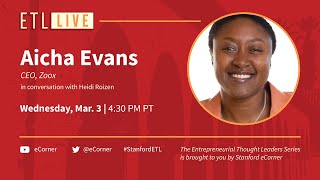
This content was created by GHION.AI . This content was uploaded by GHION.AI . This is a YouTube recording (ETL Speaker Series: Aicha Evans, Zoox) of an Entrepreneurial Thought Leaders seminar at Stanford (created 2021-03-04). It is an on-stage interview/talk featuring Ravi Belani (host/intro), Heidi Roizen (interviewer and former board partner), and Aicha/Ayesha Evans (CEO of Zoox). The discussion covers Evans' origin story (Senegal → U.S.), her move from Intel to Zoox, co-founder dynamics, leadership style, building the company and manufacturing during COVID‑19, Zoox's acquisition by Amazon and strategic fit, competition in autonomous mobility, and diversity/immigration topics and advice for founders and students. The excerpt is an organized speaker-led presentation/Q&A rather than a diarized multi-party conversation.
Chapters
Welcome YouTube and Stanford communities to the Entrepreneurial Thought Leaders Seminar. I am Ravi Balani, a lecturer in the Management Science and Engineering Department at Stanford and the director of Alchemist, an accelerator for enterprise startups. The Entrepreneurial Thought Leaders Seminar is presented to you by STVP, the Entrepreneurship Center in the School of Engineering at Stanford. And BASES, the Business Association of Stanford Entrepreneurial Students. Today, we are very excited to welcome Ayesha Evans, the CEO of Zoox, to the Entrepreneurial Thought Leaders Seminar. To introduce Ayesha and to facilitate this session's ETL, I'm going to hand the baton over to Heidi Roizen, who I get to introduce to you now. Heidi is no stranger to ETL. She is one of the rare few people who's actually been a keynote at ETL twice. So she's an icon in her own right. She's also part of the Stanford teaching team. She's an adjunct lecturer in the Management Science and Engineering Department at Stanford. And she also got her bachelor's degree in English from Stanford and her MBA from Stanford. And as if that doesn't prove that she bleeds Cardinal enough, she also directs the Stanford Threshold Ventures Fellows Program, which is named after the fund where she's a partner, Threshold Ventures, and on behalf of whom she served on the board of Zoox. So this is not just an interviewer-interviewee dynamic, it's also a board member-CEO dynamic, which we think will make an especially interesting ETL. Heidi's worn several hats, more than I can name, just given our time right now, but among them, they include being the former VP of Worldwide Developer Relations at Apple, and the CEO of her own venture-backed company, TeamMaker, which she was the CEO of for over a decade. And she currently serves on the boards of a bunch of public, private companies, and other organizations. So without further ado, I'm gonna hand over the baton now to Heidi to take it from here.
All right. And I'm also, another title I have that wasn't mentioned yet is I am the unofficial president of the Ayesha Evans Fan Club. So we've got that too. So now it is great, my distinct pleasure to be able to introduce Ayesha Evans. Aisha joined Zoox as the Chief Executive Officer in February of 2019. Prior to Zoox, Aisha served as the Senior Vice President and Chief Strategy Officer at Intel Corporation, driving the company's transformation from a PC-centric to a data-centric company. Previously, she ran the company's wireless efforts and oversaw a global team of over 7,000 engineers. She holds a bachelor's degree in computer engineering from the George Washington University. Welcome, Aisha.
Thank you.
Well, I'm also, uh, the president of the Heidi fan club, so we ought to have a fun conversation today. I've been really looking forward to this. So Aisha, let's start with your origin story. Tell us about your journey from Senegal to Silicon Valley.
All right, well, thank you all for having me, and thank you for attending. I know that your time is precious. I appreciate it. I was born in Senegal, West Africa, and I bounced back. My dad was in telecommunication engineering, and at that point we were an ex-French colony, so there was a lot of cable being laid in Africa to basically have the communication infrastructure wired at that time. And I had the pleasure of bouncing between Senegal and France, and I quickly saw the difference it makes to have technology and not to have technology. This is something that I saw from my personal life, trying to stay in touch with my friends when I was in Senegal or when I was in France and having to hack my phone at home to be able to make phone calls to stay in touch with people. And my dad saying, why am I getting crazy phone bills? And then I wanted to study computers. And really the US was the place to do that. There was also a certain element of sort of taking charge of my own life. When you're a Senegalese kid, when you're in Senegal, people are like, no, no, you're from France. When you're in France, they're like, you're from Senegal. I was a mix of a lot of different cultures and viewpoints, and I wanted to be me. And so I came to the US to study. My dad only had one requirement, and you know, tuition is expensive, so you do have to listen to that part. And it was to be in DC because he had a lot of friends at the IMF and World Bank that were gonna quote unquote supervise me. Then came here, went to school, met my husband who's American, and the rest is history. And first engineer, born, raised as an engineer, enjoy that, but I'm not for happy engineering. I love technology, I love when you do something and it works, but I wanna see the impact. How does it make people's lives better? How does it advance society? And that's sort of how I've guided my career.
Terrific. Well, and in terms of impact, I think what you're doing today is going to have huge impact on the world. So Zoox, for those not familiar with the company, can you tell us a little bit about Zoox and what it does?
Yeah, I'll start at the top, uh, as if you are a customer. Um, urban mobility is really important in movement of people in cities, and so we sell you a ride. Uh, the— what's behind the ride is an autonomous, uh, machine really, uh, that takes you from point A to point B. So we like to say that we are reinventing personal transportation, especially in urban centers, to make it cleaner, so the environment's safer. We know that we lose close to 40,000 people a year in car fatalities, and also to make it enjoyable. Why should you be worried about driving and parking, and why should so much real estate be dedicated to parking spaces? Look at a city like San Francisco that has a housing problem and that wants to retain economic activity, but 30% of its real estate footprint is for parking. Look at congestion for 30% of the time, the congestion is really caused because people are looking for parking. And so think about the most efficient and sustainable movement of people by you saying, I wanna go from point A to point B, you have a Zoox app, say that, we show up, pick you up, you step into this beautiful machine, sliding doors, almost like a moving living room. You have your little screen that tells you what's going on. You can control your HVAC. Your music. By the way, you can be on your phone, you can meditate, you can relax, you can do whatever you want. And then we drop you off and pick up the next person.
It's pretty exciting. It's very exciting. I, I get to say that as one of the people who've actually been in one of the prototype vehicles. So when it, when it gets commercialized. So let's go back a few years. Um, when I first met you, you were Chief Strategy Officer of Intel and you had upwards of 8,000 people reporting to you at a prior role there. And, uh, Besides my incredibly persuasive skills, what made you decide to take the leap to the startup world and the CEO role?
Ah, so look, first I was really happy at Intel. And when you're in Silicon Valley and you look like me, you have to be careful to check your ego at the door because you get a lot of calls for different roles. And I had to have a one-on-one with myself after almost leaving Intel a few years ago. And say, what do I really want? What's important to me? I've earned, I think, sort of the opportunity to decide what I want to do. And I had decided that I was not gonna go to another big company. I was gonna stay at Intel. There's plenty of work to do even today. Good luck to Pat, by the way. And that was the decision. And a few friends of mine in the recruiting world, people I'm close to said, well, yeah, but what can we call you for? And I basically said, look, if it's a forward-looking technology, a big impact on society. It has to be private. I have two teenagers and I can't afford the public life right now. And it has to be a team of founders or a founder that sort of I fall in work with love with, and they need somebody like me, not because the board told them, but because intrinsically they know that they need that. And it has to be in the Valley because I didn't want to move. And really, ZOOX, I mean, it was scary a little bit. It's a big mission, but it ticked all the boxes. I mean, economic activity and advancements in societies happen through the movement of information and people. Even the internet, it's actually a transportation system. It just happens to be virtual and it's for knowledge. So ZOOX ticked that box. Our cities need a lot of help. We're not going to destroy them and rebuild them. There isn't space to redesign them. They are the center of economic activity. The climate and the environment, especially now that We have a new world order a little bit in the US. Hopefully we're not arguing about that anymore. That's important. And then just what you make possible and what you unleash for people in terms of economic access. So Zoox, really, the mission is bold, it's ambitious, it's absolutely worthy. And I wanna spend my time on worthy things. And then I have a wonderful co-founder that, yeah, we do quite well together. So that's in the end why I said no. By the way, I never told you this. A lot of my friends in the Valley said, are you nuts?
Well, I'm not surprised by that. I'm glad you didn't listen to them, or I'm glad you didn't take their, take their concerns. Well, you bring up the co-founder, and, and I want to, I want to talk about that a little bit, because I know from being on the other side of the recruitment effort that the most important relationship— and really, while there were, there were 4 of us on the search committee, and you were the number 1 choice of each of us individually, but one person's vote mattered the most. And that's Jesse Levinson, because of course, Jesse being the co-founder and the person you were going to have to work incredibly, incredibly close with, that relationship is really important. And I think that's an archetype of a lot of relationships in technology, in Silicon Valley writ large, that it is a relationship between someone who comes in with a lot of experience and someone who was the, you know, the, the, the the person who started at the very beginning who may not have had all the kind of experience. It's that melding of the two skill sets that really makes magic happen. So can you tell us a little bit about what you actually did to figure out if that was going to work and what you've had to do to actually make it work?
It's funny. So I went into— I remember we all talked, you all members of the search committee. And then it was like, OK, well, now you need to— now you have to meet Jesse. And I remember everybody, like, preparing me, like telling me, well, you know, this and that. And I was like, okay. So I kind of knew going in. I drove to Foster City to meet him for the first time ever. I had never heard of him. And I was like, all right, this is going to be either a very short conversation or the beginning of something beautiful. So I came in and we walked around instead of sitting down. And I don't know how to put it. It's like very quickly— he's very logical, which I appreciate. He has a good value system, which I appreciate. He's super excited about the mission. I mean, it's almost like, it's unbelievable how rooted it is in him basically. And most important point, the most important point, he's a learner. And this is key to me, that makes a big difference because frankly, if you're the co-founder and you know it all, you don't need me, let's not waste time. And so the fact that he was a learner and we had a value system and we kind of tease, It's been 2.5 years now. We're very similar. We have moments we're driving people nuts at Zooks because sometimes they'll be like, did you guys talk? I'm like, no, we independently came to the same conclusion. Or sometimes we'll send exactly the same text at the same time. Now we have to watch for that because what's important is diversity of thought. Your similarities are good and your value system to sort of make you a good team, but you do need that diversity of thought. No, but we, I don't know, we like each other. Now turned out he knew more about me than I knew about him. So he had a leg up a little bit. But it just clicked. And then there was a moment. I would prefer not to say what the question was because it's an intimate moment between the two of us. But I walked in there going, I don't care what happens. If it's going well, I'm gonna ask him this question because I'm gonna know what he's made of. And I asked him a very difficult, intimate question that had to do with Zouks. And he— you have to know Jesse. First, he did his little like, "Ram, Ram, oh, I can't believe you're asking me this." Then he took a deep breath, and then he gave me the answer, and he defended his position. And he said, "You know, at the end, I don't know if I was fully right, but I think I was, and I stand by what I did." And, and yeah, so that also brought respect into the relationship. And then from there, we talked and talked and talked and talked and talked many, many times. And then we got down to negotiations, you know how it is. And You know, money is important, but at the end of the day, you know, I'm one of those, and I don't— I promise I'm not saying this from a position of privilege. It's like, if you do— I truly believe you do the right things and the right things will happen. In the grand scheme of things, as a young girl from Senegal, West Africa, we're all very blessed. If you're on this call, if you're participating in this virtual conversation, we're very blessed. So we had the lawyers, I'm sure you remember that, exchanging red lines, and it came down to what to do if it didn't work out. And it was driving me nuts, and it was giving me a bad feeling. And I was like, you know, it's like I didn't go into my marriage thinking what's going to happen if we get a divorce. And so I was in Palo Alto— sorry for the long answer— with some girlfriends seeking advice. And I texted him. I said, hey, where are you right now? He said, Foster City. I said, I'm in Palo Alto. Do you mind coming by? I have an important question for you. He's like, yeah, I'll be there in 20. And my girlfriends are like, no, let the lawyers handle it. I'm like, OK. So he came over and I'm like, look, I want to do this. I think it's going to be fun. I think we're going to do wonderful things together, but this phase is really driving me nuts. So this is what's going to happen. I'm going to call off my lawyers. I don't want to— what happens if we get a divorce? But first, we need to have a little conversation here. We're doing well. We're going to do well, but we're going to have tough moments. And I want to know that when we have tough moments, you remember this moment that we chose this life together, this work life together, and that we're going to figure it out, the two of us. We're not going to have interventions or anything like that. And I want to know that you're committed to that because I'm committed to that. And if you are, you call off your lawyers, I call off my lawyers, I go on vacation for 2 weeks, and then let's roll.
And I have to say, this is one of those moments that when the recruiters called in there and they said, well, you know, we're going to have to negotiate sort of the, you know, the employment contract and all this kind of stuff. And then they called and said, or Jesse called me and said, no, we're done. We're all done. Ayesha doesn't need that. And let me just say to everyone out there, to bring on an incredibly senior executive like Ayesha with that was— first of all, I think it was just a great sort of symbol of what the future was going to be like, which was incredible and so incredibly refreshing. And also, it really, I think, left everyone with the— deep understanding that you were putting your whole self in this and that it's a little bit like, you know, leaping without the net, right? And so I think it was, I think it had such a huge impact on your relationship with the board and with Jesse. And, you know, obviously it's been, it has been an amazing relationship. So now, but it wasn't just Jesse, you were jumping into a company of close to 1,000 people, or maybe we were 700, 800 at the time. Uh, now you'd managed lots of more— lots larger groups than that before, but it's a little different being a CEO, right? I mean, how was that different for you?
Well, I mean, first of all, it's very lonely. Uh, second of all, there's a sense of responsibility. You're not just responsible for Zoox and the execution, the roadmap, the fundraising. You're, you're responsible for a lot of families. When you work in the big corporation, you can always look up. It's the CEO's fault, it's the board's fault, it's the market's fault, somebody just doesn't get it. Well, here the buck stops with you. You don't get to whine and complain. You can have a support system. And so the first thing, I think you were there, the first all-hands, they were like, you know, what's your goal for the first, I can't remember, like 90 days or first year or whatever. And, you know, usually people have their normal baked talking points, 1, 2, 3, and I'm gonna do— and I was like, look, I'm— I don't know in terms of outcomes and deliverables. Uh, my first objective is to be one of you. Uh, and so a year from now, I want you to kind of forget that I wasn't here for the beginning of the journey. So I'm gonna spend a lot of time with all of you. I'm gonna learn, I'm gonna listen, uh, I will form opinions. I won't talk a lot at the beginning, uh, not because I don't have opinions, but because I want to understand what makes this company tick and what's— what is important. And then after that, and in the process of doing that, I had a very good board. Thank you for that. That was lucky too. Started sort of forming some opinions. You're in a startup, so capital is top of mind. This is a capital-intensive endeavor. So the whole fundraising strategy, who we are. The second part was a little bit more funny, a little funnier. At Intel, I was known as the change agent and renegade. Why do we have this process? Why is this bureaucracy? Why can't we do this? Why can't we do that? Why all this infrastructure? Well, At Zoots, you're not just driving execution, you're building a company, hopefully an American icon. So I was like, wow, nobody's coming. It's me. I have to build the infrastructure, HR, finance, all of the systems and sort of like have an integrated roadmap, drive towards milestones, but do it from a place of generosity, from a place of teaching and learning. And really manage the rhythm and cadence so that you meet people where they are, and then you go along the journey with them. Human beings do not like change. And so you have to try to make the change positive and extra credit, make it even feel good. And that doesn't mean you don't make tough decisions. I think within the first, what, 3 months, a few executives were no longer with us. That was hard. Make the calls, don't sweat the small stuff. And remember what Andy Grove told me once. I was criticizing him and saying, I heard that during your days this and this happened. I can't believe you didn't deal with that, because, you know, I know it all, right? I'm opinionated like all of them. And he's like, Ayesha, I knew about that, but that was number 25 on my list, and number 1 and 3 were so much more important. So sort of learn where to put your attention. Where do you teach to fish? And, uh, but it's been a great journey and I've learned a ton too. This is a technology that I didn't know in detail. Uh, this is probably the smartest collection of people that I've worked with. And this is definitely the greatest variety of skill sets that I've had the pleasure to work with and building one thing together.
So it does sound like, and I know if you have to articulate your leadership style, you definitely, it seems that you do a lot of teaching and motivating through sort of the define the mission, but let people find their own motivation within that. Is that, is that how you would describe your leadership style?
Yes. I mean, I would say, of course, you know, I'm an engineer first, so that's just the way it is. So logic, math are very important. I also like philosophy. So heart, balance are important. And yeah, you have to learn, you have to be a learner, you have to be a teacher, and you have to make sure that you switch from being you, the personal best or the smartest or what have you, to enabling the collective best and the collective smartest. So you have to motivate, you have to have clarity, you have to communicate, communicate, you have to be transparent, you have to be authentic. And those are the things that I strive to practice every day.
Great, great. Now, of course, you faced something just about a year ago that a lot of people in the world faced. We, you know, all of a sudden COVID enters. Yes. And you actually run a factory and a prototyping factory and a lab. And I mean, you, you can't just send everybody home to work from home. So question for you, how did, how did, how did the pandemic change what you did at Zoox? And how did you keep Zoox moving forward during that time?
Well, first I had to have a little bit of a one-on-one with myself. I was like, no, this is not happening. So I had to accept that it is happening. We were actually probably a week too late telling people to go home because I was literally in shock. Then, as you know, I had my little crying moment. Yes, I do cry at home by myself. And I was like, dang, we're done. I don't know how we're going to do this. I need people. Literally, we had to reveal the vehicle at the end of the year. That was a big deal. And that was one of those decisions that will always live with me. Whether it was too late, too early, or what have you. And I am not joking, we use this expression that right at the beginning of the pandemic, when we told everybody to go home, all the vehicle parts for 4 vehicles we needed to build, test, and then reveal, they were in crates. We joke and say the bodies, because there's the big vehicle body, the bodies, everything was in crates at our, at Kato, our manufacturing facility. So After crying, calling you probably, and Carl and others many different times, I was like, all right, we got to figure something out here. And Andy Grove really helped me again from the grave. Good companies in crisis, you know, bad companies die, good companies survive, and great companies actually thrive and emerge stronger. So it was like, okay, let's break down the problem. How do we figure out how do we work with the counties to have the minimum number of people on site to be able to build this vehicle? How do we organize the shifts and phases so we can have social distances, distance, and all of these different things? How do we work with our head of environmental health and safety to put protocols in place? Also got a medical doctor as a consultant to help us with all that and sort of reassured everybody also that this was totally voluntary. And if they were not comfortable doing it, then we were not going to do it. And basically started building the vehicle step by step and started the testing and rotating people around. Kudos and shout out to our software team because they were doing— I mean, the vehicle doesn't do anything by itself, right? By itself, it's basically, you know, a paperweight. And so they were developing and testing remotely. So imagine the tools and infrastructure to do that. And then there was the other side of the thing, which is I'm supposed to be closing a fundraising round, right? What the hell are we gonna do? But it also brought a lot of clarity in terms of, this is a long-term game. This is capital intensive. We happen to have one company, Amazon, that we felt it was logical for them to be in this game, but they weren't. And to make a long story short, we ended up with them, did right by our investors, at least as the best we could do. Heidi called, taught me, no value destruction.
I said, yes, value creation. No, you did, you did great. And I think Amazon is, you know, is it, it is a great place. They still operate you independently. Um, they recognize that this is a multi-billion dollar effort and, um, and it is going to take a while to do this. It's got to be right. It's got to be safe. It is an incredibly complex thing to do. And it's wonderful that Amazon has stepped up to keep the whole team intact and to keep you moving on your mission, which is amazing, and keep you as in the leadership position as well. So having said that, it is a little different from being a startup. And how do you keep the entrepreneurial spirit alive being, um, owned by one of the largest market cap companies in the world?
So first of all, we are still a startup. We're at length— the way I explain it to people is we just happen to be owned by one big investor, and it happens to be an investor that also has a lot of experience at building multi-billion-dollar adjacent and orthogonal businesses. And so we— it's a great single investor owner, but that also has a lot of advice. And down the road, as we earn the opportunity to do so, there are also a lot of opportunities to do stuff together. So what I tell folks is nothing's changed. We're a startup, agile, nimble, fast. We have to take risk. It's funny, we were in a review and an Amazon executive said, well, you know, if you need more of that, you have to ask and, you know, we'll figure out the funding. And I was like, yes, if we need that, we will. But then I turned to my Zoox team that was— we were together and said, hey, hey, hey, we're poor. We don't have any money. You know, we stay hungry, we stay determined. So really, a lot of people ask me this question. We're still a startup. Zooks, when you come in, it feels exactly the same. It's just that we have security now. We don't worry about tomorrow morning, but we operate still like a startup, and we have competition out there. We have a big mission, and so we haven't changed our mindset a bit.
So let's change topics a little bit. A couple quick questions at a kind of more personal level. The first one is Silicon Valley is notoriously bad when it comes to diversity, both women and people of color. What are your thoughts on the state of diversity and inclusion in the Valley, and how can we change it for the better?
Well, I mean, the state is, it's not good. I know, I know personally, I mean, I'm decent at what I do and I'm very proud of my career, but I know I'm not that good that I should be getting the amount of phone calls that I get. Let me put it that way. So it's not good. Look, how we can change it? So this is probably going to be controversial, and now there are going to be a lot of questions popping up. Yes, you have to do something purposeful to change it, but I'm not sure that I agree with— I'm not one of those like you have to impose it on people basically through, you know, well, now we're going to have at least 2 women or these numbers or what have you. I think that's a step. But I don't think that should be the first step. I don't think we're, we're applying enough generosity in sort of sitting the majority down and talking about what it means not to have diversity and inclusion for companies from a bottom line and from just an innovation standpoint. And frankly, for this nation, this nation is not going to compete in the long term by all of us having more babies, right? This nation was founded on innovation, on risk-taking, and on bringing so many different people from from so many different countries choosing this nation and choosing its value system and bringing all of that together to create what it is today. And so I think that there needs to be almost a resetting of the conversation. This is not about scarcity, because I mean, look at it. If you tell the majority it's about scarcity, well then human beings don't react well when you talk about scarcity, then they are in defense, then there is negative energy, and so on. So I think we need to reset the conversation. Then we also need to be honest with the folks who are not in the majority and say we didn't get here overnight. A lot of things are very systematic. I mean, taking my son to LEGO Robotics opened my eyes because he said, I'm the only brown person here. And by the way, you know, the other people who just have a brownish color and straight hair don't count. And that was quite eye-opening. But that taught me a lot because of course, what did I do? Well, I'm going to donate a lot of money to LEGO Robotics. They're like, yeah, we'll take your money. Let me tell you what we need. The kids you want to bring into the conversation, the kids you want to, you want to participate, you want them to participate, their parents, some of their parents work on weekends. They don't have time to drive them to this. They don't have mentors in their schools on the Lego robotics project. And when there's a project, they don't have access to Silicon Valley parents who go, oh, it's going to be about a massive trophy on the way to state. Don't worry, I'm gonna call Heidi because she knows somebody at NASA. And the next day you're talking to like the number 3 person at NASA. So there's a lot of stuff that's very systematic that we're not gonna solve overnight. And so to me, we need to reset the conversation, create a mentality of abundance. So it's all of our problem. And then talk about all this bad systematic stuff that's been installed overnight. How do we go after it? And what unnatural acts and chances do we give to make that happen.
Yeah, it makes a ton of sense. Makes a ton of sense. So we all know about Intel inside, but now we're going to get to Ayesha inside, figure out what makes you tick. Um, you've had a tremendous career and you kind of don't have to work. You're the CEO of Zoots, you're on the board of SAP. Can I, can I say your new board that you just joined? Yeah, you just joined the board of Joby Aviation, incredible company. Um, Goodness gracious. What drives you? Do you have a personal mission here? I mean, what, what, what, what makes Ayesha tick?
I want to drive change and I want to leave the world better than I found it. And I want to make sure that the very, the blessings that I've received, I find a way to scale them for others.
Yeah. I mean, and the last question from me, and then we'll open up the Q&A. And you brought it up. You are the mom also of two teenagers in your spare time around all this other stuff. What do you hope to teach them by example? And is there any advice you'd give them that's different from your own path?
Yeah. First and foremost, I want them to be good people. I want them— I want them to have a good value system. I want them to work hard. I want them to— earning the discretionary energy of folks around you, whether it's at work or in your family, is important. I want them to inherit that. And then other than that, you know, be happy. And happiness is a choice, by the way. It's really, you have to decide to be happy. In terms of the advice I give them, it's not more, it's not advice, it's more of an invitation. And I tell them that to me, to not obsess too much about money and sort of competing. Because first of all, they'll be fine. Second of all, I said, look, especially in the Valley, yes, we have homeless people. We know that in San Francisco, but we also have a lot of people that are very lucky from a financial standpoint, but frankly, they ought to be ashamed relative to the homeless people because they're not contributing anything to society, but at least the homeless people don't have the means to. You're here to contribute and to make society better. You are not here to be just a consumer and just like occupy space for nothing. And so live by that value system and make something happen in the field that you're passionate about. It doesn't have to be in engineering or in high tech, but make sure that you contribute to society and you don't chase money and you don't become a prisoner of your ambition.
Well, of all the people who are lucky to have you in their lives, I think your kids kids should know what a great mom they have. And if they need to be reminded, tell them to call me and I'll tell them.
Will do.
Well, that was great. Let's turn our attention to the Q&A that we've amassed here. And Ayesha, can you see it as well?
Yes, I can.
All right. Do you want to go through and pick?
Yeah, I'll just go by the voting. So I'll do the first.
I know, by the way, I know in the all-hands meetings at Zoots, they use the same voting system. So, and I, and I have watched I should go through every question. So—
Heidi and Aisha, just to interject, if you can read the question, because for the people on the podcast, they won't be able to see it. Right.
Thank you. All right. So Zoox is no longer a startup, having become a subsidiary of Amazon. What does Amazon gain directly from Zoox's asset and talent? Why is Zoox a good fit for Amazon? Might it possibly reduce Amazon's operating costs by automating delivery vehicles? I ask because Amazon Amazon likes to acquire companies that it can directly integrate into its service or supply chain, i.e., distribution, Amazon Prime Air, Whole Foods, Twitch, AWS, etc. And then there's a source. So as I said earlier to— first of all, thank you for your question. It's a good one. As I said earlier to Heidi and to all of you, we're a little different in the sense that, no, we're still a startup. We just happen to be owned by Amazon. And we also get a lot of advice and sort of an acceleration in in doing our mission. And our mission is exactly the same. You can actually go on the Amazon Day One blog and search for Zoox there. And these are very smart people. There's a reason that they've had so many successful businesses. Look, if you can move people, first of all, that's where the economic demand is, right? And that's already starting. You see it with non-autonomous mobility on demand today, with ridesharing and so on. So their view is work hard to establish the technology, get to market, make it safe. That's where the demand is. That's a growth business and earn the opportunity. And I agree with that to then have intersection points with whether it's delivery, whether it's Whole Foods, whether it's Alexa and other things. And what it gains is at the end of the day, it gains wonderful technology that is a great business. And at the same time, that also allows some synergies and some opportunities with the rest of what they are doing. All right, I'm gonna move to the next question. I think I lost Heidi for a little second, but I'm sure she'll be back. I believe Zoox has many competitors, Cruise, Waymo, etc. How do you balance between working to achieve Zoox's mission while also ensuring Zoox does not fall behind competitors? What advice would you give for a founder working in a market with many competitors. So yes, by the way, we consider them competitors and fellow travelers. This is a brand new sort of inflection point in transportation. And so we have a collective responsibility. According to Morgan Stanley, it's a multi-trillion-dollar opportunity. The hand of Adam Smith says that, and we've researched this, There aren't multi-million, multi-trillion dollar industries that are basically dominated by one player. So several of us will succeed. And in terms of your focus, look, you have to be very— I mean, one of the things about Zoox is since 2014, we said this business model of selling rides versus selling a vehicle is the way to deploy autonomy. We also have been extremely consistent that if we agree that AI is going to replace the human for this particular model, it's important to re-architect and redesign the vehicle to make it easiest and safest for AI to drive. So yes, competition is important, but be very grounded in your mission and your approach. Apply a lot of consistency. And yes, look around to see what they are doing and what makes sense and what doesn't. But that should just be a reference check as opposed to sort of turning your mission into, what do I do in reaction to competition? And in our case, it particularly makes sense to do that, because it's a big market and several of us will make it, and that's okay, that's good.
I'm gonna step in just as a proxy for Heidi until we have Heidi back. That was a terrific answer, Ayesha. Before I jump into the next one, one of our themes for Stanford is principle-driven entrepreneurship. Do you ever have a conflict, not with competitors, but let's say with Amazon's objective versus your heartfelt mission for why you started Zoox? Does that ever come into conflict? And if it does, do you use principles to navigate that, or can you give us examples of how you navigate those tensions?
We haven't had one with Amazon yet. It's been 6 months, and maybe we'll have one. I mean, there's enough intimacy that there should be. Even in family, there are tensions. What we have is what's called tenets. And they are established from the beginning, before even the close of the transaction. And we always go back to those tenets anytime there's a question or anytime there's a discussion. Now, with competitors, it's more like if it's happened once, and then you get on the phone and you say, look, we need to talk. And you get on—
You called up your competitors? You actually called them up directly?
And you sit down and you have a conversation, and then get to a conclusion and move on.
Oh, that's great. That's great. Heidi's back. Heidi, we're just going through the questions.
System crash right in the middle. So we're still, you know, we're still dealing with all the vagaries of technology, I guess. Sorry about that. Thank you for picking up, Ravi. So, Ayesha, you're— well, you're on a roll. What's the next question you want to tackle?
All right. What do you wish natural-born U.S. citizens knew about immigrants and immigration? Having that perspective. Do you think international talent is an underrated asset in U.S. entrepreneurial ecosystem? Huh, that's an excellent question. I think actually U.S.-born citizens know this. They just need to sometimes remind themselves. How this country was founded is not a secret, right? It was founded with a lot of people coming here seeking a better life, sharing a value system, coming from all walks of life and different countries and so on. So, I think what I wish they would do is pause and sort of kind of remind themselves and just look at how it happened to begin with. The second thing is I wish people would educate themselves a little more because even in the high-tech of today, right, it's quite clear that entrepreneurs and very successful founders have come from all walks of life. I mean, in my space, One of the company people, I'm not going to say his name, but you know, there's very deep South African roots. A lot of people don't talk about that, but they should. So now what advice? I think, yes, the talent is underrated, not because we're being mean and giving them a bad score, because we're forgetting our roots and how you drive innovation. It's logical to me as an engineer that wanting the best talent worldwide to come innovate in the United States is good for the United States. United States. So it's more of a reminder, pausing, don't get caught up in all of the division and all the craziness out there in social media. You're all super smart, just pause and ask yourself a few questions and that will be a good enough reminder. Oh, I was afraid of this question. Okay, are you involved with the African diaspora in tech? Of French-speaking community in the Bay Area? I am ashamed to say no, I am not. At least the African diaspora. This is something that weighs heavily on me because I feel that it's violating my principle of giving back a little bit. It's not by— it's not that I'm against it, it's just my time is extremely limited right now. And between work and my kids and my husband, my life, you know, I have soccer games, I have all these things going on. And I don't really believe in being involved by just, you know, calling into a couple of Zooms and sending a check from time to time. So this is something that I hope to do better at in the future. And then yes, the French-speaking community in the Bay Area to some extent, because my friends— my kids go to a French school, or at least, you know, what do they call it, like multi-language school, and French being one of the languages. And therefore you become friends with the parents. But nothing in a very formal way. All right, what advice would you give to minority and international— sorry, go ahead.
Okay, no, go ahead, go for it.
What advice would you give to minority and international students currently in college? Aha, that's a good one. So first of all, don't think of yourself as a minority. That's a diminishing word. I don't care what you're labeled, but you're the boss of you. You're the CEO of you to begin with. And so I want you to please consider thinking of, thinking about yourself in a different way. You actually bring to the table something that is rare and something that is going to be different. It is very likely that because of your experiences and viewpoints, you're going to be having ideas, asking questions that maybe others won't necessarily ask. So I want you to actually switch it in your mind and treat it as an advantage, as opposed to anything else. For international students, I think it's important to ask yourselves, are you here just to get an education and go home, which is totally OK, by the way, or are you here to get an education and you kind of like it here and you want to be part of the diaspora? And go back to my initial question, immigrants and sort of that international infusion has always been good for the United States in terms of innovation. Embrace it. Go find your journey. And please, please, please don't pick the easy jobs. Don't pick the easy projects. Sort of take some risk. I like to say, and I hope this is not too controversial, you know, if you fail, it's— there's no failure really, because if you succeed, you get noticed and you get given more and you get a support system. And if it doesn't work out, you learn, back up, look at the triggers, reload, and try again. So either way, you win. Great.
You want to take on the next one here?
Okay. All right. With any new market disrupting technology or product, there are people who aren't on board. This is the hardest part, marketing to those and convincing those who are not on board. What do you say to the people not on board with self-driving vehicles? They probably already know the facts. Self-driving companies market with less deaths, safer. How would you speak to these individuals? So that's an excellent question too. So yeah, you don't throw the figures and the facts at them. Let me tell you a secret. I believe in momentum. I think sometimes we engage in conversations with either what I call the non-believers or the detractors. The detractors a little too soon. So when you have a disruptive technology, by the time it's mainstream, everybody forgets that it started tiny, small, medium, large, and scale. So I don't— I personally, I don't believe, unless you absolutely need something from somebody who's a detractor or who's not on board, meaning they are absolutely necessary for you to move the mission forward, I think that sometimes we make the mistake, especially in high tech, to try and convince those detractors or folks who are not on board way too early. So first question I ask myself is, is it absolutely necessary to have those people on board right this minute because without that the mission cannot carry forward? And if the answer is no, it is not necessary, then kind of leave that for down the road. Because at the end of the day, if you have a great product, I mean, we talk about the iPhone now, right? And Apple and all that. People forget the first iPhone launched on the AT&T network and only in the United States of America. It wasn't even on the other networks. And we now look at what's happened over 15 years or so. It is worldwide. So my view is, is it necessary? If it's not necessary, I'll catch you a little later. And by the way, maybe I won't even— won't have to catch you because momentum— if I'm delivering value, momentum will take over. Now, if it's really necessary, then I have to understand why is it you don't believe And then we have to basically get in conversations and we have to get into a little bit of an SLA or a little bit of a contract as to what has to be true or what do you need to see to start believing and then keep earning that and put points on the board.
Great. I think we can— we have— looks like we have 2 more here that we can probably get to before we run out of time.
You pick.
Well, let's start with this.
Do you feel—
here's one. Do you feel like business school is necessary to be a great executive? Seeing as you chose not to get an MBA? Oh boy, I know you have a lot of MBAs working for you.
I do. Look, um, first of all, I mean, the fact that I didn't get an MBA was just an exercise in circumstances. I actually thought that I needed one. Look, I think an MBA is a very good tool. Uh, it's also sometimes, um, it's, um, how should I say, an entrance fee, meaning there are cases and companies that won't consider you unless you have one. So I'm not going to talk about the MBA, I'm going to talk about you yourself. Each person. Be clear about who you are, be clear about what your passions are, especially early in your career. You, you have the opportunity to really have mistakes, so pick the bold things, learn a lot, always put the truth on the table, be respectful, have conviction, conviction, and I promise you that whether you have an MBA or not, you'll be fine.
Great, and I think this is going to end up being our last question. It's the last upvoted one. It is from someone from Uganda who says, I'm from Uganda and a veteran in corporate transportation arena here in the Bay Area. What is your experience being accepted by African Americans and white Americans? This is on a simple, on a simple topic.
Yeah, exactly. This is not going to sound good, but I have to be candid and honest. I do not worry about being accepted or not.
I—
my philosophy is you don't get to decide that. I get to decide that. And so I worry about understanding what our relationship is based upon, irrespective of what color you are, what socioeconomic, what education, and what have you. What is the basis of our relationship? How do I make it a win-win? How do I seek to understand who you are, what's important to you? How do I— and by the way, and if I don't, that's that's at the beginning not your problem, that's my problem because I always say what do I own in the relationship. So I do not give people the pleasure and privilege to decide for me whether I'm going to be accepted or not because I'm going to happen to them and hopefully they'll happen to me and collectively we'll be better together. That's sort of how I live my life and one of the things that's really very important to me in this field whether it's as an international student, an immigrant, or somebody of a different race or social strata. Look, Buddha says that holding on to anger is like drinking poison and expecting the other person to die. So the combination of— I know the first statement was a little arrogant in some ways. The combination of those two, I think that is what people individually need to focus on, and then the rest will be history.
Well, that was fantastic. That was fantastic. Thank you so much, Aisha.
Thank you.
Thank you very, very, very inspirational. Ravi, I think I turn it back to you at this moment.
Well, I just want to thank you both. That was so, so good. Um, thank you, Aisha. There were so many phenomenal nuggets. Um, I know you had an impact already, and I know you're going to continue to have an impact with those words in our archives as well. Um, and I want to thank Heidi for facilitating This is such a unique combination that we get to benefit from having both Heidi and Ayesha here. So thank you both, and thank you to everybody who tuned in. Thank you to the YouTube community and the Stanford community. Please join us next week for ETL when we'll have the managing director of General Catalyst Partners, Hamath Tanasia. And you can check that out on the Stanford eCorner YouTube channel, or you can also get more videos and podcasts and information if you go to ecorner.stanford.edu. And that's a wrap. That is ETL for this week. Thank you all.
More from GHION.AI


O processo de reconhecer limites, mesmo quando a vida parece exigir sempre mais.





Depois de tantas histórias, aprendizados e pausas necessárias, o @interior_iza está de volta



