ETL Speaker Series: Amy Francetic, Buoyant Ventures
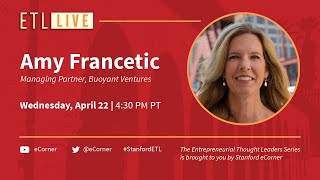
This content was created by GHION.AI . This content was uploaded by GHION.AI . This is a YouTube video titled "ETL Speaker Series: Amy Francetic, Buoyant Ventures" from April 23, 2020. It features a talk by Amy Francetic, founder and managing general partner of Buoyant Ventures, as part of the Entrepreneurial Thought Leaders series at Stanford University. The discussion, led by Toby Corey, covers Amy's career in venture capital and entrepreneurship, focusing on digital climate solutions and clean energy investments. They also discuss the impact of COVID-19 on climate change and the importance of political will and innovation in addressing environmental challenges.
Chapters
You.
Hi, I'm Toby Corey and I'd like to welcome you to Entrepreneurial Thought Leaders series presented by stvp, the entrepreneurship center in the School of Engineering and bases the Business association of Stanford Entrepreneurial Studies. Today we're excited to welcome Amy Franzetti. Now, Amy's the founder and managing general partner of Buoyant Ventures, a new venture fund in Chicago that aims to invest in digital climate solutions. She previously founded and led Energize Ventures. Her career spans over 20 years of high technology entrepreneurship, private equity and research. Amy also co founded and served as the CEO of technology accelerator Clean Energy Trust and held roles at private equity firm MBC Capital and the Stanford Research Institute. Earlier in her career, she was co founder and CEO of a tech company that she sold to LEGO Systems and she helped fundraise for mobile gaming company GLU Mobile, on whose board she served until it went public on the Nasdaq. Amy has a BA from Stanford University. Welcome Amy.
Thank you. Thanks, Toby. Thanks so much for having me. It's such an honor to be here. I wish I could take this class.
Well, we're honored to have you. Now I'm going to open up with Is it pure luck, the universe, or the Greek earth goddess Gaia working her magic that you're here today leading a climate crusade on earth day?
Absolutely. 50th anniversary. Woo.
Woo. I know, huh? All right, so we got a lot to cover in such limited time, so let's kick things off. We're going to start with a quick quiz using our Zoom polling function just to set the stage for today's talk. So here we go. That quiz shook up in a second, but let me read the question. How have green energy funds fared over the last six years compared to general VC funds? You guys can see looks like the polls up there. So start answering the poll. We're going to reveal the answer a little bit later in the conversation. So Amy, let's get into it. You started your career developing children's software, educational software. Then you sold the company to Lego, then over to a leading think tank, Stanford Research Institute. Off to private equity venture capital work. You founded a technology accelerator called Clean Energy Trust, then left to raise $165 million venture fund at Energized Ventures. You've served on private nonprofit boards. Now you've started Boeing Ventures where you are focusing on digital climate solutions. I will say that's a really heavy polymath career trajectory. Could you walk us and the students through that journey and share some of your insights and lessons learned? Because it's fascinating.
Well, thank you so much. I feel like when you recite it all, I feel really old, but I do feel like I still have so much to do. So I think the key theme is entrepreneurship. Buoyant Ventures is my fourth startup, and I think it's been really great to take what I learned at Stanford and to try new things and take risks. And a big part of another theme that kind of is a thread throughout my career is working alongside of engineers and scientists. And I guess I always wish that I had become a scientist or become an engineer. And instead I'm a business person. And so I try to do the best that I can to apply my business schools skills rather to scientists and engineers to help them realize their dreams. So that's a big part of what's driven me throughout my career. I'm kind of a science junkie. I love to read about it. I love to talk to scientists. I love to try to understand how they think. And I'm also really struck by the potential of all these great ideas that are coming out of labs and universities and how can we bring capital to help these people tackle some of our most daunting challenges, like climate change. And I think that's a. I have great respect for anyone who dedicates their life's work to that, and I want to help them be successful.
Yeah. So one thing related to that, I guess, is that you have been able to find and cultivate really great mentors throughout your career. That's a huge topic at Stanford. I've been teaching out there for 10 years. So how have mentors shaped your career and what have you done to really help find some people that have made a big difference in your life and your career?
Well, I think I have to embarrass one of my very early mentors, whose name is Kathy Schlein, who. She has a lot of Stanford folks in her family, but she was a friend of mine. She was my boss, actually, early on in my career when I worked for Hasbro and we were making a line of kids software. And I remember very fondly that one of our first interviews, she was a runner. I was a runner at Stanford too. I walked onto the track team, so. So I wasn't good enough to be recruited, but I loved to run so much that I walked onto the track team. And the only reason I really raced at all was because the gal who was an Olympic athlete in my races was injured. So that's why I was able to race on the Stanford track team while I was there, but Kathy was a runner too, and we both ran 8 hundreds and she really drilled me in our first interview about what my times were. And so I think if they weren't respectable, she probably wouldn't have hired me. But I think it's really important for women to find women mentors. I think that's a really important thing. Kathy was a great mentor of mine. She really taught me to speak up for myself. And she really set a great example about being authentic and being your authentic self and I think being fearless, that's a really. She worked alongside Steve Jobs and so she had picked up a lot of great experiences working with him at Apple and try to bring that to us and relay some of those great learnings. But I think also there's, you know, it's great to have women mentors, especially for young women starting out in the business world, but sometimes they, you have to also find great men mentors as well. And so I've had a number of those throughout my career. And folks that helped me kind of realize some of my goals and also maybe try to help avoid some of the pitfalls, you know, pointed things out and were honest when I needed that honesty and showed some tough love, which is really important, is to get. Have real honest feedback from your mentors and your peers whenever possible. And you really realize then how rare that is. It's really rare to get someone who can really tell you when someone's told you no or they're sort of not letting you do something. You don't often get the feedback about why or how to do it better. And so it's really valuable to work with people that can be honest with you and that builds a really terrific trust.
Yeah, that's awesome. Fantastic. So tell us what led or inspired you to pursue clean energy? Because that's not the easiest industry to be in, but what got you on that track?
Well, I was working in the high tech business for the first part of my career and had started out actually in video games and, and then worked in the wireless business and had run a company that spun out of a think tank that Paul Allen funded. The think tank was called Interval Research and the company was called Zowie. And that was one that I did also with Kathy. She was helpful and was an advisor to that company and gave us a lot of support. Anyway, so I moved to clean energy because there was a turning point in my life. At a relatively young age, I actually got sick. I had kind of a rare form of cancer and had that fortunately had that treated. And in the recovery of that, I just felt like I really wanted to do something with my life that was meaningful, that gave me more meaning and that was going to leave the world in a better place than how it was. I found so much great joy and comfort from being outdoors. I get a lot. I mean, basically nature is like my religion, so that's a really important thing to me. And I wanted to protect that and make sure that it was around and healthy for my kids and their grandkids. So I thought, let's just put the rest of my career into trying to do something to address climate change. And so that's what I've done with the last few startups. It started with Clean Energy Trust and then Energize and now Buoyant Ventures. And yeah, I think we can do this. I think we can turn this ship around. I mean, I really, I just have been thinking a lot about climate change, especially amidst the whole Covid crisis, and really like what some of the leaders in Europe are doing where they're really trying to get the stimulus funding and the recovery funding that the EU is going to be deploying to invest in clean energy technologies and innovation because they don't want to go backwards, they don't want to be beholden to fossil fuels. They want to move forward and they want to do more coming out of this crisis to make things better and solve some of these other big challenges that we have. So that's kind of what drove me, is I wanted to, you know, just wanted to have more purpose in my work.
Yeah, that's fantastic. I worked at SolarCity and at Tesla and it's definitely not for the faint of heart. It's a space that has got a lot of lobbying interest and there's a lot of work to do. The good news, I do think that, I think sentiment is changing and I actually think COVID 19 is, is going to be a potential catalyst for that. But we'll get more into that in a little bit. So before we reveal the polling data, I wanted to get a better understanding of. As you look at your investment, theses for your new fund. Looking at digital climate solutions. So what does a good investment look like in general terms?
Sure, sure. So digital climate solutions means technologies that are primarily software, some hardware, Internet businesses, the general tech, digital technologies that have made up most of the venture segment over the last several years, but applying them to industries that have the biggest climate risk associated with them. And so those industries are energy, agriculture, transportation and the built environment. Those four industries are the major contributors to carbon emissions. And so we want to turn use digital technologies to help businesses and some governments and communities address climate risk in their businesses and their communities. And to do this in a way so that it can be scaled very, very quickly. There's a lot of great technologies that other investors are working on, people like Bill Gates and Breakthrough ventures that are trying to look at battery chemistry or fuel cells or fusion even. The challenge with those technologies is that they take a long time to mature and they require a lot of capital and they're not necessarily built for a 10 year traditional venture fund. So with Buoyant Ventures, we really wanted to use these very scalable technologies that require tens of millions of dollars as opposed to hundreds of millions of dollars to scale and that have also, these technologies have also matured quite a bit over the last five years. So the value that they can bring to these businesses is more meaningful and is more impactful today than it was even five years ago. So, you know, the data that a lot of these businesses are contending with, the volume of data is overwhelming and trying to draw some kind of insights or competitive insights from the data is really, really challenging. So a lot of these young companies have created solutions that allow asset managers, business leaders, insurance companies to better understand and take signals from the market to make decisions that are going to either help reduce the emissions in their business, that will help them adapt to this new climate reality, or can help them operate more efficiently and do more with less. So that's just a broad sort of summary of our thesis. I know I can go into specifics or give you a couple of specific examples if you'd like.
No, I think that was really helpful. So if the STBP team could publish the results of the poll so you guys can see. Pretty sure everyone can see on their screen, hopefully. So 61% said that the funds fared 10% better over the last six years of a general VC fund, 17% 10 said, 10% worse, 11% said 30% worse and 11% said about the same. But let me tee up a question because I'm going to have you reveal the answer. Amy. So green tech was really red hot area like 15 years ago. I know. I think Kleiner and Draper Fisher, there was a lot of aggressive money in that space and of course I worked at SolarCity and Tesla. But I know it's been a really tough business to make money and deliver returns. But what's changed since then and why is the right time now? And before you answer that question, what's the Real answer to the poll?
Well, I think if you compare it to the general. I would compare it to the IT and the tech funds. Let's compare it to that which have done very well over the last six years. So those funds have done quite well. It's actually fared 30% worse.
Okay. But I think what's important now is as we, the landscape is different.
Right.
Heidi Rosen talked about that last week. So someone that had a evaluation, other folks that have had companies that were on fire are letting people go in mass quantities. Right. So the world's an entirely different place.
Right.
So why now? We're at a really interesting time in history. Right.
Well, okay, so first to go back to the transition, the 15 year transition that you said to sort of the last six years, right. So the, you know, if you look back and you measure clean tech funds from say 2010 till now, they were, they had terrible returns, right? So they were, you know, single digits or negative, you know, not even returning their base capital the since in the last six years they've done so much better. So the top quartile clean tech funds have been delivering on average according to Cambridge data, which is the data that I'm citing in the mid-20s. So that's really good. That's a really good venture return. That's a, you know, a 3X net. That's a 3X net return for these funds. The IT funds that, you know, the IT venture funds have done in the mid-30s. So they've been really great over the last six years and you guys know all about that and some of the big funds in the valley that have been leading the way there. So what's changed? What's better now? So a few things have changed. Number one, the core equipment and technology for renewable energy is much, much more cost competitive and is much, much cheaper than it was 10, 15 years ago. So you know, wind and solar are very, very inexpensive and some of the, some of the lowest cost energy you can build, new generation you can build today. They'd certainly beat coal and nuclear in every market and even in some markets beat natural gas. So the core base technology has become very, very cost competitive. Another thing that has changed is the, in the venture space is this addition. You know, there's been a lot of new capital that's come in that is looking for venture fundable technologies. So there's, there are some very ambitious folks that are shooting high and Maybe looking for 20 year returns like breakthrough. But there's a lot of new funds that have been raised in the last four or five years and filling that gap that had existed before to help commercialize a lot of these technologies. They're getting very good at choosing companies that can scale in a venture time frame in a 10 year timeframe. One of the things that's gotten worse is I think the political headwinds that we have in at least the United States. So you've got really great leadership happening globally. The rest of the world is kind of woken up to the fact and accepts climate change and accepts the science. And then we've just, with this administration we've had a lot of resistance. So that has opened up some additional capital. Folks almost maybe activated a part of the market that before wasn't activated because they want to do something about it. So it's helped to bring some new capital into the market. And a lot of that new capital is coming from family offices and foundations and others that have a really strong impact, an ESG impact drive for their capital. So they're looking for not just financial returns, but some environmental, social or governance benefits for their capital. So that's a big thing that has changed in the last few years. And I think it's brought in some new sources of capital that have a really strong intention with their, with their money. So that's at least where we've seen a lot of funds have been successful in raising from some of those folks.
Yeah, I would agree. And I think too obviously we're going through a very difficult social transformation right now, but now seems like a really good time. It's a very contrarian point of view to actually start this initiative and look at some of the great companies that have been founded during the dot com bust, the housing crisis. Who would have thought a guy like Elon Musk could transform the transportation industry? Right. So what are your thoughts on timing?
I think the timing is especially good now because everybody has talked about how frothy the valuations were over the last few years and those are coming down. I mean, you want to be putting capital to work when you're at the bottom of the market. So this is a really good time for folks that have dry powder. I think the other thing that's really happened in the space that is exciting that we hope will resume, you know, post Covid is all of this, all of the promises and commitments from the super majors, but also all the institutional capital that is moving into the sector. Right. So all the big banks have made commitments to address climate risk in their portfolios, endowments. You know, the universities have, are getting a lot of pressure from the students to divest of fossil fuels. So that's helping to bring more capital into the market. And I think we'll see, we'll continue to see the momentum build again from those institutional investors. I don't think we're going to go backwards and they're suddenly going to say, oh no, we want to go back to how we were investing before this. I think that you're going to see that the sustainable funds are going to outperform the traditional benchmarks and they're certainly going to outperform any funds that have any kind of fossil exposure in them, especially considering the price shocks that we're seeing in the oil and gas industry. So I think you're going to see definitely a good momentum returning to any of the folks that are investing with ESG top of mind. And I think we'll see some big institutional players will double down.
Yeah, I'd agree with you. So I think your fund is more Series B, early stage.
Yeah, we're early stage.
Yeah. So for all those super talented smart folks that are thinking about becoming an entrepreneur and want to do something about what I think is the greatest human existential threat around climate change, what advice would you give a big idea entrepreneur on how to raise capital? And we all know that the top three reasons ventures fail, one is they find out there's no need for their product or they don't get the product market fit, or two, there's the wrong people involved or three, they run out of capital. But as you sort of think about sort of how you're looking at the future, some of the opportunities here, what advice would you give a young entrepreneur that wants to do something in a climate change space?
Well, first of all, I would say I draw a lot of inspiration from college students. You know, Clean Energy Trust has, since its origination in 2009, has been funding student led businesses with their capital and they've had support from the Department of Energy as well as a number of corporate sponsors. So, you know, young people are going to save us, but they have to save us. We're counting on you all to save us. But I think one piece of advice is there's so much many great support systems for young people starting companies, whether you're a student and you have support through a venture fund at your university. I know Stanford has terrific support in Brian Bartholomew's class and some other more accelerator type support systems there, the Y Combinators and techstars. I mean, that's a relatively recent phenomena and they do a really, really great job of helping people hone their business ideas. And investors like myself, like, we definitely go to all those demo days, we watch all of those pitches, clean energy, trust funds, those student companies, and you've got a lot of young, early, early stage support for new ideas. And I think that's really a great place to go. Learn from your peers, find mentors. There actually is a techstars sustainability initiative in Denver or Boulder that is also sponsored by the Nature Conservancy. So you now can find a techstars type program specifically for climate. And I've heard really terrific things and have talked to the folks that run that and they do a really great job of helping people shape their businesses and get them in front of mentors and help run those interviews, like Steve Blank's questioning that he does for new business ideas. I think that they do a great job of giving exposure and helping people get in front of customers to hone their ideas. That's what I would say is get yourself into one of those programs so you get all that support wrapped around you.
Yeah, I would agree. I think your timing is exceptional because I think if you sort of look at how the evolution of software and look where it was just 10 or 20 years ago, it was really hard to build software, and with the tools and the frameworks that exist today and other new infrastructure companies like Plaid that comes out that allows you to plug into any sort of bank for an ACH poll and you look at the distributed energy assets that are sitting out there today. So I think your timing is great that there's enough of inertia and kind of raw material out there for the second act of the play that can really take this thing to the next level. So I love the space that you're in. So let's shift gears a little bit. We're all dealing with a super significant pandemic. We're seeing nothing like I don't think any of us have ever seen in our lifetime. The unemployment rate is skyrocketing. I don't think we've ever seen an economic shutdown like we have the health issues that we're all facing. How do you think Covid, sort of what does that do to climate change? How do you see it playing out?
Well, there's definitely a connection. You know, I think that what we've seen is that some of the people that have suffered the worst and have died have been in areas with a lot of air pollution. You know, they may have had underlying asthmatic conditions, which is again, very much a condition of living in highly polluted areas. So when you have a respiratory disease, that's a very strong factor. And you know, when you've seen what happens when we shut down the economy around the world and you see how clear the air is and how clean the water is and all that, like, to me that's a great opportunity that we just got a taste right before our eyes of how good it could be. And we don't want to have to shut down the economy to achieve that. We want now human ingenuity to come up with solutions and technologies and policy that will help us achieve this, but stimulating the economy. And so I think, again, like I said, what these 13 countries in the EU have called for an investment in the space and I think recognizing the job potential of the space as well. The wind and solar and energy efficiency industries employ more people than the coal industry, three times as many people as the fossil fuel industry. A lot of these businesses are small businesses. You talk about the SolarCity and the Tesla roof, all those installers pretty much now are out of business. They're not working, let's just say that. Not that they're out of business, they're not working. So you can't go and, and really have that business continue if people won't, they're not considered essential. And if people won't let you into their home, then you can't do energy efficiency retrofits or do these installations either. So we need to get those folks back to work. And more than half of the employees in the clean energy space are with small businesses. And that's just the job creation engine of the country. So I think we have to recognize that I hope in a future stimulus package or recovery package that clean energy will get some support because there was a lot of progress that was made in 2008 under the Obama administration when they stipulated that those ARRA funds, the American Recovery act funds, had to go into clean energy. And it really did stimulate the growth of the business and help to bring the prices down in the, the energy that we have today and the equipment that produces the energy today. So we need to get this, you know, the industry back to work. We need some support for these workers. And I think we have to, we just got a taste of what, you know, what actually the emissions reduction over the last quarter is about equivalent to what we would need to do to prevent a rise in temperature by 1.5 degrees. So we just seen how that can happen. But now we can't do it by shutting down the economy. We have to do it with human innovation and policy changes.
Yeah, I know. You're so spot on. I remember hearing some criticism from the conservative side of the House about the federal tax credit that's actually been around for quite some time, going back to the 60s to spur housing development. And that was so matter of fact, that money ends up coming back into the treasury anyway. And so we were able to take like the cost on a per watt basis from about $8 a watt down about 3 or $4 a watt because of that federal tax credit. And it allowed for massive job creation, great paying jobs versus being in a coal mine or working on an oil rig or doing something that's just so damaging to our economy. And it really is. It's quite unconscionable to sit here and look what's playing out. I, like you, have a lot of hope. I think Generation Z and Millennials are. They're wired differently. And I think that you're going to have this opportunity to unlock this incredible talent. So if you had, if I gave you a magic wand and I said, what would be the one thing we could all do to make the biggest impact around climate change? What would that be?
The one thing? Maybe eat less meat would be one of the one things you could do. Right. And it's not obvious, but if it's an individual person, you know, livestock in the ag sector is a major contributor to emissions. So if we ate, the resources that are necessary to feed the livestock that we eat are enormous. The amount of water that it takes is enormous. If we ate less meat, especially in the developing countries, we would have a potentially really positive effect on the emissions from the egg sector. I think that would be a major benefit.
Yeah, I would agree. And they're really there. That's such a massive contributor and it doesn't quite get that play. My guess is that there's still really strong lobbyists in Washington.
Absolutely. Yeah, absolutely.
But I would say. So I would agree with you. The second advice I would give is please get out and vote in November, people, especially young voters. You're historically fickle and to the extent you can make the difference this November. So hopefully we get a lot of folks out there.
Actually, we won't change anything if you don't vote. You know what I mean? Like, we have to, we have to get young people to vote. And we know that climate change and sustainability is one of the number one issues for young people. So you have to make your voices heard. And that's. We really, we really need you.
Yeah, okay. We've Got a whole bunch of questions coming in. I'm going to pivot to that in a second, but I had a couple last questions for you. So we've been talking a lot of business and a lot of shop and big thinking stuff and we're the thesis of your investment fund and where the world's going. So what do you do to reduce stress?
I run, I swim. I can't run as much as I used to, so I swim, but I can't swim now because all the pools are closed. So I get outside. I mean, that's my nirvana. You know, I get outside with my dogs and my husband and my girls and you know, we just walk for miles and miles and run and get fresh air. And honestly that's our saving grace right now. It's kind of keeping us mentally sane and physically sane. Although it will be months and months before I'll fit back into any of my pants. So helping, but it's not making enough of a difference. It's not counteracting all of the cookies and baking that my girls are doing here at home. So yes, I have to go get a bunch of new pants to wear.
I'm curious to know because you and I have had somewhat similar careers, a lot of pressure working for very high stakes companies and the demands are quite extraordinary. And I'll admit my work life balance historically has not been good. But you've worked at some very high pressure jobs. You dealt with a life threatening health issue and you just seem really centered and you know, so what else do you, what have you done throughout your career to kind of work through, you know, lots of stressful times and where you got to today, whatever it's done looks like it's working.
Well, you're very kind. And I don't, I mean, I think, I don't really know if I have a great answer. I wish I did, Toby. I wish I had the advice. I think I feel a deep responsibility to try to make a difference and I feel like people are counting on me and that makes means a lot. And I function really well in a team. So I really like to be part of a team and I take really seriously the success that we all have. That responsibility we have for success for each other. So that's the biggest thing that kind of drives me to do the right thing is think about my team, to think about my family. You know, you haven't asked me what it's like to be a working mom. You know, I have two teenage daughters and definitely had times, you know, where I missed out on things that they were doing to work. But, you know, we talked a lot about why I was working and what I was doing and they were supportive of that, you know, goal and that mission. But I also tried to be in jobs where I had the flexibility so I could be there for the most important things when I needed to, you know, and that sometimes meant that you couldn't work for folks that weren't supportive of that. And so I think that that's another key thing for women as they are in their careers is to really find those bosses that, you know, have a family and want to, you know, understand that they're going to get better work and better loyalty and commitment out of their employees if they are flexible and allow you to also be a mom and wife and, you know, and a dad, you know, and to turn up for your kids. That's so important.
Yeah. Somewhat related to that. Do you feel if you look back again on your career, and I know some young students are just getting ready to start their career, did you get to where you got to where these things just sort of stacked on top of each other, or was there some non linear moments where some positions and some things just really catapulted you far faster than kind of the linear step?
It was definitely nonlinear. It was definitely nonlinear. And actually one of the big sort of debates I had with myself and some of my bosses and my peers was going back to business school. I have a BA from Stanford and I don't have a business degree. And when I was in my late 20s, I was in the very fortunate position to be running a company. And I felt like I was learning so much running that company that I couldn't afford to take the time out to go back to business school. Like what I was learning, you know, raising capital and running the business was more important than learning it in a classroom. But I highly think I highly recommend people do that because I know people. All the MBAs that I've hired over the years have gotten so much out of that experience and, you know, especially the relationships and friendships that they've built in. Business school has been so important. But that was always a debate that I had was, should I be going back to business school or not? So I had a couple of opportunities early on where I got a lot of experience and that was all sort of on the job and that's how I decided to learn. And then I filled in the gaps in areas where I didn't know, like I didn't know much about accounting. So I took an accounting class. You know, nowadays you can do that too. You can sort of supplement your education relatively easily by taking online classes. So I'm a big believer in that sort of learning what you can, you know, while you're working, because you get to apply it right away. And that's sort of the best way to learn it too, is to put it to use the next day. So, yeah, I think that, that I forgot even what your first question was. Hopefully I didn't ramble too much.
I think it's important because, you know, you sort of looking at this incredible career trajectory is like, wow, did these things sort of stack up and learn, learn, learn, or whether I know my career. There were moments where it was super non linear where just like what I learned was an explosion. Other things are more kind of incremental. And I was wondering if the same experience. And to that end you worked at a really interesting. Had a career stop at Stanford Research Institute, which is an incredibly secretive place. And I was curious. That seemed to kind of be a little bit different. I know. You know, yeah, I'm curious to know what you learned there and what that was all about.
I loved my time there. It was awesome. I was actually working in the ventures and licensing group for Norm Winarsky and he's credited with helping to identify what became Siri. I actually worked for a period of time with Adam Chayer on what. On the early, early, early part of the research that became Siri there. And my job was to be the business person to help either license, figure out the licensing of the SRI technology or to raise, help, raise capital for spin outs. And they had a very good, successful track record of turning their research into viable businesses, especially in the voice recognition area, also in cyber security. So I worked a lot on cybersecurity there when I was with them. And you know, that was super fun because it was just like I love to be in the labs. I love to, to sit alongside these scientists and these crazy smart people and then just dream about, well, what could we do with this? Where would it fit in the market? Who would buy it? You know, how much would it have to cost? Like, what partners would we need? And that was my job, was to think about the business part of it. And we got to interface with a number of venture capitalists that were supporting that effort at sri. So they had put together this great advisory panel of some of the top venture capitalists in the area to help review their technologies and to have opinions about that. And that was super fun. But I loved working With Norm and I, actually, the reason that I stopped working there was we moved back to the Midwest to raise. Once I had both of my daughters, we really wanted to be closer to family. So we moved back to. From Menlo park, we moved back to the North Shore of Chicago to raise our kids closer to my family. So that's what disrupted that. Otherwise, I think it would have still been there. Working on that. I love. That was one of my favorite job experiences. So intellectually stimulating.
Yeah, it's a very fascinating place. Some amazing technologies are conceived and birthed there. So that seemed like it was a great stop. Okay, one last question. We had some really cool questions popping up in the Q and A. But lastly, so if you went back in time to your freshman year at Stanford, what would you do differently?
Well, would think. Let me talk about my Stanford experience in general. One thing I would do differently that I regret is I never studied overseas. So I wish I had done that. That's what I wished. One thing I wished I had done, and we didn't have a lot of money. I was on a big scholarship. I had to work throughout my Stanford career. I had a big loan. So I think that felt very luxurious to me. And I didn't think I could afford to do that. So I wish I had done that because everybody I know that did it, had a great experience. And I sort of then set about after graduating, trying to travel a lot because I missed having that experience as a student. But I do remember one thing, one piece of advice is I would give a little more forgiveness to myself that freshman year, because it was. I came in. I was class valedictorian in high school. I had straight A's, but I was not prepared for the intellectual rigor of some of the advanced math and science classes at Stanford. And they just kicked my butt. And. And I remember feeling I was so. I was just like, so humbled. It was really. I think it took me quarters to recover from that, like, signing up for some of these classes. And I thought, oh, my God, I'm not. I don't belong here. I totally had that, you know, imposter syndrome. I don't belong here. Like, what am I doing in these advanced math classes? So I had to get sort of put into the right classes. And that was really. It was like a huge confidence, shattered my confidence. And I think I wish I would forgive myself a little bit more for those experiences and maybe fumbling a little bit freshman year, figuring out where I belonged and what classes and all that kind of stuff.
Yeah, I love it. So, look, I think fate played a big role in you being here today on Earth Day. I so applaud your work and effort and courage in what you're doing. And I don't know if we've hit 420 parts per million yet. I know we're at 419 last time I checked, and we're clearly not on a sustainable path. And I've looked at studies that show within 100 years, so students, your kids are going to be inheriting something quite extraordinary here. It could reach $2 trillion a year to deal with climate change. That's not going to education, that's not going to infrastructure, that's not going to investments in the future. It's paying for the past, so it's not too late. Thank you so much for everything that you're doing. I think your fund is going to be for phenomenally successful and I think you've shared some amazing insights with our students today. So we got a little bit of time. Let's do some Q and A. And so they've got some good votes here. So the most voted up question is, broadly speaking, what does the success scenario look like for climate change technology and what is the end game and how different and how is it different from today?
Well, let's see. Let's talk about, you know, wow, success. What does success look like? So I think we kind of saw it a little bit, like I said, just the last, you know, the last month or so, as we saw how, you know, how you can see the Himalayas from the cities, you know, in India, how you can, how clean the air is in LA and in China, I think, you know, success is definitely keeping us under that threshold, the emissions threshold and the temperature threshold. I think more importantly, it is, you know, we caused a lot of damage even to the ecosystem and the biodiversity. And I think that helps. Big success will be restoring that and these habitats that a lot of the, you know, we've encroached upon a lot of the habitats of, of all the animals and that's been a big cause of infectious diseases. Right. So as we've encroached upon their natural habitats, we've seen more and more, you know, animal to human infectious diseases. So I don't know that it's going backwards to what we had before, but I think it's like renewing the biodiversity. It's clean air and water and I think, you know, a big part of it from a. Like you think about the energy sector in particular, I think getting us to 100% clean energy is definitely doable. I think we can get there. I think what we need is we need the political will to build transmission and to connect up all the renewable energy in the rural areas where it's very inexpensive to produce it and to deliver it to the load centers, but also to have some of the changes in the energy rules so that we can transmit that power over state lines. I know you guys have a special situation there in California with figuring out how to import enough renewable energy, but also how to deal with your solar. You have so much solar and how much curtailing that will be. So how do you sort of balance that on the grid? So a lot of these are very, to me, those are very solvable problems. And I think if we have the political will to get there and can change some of the rules and regulations so we can use all these technologies that exist and just put them to work and let them do their thing, then I think we can make really tremendous strides. And I think we have it. Tesla and their amazing electric cars, they basically helped to make the EV market. So we'll get back to that eventually. EVs are going to take a major hit from COVID just people's disposable income and people aren't going to be buying as many cars. But again, I think that the internal combustion engine is not necessarily going as fast as the way of the coal plant, but it's on that trajectory. I think that that will resume and we'll get there on the transportation sector and removing the emissions in that sector. So I think we can get there. I think we just have to let all of the great inventions we already have, they have to be scaled and we need support from the government to do that in a sort of a rulemaking and regulatory standpoint. And if we had a price on carbon and we could get the political will to do that, that would accelerate us in a really positive direction. So maybe we can get that with a new administration.
Yeah, I mean, I would agree 100%. I remember back when Elon was very active at SolarCity while I was there as our chairman. And I remember when these green products first came into the marketplace, they were typically not as good and they cost more. And that was just like an anathema to Elon. And if you think about it, they don't advertise an electric car. Like he's completely transformed the driving experience. It just happens to be electric. It happens to be great for the environment. I think that's the opportunity that's there. How do we create extraordinary, awesome products? Big thinking, big breakthrough opportunities that the market wants and needs. And the timing is so right. We're literally dealing with 100 year old technology. That's how old our electrical infrastructure is today. And we've got kind of the first wave of renewables that has sort of made its mark, are being deployed today.
So.
So the opportunities are just absolutely huge. But you're right, we need to elect the right folks that are not thinking about yesterday, are not thinking about 1950s policies, and are thinking about what's right going forward for humanity, the viability of our planet. And this November is going to be really important. Okay, next question. That was voted pretty high here. How do you see travel impacting climate change in the future? There seem to be potentially two camps. The camp travel will decrease in light of COVID and the camp that travel will continue to steadily increase as access to transportation becomes more widespread across the world and as global population increases. How will the travel problem be solved in the future as we work towards global sustainability?
I think that, well, certainly travel is going to be curtailed until we have a better handle on a vaccine. So that's really the, I think the big thing. And we won't even once we have a vaccine, we won't have it produced in enough volume to really vaccinate everybody that needs it. Right. So that's, you know, inventing it is one thing and then producing enough of it is another thing for sure. So I think that travel will resume. I think that virtual is great. I think it's absolutely helpful, you know, that we have all these amazing tools. And when I think about digital technologies, I think about how Zoom scaled from 10 million users to 200 million in a quarter. You know, like we, we have these tools that are going to make it easier to, to communicate virtually so we won't have to meet as often in person. But I do think that, you know, I don't, I mean, we are such a, you know, I'm a. I don't think we're going to go backwards on the globalization. I really don't. I think the effort to try to prevent that is futile. I think that, you know, trying to keep people out of this country and trying to limit, to limit immigration and also trying to limit dependencies that we have on each other, the countries have on each other. I just don't think that that's worthwhile. I think we have to embrace that and we have to be more prepared in the future when the next pandemic happens, because it will happen. It's going to happen. I mean, it's going to happen again. So we have to learn everything we can from this one to know how to get communication out and how to treat everyone, you know, more successfully, how to make sure our hospitals are better prepared and have all the equipment that they need to be more effective. You know, that's been such an issue is for them to have what they need to do their jobs. They don't have what they need. So I think we're gonna have to rebuild all the stockpiles. And I think that again, like the whole supply chain for medical equipment is completely global. So you can't, you really. I think we have to just embrace the fact that we are dependent upon each other and make sure that we have better systems for dealing with the next pandemic. But I am hopeful that global travel will resume. And I think that from a carbon standpoint, that is a big emitter and we do have ways we can address that in jet fuel. We have ways that we can address that certainly with electric vehicles. And then even I was talking to Maersk the other day and the shipping industry is a huge, huge opportunity to address for emissions and looking at pulling carbon out of the shipping industry and the transportation industry. The logistics end of things like you can do so much more with less fuel and there's a lot of great innovation that you can use to reduce the amount of fuel needed to transport these goods. And Maersk is one of the leaders in that area. They've got a commitment to be to net zero carbon by I think they're 20, 40. They're trying to get there by. So like that's incredible goal that they have because especially since the fuel for the shipping industry is so, so dirty, they have to do even more than others do than say the airlines do to try to try to address that. But I think we will. Again we have the innovation. We know how to make biofuels, we know to help the, to help flight and to help the airline industry. And we know that electric can do their part. Electric vehicles, trucking fleet, everything can be happening on the sort of vehicle front. So I think we'll get there and I think it will resume. It'll take a long time and I know people are probably going to be starved for getting back together in person too. I think we won't do it as much, but we're going to really do it for what's really, really important.
Yep, I agree. Okay, we have one last question. Let's see in your opinion, what let's see, wait, here we are. In your opinion, what are some near future green alternatives to fossil, excluding nuclear?
Okay, well, you know, I think the alternatives to fossil, I mean we've got, you know, wind and solar are super effective. Right. So I think deploying that at scale and you know, we've got a lot of rooftops that could still take solar on them and putting battery storage and pairing those with battery storage is really important. So we've seen that that can be very cost effective. Tesla's been a leader in that for sure. So I think deploying the technologies that we have at scale and then focusing on the transmission of that power, that's the transmission is the really the difficult. If we could transmit the clean power more easily to where it's needed, that would solve a lot of the problems that we have. So, you know, you've got some really great thinkers there at Stanford that are thinking a lot about this problem and how you do this. And I tend to agree with them, Mark Jacobson and some of the others who aren't looking for us to depend upon nuclear power. And they're certainly planning for storage to be a big, big part of that solution. But even if we didn't get to 100%, if we got to 80%, we'd be in really, really good shape. So I think if you still needed to use gas peaker plants in certain locations, if you kept open the nuclear plants longer than they're supposed to be, which is basically the entire fleet that we have in the country is operating way beyond its useful life. But if you could safely keep them online for a little bit longer, I think you could get there with really, with more transmission and with more storage that's deployed at an even greater scale.
Yeah, I would agree. I think just the efficiency of panels is going to leap in the not too distant future. I think just how smart storage is going to be is going to be incredibly transformational and I think just adding intelligence in to make the grid smarter because it's still pretty dumb today, it's a very few pockets. And for example, I was recently on the board of directors of a company that's doing some really great work. And actually energy trading is still very inefficient. It's done on an Excel spreadsheet with lots of human beings and company that was involved in is transforming that through AI. But the most important thing is that because the problem is that these renewable energy assets, it's really hard to monetize them because of the efficiency of the trading market. So this technology actually will allow for more both in front of and behind the meter, renewable energy assets that can be monetized. You're going to get those funded more and you're going to then take another leapfrog forward and getting off fossil fuel. So huge opportunities going forward.
Yeah, we really do have a lot available to us. We just have to put it to work. We need a commitment to put it to work at scale. And I think we can get there. I really believe that.
Yeah. Look, this has been an incredibly fascinating talk. It was so great to meet you. Thank you for coming on etl. Amy, what a great talk. All right, folks, we want to invite you all to tune in next week to hear from Joe Tsai, a member of Alibaba's founding team and now Executive Director Chairman, in conversation with SDVP faculty director Tom Byers. Amy, have an amazing day. Thank you so much.
Thank you. And thank you so much for everything you've done in your career, too, to help us with this fight against climate change. And thank you to Tom Byers and your whole team for having me. I'm so honored. I'm so honored that you wanted to talk. And I'm very inspired by all that the students are doing. They're going to save us.
Well, we're going to see you at 178. You're going to get the link for that, and I'll catch you in a few minutes.
Sounds good. Thank you.
Thanks, everybody.
More from GHION.AI


O processo de reconhecer limites, mesmo quando a vida parece exigir sempre mais.





Depois de tantas histórias, aprendizados e pausas necessárias, o @interior_iza está de volta



