ETL Speaker Series: Annie Kadavy, Managing Director, Redpoint Ventures
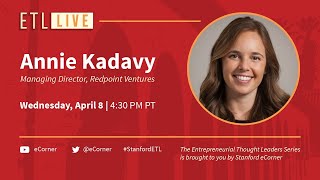
This content was created by GHION.AI . This content was uploaded by GHION.AI . This is a YouTube recording titled "ETL Speaker Series: Annie Kadavy, Managing Director, Redpoint Ventures" (Stanford Entrepreneurial Thought Leaders series) created April 9, 2020. It is an English interview-style presentation hosted by Tina Seelig (Stanford) with guest Annie Kadavy, a Redpoint Ventures managing director. The session covers early-stage venture capital topics — sourcing, diligence, term negotiation, founder/board dynamics, evaluating breakthrough ideas, gender diversity in VC, and practical advice for founders — and includes audience polls and Q&A. The format is a moderated talk/interview with interactive audience participation.
Chapters
Good afternoon, I'm Tina Seelig, and I'd like to welcome you to our Entrepreneurial Thought Leader Series presented by the Stanford Technology Ventures Program, which is the entrepreneurship center at Stanford School of Engineering. It's also brought to you by BASES, the Business Association of Stanford Entrepreneurial Students. Today we are super excited to welcome Annie Kadavy, Annie, I'm Tina Seelig, and I'd like to welcome you to our Entrepreneurial Thought Leader Series presented by the Stanford Technology Ventures Program, which is the entrepreneurship center at Stanford School of Engineering. It's also brought to you by BASES, the Business Association of Stanford Entrepreneurial Students. Today we are super excited to welcome Annie Kadavy. We have a problem. I'm Tina Seelig, and I'd like to welcome you to our Entrepreneurial Thought Leader Series. —presented by the Stanford Technology Ventures Program, which is the Entrepreneurship Center at the Stanford School of Engineering. OK, let's try this. Is this— can you hear me?
I can hear you.
OK, I'm going to start over again. OK? That was, I think, the audio on my own computer. So good afternoon. I'm Tina Seelig, and I'd like to welcome you to the Entrepreneurial Thought Leader Series presented by the Stanford Technology Ventures Program, which is the Entrepreneurship Center in Stanford School of Engineering, as well as BASES, the Business Association of Stanford Entrepreneurial Students. Today we're excited to welcome, welcome Annie Kadavy. Annie is a managing director at Redpoint Ventures, where she focuses on early-stage technology investing. She's an investor in companies like ClassPass, DoorDash, Patreon, Guild Education, Ike, Tend, and Tundra. Before joining Redpoint, Annie worked at Bain, she was at Warby Parker, and at Uber Freight, where she was the head of strategic operations. Annie has been named to both the Forbes 30 Under 30 list as well as the Midas Brink list. Annie holds 3 degrees from Stanford, and she lives in San Francisco with her husband, her daughter, and her dog Ruby. Welcome, Annie.
Hi, Tina. Thanks so much for having me.
It's such a treat. Thank you for experimenting with us. This is just such a treat. So I want to ask you, I'm going to start with a few questions to help us sort of have everyone get to know you a little better. So not long ago, you were a student at Stanford, and I'm wondering, you know, what were you thinking you were going to be doing a few years out?
Oh my gosh, well, I guess at this point I'm more than a few years out, but I, I really thought that what I would be doing would be running my own company that was tied to some invention, probably more of a product or a device. And I didn't really, I hadn't really conceptualized what that meant, but I knew that I had kind of a deep interest and respect for the entrepreneurial journey. And that was really what was guiding me to take the classes I was taking, to apply for the jobs I was applying for, was to learn in service of getting me to a place where I could do that.
So I'm curious, when did you decide you wanted to go into venture capital and what was your path towards that objective?
You know, I didn't decide to go into venture. I very much fell into it. And after I was there, kind of realized that I liked it maybe more than I anticipated I would. And so I first took a full-time job in venture about 8 years ago. I was coming off the tails of having tried to start my own company, and I had met some really great people in the venture ecosystem, one of whom decided to take a chance on me, and I ended up joining that firm, which is really where I learned the venture business. Ah, very interesting.
So you came, you obviously had operating experience before you went into venture. Is this something that's needed? Is that really an effective path? And if you don't have operating experience, is that— does that put you at a disadvantage in the venture capital world?
Yeah, I think some of the best advice I've ever gotten, and it was in the context for me of getting into venture but could be applied to really anybody getting into any job, which was, um, go and look for the example that you want to find. And what was the nugget in that piece of advice was I didn't know anybody who had my exact background or looked exactly like me who was in venture. And the point was, go look and you'll find someone. And you might not find all of those pieces of your experience or all of the things that make you who you are in one other person who's doing this job, but most certainly there are examples of people who have been and will be successful in this job who are just like you. And so operating, you know, I could give you examples of some of the best investors out there. Some of them have been operators for decades and some of them have never operated a day in their lives. I do have the opinion that having some amount of operating experience is helpful, specifically as an early-stage investor, because really what you're trying to do is help a team operationalize their business in many ways. Growth-stage investors, I think it's less important. Very interesting.
So that's a really interesting distinction, is that if you're at the early stage, having that operating experience ends up being very valuable.
That's my opinion. Yeah, that's your opinion.
So what is a typical day? I know that we have lots of people who are really curious about what it would be like to be a venture capitalist. Sounds like such a glamorous job. So what is a typical day in your life as a VC?
Well, currently it is I wake up and I get on Zoom from my house. Exactly. Yeah. Um, So I think it's maybe easier to think about it in terms of a week because any given day can be very, very different. So in the course of a week, every investor is doing the same set of things in a different proportion. So when you first start off in venture versus you are a more seasoned investor, you're still doing the same set of things, but the proportion of your time you're spent doing each of those is different. So at the very beginning of the funnel, what you're doing is looking for new investments to make. So sourcing, broadly speaking, that can take on a lot of forms, but it can be research-based, it can be having conversations with people, it can be going to a demo day, things like that, where you're looking for like top of funnel, new investment opportunities. And second, you're doing diligence. So you've gotten excited about a space or a company. So you're like digging into what is this opportunity and how excited am I? Then you are closing deals, which is actually by a fraction of time spent, very small, but is usually kind of your, peak excitement moment, right, where you're taking the opportunity to work with somebody for hopefully many years going forward. And then really what ends up being the bulk of my time is portfolio work. So after you've made an investment, you're working very closely with the founding teams of those companies to help them go build against the vision that you invested in. Well, it sounds super interesting.
It sounds very diverse. What was the biggest surprise that you had going from being outside that world to all of a sudden being an insider?
Yeah, my biggest surprise is, or I should say was, how hard it is. And specifically, I used to describe my job as a professional dream killer, which is a terrible thing. And why would you ever want to be that? But as it turns out, your job as an early-stage investor, or really even a later-stage investor too, is you say no 90+ out of 100 times. And that can be really disheartening if you aren't able to kind of reframe it in a way that you believe is actually being helpful to the people on the other side of the table who are the real stars of the show here. They're the ones that are having the courage to go and build these companies and put it all out there. And who am I, a person who spent 45 minutes getting to know what they're building, to say, no, I don't think it's a fit. And so navigating how to say no in a constructive way was, I think, for me, the biggest surprise.
Yeah, I always hear that VCs never say no. They always say, well, that's super interesting. Please keep me posted. Is that true?
I think that there is a lot of truth to that. I have certainly done that. I couldn't lie to you about it. I try very hard, and I think I've gotten a lot better at it over the years, to just be explicit and recognize when I was entrepreneur, when I was an operator, I just wanted clear, direct feedback. Tell me if the answer is yes. Tell me if the answer is no. If the answer is no, why is it no? And are those things that are in my ability to control, or are those things that are going to be just representative of what I'm building? And so I know those things that can be helpful to me in kind of pursuing other options.
Really good point. So I'm really excited that we're going to try our first little mini case here. OK, so let me just tee it up. So we have a lot of people who are listening who are first-time founders or are hoping to be first-time founders. And one of the issues is there's a real difference between the amount of experience you have as an investor and them. When they come in, they're naive in a lot of different ways. So when you are negotiating with a first-time founder, do you— A, do you— and we're going to put up a poll in a second, OK— do you, A, connect them with someone who can help them advocate for themselves and get the best terms? Do you 2, help educate them yourself about the process, even if it means that you don't get the best deal, right? I mean, you might make them, you know, put them in a position where they're going to ask for more than they could have or would have known to ask. Or 3, do you do everything you can to get the best deal for your firm? So let's put up the first poll and see what our audience thinks. We're going to give you 10, 15 seconds to, to look at this to see if, you know, You connect them with someone. Do you educate them? Or you do everything you can to get the best deal for your firm. What do you think Annie's going to say? What would you do if you were venture capitalists? Give you just a couple more seconds. All right, let's see what people say. Let's look at the results. Let's see, are they going to show up? Let's see, is it tallying? I don't know. Well, while we're waiting for the results to show up, let's find out from Annie what she would do.
I'm like on pins and needles over here. I'm like, what do people say?
What's going to happen? Let's see if anybody answered the poll. Okay. Oh, the results are sharing. It says— I'm being told that the results are sharing. Maybe we just can't see them.
Oh, you and I just can't see them.
Okay. Okay. Well, that's interesting. Maybe they'll send me a clue. Okay. In the chat. Okay. So what would you do, Annie?
Okay. So the— I'll go answer first here. So the answer I give is number 2. And the reason for that is that this first negotiation, which is your true first negotiation with a founder, and it's your first probably true, like, hard conversation, is really— it's an important learning experience and a trust-building opportunity between the two of you, right? And so every negotiation is different. I have walked away from deals because, for example, a founder is demanding a higher price than I'm comfortable with. I have negotiated for over the course of one day, over the course of multiple days. Most other terms in term sheets these days are actually pretty easy to navigate. We're in a time in history where term sheets tend to be very founder-friendly and very consistent across firms and across deals. And so Well, I do believe it's my responsibility to help. Oh, here we go. We can see the results here. Yeah. Yeah. Yeah. All right. An interesting mix. That feels like, for me, that feels like success that we like framed it up in a way that you could kind of answer it in any way. Exactly. OK, great. So anyway, coming back to why I say two, I think one, it's the most important conversation you're going to have to date with this person. And so you want to be able to build trust. And I want a founder to be able to ask me a question of, well, why are you motivated to put that into the term sheet? Or why is this the price that you came up with? And vice versa, them, well, why do you care that this is the board structure that we have as opposed to this or that or the other? So going to number 1, certainly they— any founder can and should, I would recommend, reach out to other founders or even to the law firm that they're working with, often becomes a valuable resource to give them some other perspective based on other things they've seen. And on the flip side, number 3, yes, it's, you know, it's my duty, it's my responsibility to get what I would consider a fair deal. But usually if it's plus or minus, you know, $1 or $2 million pre or post here or there, there's going to be some wiggle room that I want to be able to have that conversation in a productive way.
Yeah. So I'm going to share the results for those people who are listening to the podcast. Turns out a very interesting 41% of people said we should definitely try to connect them with someone else who's going to help them. 38%, so pretty close, said you should educate them about what the terms are and help them kind of get up to speed. And 22% said you should do everything to get the best deal. So it's interesting. My guess is if you went to different VCs, you probably would get also different responses to this. So one of the things that's interesting is when you choose a venture capitalist to go to, you might want to think about how they would answer this question, right?
Yeah, and I also think that how they would answer this question is going to be indicative of how they answer future questions that you work on together about your company. And in some sense, none of these are wrong answers. But they do represent kind of the person that you're working with. Yeah, so it's interesting.
I always think about the fact that when we teach negotiation, we think about every negotiation is the first step to the next negotiation. And my guess is that when you're an entrepreneur, this is the first negotiation you're going to have with your venture capitalists. You might have lots and lots and lots of other discussions where you're negotiating. And making sure this one goes well is a, is a great and important starting point. So let's try another one, okay? And, uh, I think we're getting this down. This is the beginning of a quarter, beginning of being online, beginning of using these new tools, and I think we're doing pretty well so far. So the second one is, when you invest in emerging technology, you often invite in, you know, lots of different people who are in that space to pitch with the intention of investing in one of them. So this is sort of an education process for you, and When you're doing this, do you A, try to get the founders to divulge as much proprietary information as possible and share it with the company you end up investing in? So do you say, oh, this is a great way for me to get some good intelligence about competitors? Do you tell them when they come in that you're meeting with their competitors as well and let them decide to limit what they tell you? Or do you not say anything? They should understand that VCs meet with lots of companies in the same space and that they should be very careful about what they say. So do you essentially get them to divulge a lot? Do you tell them you're meeting, or do you keep your mouth shut? So we're going to give you 10 seconds to look at this and see what people think. Interesting question. Okay, very, very interesting. Let's see what people have to say. Okay, well, Annie, while they're figuring out— oh, look, here's the poll, it's popping up. The poll says, okay, so 4%, only 4% say try to get them to divulge as much information, so we've got a very ethical audience here. Okay, 52%, so it's split between the other two. 52% say tell them you're meeting with competitors and let them decide what to say. And another half of them say don't tell them anything, they should understand. So what do you think?
Okay, so my answer to this is also 2. And the reason is fundamentally this is also about trust and relationship building at its core. It is completely reasonable for for a founder to say, "I don't feel comfortable answering that question," or, "After we spend more time together, then I'd be happy to share that data," or, "I will tell you this in confidence, but please don't share it outside of this room." Those are all totally reasonable responses to a question that I might ask about your user data or your product roadmap or any other number of things that you would view as highly proprietary to your business. That said, in order for someone to make an investment, you're going to need to share all of that information at some point. It doesn't have to be in the first 5 minutes of meeting somebody on a first date, but at some point you do want to share that. The second thing I would highlight is that you actually really want an investor that is actively meeting your competitors, because that demonstrates that they have genuine interest in the category that you're building, or perhaps the problem that you're trying to solve. And so on the margin, this is actually, I think, a really good sign if you have an investor say something like this to you of, "Oh yeah, you know, we're interested in your company. We've also met X, Y, or Z. How do you compare the business or the strategy that you have to those?" And the last thing I'll say, as, you know, as an investor, I'm actually quite interested in that answer because it not only tells me how they view the market shaking out, but it also tells me what they believe their relative strengths are to the other competitors in the space.
Really interesting. I love that. I like the idea that it's interesting, that it's really a great idea that they're looking— it's, it's a positive thing if they're looking at other competitors in the space. It indicates their interest, really deep interest in that market. Yeah, great. Okay, so let's do one more before we go back to just our discussion. Uh, here we go. You're in the middle— okay, this is very timely— you're in the middle of negotiating a deal with a startup. Okay, and all of a sudden the world changes. Maybe there's a pandemic that changes everything in the world. Do you continue the negotiation in good faith? Do you use this as an opportunity to get a better deal, asking for more equity, for example, since it's a higher risk? Or do you put out the, put out the deal for now and put it off and tell them to come back later? So let's see what people think. I mean, do you just continue as if nothing's going on? You know, we're in the middle of this deal. Do you say, hey, you know what, the world has changed, we're going to squeeze a little more out of this? Or do you pull out for now, say come back later when things, things get better? All right, let's, let's see what people say. And Annie, what do you say?
Sure. So, oh, how interesting. Okay, do you want to read the results, Tina?
Yeah. So let me, let me just do this. So 43% say continue in good faith. So That's really interesting. 25% say uses an opportunity to get a better deal, and 32% say pull out. I mean, it's really even. Gosh, this is so fascinating. So what would you do, Annie?
OK, so in some sense, I would say that everybody can be right here. And the reason is that it depends what your definition of in the middle of negotiating a deal is. So in some sense, this demonstrates the nuance of the process of negotiating a deal. So the answer that I give is number 1. And this is the right answer, but of course, not always what is going to happen. And specifically, I would give this answer, say, with the caveat that it depends where exactly the negotiation is. And if I define it as there is already a term sheet out, I have already said I want to invest this amount of money, I've already signed my name on it, I have already said we are signed up to work together for a very long time, then there shouldn't be a backtracking of that that is forced by me. There could still be if there is a conversation where we talk together and say, hey, you know, the valuation environment is going to come down probably after this. Are we sure that we want to do this deal at this valuation? Is that going to be the best thing for the company? But that's a mutual conversation as opposed to, hey, I'm pulling this term sheet and instead going to give you something that's 50% the valuation. That said, if it's pre-term sheet signing and you are still in a conversation saying, "Hey, I think I'm interested in investing. What might that look like? How much exactly do you need to raise? What kind of valuation are you thinking?" Then I think it's completely reasonable to bow out if the world has changed because your appetite for whatever that valuation, whatever that investment amount was, very well might have changed. Very interesting.
So I'm curious, how do you personally decide what to invest in? Oh, how do I personally decide what kinds of things? I mean, you know, you've got all these people coming, you probably hear 100 pitches for anyone you might say yes to. So how do you make that decision?
Yeah, you know, my favorite part about— I'm primarily a Series A investor, so that's, you know, I would define as usually the second round of institutional capital into a company. They may have raised a seed round, they're probably 10 or 15 people. That is my favorite stage because it is a mix of right-brain and left-brain decision-making. At the earlier stages, when you are, you know, if you're a seed investor, there is no product, there's very rarely data for you to invest off of. And so it's more of a gut feel on here is the person or people that are building this, and here's that vision or strategy that they have to achieve something really big. And then as you flip onto the other side, growth stage investing, it's very data-oriented. Because you have years of data, you have a full management team, you kind of know exactly what the business looks like that you would be investing in. At the Series A stage, it's mixed. And so how I make an investment decision is also mixed. So on the kind of left-brain quantitative side, it is what, you know, how well do the core metrics demonstrate product-market fit? Depending on the business, those metrics are going to be different, but usually you're looking at some version of longitudinal use case or cohorts over the course of time. And then on the kind of other side of things, it is who is this team and why are they building this company? How motivated are they to do so? Are they the right people to go and build this, like, against this kind of problem? And if they're successful, is this a massive, massive business? And I think that that last part is probably the most common reason why I don't invest, which is, hey, it's a great team, it's a good business, but the outcome profile of this company is just not going to be big enough for a fund of kind of our size and stage.
Interesting. So how do you work as a partnership? Does everyone have to agree on, you know, yeah, we're all in, or, you know, in on this deal? Or can you say, you know what, I'm all in, and honestly, I know you're skeptical, but I'm, I'm really going to get behind this company?
Yeah, um, that's one of my favorite parts about working at Redpoint. Uh, so we collaborate as a team We are not a consensus-led decision-making group. That means that any subset of our team can be excited about doing the deal, and then we can do that deal. In fact, we'd actually prefer to have some tension in our group because we think that those deals that people can view why it will work and also why it won't are actually have a higher likelihood of being really great companies if they do work, because it means that they're risky. And so when we have a company come in, to be quite specific, we've actually have our own app internally that one of the people on our team built, and we vote with that app. And we're voting against 5 things, which are the team, the market, the go-to-market, um, the product, and then the deal.
Interesting. So how do you meet the people who you normally the teams that you invest in. Can— do you ever meet with people or invest in people where it's just a cold call, they send something to you, or does it have to be a warm introduction? I mean, this is something we always hear is that you need to find someone to introduce you, that things that just come in over the transom are really unlikely to get any traction.
Yeah, um, I can give you examples of both, but certainly a warm introduction is going to have a higher likelihood of a first meeting and therefore a higher likelihood of an investment. But we have made investments as recently as in the last year that were actually cold inbounds. Interesting.
So I want to go back and do a couple more of these little mini cases because I think it's so interesting to get everybody involved. So let's imagine that you're on the board of a company with two co-founders, the CEO and the CTO, and they come to you and they say that one of them needs to leave the company because they can no longer work together. Okay, so one, do you support the CEO because he or she is the ultimate decision maker in the company? Do you explain that it's their responsibility as operators to decide together and that they— it should not involve the board? Or do you meet with each of them one-on-one to hear their perspective, interview other executives? I mean, essentially, do you get actively involved in this decision? So let's look at the poll and let everyone decide. Where's the poll? Poll gonna come up? Okay, here we go. So question: they're not getting along, do you support the CEO, do you explain to them that it's their responsibility to figure it out together, or do you meet with everyone and get actively involved? All right, let's, uh, okay, let's see what people have to say. All right, okay, so only 3%, this is pretty clear, 3% say that the CEO makes a decision, 20% say explain that their responsibility, and 77% say you have to get actively involved and figure it out. What do you say?
So I agree with the majority on this one. The answer I have is 3, um, and I think that the primary lesson here is that as an investor Your fiduciary duty is to the company, which is almost always aligned with to the CEO. But in this case, it would not be. You want to do what is the best thing for the company. And this is a kind of textbook example of where you would want to get involved to help get to the right answer. I have seen this happen in real time more than once. And there is a bit of kind of a process playbook, I think, that you can run in having these conversations with certainly the CEO and CTO in this case, but also other leaders in the company or folks that have been there for a long time to gauge kind of their opinion on which direction the company should go to, if there's a reason to change things around with these two.
Okay, so that's really interesting. I mean, because I wasn't sure what you were going to answer there, whether you say, you know what, you guys got to figure this out, but it's clearly, it's important to be, you know, get actively involved. So let's go to some of the questions from those who are watching. Some really interesting questions. I'm going to start with this one because it's a little bit of a build off what we were just saying. What are some of the biggest red flags you've seen in entrepreneurs? I mean, as opposed to the deal, when you meet someone, you go, oh, this is a red flag. Is that a hard question? Or are there things that you say?
Yeah, I think you're more likely to see orange and yellow flags, which are more difficult. But red flags would come in the form of— some can be reputational, right? For example, you could have a repeat founder that had a really terrible falling out in a previous company. That does happen. So reputation of the founder could be one. Other times, sometimes you'll find someone who is in some ways like too myopically focused on a part of the business, and you're trying to see, can they see the full picture of what this could become, or are they going to build something that is like very linear. And that would go into the broader question, which is, is this a person who is open to feedback and open to hearing an opinion that might not be the same as their own? It doesn't mean they have to take it, or it doesn't mean that they have to believe it to be true. But sometimes you'll find people that are in some ways, I think, too set in their ways, and that is a hard personality to build a business.
Okay, thank you. There's another question that's gotten a lot of votes from people. They want you to divulge a secret. They want you to tell us something that's not publicly known about VC that everyone knows internally.
Oh my gosh.
I mean, Tina— Is there something that we all really, like, inside, you know? Um, okay.
So I think that you said something earlier when we were kind of— we're first talking about venture, about how it's this prestigious job, it's really fun and exciting. Um, I think the thing I would say that most people don't know, and I certainly didn't understand until I came into venture, is that most VCs are wildly anxious and very fearful about making the wrong decision. And so the uncertainty that you might feel as an individual, as a person, that I think we all feel certainly in an environment like right now, that you would feel as an entrepreneur, that you're really sticking your neck out to go build something, and that is hard and that is scary. I think don't believe that there is a power dynamic where that does not exist on the other side of the table.
Right, so they, they've got a lot of things that they're worrying about as well. So you're worried about your, your issues, but they're worrying about their returns as well, and to understand that fully. So this is a very tactical question that's coming, and it's interesting that so many people are clearly very entrepreneurial and they want to know, so you've got a big idea, what's the first step? How and when do you approach a VC? Now, I've heard lots of things about this, you know, like, you know, how early, you know, do you have to have data? Do you want— or do you— and a real whole business plan or business model built? Or is the first step to like start just building a relationship before you even have anything? So when do you start? When you start?
Yeah, I think the first thing you need to do is convince yourself that it's a big idea. And maybe let's say you've done that, right? Then if you are talking to a VC, presumably you're considering taking venture dollars as a way to fund the opportunity that you're excited about building. And so at this point, there are seed investors and there are what we call pre-seed investors. And in that mix are some people that are representative of their own funds and others are generally high net worth individuals that are just kind of prolific angel investors. Those are going to be the most likely kind of first opportunities for capital. And I know many folks that that's the stage where they play in, and they take a lot of first conversations that sound kind of like what you just said to me. It is, hey, like, I'll talk about a friend, Charles. Hey, Charles, like, I've got this idea. This is the market I want to go after. Here's who I am. Here's why I, like, really know this is going to be a huge company. Here's what I've done before that would lead you to believe that I can actually go build this better than anybody else. I'm considering raising $500K or $1 million. What questions would you have for me? Or what advice would you have for me? I'm just starting to think about it. I think it's a totally reasonable thing to say and a place to start. I have that conversation with probably several people a week where it's very obviously too early for me to invest because I would invest hopefully in their next, next round. But it's an opportunity to say, like, what am I missing or what questions am I not thinking about? So in the sense of, you know, rather than ask for a job, you ask for advice. I think the same thing may hold true here, where instead of asking for dollars upfront, you may start the conversation just by asking for advice.
I think that's really smart. And it also allows you to start building the relationship so that even if they end up having another idea down the line, you've at least built that platform. So there are a bunch of people who want to know about your role as a woman in VC. And basically the question states, the VC world is incredibly male-dominated, 2.2% 2% of venture capital goes to female founders. 11% of VCs are women. Clearly, this person's done their homework. All right. Can you talk about the experience of being a woman in this space? Yeah, sure.
I appreciate that question, and I appreciate the level of interest. When I first got into venture, the percent of women in venture was probably half of 11. I mean, I don't know, Tina, if you remember. It wasn't that long ago. But the number of women in venture has grown dramatically in the last 10 years. And so has the number of venture firms, quite frankly. So I will say, when I first started in venture, I was the only female at my firm. I was one of 10 or 12 investors. I also was one of the younger people on the team. And it was hard. I would cry on the way home sometimes because I was just so overwhelmed with feeling like I was the only. And I had a hard time A/B testing if that was because of my gender or my age, for obvious reasons. And I will say that I was my own worst enemy. I never experienced— and I think I know all the women in venture, certainly many of them are very good friends of mine. Most of us have not experienced anything kind of like truly terrible that you would imagine reading a headline about. But there are these kind of microaggressions, right? Where the assumption of using the pronoun he all of the time, if you're talking about a founder or a person to hire. And there are things like that where you know, whoever's listening to this, if you consider yourself an only for whatever reason, you hear those things through a loudspeaker because you are primed to hear them. And they don't necessarily mean that people are out to get you. It's just that they don't know. And I think for me, unlocking that and realizing, oh my gosh, like nobody is doing these things to harm me or make me worse at my job or put me at a disadvantage. Instead, let me just turn it around and use it as a strength. Has been really empowering to the point that now I don't even see it anymore. Part of that is at Redpoint, 3 of the 7 of us on the early-stage team are women. And so when you have that mix, you just, you don't think about it nearly as much. And so in my experience for myself and talking with other friends who have also come up as women in the venture industry, I think that for the most part, I and we have been our own worst enemies. And once we were able to kind of own who we were and address that head on, it, it hasn't been a problem.
That's so great. I think that's really wonderful guidance because there's, there are the things that are really happening and then there's a story we're talking, saying in our head. And if you can't change that story, you change a lot. Yes. So a lot of people want to know about what degrees you got at Stanford and what turned out to be the most useful. Useful for you. Obviously, they're sitting there thinking, you know, if I want to be in your chair in a few years, what should, you know, what should I be studying? What should I do to prepare?
Yeah, I'm thinking of all the like funny or fun like clubs or things I was part of at Stanford that, you know, were arguably like a lot more valuable or fun than a major. So I was a human biology major. Um, if you were to look at my transcript, I— it would look all over the place eclectic. And at least at the time, I assume it still is, human biology was one of the more flexible majors where you could define an area of focus. And so part of the reason I ended up being a hum-bio major was that I could pull in this kind of scattershot set of classes that I had taken elsewhere and tie them together. Um, I think if I were at Stanford now Really, the major that I was trying to pursue was a product design major, but it didn't exist when I was there. I then did a co-term in— it was called Business Organizations. It was through the sociology department. I did that my senior year, and then I came back to Stanford years later and did an MBA. And then to the second question of what's most useful, You know, they're all useful in their, in their own ways. Some of it is about the people you meet, sometimes it's the classes you take. You know, some of it is the, the things that a professor maybe said that I still think about. You know, here we are like well over a decade later. And so I don't know, I think that they're kind of all valuable for different reasons. Right.
And I'm going to guess, guess, are the things you— that happened in the classroom as well as all the extracurricular things that were going on that were an influence So there's so many questions here, it's sort of difficult to pick which one, but I think that this one is a very important one. It's pretty easy to evaluate things that are incremental, but when someone comes in with something that's a really new novel idea that's going to be really transformative, it could really work, or it could just be a crazy idea. How do you evaluate things that look crazy at the beginning? How do you assess things where there isn't really a market yet?
First of all, I would say if any of you have those ideas or know anybody who has those ideas, please send me an email. It's annie@redpoint.com, because those are going to be disproportionately the big, big, huge company outcomes. They are the most fun due diligence. They are more likely to be consumer companies than they are to be enterprise companies, just by definition of what already exists in the world and what doesn't exist in the world, but they can exist in enterprise, in an enterprise state as well. How do you diligence them? One is through early data, right? I mentioned like cohort data, for example. You want to see of the people that are using your product or paying for your subscription or whatever it might be, how often are they using it and how frequently are they coming back to use it again? That's going to be the most important question that you answer. Usually when we ask, when we ask that question, I'm thinking of a few recent examples. They can give you the data, the team can give you the data, and then you ask why, and they're like, we don't really know yet, like we're not quite sure. And so then it's kind of collectively brainstorming or drawing on other companies you've seen or other baseline understanding you have of consumer behavior or trends to help inform Is this something that's going to continue to be a pervasive use case, or is this something that might be a flash in the pan, like, you know, a new game that people think is really fun and then they're going to forget about it in 2 weeks?
Very interesting. And I'm excited that you said, hey, send those ideas my way. Those are the ones that are the most exciting, the ones that are going to break everything and create something brand new. So I'd love to do the final little case here that we have. This is a bit of an ethical case, and here's what it is. An employee of a company that you're on the board of sends you an email saying that they believe they are not being paid equally or equitably. Do you: 1, call the CEO to share the context of the email and let them take it from there, say, hey, listen, I got this figured out. Do you respond immediately saying you're sure they're mistaken, but you'll call the CEO promptly to talk about it? Or do you request that the CEO provide all the salary information across the company so that you can do an audit and follow up with the employee directly? So what do you do? Give it 5 more seconds. This is an interesting dilemma. This is again sort of like how involved are you in the company and what sort of role do you play in, in these very important decisions. All right, let's see what people have to say. And while we're waiting for the poll numbers to come up, Annie, oh, look, here we go. So, oh, interesting. So just about the smallest group says respond immediately and say that, you know, the CEO was— say that they were mistaken and talk to the CEO. So 16% say that, but 39% say request the CEO give you all this information so that you can look at it directly, and 45%, so almost half, say you should call the CEO to tell them and essentially let them take it from there. What do you do?
Okay, so the answer I give here is 1. This is an example where you respect the role of the CEO. You call the CEO and you say, hey, I just received this email from this employee and this is their concern that they have. You need to address it with them directly. The caveat that I will add to that is number 3 is something that should have already been done. And it doesn't necessarily need to be done in the form of an audit, but a conversation early on with how are we hiring, do we have salary bands, are we sure that the people that are doing the same jobs at the company are being paid the same. This is a, you know, I should, we should have started with Tina too. All 5 of these are real examples that I have lived through, including this one, both as an investor, as a manager, and as an individual. Not that I sent an email to a board member, I chose not to do that, which I would also recommend not doing, but the knowledge that you are not being paid in the same way as your peer and what do you do about that. And the answer is that the leadership of a company is responsible for that, and as a board member, we're responsible for ensuring that that's happening. This is something that historically has not, I think, been talked about as openly as it should have been, but is increasingly a topic that I would, I would like to say certainly of my companies, but I would like to say more generally is certainly a topic that people care a lot about.
So you send it to the CEO and say, listen, I got this. Do you respond to the person who sent it and say, I sent this to the CEO? I mean, do you close the loop with that person?
I would say it depends. If it's a person that I already know or have a relationship with, yes. If it is, like, I could give you another example where it was, you know, relatively new, very junior employee. I had no idea who they were. It wasn't until I went on LinkedIn that I knew that they actually worked at the company. In that case, it's the CEO's responsibility to deal with it.
Great. So I'm curious, we're living in a very unusual time now. How has your job changed as a result of the COVID epidemic?
Well, I wear my slippers every day, which is really great. Yeah. Let's see. It's been an adjustment for everybody, not just VCs and entrepreneurs, of course, but for everybody everywhere, quite frankly, that's dealing with this. And we are— everyone listening to this right now, and certainly the two of us, are very fortunate that we have the opportunity to continue to work or learn from our homes. That is certainly not the case for most people. So with that as a backdrop, what I would say, how has it changed? I think in some ways for me, it's bifurcated the types of deals that exist in the world. One is where we know the team or people already, that we've met them face-to-face, that we have a perspective on how they build a company. Those are deals that are still able to get done in the same timeline, in the same process. I think that there is an added hurdle right now for net new deals or folks that we don't know. And I'm trying to figure out, how do I do that? Like, if I get really excited about someone who I've met over Zoom, you know, what I'm inclined to do is say, hey, can I meet you in San Francisco and we can go on a walk 6 feet apart? But I need to, like, get, you know, more of a sense for who you are and are we going to work well together.
Very interesting. Well, in our last couple minutes together, I I always like to ask this question. Now, you're only a few years out of school, you know, 10 years out of school, but if you were to look back, what do you wish you knew when you were back in school?
I wish I knew that my resume could be whatever I— whatever story I wanted it to be, and that I would not do things that were just to check a box. I would do things because I was— all of the things I would do would be because I had genuine interest interested in learning what they were. I think that that's a hard balance, or at least it was a hard balance for me when I was in school, to think about, do I have to take this physics class? I really don't want to do that. Like, I'd rather take this one over here. So that would be one. And then the other thing would be enjoy every minute of it because it's the best time ever.
Well, that was incredible advice, and I think everybody is going to have to spend some time thinking about that. The fact is you get to put together your own path. You don't have to follow one that anyone else put out, you know, everyone else had. So I can't thank you enough for being willing to help us kick off this very unique quarter. I actually say I really enjoyed this. This has been such a treat. I might want to do all of the interviews over Zoom. And I want to remind everybody who's watching that we're going to do this again next week. We have Heidi Roizen, Anne as a very, very special guest. And I know she's got some very interesting insights to share with us about how her life and her world have changed. She's a venture capitalist at Threshold. She's amazing.
She's a mentor of mine.
And she's going to have some amazing stories about how this has changed leadership in all the companies that she is on the board of. So thank you so much, Anne. This was such a pleasure. And wishing you and your family the best.
Thank you so much, Gina. Bye. Take care. Bye-bye.
More from GHION.AI


O processo de reconhecer limites, mesmo quando a vida parece exigir sempre mais.





Depois de tantas histórias, aprendizados e pausas necessárias, o @interior_iza está de volta



