ETL Speaker Series: Ashley Flucas, Flucas Ventures
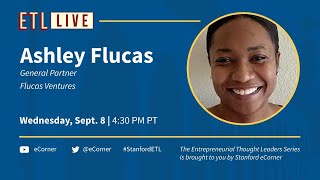
Chuck Heasley interviews Ashley Flucas, founder of Flucas Ventures, about her path from lawyer to venture investor. They cover her investment strategies, how platforms like AngelList are changing angel investing, and shifts in the venture capital landscape.
Chapters
Welcome everyone to the final of three special live ETL episodes we're presenting this summer before we kick off the fall quarter in late September. I'm Chuck Heasley, an associate professor in Stanford's Department of Management Science and Engineering and faculty member at stvp. And today I'm excited to be joined by Flukas Ventures founder and general partner, Ashley Flukas. Based in West Palm Beach, Florida, Flukas Ventures is a syndicate of around 2,000 angel investors and has invested in more than 200 startups. Ashley also serves as a partner at Jupiter, a Florida based real estate finance fund with 3 billion in assets under management. And she's a graduate of Duke University and Harvard Law School. I stumbled across Ashley Syndicate initially on Angellist and saw she was a fellow Duke alum and then also attended that school in Boston up the river from mit. I was quickly impressed by the depth of her due diligence and the thoughtfulness of her investment memos on startups, as well as her advocacy for historically underrepresented groups in tech. So I'm very excited to chat with her here on etl. Welcome, Ashley.
Thank you. Thank you.
So you started out as a lawyer in the real estate business in Florida and now you're leading a syndicate that has more than 200 startup investments. Can you explain briefly how you got interested in investing in early stage companies and what some of your first steps were?
Yeah, so I actually first got the idea that venture might be something that I wanted to do about 10 years ago. It just took me forever to act on it. I actually read a book called the Monk and the Riddle by Randy Comisar and he plotted a path that I was like, this is what I want to do. Nikki also went to a school up the river and was starting out as a trajectory as a lawyer and just kind of didn't see it as the front path for him. He didn't see his life kind of wanting to follow that linear trajectory and ultimately did a few things within business and tech and then that led him into the startup space. And then as he was kind of describing his life and his day to day and what he was working with, I'm like, I know that's exactly what I want to do. And now I see that there's a path to use this skill, skill set to get there. But I still kind of went about my bit about went about my business for a while and it took me seven years from having that epiphany to actually act on it. But things happen as they do, so yeah, fast Forward. I originally actually started out as a capital markets lawyer and practice in London for a while before getting involved in real estate. But candidly, I got to a place where I had the means to actually pursue angel investing or venture investing in a meaningful way. And I was thinking about investments in general and not just from an alpha and return standpoint, but also how do I want to spend my time and what do I want to build. And then that venture just came up again and I thought, all right, I'm going to figure this out. But I was literally, you know, starting from, from zero because despite those, you know, school networks, I didn't know anyone in tech and I didn't know anyone in venture, not to mention trying to do this from Florida before it became the new, the new kid on the block as far as being a destination for venture. So pretty early on, which was now, I'm now hitting my three year anniversary of my first investment, I had to figure out how do you do this virtually and how do you kind of do it from a complete cold start? Yeah.
So I think that's really interesting. And Randy Comazar's book is great by the way. I have that as extra credit on one of my courses, E145. Great guy, great book. So I think a lot of people are going to be interested in this as more and more folks have gotten interested and aware of angel investing. Do you have any advice in terms of how to establish credibility as an early stage investor or how you were able to do this when most of your network, I assume, was originally in the legal and real estate worlds and not so much in tech and venture capital. So any thoughts along those lines?
Yeah, so I think that the best way to get started and kind of, I mean, obviously I'm sure people chart other courses. So I just have to talk from my experience, not having that tech background, not having the context, you know, I really learn immersive style in terms of learning by doing. And the way I literally step one for me was doing my homework and thinking at a time it was 2018, but in my mind the thought was it's 2018, there has to be a way that I can do this from my computer that doesn't involve me trying to like hop on planes to San Francisco and New York or wherever the other epicenters were. And eventually just from literally, Google stumbled upon Angelus and saw some different writings about them. And different reputable sources saw that there were deals passing through and that they had a track record of some pretty strong deals. Several unicorns actually having passed through the platform. And so I'm like, okay, great, I'm actually going to get started here. And so the first things that I did, you can basically the way Angelus works, you can apply and join a bunch of syndicates. And these syndicate leads are putting together deals, deal memos, terms, decks, and a lot of valuable information. And I must have joined maybe every one of them on the platform. So I mean, maybe literally if I look today, I probably back like literally hundreds of syndicates. So my inbox is a mess. But I just, I was just kind of eager and wanted to be a student. And my whole thing was everything that someone puts out. Like, I'm gonna read it. Because the only way to be, be good in anything is to become fluid in that language. I mean, you know, for example, you know, yes, there is some training, but the difference between a lawyer and a non lawyer is being fluent in legalese and the concept and understanding kind of like the rules that govern that world. And I figured by analogy that also had to be true adventure. So just kind of like voraciously reading everything that I could get my hands on. Even if I saw a deal and it very clearly, at least in the beginning, maybe felt like it wasn't something for me, I'd still take the time to read everything that I could read all the materials, look up things about it, and then in the background always be looking at things like, okay, well who are the major players in this? And then what are their thoughts on different things? Because that's the only, I think the only way not to segue to be, to really be good at this is you kind of have to have some institutional base of knowledge and understand trends and understand kind of the broader universes of what's out there. And so if you're an individual, you have to either digest a lot of information or have a wide network that digests a lot of information. So it started out on AngelList looking at a ton of deal flow, but it also took, you know, me, you know, kind of biting the bullet and putting my toe in and putting, you know, a lot of my own capital at risk and learning just by being in it, by feeling the highs of seeing deals do well and follow on investors coming in to uncertainty and everything else that comes with angel investing. Only by taking those first steps can you really get started. And for me, the Agelist platform was great because it was kind of a safe environment to do it because it is a little bit more of a passive exercise. There's no obligation to invest in and I could just kind of build and get comfortable over time and then also use that platform to network, to reach out to other people who I could see were doing, who were investing in the same deals, the people who are leading the deals. And that's how I formed some of my earliest connections was through. Through kind of collisions that happened on the platform until I eventually I looked up and I was doing them at a clip far greater than what I would have anticipated and spent far more money than I would have anticipated. But I realized, oh, I'm starting to kind of have a track record and even in a short window of time seeing how things evolved with those startups and that gave me confidence to then be a direct investor and start going after deals or being comfortable.
I think we just lost the connection. Hopefully Ashley will come back in just a minute, at least on my side. I've lost her video and audio. So we'll give her a minute to reconnect here.
There she is. Not sure what happened there.
That's okay, that's okay. We'll roll with it. So it's an amazing story and the power of tech platforms and AngelList in particular these days. I wonder. There's a lot of blurring of the lines these days as well between angel and vc. Can you talk a bit about how Flukas Ventures works and how the model differs from a traditional venture capital firm?
Yeah. So I think what you said was pretty poignant that I definitely think there is a blurring of the lines because I call myself often an angel investor because that feels like the default thing to say as an individual or a solo person developing. But if you actually look at my investment activity, that was probably true in the beginning, but it's not necessarily true anymore. And there's now just because of just kind of the explosion of emerging managers, the explosion of platforms, the ability for smaller for angels to put together checks like things like syndicates, that there's now an opportunity for someone who might have traditionally been pigeonholed to being just an angel investor to truly being an overall venture capital investor. So for context, when I first started it was mostly seed, maybe a little bit of pre seed, some Series A stuff. And then I'm sure as you get bombarded with my syndicate email, you see, and I did last week, I did the Series H for databricks, the Series C for Picasso, and a number of later stage deals as well. And so I think of myself as just a venture investor, still do a lot of early stuff and there's still a certain Thrill that comes with the discovery and a different set of returns and a different set of framework, one stage versus the other. But like I said, I think because of the explosion, and I won't say access has been fully democratized, it's definitely a work in progress. And then particularly as we think about other communities participating in this asset class, but there's certainly more opportunity where folks aren't just going on Sandhill Road and talking to the same handful of funds. There's so many ways to get capital. Capital is being commoditized. So that creates a lot of opportunities for disruptors and folks like myself to sneak into some of these rounds. Yeah, and I apologize, I think there was another part of your question that I may have missed about the blurring of lines.
Oh, I was just asking a fairly broad question about how your model differs from the traditional venture capital firm. And so folks in the audience are going to have a range of backgrounds. And so I think laying some of the foundation of a solo capitalist versus an angel investor versus a VC firm is probably going to be helpful for some people.
Okay, yeah, happy to do that. So I think, you know what, you can categorize what I was first doing as just, I'm an angel investor. I'm writing, you know, not, not, not huge checks, checks that are below, you know, and it's relative to everyone what you consider a large check, but checks that are below six figures into companies, usually earlier, earlier stage, either directly on the cap table or with, or with other angels. And then there's another model which I then graduated to, even though I still do some personal angel investing, which is the syndicating. And so for those who don't, for those who don't know, I'm now targeting a wider range of companies because I can write a bigger check by virtue of pooling capital together. So what does that look like? I diligence just like I would if I were angel investing. I diligence an opportunity, it's ready to go. But the extra step is I then need to make an argument to folks in my syndicate as to why it's a compelling investment because it's not just my own money at this point. So basically I'm putting together a memorandum, a persuasive writing basically, as to why you should invest in an X company and basically on a, you know, no obligation basis. But the people in the syndicate, those, you know, that consortium of 2,000 different people and family offices and micro funds and partners and whoever else, they make a decision if they want to invest alongside of me, I run my process through the Angelist platform. So they have a kind of a great back end where people can kind of click through, through and they handle kind of the logistical process and handling money and all of that. But the gist of it is now I'm somewhat like an angel, but there's now this leverage because instead of writing my check, I can bring the power of a group to a deal and then that changes the games in terms of deals that I'm able to access and the stage across which I'm able to invest. Because if you, you might be an amazing person, but if you were typically maybe going earlier stage deals and you know, maybe you were investing directly and you were investing 10,000, if a company is more mature or if they have, you know, whatever sensitivities about their cap table being crowded, they're maybe not necessarily going to accept that check from you at past a certain stage. But if you are your same person with your same value add that you always had at the smaller stage. But it's now, oh, I have a group of people and we're going to invest a half a million, we're going to invest a million, then it actually becomes easier to access more cap tables that way. So now the evolution with the syndicate is being able to invest across all stages, unlike a venture fund. However, as a syndicate I do not have captive capital going into any deal. I cannot technically guarantee or state I am going to invest X. Now I have enough experience that when I look at a deal I can kind of look at all the variables and I pretty much know within a pretty tight range what I'll be able to deliver on. But at the end of the day, it's not like I have, like I said, a captive capital pool of funds to write checks for from like a venture fund. Other differences One of the advantages of being either an angel or a syndicate style investor is you don't have a number of the requirements that a fund does. For example, I don't have to target any type of ownership percentage, which is very freeing because I can just look at every deal on its own and say is that individual deal a deal I would like to be a part of based on whatever my criteria of. And I don't have to kind of weight that against the overall portfolio. Every deal stands on its own and so that's really advantageous. Secondly, because I'm not a fund, I'm not putting out competing term sheets, etc. It's almost like you're forget what you call them, but Basically like the symbiotic fish that like swim with the sharks and like clean, clean their teeth. You know, you're not, I'm not, I'm not competing with, you know, insert Sequoia Andreessen. Whoever I, my investment is, is, is completely symbiotic. They have no reason to view me as a threat or a reason not to also be on the cap table. So I think you can also kind of wedge into more deals that you maybe could not if you were even a pretty reputable fund because of some of those restrictions. Not to mention, although there are a number of funds who are moving really fast these days. When you get to a point of maturity as an angel or as a syndicate and you kind of know what you like, the speed of execution can be a bit faster, especially as a solo capitalist. Right. There's not necessarily any committee. You're not running things by your partner. Like the bureaucracy is kind of out of it and so.
Which can be really advantageous when a lot of these deals are very fast moving these days.
Yeah, yeah. And so founders, you know, if they like you, you know that you can deliver X check, you're doing your diligence, but you don't necessarily have the same processes and time waiting period as some of these funds that can allow you to kind of sneak in as well. So it creates a lot of, it creates a lot of flexibility in those access points. You know, the disadvantages obviously, except for, you know, the solo capitalists or angels who become super angels or have some kind of brand around them, is unlike funds, you may not have any kind of brand, brand awareness in terms of getting access to deals. That's something you have to actively work on. Second, you don't have that captive capital. And, and also that's a whole different conversation. But the economics also work different and you might have a preference one way or another as to fund versus angel versus syndicate.
Yeah, this is a whole world that I think not many people are aware of. And so it's good to kind of increase the education and background on these distinctions and the way that angel investing and venture capital is changing as a result of platforms like AngelList and syndicates and roles. I want to circle back to some of those ideas that you mentioned a little later about democratizing access. But let's talk a little bit more broadly about angel investing for a moment. So I did a Stanford alumni survey a few years back and we asked all of the alumni about entrepreneurial activities, angel investing, venture capital investments, and found that there were about eight to ten times as many angel investors among the alumni as venture capitalists. And there's some research from the National Venture Capital association and University of New Hampshire that estimates that about 15 times the number of startups receive angel investment relative to venture capital. So of course, as you mentioned, part of that is earlier stage and smaller investments in a larger number of companies. And you were mentioning some of the other distinctions in terms of the decision making, speed and consensus. Can you talk a little bit more about the platforms that are driving these changes in angel investing and AngelList in particular? How significant do you think this phenomenon is and what can or can't they do for investors?
I think it's very significant. As I kind of mentioned at the beginning, I started doing everything virtually out of necessity because there was no, no activity going on in Florida and definitely not in my part of Florida. And so I had to figure out how to do things virtually. And so angellist was instrumental in me and me being able to get started. But I think these, you know, angellist is the one that I use the most often. In the past I've looked at other, some other platforms. There are a number of them out there and many that are emerging. So you've got things like Seed Invest and well, Republic I guess actually is the affiliate of AngelList. But you've got these, these platforms cropping up and what's powerful about them is it's building on some themes that are now, you know, they were early on some themes that we now all accept, which is being able to do things virtually, being able to do things in a distributed global way. They already had the infrastructure set up to do that. So you know, case in point, something, something like my syndicate, in a, in a normal context there's no way we could have met. But for Angelist and you know, someone like me who, you know, I scaled my syndicate from literally zero to now is about 2,200 LPs in 13 months. That would not be possible manually and it would not be possible but for a platform like that. And those platforms, like I said, those platforms are powerful because they have global reach and it's expanding. And then also in particular a platform like Angelus because it's also a marketplace, right in a discovery tool. So yes, they're doing the mechanics and some of the back office stuff behind investing, but it's also allowing folks like me to build a following if you were in a quasi public way and it's allowing investors to discover people like me who are putting together deals, but it's also allowing People like me who are putting together deals to discover investors. And so like I said, I don't think there's any faster way to scale it than these platforms. And then when I look at my LP base, I mean, I have folks from literally all over the world, all time zones, all professions, and you know, from folks who are just, you know, they have, you know, they're doctors, lawyers, engineers, and they're doing some angel invest things to partners at venture funds, to CEOs, CFOs, professors like yourself. And I think these platforms are so huge and in some ways are really just in the first innings. Because I think about, you know, when I first joined Angellist, you know, three years ago, even though I backed a ton of syndicates, there are really only a handful that were really active and there wasn't a lot of noise kind of on the platform now. And you've probably seen it yourself, there's this massive proliferation of new syndicates, new investors, the deal flow has increased exponentially. And I think it's also had a positive impact on the quality of the deals because one thing that everyone has to be careful about as an angel is kind of figuring out this issue kind of around adverse selection, right? So you only see what you see, whether that's in your close network or platform like AngelList. And so if, if that is the only pool that you're invest, you're investing from, you have to have some examination of are these actually good opportunities in and of themselves or am I kind of investing in a vacuum? So when platforms like AngelList continue to expand, continue to kind of open up the tent, get diverse fund managers, or whatever you want to call them, syndicate leads, get diverse investors, that drives better deals to the platform. And I think that starts to help that particular problem, definitely.
We've got some great questions coming in from YouTube and social media. We'll get to some of those in the Q and A. But before we do that, I wanted to delve in a little bit more to your decision making. Now that we talked about how you got into investing in startups, let's talk about your investing strategy a little bit more. So first of all, I think a lot of people assume that physical proximity to Silicon Valley can be important in terms of staying in the loop on tech and early stage investing. Do you think that not physically being present in a place like Silicon Valley is a detriment? I know in the public equity markets Warren Buffett often says that being outside of New York, being in Nebraska is an advantage, actually. Do you feel like you're able to participate equally in the innovation economy from just about anywhere.
Now, I certainly think that we're in a moment where that's possible. And to give an example, I looked at this week actually, because I was just curious for myself about, I think it's about 15% of my investments are actually concentrated outside of the US so we're talking Africa, Latin, Southeast Asia. That is literally only possible because of being able to do things in a remote way. And I've not found that I feel like. And I've found that, you know, this has been doing things remote is a powerful way to access those opportunities. And I don't see why that isn't applicable in the US as well. And pivoting off your example with Warren Buffett, you know, I probably have some bias here because it's the only thing that I know as far as doing business virtually or not being near one of the epicenters is I think it makes me a better investor in a number of ways because I think like so many things, it's easy to kind of be caught up in an echo chamber or a way of thinking the group think. And so I think, you know, my in some ways naivety, but my freshness, my coming from a non tech background, from not being a part of Silicon Valley, from having a framework of how to look at investments, but it being informed by a wholly different set of life experience from law to how things operated from business perspective in real estate, et cetera, give me a different framework for how to look at companies that I think is maybe a little differentiated. And I think I have a little bit of a differentiated voice. And I hear founders tell me that as well, even in doing advising. And I think that it can be pretty potent if you hone on what makes you different from folks who are in those typical geographies and use that to your advantage and don't run away from that and be an individual. Because I think at the end of the day, being a successful investor is about being able to identify outliers so that it stands to reason that you being an outlier, you being concentrated, concentrated away, or you being out, away from where folks are concentrated can play into that definitely.
So I'm curious to dig deeper on that. Do you think there's a filter that you use to vet investments that people in the audience might find unusual or surprising? Do most successful angel investors use the same general set of best practices or do you think there's some frameworks that might be somewhat unique to you?
I don't Know if I would say unique, but I guess a couple of thoughts on that. Again, I'm going to do another book plug and it'll be funny if it's also one that one of your classes reads, but pretty probably. When I was on investment number 10, I came across this book called Play Bigger and it got all into this idea of category creation and outliers and that at the end of the day, singles doubles, that's great. But you're really looking for these companies that only come around so often that generate kind of the massive returns for the industry. And how do you look at identifying those? And so it's a little different, I guess like I said, like if you're investing later stage. But early on for me it's like, it's almost like reading a heat map for some of the signals. And this book kind of gets into it. And so the thing that I probably do that's a little different is, you know, a lot of venture funds, funds and a lot of investors are operators. And I think a lot of times with operators, they, they get obsessed with a product or they, they sometimes get too obsessed with the team or they think about how they as an operator would run the business and they're too zoomed in on that instead of kind of seeing the forest for the trees and the things that, you know, regardless of, you know, besides maybe like deep tech or biotech, but regardless of the sector, the things that need to hold TR for a company to be great. And for me, I kind of actually look at the product last. This is the thing, one of the things that I'm not that I'm not into I'm like interested in intellectually but from an investment standpoint I'm looking at, you know, things around and for me, my number one thing is distribution and kind of go to market and doing something really novel around that or showing that you've got strong channels there. That's the number one thing that I care about more than anything because a product that is not truly revolutionary, you could have a consumer product, you can have.
Lost the connection to Ashley again. But if the previous experience is similar, she should come back pretty soon here. I'm eager to hear more on this point about the investment lens.
Guys. I think it's my, I think it's my AirPods that slipped out that killed us.
No worries. We got you back quickly. So.
Yeah, yeah, but I was saying, I was like you look at some consumer products, for example, mattress companies, exercise companies, and there were billions of billions of dollars not because they necessarily had an idea that was going to change humanity, but they had brilliant playbooks around distribution and that's what leads to phenomenal returns. And similarly, there are a million brilliant ideas right now happening on Stanford's campus that could maybe change humanity. But if they, the teams haven't figured out how to distribute and scale that, you know, nobody will ever see it. And so distribution is one of the big things for me. But there's a few other things like that. And I'm so focused on answering those questions first before I even allow myself to get excited, excited about kind of what the underlying product is. And then of course, I diligence that and, and want to go around on that. But I think I work from the outside in and a lot of people work from the inside out. And I think that's what differentiates me. And as I look, you know, at some of my companies that are doing pretty well and, you know, I'm starting to have exits now and even, you know, much earlier than I expected, considering that this is, this is year three. But two of my, one company that just listed on NASDAQ and one that will soon, one exost trucks, the other vicarious surgical, and we were talking robotic surgery and electric trucks. What does that have to do with anything that I know whatsoever? But when I remember when assessing those investments, it wasn't. I could never possibly have a deep technical understanding of any of those things. And there are probably people who did, who passed on them because they thought they knew more than they did. But what I could understand were, like I said, from that outside in approach were all the things that were flashing to me like, this is going to be a big deal. And I went with that. It wasn't kind of blinded so much on the, on the actual technical, technical side of things. And I see that coming to fruition a lot. Now, don't get me wrong, there are spaces where I think I have more direct knowledge like fintech and prop tech, and then I can get kind of more critical in those areas.
But definitely with your legal and real estate background. But it's an interesting point, especially with regards to what you said earlier about you're looking for outliers and things that are going to be the tail end of the distribution. So let me transition. Obviously, angel investing can be risky. And Scott Shane at Case Western has a book, Fool's Gold, that points out the data across the US in the aggregate that shows that a small minority of angel investors generate the lion's share of the returns. And a lot of angel investors do pretty poorly. So for those in the audience, if I'm interested in doing some angel investing, how might I figure out if I really have the skills to properly diligence companies and not just make my money back, but ideally generate returns that are going to outpace the public markets or with syndicates and angellists? Now, is it more about diligencing the lead rather than the individual companies?
All great questions and observations and a few points of view on this. The first thing that I'll say to anybody in the audience is, yes, you are qualified to do this and do quite well. What separates the folks who do quite well and the folks who don't is one word, and I'll stand by this, which is access. I don't think people who are necessarily making these great returns are any smarter than anyone else in this audience or have some crystal ball, because a lot of this is educated guessing. If you're investing at a seed stage company and you said you knew that they were going to be worth 5 billion, you are lying. You had some clues, some things in your gut, or you just randomly did it and got lucky. Luck is another part of it as well. And there's a lot of egoists in this field who don't want to admit that access and luck are a big part of it. But I don't think if you put in the time, like I said, to learn the language, to learn the trends, to learn the players, to pay attention, what's happening on a macro level as well as what's going on in that company's specific industry. I think as a generally intelligent person, you can make good decisions, but you have to solve for the access problem. The other thing you have to solve for as an individual angel, and we were kind of talking about this earlier with adverse selection. It's the adverse selection, which is a corollary to what I just said. But it's also figuring out where your biases are. And that's something that I've tried, I still have to do with myself now, and that I tried to do very early, which is why do certain things get me really excited, why do I have fear of certain investments, et cetera, and really dig into that because, you know, you could get lucky if you invest in your neighbor and, you know, he built air table or something, but. But that the odds are really not that good. And so you have to, you have to think about, you know, you have to think about all of that. And, and sometimes it's not just you have to, like I said, you kind of have to zoom out and understand like how wide of a net am I casting, what is the quality of these things? But you only, like I said, I think you do that through some of the things that I said earlier. And so for me, on top of trying to hone those deals and figure out what defines a company that does well to hopefully be able to make more choices, the other things are, I think, to be successful in this, in some ways it's not all too different from public equities and that I believe in diversification. You know, I'm a generalist. Not everybody is going to take that point of view. So that's strictly my point of view. But I think if you, if you solve for the access problem, which I could talk about, but you're investing kind of broadband basket, almost like public equities, where you're across some different sector stages, possibly even geographies, things that run countercyclical, you're ultimately going to build. Diversification is still always the most important rule of, of investing. And I don't think that changes just because you're dealing in private markets. And so I saw that bear out during the pandemic with, you know, some companies that were hurt, but because I had this, this kind of really diverse portfolio, so many did incredibly well because I wasn't anchored to kind of one to one thing. And then on the access point, you know, it is if you don't have the fortune of coming in with those networks, like I think that I'm an example that you can build them if you want to. And I'm not even a natural extrovert, so I'm an introvert. So, you know, it's about want to and me understanding that in the day there are certain folks who are getting most of the returns and doing the same deals. And so leveraging platforms like Angelus, doing events, you know, talking to people, joining communities, doing angel fellowships, whatever you need to do to build your tribe, the more people in your tribe, the greater probability that you're going to have access. Because. Because it's not about just being brilliant and being able to spot the next Uber and Airbnb. You have to be invited to the deal in the first place. So that's the number one thing you first have to solve for. But it's not insurmountable.
Great. So there's a question related to the impacts of the pandemic that I'm going to get to from the Q and A in just a moment, but I wanted to ask one last question before I Turn to the Q and A, which is, is from the other side of the table. How should entrepreneurs be approaching investors that might be running syndicates similar to yours or just angels in general? Are there approaches that might need to be different? Have things changed due to the pandemic and a lot more deals happening virtually? What advice for entrepreneurs would you have approaching investors?
I would say the advice for entrepreneurs definitely kind of depends on where we are in a macro moment. But the moment we're in right now is never been a better time to be an entrepreneur because there is so much powder out there. And like I said, it's not just the institutions. It's down to syndicates and individuals and solo capitalists. So it's a really powerful time to be a founder because valuations are eye popping, capital is flowing, there are more sources than ever to get capital from. So it's a great time to be, to be a founder. And so I guess my advice around that is it's kind of almost like in real estate, but it's a buyer or seller market, because it's a founder's market right now, is that you can kind of really take stock. And it's a question that I actually, a lot of times when I talk in a founder is, and it gives me insight into them as to thinking about how they're constructing their cap table is that you don't have to necessarily pursue it in a traditional way and you can be. And I'm seeing a lot more founders who are thinking about value add, but not as, you know, not just as an empty phrase. What do you actually need beyond money? Because this is a market where you can require it. And you know, yes, all the great funds, you know, from a branding standpoint, from a resource standpoint are great. But there are folks, there are individual angels, there are syndicates, there are investment clubs, there are other vehicles where they can also, especially early, they can also give you money, but they can introduce you directly to customers, they can help you with hires, even though their checks may be smaller. If anything, for that reason, it's probably more meaningful, the money is probably more meaningful to them and they're usually going to be probably even more enthusiastic and way more focused on what you're doing. So I think for founders it's being thoughtful about who you want to work with, who you want to have a relationship and realizing that the options are greater than ever.
Now, definitely some good advice. Let me turn to the Q and A. We've got some good questions here from the audience. The first one that I wanted to ask you how has the pandemic changed your approach and or the types of startups that you've invested in? And also they wonder is there anything you would have done differently if you could go back in time?
Good questions. And if I forget any piece of that, please. The pandemic was actually my aha moment for wanting to build a syndicate and invest at a far greater clip that probably owes a bit to again kind of the real estate background where the idea of distress and trouble is the absolute best time to be an investor if you have the capital because you're going to get some deals that you maybe have no business doing, you're going to get some discounts and a lot of people, the competition is going to be way less because people are going to be on the sidelines. So it was actually the pandemic that inspired me to get really aggressive and start trying to build, build and scale what I'm doing and invest in a more deals now. With that said, you know, I, you had to think of the pandemic like what's going to be short term affected versus what's going to be long term affected. And you know, nobody is going to be 100% right and predicted that. So you know, in the short term, you know, even though there's deals to be had, you know, I'm not investing in things or even though I absolutely love to travel, not investing around things in travel for example, because I just really don't know how that's going to be impacted. And so that's kind of a scary place to invest in. But by the same thing token, things that I think have been accelerated and aren't going back or certain things around E Commerce for example. So that's a sector that I really ramped up on. Fintech is a sector I've really ramped up on Cyber because of those other two. Ramping up I think actually brought that along as well. Another sector I've really ramped up on and then there's some that are more ambiguous. Right. So there's a host of things now that are kind of servicing remote work, for example and I'm still very cautious around that because I think no one really knows what's going to happen when hopefully the pandemic is behind us in terms of, you know, how people are going between office and home if people are still going to want to hop on virtual events as much if in real life is a possibility. So it's not why I won't avoid the category, but I'm cautious around it. So I really try to think of categories in terms of what do I think is here. And there's no going back, even as things return to normal, or things that I want to put a pen in until there's just a little bit more data. And there was a second part to that.
Yeah, the second half of that question was about anything that you would have done differently, having the benefit of hindsight, either in terms of getting into angel investing or of course, I imagine it's easy to, in retrospect, pick sectors or startups you wish you would have invested in.
But yeah, I mean, philosophically, I'm not really a regrets person. I think that you are who you are, kind of the sum total of your experiences. And so any mistakes I made, any opportunities that I didn't get in or take advantage of, that's how I learned. And so I would never want to change anything because I'm very comfortable with where I am now. The only thing that I might say, and then my advice to people, the only thing that I think that I really could have done differently or that anyone can end up doing is, like I said, I have first had the idea to do this 10 years ago and I waited seven years to start. Now, granted, I don't know when Angelus first came into existence or technically what it would have been feasible for me to actually, when it would have been feasible for me to truly first start, but it was probably sooner than three years ago. And so my biggest thing to myself, and I try to apply this going forward and tell other people, is get started. A million reasons why you can tell yourself you're not qualified to do it or why it'll be hard or why you can't start. And once you get into it and you begin to figure it out bit by bit, you realize it's actually, it's feasible, it's quite possible, and you'll only wish that you'd done it sooner once you start to see that.
Nice. We've got a question about your take on NFTs. Any thoughts on that? Or the blockchain space more broadly.
Lovely. Yeah. So, you know, I, I've invested across so many sectors, but that, that is the area that I have the, the least amount of exposure in. Though I did, I guess, my first investment kind of adjacent to the, to the space in a company called US Bitcoin Mining, which is kind of doing like green bitcoin mining here, here in the US and they're doing extraordinarily, extraordinarily well, you know, it's interesting. I think it's, you know, you know, folks who are a bit older than me probably have an even greater perspective. But when you're around this new technology and these new ideas and you don't know quite know what to make of it and, you know, different people are making a ton of money, some people are losing money. I've said to myself, and I think you owe it to yourself to explore what that is, because, I mean, it's a bit cliche. I'm not the first person to say it, but ignoring blockchain, ignoring crypto, ignoring NFTs would be like being in the 90s and pretending to ignore the Internet and just focusing on whatever conglomerates were around at that time. And so you do not want to be that person. With that said, because it's so new, because there's a lot of noise around it, I do think it can be difficult to be discerning. And so my whole thing, and I'm in a place, like I said, I literally, I pulled the trigger on my kind of first investment in the space. This is probably about three weeks ago. Is, is kind of approaching almost like I approached Angelus in the beginning, which is, you know, just getting educated, keeping a pulse on following people who I know who are, who are smart in this space and dipping my toe in and letting that kind of be the beginning of things. But we're in an interesting moment and so.
Give Ashley a second to rejoin here at least. Previously she got back on pretty fast, so.
We were doing too well for me to not disconnect. I was like, people could give you a hot take about it. There's some kind of futurist and absolutely know where the market is going. And I don't really have a true view, whether it's a fad or a flash in the pan or if he. It's here to stay. What I will say is I think we all kind of, if you're, if, if you're a curious person, if you're interested in investing, you owe it to yourself to at least not ignore it because you may regret it, because it could be, it could be NFTs, could be 1.0 into what is truly going to be the thing, but you kind of need to crawl before you can walk.
Yeah, definitely an interesting area. And I feel like I could chat with you for another hour if we had it, Ashley. But I have to say thank you for a fascinating discussion to our audience. Thank you for joining the Entrepreneurial Thought Leaders series. This was the final session of our summer miniseries. We'll kick off our fall quarter talks at the end of this month. We hope you'll join us again on September 29th to hear the Twitch co founder Justin Kam. You can find that event and other future events in this ETL series on our Stanford E Corner YouTube channel. And you'll find even more of our videos, podcasts and articles about entrepreneurship and innovation at Stanford Ecorner. That's Ecorner Stanford Edu. And as always, thank you for tuning into etl. Thanks so much for being here with us. Ashley.
Thank you guys for having me.
More from GHION.AI


O processo de reconhecer limites, mesmo quando a vida parece exigir sempre mais.





Depois de tantas histórias, aprendizados e pausas necessárias, o @interior_iza está de volta



