ETL Speaker Series: Chris Sacca, Lowercarbon Capital
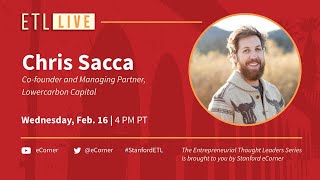
This content was created by GHION.AI . This content was uploaded by GHION.AI . This is a YouTube video titled "ETL Speaker Series: Chris Sacca, Lowercarbon Capital" featuring a seminar from February 17, 2022, where Ravi Balani, director of Alchemist and lecturer at Stanford, interviews Chris Sacca, co-founder of Lowercarbon Capital. The discussion covers Chris's career, his approach to venture capital, and his focus on climate solutions through Lowercarbon Capital. The conversation also touches on Chris's past investments, his retirement, and his return to focus on impactful investments in sustainability.
Chapters
Seconds or for a minute. Welcome YouTube and Stanford Communities to the Stanford Entrepreneurial Thought Leaders Seminar. I am Ravi Balani, the director of Alchemist, an accelerator for enterprise startups and a lecturer in the Management Science and Engineering department at Stanford. Today we are thrilled to welcome Chris Zaka to Stanford and to etl. Chris is the co founder and Managing Partner of Lower Carbon Capital and an accomplished venture investor, which is an understatement. Chris was number two on the Forbes list of the top venture capitalists. He's also a company advisor and entrepreneur and manages a portfolio of startups through his firm Lowercase Capital alongside his wife Crystal. He built Lowercase around very early stage investments and in transformational tech companies like Twitter, Uber, Instagram, Twilio, Docker, Optimizely, Stripe. It goes on and on and on the list. Chris famously retired in 2017 and we'll talk about that to focus on healing the climate, restoring American democracy, promoting diversity within tech and VC, and reforming the criminal justice system. Chris grew up in an Irish Italian American family outside of Buffalo, New York. He earned his Bachelor's degree in Humanities for all humanities and social sciences majors. Chris is a fellow Humanities and International affairs major and got his JD from Georgetown. He also famously used his student loans, always an entrepreneur in undergrad, to start a hedge fund where he parlayed a $20,000 loan into $12 million and then subsequently parlayed that into $4 million of debt, which we also might talk about and how Chris crawled out of that. But Chris famously retired in 2017 but he is back and he's come back out of retirement to head up the science and investment team at Lower Carbon Capital, which is pursuing ambitious solutions to the climate crisis through innovations in energy, building, materials, transportation, food, industrial chemicals, reforestation and more. He's already funded some Stanford grads and Lower Carbon aims to demonstrate that focusing on climate solutions is simply good business. Before setting out as an investor, Chris served as the head of Special initiatives at Google and earlier in his career he was an attorney at Fenwick and West as well. So please welcome Chris. Virtual Applause Chris for you from the Stanford and YouTube communities.
Thanks. I look forward to the day we can hear real applause again sometime soon so that we all get to flex our antibodies at some point.
I think you're going to be invited with open arms as well whenever you're back near the farm to come in in person too. So Chris, the way I would love to start is for me you are a case study in carving out a non traditional path in life and succeeding you became number two on the Midas list even though you'd never worked at a venture capital fund prior. You became a major catalyst in tech innovation and, and now in sustainability tech innovation, even though you didn't formally study technology as an undergrad. And so I want to investigate how you made this self determined life. And what I would like to first start out with is it feels to me like part of the success is as much attributable to things that you said yes to that proved to be prescient as much as it is saying no to the beaten path when it felt like the path that most of society would undoubtedly have said yes to. So you quit Google after having earned your stripes there in four years, in 2007, when Google was really taking off. You know, it's grown 10x since 2007. And even though you got a founder's award at Google with just the highest designation, you chose to leave at that pinnacle moment. And then famously in 2017, you seem to be on top of the world you had made. You know, you had a fund that I think was a 250x return, one of the top, if not the top VC funds. You funded Twitter, Uber, Instagram, Stripe. You built lowercase capital into this brand name. You were a judge on Shark Tank. The whole world sort of knew you. And then you famously wrote this blog post saying hanging up my spurs where you explained that you were retiring from investing in startups. First of all, was that an easy decision? And when you make these famous nos when you're deviating off of the path that all of society would have said, this is why you built everything, is to stay on the path at this moment. Is it easy? And can you walk us through knowing when not to stay the course?
Okay, you should get a job in the White House press corps because that was an incredible multi part question. That's the way to get all those things in there. So starting from that retirement post and working backwards, I guess, you know, I get asked all the time, so how do I get into vc? And I think that's one of the challenges is there is no uniform path. And these people who just go and do kind of the banking consulting grind there, you know, it may feel like the way, the right way to kind of make your parents happy and pay back your student loans, but it isn't necessarily a guaranteed path. The only thing that assures that you will be successful in that game is to be helpful. And so that's all these startups need, is someone who can be helpful to Them, Right. And so. And that's what separates kind of a value added investor from a dentist. God bless all the dentists. I have my cleaning scheduled tomorrow, but, like, that's the separation there. And so. So how do you be helpful? Well, I think each of us is helpful in our own different way. And I've tried to, throughout my career, have an honest personal inventory of what am I good at and what am I not good at. And then, you know, people have called me along the way. Self promotional. Fuck yes, I'm self promotional. Like, I have to remind everyone what I'm good at and why they should come to me and bring their companies to me and why they should collaborate with me. So as I look back at the beginning of my career, I started realizing things that I was good at. And often our superpowers aren't even that obvious to us because they're so easy. They don't require that effort, whereas other people's superpowers are daunting. And so what I started to do is just build this inventory of how am I helpful to these companies? I think back to one of the very first. I think it was the first Y Combinator gathering in 2005, actually, where I was a speaker. And it was like the Reddit guys were there, Alexis and Steve, and they said, oh, thank God, a Google guy's here so he can help us with advertising. And I'm like, do I tell them there are 15,000 other people in the building who know more about advertising than I do? But as the conversation evolved, I started to realize, you know, what, shit in this room, I do know the most about ads. And I started to kind of identify each of these characteristics. What did I do? Well, I was a great storyteller. I was great at helping a company distill their story into something they could tell investors that they could tell hires that they could tell users. I was good at taking a front page and making it simpler, moving pixels around and making calls to action clearer. I was good at recruiting that next three, four, five employees who, you know, I. I wasn't a great sourcer of candidates, but I could land those candidates once they were interested. And so I started to realize, you know, I was great at helping them raise their next round or even sell the company, but I wasn't great at a database challenge. So when database issues came up, I had people I would call and bring in. I wasn't. When I talked about sourcing candidates. I remember being in a. In a board meeting at Uber with Bill Gurley, who's been a friend and a mentor for a long time and we needed a cfo. And I kind of sat there and was like, who do I know could be a CFO? And Bill opened up this dossier that had six resumes of public company CFOs all vetted, ready to go, all who wanted the job. And I was like, that's what Bill Gurley does for a living and that's why he's rich. And so in each case, I looked for a way that I could be helpful. And so my number one piece of advice to anyone trying to break into this space is to show up and find ways to be helpful. And your general skills, skills are sometimes very, very applicable. You know, at Google I had kind of the most half assed resume of anybody in the building for what I was trying to accomplish there. You know, I didn't get into Harvard and Yale. I went to summer school at Stanford. That was cool. I went to like junior statesman political geek camp once, but I didn't even bother applying. I knew I wasn't that caliber of student. And so there I was for the first time at the Stanford of companies surrounded by the smartest people in the world. And yet what I found was that compared to these people had these incredible resumes from Yahoo and Microsoft, the company I worked at before then, Spidera Networks, we were 35 people. And because we're 35 people, we were all in one room. And whoever was sitting closest to the door that day was the receptionist. If we needed to move servers, everyone was in the ops team. If our sales were under the projected number, everyone picked up a phone and started selling. And so as a result, I had basically held every job in that company. So when I came to Google, I was lethal because I was effective in each of these little categories. I knew enough to be dangerous and to stir some shit up. And so that was what made me rise through the ranks really quickly at Google, was that I had this ability to see across departments and to find my way into situations and be helpful. And that's all anybody wants ever is somebody who can be helpful to take stuff off their plate. You know, I, when I hire people, we have a lot of tests we put people through. But one is, I know the people who stay with me the longest are going to be a net consumer of email, not a net generator of email. I want to know that in the end when I'm hiring somebody, I can delegate things to them and give them a ton of rope and trust them to go the whole way. Because they're helpful to me. You know, every time we hire we, and this is in our portfolio companies and in our firm. So everyone in our firm owns a piece of the firm. And every time I give someone a piece of those profits, I am making a calculation that after I give that piece away to them, my remaining piece will be worth more as a consequence of them joining. And that's why everyone should always think about every startup too. You don't just kind of hand equity out because like that's the tradition. You say, hey, I am giving you X percent of this company because I think the remaining percent will be worth more as a consequence of you being here. And that's the thing, is that ultimately every single one of those kinds of relationships and transactions and evaluations comes down to is that person helpful. And so everything you do on your path should be oriented around what problems am I identifying? What am I seeing people struggle with out there? What seems to be the issue that folks are wrestling with and how can I be helpful there? Because at the end of the day these startups, particularly the best ones, don't actually give a shit about your resume. God bless you and all your student loans. But they don't really care. They just care if you are going to be helpful.
And are there any unintuitive insights on how you are helpful in ways that Bill Gurley example, Bill Gurley Gang is a famous partner from Benchmark. Are there any unintuitive examples of how your help can be received? Maybe more than others who have the intention to be helpful but don't have the same impact.
Well, I mean one of the ways in which I, you know, the kind of a fabled story of mine is I would just invite myself to meetings I wasn't really invited to and I would take the notes and you know, and I think in the Google culture note taking wasn't really a secretarial function. It was a way of capturing and sharing knowledge. But I've done this my whole life. Even at my law firm. I worked at Fenwick and West, just a couple blocks, well, it used to be a couple blocks from the farm, but now it's a mountain view. But in there I would just volunteer to come in on weekend and take, come in on weekends and take the notes. And I was the 20 something year old in the room with John Doerr when he was coming up with the plan for Segway. And you know, and I just got, we didn't have, you know, much more than we didn't really have blogs or Twitter or anything like that. At the time, we didn't read Red Herring and Industry Standard and try to get some exposure to the thought process. So by volunteering to take the notes, I was in the room and I watched. How did they ask questions? What was the deliberative process? What was their framework for making a decision? And then in doing so, I made myself reputationally as a helpful person. And those hours of doing that weren't excruciating or anything like that. It was just me showing that I wanted to be helpful. So that's one. It's just finding something you can do to get in the room, even if it feels junior again. At Google, it is not usually the junior person who takes the notes. It is a leader of the company, and the notes are actually projected in the meeting. So here are the slides that we're talking about and here are the notes, because that is actually how we capture and share knowledge. And people can subscribe to those notes as they disseminate. But for me, just putting myself in a position to be like, look, I'm looking around. I'm just seeing an issue like that. It's funny, we have a guy who works for us named Harsh, who basically emailed me for a couple of years from Georgetown and knew that we were working on Lower Carbon, started sending thoughts over companies we should see. And so ultimately, when we went to hire a junior person, while we'd had hundreds of applicants, we felt like we knew this guy already because he'd already been helpful to us. And since he's come to Lower Carbon, I'm not even sure what his official title is, but he does things from administrative work that he picks up to. He's leading a deal for us right now. I'm not even sure if he's 23 yet, because it doesn't fucking matter to me. If the guy is helpful and he can really move the needle, then that's all I care about, right? If he has done the work and identified a company and built a relationship and found our way in there and done the analysis and got us a great price and a material amount of ownership, and it's a company that we can make more likely to succeed, that's all I care about. And so I love this guy, and I think he's a perfect example of that. I think another thing that I learned along the way is that with the tools available today, anyone can become an expert in anything. If you're willing to invest the time, if you're willing to read, to call up the authors and ask the questions, to visit the professors in the labs, to lurk in the chats, in the subreddits and on Twitter and follow those people and watch the YouTube videos. You can get smart on something. You know, I know we all like to joke about. I think there was a funny tweet that said, you know, it's hard to be an expert immunology and constitutional law, but welcome to the world of venture capital. And the reason there is some truth in that, because our job is to get smart on stuff quickly. I love it. I have friends like my friend Evan Williams, who's the founder of Blogger and Twitter and now Medium. We tried before lowercase kind of being VCs together, and Evan didn't really like it as much because Evan really likes to be focused on one thing. I like to be learning about 25 things in parallel. It's just the way my mind works. It's multi threaded like that. And so for me, it was Larry and Sergey who taught me, like, hey, just go out and learn. And so I went from not being a wireless engineer to running a multibillion dollar wireless division at Google within 18 months. And, you know, it wasn't accidental. It certainly wasn't nepotism and it certainly wasn't my resume. It was something I earned by basically absorbing everything I could possibly find in the world about that. And this has been the same with climate. I mean, back at Google, I ran a lot of the energy stuff. I did a lot of the big energy deals back there and was in the room with Al Gore. Al Gore got to recognize me enough that he started calling me that guy. So I'd moved from hey, good to see you to hey, that guy. So I worked on a lot of the green initiatives back then, so this wasn't all entirely new to me. But by the time we started to focus on climate again, I realized I needed to get up to date on science that had improve geometrically since I was involved. And to do that, it just meant, all right, we got to read everything, call everyone, visit all the labs and start building that knowledge base from there, asking all the questions and seeing how we can be helpful. And, you know, and now I would say that between us and the folks on our team, we have a tighter knowledge base than anywhere in the world.
That's so many gems there. So thank you, thank you for pre answering a ton of questions too. For all you Stanford students wanting to get into venture, I think that guidance on just don't ask for a venture job, but just start doing it is gold and getting looped in.
I can't imagine ever posting a want ad for someone to work at a venture fund. Like, I just. I'm fascinated. When I do see that happen, I'm like, holy shit. Like, the whole idea here is that we hire people that have blown us away right in any role in anywhere on our team. The people leading investments right now are not investors. Even Clay, our managing partner. Clay came out of the Obama White House where greatest job reference in the world. When I was calling to reference him, I got a text message from President Obama, said, hire him now, thank me later. And I was like, okay, that works. But Clay did not have prior investment experience. He had some prior clean tech experience, but he worked for the deputy chief of staff in the White House and for the office of the Chief Digital Officer there at the White House. But again, Clay came in, made himself indispensable to lowercase, and then co founded Lower Carbon with us. And Clay is a widely cited source of knowledge in this space now. And so along the way, as I look at Clay Kohlster, Dr. Clay Colster, who is from the Stanford universe, who is our head of science, not previously an investor, but an absolute badass. Alex Laplaza was one of our earliest hires. Previously not an investor, but absolutely invaluable to us. And so, you know, I. It's funny, I spend a lot of time teaching people how to do deals, but I think that's the easy part, frankly. I think the hard part is finding great companies or having them find us. I mean, this is the. You want to know the secret formula? I'll share this with however many of you. We have all the great companies in the world come to find us, or we know where to find them from those we have the expertise to be able to choose the very best ones. We do deals where we get material ownership in those companies. So it's worth our while where every single deal we do has the capability of returning the entire fund. No base hits here. And in parallel, we only do deals where two things are clear. One is that there will be a massive impact on the planet if this company succeeds, because otherwise I wouldn't be able to hire the best and brightest and the folks that we have if they didn't deeply believe in the work we were doing. And number two is that we have to be able to personally impact the outcome of that company. We have to make it more likely to succeed by virtue of our involvement. I don't invest in cancer startups. I'm rooting for all of you who are working on that stuff. But I don't know how to be helpful. So I give my money to other people to invest in that stuff. And I really hope we cure cancer in this lifetime, but I can't do anything about it. But I know exactly what I can do in cleantech and energy and, and carbon removal. I know exactly how helpful I can be there. And so that's how we rigged the game and it's been fantastic for us so far.
And is it the same rigging as when you were doing digital investments? So history has been littered with VCs that famously forayed into sustainability tech and then really got burnt bad. Why is this going to be different? Are the lessons from investing in the Twitters and the Ubers relevant when you're investing in the next deep deep tech or clean tech or sustainability tech ventures?
Yeah, I think all you have to do is kind of look at what happened with Y Combinator and the web era right before Y Combinator. And Y Combinator uses kind of a marker in time of a bunch of things that were happening. But before then, it cost millions and millions of dollars to start a software company, an app, and it just, you had to get. I mean, so I'm 46, I'm ancient, so I remember these things. Internet connections cost tens of thousands of dollars per month. You had to actually build your own rack of servers. Not kidding. You had to have a person or multiple people to build that rack of servers in a hosting center. You had to buy an Oracle development environment in a Sun development environment and maybe a Novell environment before you could code anything. So what was getting funded back then were very thick business plans, and they were mostly bunk. And it was mostly kind of like snake oil salesman who were able to charm the VCs into giving them millions of dollars to start these things. But it was just incredibly risky. And when you talk about getting burned, like that's what happened in Web 1.0, right? I mean, we. There was a time where I got laid off from my law firm in, well, four days before September 11th. And for that next year, you couldn't get a U haul out of San Francisco because they'd all gone one way back to Indiana and shit. So everyone had moved back with their parents. It was bleak, right? But what happened with the arrival of open source software, cloud hosting, ubiquitous Internet connections at frigging coffee shops. Like suddenly now you had this explosion of entrepreneurship because the cost was so low. Now the result was there was a lot of crap made back then because the barrier to entry was lower. But there was a lot of amazing stuff too, because we didn't have all these gatekeepers and we didn't have all these things standing in the way of building stuff and trying it. And so the result was we saw this shift where the cost came down, the unit economics made more sense, and now there was a direct relationship between the app developer and their user. Back even when I was at Google, I was there 03 to 07, we had to do deals with the carriers before users could see an app. And so now you think about it, you just post something up in the app store and as long as it complies with their rules, users just get to go download it. And that wasn't the case back then. And so what we've seen in cleantech, and believe me, I am grateful to John Doerr and the Kleiner team and grateful to Khosala and all the other folks who really pioneered this stuff, they were right. It was just a lot slower than. And so John Doar's billion dollars into clean tech turned into $3 billion. It just took a while. And the reason was those companies were really expensive to start. They didn't benefit from any of the things we benefit today that I'll mention in a second. And then the unit economics of what they were selling didn't make sense either. And so they counted on government for subsidy and they counted on regulation. What's changed is that these companies are so much cheaper to start. Now a lot of that is just all about machine learning, compute clusters, about CRISPR, case 9 available to teams of like two people when you needed a half billion dollars just a few years ago to do that, what's happening in synthetic biology and protein folding, all of that has brought the cost down to where the unit economics of what they're selling just makes sense on their own. And so without any government and regulation, and I'm allergic to that stuff, without any of that intervention at all, we can now go direct to a consumer, direct to business as a buyer, and direct to government as a buyer. And so that's what's changed and that's what's dramatic. And it's funny, you know, I had a. I have a good friend named Andrew Beebe who's a partner at Obvious Ventures. And a couple years ago, Andrew saw me at a climate event and we'd been friends. He. He was selling solar panels back when I was at Google and I was buying solar panels from him. And so we'd known each other forever. And he pulled me aside, he's like, dude, save yourself. Don't get involved in this space. It's like where. It's like where passion and idealism go to die. And I said, no, no, no, we really think it's changed like that. The numbers are there and they moved. And this is the golden era right now. And about six, seven months ago, he came back to me and was like, you know what, thanks for saying that, man. I got my second win. And he's seeing it too. And he's one of the OGs and the leaders and someone I really respect in the space. And so that's what's happened is we've got companies, like, I'll give you an example. We got a company called Solugen. Solugen makes industrial chemicals using enzymes instead of petroleum. Now they do this because, look, digging up and burning old dinosaur bones is expensive. And so anytime you can use the sun or a natural process, you're just going to save money. So they make hydrogen peroxide, for instance, at industrial scale. And they take it to a guy and I like to imagine him as like a, with a, you know, a Make America Great Again red cap on and like a jumpsuit, maybe he's got a tobacco dip in. And he asked two questions. Is it hydrogen peroxide? Is it cheaper? Well, then fuck it, I'll buy it. And like, that's my ideal customer right now. Someone who has no shits to give about the climate whatsoever, but just wants to buy the better, faster, cheaper, more delicious, easier to use, easier maintain option. And so that's a company right there that's doing a nine figure run rate with 60% margins, selling a commodity in parallel. We see stuff like Hart Aerospace. We have this team, when they came to pitch us, and I shouldn't even say they, it was a guy, a guy named Anders from Sweden. We were kind of like, where's the rest of you? And he's like, no, no, I got this. I'm going to build a 19 seat, fully electric regional commercial aircraft. And we went and gut checked it with Boeing and Airbus and they both told us physically impossible. Bill Gates team was even down on it. And so we invested. I wish we had invested more in hindsight, but we invested and we stayed close to him. And what he did was he took the seed money and he rented a hangar in Sweden. So he's got this huge hangar, but for the first year and a half he just sat in the corner of the hangar and started hiring some computer scientists and some aerospace engineers. And they Built the plane in the computer. Using machine learning and AI, they built the entire plane. And as they started to hone in on the final design, piece by piece, they built that full scale powertrain and reduced scale fuselage in the hangar. And they went from in an industry where usually introducing a new airframe takes 10 years and billions of dollars on single digit millions of dollars with a team that was small enough to fit inside their 19 seat airplane, they went from zero to billions of dollars in orders from the major airlines. And those major airlines aren't doing that because they're like tree huggers. They're doing it because these are, these are airplanes that make their least profitable routes profitable. And so they're doing it on sheer greed. And so for me, that is again, that typifies what's changed. What's changed is that the tiniest team can build something massive leveraging computers and that the market is there to buy it without anyone telling them they have to. And so that's why right now is different.
So if you are an aspiring Stanford student who wants to do something more than a digital company, your argument would be that you can still go after something in sustainability tech or go after a more ambitious vision than a typical startup. In the sustainable world, without sustainability world, without needing to have a different playbook, you don't need to have a different playbook on how you have to build that company because of the capital intensity. It's the same basic playbook as what's existed over the last 10 years.
Yeah, I mean, I'll say a few things about that. One is these are still companies, you still, you still have to build them. You know, we started something with some friends, some friends started, we sponsored it and helped out. It's called the Climate Draft. And it was basically an attempt to give an off ramp to well known tech executives to move out of their digital companies into clean tech companies. And it's been fascinating. It's a quiet, safe space. People in the zooms get to use pseudonyms and keep the video off. But I know who's been hanging out there and it is mind blowing the amount of talent, particularly after being locked in their house for a couple of years. You were like, what is my legacy? What is my impact? What do I want to actually do with this life? Like, what do I want to explain to my kids was what I did, did I just make a much more compelling app in the metaverse where none of us have a lower half of our body? Or did I actually make this planet livable and save hundreds of millions of lives, most of which are black and brown, living in low lying areas that I prevent war and famine and pandemic and generally stabilize this climate so that we can all, both humans and flora and fauna, live harmoniously for generations. Which of those? I don't know. Where does that come out? And so, so, but they're companies. We have to build them, we have to scale them. That's, that is hiring and recruiting an organization and communication and it's, and it's software and it's computer science and it's all of these things that go into those other companies are required to build these companies too. Even if they have hard science at their core, they're still companies. What I'll say is different actually is that yes, these companies are capital intensive, but they get to non dilutive financing faster. Meaning instead of raising series D, E, F, G, H, whatever the hell, they can get to where they borrow money faster because they actually have revenue faster. And this is what's funny. I mean the traditional journey of building a web app is, okay, we've got an idea, we go raise money, we take on millions and millions of dollars, we hire a bunch of people, It's a beautiful idea, we think it's fantastic. But we spend a couple of years developing this thing and we prepare for launch date and we put it up in the app store and we cross our fingers that anyone gives a shit. And most of the time they don't. No matter how well intentioned it is. Like most of the time nobody cares. So sometimes they do. And if they do, then you give it to them for free for years until you've got millions and millions and millions of them. And you try and figure out, okay, how the hell are we going to charge them for this now? How are we going to make any money, right? That is like the desperate arc of web apps. And God bless, I've made a lot of money funding those things, but that's how that works. And so with our companies we have a prototype, we see it like, okay, it works, let's go to that first customer. The first customer may buy a VAT this big or a couple kilos of something, but they're an arm's length customer. We're not selling to an uncle. And so we're like, okay, that's a real thing. Now we go scale. And as we scale, we generate cash flows and we generate receivables and then we can go to an actual bank. And so it's hilarious, but we have an LP in our traditional lowercase fund who asked us this question when we were pitching our carbon fund and I explained this thing to them and I kind of looked at Clay, our partner, and I was like, these guys are kind of old white hairs. Are they going to believe this at all? And they were like, oh shit, we were just messing with you. We've already lent to two of your lower carbon companies just off their balance sheet and income statements. And so that's what's changed. And I will say this, there will absolutely be more wealth generated in this space than in the Internet all time. There is no doubt. Just look at the numbers spent right now on Internet advertising, on E commerce. And I say this as a very proud stripe investor, but just look at the scale of that and then compare that to what's happening in energy, transportation, building materials, building operations, food and agriculture. Just look at the scale of that. We have multiple companies in our portfolio right now that I know will be worth multitrillion dollars.
Okay, gang, you heard it from Chris. So, and gang, I'm going to go to the questions in about, in a few minutes I'm going to ask one more question to Chris. So post any questions that you have and then we'll have student driven questions. Chris, you're clearly passionate and I love that. One of the core tenets for Stanford this year is around principle driven entrepreneurship. Having values guide your decision making, especially in difficult times. You not only seem incredibly mission driven, but you're also empirically an amazing capitalist. You are number two on the Forbes Midas list.
I mean, look, number two is first. Last, right? No, his first.
Laughs.
Come on, look, I mean, look, I don't think they're mutually exclusive. Like, and, and that's the beautiful thing about this, right? I mean, you know, we, we glossed over retirement, but I got to the point where I love Shark Tank. That was a super fun experience. Number one show that like parents watch with their kids. But a kitchen gadget would come in and I would say, you know what? I actually, I think you're onto a good idea and I think I could make it better. And, and I think together we could make a bunch of money. But is this really what I want to tell my kids? Like why I couldn't hang out with them? Because I have to zoom with the fucking kitchen gadget company. Is this what I want to do with the rest of my life? Is this the impact I'm going to have? You know, I'm an Aspen Institute Crown fellow and they have this motto of moving from success to impact. And I really, I've spent my whole life reflecting on that even before I was successful. But it really hits home. And so what is remarkable is how driven. I know everyone likes to beat up on the youth and you know, everyone's shiftless and the great resignation. Nobody wants to work. But in my experience, that's some bullshit. You know, we find the cream of the crop and these are people who, you know, in college, honestly, I was making fake IDs. You know, we, we had this question or this discussion the other day among our team and Kristen Ellis, who was on our team, said, you know, this reminds me of my freshman year project where I was doing nano diamond particle vapor deposition work. And I was like, fuck you. Like, these kids these days are amazing. They blow my mind. And not just their talent, but their drive and their passion. And when we told one of our most senior employees the amount of profit that we were going to share with her, she really reacted like, oh, I didn't even know that was a thing. I was like, what? You didn't know that? Like you're entitled to. And she's like, no, I'm just working here because I believe in this. And that's what's amazing is, you know, I'm doing 78 hour weeks right now. But they don't feel like that because each of these things is a continual exercise in learning. It's something where I feel I can be impactful and I'm watching the results stack up. And doing that while getting filthy rich is a pretty good gig.
And how do you thread the needle between the two? When they're in conflict or are they in conflict? Do you view yourself as a principle driven decision maker? Does that resonate with you as something that feels, feels as personal?
Yeah. So number one, even if I weren't, I wouldn't be able to have this team because they are. I am as well, because that's why I'm doing this.
Right?
Lowercase was by necessity, lower carbons by choice. And so I am doing this. I don't have to fucking do it. I've run out of things to spend money on. So I am doing this because I love it and it is principle driven. And part of my mission, by the way, is to get people there where they have actually don't care where. They're just there to make money. I was invited to address the IMF World bank recently and they're all hands and they were asking, will carbon emissions come down? And I was like, absolutely, it's inevitable. Greed will drive them down because it's just more expensive to use carbon than to use the sun, period. What we're doing will accelerate that and bring that cost down faster, but it's going to happen. The same kind of people who are doing palm oil deals and displacing indigenous tribes are now doing clean tech deals. They're walking away from Arctic drilling finance not because anyone shamed them on Twitter. They don't give a shit. They're doing it because the money is in clean tech. The largest total addressable markets in history with the widest margins. When you see these big quant firms that have pivoted, there's a huge quant firm out there that has pivoted to being the number four solar operator in the world. They're not doing that because it's warm and fuzzy. They're doing it because that's where all the money is. And so personally I'm principle driven here, but I am wide open to the people who aren't doing this shit just because that's where the money is, because ultimately that is what will save us. You know, John Arnold likes to say markets work most of the time. And so Crystal and I do a lot in philanthropy still. We do a lot where we fund research in a space where there isn't a business model associated. But if humanity is going to have a chance, we have to fund this research that includes stuff in sunlight reflection, for instance. It's absolutely an indispensable part of buying time for emissions to come down and carbon to get sucked back out of the atmosphere. But for the most part, there's only a couple hundred million people on the planet who think about the climate when making purchase decisions. We're not going to get to the other 7 billion of those people by making them feel bad. We're going to like, we're not going to bring China and India and Russia and fucking the United States along with us unless we just give them a better, faster, cheaper option. And so that's what I'm going after. So it's principled, but the money is actually, I am going for the wallet share because that is what will motivate the change in behavior at scale.
Terrific. Thank you, Chris. I'm going to move to the students. So these are student driven questions. You can check them out if you see, you can see the Q and A and if there is any question that you want to prioritize, just let me know. But otherwise I'm just gonna go in meritocratic order. So the first question is, as a VC investing in startups what do you look for in founders? Has that changed over the years from the 2000s to the 2000s?
Yeah. So there's two things and obviously. So. Okay, let me make it three. First of all, I try not to have a thesis about a space because I think confirmation bias is poisonous. You know, I like there, there. We didn't have a notion for Uber before Uber came together, you know, and a lot of it came together in my living room. Like we just saw a problem and Garrett came up with a solution to it and a team started to form around it. But then I saw people go write the shared economy blog post and invest in all this half ass shared economy stuff and then lose their asses doing it. And it was because the deals they saw were, okay, not great, but it confirmed their blog post. And so thank God there was no Twilio before Twilio or even Twitter. What the hell is Twitter? What is Twitter now? And so other than it's an evil tool used to overthrow democratic regimes, but back then it was just a fun, goofy way to tell your friends what you're up to. And so, but for each of those things, we gave it a fresh look. And I think fresh eyes are the number one thing I try and bring now in climate. It's tough. And we really try hard to keep pushing ourselves to look at each of these things and say and to revisit each of the assumptions in our business to make sure we don't get into a pattern or start pattern matching. Recently we launched a carbon removal fund and a fusion fund. And both of those are separate funds that were not raised back when we raised our main fund, but we raised them because the game had changed. Carbon removal was a small part of what we were doing, but two things on the supply side, the capability of delivering carbon removal accelerated geometrically. The first generation of projects were like science projects. They were demonstration projects. Often more carbon was expended and flying to the ribbon cutting than could ever be removed by that project. But now it's different. Thanks to advances in electrochemical membranes and for direct air capture and mineralization, in aquaculture, in point of emission capture and bio sludge and all kinds of bullshit. So now it's grown geometrically and the ability to capture at scale is happening in parallel, thanks to Patrick and John at Stripe. You know it wasn't. Yes, they put up a million dollars to go ahead and buy carbon removal, which did help jumpstart the space. But what the genius thing that they did was was they put a checkbox into the stripe signup flow and said, hey merchants, would you like to dedicate 1% of your top line to permanent car removal and storage? 8.5% of merchants said yes. And before you know it, the biggest success disaster in the history of climate happened. Where now hundreds of millions of dollars of demand is there for a service that doesn't exist yet. I fucking love it. Like, so they're literally paying and Shopify did the same thing and Amazon and Microsoft and Google are all involved now, but they're literally paying for a service that gets delivered in three to five years. Right now it's my favorite business of all time. But that was an assumption that changed Fusion energy. We knew fusion, we've always been believers in fusion. We knew it was a little further out in term. I am going to stop myself before I preempt anyone else's announcement. There have been three major public lab announcements in the last 12 to 14 days that have shown absolutely how close it is. I'll just say that private companies are probably ahead of the publicly funded efforts. And I will just say that in the same way, when you look at your cards and you're like, oh shit, I see what cards are in the middle and I see what I'm holding and the odds have changed dramatically. I'm pushing all my chips in. We raised a fusion fund as a result. And so those are times where we start every team meeting by constantly reassessing our assumptions. Where have we been wrong? What are we not doing? I'll tell you one thing we're not doing much anymore is, is like carbon footprint SaaS like bless that stuff. There is a ton of demand for it. Investors, regulators, everyone want to know like what is your actual carbon footprint and what are you going to do to clean it up. But all these VCs who now want to transform their careers to having some impact and building some legacy, that's where they're all going. Because they don't have science teams and they can't do the hard science stuff. So they're all going to software. And so that's one area we've shied away from. But this is this continual reflection and philosophical discussion on what do we do, what are we good at, what are our competitive advantage, what do we suck at, where do we need help, et cetera. So that's number one is we try and go into every single deal with the freshest eyes possible, even if we have expertise in the space. It's a question oriented dialogue. It is all about asking, teach us this, tell us this, you know, when, when we have our deal review and, and get skeptical on a deal, we will have an internal debate. And then our next move is go back to the entrepreneur and have them answer these questions. Like, go back and give them a chance. What's their argument? Be in this dialogue with us and see if you can challenge our thinking on this. So that's one. Number two is for a founder. If I look at the regression analysis across all of the founders who have worked out, and Lori Siegel has a book coming out in the next couple of weeks, by the way, an incredible tech journalist who I like. I forget what it's called, but Lori actually put a quote from an interview we did together in there where I essentially say, you know, founders aren't normal. They're not balanced, they're weird, they struggle, they're manic. You know, I mean, some can tend to be sociopathic. Try and avoid those if you can. But founders aren't, you know, they require like the, the healthy, perfectly balanced founder is rare. Instead, they are weird people because they see things differently and they act in unpredictable ways. I am definitely one of those very weird people. My wife and I on our wedding rings have mutual weirdness forever inscribed on them. We are very self aware of how abnormal we are in that respect. But what I would say is that every single one of the founders I've worked with has seen the inevitability of the success of the thing they're building. And that comes through in the story. When they talk to us about what they're up to, they're not selling us. They're literally, you know, I remember Kevin Systrom was telling me, like, and so when we get to 5 million users, that would be, you know, something we would roll out. I'm like, five million users, dude. You're sitting in like a shared workspace. You and Mikey, it's just the two of you. You've got 50 users today. What are you talking about? You know, I know. I remember, you know, uh, like Evan Williams, when people are asking, how is Twitter ever going to make money? And he's just like, you can't really process when we have a hundred million users how much data will be in that corpus and what that's going to be worth. And I can, I watched that happen. I watched that happen with Patrick and John. I watched that happen with Shivani at Tala, who's one of my favorite founders of all time. So Shivani Saroya would just talk to me like it was a big multinational company already, and I'm like Shivani, we are literally borrowing office space from the Uber team in Santa Monica. And yet there's just this inevitability. And they're not, it's not bullshit. They're not trying to sell you on something. They just believe it. They feel that. And so, and, and, and number two or number three, I guess, on that list is that I think the very, very best companies are led by people who realize that their power comes from recruiting better than they are. I learned this lesson in a very uncomfortable way. My work partner at Google, who's a Stanford grad, she was taking the notes one day and it was my first time running a division. It was a big deal. And we got to a point where I didn't know what to do. And so she typed in the notes, Saka doesn't know what to do about this. And then hit send. And they went to everyone who subscribed to those notes, including Larry Page. And I flipped out that night when I read the notes, I was like, you just ruined me. Everyone's going to know. I don't know what the hell to do here. And so I thought I was done for the very next meeting. Larry Page showed up and so did a bunch of engineers who didn't work for me who all had ideas about how to solve that problem. And suddenly I was more powerful and influential and I had more people helping me achieve the goals of my project just by virtue of. And I wish I could say I did this voluntarily, asking for help. And so what I've learned is that the very best company leaders are the ones who can realize, okay, this is where I need help. Bring that person in and they will actually make this more valuable. You know, our partner, Clay is not only a fascinating mind and a brilliant guy, and I'm sorry he went to Harvard, but he's also just an incredible manager of people. So he's the best hirer I've ever met in my life. And so when he, when he builds a team, when he manages the folks who work for us, when he brings them in, they are each exceptional. And I really look for that. You know, Rich Barton, the founder of Expedia and Zillow, is a, is a friend and a mentor of mine. And Rich has always been on me about, you have to build out your team, you have to delegate. You can't do all this yourself. And I, you know, I lowercase was built out of my three bedroom house with me and Crystal. You know, people used to ask us why we didn't have a more Diverse team. And we're like, because there's three people who work here, you know, and then we were retiring. And so I think at our biggest we were five people. I was always a control freak. Do everything, stay up all night, lose a lot of hair, gain a lot of weight and freak out until it all came together. But this time around, it's been amazing having an actual team and realizing we can bring in these people who are better than us. And all these ways makes us stronger. And so I look for that above all else. I guess the last thing I would say is that we look for resilience, stories of resilience in people. You know, I think one of the ways that diverse voices get shut out of our industry is because they have been put on a track of like, okay, let's look where they went to school, what degree they obtained, what their job title was at their last place. And yet that takes people from diverse backgrounds and excludes them from a process that would actually reveal interestingness and resilience. What obstacles have they overcome? What have they built? I mean, for me, in the same way that I just said, try and build your career into a place where you can be helpful. You know, I, I often say that it's, it's those stories of resilience and overcoming obstacles that make young investors and diverse GPs with first time funds more helpful to those portfolio companies. And so we are constantly looking for that. I mean, my wife and I are LP limited partners and personal investors in dozens and dozens of funds run by first time managers and more than half from diverse backgrounds. And in each of those, their resume probably isn't going to hold a candle to the person who went to your fancy school. But in each of those, I am going to learn about the shitty job they had, the tipping environment they worked in, the storytelling they learned at their bartending job, the grit they picked up either working in the kitchen or a construction site. And how each of those things informs what they do today and why that makes them so lethally effective in their job. And it works. It absolutely works. So I don't know. Those are some of the things I'm looking for.
That's great. Thank you, Chris. We're not going to have enough time to go through all the other questions, so I might. We'll probably have only time for one or two more. But this next question is an important one, which is, how can aspiring entrepreneurs balance profitable business with positive social change? In your opinion, does this balance need to be present in the beginning of a company or can it be developed later on.
It has to be present in the beginning because the culture of a company and the principles of a company are formed within the first 30 to 40 people that you hire. That's it. Once the train has left the station, you are not going to turn that around. And that's why you read so many stories about bad behavior and bad culture. And so, no, you have to establish that up front. Hopefully you can find a place where those things aren't mutually exclusive. I miss the Airbnb investment because all I could do was assume the worst case. I pulled the founders aside and said, you guys, this is a terrible idea. Somebody's going to get raped or murdered and the blood is going to be on your hands. What I forgot is that of the billions of the people on the planet, most of them are actually really nice and helpful and caring and loving and will bail you out of a situation if they have that chance. And so I let the negative case dominate my thinking there. And in this case, I actually think most good businesses aren't mutually exclusive with being good citizens. Most people want to spend their money on something and do something and have an experience and raise their kids in a way they're proud of. And so I even see this in the oil and gas executives I meet with. You know, I don't shame anyone in the oil and gas industry other than the propaganda division, but anyone actually working there, that was the good job. When you came out of college, if you were an engineer and you wanted to raise a family and be a good wife or husband partner and go on a vacation to Disney World or go fishing with your buddies, like that was the job. The same with people. Went into Big Ag in Monsanto. You can't shame them. That was the job. They had student loans, too. And so same with automotive, same with aerospace, and same with pharma. And so the only way we're going to bring them along is to give them opportunities to be prouder of their work while also making a great living. And luckily, I can say that is universally the case in this space. And I haven't given a lot of thought about what can be done across other industries, but we've got a big enough swath that I'm pretty confident we're going to have a massive impact.
Fantastic. The next question is, how do we actually figure out what we can do better than most people and distinguish that from what we want to be able to think we do better than most people? What if what you are able to do better than most people doesn't give you satisfaction.
Oh, that's a good one. I mean, look, I was the most bankable VC in the world in 2017. I was in 2018, and I wasn't even doing business. I had billions of dollars thrown at me when I was walking away from the game.
So.
Because that wasn't. Everybody else was telling me it was what I should be doing, but it wasn't what I should have been doing.
I didn't like it.
And I was lucky to have the freedom to make that choice. By the way, I think some of the people I admire most in the world are the people who make choices like that before they have all the money in the world to make that choice. Those I am. I'm blown away by the courage of people who can choose happiness and fulfillment before they have complete security. I'm not one of those people and don't claim to be, but I think there is so much personal inventory and awareness that goes into this work. And that's why some of the automatons who have just drilled their way through computer science programs fail at it so badly. That's why you have such cultural problems at companies like Facebook or Meta or whatever the fuck we're calling it today, but is because you have a culture of folks who've never studied abroad, who've never worked service jobs, who've never relied upon the kindness of strangers, who've never volunteered their time and are completely out of touch with the human condition. And so each of those experiences, I mean, that's what I'm looking for on a resume is tell me when you were in the grind. And I don't mean like hustle porn grind. I mean actual grind. Like, tell me about what your growing up experience was like. Tell me about what your immigrant experience was like. Each of those. I mean, it's not an accident. I don't want to sound like Hamilton. Immigrants get the job done, but it's not an accident that we see so many immigrants rising to leadership positions and companies in the United States because they had these incredibly challenging experiences that along the way built not just a technical skill set, but a humanist skill set too. And that's sorely missing in our computer science programs that don't even let kids study abroad anymore because they're too busy, you know, and we get these kids who the toughest job they've ever had is taing a class. No offense to any of the TAs, but that's some bullshit. And so we need to get kids out there with actual jobs again, learning some executive function, et cetera. And so for me, I think you will hone more of those generalist humanist skills by having a diverse set of experiences. I gave a graduation speech a long time ago about interestingness and how interestingness can be learned. You don't necessarily are just blind and an interesting person, but a diverse array of experiences can actually hone your interestingness and help you identify that. And I think the same thing with helpfulness. Just show up, be in the room and see if you can be helpful. There are things where that are just going to jump out to you are going to be like, wait, instead of stopping to explain why you might have an answer, throw it out there and see how helpful you can be. And it comes together. It's kind of amazing.
Well, Chris, I think we could keep talking and I know there's a lot of demand, there's a ton of pipeline of questions, but I have to cut it and exercise my obligations as a moderator to cut the talk. I'm just going to end it by saying profuse. Thank you. Thank you, Chris, for a fascinating discussion. Always welcome back if you want to continue it further to our audience. Thank you for tuning in to this session of the Entrepreneurial Thought Leaders series. Next week we're going to be joined by Matternet and Glass co founder and CEO Paola Santana. You can find that event and other future events in this ETL series on the Stanford E Corner YouTube channel. And and you can find even more video podcasts and articles about entrepreneurship and innovation at Stanford at Stanford E Corner. That's Ecorner Stanford Edu. And as always, thank you for tuning in to etl.
Thanks everybody.
Thanks.
More from GHION.AI


O processo de reconhecer limites, mesmo quando a vida parece exigir sempre mais.





Depois de tantas histórias, aprendizados e pausas necessárias, o @interior_iza está de volta



