ETL Speaker Series: Dante Disparte, Circle
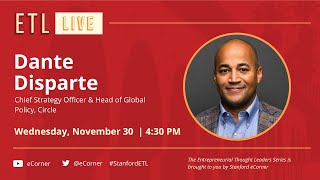
This content was created by GHION.AI . This content was uploaded by GHION.AI . This is a YouTube video titled "ETL Speaker Series: Dante Disparte, Circle" from December 1, 2022. It features a seminar hosted by Ravi Balani, a lecturer at Stanford, with guest speaker Dante Disparte, Chief Strategy Officer at Circle. The discussion covers topics such as the role of Circle in the digital currency space, the impact of the FTX collapse, and the future of crypto regulation and ethics. The seminar is part of the Stanford Entrepreneurial Thought Leaders Seminar series.
Chapters
Welcome YouTube and the Stanford community to the final Stanford Entrepreneurial Thought Leaders Seminar this season. It's so great to have you here today for our final etl. I am Ravi Balani, a lecturer in the Management Science and Engineering department at Stanford and the Director of Alchemist, an accelerator for enterprise startups. This ETL series, as you may well know by now, is brought to you by stvp, the Stanford Engineering Entrepreneurship center and basis, the business association of Stanford Entrepreneurial Students. Today we are thrilled to end the quarter with Dante Disparate, who's joining us at ETL today. Dante is the Chief Strategy Officer and head of Global Policy at Circle, a global financial technology firm at the center of digital currency innovation and open financial infrastructure. Circle is the issuer of the digital dollar currency known as USDC, also known as a stablecoin. USDC has over $40 billion in circulation and over $100 billion has been redeemed. I mentioned that because liquidity is an important thing to highlight these days here in crypto, and Circle's mission is to raise global economic prosperity through the frictionless exchange of financial value. Dante knows a thing or two about global economic prosperity. Dante grew up in Puerto Rico, which he has described as a place that makes Mississippi look rich, and he's the first person in his family not only to go to college but also high school. And he's hit the ball out of the park. He speaks six languages and has lived and worked around the world. Prior to joining Circle, he was a founding executor of the DiEM association, previously known as Library, which you may colloquially known as Facebook's Endorsed Payment Coin, Payment Platform process and Coin System. And he's a member of the World Economic Forum's Digital Currency Governance Consortium, also a life member of the Council on Foreign Relations and has served as an appointee of the FEMA National Advisory Council. He's an expert on risk and also the co author of Global Risk Agility and Decision Making, and also the author of a series of publications from many prestigious publication places, including writing a piece for the Harvard Business Review on simple ethics rules for business risk management. Dante earned a Bachelor's degree from Goucher College and is a Program for Leadership Development graduate of the Harvard Business School and has a Master's in Risk Management from the NYU Stern School of Business. So please join me in welcoming Dante to etl. Dante, a huge virtual round of applause for you from the ether. But Dante, I just wanted to start it off by giving you the floor. If you want to add anything to a message about what Circle is to the community or any other messages before we dive into the directed Q and A.
No. First of all, Ravi, this is awesome. And a very generous. I'm wearing NYU colors tonight. Apparently it's purple. But it's a real honor to be with you and to be with the entrepreneurial community here at Stanford virtually. And for those joining us on the web, an additional word about Circle obviously is it would be remiss of me to bury the lead right now. We're in the deepest, darkest, coldest phase of what in the crypto industry is known as a winter. Some are arguing is that it could very well be an ice age. And so I'm sure a lot of the conversation will pick up how do you navigate and how do you create a competitive strategy in an environment where the brand name of your industry potentially becomes toxic? And then how do you then stand out and how do you break free of some of the speculative cycle that has created this very rapid boom and bust? And so Circle is deeply focused on opening up this utility value phase of what does it mean to be banked? What does it mean to have a form of money in digital native form that you control? And so I'm looking forward to diving in very much and again honored to be with you and with all the attendees.
So then I'm going to play off of that cue, Dante, and I think the elephant in the room here, I think is ftx. And given that you are an expert both in crypto and in risk and ethics, which I think it's a rarity for us to have that Venn diagram overlap, let's dive into this issue because we have an audience here of the future generation of Stanford and peer institution entrepreneurs. We just had, as you relayed to me, one of the youngest self made billionaires collapse in 24 hours. And so I want to get your take from an ethics and risk perspective about what went wrong, especially for the lessons for our next generation of founders to really internalize here. For those that aren't familiar with what's happened, which is this elephant in the room, which many would call sort of a crypto Armageddon as well. It might be good to pause right now the video and go listen and fill up on that. But I will give you a quick summary. And Dante, you can please augment this if I'm wrong. But the quick summary here is that FTX was the fourth largest exchange to buy and sell crypto that was started just in 2019 by an MIT grad who goes by the initials Sam Bankman FRIED and so in a very short period of time, it became one of the largest places for buying and exchanging crypto. Two years before that, Sam Bankman Fried SBF also started a quant trading platform called Alameda Research, which was making money by buying and selling crypto. And he was the majority owner of both. And it came to light that he was actually lending money from the customers of the of FTX to Alameda Research, which unfortunately was then not able to cover that liability to just really superficially summarize things and got overextended. And that led to this cascade of dominoes falling, ultimately having the whole all, all of FTX go file for bankruptcy. And in 72 hours, the crypto industry lost about $150 billion of value. That's the quick summary, just to get you up to speed, if you're not familiar with what's going on, this is a fascinating though invitation for us to learn and also to mitigate what might happen. You know, anything for us to all improve for the future. And so with that, Dante, can you share your thoughts on from a risk and ethics perspective and a lens on your take on what happened and lessons for our future entrepreneurs?
Yeah, well, look, I think first of all, it's a teachable lesson in not necessarily the failure of a technology. So at the outset, I would be remiss if I didn't say the word crypto is short form for cryptography, in the same way that the emails that you and I receive and send is probably the greatest vector of misinformation and disinformation and ransomware attacks all over the planet. And you're as good as the person between the keyboard and the chair if you want to keep a company safe of noisome and terrible and insidious cyber risks. We also have to start to disambiguate the term of art that relates to a technology. And technology like a hammer can be used to build a house or tear something down from effectively bad behavior, bad conduct, the lack of, call it a North star, corporate ethics or anything of the like. And so ftx, I think history will bear out, will be a teachable lesson in the perils of fraud or nearshore, nearly regulated companies that have risks of opportunity versus the failure of crypto and blockchains with it. I also hope, as I said at the outset, the crypto industry has come up with a lot of jargon. One of them is this idea that you're entering a winter phase whenever there is a decline in speculative activity, a decline in trading or a decline in Bitcoin's value. The term of art is it's a winter. My hope is that it becomes an ice age to end the era of speculation in the same way that you needed the dot com bubble to burst to give the Internet and web one or web two over to real long term, durable founders, durable leaders, durable business models. I think crypto needs the speculative face to stay frozen in ice and to be a testament to the misdeeds of Just because you can do it with the Internet and with code and with blockchains and cryptography doesn't mean you should piece one, piece two. Finance and the movement of money is rules based. I know very intimately because if you want to get summoned to speak at every Senate hearing all over the world, all at once you produce a white paper with the byline Reinventing Money AKA the birth of the Libra project. And all of a sudden the central banks, the policymakers, the regulators and everybody else has an opinion about who can reinvent money and what are the boundaries of reinventing money. So finance and money is rules based on fintechs and cryptographers would do well in watching the post FTX lessons and having some healthy respect for what those rules might be. Even if it's a loosely regulated domain, respecting those rules can help build a durable business versus one that has flash in the pan variety, flash in the pan growth. And so there's a teachable lesson here between maximizers and optimizers as well, where the optimizers want as much value as they could have for as long as they could have it. And with money there just simply are no shortcuts.
So many good gems in there, Dante. So I want to really unpack this because it's a critical lesson and I do want to make it a critical teaching moment. And so I appreciate the distinction between tech and behavior, that this doesn't have to do with the tech. This really is, as you know, it may be in fact a series of misdeeds, but I want to dive into that and specifically how do we mitigate that in the future? You wrote this article in Harvard Business Review. Simple Ethics. Simple ethics, Rules for Better Risk Management. And you say many great things. You have many great lines. One of the lines I love is you say no one gets extra credit for doing the right thing when it is easy, but it is in these moments when I think they can sometimes be these micro moments when decisions are made that are clearly the wrong decisions, and maybe these are the maximizing moments when people are being excessively maximizing and they're doing a local maximum and not thinking about the big picture that these misdeeds occur. So, you know, in the moments when, and I don't know if you ascribe blame to SBF or the system, because there are some people that would would say sympathetically that SBF was just being an entrepreneur and there wasn't the checks that the government should have been doing on, on ftx, the venture capitalists weren't doing the checks that they should have or the markets should have had insurance to mitigate this. But if in fact you ascribe it to the behavior of sbf, what practical things could have been put in place for when he was making those moments of decisions that were the unethical decisions when he was making the moments to maybe lend when you shouldn't have lended, that could have mitigated against that?
Yeah, well, well. So no, and thank you for hearkening back to that article the way I describe it, and maybe another analogy for folks listening in is the Geneva Conventions that you do not torture prisoners of war. Pre 911 were nice value statements. Post 9 11, even the United States was confronted with the idea that your value systems as a nation or as a company or as an individual leader are most important and therefore most real when you're in periods of duress and stress. It's teachable in hindsight that the US operation of ftx, ostensibly the one that was regulated with a primary regulator, the Commodity Futures Trading Commission, the cftc, arguably is still a going concern. Why? Because again, money and finance and the movement of money, irrespective of the technology stack that you're using to move money, is rules based. And some of the rules that I think fintech entrepreneurs and crypto entrepreneurs and other entrepreneurs might take for granted are there for a reason. Now, the public policy indictment, however, is what put FTX in the Bahamas in the first place. And so we have had now, since 2019, multiple public discussions in the United States, multiple hearings. I've been in virtually every single one of them. One of the first was I was sitting next to Mark Zuckerberg and David Marcus, the protagonist of the Libra story. And then the more recent ones, I myself was in the hot seat in the Senate Banking Committee and in all of those public hearings on crypto and risks of this novel economy that is emerging, on the movement of money and capital markets. And all these things pose potential risk to consumers, to markets, to all kinds of issues, systemic risk, and many more so on. Who does the indictment lie? In the extreme, obviously, in a case of fraud and illegality, it sits with the leadership and it ultimately may very well sit with Sam Bankman Fried. We will all litigate that. In fact, get your popcorn. There will be some hearings later in December of this year to litigate what happened and how did it happen. But there's also in my mind, a public indictment of the inability to capture obvious predictable risks before the risks rear their ugly head. And that's the problem. And so a million consumers who use the FTX platform for trading activity and had some semblance of trust in no small measure because FTX was a failure in underwriting risk as much as it was a failure of the management of that company, of doing the right thing. So they probably thought they can get away with it. They probably thought the trading activity will always be greater than the risk that we're knowingly taking. But ultimately it was also a failure of underwriting. And this is not the only one. In the crypto economy before ftx, there was a large so called algorithmic stablecoin known as Terra Luna that was a $60 billion unfunded loss and it blew up. These two events are testaments to financial alchemy on the Internet, but they're also massively teachable testaments to the failure of underwriting. So it's like Elizabeth Holmes and Theranos had a child and that child started tinkering with the financial services sector. And on who does the indictment also fall? The capital markets, the investors, the sporting leagues, the superstars that endorsed this vision of doing business and having at no point done the very basics of checks and balances and underwriting.
And is there a way? So thank you. Fantastic. And it does seem like it's multiple checks that failed, or at least that's sort of the thesis. But it also seems like those, the failure of those checks compounded on each other, that, you know, there was something around how the markets were feeding this animal or this frenzy that became significant risk and then, and then had this colossal impact on people and also the whole global outlook on things. Is there what can tactically be done now? Do we start with the protagonist? Do we start with the next generation of founders and bake in ethics into their core? Is that unreasonable? Or is it more where the markets need to be fixed with capitalist responses, where we have better insurance products that can do the, can do the risk, do the underwriting more effectively, or is it public policy? How do you think about, you know, the next step then? What, what is the most critical thing to Change next.
Yeah, well, considering this, I presume is a slightly newer generation of leaders who are listening in. We may not all remember that after the 2008 financial crisis, many of the world's leading business schools for about, I don't know, 30 minutes were flirting with the idea that to go to a great business school or to be a great business leader and entrepreneur would also be endowed with this concept of a professional liability. For about 30 seconds the management science was tinkering with the idea of perhaps business leaders need a Hippocratic oath. Ironically, if you get an MBA from a leading business school, you have no professional liability. The worst that can happen to you in this case these giant white collar frauds and white collar crimes is a slap in the wrist and you will fail. Forward. Many in the industry, the crypto industry are really, really upset that we continue to lionize and create a platform for Sam Bankman Fried as opposed to putting a seal, a scarlet letter of what you have done is to effectively take good technology and co opt it with bad behavior. And all of us in the industry will now pay a price. But one of the post 2008 financial crisis discussions was very short lived, but I think it should be revisited. This idea of baking into management science an individual liability that supersedes your corporation. It's called skin in the game. In Nassim Taleb's thinking, Black swan antifragile for the thousand days before Thanksgiving, every turkey is happy and then it's Thursday. I do think this idea of it's known as a moral hazard. The technical terminology is risk taking without bearing the consequences of your risks. And native in the environment of a platform like ftx. Very much like we saw with the Ranos and very much like we saw with these other so called unicorns hiding in, you know, masquerading as technology platforms or novel companies with durable business models was some degree of risks of opportunity, but also an enormous degree of moral hazard in which the business leaders and the billionaires and the entrepreneurs and others were taking risks, but ultimately not necessarily bearing the consequences of those risks. Now we don't want to indict risk taking what we want to indict. And I think what matters from an ethical business leadership vantage point is for people to have a sense of the consequence of the decisions that they make on others, on markets, on consumers. And candidly, I do think the public policy environment has also fallen short. Observing risks and doing nothing about it, observing novel industries emerging near shore offshore from the United States and not allowing them to become regulated in the normal perimeter of finance, I think is equally a public indictment as well.
So I just want to close the loop on that because I think that is the disconnect what you were saying and also what you also say in the article about how these ethical lapses occur when you don't incur the personal consequences of the risk that you take. And maybe I missed it, but. So what is the next natural, the next step? How do you close that gap?
Well, so, so the next step is obviously my. I think I could tell you what the next step will be based on rote and based on the predictable pattern of how the regulators, the policymakers, et cetera, the media will deal with FTX and Sam Bankman Fried. That will be a predictable fact finding pattern. It will be forensics, it will be policymaking. And the sad thing, unfortunately is all of that will be backward looking. The risk that rears its ugly head a year from today and hurts entrepreneurs, consumers and markets will not look the same as the last one. That's why it's called risk. If you could predict it, many of us wouldn't be on this lecture tonight. We would be going and betting and potentially even speculating. In my mind that would be a failure because the opportunity of leveraging novel technology for the movement of money at scale, the utility value opportunity here should not be held at bay because one company failed due to old classical garden variety fraud. And that's what I'm afraid of, is that the knee jerk, instinctive policy reaction to Sandbank and Fried and FTX will be to litigate how it happened, but to do nothing about enabling the responsible actors in any space, not just finance, not just crypto, not just blockchain, but in any space to innovate on the edges. We have in our society today a deep anti innovation streak and a deep anti technology streak and neither of those are going to get us through the twin perils of COVID 19. In an anemic market environment and anemic macro environment, we need innovation to be at the core, but we need responsible innovation. And therefore, hopefully the message tonight is to the entrepreneurs listening in, there is a good durable way of building a business and there's a very, very bad way of building a business. And if you want to play the long game, I would opt for the latter approach. And ideally FTX and Post FTX allows us to actually go build.
And the way you do that is how do you. What I want to make sure of is that the takeaway is the takeaway that this was a misdeed on SBS part a misdeed in degree. He just didn't quantify the risk appropriately. But if he quantified the risk appropriately, he should have. He could have still acted. So if he just, you know, didn't, if it didn't collapse, would you, would it still be okay? Or was it a misdeed in kind that this was just fundamental fraud? And, and I understand the first one might be around creating better either insurance mechanisms or a way to quantify risk, but it feels like what we're dealing with is an issue on the second is more of a moral compass and I'm not clear. I want, if, if, if our, if our future entrepreneurs do want to act with a moral compass, but they're also acting within this economic capitalistic environment where their peers are all being driven by FOMO and over optimizing, are there tactical steps they can take to ensure that moral.
Look, I think that this is why I opened up with this notion of a risk of opportunity. Does leaving your purse in an inner city car in the passenger seat visible to anyone produce more crime or is it a risk of opportunity? And I do think the idea behind this entire structure and the fact that there was very little if no fiduciary guardrails between customers assets and trading assets and the company's assets, I think these are just basic fundamental guardrails around regulated financial services. Right. And so there may have been in the, you know, there will be an enormous amount of forensics on this. There will, I think a story will be told in which there were clear ethical lapses and there were clear, clear enormous risks of opportunity. How those then fester and for how long they fester and how big an FTX gets and how many blinders people wanted to put on to allow this company to become, to buy the naming rights for stadiums in the United States and to get the biggest of the stars around the world to endorse it is equal parts a failure of underwriting and when I mean underwriting people who failed to see perhaps predictable risks around FTX and therefore legitimize it and normalize it, this is where it looks like the dot com bubble and the 2008 financial crisis and clear enormous lapses of governance ethics guardrails. And this becomes a real point for the entrepreneurs listening. Businesses built on cults of personality may always have this potential opportunity risk of the cult of personality superseding the naysayer, superseding the voices of dissent versus businesses built on durable business models and fundamental business models. I have a quote on this, which is that in a company without a business model, you need extraordinary people to deliver ordinary results. In a company with a business model, ordinary people can deliver extraordinary results because the business model is what drives it and nowhere more so than in money and finance. Does that principle hold?
I think that's such a great takeaway. There's lots of great takeaways getting there. I just want to make sure we got those. So the first is to have the basic hygiene was not correct in terms of just the reporting and the transparency around the reporting. Then there is the systematic issue of being able to assess risk that needs to be addressed. But then on the moral compass, this notion of the personality being required if the business model isn't there is a terrific check. And I think that also. Isn't it also a red flag with ftx, the fact that he was confused he had two different businesses. Is that a red flag? Where he had was he was deprioritizing what his customers really needed or cared about from the exchange with the token that he was trying to create.
Well, look, where else do you see a cult of personality, a leader with perhaps too big of a portfolio, extending and destroying an enormous amount of value, an enormous amount of market trust and enormous amount of jobs along the way? If people are tweeting this tonight, you could look to the Twitter platform and you could look to a $40 billion acquisition of a platform that at some level may be under the perils of a cult of personality leader who now may have a portfolio far too big. In general management, the idea of a basic span of control is you can't have between more than six or eight people in your direct reporting lines. So at some level, I think the same would hold true in terms of just the complexity of this cult of personality model of entrepreneurialism.
I know there's so much to talk about. I'm going to dive into questions in about five minutes. But Dante, can we talk about cultivating that, building this moral compass that you're talking about? Can you share about how you've built that over your life? Especially Bill George at Harvard Business School. He has this book called True north where he basically says that you really can't be. He ascribes the failure of people like Enron or even all these other companies as these rising. These golden boys that became sort of. That had too much success too quickly and never went through difficulty or challenge in their life to sort of galvanize their moral compass. Can you share about your personal journey? Because it is rare for us to have somebody who grew up in Puerto Rico, you know, from you're the first in your family to go to through a formal education, and now, and you've been involved with now in the mix of all these projects that are also surrounded with all these people that are acting sometimes unethically and then sometimes very ethically. Can you share from your own personal reflections about what's galvanized your moral compass and also any learnings you've had by assessing other leaders and risk and ethics on what is important to galvanize true moral compasses?
Yeah, well, I mean, I think the academic answer is values matter most when it's least convenient. And I think the reason I've managed to really anchor my career and my leadership, generally speaking, against the True north, is because when you start from a relatively low position, be it a station in life, be it an academic ladder, and the general sentiment in the world is your mere presence in the room is odd or anathema, then at some level, when you start to own the adversity that you started with, you realize that your greatest asset is a blend of authenticity and being unimpeachable. My earlier career was gravitated towards the risk and insurance industry. It's a $5.5 trillion industry. It's the other side of the global financial system. But no matter the outcome, it was an unequivocal good. When the consumer used the financial service we provided, no one complained that their house was rebuilt, even if their premiums might have been too high. And so that was my first foray into finance. And then the next question becomes questions about equity. I mean, you said circle's mission statement at the outset. One of the reasons I'm very, very deeply committed to what CIRCLE stands for is, is we live in a country here in the United States of Fortress Nation, where you are at the mercy of a zip code lottery on whether you get very basic public services, very basic public education. And so if we people, businesses and others don't start demanding greater ROI for the taxpayer dollar and greater ROI for the idea that we all are at the mercy of Commons, digital Commons, physical Commons, public service Commons, demanding better outcomes, then we've all opted out. And so I've come to the business world in my journey as an entrepreneur from, like, almost a deep bent of public service and this idea of greater good. It's hard. I would encourage people to look at the Senate hearing I gave last year in December. It is very hard to criticize someone who has an unimpeachable North Star, even If they're trying to defend an otherwise complicated industry, the word crypto today might as well be tobacco or asbestos. But yet, because I believe in the vision and mission that Circle stands for, and because Circle is a breakaway company with a durable business model that isn't trying to create shortcuts, it's an easy business to defend, even if the industry or the term of our crypto gets co opted by the market, by the media, and by many other players. And so that superpower, I think, is native in all of us nature. But the ability to overcome how to exercise it takes practice, takes no fear of failure and trial and error. And that's how you sort of exercise those muscles.
And can you, and I'm going to go into questions after this and can you remind everybody, because thank you for all the great thoughts on ethics and personal journeys and moral compasses. But remind everybody in this winter of crypto, why are you so optimistic about Circle? Why are you spending your one precious life professionally on Circle?
Yeah, well, thank you for, thank you for that question. And I know I'll try not to make this piece an advertorial, but we live in a world with 1.7 billion people who have no access to the formal economy. If for those 1.7 billion people to be banked hinges on brick and mortar, they're all in trouble. And this is not an abstraction for emerging and developing countries or south of the equator. Today, inside the United States, there's an enormous preponderance of people who have very limited access to the formal economy, very limited access to the very best Wall street can provide them in terms of wealth creation and capital and lower cost payments. And so it's an irony that in a time of national retrenchment, in a time of de globalization, whether it was Mother Nature or a laboratory, the advent of the COVID 19 pandemic laid bare in our society a whole host of pre pandemic vulnerabilities, virtually all of them needed technology at the core for any semblance of continuity. Political, household, educational, you name it. Tech cannot be construed as a bad word. Whether it's crypto, blockchains, AI, we have to start having a pragmatic view in the middle. And Circle twice now, in both of the calamities that I've described, the collapse of Terra Luna and today the collapse of FTX has been a growth company telling a counter narrative. The functions of that growth, real people, durable business model, regulation, first trust. You can't buy trust when your house is on fire. Any More than you could buy insurance and circle has grown despite all of the rest of the industry, the rest of the economy potentially facing turbulence.
Terrific. Thank you, Dante. I'm going to turn it over now to questions. The first question is can you please share your hopes for the future of US regulation or lack of in crypto?
Yeah, well, so, and I have a lot of writing on this topic. So if the ask is to go deeper, I would suggest you take a look at the writing. But many, many describe what we're in as nothing short of a digital currency space race. It's the United States versus China. The Chinese central bank has launched a central bank digital currency that has more than 260 million total users. And so a lot of people are framing this idea of device centric banking and payments, AKA cryptography and blockchain based finance as a digital currency space race. For me, a good outcome for the United States, like the real space race, is that if our political leaders start to give us a destination, then we can marshal a whole society response. And so the answer is not to pretend it doesn't exist and that you could put the genie back in the bottle. The answer is actually to figure out how to enable the technology and enable a convergence of these technologies into the traditional financial system so that billions of people around the world have greater access to it.
Perfect, thank you. Next question. There's a lot for you. How do you feel about the consolidation of many crypto exchanges going against the original philosophy goal of having a distributed financial system?
Yeah, isn't that an irony? Right. So crypto was supposed to be an Internet of value and the superpower of the Internet of course was the idea that it was completely distributed, networked. And so the other irony is that yes, crypto is incredibly centralized and it's the totality of it. Bitcoin mining power and the concentration of mining is heavily centralized. The world's largest crypto exchanges are heavily centralized. One of the things I've called for from a policy vantage point is the creation of a so called stablecoin glass Steagall provision to keep the separation of so called church and state in some of these exchanges from being token issuers separated because that concentration creates risk. FTX had an exchange token. There are many other global exchanges that have an exchange token. And with that type of token you create an incentive, whether malign or whether through torpitude and stupidity, you create an incentive for the exchange to make bets against the interests of the coin holders. So it is heavily centralized, but that's one of the Ironies.
Next question is, do you believe that the fintech sector is a red ocean for creating startups?
No. In fact I would argue, and I love the analogy, blue oceans, red oceans. I mean if you think of it this way, while it's very easy to indict the risks of fintech and crypto, we should all remember that the last time there was a dislocation of trillions with a t trillions of value from real people, real consumers and your hopes and aspirations, your retirement dreams, your school savings dreams were all evaporated was because of unchecked risks in the global traditional economy. And crypto originally was a correction and a market response to the misdeeds post 2008. And so we need challenger innovations. My analogy is would taxis in many cities across the United States have accepted credit card payments or traveled to the wrong side of the tracks and picked up the people that of so called the wrong complexion if they didn't have a challenge or innovation in the form of mobility, uber lyft, et cetera. And so I think fintech and crypto represents challenger innovations to stayed brick and mortar banking and payments and we need those innovations to be able to thrive.
Okay, I'm going to exercise my prerogative and cherry pick a couple of questions because there's a lot that are equally upvoted. But I'm going to ask this question about Puerto Rico, which is that Puerto Rico is considered under foreign jurisdiction by the IRS but at the same time is exempt from the Foreign Account Tax Compliance Act. This has made Puerto Rico a little bit of a crypto haven. Can you talk about the unforeseen consequences of this or the unseen consequences of this and what you want to see from the government of Puerto Rico and USA going forward?
Yeah, look, I have a lot of writing. This might be from one of my fellow boricuas listening and I have a lot of writing on Puerto Rico. One piece refers to Puerto Rico. It should be the Singapore of the Caribbean instead of this territorial backwater. Unfortunately, as an island that faces a fiscal crisis and an out migration of its middle class and anybody else, turning itself into a tax haven is not a particularly great way to get its economy started. Puerto Rico once upon a time had a vibrant diverse industry. Pharmaceuticals, tourism, food, agricultural services, IT logistics, you name it. And the idea that the island under Act 20 and 22 is becoming a tax haven for mainland millionaires and billionaires and with them I think a particularly bad branch of the crypto segment isn't ideal to restart the Puerto Rican economy. And isn't a great strategy to build national competitiveness. So Puerto Rico needs a strategy. I have an article that talks about the 10 steps to reinvigorate Puerto Rico both domestically and from a mainland vantage point. But I'm not a particular fan of creating a tax shortcut when you need to actually grow revenue and you have a municipal debt burden that was Greek in its proportions. At one point, $73 billion of municipal debt for Puerto Rico.
Next question is. Hello Mr. Dante, thank you for speaking to us today. I'm curious where the best place to start is. If you are a young entrepreneur trying to get into crypto, how can we obtain the best information?
Yeah, well, look, the cool thing about crypto, and so what I must say is what's so powerful about crypto as a cultural thesis is that it isn't about fomo, fear of missing out and trading and speculation. It's actually a community that is largely about open source technology, largely about education, and largely about creating this kind of challenger innovation to traditional financial services. The piece of the puzzle, however, is to not think of it strictly as a financial innovation, but rather generalizable technology. I think of blockchains and cryptography as generalizable technologies that have implications well beyond finance. And today the first beta versions of these companies, these innovators, these entrepreneurs, and frankly these failures have been articulated in finance. But the reason why finance is because the activities basic technologies like blockchain are supposed to support should be simple and generalizable. Therefore payments is a killer use case. I guarantee you 5, 10 years from today you will be executing blockchain based payments. But the technology would have faded to the background and we wouldn't even describe it as crypto. And so finding elsewhere in the real economy and elsewhere as an entrepreneur, generalizable problem statements that are simple but where trust and the deficit of trust could be a difference maker, you may very well have a crypto opportunity and a crypto business in your hands.
Okay, this next question is do you have any tips for people who are interested in working in the intersection between finance and policy? This is going to be for all.
Of the good news is if I've cared over the last five years of my career in this industry about poverty alleviation and financial inclusion. Ironically, the two people I've kept gainfully employed are lawyers and public policy. The reason public policy and that nexus is so important is because the technology is jargon ridden and virtually every company in fintech and in crypto today has realized that Washington as a city is not A flyover city, and that you need translators who can create the relationship map, whether it's through words or through expression. Indeed, the relationship map of this novel technology and all of its jargon and how to relate to it from a public policy vantage point. So I think it's a space for gainful employment. But if you're an entrepreneur, it's also a space that is you may not build the business here, but you could be very, very deeply entrepreneurial around public policy and the formation of public policy that is enduring. So it's an incredibly satisfying space.
Okay, I'm going to exercise my discretion, but you go through the questions if you want to, Dante. Otherwise, I'll pick. I'll cherry pick some. There's a question here about globally speaking. One of the issues of having a global coin is actually the banking regulation of each country. How can we overcome that issue to create a global coin?
Yeah, it's a good question. And you know, in its ambition, Libra till now, the original LIBRA project was unrivaled in its ambition and perhaps in history and in hindsight, unrivaled in its Silicon Valley hubris. Because the original structure was to be a global neutral currency that would be a composite of dollars, pounds, sterling, yen, euros, and therefore would be usable and neutral for everyone. Again, nice idea. Perhaps on a whiteboard in Silicon Valley. Present that to the planet with the backing of the companies we once had. And literally you are summoned to talk to every central bank all at once. However, the idea ultimately is that these innovations cannot circumvent regulations for very long if they expect to get very big. Crypto today is fringe finance. For crypto to become mainstream, usable by billions and billions of people, banking regulators, central banks and countries will have a policy. Here the good news is entire countries and entire regions from Europeans, they have a framework known as the Markets and Crypto Assets Framework, which will be to crypto what GDPR was to privacy. That is the third largest economy in the world has a common legal and regulatory framework upcoming for this industry. So the industry is not going away. Sam Bankman, fried and the FTXs and all of these failures behind us are down payments on a better, more durable version of this. But there will be harmonization of those rules, which is one of the reasons I think it's critical for the United States actually have a policy position. Hurry up and wait is not a great strategy.
Just on that. How culpable do you hold the US Government for being a laggard in actually creating oversight in this industry which has forced founders to go away from the US to the Bahamas or the bvi. And if the US was doing that out of the intention because they felt it was too risky, was that the wrong approach? Yeah.
Well, it's kind of like the irony I think, of what is the current state of affairs in the United States with fintech innovation, you could argue is a fintech constitutional crisis. But in hindsight, maybe that is a feature and not a bug. The Europeans after Libra went and created a body of law that would make it very, very hard for basically any company to operate in Europe in this industry or in fintech. So the question is how many circles would have been started in Europe? And so the superpower of entrepreneurialism in the United States is that the states, including for fintech innovation, or the laboratories that allow certain companies like PayPal, like Circle, like Stripe and like so many more that are leveraging blockchains, leveraging cryptography, creating safe on ramps for these novel technologies to be onboarded into global finance. How many of those firms would have been founded or would exist anywhere else in the world? The fact that some of them are near shore or offshore is perhaps a design of the founders to cut corners. Circle, by contrast, nine year old firm has a license in every state that requires a license equivalent to PayPal. No shortcuts. It's called electronic money. And so when people say, well, there are no rules, therefore I went to the Bahamas or the Cayman Islands, it begs the question of the founders, why? Because we do have certain norms and certain rules and the longer game is a more durable one than the shortcut. So I don't know, I mean, I think that fintech constitutional crisis and this idea of federalism is a very powerful feature when we do get it right, even if we're slow. The United States is not a country to ignore, especially if the notion is geopolitical and geostrategic that we're in this pitted fierce digital currency space race. The dollar is actually already the currency of the Internet. And Circle is responsible for at least 40 billion and change and more than $6 trillion of dollar denominated transactions in this new economy. There's no one else that comes close to this.
Next question is also on usdc. How many people on a daily basis do you think US use stable coins? Actually it's stable coins, including usdc, for purposes other than trading crypto currency. And what do you think is the primary use case for usdc? That's question number one. And then there's a second question. What are your thoughts on flat coins, coins that are stable in purchasing power.
First of all, it's a great question. So if I was going to upvote one that was on my list, because on the one hand, people dismiss stablecoins. By the way, I hate the term. We would rather call USDC a dollar digital currency, because the term of art stablecoin puts all of these so called stablecoins under the same shelf space in the crypto supermarket. Some of them are like rat poison with the label baby food. Others are actual digital dollars. So we reject the term stablecoin. But for the sake of answering the question, if the argument that many public policy leaders make about stablecoins is that they're nothing more than poker chips in a crypto casino, at a real casino, it is usable to prototype faster, better, cheaper forms of payment. And so it's a little too dismissive to think that just because a stablecoin might be principally used in crypto capital markets, it has no other utility value. Here's the other irony, though. In the case of USDC, more than 75% of USDC in circulation is held by what is known as an eoa, an externally owned address, meaning an individual personal wallet or a company's individual wallet. And so it's held off exchanges and held either as a store of value, a medium of exchange, or a unit of measure. And so for the economists listening in, those are the three definitions of money and usdc, a function of how it's regulated, how it's trusted, the type of disclosures we provide, not because we're asked, but because that's called leadership, is used almost universally in those three fashions. Absolutely. The prototyping use case was crypto trading and crypto capital markets. But why? Because it's an enormously exacting domain. People want instant settlement. They want 247 banking. The banking system takes holidays. Your financial needs do not. And so we're seeing an enormous growth of use that feels very retail to companies like Circle. And not all stablecoins are created equal even in that type of use case.
And unlike banking dollars, is every USDC backed by a physical dollar or is there leverage? Is there partial coverage of the.
So if I were in a physical room, this is where I would lean in and tell the audience to lean in and pay careful attention. Exactly. Lean in, Ravi. So look, this is where my banking friends and colleagues have to pick careful attention. USDC and the risk management standards by which Circle runs its company would put the top 10 global systemic banks to shame. The reason is very simple. Every single USDC in circulation is 20% cash, 80% US treasury obligations of 90 days or less in the care, custody and control of the American regulated financial system. And a dollar at a bank is 20% dollar paid back to you, 80% rehypothecated in the form of leverage lending, et cetera. Circle's business model is a fully reserved business model. And so it's money good on demand, presented to Circle or presented to the open ecosystem that support usdc. It's a very, very different bank risk profile.
So it's not just efficiency gain, it's efficacy. We're not just making dollars digital, we're actually making dollars better.
Well, and if I could, if I could, Ravi, not to wax too philosophical, because this is why it's such a powerful breakthrough.
We're out of time. So, Dante, we have 30 seconds or a minute, so go for it. I want to give you the final words. These are your final words. Yeah.
All right. Final word. The reason the innovation matters and the reason the innovation is emotive to central bankers is if I went to you today or to a regulator today with an innovation called cash, physical cash, it's likely it would not be authorized for three reasons. Number one, it's backward looking. Number two, not particularly useful in an always on Internet economy. It goes as far as my arm can reach. And number three, in the context of a public health emergency like COVID 19, it's a vector for spreading disease. And some countries resorted to actually laundering their physical money. And so that's why the breakthrough of stablecoins and things like USCC is so powerful. It's the extensibility of the Internet with the trust of a US dollar.
True. Thank you. Thank you, Dante. That's a fantastic vision to end on too as well. And a fantastic note to end on too to the community. So gang, that wraps up the final ETL of the season. Thank you, Dante, again for a fascinating discussion. Thank you everybody else for tuning in to our final session of the Fall Entrepreneur Thought Leaders series. We'll be back here after the holiday season on January 18th as we kick off the winter ETL series. So thank you all for tuning into ETL and we will see you next year.
More from GHION.AI


O processo de reconhecer limites, mesmo quando a vida parece exigir sempre mais.





Depois de tantas histórias, aprendizados e pausas necessárias, o @interior_iza está de volta



