ETL Speaker Series: Daphne Koller, insitro
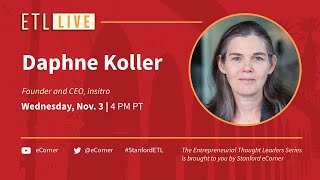
Daphne Koller, co-founder of Coursera and CEO of insitro, discusses her move from academia to founding companies focused on machine learning and drug discovery. She reflects on her career transitions, the challenges of being a female founder, and how Theranos affected biotech entrepreneurship.
Chapters
Welcome Stanford and YouTube communities to the Stanford Entrepreneurial Thought Leader Seminar. I am Ravi Balani, a lecturer in the Management Science and Engineering department at Stanford and the Director of Alchemist and Accelerator for Enterprise Startups. And I'd like to welcome you officially to etl. ETL is presented to you by stvp, the Entrepreneurship center in the School of Engineering at Stanford and basis, the Business association of Stanford Entrepreneurial Students. Today we are very honored to have Daphne Kohler to etl. Few people I know are as accomplished in both breadth and depth across academia and entrepreneurship as Daphne Kohler. Daphne got her bachelor's and her Master's degree in Computer science in Israel. Another and Daphne's another example of how America is the beneficiary of amazing Israeli trained engineering talent. Daphne then came to the farm to Stanford to get her Ph.D. in computer science. She did a small postdoc in computer science at Bezerkli and then came back to the farm where she was a professor in computer science for 18 years. And not only was she a professor in computer science, she was highly, highly distinguished. She was published in the top journals, she was inducted into the American Academy of Engineering and she even won the prestigious MacArthur Fellowship, which is oftentimes known as the Genius grant. And yet, in the midst of having such an illustrious academic career in computer science at Stanford, it in her 40s, 18 years into being a professor at Stanford, the entrepreneurial bug bit Daphne. And Daphne in 2012 started and was the co founder and the co CEO of Coursera, which is one of the darling edtech companies that has been created in the last decade. Coursera, by the way, IPO'd earlier this year and is now valued at over $4 billion as a publicly traded company. But that was not but it didn't stop there. After Coursera, Daphne shifted gears again and joined Calico Labs, an Alphabet backed biotech company focused on aging and longevity as their Chief Computing officer. And she continued to explore the synergies between computing science and biomedicine. In 2008 when in her 50s Daphne Co founded in Citro. Not to say that 50s or 40s is old, but, but just I think Daphne is a powerful example of how entrepreneurship can emerge at any time and you can build at any time brave disruptive companies. But Insitro right now is at the forefront of machine learning and drug discovery and Daphne is the CEO. And if anybody is thinking wants to be on a rocket ship that's exploring these boundaries between machine learning and drug discovery, I'd urge you to check out the In Citro site to see opportunities that are there in 2020. Daphne also co founded another digital learning company called Engagely. So if it's not already self evident, Daphne's been very busy accomplishing a lot in her one short, precious life. And so we're very honored to have some of her time today at etl. So please join me in welcoming Daphne to etl. Welcome, Daphne.
Thank you very much, Ravi, for the very generous introduction and thank you for inviting me to be here.
Well, it's really an honor and I would say that for many of our students, I'd love to. There's so many different things to unpack that we're not going to obviously have enough time just in the short period of time that we have. But I do want to touch upon a few key parts of these different phases of your career. The first of which I'd like to do is talk about academia. There are many students that are thinking about academia as a career path. Can you shed some light on when was the moment in your life that you said, I want to dedicate my life to academia? When did that occur?
I was an academic brat in the sense that both my parents were academics. And I think given that I was pretty good at school, it was almost preordained in my mind and that of my parents that I would follow them into an academic career. So it was almost never really a matter of debate that this is what I would do. And when I got my PhD, I mean, it was obvious that I would continue to do a postdoc. It didn't even occur to me to do anything else. And then came to Stanford as a faculty member and I was convinced that I would retire as an academic.
And was this something that would. Do you think that you actually just never proactively. Was it something where you just didn't really proactively choose it, that but. Or was it a decision that you. That you felt like you actually chose?
I think it was more of a natural gravitational pull, partly because of the, you know, the parents that I had in the home that I grew up with, and partly because I'd always enjoyed intellectually stimulating activities and thinking about really hard problems. And, and that seemed like a very natural home for that. And when I grew up, I think there wasn't as much of an entrepreneurial culture, certainly not in Israel at the time. Of course, now it's a completely different universe over there as it is over here. And so it's like, what, am I going to go into business and just be an employee grunting through stuff. And so it was clear that if I really wanted to be intellectually challenged and innovate with new ideas, then academia was the place to take do that.
And did academia fulfill that for you?
I think to a large extent for a while it did. And, you know, I think I was fortunate to have encountered and chosen to go into areas relatively early in their development. So there was a lot of entrepreneurial spirit in the disciplines that I worked on. I was one of the early people into the field of machine learning, for example. I started to work in that in the early 90s, literally as it was becoming a field. I remember being the program chair of the, what is now called Europe's 2007 conference. And that was a. You know, we thought that the conference was getting really big because we hit 1,000 people and 1,000 submissions. This is a conference that in the last pre pandemic incarnation, capped out at 8,000 because they just couldn't accommodate any more people in the conference venue. So. And it could easily, you know, have, I think, had 20, 30,000 people registered, if not more, if that had not been an issue, and did in pandemic when we were. When it was all going virtual. So, you know, it was a very entrepreneurial thing to do, to be early into machine learning. It was similarly entrepreneurial in the late 90s, early 2000s, when I was one of the first machine learning people to sort of foray into machine learning applied to biomedical data sets, when everyone around me was still working on, you know, MNIST data and, you know, recognizing digits, handwritten digits and such. And I was like, this is not that inspiring. I want to go work on something that has more aspirational value and more complexity in the data. And I want to work on understanding gene regulatory networks and transmission chains of tuberculosis. One of the early epidemiology papers, long before epidemiology was a thing that all of us armchair scientists now consider ourselves to be epidemiologists, as we are in the post Covid era. So I think there's a lot of opportunities for me, there were to sort of be first and at the forefront of an exciting discipline.
And so can you tell me, can we talk a little bit then about the transition out of academia? Because many people would say that, you know, when you were 18 years in, that's the point when things are good, when you suffer the slings and arrows of all of academia to get to this tenured spot where you have, you can do whatever you want with your life. And then at that Point you decide to leave academia and pursue Coursera, can you speak to it? Was that out of aspiration, as you said? Was it similar to when you were pursuing all these new initiatives? Was it an aspirational pursuit? Some founders do things out of aspiration. We've also had very successful founders that have the entrepreneurial bug bite them from desperation. We just had the CEO of Girls who Code, Reshma Saojani on, and she talked about how she had to hit rock bottom when she was a hedge fund lawyer to then suddenly open to entrepreneurship. What was that transition like for you?
So for me, it was a matter of deep sense of internal urgency combined with a sense that I was on a treadmill that didn't change very much. So at some point, I'll start with the latter. There was a clear sense that whatever it was that I was doing at academia, I was doing pretty well. I had a, you know, a steady stream of high profile grants. I had incredible graduate students and we were producing papers. And it got to the point where it's like, yeah, paper, yet another grant. And that was all very well and good, but I began to feel a sense of urgency to do something meaningful that actually touched the lives of people. And actually, one, it's interesting that the real transition point in sort of really driving that home was, ironically enough, that MacArthur Award that you mentioned in the introductory comments. When I got that, that was in 2004. And most people, when they get an award like that, they celebrate. And it threw me into, like a deep funk. And the reason for that was because this is not the kind of other awards that I've gotten before, like the National Academy of Engineering and such, where there is a relatively limited group of people who are even eligible to be considered for that award, and I was a plausible enough candidate. This was something that could have been given to any one of the residents of the United States. And I was like, why me? There's so many amazing people out there. What have I done to really earn it? And I went back and looked at my publication record and I said, are all these papers really enough to have caused me to be selected as one of a handful, 25 people out of, at that point, 250 million people in the United States, that doesn't seem like I'm the most obvious candidate. And I felt like I had to pay it forward? And so basically was, what can I do to make the world a better place that would retroactively earn me this award? And so that combined with the fact that when we at Stanford based on much of the work that I'd done, even internally within Stanford, on technology assisted education. Suddenly we had these big courses, these MOOCs with 100,000 learners in each one, and was like, this is a really big thing. So am I going to go back and write more papers or am I really going to go out and try and make a difference in the world? And so I decided that I just couldn't let that opportunity go by to really make a difference.
And I think, you know, this is one of the classic decision points in entrepreneurship is, is when there's a difference between the external world and your internal conviction, when the external world is validating you in this case, but you're internally not feeling like you deserve that validation and then decid to follow your internal conviction. And it seems like that's happened at a couple moments in life when you're saying, you know, I need to go and pursue this for everybody else who's on that path or deciding, should I listen to my heart and pursue this, or should I listen to the external world? And. And if it's telling them something different, any, are there any realizations that you've had over the years of when you should just push forward?
So one of the things that I've used as a sort of guidepost in making decisions, and again, people need to have their own internal compass on what is important to them. To me, what grew increasingly important as I move forward in life is to make a big difference in the world and specifically think about places where I have in some ways, a unique ability to make a difference. So not something that, sure, I can go do good in the world by, you know, digging wells in Africa, but I'm not particularly good at, well, digging, so it's not going to be all that, all that helpful relative to having another person go and do the same thing. So I've always looked for opportunities where the experience, the skills, the mindset that I bring have a disproportionate leverage. I'm a big believer in leverage. So if people are facing decision points, I would encourage them to think about what do you bring to the table that is unique to the point that you can do something much better than the next best person, perhaps, or most of the next best people in that. In that role.
Okay. And so Coursera emerges and this is an opportunity for leverage because it leverages all of your academic background and experience. Then also, I'm sure at the time one of the killer courses is also on things that you're an expert in as well. And so I'd love, let's spend a little bit time on that. So first of all, are you scared when you do this transition? So when you jump in and you're, and you're giving up 18 years and I don't know if you're Israeli parents or the angels that are around you or if that has any effect on you, if they're like, what are you doing leaving this storied career in academia to doing a startup? Was there any sensation or was it easy?
Okay, so first of all, my mom thought I was crazy because how could you possibly give up a tenured shared position in the world's top computer science department to go and do something else now? Fortunately, I, at that point in time didn't have to cut the cord immediately because I was able to take a two year leave of absence. So I did that and I was like, I could go back. And in fact, the plan had been for me to go back. So I really only pulled the cord, if you will, two years later when Stanford said, well, we have a strict leave of absence policies, are you coming back? And I was like, not right now. And they're like, well, okay, it's now where you don't come back. So that was when I really pulled the cord. And that's when my mother thought I was crazy.
And, and how did you know at that moment to, to pull the cord, like, so just so people can really understand this, because how is it clear to you that you needed.
Because I felt what I was doing was incredibly important. And even then we were seeing the impact. This was right around the time that we had published our first learner Impact survey, which was a place where we could demonstrate that not only we were reaching a lot of people, but they were really being impacted with tremendous benefit to their lives, their careers, their happiness. I didn't feel like at that point two years in the company could really survive if I left. And so it was, it was more a matter of like a moral judgment. I couldn't just like let it all fade away.
And I just want to. And I think that's so powerful. I want founders to understand what it feels like when you're actually on something that succeeds. What was the data that you saw that where you knew that this was valuable? What was it specifically from that impact survey?
So, I mean, first of all, I mean, there's the numbers that everyone sees, which is just the number of learners coming onto the platform and so on and so forth, number of universities, number of courses. And it was clear, honestly from relatively early on that we were on a roller coaster, or rocket ride, if you will. Actually, it turned out to be a roller coaster. So that was. That was maybe a Freudian slip, but one that is very apt because, you know, 2012 was the year of the MOOC, and 2013 was the year that the MOOC died. And both of these. These were completely exaggerated and the hyperbole was just ridiculous on both sides here. But. The impact, I think beyond the numbers, which were the visible manifestation, was when we started to get learner stories, one at a time where people were telling us that they were on a path to nowhere, they were homeless, they were unemployed, they were inclined to. They were. There was one that basically was one on the forum saying, coursera saved my life. And it was about a woman who had literally tried to commit suicide and was. Because she had married early, was constantly pregnant, very traditional family, and just didn't have any path to expanding her mind. And she found Coursera, and it gave her a sense of hope and a sense of fulfillment. We have a woman from Bangladesh who saved her life and the lives of five or seven other women by giving them a job in a bakery that otherwise she would not have been able to succeed at because she didn't have any business training. So when you hear those stories and they give you this visceral sense of, I'm actually helping people in this very immediate time frame. And then, you know, because one always knows that it's always possible to cherry pick great stories, although those are really compelling. But. But then ask yourself, okay, is this really a trend or is this just a few isolated examples? And then we ran this learner survey, and we just saw that the numbers supported the fact that of the people who came onto the platform, which is over half in order to transform their career, a third had a transformative outcome. They were unemployed, and then they were employed, or they got a big promotion or a new job. And those might numbers are huge because you're talking about, you know, we currently have 80 million people or more on the platform of Coursera. So even if you think about, you know, 50% of that is 40 million. And then, you know, you do the numbers, even once you whittle it down, it's like a significant number of people whose lives I think we've been able to change. And I'm so incredibly proud of what we accomplished with that.
And you should be. But let's talk a little bit about the roller coaster, because I think there's also learnings in that, you know, one of the, I think whenever you're doing anything so disruptive as Coursera was doing, or any disruptive innovation, there's this question of how do you navigate the relationship with the incumbent that you're disrupting or that you're depending upon? And many people would say that Coursera was a disruptive innovation when it came to education and universities and you sort of had one foot in both worlds. And can you speak to, was that a challenge of thinking about Coursera's relationship with the universities versus the professors? There were other platforms that were going very aggressively against really dismantling sort of the university structure. Was that a challenge and if so, any guidance on how you navigated that for people that are wrestling with similar issues around disruption.
So we've made a very deliberate choice at the early days of Coursera that we were going to work with rather than against our universities and actually partner with them as a way of creating a win win situation. Now, I'm not saying it was going to be easy to get them on board with a win win situation, but we did, we were able to do that. And that was a critical part of our success, was that we had the support of the universities in helping us recruit star professors to teach their courses on our platform, having them support those professors and creating high quality content, providing us with the university brand, including those certificates that frankly without the university brand would be considerably less valuable. And subsequently that translated into what has turned out to be a really powerful component of the Coursera business model, which is the partnering with universities to take some of those learners who come onto the platform to learn lightweight, sort of, you know, four week, six week long courses and convert them to full blown online degree students, which is an even more transformative educational experience, much more serious investment, but it allowed the university to kind of identify and, and bring on those students without just going out and worrying about the cost of customer acquisition, which is what a lot of the sort of traditional companies that offer online work with universities for online content. All that being said, I will tell you that there were very challenging moments in the process that gave us that ultimately resulted in this business model. So for instance, in the early days of Coursera, as we were starting to have these discussions with the potential university partners and convince them that this was a good idea. It was slow moving because what we were asking universities to do was incredibly out of the box thinking. You are opening up the things that are most your most precious assets. Your top faculty, your brand, your content, and you're giving it for free. I mean, It's a ridiculous thought, right? And while we were having those conversations with universities on that, as well as on a number of other things that were considerably more fraught even than that, like, you know, ADA accessibility and how do you get the platform to be that and you know, wranglings with lawyers about ownership of IP on the content and such are, shall we say, peer platforms were going out there like, oh, we just recruited 100 top instructors. And so they were able to move much faster because they didn't have university legal to deal with. And it was a very significant decision. I remember it very clearly. We sat around the table and there were voices who said, let's copy the business model of those other people. They're moving so much faster. Why are we bickering around with all of this university legal stuff? And it was a very, I think, courageous choice for us to say we're going to stick through our existing plan. It's going to be slower, but it's going to be the successful path at the end of the day. And I think that the ultimately that was borne out in the results that we had.
Yes. And I don't know if there's any more color that we can add to this because one of the core themes for ETL this year is about principle driven entrepreneurship, which is really these moments when you're having values or principles guide your decision making above and beyond what might be the unit economics or the for profit drivers of a business. And I think these moments in a startup's trajectory are so critical and also so difficult to actually navigate that conversation when the zeitgeist would tell you, growth, growth, growth, you know, go after what has more immediate value. So I know you already talked about it a bit, but is there any other color you can add about how you guys actually navigated that discussion? What did it feel like when you were having that discussion? Was it a difficult conversation? And how did you, how did you orchestrate the people that were on the different sides of the issue?
It was a difficult conversation and I mean ultimately it was a call that we had to make the founders of the company to basically say this is what we set out to do. Here is why we think ultimately it's going to be more valuable. And we had a list of arguments that, for example, having the university support in especially the more, shall we say, prestigious faculty, the ones that are the superstars, having the support of the institution is going to be really enabling to recruit them. It's the only way to get access to the use of the university Brand and that brings value to learners. So really what we had which was really important was a North Star on what is best for learners and having access to the university's content engine and brand was really the best thing for learners. And so we decided that it was worth, and I will say this wasn't the only example where we made a principled decision that ultimately led to a good outcome for us as well as for the principles that we were trying to live up to. So one such example was the decision to offer a financial aid option to all learners. Even when we launched the paid product, which was the certificate product, we basically said, and we even told the team that we would delay the launch of the paid product by a week or two if they were unable to, from an engineering perspective, offer a financial aid option. Financial aid is basically just a payment waiver. It's not, there's not like a financial aid office or anything like that, but it's basically a process by which people say, I can't pay. I attest that I can't pay and I'm going to request financial aid. We made that decision out of principles because we felt like there were so many people in countries like Bangladesh and Uganda and Nigeria who were never going to be able to pay the $50 that we required because it was like months of earning for them. We decided that we were going to offer this to everybody. There was a lot of pushback about lost revenue and blah, blah, blah, and. And we were very much adamant that we would continue to do that. And ultimately, again, that history bore us out in a couple different ways. For instance, one of them is that we had, as some of you may know, a nonprofit competitor called edX. And there was a lot of narrative in the media at that time about nonprofit versus for profit. And everything that's for profit, of course, is immediately tainted and suspect as being greedy capitalist, which I don't think we were, but. And we were able to point to that decision as well as others that we had made to say, look, ultimately it isn't about what your tax status is, it's about the decisions that you make and are you a principles driven organization or not? And I think that wasn't why we made that decision. But I think sticking to your principles really allows you to, when there is controversy, to go back and say, look, don't judge us by our words, judge us by our actions.
Yes. And I think it's such a grounding compass too. It's energizing in some ways too. When you do that in the Moment of resistance. I think it actually galvanizes. It can galvanize the company forward. I'm going to push forward just for the sake of time, which is because there's so much. So you become the chair of a tenure. You're a tenured professor at Stanford. You leave that, you start Coursera, which becomes now a $4 billion publicly traded company. But you decide to leave Coursera then, and then you join Calico, and you start to explore these things at the nexus of machine learning and biotech and drug discovery and health and aging. Can you talk about that transition? When was it clear to you that now the time was to stop pursuing Coursera and start to pursue this next new chapter in Daphne's career? How did that unfold?
So this actually comes back to one of my earlier answers to one of your questions, which has to do with where can I have the maximum leverage to maximally impact the world for the better? So this is now 2016. Coursera is now about five years old. So it seems like a natural moment to pause and reflect. I lift my head up from the trenches where I've been for five years, and I look around and I say, oh, my goodness, machine learning is changing the world. Which it wasn't when I left academia in 2011. That was really pre. That sort of big inflection point in the way in which machine learning was able to have an impact. And I won't say that I hadn't noticed that machine learning was being much more broadly adopted, but I've never paused to think about it. And so this is 2016. I say machine learning is really transforming the world. And I'm a machine learning person. And not only am I a machine learning person, I'm one of the very few people who actually legitimately have worked in both machine learning and biology for, you know, well over 15 years. And that gives me a unique skill set that I can now bring to bear towards what I think is a really important goal, which is taking that impact that machine learning has had on so many other areas in society and deploying it towards life sciences, where it hadn't made as much of an impact. And I think one of the biggest reasons why it hadn't is because there aren't that many people who are what I call bilingual, who are actually able to communicate with, on an equal footing with both the data science, computing type of people as well as with the scientists, life scientists. And so I felt like, sure, I could continue to work at Coursera and I could continue to sort of steer that ship, but the trajectory was pretty well set. And I think there were other people, as has been demonstrated, who were able to come in and kind of just continue to build that company. They no longer needed the. The founder there, I think. And as a company, there isn't like a hugely deep technology stack where the skill set that I bring can really help navigate that to a better outcome. And so at that point, I was like, I'm going to go back and really try and bring those two worlds together. And I debated going back to academia. I debated a number of different options. And honestly, the decision to go to Calico was a very chance. One I had previously met on a number of occasions, Art Levinson, the former legendary CEO of Genentech, that brought the company from effectively nothing to a hundred billion dollars at the time that it got sold to Roche. And he was also on the board of Google, on the board of Apple. And I felt like if someone could advise me on what was a good home for someone with my skill set, he would be a great person. And so I reached out and he was like, you should come to Calico. Okay. I didn't even know exactly what Calico did, but aging seemed like a really important societal problem to work on. And so I figured it was at the very worst. It would be an incredible opportunity to work with one of the world, one of the most remarkable leaders in. In this space, which turned out to be true. So, so I did that without, I think, having a real plan of where that would take me. And I spent 18 months there. I learned a ton. I. You know, it's been, first of all, it had been five years since I'd been in any kind of scientific discipline. So I had to relearn all the latest and greatest machine learning. I had to relearn all the incredible advances that had happened in biology. Like CRISPR happened during that time as well. I mean, when I gone to Coursera, there was no crispr. So all of these things were kind of like stuff that I was able to assimilate during that timeframe. And I also realized that what I wanted to do wasn't to be in a company that focused on a single biology, but rather really build a platform for how to do drug discovery differently. And that's what led me to, in early 2018, to sort of basically take my own path and found in CTRL instead.
And you're learning not about new technologies, but you're also, I assume, learning about how to be a CEO. I mean, I know you were the CEO of Coursera, but you jumped into that from academia. And many people would say that the skill sets of being a successful academic are orthogonal to being a successful CEO. So can you speak to how you learned how to be the CEO, not the cto, but the CEO of the company? And did you learn from Art? Were there lessons that you took away that you're applying now or any, any, any guidance on that?
Oh, I mean, absolutely. And I would say that the trial by fire of founding Coursera and building a company, and I would just as a particular point on that is not only had I never run a company, I'd never been in a company, I'd been in academia my entire life. So I'd never even been in a one on one, far less, you know, built an entire company. So it was a, an incredible trial by fire to learn how to do that and really learning it on the job, being able to take that experience where I found myself inventing new stuff from whole cloth and then going into a company with experienced leaders. And it wasn't only art, it was also Hal Baron, who was there as the president of R and D and I. He and I learned a tremendous amount from both of them in terms of, you know, how to think about giving feedback to people, how to think about structuring an organization, and then as well as just the core questions of on the technical side of what does it take to build drug discovery company, which is a very different beast than a tech company. So there was a tremendous amount of learnings and some of those I took away as things that I wanted to emulate, and other things I took away as things that I wanted to do differently, which is fine because every company is a different beast. And I think that's important for people to recognize. You have to find your own style and your own way of doing things. And so that was a very valuable experience for me on both those fronts.
Well, you know, I would say that one of the most difficult things in entrepreneurship or even venture capital is timing, knowing when things are going to take off. And you've been an oracle of timing, whether that's been intentional or not, of going into spaces that end up becoming big. Computational biology has been around for a while, it's been around for several decades. It hasn't led to that much fruit. Can you speak to why you are so excited now within CTRO about machine learning and drug discovery and anything that you want to tell to the next generation of biologists and computer scientists that are in the Stanford community right now?
So I think that as I Picked my head up from the trenches and looked around. What had become clear to me was not only that machine learning was transforming the world, but also that there was now finally an opportunity to apply machine learning in a meaningful way to the life sciences. Because when I left academia to go to Coursera, a large data set in the Life Sciences was 100, 200 samples, 500 if you were really lucky. And what I saw as I looked around was that there were now a wealth of technologies that had emerged that enabled large amounts of high quality, high resolution data to be collected at scale from both human individuals as well as from model systems, cellular systems, and experiments that when I, for example, did my sabbatical at UCSF with a WET lab in 2009, experiments that took years to do in a yeast organism, which is a much simpler, easier to manipulate model system, now could be done in a matter of a couple of months in mammalian cells, in human cells, and using CRISPR and various other technologies, and could give rise to much, much larger, higher fidelity data sets. And so I felt like we were at the convergence of two revolutions. And by the way, that's still how I characterize in. And if you think about the name in Citro, it's the convergence of in silico and in vitro, which means in a computer and inside the lab. And what I felt was that there was now this opportunity to create massive amounts of data that would help inform our understanding of biology, of disease, of therapeutic interventions that can help provide cures. And so seeing. So first of all, I've always believed that the most interesting innovation lies at the boundary of things, because that's where you can really sort of bring in ideas from these different disciplines and create something that is truly transformative. And I felt like we now had enough tools and capabilities on each of those sites to do that at this intersection. Now I will tell you that when I started in CTRO and we had these conversations with various like Big Pharma people and such, that you would get a slight sneer and a raise of the eyebrows, like yeah, machine learning, very interesting, haha. And it ranged from downright skepticism that there would be any value to the more optimistic ones who would say there is like niche uses for the technology and this little problem or that little problem, you don't hear that anymore. Three plus years into this journey, when you go talk to big Pharma now, they realize that this is going to have the same impact on their industry as it's had on so many others. And the only question that they have now is how do we get some of that into our organization? And so I think it was the right decision at the right time.
Yeah, it was. Gang, we're going to go to Q and A after this next question, so post any questions that you have. And I'm going to. I'll call on the most popular ones. I have time for one more question, and if I could, I would love to get your to have you opine on the situation with Theranos. Let me just first clarify if I can exercise that liberty. Let me first clarify that there is no relationship or connection between Daphne and in Citro and Theranos. None whatsoever. They're completely distinct. The investors are completely distinct. Everything's completely distinct. But having said that, while I have Daphne here, and because Daphne is such a strong member of the Stanford communities and the bio and computer science communities, I would be remiss if I didn't give. I wanted to give you an opportunity to speak to this because there was this article from the New York Times that was entitled they Still Live in the Shadow of Theranos Elizabeth Holmes, that observed that female founders, in particular in biotech, feel like they often have to push back at people bringing up Theranos in conversations about their own work. And there's these competing narratives about whether or not Theranos was just a more extreme version of the classic Silicon Valley formula, fake it till you make it. And I think there is confusion about what is considered appropriate risk taking and inappropriate misrepresentation in biotech that may be harming biological tech and even female founders in particular in biotech in general. So I want to just create some space for anything that you want to relay on the Theranos situation.
So I'm going to separate this problem and this question into two. I'd like to first speak to the question of the fake it till you make it and what I consider to be an appropriate or inappropriate line. And I'd like to speak to the female founders in particular, because that I think is something that transcends the Theranos situation and I would say is just a thing that women have to deal with when they in multiple careers, including an industry. So on the fake it till you make it, I personally find hyperbole very problematic. And I think hyperbole is something that is easy to fall prey to and it is very tempting at the time to make bold claims and, you know, make big promises and. And it ultimately ends up hurting you because it taints the field. Because when you're unable, as is often the case to deliver on big promises, then I think it creates a sense of distrust on the field as a whole. And I've lived through multiple AI winters where people made hyperbolic claims about AI and machine learning that didn't end up panning out because they were premature. And that caused a huge sort of drought for a decade of no funding, no one going in into the field, because it was viewed as, like, such a complete flop. So I tend to dislike hyperbole in general, and I try and, you know, whenever I'm on panels, try and balance conveying that there is a tremendous opportunity, a lot of potential. But that's very different from saying that things are things have happened that have not happened and accomplishments that haven't actually materialized. In the case of Theranos, I mean, it went like, three steps beyond that. So even if you're kind of like, okay, I'm going to forgive the fake it till you make it, this was an organization actually lied to its investors, lied to the patients, and put people's lives at risk by actually giving them test results that had no. On medical. A real serious medical conditions that had no relevance to the actual. To their actual state of disease. And that's not fake it till you make it. That is endangering people's lives. And to me, that's just. It's not even a gray zone in the way of, like, hyperbole. It's like, so far into the black that it's not even funny. The other thing I'd like to speak to is the female founder saying, and to those of you in the audience who are women, and I hope there are some among you who are actually women, it's not an easy life to be a woman and a position of leadership. And I think the same is true for other underrepresented groups. There are multiple, I think, what have come to be called microaggressions, where it's nothing that you can, like, call out without sounding like a petulant child, but that happen all the time that are really kind of accumulate and make it hard for someone to really lay claim to the contributions that one makes without having to constantly fight for it. For those of you in the audience, I will make a call to all of you and not just the women, that when you see these microaggressions occurring, speak out if it's you who needs to speak out. It's hard to do that without feeling like you're whining. But there are ways that I think one can navigate that and maybe even more importantly to Those of you who see it happening, and especially if you're a man, say something. So if you're going around the table and Jane says something and no one pays attention, and then five minutes later John says the exact same thing and everyone says, great idea, John. Wow, what an incredible insight. It's okay for you to say, yeah, John, that was a great idea and Jane made that. It's a very similar point a few moments ago. And I think that is very, very impactful. So I would encourage you to think about being supportive in that way to people who otherwise may have a challenge finding their own voice to do that kind of thing.
Thank you. Thank you, Daphne. I'm going to go to the student questions now. There's quite a few. If you do see any question that jumps out at you, let me, let me know. Otherwise I'm going to just go meritocratically. So the first question is, what would you recommend to somebody that struggles in an academic setting but still aspires to be an entrepreneur?
So I think it depends what your entrepreneurial wishes are. I would say that there are certain areas where it's very hard to be an entrepreneur without having strong academic credentials. I would say that for example, if you are going into a very science driven field like biotech, it's hard, not impossible, but hard to do that without having strong academic credentials that demonstrate that you know what you're talking about. But there are many other fields where that is not a requirement and what you need is a lot of is a good idea. Perseverance, grit, courage and being able to convince people that, that what you have is valuable. So I don't think academic credentials are necessary in all aspects of entrepreneurship.
Okay, terrific. Next question. Being involved in academia for so long, how did you develop a toolbox of entrepreneurial skills? What were the key resources, relationships and experiences that have helped you translate your academic ability into impact?
There are some elements of being in an academic role, especially as a PI of a group, that, that do translate over to the entrepreneurial world. There are being able to tell a story. People think of an academic primarily someone who sits there and thinks deep thoughts. But if you're unable to convince, for example, funding agencies or prospective grad students that what you have is a good idea, you're not going to get a lot of funding for your lab. So narrative is a really important skill. I think leading a group is a very important skill, especially in the one on one aspect of mentorship and really growing people. That's a place where there is a lot of Similarity. There's a lot of places where there is a big difference. So, for example, I talked about leading a group. It's very different to lead a group of individuals, each of whom has their own thing, as is typically the case in an academic lab versus building a research. Sorry, building an organization in a company where people really have to row together in order for the boat to get to the right destination in the most efficient way. And that alignment process is a very challenging skill to learn. You don't learn it as an academic, and I will say I'm still on the learning curve. So a lot of this is just, you know, trying out different things, getting better, asking people for help and advice, hiring other senior people into your organization who've been there, done that. I found that to be really critical. It's a mistake I made at Coursera by not doing that soon enough. So be humble and willing to learn.
From anybody, and you're a master learner and a master teacher. Are there any other unintuitive hacks that you know about learning something new that. No. Okay.
Read books. I've read a lot of books on leadership, on entrepreneurship, on coaching, on mentorship, and just be constant learner and really be humble about knowing that you don't know. And sometimes not even knowing what you don't know.
Yeah, that's the most dangerous. If you don't. Knowing that you don't even know that you don't even know those things. Yeah, that's great. Next question. Many entrepreneurs believe that a college education is not needed to become a successful entrepreneur. Do you believe you would have pursued entrepreneurship without your formal education?
I mean, not for the companies that I. That I started. I think that the companies that I started, the educational credentials that I had, were really critical in Coursera. It was an important way of gaining the trust of our university partners in ctro. I think the scientific training that I had, by the way, it's not about the degree per se. I don't think pieces of paper confer that much value, although they do in some cases in terms of the perception of the world. But really it's about having the strong scientific basis for the kinds of decisions that we need to make. So I think it's not. Yeah. So.
Okay. Okay. You mentioned that when you received your MacArthur Award, you wanted to do something that would make you feel like you really earned it. What motivates you and what has filled you with your deep desire to achieve?
You know, at the beginning, I don't think I felt that as a young person, I Was very enamored with, with just intellectual curiosity and the curiosity driven accomplishments and just playing around with fun ideas. But I think as I became more and more established, I was kind of recognizing that I grew up in a very privileged life. We weren't wealthy when I was a child, but my parents were established. I would say we were middle class, maybe upper middle class, but they were very highly educated. They made sure that I had access to all these educational opportunities. A lot of people don't have that, that discrepancy between people who are like myself, born into a good life and the very, very many people who are not. And what, what I've been able to accomplish because of that beginning versus many people who are probably equally talented, more talented, don't have the ability to do that opportunity. I think it's important for those of us who are fortunate to try and give something back, to try and leave the world a better place for us having been here, because otherwise, what's the point?
But you know, Daphne, there's so many people who actually come from resources that don't have that desire. And you have that desire in spades. Do you think that came from your childhood, from your parents inculcating that inside of you? Or where do you think that innate sense of needing, really strongly needing to do something with impact, is that something that you're born with or can you cultivate it? I guess that's what I'm wondering.
I think. I mean, I can't. I can't tell you that I was born with it. I don't remember that sense in myself as a child. But I think it's certainly something that I have tried hard to instill in my children. And my daughter, who's now applying to college, actually mentioned in her college essay, as in, this is a bedtime conversation that I used to have with my mother on a regular basis, that I need to make the world a better place. But I think it's possible to instill that in yourself when people can take a step back and think deeply about the life that would have happened if, like the. What if I had been born in Bangladesh? What if I had been born as a woman in Afghanistan? I mean, think about what that life would look like and what can I do to try and make that life? What can I try and do to help make life better for those people? Think, look at the people with chronic disease who are, you know, in a wheelchair, in a constant life of pain can I do to try and make their lives better? And I think if you really Open your eyes and look at the world. It's kind of hard not to recognize that there is a moral imperative to try and do something about that lack of fairness.
Yes, yes, that was very, very well said. I'm going to keep going on with the questions. Next question is how can we democratize biomedical research? The Internet and other things in tech grew exponentially because everyone could contribute, but very few individuals can contribute to bio research. Any comments?
I don't know that that's really true. I think that there has been a democratization of bioresearch because of the availability of resources that range from bioarchive to data sets that are actually quite rich and valuable and available to people anywhere. It does require more of an upfront investment. So you can't just, you know, come in and say, I know what I'm doing. Frankly, even in tech, that's not, you know, necessarily a recipe for success. To come in with the hubris. If I don't need to learn anything and I'm just going to be successful because I'm really smart. I, you know, I don't like hubris. I think in biology it's even more dangerous because you're meddling with, you know, people's lives. But I don't think it's. I just, I don't think it's impossible for people to go there. I think it just requires the willingness to be humble and be willing to learn.
Okay, next question. I'm just going to read the question and the questions. It's from an anonymous attendee. I am a woman in computer science. Although I know that it is nonsense to say that women are worse in math and computer science and stuff, I'm still affected by these stereotypes. I still feel inferior to my male peers. I question myself whether I'm really not talent. I question whether I'm really not talented enough to study computer science. How did you find your confidence in this field?
That is a really great question. And as the mother of two daughters, I resonate with that because I see it in the girls that I'm raising. I guess this is one of those places where, you know, fake it till you make it actually does resonate. I think you just need to pretend that you have the confidence and eventually it will come to you. As you get more and more external signals that you are as good as your male peers, because you are. I will tell you that those stereotypes, as more and more research has been done, they have no validity. One of my favorite papers that I actually hung on my, you know, cork board in my office at Stanford, before I even left was paper from science. I think it was 2008 or so that showed on the X axis, a measure of equity in society as measured by various UN metric. There's a metric that the UN had defined that had to do with salary equity, number of women in positions of power, and so on and so forth. And the Y axis was the so called math gap. And you know what? As you move to the right, when there was more and more equity in society, the math gap closed to the point that in the Scandinavian countries where there is no gap in equity, that girls were actually outperforming boys in these PISA tests, which are these sort of math tests that are given in high school. So there is no gap. Just keep telling yourself that and just try and let it roll over you, over your back when. When people tell you otherwise.
Okay, thank you. We have time for one final question, which is I'm going to say, oh, it looks like this one just got upvoted. I actually like the other one more, but I will. I don't know, Daphne, if you have a preference for which question to answer, but otherwise I will ask how much of. Okay, how much of the bio I'll be meritocratic? It's how much of the biotechnology and in vitro comes from yourself versus your team. Furthermore, when constructing the team, to what degree did you prioritize business knowledge versus biotech knowledge?
So every company is a team effort, biotech more so than most. And especially a company like in Citro, where what we're trying to do bring together disciplines that are very, very disparate and don't usually talk to each other. So I would say that the vast majority of knowledge in the company comes from people other than myself, certainly on the biology side. And I'm very proud to have assembled an incredible team of individuals that are not only super smart in their own discipline, but also come in with not only the willingness but the active interest to collaborate with each other with people with. With expertise very different than their own. And I think that is at the core of what will make in Citro successful in terms of the business knowledge. I'm fortunate to have an incredible group of business people, all of whom, as it happens, were trained as scientists before they went into the business world. So my chief business officer is a chemist From Harvard, her second in command, did his PhD in genomics also at Harvard. I'm very fortunate to have business people who are scientists and deeply understand what we do from a scientific perspective. And I highly recommend that when you are hiring business people. That is an attribute to look for.
I'll sneak in this final question. We have a minute. Fast forward to a few years later. What does In Citro's success look like to you personally? Do you have a vision of when you feel like you're going to be a success within Citro?
So I'm going to go back and say my daughter asked me a few months ago, actually I guess over a year ago now, mommy, when you is in Citro, your perfect job. And I thought about that and I said, no, not quite right now. And she said, why not? And I said, because one of the things that we had at Coursera that I don't have in Citro is that I'm able to stand in front of an all hands every week and read a learner story or have someone read a learner story of someone whose life we've been able to impact. We don't have that yet at In Sitro because drug discovery is a really long journey and it takes a long time before you can point to a patient whose life life you actually have changed by the work that you did. So when you ask me what success looks like at Insitro a few years from now, it's when we have drugs that have gone out into the market and I can bring a patient into In Citro who would stand up in front of the company and say my life is better because of the work that you all did well.
And on that, I'm going to close the Entrepreneur Thought Leader Seminar for this week. Please join me everybody and thanking Daphne for a fascinating discussion. Daphne, lots of Internet love and virtual applause for you. Thank you Daphne to our audience. Also, thank you for tuning into this session of the Entrepreneurial Thought Leaders Seminar. Next week we'll be joined by Jumia Nigeria Chairwoman Juliet Anima and Stanford Seed Executive Director Darius Teeter for a conversation about scaling technology innovation in Africa. You can find that event and other future events in this ETL series on our Stanford E Corner YouTube channel. And you'll find even more of our videos, podcasts and articles about entrepreneurship and innovation at Stanford E Corner. That's Ecorner Stanford Edu and as always.
More from GHION.AI


O processo de reconhecer limites, mesmo quando a vida parece exigir sempre mais.





Depois de tantas histórias, aprendizados e pausas necessárias, o @interior_iza está de volta



