ETL Speaker Series: Emmy Sobieski, Competitive Storytelling, Inc.
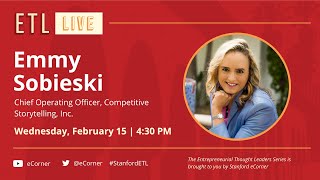
This content was created by GHION.AI . This content was uploaded by GHION.AI . This is a YouTube video titled "ETL Speaker Series: Emmy Sobieski, Competitive Storytelling, Inc." created on February 16, 2023. It features a talk by Emmy Sobieski, COO of Competitive Storytelling, hosted by Mo Fong, Executive Director of the Stanford Engineering Entrepreneurship Center. The discussion covers Emmy's career, her experiences in competitive sports, entrepreneurship, storytelling, and personal and financial leverage. The talk is part of the Entrepreneurial Thought Leader series at Stanford, aimed at inspiring students in entrepreneurship.
Chapters
Hi everyone. I'm Mo Fong and I'm the Executive Director of stvp, the Stanford Engineering Entrepreneurship Center. I'd like to welcome you to the Entrepreneurial Thought Leader series presented by STVP and basis, the Business association of Stanford entrepreneurial students. Today I am delighted to welcome Emmy Sabiesky to etl. She is the Chief Operating Officer of Competitive Storytelling, which helps venture backed founders from seed and beyond tell their story through methods such as the Founder fundraising program. Emmy is also the author of the book $100 million the five fastest paths to wealth beyond you'd wildest Dreams, released in December 2022. She ran the Nicholas Applegate Global Technology fund, the number one fund, in 1999 and has 25 years of experience as a professional technology investor working for funds of various sizes and strategies. In the past five years, she she has taken on executive co, founder and advisory roles at multiple technology startups and hedge funds. She was ninth in the 2005 U.S. world cup trials in dressage and has been nationally ranked in bodybuilding, track and field and dressage. She has also placed in the top three for her age group in both marathons and ultramarathons. Thank you so much for being with us today, Emmy. So great to have you.
Thank you so much for having me. I'm really excited to speak with you and the students, as are we.
So before we dive into the world of entrepreneurship and competitive storytelling, can you help us understand what is dressage and how has your participation in competitive sports shaped who you are today?
Dressage is the French word for training. And, and what it was used for is back in the day before we had tanks, horses were what you use to fight a war. And if your horse got shot or killed and you got on another horse, you'd need to know that it would respond to the same aids. So you know, if you tell it to go left, some horses, you use your left leg to tell it to go left. Other horses, left leg says go right. So if you get on and you go the wrong direction, you could die. And so they had competitions, Germany especially had competitions from the when the horses are young until they're trained for war. So that judges in the military could say, yes, these horses are all trained in the same system. The riders are trained in the same system so that if a horse or a rider dies, you can interchange them to just like you could a car today. So that was the background of dressage. And then when, when we started using tanks, then it became an Olympic sport much more just for beauty and as they call it, the sport of. The sport of kings and queens, because it's so expensive. And what I learned in dressage was I learned how to win. And I took that to all of my other sports. And here's what happened. When I was 16, I didn't have a lot of confidence in 15. And so I would go. I would have prepared really well, trained really well, done my best, and I would go in that competition and maybe one to two moves before the end, and they're judging you the same way that they would judge, say, a figure skating. They're giving you between 0 and a 10 on each move, and they watch your moves and score you one to two moves before the end. I would make a small error, and then I would get second or third in the class. And it's. I would always be doing some little thing to hurt myself. And I finally had a coach, one coach actually just knew that I was good. And I kept doing things like going a little bit off course. And so she pulled me halfway off the horse. Uh, this wouldn't really be allowed by Safesport today, but kind of pulled me by my collar halfway off the horse before I went in the test. And she said, if you go off course again, so help me God, I'll kill you myself. And then I went in and I started winning. And the same thing happened. When I moved to New York, I found another trainer who really believed in me. And again, I was at a higher level. I felt the pressure again, and I started to get that. That feeling like, ooh, and making these little errors. And he believed in me so much that I started to believe in myself, and I learned how to win. And once you learn the feeling of putting out your best and doing it all the way until the end, not doing it until two steps before the end, or starting to think about how did that speech go? Or how did that performance go, or how did that test go five minutes before it's actually finished? To just really finish strong and to learn that, then you can take that into everything you do in life.
Absolutely. Oh, thank you so much for sharing that story. I know students who are just beginning to think about entrepreneurship, they may feel a little imposter syndrome. Right? Can I do this? And then it gets hard. But what you're telling us is, like, just try to finish the race right and have that coach next to you that really believes in you. And thanks to the history of dressage, because I was like, wow, that's. You know, first of all, thanks for the pronunciation. It's like French dressage. And it's really that history is so high stakes and glad that sport has changed over time, but, you know, even entrepreneurship seems really high stakes at times. Right. But I think we just have to apply ourselves and go for it. That's awesome. You know, you wrote this book, $100 million careers, and I read it, I loved it. And there's a couple of things from that book I really want to dig into with you, some of the concepts you put forward. And I loved Robbie Crabtree's Ford in your book. Right. And he said, you know, and I'm going to read just a snippet of it. He said, emmys lived an extraordinary life filled with so many lessons and so much wisdom. It was the stuff out of a movie. She was friends with industry titans, watched coworkers go to prison for breaking the rules, and had a track record on Wall Street. That just blew me away. Most people would take those things and become arrogant. Emmy's never been about that. She gives generously and stays humble through it all. That just speaks to me because in suvp, that's what we say. We have humble audacity. How do you stay grounded being with industry titans and amazing people that you're meeting? How do you stick by those values that you live your life by? And what would those be?
One thing I will mention, I've worked for four billionaires, and their lives are not perfect. And I know multiple people who have spent three, six, ten years in jail. And so when I look around when I'm in these crowds of wealthy and powerful people, first of all, a lot of them are not happy. And second of all, a bunch of them don't have their freedom. They're in jail. So it's not really what I want to optimize towards. You get that hubris and you're miserable. The key for me is to do my best every day, get a lot of joy out of doing my best every day and not iterate out of optimal. So if I find a nice balance like I have working for Robbie, where I get up in the morning, I go for a walk with my friend, then I go to the gym for a couple of hours. I've told Robbie when I was joining him, I'm going to be working out and fueling myself for the first five hours of every day, and I'm available after 9am I starting at 4 or 5am and I'm available after 9, 9:30am and I'm available for the whole rest of the day. But that beginning is for my health and self care. And often you'll get all kinds, I'll get all kinds of offers to be on a webcast or do these interesting things in the morning. And I have to remind myself, don't iterate out of optimal. Now there was a story that you and I were talking about before, that is the other piece of this. So there's one piece which is stay grounded, know what true happiness is, know that happiness is individual, all that kind of stuff. And the other piece is don't get starstruck by these people because these same people are going to be the people running unicorns that you think you've got to get, get in their unicorn. But something's a little bit off and you've got to pay attention to that. So would you like me to share that, that story of that startup?
Yeah, absolutely. Like when have your values been tested? Right. This is a great story about that.
Well, yes, and, and, and early and often my values have been tested because when you're living in the world of money and people want performance, they get nervous and they think, well, maybe you need some insider information. And I really believed that all I needed was to do great analysis and pick the companies that I thought were going to be winners. So that's kind of an overall. But this was a case where I had been an institutional investor for 25 years. I wanted to move into corporate. Nobody would hire me in corporate. So I started. They basically the feedback was, you're too senior for your lack of experience, which is, you know, borderline not legal commentary from people that are executive level, but fine. And so I, so I moved on because I really believe, like Byron Katie says, you've got to love what is. You can't wish what should be. And so I built my own small coaching and course company and learned all kinds of things that startups need to do. Growth marketing, social media, marketing, sales forecasting, all of these things that are more operations. So I kind of taught myself that. And then I got a call from someone who was willing to hire me at a vice president level and the first job that he asked me to do really was it was trading all hours. It didn't seem like it was what I wanted to do at my stage in my career. So I said, no, thank you and, and then he said, well, what about being vice president, platform expansion and doing partnerships and all this? And I was like, wow, that's super interesting. So I moved to Las Vegas to join this company called CoinCloud. Now I was there about four months and they said, you've got to do that first job. And by this time, I'd learned a little bit more about that first job that they had offered me. And I wasn't entirely sure that it was legal, and when in doubt, don't do it. And they said, unless you do this job, you will need. You need to leave. And so my response was, would you like me gone in today, 48 hours, two weeks, your choice. I can transition things or I can just pick up and leave right now. No problem. And after I left, the person that I had hired there, who was a brilliant crypto options trader, if you can even believe that's a thing, he was brilliant. He found a mispriced Oracle and was able to purchase for five. He was able to purchase his coin for $5. That then turned into $3 million in one day off of that one trade.
Can you repeat that? Repeat that one more time.
He bought the coin for $5 and by the end of that day, so eight hours later, it was worth $3 million. I have never seen anything like it. His overall performance was up 800% in six months. He was brilliant. They agreed orally to pay him half of. You know what he. Because he said, look, this is different than, this is not my normal trading job. This is just, I found this thing, I don't have the time to move it into my wallet. This would be something I would do for my personal account. It's not really an institutional thing. Could we just share in the profits? They said, sure. He made the trade and then they reneged. Now, when you continue to. So this is the first thing to look for when you're looking at companies. And I saw it again in back when I was just graduating from my MBA in 1994, I tried to get a job at Provident Investment Council in Los Angeles. And it basically said, we already have one woman portfolio manager. The only other women we're hiring are secretaries. And I thought, if you're not sourcing from 50% of the talent pool, you're going to fail. And lo and behold, 2008, when we had the financial crisis and all kinds of terrible things were happening, they went bankrupt. So go back to CoinCloud, very similar thing. They had $100 million. And this is public. This is in the bankruptcy filing. It's a little tip. They went bankrupt. They had $100 million loan out because the CEO was convinced the Bitcoin was going to 100,000. And you could look at it, the Coinbase IPO came out and that Topped the market that topped all the, and the market just started. Bitcoin went to 67,000 that day. And then they just started going down. And after nine months of going down, you got to realize it's not going to 100,000 and maybe change your bet. But he just dug in and stayed with that bet. And they used the hundred thousand dollars loan to be able to keep all the bitcoin and make these directional bets on bitcoin while trying to build a Bitcoin ATM business. So they took a business that had in 20, 21, 300 million of revenue tripling every year and now it's zero. Now it's, it's bankrupt. And so the lessons for me, number one, when you start making bad errors like firing someone that makes you $3 million in one day and telling someone else, you know, doing a bait and switch to trick me into doing a job I told them I wouldn't do, when you do that over and over, you're not going to have a successful company. But the bigger lesson for me is you've got to know what your bet is. So they blamed FTX contagion and this, this loan that was over at Genesis. But that wasn't the problem. The problem was they had a leveraged bet that bitcoin was going to 100,000 and it went the opposite direction. And so it's like they didn't take responsibility for their, they didn't take responsibility. So then they didn't even look at themselves and look at that trade and question it. And so they just took the thing down the drain. So that, anyway, it's a, it's a very long answer to it. But the, the big things are to take responsibility for, you know, that the buck stops with the CEO and, but each person down the line that can take responsibility for their own actions and be self actualized really helps the, and then bad decisions compound.
And so what advice would you give to students who kind of see things going south? Like how hard was it to walk away? And how did you do that gracefully? So you don't wear bridges on the way out, assuming that you want to keep any of those bridges?
Yeah, no, I did not want any of those bridges, but I have, there are other ways to exit when someone is. And, and I had a coach that was helping me through this and he's like, well, maybe you can, you know, find a common ground. There is no common ground. They're asking me to hold client assets on my personal cell phone and I'm not a registered custodian And I'm a chartered financial analyst. And so I truly know that that's wrong. So there was no common ground for me. So for me, the thing is, is not to get into the. Try to get yourself out of the explaining game. The bottom line. And so when I have exits that are going to be a little uncomfortable, I try to stay high level. Look, I'm leaving. I'm not going to have an argument with you. I'm not like, I'm leaving. What do we need to do to get to have that happen? And how would you like me to leave? So I don't get into the. You did this and I disagree with it. And you tricked me into coming to Las Vegas and you did the bait and switch because then they're going to get it into. Now you're in the muck and now you don't have a good exit. So I try to keep it extremely high level. When I had a partnership for a hedge fund that I had to exit. Same thing, keep it very high level. Listen, I have decided to exit. What do you think is the best way to let the investors know how can we do this in the most smooth way? So you just keep it very high level.
Wonderful. So we talked a little bit about exits. I want to bring us back to the beginning of an entrepreneurship journey, which is about setting goals. Right. And I think you're definitely an entrepreneur at heart and throughout your career. And we spoken about the importance of setting aspirational goals as an entrepreneur. And so for many of the students, getting to college and maybe getting to Stanford was the aspirational goal and they've achieved that. Right. So what's next? Right. Can you tell us a little bit about how you think about goal setting? Kind of like the Goldilocks effect, like what's too low, what's too high, you know, what, what seems just right.
I'm going to argue that nothing is too high.
Tell us more.
Take, take. Make a big, huge goal so big you couldn't even imagine, and then double it and then have milestones so that you can treat yourself, tell yourself you're doing well. See progress. So you want to have milestones in progress, but you want to have a jfk, let's put a man on the moon. And by the way, they didn't have any of the technology to get a man on the moon when he did that speech, because then you had some of the most incredible technology inventions made during that period of time because the goal was big enough. I knew this woman who Germany had. We Back to dressage. Germany had won every Single Olympics since 1952. She's from Holland, near Germany, but has a different style. She's going to win the Olympics, but she's really, really determined. And she sets a goal to get not one, but two consecutive Olympic golds and two consecutive Olympics. She hits that goal, which just blew everybody away because the Germans were number one individually and as a team. And she went and she beat them, and she beat them two Olympics in a row. And I saw her a month afterwards. Her name is Anki von Grusven. I saw her at her barn and she was depressed. After her second Olympic gold, she was depressed and she said, emmy, I have no motivation. I've done everything that I set out to do. So even her, she had this impossible goal. She achieved it. She should have had a bigger goal. It is so much harder to pick yourself back up. I wanted to run the number one fund in the world. I wanted to work at a hedge fund. I wanted to ride Grand Prix. I hit all that and then I kind of, I kind of like faded and I didn't, I didn't keep the gas on because I hit my goals. It's one of the biggest risks is hitting your goals is arriving, arriving too early. So you've got to have much bigger goals than you think. Because a human, we are so incredibly capable, so much more than we think.
I love that sometimes we set goals that are multi year, right? And so we keep trying and trying. How do you know when the goal might be too big? Maybe. Is that ever a thing?
I don't ever think the goal is too big, but it could be. The goal is not serving you anymore.
Tell us more.
So I really wanted to be in investment management and I think I stayed too long because that's all I knew I wanted. So I had to set new goals about being an entrepreneur and being in startups and getting to be in the C suite in a startup and helping to scale a really exciting startup that helps people. So I had to set new goals. It's of course, much harder than just having an audacious goal. But part of the problem was is that it's maybe if my goal was 100 million by age 50, then it would have fit in to both investment management and the shift over to entrepreneurship. But because my goal was a little too specific and a little too small, I had that lull in between and I had to find new goals and pick up the gas again.
That's incredible. And now you're in the C suite of A startup. So you're right, that's you.
And you know, it's funny, I was just on a COO call, kind of a COO community call last night and they were talking about how you get it, how you get a job as a coo. And they're, you got all these years and operations, do you work your way up and you get these. And I raised my hand, I said, well, I had four months at a place that asked me to break the law, but I had the VP, a VP of partnerships on my LinkedIn and then I went and joined a startup and look, if you don't ask, you're not going to get it. So I just said I want the COO role. And most startups that are just brand new startups aren't going to even have a COO role until you're say, Series B funded or whatever. But he wanted me enough. I wanted that title, I wanted that title more than I wanted pay. So I got the COO role and I wasn't going to get it if I didn't ask for it. And you know, we can bid against, we, we can basically bid against ourselves by saying, well, you know, I only was a VP for four months, who would hire me as a coo. Like we had enough people against us, we don't need to bid against ourselves. So I just said I want it. And he was quiet. And then he went and asked his co founder and came back and said yes. And then I, then I quickly went on Amazon and bought a book called how to be a Chief Operating Officer and then found that I have this absolute love for systems. Every book that I read on running companies, scaling small companies, being a chief operating officer, as I was reading the book, I was thinking, oh yeah, I could put this into a system. And I built the whole system in notion and it's an incredible operating system for the company that allows it to scale really fast. And it's now something that I've known, I'm known for with my now 16 months of experience in operations among the three companies. So anyway, so it's just, it's a story that anybody can, you can get in and you, you obviously you need to do the work, you need to be able to deliver, but you're not going to get the role if you don't ask for it.
Amazing. I mean, my couple of takeaways there is number one, bet on yourself and ask for what you want and don't be shy about it. Right. I'd love to hear a little bit more about this company's competitive storytelling. And we've heard in many different forms how much entrepreneurship and making your pitch is about telling your story. Now, you know, after you've been working with Robbie Crabtree for a while, do you have a secret sauce on how to be a good storyteller? And you tell wonderful stories, too. So anything personal.
Thank you. I love telling stories. People are always saying to me when I tell a story, they're like, you should write a book. And I'm thinking, are they telling me that to tell me to shut up in a nice way, or do they really think I should write a book? And now I've written a book. So, number one, why I joined this company is because Robbie is hardworking, he's honest, and he's nice. And when I look back at, I mean, of course, there's the mythicism of the unicorns with the crazy. The crazy founders and all this kind of stuff. When I just look back at the angel investments that I've made in private companies, the one that is has grown and performed 5x better than the others, has a servant leader, CEO who's nice and super honest. So it's, you know, you can find them. And in my experience, that's the ones that really perform. Now, I don't know if it's going to be, but these unicorns, they go to unicorn and then they go to zero a lot of times, right? They blow up. And so do you actually get your return out of that? Are you able to exit? So. So I really believe in that. And I think the pieces of telling a great story for me, number one, is to be brave enough to be yourself. That does not mean wearing my pink chenille robe on Zoom in a live webcast. That is not. I've been asked this by students a lot. They're like, well, you should really see who I really am. So. But it's being authentic and being open enough to be able to share something like I did about CoinCloud, to be able to go to that edge so that you're sharing something that's real. You're not just sharing platitudes. And then, number two, people say, well, I'm young. I don't have any stories. You won't believe all the stories you have from growing up, from your parents, from what you saw happen with your cousins, from different business stories. So start a story bank, start it early. And as you start to write down the stories that you know, you'll find more and more will come to mind. And then you just Kind of go through and get your top 10 together. Those are the big. And then you practice, then you practice. And then for entrepreneurs, Robbie has lots and lots of writing about. You want to have your founder origin story, which is why you. Your startup vision story, which is why you should be building this startup. And the future vision story is what is the world going to look like when you've built this startup that you are uniquely bred and built to build. So those three pieces are the pieces. And he has tons of. He writes about it on LinkedIn. You can follow him on YouTube. You can learn all kinds of things from him for free, you know, and more.
So fantastic. Thank you. Definitely have to take a look at those resources. You know, another concept that you and I have been talking about a lot about, you know, what makes entrepreneurs successful. Storytelling is one of them. And then there's this notion of leverage. Right. So I think most of us are familiar with the concept of using a lever like a crowbar to help us lift heavy objects or a jack to lift up a really heavy car. And you talk about time and financial leverage, which I found super fascinating. Now I'm completely obsessed with this concept. So can you tell us more about that?
So, because I came up, in finance, we think of leverage. Like you buy a house, you put 10% down. Now the house goes up by 10% and you've made 100% on your money because you only put 10,000 into $100,000 house. So then it goes up by 10% to 110,000 year, 10 goes to 20,000. So that's the leverage that we think about. And we think about that in the stock market, maybe you have a margin account and you have 50%, you put a 30% leverage in there or something like that. So you can make a lot more the same as the house example, but with the stock, if something happens, people freak out, analysts downgrade it, then the Stock goes down 50% and you lose all your money because you only had 30% in. Or you'll lose 90% of your money when the stock goes down 50% because. Because you had that leverage. So in my mind, financial leverage. And. And you also can have it in derivatives options, things like that. You have embedded leverage even if you haven't borrowed to do it. So there's all this kind of financial leverage, which means if it goes the direction that you're betting and if you understand the vehicle, so if you understand the options, you understand the derivative, you understand how it should trade if you're betting. So first of all you need your bet is and then you have to understand the vehicle. And if it's going to trade the way you think it will, when your bet is correct, then you can make a ton of money, but you can also lose it all. So financial leverage is, is very, to me, is risky. When I think about personal leverage, it is the decisions you make about how you use your time. Where can you get an assistant now? Students at, students at Stanford may not be able to afford assistant right now. How can you use ChatGPT prompts to do the work of an assistant? How can you use Google? How can you use Python to automate a whole bunch of your tasks? So every time I do something twice, I ask myself, could I spend 10 minutes and automate this and never do it again? And the thing that really struck me where I, this, this changed in my mind, I used to think about the 8020 rule. 20% of my effort results in 80% of the benefits, either profits or earnings. And then I read this book by Gary Keller called the One Thing, and he asked, what is the one thing you could do today, right now, that would make everything else on your list unnecessary or easier? And that is personal leverage.
I can just see a lot of students like taking their lists now and trying to whittle it down to the things they can have leverage on. That's amazing. You know, one last question before we open up to audience and student questions. You know, we ask, what is the advice that you would have given to your younger self so that you could have maybe you have avoided mistakes or have even more success than you've already experienced?
So people ask me, well, Emmy, if I, if I don't even have $1,000, I'm just hoping to make a million, how do I make $100 million? And it's, there's a three step process. Break in, build equity and break out. So you break into the industry that you really think is going to be, first of all, you're going to enjoy and it fits with your personality and it has the opportunity to give you success, then you build equity. You're either running a fund, you're getting paid for performance, or you own equity in a significant startup. And then later, if you want to move beyond that hundred million or you want to make sure you make the hundred million, you then need to form your own company, form your own fund, your own fund company. So when I, when I think about that process and I look at what I did with my life, I did the first two steps. So what I would give So I took plenty of risk early. The two big things that I say to students is take big risks early and then keep the gas on. Take big risks early gets you to a million to 5 million to 10 million by age 30, as long as you take the right risks. And keeping the gas on moves you from that 8 to 10 to 12 million to the hundred million by age 50. And so that breakout moment that keep the gas on is the thing that I would remind myself. I was great at taking risks and I did not keep the gas on. So that's what I would advise myself as my younger self.
That's amazing. Just keep that gas on and you can go to new heights for sure. And you know, I think one thing that we also talked about is to lay down the foundations, right. Of nutrition, exercise and connection. So as you're like skyrocketing towards this path, don't forget to take care of yourself too, right?
Absolutely. Absolutely. And I don't know that I would go back and tell my younger self that, only because that's what I've done the whole time. So I think it didn't come to mind, but absolutely. It's movement fueling and connection and connection seems funny, but we think about ourselves like we're much more able to survive if we are connected to our mother or we're connected, we're in a group than if we're out alone think. You know, our lizard brains, our ancient brains, still think that we're hunter gatherers, out fighting wolves and bears and things like this. And so when you are not connected or you're not good at connecting with other people, you will always feel nervous, you'll always feel insecure. And so it's important to learn how to do that. And there's terrific research on it, which is that you focus on the person that you're with with 100% of your energy. They are the only. Bill Clinton was great at doing this. They are the only person in the entire world for that moment. And it's been shown that those micro Moments of connection, Dr. Barbara Friedrichson at University North Carolina Chapel Hill has studied this, that physiologically we don't know the difference between that being love, just adding up those micro moments of connection versus grand gestures. So you can be super busy building your startup and doing all of this and you can have so much love in your life and so much connection by having these very brief moments where you really give someone else 100% of your attention. And it's a massive gift to give.
Fantastic. Thank you so Much femi. I'm going to turn it over to student questions now. So the first one that was asked that got upvoted was when pitching VCs expect you to tell the big vision of how you can change the world. And as much as you try to be authentic, you don't always have a clear conviction on how this vision can be achieved. How do you balance sharing the big vision without overselling?
Yes. So this is a little bit better of a question for Robby. So this is one I'm going to say. This is what Robbie would say, but don't get too specific. They want to see your belief and you can have a belief. For instance, think back to JFK speech. He didn't say, we're going to put a man on the moon. So first we're going to learn about microwave technology and then we're going to figure out how things oscillate so that we can put them up into space. And then we got to figure out how to get them back. He said, we've got to get a man on the moon before Russia. Let's go America. And we're going to do it because we're better and we're going. And you know, you can just feel the hair standing up on, on your arms. Even though when you go back and look at that speech, he didn't know how we were going to do it. Even his top scientists didn't know. So it's the same way. I was talking about leaving an uncomfortable job. You stay high enough level, you'd stay at a high enough level that you're like, this is what the world is going to look like. Not specifically, step by step, how you're going to get there.
That's great. Thank you so much, Emmy. The next question is about a class action lawsuit was filed yesterday against three of the biggest venture capital firms that invested in ft, alleging their misleading market materials by FTX induced customers to trust ftx. How do you navigate the balance of helping startups and venture capitalists to tell their stories, which are often inspirational, without misleading consumers?
That is a fantastic story. That's a fantastic question. I would actually point you. Well, first of all, I don't know. I mean, that's a bigger question than I could possibly answer. But I will point you to Bill. Girl it. All of these cycles, you have these cycles of boom and bust, right? And each one of these cycles, when the economic cycle goes out, it's a little bit like, you know, when the waves come out and then you see all the shells and you see maybe some, some dead fish or something like that that all kinds of appear. So if I go back to 2001, when the economic wave came out, you had Enron go bankrupt and WorldCom go bankrupt. And that was so many people invested in Enron. And I will tell you, I actually looked at that Stock Back in 1996, four years before it went bankrupt. And people said to me, it's incredible, right? The same as ftx. It's excitement, it's incredible. It's the greatest, greatest stock. You've got to look at it. All they do is beat numbers. I said, great. I called them up and I say, this is before you couldn't look up. There wasn't any Internet. So I had to call them up and get the annual report. I said, can you send me now? Annual report is for one year. Can you send me the annual report? And they said, which one? And I said, how many do you have? And they said, five. And I said, all for the same year. And it turned out that it was a shell thing where each one owned a fifth of the other. I thought, well, I'm just out of grad school. So I put the whole spreadsheet together having each one, each cash flow statement linking to another one and it didn't reconcile the cash. These are audited financial statements. And so I called up the other analysts and they said, well, we know, but if we downgrade it to sell, right, which is similar to these VCs. If we downgrade it, we will. The two guys that did lost their jobs and they can't even work in the industry anymore. So there's this real conflict of professional investment managers who, you want to be honest, but it's very costly sometimes to be honest too early. I know that's a terrible thing to say. And I felt super lucky that I was somewhere and this is a good thing to do in your own careers. I was somewhere where I could say, you know what, there's other fish in the sea. I don't need to own Enron, I'm just going to own something else. But I didn't work at a sell side firm where they told me I had to have a rating on it, otherwise it would have been a really tough decision. And so Bill Gurley of Benchmark, he said, you know, he put on Twitter about ftx, he said, you know, they wouldn't, they wouldn't allow any board representation, they wouldn't show you any financials, you know, no, thank you. But other times he said, you've, in order to get in order to stay competitive as a vc, you've got to play all the way into the froth valuations, otherwise you will just have normal returns. So, you know, so, so it's like he's, he's far enough along in his career. He's worth, what, $7 billion? He can just take a pass on FTX, other people couldn't. And he was an incredible storyteller. I mean, he used it to his advantage that he was playing League of Legends when he was talking to Sequoia because they got total FOMO and then they asked less questions and they didn't require the things that they require from others because they assumed he was making so much money because he was, you know, donating to people and getting, getting into sponsoring stadiums. You know, so you can sit there at all of these times, you can look at Enron, it doesn't make any sense. You can look at Bernie Madoff and what he was doing, and it just, it looked impossible. And it was each one of these, you can say, but it's really tough when you're in there because you're kind of, you know, you're kind of, you're forced to play the game or get thrown out of the club, get thrown out of your own career. And so it's, it's not always an easy choice. I don't even know if that fully because it doesn't really answer the question of, like, how do you protect the consumer? And I certainly wouldn't want to be on the side of FTX on this one. I did find it very interesting that sophisticated hedge funds were leaving their crypto on an exchange when we have all been taught since, I mean, I've been in crypto since 2017 or before, keep your crypto on cold storage. So there is there, you know, but everybody started to trust them because people, because they were in with the politicians and they were sponsoring stadiums, but could they really afford to sponsor the stadium? So I think, I think I can't fully answer the question, but I would say to all of the students, always go back to first principles. It just. Does this make sense? Especially when it looks really interesting and really complicated and like, he's such a brilliant man. That's when you go back and you say revenue is price times quantity. Like, what kind of margins should these guys be making? What kind of money should they be making? Does this make sense? And so always go back to first principles. Always. Whenever something, when people tell you something's complicated, go simple, a little like the Warren Buffett rule.
Right. Don't invest in anything you don't understand. So, yeah, a lot of it is based on that, too. That's great. Thank you so much, Emmy. I'm going to turn it back to something a little bit more personal that we talked about at the beginning, too. Right. How important it is to have people who are coaching you cheering you on in order for you to be successful, too. This question is, how can you tell us more about how mentorship shaped your journey? Where did you find those mentors and how did you cultivate those relationships?
Great question. A lot of people come to me and they're like, I need a mentor. And my experience has been that if I come to someone and I've got just this massive curiosity, which I naturally do, but a curiosity and a sponge and wanting to learn, they get so excited to help me and to guide me, that they have just offered that they just kind of become my mentor without me even asking. And so I've been super, super blessed to, first of all, work for four billionaires. And all of them considered themselves. Well, three of the four considered themselves my mentors, and it was wonderful. So I would normally take on extra projects at work. At Farmer's insurance, I worked 50 hours. Well, I really, really wanted to work at Capital Guardian because they take two years to teach the student. They teach you the industry before you ever invest, and you do that for two years. And I didn't get to do that at Farmers. So I said to myself, I could do that. I could take 50 hours a week and do the investing I'm supposed to do at Farmers Insurance and the other 50 hours a week and learn the industry. And I could pretend I was a Capital Guardian. And so as I was doing that, I was taking on all these different projects, writing reports for different equity analysts, and then I would take them in to our head of equities, who I found brilliant. After the market was closed, everybody was gone, and we would hang out and he would talk to me about Coke and I would bring him different investment ideas I had and he became a mentor. So it's a much more simple thing than you think, but it's not really going in and saying, hey, I need. This is what I need. I need a mentor. Will you be my mentor? It's more, hey, I have this great stock idea. I think you could make a bunch of money. Would you listen to my stock idea? Now all of a sudden, I'm helping him, hey, I really want to learn about equity analysis for Pulp and Paper. I'm covering it in bonds. Could I write a joint report? I'll write the whole report for both of us if you would just edit it. Now, I've become friends with the equity analyst who's very senior in pulp and paper. She starts mentoring me. So that was my strategy, was to try to bring them a benefit, either a stock idea or, or take some work off their plate or do some work that they didn't even imagine needed to be done.
That's amazing. I think it's interesting. I'm looking at these questions, and one of the questions here is also about, you know, not just mentorship, right. But how do you operate as a team? Right. And so the question is, how do you recommend reading the signs of an unhealthy company or team behavior? How do you know when it's better to step away from an issue rather than trying to work through it? So it's a little bit of the other side of the coin where you're trying to find mentors and people who are building everyone up, and that's a good, healthy team environment. So how do you read the signs of unhealthy company or team behavior?
So it's like anything. If you, if, if you're in a relationship, how do you know that it's an unhealthy relationship? There's relationships that are abusive. There are relationships that are controlling. There are relationships where someone's a little bit more of a taker, but you can negotiate it. You can set your boundaries. There are some relationships where someone might just not be good at a relationship. So they need a little training, a little coaching, a little feedback. So there's kind of this. There's a large scale. If someone is breaking the law, leave just, you know, you don't need to go to jail, and people go to jail. What, what has blown me away in my career is how many people think, you know, good enough people don't go to jail. I'm like, no, no, no. I know a bunch of people who went to jail. They go to jail. So, and, and, and that was crazy story because there was a guy that was. This is a little off topic, but. But it's a fascinating thing because it's very hard to prove insider trading. But the, the, the, the FBI was convinced that this guy, because he was Sri Lankan, that he was using hedge fund profits to fund Sri Lankan terrorists. And so they basically tapped his phones. And I mean, they got, they got. Okay. To tap everybody's phone. So they tapped his phones and all his contacts, and he had this massive insider trading ring. And after three years, they couldn't prove anything about the Sri Lankan terrorists, but they had these boxes of tapes and they walked it over to the sec and all of those people went to jail because it was like, you know, you could really prove insider trading here because this was an insider trading ring that was recorded for three years. So you just, you just never, you just, you just, you just never know. So break the law. Any kind of feeling, like that they're close to the line or that it's uncomfortable, life's too short. You do not need to be put in a box. You need. Your freedom is worth more than anything. And, and then it, then I think it comes down to, for me at least, is what am I going to get out of staying? So there have been times where I've put up with a lot. I've put up with inappropriate sexual moves, conduct, all kinds of things that could be reported. I've put up with that. But it was incredible for my career. And I don't know that I would do that later in my career now. And I would hope that none of you have to make that trade. But, but I have a very strong personality and I'm extremely resilient person. And so that was a trade that I could make. And each one of you have. Has to make that own determination. And hopefully you're not going to have to make that trade off. But it's. When you're analyzing it, you look at it the same way as you would look at a family or dynamics within a fraternity or sorority or a friend group. You know, is there unhealthy power dynamics going on? Control, all that kind of stuff. It's the same within a company. And so you just analyze it and you say, you know, am I going to get a lot out of this? Is it going to be worth it? Am I resilient enough?
Yeah, absolutely. Well, on that note, we're going to call it a wrap, right? So please stay resilient and thank you for all that you're doing. I know you're really wonderful mentor to so many underrepresented investors and founders. So thank you so much for all you do. And it was just a fascinating conversation today and to our audiences. Thank you for turning into the session of Entrepreneurial Thought Leader series. Next week we'll be joined by Austin Russell, the founder and CEO of Luminaire, in person in the Nvidia Auditorium. And you can find that event and other future events in this ETL series on our Stanford E Corner YouTube channel. And you'll find even more of our videos, podcasts and articles about entrepreneurship and innovation at Stanford E Corner, at eCorner, Stanford Edu. And as always, thank you for tuning in to ETL. Thank you so much, Emmy.
Thank you so much for having me. And thank you everyone for listening.
More from GHION.AI


O processo de reconhecer limites, mesmo quando a vida parece exigir sempre mais.





Depois de tantas histórias, aprendizados e pausas necessárias, o @interior_iza está de volta



