ETL Speaker Series: Eric Yuan (Zoom) and Santiago Subotovsky (Emergence Capital)
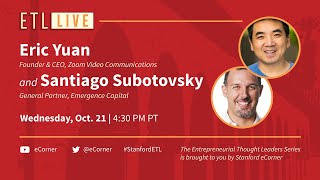
This content was created by GHION.AI . This content was uploaded by GHION.AI . This is a YouTube video titled "ETL Speaker Series: Eric Yuan (Zoom) and Santiago Subotovsky (Emergence Capital)" created on October 22, 2020. It features a discussion led by Ravi Balani with Eric Yuan, founder of Zoom, and Santiago Subotovsky, a general partner at Emergence Capital. The conversation covers the founding and growth of Zoom, challenges faced, and insights into entrepreneurship, particularly focusing on the importance of passion, user feedback, and resilience in competitive markets. The discussion also touches on personal experiences of being immigrants in the tech industry.
Chapters
Welcome everybody to the next session of Stanford's Entrepreneurial Thought Leaders Seminar. Welcome the Stanford community and welcome to the broader public via YouTube. I'm Ravi Balani, a lecturer in the Department of Management Science and Engineering at Stanford and also the director of Alchemist and Accelerator for Enterprise Startups. And this is presented. The Entrepreneurial Thought Leader series is presented by stvp, the Entrepreneurship center in Stanford School of Engineering and basis, the Business association of Stanford Entrepreneurial Students. Seldom, I think, if ever have I been able to say that tonight's or today's talk would not be possible without our two speakers. Because literally we're coming to you on the platform that was created and funded by our speakers. And I don't think that there is another product in 2020 that has become such a ubiquitous part of our lives as Zoom. And so we are incredibly honored for the time of Eric Gwon and Santi Subatovsky, who have joined us. Eric Yuan was one of the first 20 hires and VP of Engineering at the video conferencing startup Webex, which he joined in 1997. WebEx was then acquired a decade later by Cisco in 2007, where Eric became the VP of engineering. He then left Cisco in 2011 to launch Zoom, which I know we're all familiar with, but is now valued at $150 billion publicly and is one of the most valuable companies in the world. Santi Subatovsky is a general partner at Emergence Capital and he led the firm's investment in Zoom. Santi holds an MBA from the Stanford of the east from Harvard and a B.S. in Economics from St. Andrews University in Argentina. Santi is not only a prescient investor, but he's also a founder at heart, having founded AXG, a SaaS E learning company in Argentina before his days as a venture capitalist. And he's also a founding board member of Puente Labs and an organization that helps founders of high potential growth companies in Latin America scale their businesses globally. So please welcome me, please welcome Eric and Santi to etl. Eric and Santi, lots of virtual love for you guys, gang. I want to start off because I know that everybody knows Zoom now and it feels like a foregone conclusion that Zoom is the phenomenon that it is. But back in 2011, that was not necessarily clear. And in fact, this is a story that even though it feels like it came out of nowhere, the reality is that, Eric, you started Zoom in 2011, you started WebEx, so you're part of one of the first 20 people at WebEx. In 1997. And so really this started 23 years before today to get to this moment of where you're at today. And I want to start then from those early days of starting Zoom, because even though few people, I think realize it, but at the time, starting another video web conferencing company in 2011 was like the classic thing not to do. And it was sort of the classic lesson of what a venture capitalist would not fund. You had Cisco had WebEx, Microsoft had acquired Skype, Google had Hangouts, prominent VC funds had funded companies like Bluejeans Network, and there was consumer offerings like Facebook Live coming. And it was an intensely crowded space. And so I want to start from that moment in 2011 when you're in this intensely crowded space. What was your intention when you started? Was the intention just to build another great product product, or did you have a vision that was fundamentally different where you wanted to, where you're thinking about more than just a video product?
Yeah. So, Ravi, first of all, thank you so much for having me. And I think the, you know, you just described the problem back then, right? I mean, market situation back in 2011, that's one of the key reasons when I talk with friends or investors, you say, wow, there's no way for you to put it off, but it's too proud of so many other companies. But the way I look at this is you got to understand one thing is when you try to build something, why do you build that? It's not for your investors, for your friend, it's for end user. Because I spent a lot of time talking with every friend, everyone I know, and no matter which solution they were using back then, I always ask, I do like that solution. I did not see a single user told me that I really enjoy this and that, none. Then I realized, wow, if that case, I might have a chance. If I can build something better, at least I can survive. That's the reason why I dared to start. That's how I started.
I love that because there is this mantra these days that don't go after what's called red ocean waters that are shark infested, go after the blue ocean waters where nobody is there. And I love the fact that Zoom emerged from a red ocean market. And so this question is for all the founders that are in spaces where the VCs are saying, that's an intensely crowded space. Or if you make that feature, what would prevent Google or Microsoft just from copying you? How do you know if, in fact you should listen to yourself and not to the VCs it sounds like you listen to your users and specifically when you listen to your users, was there a threshold in your mind about what you were looking for to know that this was not just good but a great opportunity? Is it just if the user say, did you measure that in any way or was it more just a feeling?
You are so right. I think two things. First of all, you are so right. You know, listen to any user. That's number one. Number two, in terms of a size opportunity of the market, that's really hard, right? I do not think you have a formula to say, hey, this is big, that is small quite often. Take Uber for example. When we started, everyone thought that's a small niche market. It turned out a huge market. I think when Google started, they already have a Yahoo. Right? I think you started from listening to end user. Plus, I think sometimes in terms of opportunity, when you start, you do not know how big it is. Right. However, in the future might be bigger and bigger. I think as long as you can have a solution and plus you have a vision, you can build something better than others and essentially deliver a unique value for some of the users. I think you can survive. Don't always think about, hey, I have to enter into a market. It's a huge market. It's not like that for every business, I think.
So you didn't go in having this vision that this was going to be the $150 billion phenomenon that it is. That was you didn't need it.
Just to be clear, I think one billion is good enough.
One billion? Yeah.
I can survive. Seriously. Even today, I never think about. By the way, last week I just had our user conference. This is what I learned from a media CEO co founder Jason Huang. Don't look at the score, you know, focus on the game, right? So don't look at the big potential market. Think about how you can survive, can keep serving your customers. Along the way, you might find other opportunities to start with. Always start from very, very small. I think Santino said, always talk about in our board meeting how we can survive as a company, how we can survive. We never think about the bigger things.
I love that, that idea of focusing just on survival and focusing on thinking about what could kill you and then just how and chasing that. I want to get that really clear though. So for people, because if people are in situations where in that market where everybody is telling you we don't need another video conferencing technology platform, was there a practice that you used to center yourself to focus on? Did you Use a dashboard of saying, I'm just going to be focusing on this metric. And that's what I'm going to sense. My sense of confidence in is just if we're performing on this one or two, these two metrics, or did you use something else to center your attention and focus on to zone out all the other naysayers that were giving you all this other feedback?
I think for now, for sure, we have, I think a list of very important metrics in terms of usage, financial metrics, a lot. But early on when we started Zoom, there's no any metrics. Only metric that I have is when I talk with the user. How do you like Zoom? A paid user cancel a service. I will send them a personal email. Why did you cancel our service? What we can do differently, right? Sometimes when the users, oh, I canceled because I'm going to travel next two months. I may not use that. I do like your service. I will come back. When we got more and more feedback like that, I feel like we are onto the right direction.
And did you measure that quantitative?
Oh, sorry, it's hard. I do not. We don't as new if wants to matter that so.
So you didn't use a Net promoter score or some other equivalent score. You just every time somebody was said no, that's what you focused on is why you said, why did you leave?
No, I think of four years, maybe five years after we launched, you know, after we started the company back in 2015 or 16. We do use NPS score, but prior to that, I think, you know, we really do not have anything to measure that.
And you didn't have a North Star metric then. It was just this ethic of just focusing on the users.
Okay.
I love your story, Eric. Even more so because you didn't not only started Zoom in a crowded market, you also overcame. And maybe that wasn't even caught. You weren't conscious about it, but that you had all these elements that are fears that prevent other students from becoming founders in the sense that you had an engineering background. You had never been a CEO before. You also were in your 40s with a very lucrative job at the time and you convinced your family that, you know, I'm going to go jump this lucrative job and start something. You were an immigrant and some founders have this sense that, you know, if they can't speak English is not their first language, that's a liability. And so I know we're not going to have enough time to go through all of that. But I want to start with the first thing, which is the engineering as an engineer, was that at all in your mind? Did you view that as an asset or a liability? Starting Zoom as the CEO, having been a VP of engineering for the last.
Two decades, for sure it's not a liability. And so when you start something, you need to build a product, right? If you have an engineer background, at least you know how to build something, right? Also, at the same time, if you have a business partner, like a co founder, you know, to help you, to accompany you, that'd be great. Or you know, if you also have interests, right, about the business model or sales or go to market even do not need to have a co founder. I think again, you know, have engineer background is always a good thing.
It's always a good thing. So I just want that message to get clear.
Yeah.
And how do you spend a typical day today? And is it different than how you spent a typical day when you started? And what I'm wondering is, are you still involved deeply on the engineering side today as you were when you began?
That's a great question. Interesting enough, if you ask me this question nine months ago, I will have a different answer. For now, I think that today, the way I live every day, exactly the same as 2011, you know, sleep, eat, Zoom. That's it. For now, the Zoom is more like a developer Zoom. For now, it's more like I'm using Zoom. Right. So for the first several years, sleep, eat and develop a product, that's it. Nothing else. But now also something similar.
But right now, how much of your time is spent on engineering in Zoom and how much of it is it spent on business?
I think probably around 20 or 25% are engineers now and 75% on something else. But used to be 80% or 85% on engineering.
Was on engineering. And so for the engineers that are going to become CEOs for the first time, do you have any practical tips or key pieces of advice that have been really helpful for you? And as you now are shifting more of your time on the business side and less on the engineering side that you wish you knew earlier?
I think if you have engineer background, you want to start a company. Santi also in the call for sure, he would like to find you. Right. So you know, a lot of vcs like Sandy, you know, they like to support those entrepreneurs with engineering background. Again, I think to have engineering background is great. It is a plus. I think the only thing is you got to think about, do you like sales or marketing or others? You're not you do it by yourself. If you don't like that, find a co founder you really trust. You can work together well. I think it's something similar to a lot of other startup companies in the Silicon Valley. You have two to three co founders. I think you can start again. Don't worry about go to market, business model, sales, marketing. You can always learn because you know you have time, right? You know, get a book to learn Silicon Valley. There's so many great, you know, vcs, greater entrepreneurs, successful leaders, they can help you out, don't worry about it. Nobody is very well prepared when they start. Asante. You always start from one thing. It's good enough.
I think that's great advice. Everybody has certain trade offs gang. So everybody has this feeling that they're not complete. But that is normal. You just have to know what you don't like and get that handled in some way. And Eric, I understand that also you sometimes bring around a stack of books when you're working in different spots or maybe pre Covid and you hand these books out to employees and others. If you had to hand out any books to the aspiring founders, especially maybe the former engineers who are going to become CEOs or are there any books that you would recommend they read?
For sure. I think at Zoom, the one thing is we always reimburse any books you buy for yourself, for your family because this is our company, the mentor, you know, to promote employees. And reading a book, I think at Zoom, you know, trust is everything. There's no trust and no speed. I think that the favorite book, you know, for Zoom is the Speed Trust. The author is Stephen Covey. I think this is a great book. However, there's a lot of other books, right? Like the hardest thing about Hard things as a lot of great books, any book can help you.
Okay, that's great. One more question, Eric, then I'm going to move to Santi, which is. When you left you were making a lot of Money as the VP of engineering at WebEx. You had, you have three kids, you have a wife, you have a lucrative job, you're managing 800 people, you have all this prestige. How did you convince your wife and your family and also yourself to take the leap?
So yeah, you are so right. Actually time flies. I still remember the moment Cisco is a great company and being a corporate vice president, you know, they treated you very well. I think it's very. I never tried to convince myself I knew that's my dream because I live in Silicon Valley. I call that a startup valley. Right I knew somebody. I will start a company. I think back then that's the best time. But to convince your family member, like my wife. You are so right. It's not that easy. I still remember what my wife told me. That. What? You have a greater job at a Cisco, right? And they pay you very well. You want to start over from the ground up to build something. You know, she had all kinds of questions. No way for me to have a good answer, so. But again, you got to, you know, trust your feeling. And yeah, I was already 41 years old at that time. I also told her if I want to try it as a winning time, in other words, soon I may not have enough energy. Right. So. And yeah, anyway, that's how it started. It's not that straightforward. But you got to move forward even if you cannot convince others.
Okay, I'm going to move to Santi now. And Santi, I want to ask you about what you saw. Obviously, I think Zoom, obviously is something that took off. We'll talk about that in a second. But I think another common thread between Eric and you is that you're both immigrants. You both were born and raised in countries outside the United States, and you came to the US And Santi. So gang, I know Santi personally. And Santi is actually the first Latin VC that I think I ever knew. And I don't know if Santi, you are the first Latin VCs, maybe the first GP at a major fund. And you can correct me if I'm wrong, but if that's the case, can you share a bit about that path and that journey into venture capital? What was it like coming as an, you know, as an. As a Latin person into venture capital? How did that adventure and what was that path like?
Yeah, I mean, first of all, thank you for having me. It's always great whenever I'm chatting with Eric or you. Ravi just makes my day. I get a lot of energy. So I appreciate you having me here. And there are other Latin VCs out there that are doing really well. For me, it wasn't straightforward. And I tell people, when Eric started Zoom, a lot of people told him, VC video conference. There's no room for another video conferencing company. They told me the same thing when I moved here 10 years ago. I remember I had Excel spreadsheet where I was tracking all the VCs that I was talking to. I had 77 VCs that I was talking to, and the majority, very well known VCs would tell me that there were no Latinos in Venture. So, again, VC is not for you. You should go and try something else. It's like, go look for a different job. And that made me scratch my head. It's like, what is it? Is it that we don't have the gene or something that's going to prevent us from getting into Venture? And I actually got a lot of energy from that because it made me work harder to prove that I could do it. It's like if you have an obsession with something, that irrational passion that Eric had when he wanted to solve this problem, you need to keep on trying. And eventually you're going to find the people who believe not in your skills, but believe in you. And I help those people in my life who believed in me and gave me that opportunity. And I'm totally grateful for that. Another, I mean, Alex Mendez from Storm Ventures, he was the first one to give me a job in Venture. He said, we don't have a job, but we'll allow you to stop by and learn. And thanks to that offer, I was able to learn and get into this again. I like when people tell me it can't be done because it just makes me work harder.
Well, I think that is like the canonical experience of entrepreneurship is when the external world is telling you something, but you have some internal conviction and you have to choose or you have to decide which one you listen to and. And knowing when to listen to the outside and when to not listen to the outside and to beat your drum even louder to make sure that it's being heard. And I think that gets to the essence of it. Can you speak to then how. When Eric came to you for Zoom, and you can speak to where he was at at that journey. I don't know if you were courting him or if he was courting you, but one. But if you. Either way, how did you succeed in that pursuit? How did you. One, because if you want, you can speak to how intensely competitive the market was and why and. Or how was Zoom able to get its financing? Because I think there are some students that are asking that question. How do you get your first investors? Santi, I don't think was the first, but even Santi later, how did you then win getting into Zoom if it was on the rise?
I mean, I'll tell my side of the story and then I'd love to hear Eric's take, but I courted him. And I courted him because I was one of those frustrated users. Being from Argentina, I have a lot of friends and family there. Nothing worked for me. When I wanted to stay in touch, I could call them and I could get a family recipe or something, but I couldn't build a relationship because technology didn't work. My wife worked and lived in Nairobi, Kenya, for a while, and again, to stay in touch. It was really hard, and this is going to date me. But I was using those scratch cards to communicate with her, and it was really painful. And I felt that our relationship was getting weaker and weaker because we couldn't do this. We couldn't look at each other in the eyes and see how people were reacting. So I had that need myself. And that's why I've been trying every technology out there for this for a long time before. Came across Zoom. And I came across Zoom back in 2013. So it was early in their journey of zoom. And I remember testing it with my aunt in Argentina. She didn't speak English, she didn't own a computer or anything, and she downloaded the app to her phone and we were zooming and it worked consistently. And that's when I realized that the product was doing something different. And it changed my life early on. And then when I met Eric, the whole relationship went to a completely different level. It was less about the product, the metrics, the market, and it was more about Eric. And at the end of the day, I don't think that I invested in Zoom the company, or Zoom the metrics, or Zoom the video conferencing market. I partner with Eric because I connected with him, and I could see myself working with him for a very long time and becoming great friends. And that's. I mean, that was.
Oh, sorry. And what made Eric stand out? Because there are a lot of engineers that start companies. There were a lot of video conferencing companies at the time. And I'm asking this because the students are asking about how you got your first investment. And then there is this consistent question around, how do you get a VC to actually give you money? And Santa, you are a vc. You see thousands of pitches. What was it about Eric that made him great and not just good, whereas the other founders may seem good and not great?
Yeah, I don't think there's a one size fits all. There are some investors who are looking for the metrics, some investors who are looking for the market. I'm looking for the people. And when I met Eric, he didn't have a pitch. When I visited him in the San Jose office, he would come down and greet me and walk with me up the stairs, and they found out that the elevator never worked. And that's why he wanted to guide me into the right office. I mean, there were a bunch of dispersed offices in that building, but he had the human side of the entrepreneur who was doing Zoom for the right reasons. It wasn't about I want tech run to write about me. It wasn't about I want to get the highest valuation. It was, there's a problem here that I need to fix, and I'm not going to stop until I fix it. And we see a lot of entrepreneurs that are starting companies just because all my friends are starting companies. It's so cool. I'm going to do it. And those entrepreneurs end up giving up. When things get tough and things get tough in the life of a company, it doesn't matter if you're small or if you're big, but if you're passionate and obsessed with addressing that problem and that end customer, then you're going to run through walls. You're going to make things happen. And like Eric, Eric is working very long hours, and he's been working very long hours for a long time. It's not just now. And that's because he believes in what he's doing and his team believes in him, and he feels and he knows he owes this to every stakeholder, not just shareholders, but customers, employees, the community, the world. And when you find someone like that, it's once in a lifetime.
That's great. And Eric, can you comment on what it's like to be an entrepreneur right now at your stage? Because it's rare for us to get a CEO, founder who's at this stage in terms of, you know, Asante was saying how you're still working hard hours. I know Eric doesn't like to think about the money, but Zoom is valued at $150 billion. You're one of the wealthier people in the world now. You have more. You don't need to work. But what is a day in your life like? How many hours do you work every day? Is it a stressful life? Is it less fun now than it was at the beginning, or is it more fun now than it was at the beginning?
I think given that audience, a lot of Stanford. So last week, and we held our annual user conference in Zoomotopia, I invited a co founder and CEO of Nvidia, Jensen Huang. Right. I had similar questions. This is what he told me. That is his code, right? I love my work. I love the purpose of my work. I enjoy working hard. Remember, he started a company back in 1993. Look, at what he did. Look at what immediate change, entire industry, right. I think he is our role model. You know, having cited, I think there are so many great other entrepreneurs, right? They all want to work hard because they really enjoy working hard. They feel like this is a great opportunity for help to make the world a better place. Otherwise, fast forward 20 or 30 years later, when you look back, you will say, oh, I regret I had all the energy back then. I did not do the right thing. I think if you enjoy building up something, enjoy the work, you do not feel tired. Anything else is secondary. How you can build something to help, to help the world, I think that's where I think sustainable. And you might be enjoying doing that.
And is it. When has it been the most enjoyable at Zoom? Is there a certain phase of Zoom in the last nine years that was the most enjoyable?
Every day the same.
Every day the same. And how many hours are you working every day?
It really depends. Back in April or March, I had more sleepless night than any time in my career. You know, I think every day is different. I think a pig day. Back in April, I had a total of 19 Zoom meetings. And I do not think that work seriously, I really don't think that's worked. I just enjoyed that you think that's my life. This is work, you know, I did not see any difference.
But Eric, you not only built an amazing product, but you also built an amazing product during this tsunami of a time in the world when Covid hit. And so in March and in April, when Covid was becoming, it was clear that this was going to become the new normal and this pandemic was spreading. Can you tell us what it was like inside of Zoom at that time? Or what it was like to be.
The CEO, as I mentioned, right? Added more sleep is nice, right? It's not that easy. On the one hand, you know, every employee at Zoom, we were very excited. It feels like many years of hard work finally is well paid off. Even my kids, the school, they can use Zoom for online classes. Your neighbor can talk about Zoom for like a happy hour for online yoga class. So you're very excited from that perspective. Also, at the same time, guess what? You have to work harder, right? Because the users came from all over the world. You have to add a capacity. You got to embrace a lot of new use cases. Privacy challenge for consumers, very different user base. And plus, and you need to make sure your internal process not broken, right? And it's not that easy behind. But the good news, our investment on the company Culture and value in this critical time. Looking back, I think this is something I think I feel very proud. No employees at Zoom, they complain. They all worked very hard. They all wanted to leverage this opportunity to have Zoom to become a better company and to help people stay connected.
That's great. I'm going to turn to the student. So I've been asking some questions, but I'm going to go explicitly to the student questions. The most popular question right now is people want to know how you think Zoom will be affected when we finally get through Covid and the world starts to come back to normal. Is that something that you think about and any thoughts on that?
We do. Because first of all, I hope hopefully this crisis can be over very soon. It's not easy. We all work from home for such a long time. Mental health, depression. I think even after the pandemic crisis is over, I truly believe the hybrid workplace will be the future. Meaning even if we all go back to in office to work, very likely we probably send employees back at home one day or two days a week. I think the way for us to leverage the tools like Zoom will see. I'm not seeing the usage like today. However, the tools like this will help as long as we think about what we can innovate. What if we can embrace new use cases? That's okay. We do not worry about oh, uses might decline. That's not important for us.
That's interesting. So you're not measuring based on whether that users are going to decline or not. And then what are you measuring?
Is it just again, you know, our goal is to truly deliver happiness to our customers.
So I love.
Yeah, yeah, because customers send other feedback. Take this online class, for example, university. They see a lot of using Zoom and same time they share the feedback. Can you have this feature that features. Then you think about maybe you should have a different user interface. Right. And also a lot of Zoom hosts like online yoga class teacher. What can we do to have those people more host more meaning? We can edit the payment feature embedded into Zoom and also can have those meeting hosts to publish their events. I think a lot of things can be done in order to serve those users well. That's our focus.
And is there a dashboard now that. Is there a North Star metric that's guiding you? Because this is in some sense a chaotic time as well. Even when you were starting, it was intensely competitive and you had to zone things out. Now it's also sort of crazy in a different way. Is there a compass of a dashboard or a metric And I know it is the users, but is there something specifically that you use to measure or to track your progress against?
Is there a number on financial front? We do have some metrics. Because we are a public company. Right. We need to report back to Santee through board the Wall Street. That's very important. But behind the scene, I really do not like is it's a metrics driven company. Right. You got otherwise there's no innovation. We got to think about what metrics maybe just impede the score. That's really important. Right. And another metrics. What we can do is spend more time with customers, with users, listen to their feedback, come back, work as hard as we can to come up with a solution ahead of any of other vendors. That's the most important metrics. With that, you will have a lot of ideas coming from your employees. If you spend more time to interact with your user, that's great.
We have a question from one of the students. Andrew wants to know what are strategies to deal with competitors backed by massive companies like Alphabet. You now have a big target on your back from the big trillion dollar companies. How do you compete?
No strategy. Why do you look at the competitors? As I mentioned many times, if I look at the competitors, I even do not dare to start a Zoom. If I look at a competitor every day, I cannot sleep. There's already so many things that keep me up in the night. If I always look at a competitor, seriously, I even cannot sleep. Well, spend more time talking with your customers and users. That's the key. Don't think about competitors. What if your competitors they are making mistake. Are you going to copy what they are doing? Right. Plus a lot of bigger competitors, that's not their focus either. Again, if you always look at competitors, that's another reason why so many smart people they cannot start something. Look at in the user, look at the consumer and look at all your customers or partners. Don't look at the competitors.
I think that's great. And we do live in this TechCrunch culture where we glorify these trillion dollar companies and these huge raises and these huge valuations. But we don't spend enough time oftentimes talking about the struggles that are part of the unicorn journey. And there's a question here about that, question about becoming a unicorn. But can you guys share a hard time or a hard situation that you were wrestling with? Whatever you can share publicly and how you got through that in the journey of building Zoom?
Yes, thank you. Feel free to chime in. I think over the past Several years from time to time. We always struggle on many things on many fronts. Early on, as I mentioned, it's really hard to risk capital. Right. That's probably the first struggle. And the second thing, you know, after they have a team. Right. You know, startup is a long journey. Right. How can you make sure everyone, you know, they are patient. Right. To keep delivering happiness to customers. You know, it's also, you know, we had to convince those, especially for the young employees. Right. I think at a different time. And we have different struggles again. Even recently, we also have all kinds of, I think the things we need to worry. It's kind of. But you enjoy that, so that's okay.
I can talk about another struggle that I had with Zoom and I ended up learning a lot with Eric. In this, like Silicon Valley, where everyone's starting companies, there's always this expectation that as you grow the company, you're gonna be hiring different executives from other companies who've done this, been there, they have the credibility and that seems to be the playbook. You start a company in the enterprise sector, you wanna hire people from Salesforce, you wanna hire people from box, you wanna hire people from ServiceNow. And I came in with that mindset into Zoom. And Eric taught me that there's another way to build great companies. And the way Zoom built an incredible team is by bringing in people who worked incredibly hard and who were passionate like Eric was when he started the company. They were not doing it for the title. For a very long time we didn't have C level executives at Zoom. They were all head off. Even until the company went public, it was like the head of marketing and Janine was running everything. She would have been like a CMO at any other company, but she didn't care about that. She cared about Zoom. And Eric gave the right people the right opportunity. And these people delivered incredibly well and they were able to grow with the company and they are still adding a lot of value. And for me that was a great lesson. But I struggled initially because I felt that everyone else was hiring the who's who and we were not, but we were hiring the right people.
Can you guys speak a little bit more to that? Because it feels like that is something that's very unique and novel for this, for the journey and success of Zoom is that both in funding, Eric, it was a people driven decision. And then also, Eric, in the culture that you've built, it's been focused, it sounds like, on the qualities of the individuals more than their resumes or their backgrounds. And so can you speak to how any key tactics that you've done to create this culture where people want to work hard for you or how do you identify those people that will be outperformers if you can't look at their resumes and their backgrounds and what they've done in the past?
Yeah. So Ravi, that's a great question. Thank you for sharing that. That's exactly our practice. The reason why is for any startup companies, it's a long journey. You really cannot think about two or three or four or five years. You can achieve something. When we started Zoom 2011, our first sort of milestone in terms of we think it'd be a success is 10 years, right? It's a long journey. By doing that journey, if you hire someone is greater background, already very successful in other companies, do you think they are going to stay with you for like another 10 years? You know, our tactics is more like we want to, you know, hire those people with a greater potential. They want to learn by also self motivated. I view the scenario would be everyone at Zoom, myself included, we can grow ourselves to the next level. We can become a better version of ourselves. Along with the company goals. Guess what? Those employees, they tended to be very loyal. That's really important. Otherwise, within a long journey, four or five years later, some employees especially successful in other companies or four or five years, I still did not see anything. They might have quit. You don't want to have those employees. That's why even you set up a strategy, goal, promote. Someone may not be ready, but as long as they want to learn, I think that should be okay. That's our philosophy. But anyway, I'm not saying that is perfect, right? So it's also full of challenges. Like suddenly you have a pandemic crisis. Guess what? Our leaders, myself included, all employees, they cannot grow themselves with 30 times more traffic then you probably looking back say ah, you should have hired someone who did that before, right? Again, this is also learning curve for us as well.
Okay, we have a question about work life balance. You both have kids, you both have amazing careers. Eric, you were just telling us about how you're working even still harder now. Even though Zoom has had all the successes that it has. How do you do that? And do you have to sacrifice your personal lives? And if not, what's the secret?
Santi, do you want to start?
Yeah. I don't believe that much in work life balance. I believe in loving your job. And if you love your job, then everything is more fluid. I mean, I'm working like Saturday Sundays, at night, during the day. Now I get to see my kids a lot because I'm at home and I never think about I'm going to work from 9 to 5 and then see my kids. I love doing what I do. I mean, I love doing this. I love working with the entrepreneurs. I love helping them build their companies and sharing what we've seen in the past. So I feel that if I need to start thinking about work, life, balance, something that I'm doing is wrong. I'm not doing the job that I should be doing.
Yeah, I think Sandy. Right on. That's right. You see that Sandy and I have a greater chemistry. Right. When I was young also, I also had a similar question every time, you know, when I talk to other leaders, you know, or maybe my mentors always ask, how do you balance your work life? You know, finally I realized as long as I think about a balance, that's the wrong direction. There's no way to balance between work and life. You got to find your passion, work, your life, life, you work. You got to enjoy that. Then if there's a conflict between the work and your family and life, guess what? Family first. That's it. So that's also. We talk about a lot at Zoom, right? You know, you got to enjoy what you're doing. Don't single balance. If there's conflict, always focus on your family. That's a priority.
Yeah, I think it's a great way of looking at it. I think also if you following your passion, it's energizing and you're better to everybody around you when you're energized as well. Terrific. We have a question here around for Santi around barriers to being a Latin VC due to stigma or prejudice. Do you feel like there's prejudice or stigma and where is it from? If it does exist?
I do think it still exists. Initially, it bothered me a lot, but there's a lot that I can't control. So now I don't even pay attention to that. I remember at first, people were inviting me to football games and not my football. That's like a different football. It's the American football. My football is soccer. And I was like, okay, this is not my thing. But I felt that I had to go. Now I just don't do that. I am who I am and I embrace who I am. And to be honest, I feel that I was lucky to meet Eric and be part of the story. And because of my different background, after we invested, I tried to introduce eric to other VCs they wouldn't even take the meeting because again, it's video conference. It's like it's done. But I could see that. So I believe that we all need to embrace who we are and those differences are going to make us better and happier. And then what you can't control, just let go. It's like the competition question. It's like, why focus on the competition? Why focus on what people are saying? Just focus on what you can control.
And so is your advice if somebody else is facing discrimination or stigma to try to convince those people that are giving him or her the discrimination, to convince them that they're wrong or just to let them go and find the ones that listen?
So discrimination comes at different levels. So it depends on, on what type of discrimination people are going through. But in my case, when people told me Latinos can't get into venture, they don't do that. I just found the people who believed that it doesn't matter if you're from Latin America, from Europe, from Asia. It's like they get to know you as a person and they get past the accent and you find those people. And I found those people and there are a lot of people. Silicon Valley is so diverse. You have people from all over the world. So just find the people that you want to hang out with.
Eric, did you have any fear about stigma as with English as your second language? I actually know a lot of students and founders that actually have that as a real fear. And they don't start a company or become CEO because they think that their English is not as good as a native born English speaker. Was that at all in your mind or is that even a concern that people should think about?
Not at all. No fear at all. Because that's what he said right now there are so many great people, good entrepreneurs, leaders in Silicon Valley. I think nobody is perfect. Everyone has strengths and weakness, right? And why you need to have so many fears, right? Focus on your strengths, right? And focus on passion. And fear will not help you anything, right? Just know your weakness, have a plan to improve and enjoy that. I think that's if you're perfect, you are not going to have courage to do a lot of things. That's one of the reasons you got to work harder to keep improving, to become a better version of yourself. Fear will not help.
I love this lesson on just putting attention on purpose and passion. We're going to end gang with just any final comments that you want to share to yourselves. When you were 20 years old. So if you took Yourself back to when you were 20. Is there any advice that you would want to have imparted to your 20 year old self?
Yeah. So Santi, if you do not mind, maybe I can start. I think two things I can tend if I can tell the 20 version for myself is ideally I shouldn't know the purpose of life earlier. The earlier I understood the purpose of life better for many things. Otherwise looking back, I just wasted a lot of time, energy on a lot of things. Looking back, the stupid. And this is the first thing. The second thing is as long as you have a dream, you know, I think just. Just do it. Right? The neck is mentioned just to do it. I think this is very important and even if you are not ready, just do it. You can learn a lot on that journey.
Thank you, Eric. Santi.
Two things as well. For me, one of them is I would have spent more time with my parents. Both of them passed away when I was young and I think I took them for granted growing up. And so that's what I encourage people to do is spend time with their family because you never know what's going to happen. And the second thing, I would have moved to Silicon Valley earlier without taking so many detours. And I ended up getting here as one of those journeys. You don't know where you're going to go. But had I known Silicon Valley existed, I should have moved here earlier because this is where I find the people that just inspire me to learn. And every day I learn something new. And when I learn, my kids know, they feel that I'm energized. So after this call, I'm going to be having dinner with them and I'm going to be like super excited and they'll know that I had a great call.
That's great. Well, thank you both. I think we all had a great call. I think we're all energized. So thank you, Eric. Thank you, Santi. On behalf of STB VP, the students and the public YouTube community, thank you. There's lots of virtual zoom love for you guys, but everybody's on mute right now, so you won't be able to feel it. But thank you guys. That was great.
Thank you. Ravi, thank you for having us. Thank you.
Thank you.
More from GHION.AI


O processo de reconhecer limites, mesmo quando a vida parece exigir sempre mais.





Depois de tantas histórias, aprendizados e pausas necessárias, o @interior_iza está de volta



