ETL Speaker Series: George Scangos, Vir Biotechnology
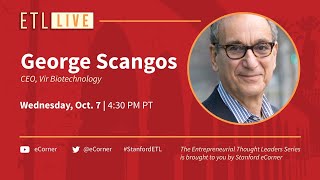
This content was created by GHION.AI . This content was uploaded by GHION.AI . This is a YouTube video titled "ETL Speaker Series: George Scangos, Vir Biotechnology" from October 8, 2020. It features a seminar hosted by Ravi Balani, with George Scangos, CEO of Vir Biotechnology, and Jodi Pugolisi, a professor at Stanford, discussing the biotechnology industry, challenges in infectious diseases, and the impact of Covid-19. The session includes a Q&A segment with insights into biotech leadership and future industry trends.
Chapters
Welcome everybody to etl. I am Ravi Balani, a lecturer in Stanford's Department of Management Science and Engineering and the Director of Alchemist and Accelerator for Enterprise Startups. And I'd like to welcome you to the Entrepreneurial Thought Leader seminar presented by stvp, the Entrepreneurship center in Stanford's School of Engineering and and basis, the Business association of Stanford Entrepreneurial students. Today, we're delighted to welcome George Skangas to ETL. Dr. Skengis has served as Verbio Technologies President and CEO and as a member of its Board of Directors since January of 2017. He previously served as CEO and as member of the Board of Directors of Biogen, a publicly traded and one of the leading global biopharmacies pharmaceutical companies focused on treating neurological diseases. Ver, by the way, is focused on serious treatments for infectious diseases. And he's also held roles as President and CEO of Xelexis, President of Bayer Biotechnology, and Professor of Biology at Johns Hopkins University. He earned his PhD in microbiology from the University of Massachusetts. So please welcome George. George, a lot of virtual love for you over the Internet right now. A lot of virtual applause.
Thank you very much.
Today, gang. We're also going to be doing a new format. This is an experiment where we're going to be matching academia with industry. We're inviting a Stanford researcher and part of the Stanford faculty to be doing the interview with George. And today we're really thrilled to have Jodi Pugolisi on hand to interview George. Jodi is a professor of Structural Biology in Stanford School of Medicine and chaired the Department of structural biology from 2004 to 2014. He's also a member of BIOX and the National Academy of Sciences. And Jodi's lab's research focuses on the role of RNA in cellular processes and disease. Please also note that this is an experiment and Jody was so gracious enough to appease us in jumping in. Even though he's steeped in in the worlds of chemistry and biology, he is jumping into the world of entrepreneurship. We think that very act signals that he has the innate spirit of entrepreneurship. But please also be kind and generous with Jodi for jumping into this new experiment as well. And so welcome Jodi. And with that, I'm going to turn it over to Jodi to take it from here.
Well, I'm certainly honored to be here with George. I think we almost understated what a giant in the field of biotechnology George is, and I'm just excited to sit here and ask him some questions that really map out his trajectory. What he thinks are the challenges that exist in entrepreneurship. That's particular to the world of biotechnology and what he's doing right now, which I don't think you're going to find anyone more topical to the health situation in the world today around Covid in his current company, Veer. So we have a lot of things to talk about, and I just hope this experiment doesn't go like many of the experiments that I design in my own lab and explode. So I'll try my best to keep this on the road and turn it over to George. The thing that touched me most about George is he was a professor at Johns Hopkins, starting out as a professor when I was a student there. Our paths never crossed because I didn't want to get my hands wet with biology. I was too busy doing chemistry and physics at the time. But that leads me to the question of his own life's trajectory and the exceptionally courageous move that he made in the 1980s to move from a cushy academic job into what was then the nascent field of biotechnology. And so I really just wanted to start off by asking George to maybe tell a little bit about his trajectory and what pushed him to make this jump from academia to biotechnology. And when you started off getting a PhD, I'm sure you had some vision of what it is you wanted to do. And now, sitting where you are now, how has that path diverged or met what you. What you dreamed of years ago?
Okay, well, first of all, let me say thank you to you, Ravi, and to Jodi for the invitation. I'm really happy to be here today, and this should be fun and interactive, and so I encourage people to ask questions. Look, I graduated from Cornell. I was a bio major. I worked for a couple of years for a company that manufactured laboratory supplies for microbiology labs. And I realized after a couple years that I didn't really care if the labs bought our supplies or the supplies from our competitors. They all worked fine. So it really made no difference. So that my efforts were pointless. What was the point? But I'd also learned that I loved what was going on inside the labs and that the microbiology labs at Harvard, I was in Boston, or some of the large universities there were really doing fascinating things. And so I decided to go back to graduate school without much thought to what I would do after graduate school. As I went through, it became kind of the default career path to stay in academia. So I went on and did a postdoc at Yale, and then after that, joined the faculty at Hopkins a few years later my postdoc advisor, this guy named Frank Ruddle, came down to give a seminar at Hopkins. I invited him down, came to give a seminar, and at that time I learned he was stepping down as department chair and he was starting a biotech company. And so I became an advisor to that little biotech company. And so once a week I'd get on there. Once a month I'd get on the train from Baltimore and travel up to New Haven to spend a day at the company and working on things. And in the, at that time when I was postdoc in Frank's lab, we had made the first transgenic mouse. And so there are only a few labs in the world at that time that could make transgenic mouse. Now it's. Everybody can do it. But it was, was new. And so they asked me and I agreed to take a sabbatical here, take a leave, go to the company, set up a facility so that we could custom make disease models that would more closely mimic human disease. We did that. I did that. I was quite taken by the work there. The quality of the science was great. It was way more collaborative than it was in my academic experience. I think that's changed over time. I was really taken mostly by the idea of spending my time doing research for the real purpose of bringing forward drugs that would improve the lives of patients rather than kind of giving lip service to doing that at the end of an NIH grant. Right. So.
Which I'm still doing.
Yeah. So I stayed. I took a year to close down my lab and you know, so. But then I stayed. That little company was bought by Bayer, big pharmaceutical company. And I ended up working a decade for Bayer. I never ever would have gone directly from Hopkins into a large pharma company. That was kind of anathema to me, but kind of my attitudes got laundered through the small biotech company. I spent a decade working for Bayer. I was, you know, head of R and D. I headed up their big. They made a separate business out of protein drugs, recombinant drugs that were also new. So I headed that business for a while and then in about 10 years later, I became disenchanted. Or wasn't one day when you become disenchanted. But over time I became frustrated with the over reliance on process and how process sometimes trumps.
Sounds like an entrepreneurial moment.
And so I thought this was ridiculous. And I did have a, there was an aha moment when I was at some off site team building thing. And I just thought this was the most Boring, ridiculous exercise I'd ever been part of. And I looked around and everybody else was into it and they, they liked it. So I said, okay, this is not the right place for me. And I went to a little startup, you know, called Exelixis. At the time it was 20 people, was newly started. I wasn't a founder, but I was there soon after, stayed there for 14 years as CEO and took it public, you know, a couple drugs now on the market. So it was a success for company. And then I went from there to Biogen, large biotech company on many billions of revenue now. And that was a really interesting experience. But that was in Boston. My wife's on the faculty at ucsf, so that was a transcontinental relationship we had. And so every weekend one of us would get on a plane. But that gets old after a few years. And so I came back to the Bay Area and we started veer, and here I am, which we'll talk about.
More and more in depth as we go through the interview. But during your voyage from academia to industry, were there any individuals in the world of biotech that were role models for you? And one of the things that certainly is a hallmark of your career are these leadership roles that you took up. And are there certain models of leadership that you learned from these people or from your own experience?
Yeah, there are several people along the way. If you think about who had an influence, me, my postdoc advisor, Frank Ruddle, really great human geneticist, great biologist, great human being, lovely families. Wife's also professor at Yale, two lovely daughters. So I learned from Frank a lot about science, but a lot about how to have a career that was quite consuming and still have a family and a normal life with a guy named Stelius Papadopoulos. So Stelius was a banker for a number of banks that were instrumental in funding the biotech industry in its early days and was instrumental in doing some of the most creative financings that were done today. They're illegal, but they were legal at the time and helped to get the industry off the ground. And I met him, which wasn't, which.
Wasn'T entirely clear that this was going to be a money making operation. There was a lot of business risk around biotechnology.
Not at all. It was speculative. A lot of people thought it was crazy, that the whole idea was kind of preposterous and you could never replicate and make in bacteria or in some artificial system proteins that humans made. They would be different. But, you know, he was visionary. He, you know, in making the transition from academia to industry, you don't know what industry is like, you know, and you know it only superficially. And you're, you're in a good situation, or at least I was in a good situation. So, you know, doing well and no reason to leave other end. So making that transition and jumping into the unknown in something new and speculative was not an easy one.
Not at all. That's still the norm. That was a courageous jump at the time.
Well, yeah, and all my colleagues at Hopkins thought I was either crazy or greedy or both.
If we fast forward to now.
Now.
The biotech industry is a mature, multi billion trillion dollar industry. Perhaps. What's changed in your view and what are some of the remaining challenges?
Well, science has changed a lot. I mean, even like conceptually, what we were doing at ExileXis in the late 90s, early 2000s, is conceptually the same as a lot of the work we're doing at Beer now. Except back then we had to do these genetic analyses in fruit flies and C. Elegans and worms, and it would take six months to do an experiment. Today you can do them directly in a mammalian system with CRISPR and get more and more and more relevant information in three weeks. And so that's a combination of advances in the, you know, in biology and, you know, crispr and Jennifer Downer won the Nobel Prize in Charlotte Gates and in data sciences because you generate reams of data and you have to be able to make sense of it and parse through it, and there's too much to do in your head. So those two things have changed. There have been successes. You know, in the early days, it was easy things. It was insulin and just factors that you normally made that now could be made. And they were easy. And as the understanding biology has gone on and things have gotten more sophisticated, you can do more challenging things. And there have been successes. So that means money has poured in, so you have access to a level of resources now that was unheard of a decade ago.
Let's talk about the science and perhaps some of the business challenges around what you're doing right now, which I think the audience will enjoy hearing about. It's immensely topical, which is your company, Veer. What were some of the challenges you faced there? And maybe give an overview of what the company's doing right now and why it's so exciting.
Well, I'll tell you how we thought about Veer. At the beginning. There was, you know, we're focused on infectious diseases and, you know, to start a company focused on infectious diseases is certainly counter to the prevailing views of the industry. Much of the pharma industry has either reduced the reference on infectious disease or gotten out completely, just shuttered it. The mantra was you can't make money in infectious diseases. And really that's because of antibiotics. And you probably read we desperately need new antibiotics to treat resistant bacteria. The reason we need them so much and nobody's working on them is you really can't make money that if you succeed and make a new antibiotic, it is reserved for last line use because physicians are appropriately concerned that overusing it will result in the development of resistance to that one too. So they want to save it for when it's truly needed. And so it's a low volume product. And because of the way antibiotics are prescribed and treated, the price is capped. So it's a low priced product and it's an acute product. You take it for a few days or weeks and then you're done. And the next time you use get sick, there's no brand loyalty. You don't come back to that. Whatever you get prescribed for your next month. And so all of those things combined to make antibiotics a terrible business model. And there were biotech companies that made very good antibiotics that went bankrupt even though they had approved drugs. And so on the other hand, Gilead, you know, in the Bay Area has, has tens of billions of dollars of revenue treating viral diseases, treating hiv, hepatitis C. Hepatitis C is also acute. You take their drug for a short period of time, you're cured of hepatitis C. The irrational part is the healthcare system is willing to pay $30,000 to rid you of hepatitis C, but they're not willing to pay $4,000 to rid you of antibiotic resistant bacteria that will kill you. It's not rational, but it's the way the health care system is. But because so many of the companies had backed out, we saw huge infectious disease problems. Antibiotic resistant bacteria, flu, you know, tens of thousands of people die from flu every year. Hepatitis B, which infects to almost 300 million people around the world. TB infects a couple billion people around the world. So there's a huge public health need and for the right indications, also a tremendous amount of money to be made if we were to be successful. So we went all in on infectious diseases. Our goal was to be the biotech company focused on and be able to compete head to head with whatever large companies were still in the running. We raised a lot of money. We raised almost $600 million initially.
And you know, that is unusual. I think, you know, maybe the audience has an appreciation. That's an enormous war chest.
That is, it's an order of magnitude more than most startups get. Most startups these days a little more. Maybe it's 100 million, but it was 50 or 60 million. It's still a lot of money. The idea was to go make some acquisitions, sign some deals, hire in a really good competent group of people and go forward really aggressively, roll up other assets in the biotech industry that were underfunded, under exploited and become the leading biotech infectious diseases. So it's pretty aggressive plan and we're on our way. We had really interesting program, we have really interesting programs in flu and hepatitis B. We have a, a program with the Gates foundation to make a vaccine for HIV and TB and so doing interesting things. And then Covid came. And so we had some asset ways to approach Covid. And you know, I met was January 5th when our chief scientific officer, a guy named Skip Virgin came to me and said this is the big one, this is going to be a huge impact and we should work on this. And so we started really early and pretty aggressively. And for a company like ours, you know, we made some big bets because we're not a huge company. We didn't want to stop the other programs. We had to add this to them, which means we had to staff up, hire more people, spend more money. We're bringing forward antibodies which now fortunately look like they're going to work. But we had to make hundreds of millions of dollars of commitments or manufacturing contracts in the future. And those are take or pay. Right. So you pay for them whether or not your product succeeds and you need them or not. And so that's a huge, almost existential gamble for a company like ours. I mean we wouldn't have made it if we thought it was truly existential, but it's close. And so now we've been focused on Covid as well as those other two. Obviously Covid's getting all the attention these days.
Maybe you can comment a little more broadly for the audience about the spectrum of therapies and approaches that are being taken by the industry to Covid and what the outlook looks like.
Yeah, let's start with vaccines and they seem to get most of the news these days. A lot of different approaches. Moderna and then Pfizer together with a company called Biontech, German company on developing RNA based vaccines, probably near and dear to your heart. Yes, indeed, that's a new technology has not been tried on a large scale basis. Before you know, the early data, I would say are kind of encouraging, but not, certainly not conclusive. And we'll see. They're each enrolling for vaccine trials. You've got to enroll tens of thousands of patients. I think their targets are 30 or 40,000 patients. And we'll see how well they work. JJ and AstraZeneca. AstraZeneca, working with Oxford University, are developing vaccines based on adenovirus. Adenovirus. They have different strains of adenovirus. My view is J and J has the more promising of the two, but that's just bias. More than based on any hard data. And then there are companies. GSK and Sanofi are two really good vaccine companies working together on a more traditional vaccine protein with an adjuvant ongoing. So those are going. The early data, I would say are somewhat encouraging. They do generate antibody responses. Whether it's enough antibodies, the right kind of antibodies. Don't know how long the antibody response lasts. We don't know whether it works in all age groups, all portions of population, we don't know. And people tend to think of vaccines like a panacea. You'd get it and it's like smallpox when you're a kid or something. If you get it, you're immune. Well, that's one extreme. The other example, it's not even extreme, might be flu, where you get it and on average the vaccine reduces transmission of flu by about 40% and less than that in the elderly and the people who need. So we'll see where the vaccines go. Hopefully. I for all of our sakes, I hope they work really well. I think it's unlikely they'll work sufficiently well in all segments of the population. And we'll need other approaches, which is really. And AstraZeneca are bringing forward antibodies. Lily published actually really interesting data this morning to say they're anybody's work and there are anybody's. Again, very small numbers still. But in their placebo group, I think it was 2.9% of patients. These are patients early in their Covid course. So they're not hospitalized. 2.9% were hospitalized in the place SIBO group and the treated group, 0.9%. So from 3 to 1, a 2/3 reduction. Huge error bars around that number because the numbers are so small but still pretty compelling that the antibodies are providing benefit for those patients. Regeneron has some data, we have some data and over the course of the next few months, everybody will have enough data to know to what extent the antibodies are working. But I think the early Signs are that they're going to be.
It's happening at a remarkably fast timescale. And you have a role as CEO of a company, but you're also in a leadership role for the biotech industry at large through an organization called Bio. Can you maybe comment a little bit how, you know, how you wear those multiple hats and that could be playing a role.
It's been this kind of day. My phone keeps. Sorry. Sure. Well, look, my primary responsibility is beer. That's my day job. And I have to make sure that our programs are going forward rapidly and we don't miss any beats here. So, so far so good. We're on our way. You know, we went, just to give you an example, we started this, I said on January 5, saying we should find an antibody that is effective and that entered clinical trials in August. So, you know, we, we found it, we had it manufactured, we got the regulatory approval. Everything ends in seven months. That's a two to three year process in normal times. So incredibly accelerated. Lillian Regenera did the same. We signed a collaboration, or we're working together with GSK on this. We have a collaboration with them. That collaboration around Covid, from the initial phone call I had with Hal Barron as head of R and D at JSK until we had a signed agreement, was three weeks. That never happened. All my years I've never had an agreement signed in three weeks. You know, three months. It's passed.
And Covid has brought people together.
Covid has changed the rules. Right. Because it is a pandemic. There's a huge. People are dying every day.
And maybe this is a good place to ask a broader question because many of our audiences are engineers and drug development. Biotechnology is a very different type of activity. Maybe some of your thoughts about the differences in biotech versus traditional tech companies and maybe some of the opportunities for these smart young kids to go out.
And change the world. Yeah, yeah, look, I think biotech is so exciting because it's a mixture these days of science, of medicine, of data sciences, biophysics. And you need to bring all of that together and they all play on each other and they all complement each other. We have an amazing data sciences group. They're actually based in San Diego. Incredible insight that we get. And they get. MIT runs these structural biology competitions. So they give you a learning set of compounds to say, here are the activity of these compounds on this target. And then they give you another set of compounds to say, now you learn from these and tell us which of these others are going to have the Most effect. And then they run competitions. See, you can do that. So we've entered two, we won one, and we're second in the other. Pretty good. So we're doing okay. But it's amazing the insights. We think now we have gene expression patterns that can predict which patients will have bad outcomes to Covid or flu just based on the expression of lymphoid cells.
Yeah, I mean, this is a remarkable, remarkable steps forward. The technologies that are available.
So the data sciences are incredible, and the biology is amazing and the genetics.
And you're talking about it already. But within the companies that you've led, creating that cauldron of creativity and innovation which is so essential to any entrepreneurial exercise, what kind of approaches have you taken to ensure that? I mean, that seems essential ingredient.
So, look, I think you need the right people. I think the success of companies like ours is really dependent on the people. You need people who have a little bit of an iconoclastic attitude, who are, say, arrogant enough to think they can succeed where everybody else has failed, but humble enough to know that that probably won't happen. And so you have these kind of conflicting characteristics you need in the people and the organization. And so selection of the right people is absolutely critical. And you know, a lot of people who are comfortable in larger companies are just not the right people, even if they have all the right expertise that you need.
Absolutely.
So you need that you need a sense of. To instill a sense of urgency. And you have to motivate people. Right. Like people don't come to work every day thinking, geez, I'm excited to go to work because if we do a good job, we'll make a lot of our money, a lot of money. For investors who are already wealthy, that is not something that gets me out of bed in the morning. You need. The motivation has to be. I'm excited to go to work because if we succeed, we're going to improve the lives of a lot of people. And I think personally, because we have the ability to do that, we have the responsibility to do that. And so so many people are suffering. And so, you know, I've had discussions with the boards along the years because there are certain people who believe that the function of a CEO is only to increase the value of the stock and do well by shareholders. I personally don't want to be part of a company that does that and has that as their mode of operating. I think that's actually irresponsible. And of course you have shareholders. Of course you have responsibilities to them. And you have to generate a return. And if you don't do that, you won't be CEO forever. So it's not that you can't do that, but you can't do that as your sole focus. We have responsibilities to patients. We have responsibilities to our employees. We have responsibilities to the community, to the environment. I mean, we have to operate in socially responsible ways. And so the nice thing to me about the biotech industry is that its focus is on improving the world, on improving the lives of people who are suffering in one way or the other. And so if we succeed, then we have accomplished an important social good. At the same time, if we do it thoughtfully, we can return, a substantial return to ourselves and our investors. So I think it's, you know, you asked me at the beginning what I thought about my career. I never thought about this, but I can't envision having ended up in a better place.
It's a remarkable story and a remarkable voyage. And I think, you know, certainly resonates with me and even more so, I'm sure, resonates with the students in the class that are part of a generation that I think really do want to make a difference and change the world and are, you know, are looking for avenues to do that. And, you know, you're a shining example of that. And, you know, we're all rooting for your success, not just financially, but in terms of your clinical trials and the success against not just coronavirus, but the next waves of infectious diseases that are sure to hit us. I'm not sure if we're supposed to maybe start answering questions.
It's your prerogative, Jodi. If you want, you can. There are questions that are on the list from the audience. You can select those or you can play by yourself.
I'll ask one last question, which is, what does the future of biotech hold? Where do you see the field going over the next 20 years? And no one's going to hold you to your predictions.
Look, it's incredible. If you think about the progress that we've made over the last 20 years and you extrapolate that forward, it's just incredible. But I think extrapolating it forward isn't sufficient because the pace at which we're advancing is accelerating. So you have to take this second derivative action to think, and that's really hard to imagine. But I think we'll be able to. Already starting to be able to manipulate genes. We understand the genetic basis of disease to intervene, will find ways to intervene safely. I mean, nobody intervenes now in like changing genomes. You could change your genome with CRISPR or you can do other things. There's still some safety concerns. Those are not adequately addressed yet. And then of course there are a lot of ethical concerns that people have as well. But over time well figure out how to do that safely and change the gene that gives you a predisposition to atherosclerosis or Alzheimer's or whatever to avoid those, minimize those. And so I think the combination of genetics and you know, you can't figure all this out just by laboratory experiments. A lot of it has to be guided computing patiently. It's just, it's amazing, you know, understanding brain circuits, being able to intervene in, you know, psychiatric issues, depression or.
Yeah, I think neurological diseases are huge. Huge, you know.
Yeah.
So area of opportunity and also the aging population in the world. All areas that will need focus.
So if you, and if you think about now or we, you know, pretty confident we can tell you if you were to like, you know, we take a blood sample today and tell you if you get Covid, you are or you are not going to have a bad outcome. You know, if that were a simple diagnostic test that could be run by hospital lab rather than a really complicated, that would be huge. Right. Then you could do your clinical trials only in those people are going to have bad outcomes. So you would save money because you're not treating a lot of people who don't need your treatment. I think it's highly ethical to do that because every drug has side effects and people aren't going to benefit or they don't need it, but you expose them to the side effects anyway. That's not really an ethical thing to.
Do just for the audience. That's a term called pharmacogenomics. Trying to understand how your genetic makeup affects your response to drugs. Which is of course a super exciting area of research and one that involves lots of computation and lots of measurements and lots of analysis. The opportunities are immense.
So I think all that's going to change. So the one thing that could get in the way, not the one thing, but we have to keep funding the industry. Well, it has to keep providing return to investors so they keep funding it. I don't think this is a discussion on drug prices, but there are certain solutions to drug prices that would crush that. There are other solutions that wouldn't. So it's not an insoluble problem, but some of the knee jerk reactions I think would just crush it. So as long as we have the right social environment, I think the students who are now in school can expect to have longer healthier lives than we have. And we already have longer healthier lives than my parents have. It's been remarkable.
George, thank you so much. Maybe we'll open this up to some questions in the Q and A. My favorite one is someone did ask me to actually do derivative, but I won't ask that question. So the question is, first question is how valuable has your technical PhD been while leading a biotechnology firm and if you knew you would end up there, would you have still gone and gotten a PhD? And maybe I'll add to this. How did you learn your business skills?
Well, that's a personal question for me. Yeah, I enjoyed getting a PhD. I enjoy the science, I enjoy the R and D and it does help running the company. We're R and D based company so I don't have to be the best scientist in our organization and I'm not. But I have to know it enough to know who is to ask the right questions and be able to manage it. And so much of the success of our company is based on the quality of the science that we do and medicine as well. So yes, it's been helpful. You do as CEO have to manage obviously the entire company, many of disciplines. You don't have any personal experience manufacturing and for me commercial, you know, human resources, all the, all the people issues, finance. And so you just, you know, I've learned that kind of by osmosis. I didn't, I didn't do an mba and you know, I, when I worked for Bayer Large Farm. One of the benefits of that is they send you to training courses if they think you have some potential. So you know, I did some mini MBAs and things like that, but those aren't really that. I mean they're pretty superficial. And so basically learn things as, as you go and you get some exposure, you ask some questions and you learn. My, my experience with most of this stuff is the principles are not that difficult, right. So you know the concept of npv, very straightforward, it's very simple concept sitting down to do one, not that complicated, but it takes some, some learning. And, but what's crucial for that is the assumptions that you put into it. And so being able to learn enough to say, okay, this is entirely dependent on the assumptions that go into it. Let's question those assumptions and the rest is math. Then you know, kind of going back to first principles, it gets you through a lot of things. You don't have any formal training.
There's a related question Which I think you've already answered, which is how can people who don't have PhDs be involved in the commercialization of research?
Well, we need people who are involved in the commercialization the company needs. I mean, we even, we don't have any products to sell yet have a commercial group. Because you have to start planning for how to commercialize things well in advance of when you actually have them. You have to start, you have to understand the markets. I think one of the key things for companies I've talked for a long time is you have to solve problems that actually exist, not that you think exist. And that's not only scientific problems and technical issues, it's commercial issues. Is there a need for this product? How would it be used? Are there some flaws in your thinking? So even if you're technically successful, no one's going to use it. And so you need to understand those issues. So you need people who understand the market, who can interact with the prescribers and the physicians and the health plans who are going to pay for this and Medicare and other agencies to understand whether, what's important to them.
How you George, without naming names, could you, can you give an example over, you know, the last 30 years or so of an example of that where a product was developed of which there was no use because there wasn't a commercialization plan?
Oh, there have been many. And it, well, I give you the recent one. It's not that there's no use like the PCSK9 inhibitors. These are new drugs that are really potent in reducing LDL cholesterol. Reducing cholesterol. So for people who are not adequately controlled on statins, they can be a lifesaver. And so there are two or three of those now on the market. They are really good drugs, but they were priced at a level where all of the payers said, no thank you, we're not paying for this. The benefit to our patients does not merit that cost. And so they actually use very little. And they are potentially life saving drugs. And so that was an error not in the product, but in how to process it into the marketplace. Gilead, when they introduced their Hep C treatment, this is a treatment that cured hepatitis C, like 98 or 99% cure rate. And I think the 1 or 2% are people just aren't compliant. You have to take pill every day, period of time. And they charged, you know, I think initially they charged $40,000 for that treatment. They got so much grief for that. They got a lot of grief and they charged it. It Was I, you know, basically it was $1,000 a pill. Right, because you had to take pill once a day and just divide it up as a thousand. So people looked at the pills and said $1,000 per day, dollar pill. Yeah. So when you actually do the cost benefit relationship, they save more money to the healthcare system by avoiding cancer and liver cirrhosis than a cost. But it was cosmetic, so they didn't deal with that.
They didn't deal with it.
Well, most of those patients on Medicaid and they didn't talk with the state Medicaid agencies and prepare them, so. So they all had their budgets just completely ruined and so they push back. So there are ways that you need to prepare the market to interact with payers that are crucial to the success of the product.
George, can I ask you two quick questions before we get cut up, which I think are good ones. One is, who is a CEO or industry leader that you look up to besides yourself?
Ken Frazier. Ken is the CEO of Merck. He is, I think, incredibly capable, decent, thoughtful, and has done an amazing job leading Merck to be a really innovative company. So, you know, I got to work with him back when I was at Biogen and I have a huge amount of respect for Ken, so he's at the top of my list.
And then I guess the final question that I'll go through is what's your advice for someone looking to enter the biotech industry as an undergrad? Do you think that focusing on honing bio knowledge via undergraduate or graduate studies is important to do before entering industry? Or do you recommend entering the industry in college itself via internships?
And George, you're have a minute to answer that in 60 seconds.
Life recommendation.
Okay, 60 seconds to answer that question. I think, look, I think you should do what you're passionate about and what you enjoy. Because my experience is it's when you do that that you do the best and so achieve excellence to the extent that you can in a field that's of interest to you. So many different fields are relevant to biotech companies. Biology, commercial finance, legal, technical, manufacturing, data science. There's so many ways to get involved in the industry. Pick what you like and pick where you want, where you have some passion and where you don't mind and actually enjoy spending 60, 70, 80 hours a week working at it.
Terrific, George. It's a great ending.
Well, and with that gang, I have to cut it off. I know I'm cutting it off too short and everybody wants more time, but I have to cut it off. As my moderator's obligation. So, George, thank you so much for sharing all those pearls of wisdom. Jody, thank you so much for stepping in and facilitating the Q and A. We're going to call that a session then for ETL this week. And we will be turning it over to to the rest of to the organizers. I think we're going to cut this off this week. And then next week, gang, we will be hosting Sylvia Acevedo. Sylvia is the author of Path to the Stars, My Journey From Girl Scout to Rocket Scientist, and most recently served as CEO of the Girl Scouts of the USA. And so we hope you'll join us at 4:30 Pacific Time next Wednesday for that talk. And and thank you all for tuning in this week. That's a session.
Thank you, Robbie. Thank you, Jody.
Thank you. Thanks, George.
More from GHION.AI


O processo de reconhecer limites, mesmo quando a vida parece exigir sempre mais.





Depois de tantas histórias, aprendizados e pausas necessárias, o @interior_iza está de volta



